Trans Fats: The Most Dangerous Fat in Our Food
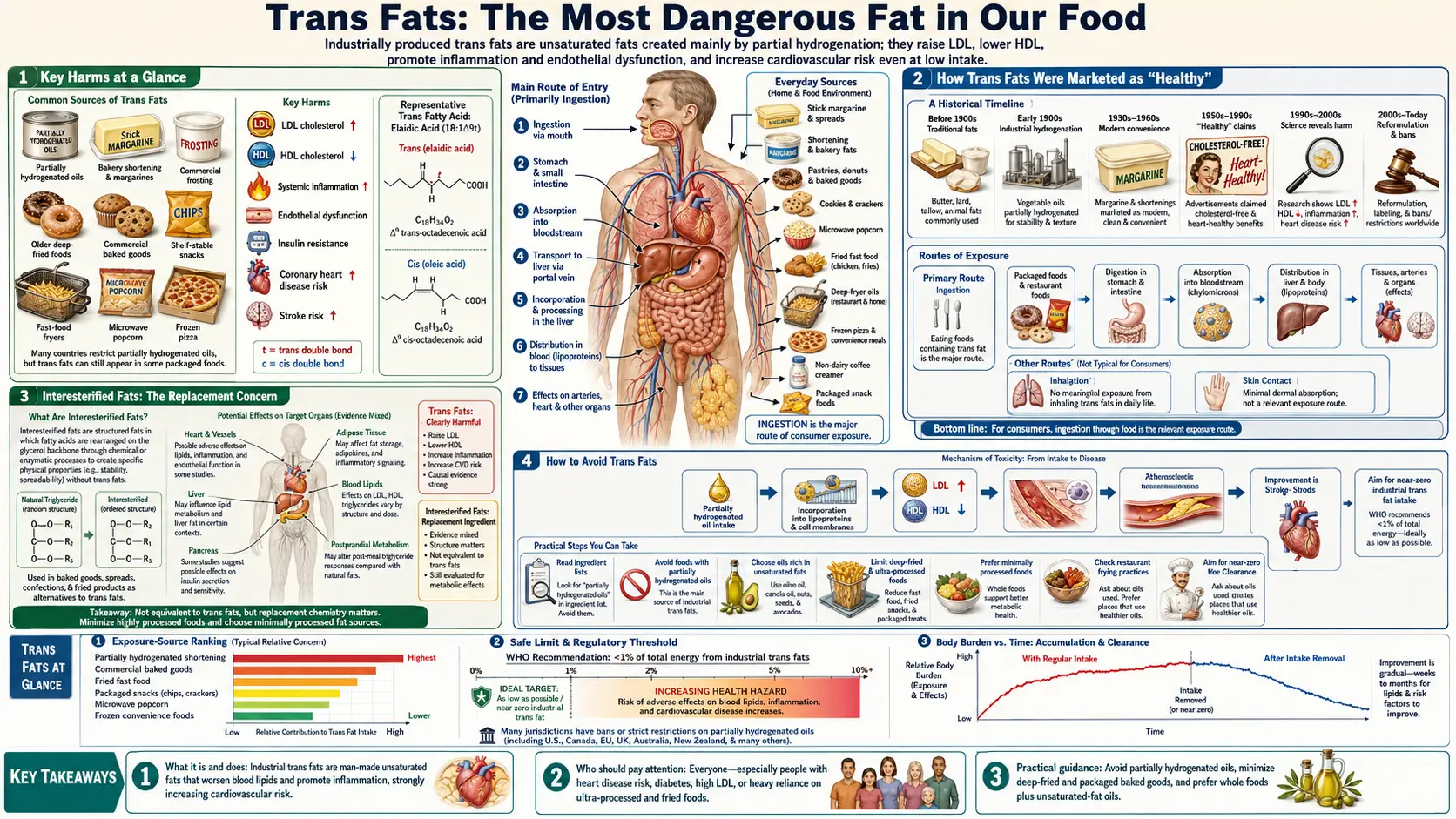
Trans fats are widely considered the most harmful type of fat ever introduced into the human food supply. Created through an industrial process called partial hydrogenation, artificial trans fats were marketed for decades as a healthy alternative to butter and animal fats. In reality, they are strongly linked to heart disease, stroke, type 2 diabetes, and premature death. The story of trans fats is one of the most egregious examples of industrial food science prioritizing profit over public health, with consequences that have been measured in hundreds of thousands of preventable deaths.
Table of Contents
- Key Harms at a Glance
- What Are Trans Fats?
- The Partial Hydrogenation Process
- How Trans Fats Were Marketed as 'Healthy'
- Cardiovascular Disease Mechanism (Health Effects)
- The FDA Ban and Its Limitations (Safety)
- Labeling Loopholes
- Interesterified Fats: The Replacement Concern
- Global Bans and Restrictions Timeline
- WHO REPLACE Framework and Elimination Target
- How to Avoid Trans Fats (How to Avoid)
- Research Papers and References
- Connections
- Featured Videos
Key Harms at a Glance
- Most dangerous fat ever introduced — no known safe level of artificial trans fat consumption.
- Raises LDL, lowers HDL — uniquely worsens cholesterol ratio more than any other dietary fat.
- Doubles CHD risk per 2% calories — Harvard Nurses' Health Study finding.
- Increases Lp(a) — independent, treatment-resistant cardiovascular risk factor.
- Promotes systemic inflammation — raises CRP, IL-6, TNF-alpha.
- 500,000 premature deaths annually (WHO) — attributed globally to trans fats.
- FDA delayed 25 years — evidence clear by early 1990s; PHO ban took full effect only in 2018.
- 0.5g 'loophole' — products with up to 0.49g/serving may still be labeled '0g trans fat'.
- Interesterified fats as replacement — inadequately tested; early evidence of adverse metabolic effects.
What Are Trans Fats?
- Chemical structure: Trans fats are unsaturated fatty acids that contain at least one double bond in the "trans" configuration, meaning the hydrogen atoms are on opposite sides of the carbon chain. This unnatural configuration gives the fat a straight, rigid shape similar to saturated fats
- Natural occurrence: Small amounts of natural trans fats (such as vaccenic acid and conjugated linoleic acid) are produced by bacteria in the stomachs of ruminant animals and are found in small quantities in meat and dairy. These natural trans fats appear to have neutral or even beneficial health effects
- Industrial trans fats: The overwhelming majority of trans fats in the food supply are artificially created through partial hydrogenation, a process that forces hydrogen gas into liquid vegetable oils under high pressure and temperature in the presence of a metal catalyst
- Properties: Partial hydrogenation transforms liquid oils into semi-solid or solid fats with a longer shelf life, higher melting point, and desirable texture for baking and frying, all at a fraction of the cost of butter or other solid fats
The Partial Hydrogenation Process
- Process overview: Liquid vegetable oil (typically soybean, cottonseed, or canola) is heated to high temperatures and exposed to hydrogen gas under high pressure in the presence of a nickel or platinum catalyst
- What happens chemically: The hydrogen atoms add to some of the double bonds in the polyunsaturated fatty acid chains, converting them from their natural "cis" configuration to the unnatural "trans" configuration
- Partial vs. full: Partial hydrogenation deliberately stops the process before completion, producing a semi-solid fat with specific texture properties. Full hydrogenation converts all double bonds to single bonds, creating a fully saturated fat that does not contain trans fats
- Byproduct of processing: Trans fats are essentially a byproduct of the partial hydrogenation process. The goal is to create a solid fat, but the trans configuration is an unavoidable consequence of the chemistry involved
- Deodorization trans fats: Even non-hydrogenated seed oils can contain small amounts of trans fats generated during the high-temperature deodorization step of refining
How Trans Fats Were Marketed as "Healthy"
- Margarine vs. butter: Beginning in the 1960s, margarine made from partially hydrogenated vegetable oils was heavily promoted as a heart-healthy alternative to butter, based on the theory that replacing saturated fat with unsaturated fat would reduce heart disease
- Crisco revolution: Procter & Gamble's Crisco, introduced in 1911, was the first major partially hydrogenated food product and was marketed as a modern, scientific, and healthier alternative to lard and butter
- Medical endorsements: The American Heart Association and other medical organizations recommended replacing butter with margarine and using vegetable shortening instead of animal fats, unwittingly promoting trans fat consumption
- Decades of harm: For nearly 50 years, from the 1960s through the early 2000s, Americans were actively encouraged to consume trans fats by their doctors, dietitians, and government dietary guidelines
- Industry knowledge: Internal industry documents suggest that food manufacturers were aware of potential health risks associated with trans fats long before the scientific consensus shifted, but continued to use and promote them due to their low cost and functional advantages
- Ironic reversal: The very fats that were promoted as healthy replacements for butter turned out to be far more dangerous than the saturated fats they replaced, representing one of the most catastrophic public health mistakes of the 20th century
Cardiovascular Disease Mechanism
- Raises LDL cholesterol: Trans fats significantly increase levels of LDL ("bad") cholesterol, the form of cholesterol most strongly associated with atherosclerosis and cardiovascular disease
- Lowers HDL cholesterol: Unlike saturated fats, which raise both LDL and HDL, trans fats simultaneously lower HDL ("good") cholesterol, the protective form that helps remove cholesterol from arterial walls
- Worst of both worlds: The combination of raising LDL and lowering HDL means that trans fats worsen the overall cholesterol ratio more than any other type of dietary fat, making them uniquely damaging to cardiovascular health
- Increases Lp(a): Trans fats increase levels of lipoprotein(a), an independent and particularly dangerous risk factor for heart disease that is resistant to most dietary and pharmaceutical interventions
- Promotes inflammation: Trans fats increase levels of inflammatory markers including C-reactive protein (CRP), interleukin-6 (IL-6), and tumor necrosis factor alpha (TNF-alpha), promoting systemic inflammation that damages blood vessel walls
- Endothelial dysfunction: Trans fats impair the function of the endothelium, the inner lining of blood vessels, reducing its ability to regulate blood flow, prevent clotting, and resist plaque formation
- Quantified risk: The Harvard Nurses' Health Study found that for every 2% increase in calories from trans fats, the risk of coronary heart disease nearly doubled, making trans fats the most potent dietary risk factor for heart disease ever identified
- Death toll: The CDC estimated that eliminating artificial trans fats from the U.S. food supply could prevent 10,000 to 20,000 heart attacks and 3,000 to 7,000 coronary heart disease deaths annually
The FDA Ban and Its Limitations
- 2006 labeling requirement: The FDA first required trans fat content to be listed on Nutrition Facts labels in 2006, leading to voluntary reformulation by many food manufacturers
- 2015 determination: The FDA determined that partially hydrogenated oils (PHOs) are no longer "Generally Recognized as Safe" (GRAS) for use in human food
- 2018 ban effective: The FDA's ban on partially hydrogenated oils in food products took full effect on June 18, 2018, after decades of documented harm and hundreds of thousands of preventable deaths
- Delayed action: The scientific evidence linking trans fats to heart disease was strong by the early 1990s, meaning the FDA took over 25 years to act, during which time trans fats continued to cause preventable deaths
- Industry lobbying: Food industry lobbying was a significant factor in delaying regulatory action against trans fats, with manufacturers arguing that reformulation would be too costly and that consumers should be allowed to make their own choices
Labeling Loopholes
- The 0.5 gram loophole: FDA regulations allow products containing less than 0.5 grams of trans fat per serving to be labeled as containing "0 grams" of trans fat, effectively hiding the presence of trans fats from consumers
- Manipulated serving sizes: Some manufacturers reduced their stated serving sizes to bring the trans fat content per serving below the 0.5 gram threshold, allowing a "0g trans fat" label on products that still contain significant amounts
- Cumulative exposure: A consumer eating multiple servings or multiple products each containing up to 0.49 grams of trans fat labeled as "0g" could easily consume several grams of trans fat daily without knowing it
- Check the ingredients: The only reliable way to detect hidden trans fats is to read the ingredient list and look for "partially hydrogenated" oils, which indicate the presence of trans fats regardless of what the Nutrition Facts label says
- Post-ban residual: Even after the 2018 ban, some products may still contain trace amounts of trans fats from the deodorization process of refined seed oils and from other processing steps
Interesterified Fats: The Replacement Concern
- What they are: As trans fats were phased out, food manufacturers increasingly turned to interesterified fats, which are produced by rearranging the fatty acid positions on the glycerol backbone of fat molecules using chemical catalysts or enzymes
- Purpose: Interesterification allows manufacturers to create solid or semi-solid fats from liquid oils without producing trans fats, providing the same functional properties that partially hydrogenated oils once delivered
- Limited safety data: Despite their widespread adoption as trans fat replacements, interesterified fats have undergone far less safety testing than the trans fats they replaced
- Early concerns: Preliminary research suggests that interesterified fats may adversely affect blood glucose metabolism, insulin response, and HDL cholesterol levels, raising questions about whether they are truly a safe alternative
- No labeling requirement: Unlike trans fats, interesterified fats are not required to be listed on nutrition labels, making it difficult for consumers to know when they are consuming them
- Repeating history: Critics warn that the rush to adopt interesterified fats without thorough long-term safety testing mirrors the same pattern that led to decades of harm from trans fats
Global Bans and Restrictions Timeline
- Denmark (2003): Became the first country to effectively ban artificial trans fats by limiting them to no more than 2% of total fat in all food products, a policy that led to measurable reductions in cardiovascular deaths
- Switzerland (2008): Adopted limits on trans fats in food products similar to Denmark's regulations
- Austria, Hungary, Iceland, Norway, Sweden: Implemented trans fat restrictions or bans following Denmark's successful model
- New York City (2006): Became the first major U.S. city to ban artificial trans fats in restaurant food, with other cities following suit
- California (2008): First U.S. state to ban trans fats in restaurant cooking
- Canada (2018): Banned partially hydrogenated oils in all food sold in Canada
- United States (2018): FDA ban on partially hydrogenated oils took full effect
- Thailand (2019): Banned the production, import, and sale of partially hydrogenated oils
- India (2022): Implemented a limit of 2% trans fat in oils and fats
- Brazil, Singapore, Saudi Arabia: Have implemented various restrictions on trans fat content in food products
WHO REPLACE Framework and Elimination Target
- Global target: In 2018, the World Health Organization launched the REPLACE action framework with the goal of eliminating industrially produced trans fats from the global food supply by 2023
- REPLACE components: The framework outlines six strategic actions: Review dietary sources, Promote replacement with healthier fats, Legislate regulations, Assess and monitor, Create awareness, and Enforce compliance
- Progress report: As of 2023, approximately 5 billion people worldwide remained unprotected by trans fat regulations, with many low- and middle-income countries lacking any restrictions
- Ongoing harm: The WHO estimates that trans fat intake contributes to approximately 500,000 premature deaths from cardiovascular disease globally each year
- Economic argument: The WHO estimates that eliminating trans fats would save billions of dollars in healthcare costs annually and is one of the most cost-effective public health interventions available
- Inequitable burden: The health burden of trans fats falls disproportionately on low- and middle-income countries where regulations are weakest and processed food consumption is rapidly increasing
How to Avoid Trans Fats
- Read ingredient lists: Look for "partially hydrogenated" in the ingredient list of any packaged food. If it appears, the product contains trans fats regardless of what the nutrition label claims
- Do not rely on "0g trans fat" labels: Products can contain up to 0.49 grams per serving and still be labeled as zero. Always check the ingredient list
- Avoid margarine: Choose butter, ghee, or olive oil instead of margarine, which may still contain trace amounts of trans fats or interesterified fats
- Limit processed baked goods: Commercially produced cookies, cakes, pastries, pie crusts, and biscuits were historically among the highest sources of trans fats and may still contain them or their replacements
- Be cautious with fried foods: Deep-fried foods from restaurants may be cooked in oils that develop trans fats through repeated heating at high temperatures
- Choose whole foods: A diet based on whole, unprocessed foods naturally eliminates exposure to artificial trans fats and their questionable replacements
Research Papers and References
Key peer-reviewed research and authoritative sources underpinning the claims on this page. Links resolve to DOI, PubMed, or the issuing agency.
- Mozaffarian D, Katan MB, Ascherio A, Stampfer MJ, Willett WC. Trans fatty acids and cardiovascular disease. N Engl J Med. 2006;354(15):1601-1613.
- Oh K, Hu FB, Manson JE, Stampfer MJ, Willett WC. Dietary fat intake and risk of coronary heart disease in women: 20 years of follow-up of the Nurses' Health Study. Am J Epidemiol. 2005;161(7):672-679.
- Mensink RP, Zock PL, Kester AD, Katan MB. Effects of dietary fatty acids and carbohydrates on the ratio of serum total to HDL cholesterol and on serum lipids and apolipoproteins: a meta-analysis of 60 controlled trials. Am J Clin Nutr. 2003;77(5):1146-1155.
- Restrepo BJ, Rieger M. Denmark's policy on artificial trans fat and cardiovascular disease. Am J Prev Med. 2016;50(1):69-76.
- World Health Organization. REPLACE trans fat: an action package to eliminate industrially produced trans-fatty acids. Geneva: WHO; 2018. www.who.int
- Brouwer IA, Wanders AJ, Katan MB. Effect of animal and industrial trans fatty acids on HDL and LDL cholesterol levels in humans — a quantitative review. PLoS One. 2010;5(3):e9434.
- de Souza RJ, Mente A, Maroleanu A, et al. Intake of saturated and trans unsaturated fatty acids and risk of all cause mortality, cardiovascular disease, and type 2 diabetes: systematic review and meta-analysis of observational studies. BMJ. 2015;351:h3978.
- US Food and Drug Administration. Final determination regarding partially hydrogenated oils. Federal Register. 2015;80(116):34650-34670. www.federalregister.gov
- Kris-Etherton PM, Lefevre M, Mensink RP, et al. Trans fatty acid intakes and food sources in the US population: NHANES 1999-2002. Lipids. 2012;47(10):931-940.
- Berger S, Raman G, Vishwanathan R, Jacques PF, Johnson EJ. Dietary cholesterol and cardiovascular disease: a systematic review and meta-analysis. Am J Clin Nutr. 2015;102(2):276-294.
- Downs SM, Thow AM, Leeder SR. The effectiveness of policies for reducing dietary trans fat: a systematic review of the evidence. Bull World Health Organ. 2013;91(4):262-269H.
- Sundram K, Karupaiah T, Hayes KC. Stearic acid-rich interesterified fat and trans-rich fat raise the LDL/HDL ratio and plasma glucose relative to palm olein in humans. Nutr Metab. 2007;4:3.
- PubMed — search for recent research
Connections
- All Toxins
- Cardiovascular Disease
- Seed Oils
- Atherosclerosis
- Processed Oils
- Food Additives
- Banned Additives
- Ultra Processed Foods
- Stroke
- Inflammatory Markers
- Full Body MRI
- Insulin Resistance
- Olive Oil
- TBHQ
- BHA and BHT
- Vitamin E
- BHA
- BHT