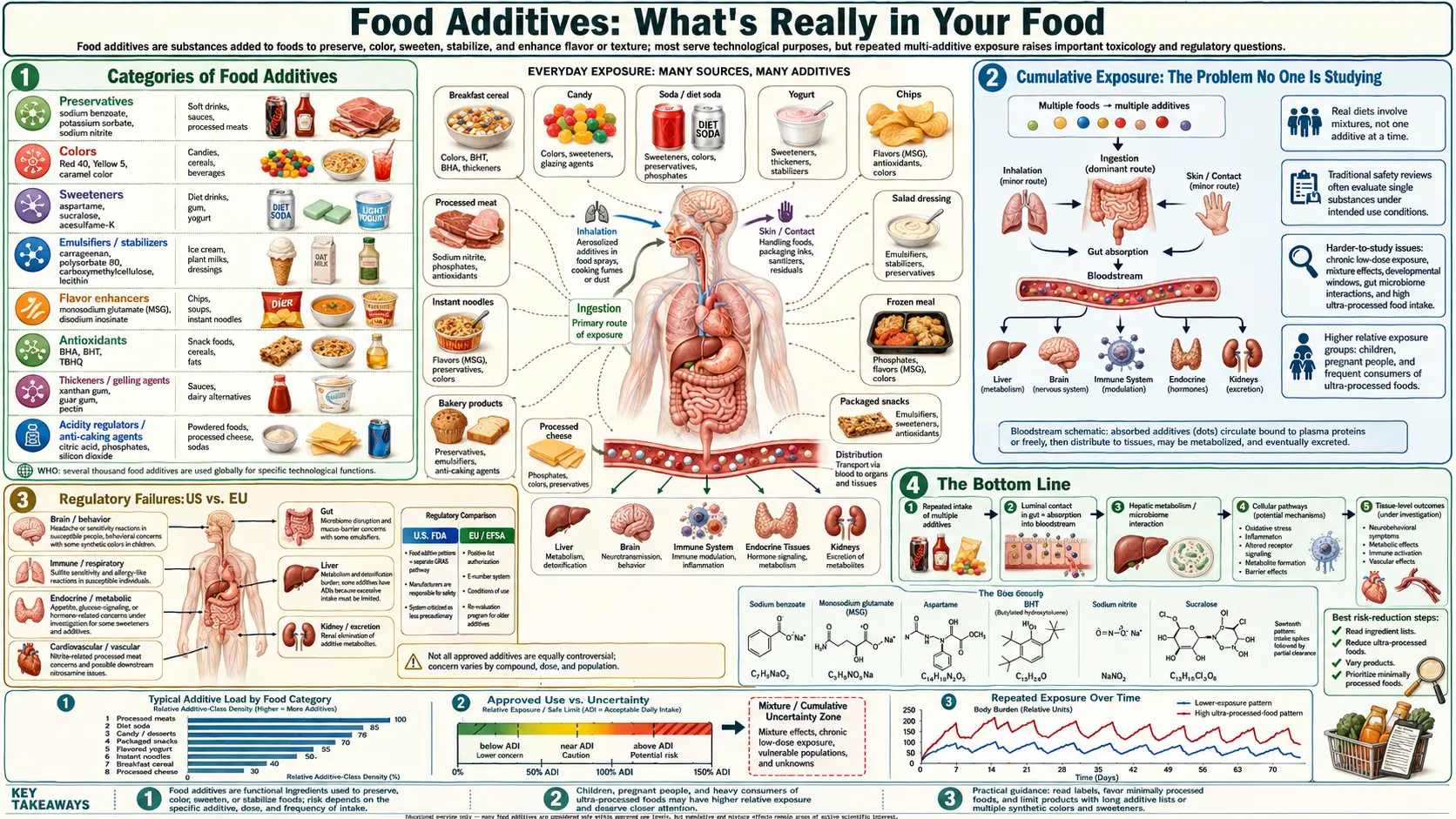
Food Additives: What's Really in Your Food

Table of Contents
- Categories of Food Additives
- The GRAS Pathway: How Substances Enter Food Without FDA Review
- Impact on the Gut Microbiome
- Cumulative Exposure
- Children's Vulnerability
- US and EU Regulation Compared
- Reading Labels: What They Show and What They Miss
- Specific Food Additives of Concern
- The Bottom Line
- Key Research Papers
- Connections
- Featured Videos
The modern food supply contains thousands of substances added during processing, from preservatives that extend shelf life to emulsifiers that improve texture. Some are well studied and considered harmless; for others the published safety data are thin. A 2013 analysis found that fewer than 38% of FDA-regulated food additives had a published feeding study, and that for chemicals added directly to food, 6.7% had reproductive or developmental toxicity data in FDA's database (Neltner 2013, Reproductive Toxicology). Individual additives have been studied for links to cancer, hormonal effects, behaviour in children and gut inflammation, with evidence that ranges from human trials to animal and cell studies only.
This page describes the main categories of additives, how they enter the US food supply, and what regulators and researchers report about their safety.
Categories of Food Additives
Food additives fall into several broad categories, each serving a different function in food manufacturing. A 2011 review of the US food additive program counted more than 10,000 substances allowed in human food (Neltner 2011).
Preservatives
- Sodium nitrite and sodium nitrate — used in processed meats (bacon, hot dogs, deli meats) to prevent bacterial growth and maintain pink color. Nitrite can react with amines and amides to form N-nitroso compounds (nitrosamines and nitrosamides), many of which are carcinogenic in animals. In 2015 the International Agency for Research on Cancer (IARC) classified processed meat as carcinogenic to humans (Group 1), on epidemiological evidence for colorectal cancer; IARC named N-nitroso compounds among the chemicals formed during meat processing, while stating that whether and how much they contribute to the cancer risk is unknown (Bouvard 2015).
- BHA (butylated hydroxyanisole) and BHT (butylated hydroxytoluene) — synthetic antioxidants used to prevent fats from going rancid in cereals, snack foods, and packaging. IARC classifies BHA as Group 2B, “possibly carcinogenic to humans” (Monograph Volume 40, 1986), and the US National Toxicology Program (NTP) lists it as “reasonably anticipated to be a human carcinogen”; both rest on forestomach tumours in rodents fed high doses, an organ humans do not have. BHT is in IARC Group 3 (not classifiable); at high dietary doses it reduced blood-clotting factors in rats and caused kidney damage in mice.
- Sodium benzoate — used in acidic foods and beverages like sodas and fruit juices. With ascorbic acid (vitamin C) it can form benzene, which IARC classifies as carcinogenic to humans (Group 1). In an FDA survey of almost 200 soft drinks and other beverages sampled from 2005 to 2007, most contained no detectable benzene or less than the EPA drinking-water limit of 5 parts per billion; 10 products were above it, and the manufacturers reformulated them.
- Sulfites (sodium sulfite, sodium bisulfite, sulfur dioxide) — used in wine, dried fruits, and processed foods. In sensitive people, reported reactions range from dermatitis, urticaria and flushing to life-threatening asthmatic and anaphylactic reactions; most studies report sulfite sensitivity in 3–10% of people with asthma (Vally 2009).
- TBHQ (tertiary butylhydroquinone) — a synthetic phenolic antioxidant used in frying oils, crackers, chips and frozen foods; US rules limit it to 0.02% of a food’s oil or fat content. In the NTP’s two-year feeding studies there was no evidence of carcinogenic activity in rats or mice (NTP 1997); laboratory studies in mouse immune cells report reduced activation.
Emulsifiers
- Polysorbate 80 (P80) — used in ice cream, sauces, and baked goods to keep ingredients blended. In a 2015 Nature study in mice, polysorbate 80 and carboxymethylcellulose at relatively low concentrations brought gut bacteria closer to the intestinal lining, altered the microbiota, induced low-grade inflammation and obesity/metabolic syndrome in normal mice, and promoted colitis in mice predisposed to it (Chassaing 2015).
- Carboxymethylcellulose (CMC) — a cellulose-derived thickener and emulsifier, tested in the same 2015 mouse study with similar results (Chassaing 2015).
- Lecithin (soy lecithin, sunflower lecithin) — a widely used emulsifier extracted from soybeans or sunflower seeds; soy lecithin may come from genetically modified soybeans.
- Mono- and diglycerides — emulsifiers made from fats and oils, used in bread, margarine, and baked goods.
Thickeners and Stabilizers
- Carrageenan — derived from red seaweed and used in dairy products, plant-based milks, and deli meats. Degraded carrageenan (a low-molecular-weight form not used in food) is used to induce intestinal inflammation in laboratory animals. A 2001 review of animal experiments reported that exposure to undegraded as well as degraded carrageenan was associated with intestinal ulcerations and neoplasms (Tobacman 2001); regulators continue to permit food-grade carrageenan, and the debate is covered on the Carrageenan page.
- Xanthan gum — produced by bacterial fermentation, used as a thickener in sauces, dressings, and gluten-free products.
- Cellulose (powdered cellulose, microcrystalline cellulose) — plant fibre, commonly made from wood pulp, used as a filler and anti-caking agent in shredded cheese, fiber supplements, and processed foods.
Flavor Enhancers
- Monosodium glutamate (MSG) — a flavor enhancer that FDA considers “generally recognized as safe” (GRAS). A 1995 report prepared for FDA identified short-term, transient, generally mild symptoms such as headache, numbness, flushing and palpitations that may occur in some sensitive people who consume 3 grams or more of MSG without food; a typical serving contains less than 0.5 grams. Ingredients such as hydrolyzed vegetable protein, autolyzed yeast and yeast extract naturally contain glutamate; they must be listed by name, FDA does not require the label to say they contain glutamate, and foods containing them may not claim “No MSG”.
- Artificial sweeteners (aspartame, sucralose, acesulfame potassium) — used as sugar substitutes in diet products. Studies have examined effects on the gut microbiome and glucose tolerance (see Impact on the Gut Microbiome below). In 2023 IARC, the World Health Organization’s cancer agency, classified aspartame as “possibly carcinogenic to humans” (Group 2B), on limited evidence (Riboli 2023); the WHO/FAO expert committee on food additives (JECFA) kept its acceptable daily intake of 40 mg per kg of body weight.
- "Natural flavors" — a flavor declared as “natural flavor” can be a mixture of many compounds; US rules do not require the individual components, or incidental additives such as solvents carried in with the flavor, to be listed separately.
Texture Modifiers and Dough Conditioners
- Azodicarbonamide (ADA) — a dough conditioner also used industrially in yoga mats and shoe soles. Not authorised as a food additive in the EU; permitted in US flour at up to 45 parts per million, and under an FDA post-market safety review opened in May 2026. During baking it breaks down into products that include semicarbazide and urethane (ethyl carbamate); IARC classifies urethane as probably carcinogenic to humans (Group 2A). Read more about ADA.
- Potassium bromate — a flour improver classified by IARC as possibly carcinogenic to humans (Group 2B). Not among the food additives authorised in the EU; still permitted in US bread, and prohibited in California from 1 January 2027. Read more about potassium bromate.
- Brominated vegetable oil (BVO) — used in citrus-flavored sodas to keep flavoring evenly distributed. Not permitted in beverages in Australia, the EU, Japan and New Zealand, according to FDA's 2024 final rule, which revoked the US authorization effective 2 August 2024. Read more about BVO.
The GRAS Pathway: How Substances Enter Food Without FDA Review
The 1958 Food Additives Amendment requires pre-market approval for new food additives but exempts substances that qualified experts consider “generally recognized as safe” (GRAS) for their intended use — originally substances with a long history of use, such as vinegar or baking soda. Critics, including the US Government Accountability Office (GAO) in 2010 and the American Academy of Pediatrics (AAP) in 2018, describe this exemption as a gap in oversight; a 2011 review found that manufacturers and a trade association, rather than federal agencies, made the safety decisions for many substances now in food, by concluding they were GRAS, without FDA review (Neltner 2011).
How the GRAS System Works
- Self-determination by companies — a company can conclude that a substance is GRAS, using its own or hired experts, and begin using it without notifying FDA. GAO reported in 2010 that “FDA only reviews those GRAS determinations that companies submit to the agency’s voluntary notification program” and generally does not have information about the others.
- No FDA pre-market review — unlike a food additive petition, a GRAS determination does not require FDA review before the substance is used; the safety evidence is assembled by the company or its experts.
- Voluntary notification system — in 1997 FDA proposed replacing its GRAS affirmation petition process with a voluntary notification program, which it operated from then on. Companies have been able to notify the FDA but have not been required to; in August 2026 the FDA proposed a rule that would require GRAS notices to be submitted. When a company does notify, FDA does not formally “approve” the substance; it responds to the company’s own safety determination.
- Conflicts of interest — a 2013 study in JAMA Internal Medicine examined 451 GRAS notifications voluntarily sent to the FDA from 1997 to 2012: 22.4% of the safety assessments were made by an employee of the additive manufacturer, 13.3% by an employee of a consulting firm it selected, and 64.3% by an expert panel selected by the manufacturer or its consulting firm (Neltner 2013).
- Determinations FDA does not see — because notification has been voluntary, the number of substances in food on the basis of unnotified GRAS determinations is not known; GAO reported in 2010 that FDA generally does not have information about them.
Substances Later Found Not to Be GRAS
- Trans fats — industrial trans fat comes from partially hydrogenated oils (PHOs). In its June 2015 final determination that PHOs are no longer GRAS, FDA estimated that removing the remaining industrial trans fat (then about 0.5% of energy in the US diet) would prevent, depending on the estimation method, from 490–3,120 to 7,740–22,770 coronary heart disease deaths a year.
- BVO — the FDA concluded in 1970 that BVO could no longer be regarded as GRAS, but allowed it on an interim basis until a 2024 final rule revoked its authorization (effective 2 August 2024).
- Partially hydrogenated oils — widely used in margarine, shortening and baked goods for decades; FDA tentatively determined in 2013 that they were no longer GRAS, made that final in June 2015 with a compliance date of 18 June 2018, and in 2023 removed their remaining authorizations from its regulations.
Impact on the Gut Microbiome
Research since the mid-2010s has examined whether common food additives alter the gut microbiome — the community of bacteria that plays a role in digestion, immune function and metabolism. Most of the evidence comes from animal and laboratory studies; human data are limited.
- Emulsifiers — in mice, polysorbate 80 and carboxymethylcellulose caused bacteria to encroach on the intestinal lining, altered species composition, and induced low-grade inflammation and metabolic syndrome; germ-free mice and faecal transplants showed that the microbiota changes were necessary and sufficient for these effects (Chassaing 2015).
- Artificial sweeteners — a 2014 Nature study reported that commonly used non-caloric sweetener formulations drove glucose intolerance in mice through changes in the gut microbiota, with similar findings in a small group of healthy people (Suez 2014). In a 2022 randomized trial of 120 healthy adults, two weeks of sucralose or saccharin at doses below the acceptable daily intake impaired glycemic responses (Suez 2022).
- Titanium dioxide (E171) — a whitening agent used in candies, chewing gum, and powdered foods. In rats given E 171 at human-relevant levels, it promoted colon micro-inflammation and preneoplastic lesions (Bettini 2017); EFSA concluded in 2021 that a concern for genotoxicity could not be ruled out and that E 171 “can no longer be considered as safe when used as a food additive” (EFSA 2021). France suspended its use in food in January 2020 (Cornu 2022), and the EU removed it from the list of authorised food additives in 2022. It remains permitted as a color additive in the US.
- Carrageenan — a 2001 review of animal experiments proposed interactions with intestinal bacteria among the explanations for the intestinal ulcerations seen with carrageenan exposure (Tobacman 2001).
- Antimicrobial preservatives — in a laboratory study, sodium sulfite and sodium bisulfite inhibited or killed four species of beneficial bacteria common in the human gut at concentrations regarded as safe for food (Irwin 2017). Whether preservatives at dietary levels reduce gut microbiome diversity in people has not been established.
Cumulative Exposure
Chemical risk assessment is typically based on the toxicity of one chemical at a time. A 2015 review identified more than 300 chemicals allowed in food that may have potential harmful effects on the developing brain, and noted that the laws regulating additives in Europe and the USA already require regulators to consider cumulative effects, a mandate the authors judged had so far been neglected (Maffini 2015).
- Additives tested in combination — the 2007 Southampton trial gave children drinks containing sodium benzoate together with one of two mixes of artificial colors; the drinks increased a global hyperactivity score in 3-year-olds (one mix) and 8- and 9-year-olds (both mixes, in children who drank at least 85% of the drinks). The trial tested the combinations and did not separate the effect of each additive (McCann 2007).
- Accumulation — in an FDA-led 90-day rat feeding study, brominated fatty acids from brominated vegetable oil accumulated in the heart, liver and fat in a dose-dependent way, alongside thyroid effects at the higher doses; FDA cited these results in its 2024 revocation of BVO (Woodling 2022).
- Lifetime exposure — acceptable daily intakes are expressed per kilogram of body weight and are intended to cover daily intake over a lifetime; the AAP’s 2018 policy statement notes that data on the effects of food additives on infants and children are limited or missing (Trasande 2018).
- Cumulative assessment in practice — the 2015 review cited above reported that both US and European additive laws call for cumulative effects to be considered, and that regulators on both sides appear not to have done so in practice (Maffini 2015).
Children's Vulnerability
A 2018 policy statement from the American Academy of Pediatrics (AAP) states that, while data about health effects of food additives on infants and children are limited or missing, infants and children are in general more vulnerable to chemical exposures. It describes current GRAS requirements as insufficient to ensure the safety of food additives and calls for substantial, urgently needed improvements, including strengthening or replacing the GRAS process and retesting previously approved chemicals (Trasande 2018).
- Higher exposure per body weight — children eat and drink more relative to their body weight than adults, so a given concentration in food delivers a higher dose per kilogram.
- Developing organ systems — the AAP statement points to endocrine disruption and other adverse effects documented for some additives and food-contact chemicals, which raise particular concern during development.
- Longer lifetime of exposure — exposure that begins in early childhood continues over more years of life.
- Endocrine disruption — the AAP technical report reviews food-contact chemicals such as bisphenols and phthalates, citing studies that document endocrine disruption (Trasande 2018).
- Behavioral effects — artificial food colors have been studied for effects on hyperactivity and attention in children (McCann 2007). Since July 2010 EU law has required foods containing any of six colors, including Allura Red (Red 40), Tartrazine (Yellow 5) and Sunset Yellow (Yellow 6), to carry a statement that the color “may have an adverse effect on activity and attention in children”; the US has no such requirement.
- Processed foods marketed to children — many foods marketed to children, such as cereals, snack foods, candy and juice drinks, are processed foods that contain additives.
US and EU Regulation Compared
The United States and the European Union regulate some food additives differently. EU general food law writes in a precautionary principle that allows provisional restrictions when harmful effects on health are possible but scientific uncertainty persists. US law also requires pre-market approval for new food additives, but GRAS substances can enter food without FDA review, and withdrawing an existing approval requires a formal rule or order and has often taken years.
Substances Treated Differently in the EU and the US
- Potassium bromate — not among the food additives authorised in the EU; still used in US bread (California prohibits it from 1 January 2027). Learn more.
- Azodicarbonamide — not authorised as a food additive in the EU; permitted in US flour at up to 45 parts per million (21 CFR 172.806) and under FDA post-market review since May 2026. Learn more.
- Titanium dioxide — banned in EU food products since 2022; still widely used in US candies and processed foods. Learn more.
- BHA (butylated hydroxyanisole) — IARC Group 2B; the EU authorises it (E 320) only in specified food categories with maximum levels; listed as GRAS in the US within limits, still used in US cereals and snack foods, and under FDA post-market review since February 2026. Learn more.
- Artificial food dyes (certain uses) — the EU requires warning labels on products containing synthetic dyes linked to hyperactivity; the US has no such requirement. Learn more.
- rBGH/rBST (recombinant bovine growth hormone) — prohibited in the EU (Council Decision 1999/879/EC) and not approved for sale in Canada; FDA-approved in 1993. According to FDA, USDA dairy surveys found rbST used on about 20% of US cows at the time of the 2002 and 2007 surveys. Learn more.
- Ractopamine — a livestock growth promoter whose use is prohibited in the EU, China and Russia; still permitted in US pork, beef and turkey production. Learn more.
Explanations Critics Offer
- GRAS oversight — GAO’s 2010 report concluded that FDA should strengthen its oversight of ingredients determined to be GRAS, noting that the agency generally does not know about determinations companies do not notify.
- Conflicts of interest — the 2013 analysis of GRAS notices reported that the safety assessments were made by an employee of the manufacturer (22.4%), an employee of a consulting firm it selected (13.3%), or an expert panel selected by the manufacturer or its consulting firm (64.3%) (Neltner 2013); the AAP describes current GRAS requirements as lacking sufficient protections against conflict of interest.
- Reassessing older approvals — the AAP states that FDA does not have adequate authority to acquire data on chemicals on the market or reassess their safety, and calls for retesting previously approved chemicals (Trasande 2018).
- Age of the law — the pre-market framework for food additives still rests on the 1958 Food Additives Amendment.
Reading Labels: What They Show and What They Miss
Much of what is known about the additives in a given food comes from its label. The points below describe what US labels disclose, what they leave out, and where additives tend to appear.
- Ingredient lists versus nutrition facts — the nutrition label covers macronutrients; chemical additives appear in the ingredient list. Ingredients are listed in descending order by weight.
- Additives with several names — many additives go by more than one name. Ingredients that naturally contain glutamate, such as hydrolyzed vegetable protein and autolyzed yeast, are listed by their own names rather than as MSG. Added sugars also appear under many different names.
- "Natural" claims — FDA has not set a formal regulatory definition of “natural” for most food labels. Components of a “natural flavor” and incidental additives carried in with it, such as solvents, do not have to be listed individually.
- Whole foods — fresh fruit, vegetables, whole grains, legumes, nuts, seeds and unprocessed meats carry none of the added ingredients described on this page; pesticide and animal-drug residues are a separate question.
- Additive-checking apps — several smartphone apps scan product barcodes and flag additives according to their own rating criteria.
- Organic standards — USDA organic rules limit the non-agricultural substances, including synthetic additives, allowed in processed organic foods to an approved National List (7 CFR 205.605).
- Additives in unexpected places — food additives appear not just in processed snacks but also in bread, dairy products, condiments, plant-based milks, supplements, and even medications.
- Food contact materials — chemicals can migrate from packaging and processing equipment into food; the AAP lists bisphenols, phthalates and perfluoroalkyl chemicals (PFAS) among the food-contact substances of concern (Trasande 2018).
Specific Food Additives of Concern
The following pages cover in depth several additives whose status has been debated or changed by regulators:
- Brominated Vegetable Oil (BVO) — a brominated oil that was used in citrus sodas for decades; not permitted in beverages in Australia, the EU, Japan and New Zealand, and revoked by the FDA effective 2 August 2024.
- Potassium Bromate — a bread additive classified by IARC as possibly carcinogenic (Group 2B), not authorised in the EU, still legal in the United States, and prohibited in California from 2027.
- Azodicarbonamide (ADA) — the "yoga mat chemical," not authorised as a food additive in the EU, still permitted in American bread and under FDA post-market review since May 2026.
- Titanium Dioxide (E171) — a whitening agent containing a fraction of nanoscale particles, removed from the EU list of authorised food additives in 2022, still permitted in the US as a color additive in candies, chewing gum, and medications.
- BHA (Butylated Hydroxyanisole) — a preservative classified by IARC as “possibly carcinogenic to humans” (Group 2B) and listed by the NTP as “reasonably anticipated to be a human carcinogen”, used in US cereals, snack foods, and packaging, and under FDA post-market review since February 2026.
- rBGH/rBST (Recombinant Bovine Growth Hormone) — a genetically engineered hormone that increases IGF-1 in milk, prohibited in the EU and not approved for sale in Canada; FDA-approved in 1993, and, according to FDA, used on about 20% of US cows at the time of the 2007 USDA dairy survey.
- Ractopamine — a beta-agonist growth promoter prohibited in the EU, China and Russia, still permitted in US pork, beef and turkey production.
The Bottom Line
Critics of the US system, including GAO (2010) and the American Academy of Pediatrics (2018), report that companies can determine substances to be GRAS without FDA review, that many chemicals allowed in food lack the feeding studies needed to estimate a safe level of exposure (Neltner 2013), and that FDA lacks adequate authority to reassess substances already on the market. FDA’s proposed rule of August 2026 would require GRAS notices to be submitted.
Several additives have changed status since 2023: partially hydrogenated oils were removed from FDA regulations (2023), brominated vegetable oil was revoked (2024), Red No. 3 was revoked (effective in food 15 January 2027), and BHA and azodicarbonamide are under FDA post-market review. Legal status in the US food supply reflects a regulatory decision under US law; regulators elsewhere have weighed the same data differently.
Key Research Papers
- Neltner TG, Kulkarni NR, Alger HM, et al. (2011). Navigating the U.S. food additive regulatory program. Comprehensive Reviews in Food Science and Food Safety 10(6):342-368 — doi:10.1111/j.1541-4337.2011.00166.x
- Neltner TG, Alger HM, O'Reilly JT, et al. (2013). Conflicts of interest in approvals of additives to food determined to be generally recognized as safe: out of balance. JAMA Internal Medicine 173(22):2032-2036 — PubMed PMID: 23925593
- Neltner TG, Alger HM, Leonard JE, Maffini MV (2013). Data gaps in toxicity testing of chemicals allowed in food in the United States. Reproductive Toxicology 42:85-94 — PubMed PMID: 23954440
- Maffini MV, Neltner TG (2015). Brain drain: the cost of neglected responsibilities in evaluating cumulative effects of environmental chemicals. Journal of Epidemiology and Community Health 69(5):496-499 — PubMed PMID: 25336676
- Trasande L, Shaffer RM, Sathyanarayana S; Council on Environmental Health (2018). Food additives and child health (policy statement). Pediatrics 142(2):e20181408 — PubMed PMID: 30037974
- Trasande L, Shaffer RM, Sathyanarayana S; Council on Environmental Health (2018). Food additives and child health (technical report). Pediatrics 142(2):e20181410 — PubMed PMID: 30037972
- Bouvard V, Loomis D, Guyton KZ, et al. (2015). Carcinogenicity of consumption of red and processed meat. The Lancet Oncology 16(16):1599-1600 — PubMed PMID: 26514947
- Vally H, Misso NL, Madan V (2009). Clinical effects of sulphite additives. Clinical and Experimental Allergy 39(11):1643-1651 — PubMed PMID: 19775253
- National Toxicology Program (1997). Toxicology and carcinogenesis studies of t-butylhydroquinone in F344/N rats and B6C3F1 mice (feed studies). NTP Technical Report Series 459:1-326 — PubMed PMID: 12587017
- Chassaing B, Koren O, Goodrich JK, et al. (2015). Dietary emulsifiers impact the mouse gut microbiota promoting colitis and metabolic syndrome. Nature 519(7541):92-96 (erratum 2016) — PubMed PMID: 25731162
- Tobacman JK (2001). Review of harmful gastrointestinal effects of carrageenan in animal experiments. Environmental Health Perspectives 109(10):983-994 — PubMed PMID: 11675262
- Suez J, Korem T, Zeevi D, et al. (2014). Artificial sweeteners induce glucose intolerance by altering the gut microbiota. Nature 514(7521):181-186 — PubMed PMID: 25231862
- Suez J, Cohen Y, Valdés-Mas R, et al. (2022). Personalized microbiome-driven effects of non-nutritive sweeteners on human glucose tolerance. Cell 185(18):3307-3328 — PubMed PMID: 35987213
- Riboli E, Beland FA, Lachenmeier DW, et al. (2023). Carcinogenicity of aspartame, methyleugenol, and isoeugenol. The Lancet Oncology 24(8):848-850 — PubMed PMID: 37454664
- Irwin SV, Fisher P, Graham E, et al. (2017). Sulfites inhibit the growth of four species of beneficial gut bacteria at concentrations regarded as safe for food. PLoS One 12(10):e0186629 — PubMed PMID: 29045472
- Woodling KA, Chitranshi P, Jacob CC, et al. (2022). Toxicological evaluation of brominated vegetable oil in Sprague Dawley rats. Food and Chemical Toxicology 165:113137 — PubMed PMID: 35588981
- Bettini S, Boutet-Robinet E, Cartier C, et al. (2017). Food-grade TiO2 impairs intestinal and systemic immune homeostasis, initiates preneoplastic lesions and promotes aberrant crypt development in the rat colon. Scientific Reports 7:40373 — PubMed PMID: 28106049
- EFSA Panel on Food Additives and Flavourings (FAF), Younes M, Aquilina G, Castle L, et al. (2021). Safety assessment of titanium dioxide (E171) as a food additive. EFSA Journal 19(5):e06585 — PubMed PMID: 33976718
- Cornu R, Béduneau A, Martin H (2022). Ingestion of titanium dioxide nanoparticles: a definite health risk for consumers and their progeny. Archives of Toxicology 96(10):2655-2686 — PubMed PMID: 35895099
- McCann D, Barrett A, Cooper A, et al. (2007). Food additives and hyperactive behaviour in 3-year-old and 8/9-year-old children in the community: a randomised, double-blinded, placebo-controlled trial. The Lancet 370(9598):1560-1567 — PubMed PMID: 17825405
Regulatory Documents and Agency Sources
- US Government Accountability Office (2010). Food Safety: FDA Should Strengthen Its Oversight of Food Ingredients Determined to Be Generally Recognized as Safe (GRAS). GAO-10-246 — GAO-10-246
- FDA (2015). Final Determination Regarding Partially Hydrogenated Oils. 80 FR 34650, 17 June 2015 — Federal Register
- FDA (2023). Revocation of Uses of Partially Hydrogenated Oils in Foods. 88 FR 53764, 9 August 2023 — Federal Register
- FDA (2024). Revocation of Authorization for Use of Brominated Vegetable Oil in Food. Final rule, 89 FR 55040, 3 July 2024 — Federal Register
- FDA (2026). Substances Generally Recognized as Safe. Proposed rule, 91 FR 51834, 11 August 2026 — Federal Register
- FDA (2026). Butylated Hydroxyanisole (BHA); Request for Information. 91 FR 6227, 11 February 2026 — Federal Register
- FDA. Questions and Answers on Monosodium Glutamate (MSG) — FDA
- FDA. Questions and Answers on the Occurrence of Benzene in Soft Drinks and Other Beverages — FDA
- Sechen SJ, FDA Center for Veterinary Medicine (2013). Bovine Somatotropin (bST) – Possible Increased Use of Antibiotics to Treat Mastitis in Cows. Report submitted to the 78th JECFA meeting — FDA report (PDF)
- National Toxicology Program. Butylated Hydroxyanisole (BHA). Report on Carcinogens — NTP Report on Carcinogens (PDF)
- IARC (1986). Some Naturally Occurring and Synthetic Food Components, Furocoumarins and Ultraviolet Radiation. IARC Monographs Vol. 40 (BHA, Group 2B) — IARC Monograph Vol. 40
- Council Decision 1999/879/EC of 17 December 1999 concerning the placing on the market and administration of bovine somatotrophin (BST) — EUR-Lex
- Commission Regulation (EU) 2022/63 of 14 January 2022 as regards the food additive titanium dioxide (E 171) — EUR-Lex
- Regulation (EC) No 1333/2008 on food additives, Article 24 and Annex V (labelling of six food colours) — EUR-Lex
- 7 CFR 205.605, Nonagricultural substances allowed as ingredients in or on processed products labeled as organic — eCFR
Connections
- Fake Food — When the problem is not what was added but what the label claims
- All Toxins
- Carrageenan
- BHA
- Titanium Dioxide
- Potassium Bromate
- Sodium Benzoate
- Azodicarbonamide
- Polysorbate 80
- Brominated Vegetable Oil
- BHT
- TBHQ
- Sodium Nitrite
- Sulfites
- Ractopamine
- rBGH
- MSG
- Food Dyes
- Artificial Sweeteners
- Preservatives
Featured Videos