BHA (Butylated Hydroxyanisole): Synthetic Antioxidant in Your Food
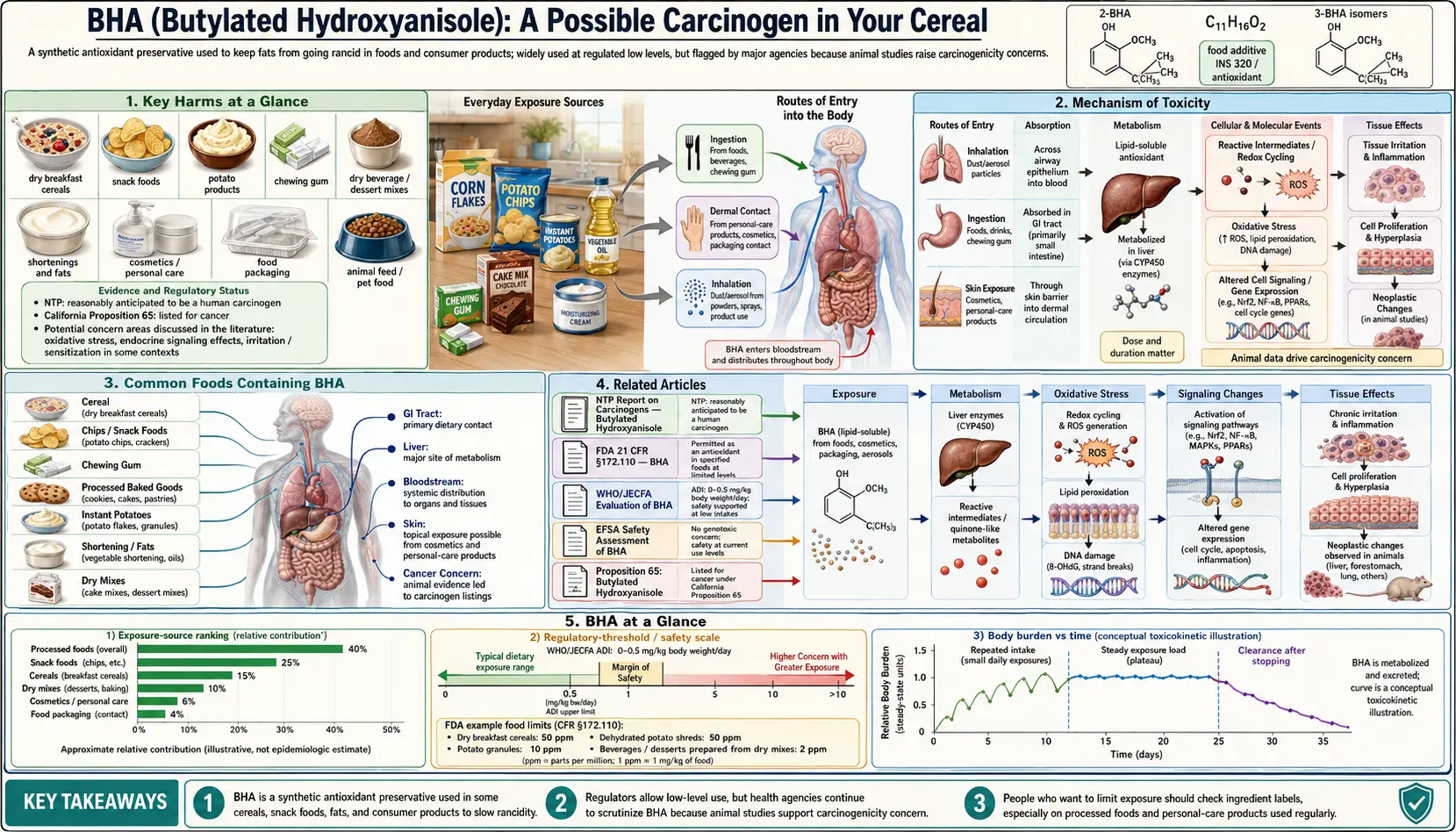
Butylated hydroxyanisole (BHA) is a synthetic antioxidant that, according to the US National Toxicology Program (NTP), has been added to edible fats and fat-containing foods since 1947. IARC classifies it as “possibly carcinogenic to humans” (Group 2B), the NTP lists it as “reasonably anticipated to be a human carcinogen,” and California lists it under Proposition 65 among “chemicals known to the state to cause cancer” — all on the basis of forestomach tumours in rodents fed high doses. It remains permitted within set limits in the United States, the European Union and Japan, and in February 2026 the US Food and Drug Administration (FDA) opened a post-market safety assessment of it.
Table of Contents
Key Findings at a Glance
- IARC Group 2B — “possibly carcinogenic to humans” (IARC Monograph Volume 40, 1986), on sufficient evidence in experimental animals.
- NTP: “reasonably anticipated to be a human carcinogen” — first listed in 1991; the NTP states that the human data are inadequate to evaluate BHA specifically.
- California Proposition 65 — listed on 1 January 1990 among “chemicals known to the state to cause cancer” (27 CCR 27001(b)).
- Forestomach tumours in rodents — BHA at 0.5–2% of the diet caused papillomas and squamous-cell carcinomas of the forestomach, an organ humans do not have (Ito 1983; Masui 1986).
- Permitted with limits in the EU and Japan — the EU authorises BHA as E 320 in specified food categories with maximum levels; EFSA re-evaluated it in 2011 and set an acceptable daily intake (ADI) of 1.0 mg/kg body weight per day. It is on Japan’s List of Designated Additives.
- Human cohort — in the Netherlands Cohort Study, usual dietary intake of BHA was not significantly associated with stomach cancer (Botterweck 2000).
- Metabolites and oxidative stress — in rat liver microsomes, the BHA metabolites tert-butylhydroquinone (TBHQ) and tert-butylquinone (TBQ) generated reactive oxygen species (Kahl 1989).
- Hormone activity in cell tests — weakly estrogenic and weakly anti-androgenic in laboratory assays (Jobling 1995; Schrader 2000; Pop 2016).
- Packaging — BHA is also used in food-contact materials; FDA’s 2026 request for information asks for data on its migration into food.
1. Overview
Butylated hydroxyanisole (BHA), designated E 320 in European food additive nomenclature, is a synthetic phenolic antioxidant used to slow the oxidative rancidity of fats and oils in processed foods. The NTP describes it as a white or slightly yellow, waxy solid with a faint characteristic odour. It is made from petrochemical starting materials.
BHA interrupts lipid peroxidation — the chain reaction in which oxygen reacts with unsaturated fatty acids in fats and oils, producing rancid flavours and odours. By donating a hydrogen atom to free-radical intermediates, it ends the chain and extends the shelf life of fat-containing foods.
Commercial BHA is a mixture of two isomers, 3-tert-butyl-4-hydroxyanisole (3-BHA) and 2-tert-butyl-4-hydroxyanisole (2-BHA). According to the NTP, food-grade BHA contains over 85% 3-BHA and less than 15% 2-BHA. In rodent studies the forestomach effect of crude BHA was largely due to the 3-isomer (Ito 1986).
BHA is often used together with its chemical relative BHT (butylated hydroxytoluene), and several US limits apply to the two combined (21 CFR 172.110). The NTP also lists uses in food packaging, animal feed, cosmetics, pharmaceuticals, and rubber and petroleum products.
2. Regulatory Status
IARC Classification — Group 2B (1986)
The International Agency for Research on Cancer (IARC) evaluated BHA in Monograph Volume 40 (1986) and classified it in Group 2B, “possibly carcinogenic to humans,” on sufficient evidence of carcinogenicity in experimental animals (forestomach tumours in rodents).
US National Toxicology Program
The NTP’s Report on Carcinogens lists BHA as “reasonably anticipated to be a human carcinogen based on sufficient evidence of carcinogenicity from studies in experimental animals.” It was first listed in the Sixth Annual Report on Carcinogens (1991). The NTP cites benign and malignant forestomach tumours in rats of both sexes and in male mice and hamsters, and notes one later study in which BHA fed to larval fish caused liver cancer in the adult fish. It states that the epidemiological data are inadequate to evaluate the relationship between human cancer and BHA specifically.
United States — FDA
FDA lists BHA as generally recognized as safe (GRAS) as an antioxidant in food when the total antioxidant content does not exceed 0.02% of the fat or oil content of the food (21 CFR 182.3169). A separate food additive regulation, 21 CFR 172.110, permits BHA, alone or with BHT, in named foods at set limits — for example 50 ppm in dry breakfast cereals, potato flakes and dehydrated potato shreds, 200 ppm in emulsion stabilizers for shortenings, and (BHA only) 1,000 ppm in active dry yeast. Other rules cover chewing gum base, flavouring substances and food-contact materials.
In February 2026 FDA published a request for information (91 FR 6227) as part of a post-market assessment, to determine whether BHA “remains safe under its current conditions of use in food and as a food contact substance.” Comments closed on 13 April 2026.
European Union — Authorised as E 320
BHA is authorised as a food additive in the EU (E 320) under Regulation (EC) No 1333/2008, only in specified food categories with maximum levels. EFSA re-evaluated it in 2011: the Panel concluded that BHA does not raise concern with respect to genotoxicity, considered that forestomach hyperplasia in rodents “may no longer be relevant for human risk assessment,” and raised the ADI from 0.5 to 1.0 mg/kg body weight per day, based on growth retardation, increased mortality and behavioural effects in rat pups at higher doses. It found that refined intake estimates at current use levels were generally below that ADI (EFSA 2011).
Japan
Butylated hydroxyanisole appears on Japan’s List of Designated Additives, the list of synthetic additives permitted in food. No primary record of a Japanese food ban on BHA was found.
California Proposition 65
California’s Safe Drinking Water and Toxic Enforcement Act of 1986 (Proposition 65) lists butylated hydroxyanisole under the heading “Chemicals known to the state to cause cancer” (Title 27, California Code of Regulations, section 27001(b)), with a listing date of 1 January 1990. A Proposition 65 listing is a state legal designation; it brings the chemical under the law’s “clear and reasonable warning” rules for exposures in California. California’s Food Safety Act of 2023 (AB 418), which bans four other additives from 2027, does not cover BHA.
3. How BHA Acts in the Body
Metabolites
BHA is metabolised to tert-butylhydroquinone (TBHQ), itself used as a food antioxidant, and TBHQ can oxidise to tert-butylquinone (TBQ). In rat liver microsomes, BHA increased superoxide formation up to 10-fold, an effect that required metabolic activation; TBHQ was much more active than BHA, TBQ more active still, and the authors concluded that TBQ undergoes redox cycling and that “no oxygen activating properties can be ascribed to BHA itself” (Kahl 1989).
Oxidative Stress and DNA
Although BHA acts as an antioxidant in food, its metabolites can act as pro-oxidants in tissue. In rats given BHA, oxidative DNA damage (8-oxodG) rose in the epithelium of the glandular stomach and, to a lesser extent, the colon, and co-administration of aspirin, which blocks prostaglandin H synthase, reduced both the DNA damage and the stomach lesions (Schilderman 1995). Reviews and regulators have not found BHA to be genotoxic: a 1993 review found “no indication of genotoxicity” and judged the published findings consistent with BHA acting as a tumour promoter (Kahl 1993), and EFSA concluded in 2011 that BHA does not raise concern for genotoxicity.
Hormone Activity in Laboratory Tests
In mammalian cell screens BHA was weakly estrogenic, less so than the environmental estrogen octylphenol (Jobling 1995). In human androgen-receptor reporter cells it partially inhibited activation by dihydrotestosterone (Schrader 2000), and a 2016 study found it to be a weak anti-androgen in MDA-kb2 cells (Pop 2016). These are cell-assay results; they do not by themselves show effects at dietary intakes.
Forestomach Tumours in Rodents
The clearest evidence of carcinogenicity comes from rodent feeding studies showing papillomas and squamous-cell carcinomas of the forestomach — a food-storage organ present in rodents but absent in humans. A 1988 review noted that BHA induced tumours of the squamous epithelium of the rodent forestomach but not at other sites, that the oesophageal epithelium was not responsive in several species, and argued that BHA would not be a human carcinogen at food-additive levels (Grice 1988). EFSA reached a similar view on forestomach relevance in 2011. Neither BHA nor its metabolites were found in the forestomach epithelium of treated rats, suggesting a direct action of BHA, or of products formed with gastric juice, on the stomach lining (Ito 1986).
Liver Enzyme Induction
In primary-cultured human and rat liver cells, BHA and TBHQ were strong inducers of the Nrf2 transcription factor and of the enzymes heme oxygenase-1 and NAD(P)H:quinone oxidoreductase 1 (Keum 2006). This kind of enzyme induction is one reason BHA has been studied in cancer chemoprevention research: in rat two-stage models, BHA inhibited liver and mammary carcinogenesis started by chemical carcinogens while enhancing forestomach and urinary bladder carcinogenesis (Ito 1986).
4. Health Effects in Animal and Human Studies
Forestomach Tumours
In a two-year study, BHA at 2% of the diet significantly increased forestomach papillomas and squamous-cell carcinomas in F344 rats of both sexes; both 0.5% and 2% increased forestomach hyperplasia, and tumours in other organs were not significantly increased (Ito 1983). A 104-week study found papillomas and carcinomas in rats and hamsters given 1–2% BHA and papillomas in mice given 0.5–1% (Masui 1986).
Human Data
In the Netherlands Cohort Study of 120,852 men and women aged 55–69, followed for 6.3 years, mean intake was 105 micrograms of BHA a day, and no significant association was found between usual intake and stomach cancer (Botterweck 2000). The NTP reports an estimated average US dietary intake of 4.3 mg of BHA a day in 1975.
Liver, Thyroid and Organ Weights
In rats given BHA by gavage at 500 mg/kg body weight a day, liver, adrenal and thyroid weights increased, and thyroid changes were seen in their offspring (Jeong 2005). A 1993 review described most toxic effects of BHA other than forestomach tumours as less characteristic and often seen only after high doses and long-term treatment, and noted that at high doses BHA, BHT and vitamin E all impaired blood clotting in animals (Kahl 1993).
Reproductive Effects in Rats
In the same rat study, BHA lowered serum testosterone and thyroxine in a dose-dependent way. At 500 mg/kg a day mating rate fell, sexual maturation of offspring was delayed, sperm velocity and number were reduced in offspring, and the estrous cycle was slightly shortened in female offspring; the authors described the effects as weak dysfunction at high doses (Jeong 2005). How these high-dose findings relate to dietary intake in people has not been established.
Allergic and Skin Reactions
Contact dermatitis from BHA has been reported in case reports (Tosti 1987). In two patients with chronic idiopathic urticaria whose symptoms remitted on a dye- and preservative-free diet, double-blind, placebo-controlled challenges with BHA and BHT brought back the urticaria (Goodman 1990). How common such reactions are has not been established.
Children’s Behaviour
The 2007 trial by McCann and colleagues, which prompted European action on synthetic food colours, tested drinks containing sodium benzoate with one of two artificial colour mixes and found increased hyperactivity in 3-year-old and 8/9-year-old children. BHA was not among the additives tested, and the trial does not show an effect of BHA on behaviour.
5. Where BHA Is Used
The NTP, citing IARC, lists BHA as added to butter, lard, meats, cereals, baked goods, sweets, beer, vegetable oils, potato chips, snack foods, nuts and nut products, dehydrated potatoes and flavouring agents, and as used in sausage, poultry and meat products, dry mixes for beverages and desserts, glazed fruits, chewing gum, active dry yeast and emulsion stabilizers for shortening. Because it remains active at high temperatures it is used in baked and fried foods.
Breakfast Cereals
US rules permit BHA, alone or with BHT, in dry breakfast cereals at up to 50 ppm combined (21 CFR 172.110).
Snack Chips and Nuts
Potato chips, snack foods, nuts and nut products are among the foods the NTP lists for BHA. Fat-rich snacks are prone to oxidative rancidity, which is what antioxidants of this kind are added to slow.
Chewing Gum
BHA is permitted as an antioxidant in chewing gum base, alone or with BHT or propyl gallate, with total antioxidants not exceeding 0.1% of the gum base (21 CFR 172.615).
Butter, Butteroil and Margarine
FDA’s 2026 request for information notes that BHA is listed in USDA’s specifications for butteroil and in the USDA and FDA standards of identity for margarine.
Vegetable Oils and Shortening
Under the GRAS listing, BHA may be used in fats and oils when total antioxidants do not exceed 0.02% of the fat or oil content (21 CFR 182.3169), and emulsion stabilizers for shortenings may contain up to 200 ppm of BHA and BHT combined (21 CFR 172.110).
Dehydrated Potato Products
21 CFR 172.110 permits BHA, alone or with BHT, at 50 ppm in dehydrated potato shreds, potato flakes and sweet potato flakes, and 10 ppm in potato granules.
Beer
Beer is among the foods the NTP lists for BHA.
Food Packaging Migration
BHA is permitted in food-packaging material as an antioxidant migrating into food, with a limit of 0.005% in the food (21 CFR 181.24), and in a range of food-contact materials including adhesives, coatings, defoamers, plastics and lubricants. The NTP notes that BHA stabilizes the petroleum wax coatings of food packaging. BHA that reaches food from packaging is not an added ingredient, and FDA’s 2026 request for information asks for data on its migration from food-contact materials into food.
6. BHA vs. BHT Comparison
BHT (butylated hydroxytoluene, E 321) is the closest structural relative of BHA and is often used with it. Both are hindered phenolic antioxidants that donate hydrogen atoms to lipid free radicals, but the evidence about them differs:
Structural Differences
BHA carries a methoxy group (-OCH3) and one tert-butyl group on the aromatic ring; BHT carries a methyl group (-CH3) and two tert-butyl groups. In rat liver microsomes BHA loses its methoxy methyl group (released as formaldehyde) to give TBHQ, the starting point of the redox cycle described above (Kahl 1989). BHT has its own reactive metabolite, BHT quinone methide, which caused haemorrhages in rats (Takahashi 1988).
Toxicology Compared
A 1993 review summarised the difference: BHA induces dose-dependent forestomach tumours in animals, whereas BHT induces liver tumours in long-term experiments; specific lung toxicity has been seen only with BHT; and neither shows signs of genotoxicity (Kahl 1993). In mice, dietary BHT enhanced lung tumour formation started by chemical carcinogens (Witschi 1983). IARC places BHT in Group 3 (not classifiable as to its carcinogenicity to humans), and BHT is not listed in the NTP Report on Carcinogens.
Combined Use
US food-additive limits for cereals, potato products and shortening emulsion stabilizers apply to BHA and BHT combined (21 CFR 172.110), and the GRAS limit of 0.02% of fat or oil content applies to total antioxidants. People eating foods that use both are exposed to both.
Regulatory Status Compared
Both are GRAS in the US within the 0.02% total-antioxidant limit, both are authorised in the EU only in specified food categories with maximum levels, and both are on Japan’s List of Designated Additives. EFSA set an ADI of 1.0 mg/kg body weight per day for BHA (2011) and 0.25 mg/kg for BHT (2012). FDA’s list of chemicals under review (current as of 2 October 2026) shows BHA at the scientific-assessment stage and BHT at the review-of-information stage.
7. Alternative Antioxidants
Other antioxidants and preservation methods are used in fat-containing foods, each with its own research record:
Tocopherols (Vitamin E)
Mixed tocopherols — the vitamin E family — are chain-breaking antioxidants that work through the same free-radical-quenching mechanism as BHA and are used in place of BHA and BHT in some products. A 1993 review found that vitamin E, unlike BHA and BHT, is not carcinogenic, while noting that at high doses all three impaired blood clotting in animals (Kahl 1993).
Rosemary Extract
Rosemary extract (E 392 in the EU), whose main antioxidant compounds are carnosic acid and carnosol, is used to slow lipid oxidation in oils, meat products and snack foods.
Ascorbic Acid (Vitamin C)
Ascorbic acid and its derivatives (ascorbyl palmitate, sodium ascorbate) act as oxygen scavengers and can regenerate oxidised tocopherol, which is why they are often combined with tocopherols. In rat two-stage carcinogenesis models, sodium ascorbate promoted forestomach and urinary bladder carcinogenesis (Ito 1986) — one example of how antioxidants in general can have organ-specific promoting or inhibiting effects in animals.
Other Antioxidants and Methods
Other plant-derived antioxidants studied for food use include green tea polyphenols, grape seed proanthocyanidins, sesamol and various phenolic acids. Modified-atmosphere packaging, oxygen-scavenger sachets and vacuum packaging reduce the oxygen available for lipid oxidation without adding an antioxidant.
8. Related Articles
Key Research Papers
Key research papers and authoritative sources. Links resolve to DOI, PubMed, or the issuing agency.
- IARC Working Group. Some Naturally Occurring and Synthetic Food Components, Furocoumarins and Ultraviolet Radiation. IARC Monographs on the Evaluation of Carcinogenic Risks to Humans, Vol. 40. Lyon: International Agency for Research on Cancer; 1986. (BHA classified Group 2B, pp. 123–159.) — IARC
- Witschi HP, Morse CC. Enhancement of lung tumor formation in mice by dietary butylated hydroxytoluene: dose-time relationships and cell kinetics. Journal of the National Cancer Institute. 1983;71(4):859–866. — doi:10.1093/jnci/71.4.859 (Editorial note: this study concerns BHT, not BHA; the title was previously misquoted as a BHA study. PubMed PubMed PMID: 6578375.)
- Ito N, Hirose M, Fukushima S, et al. Studies on antioxidants: their carcinogenic and modifying effects on chemical carcinogenesis. Food and Chemical Toxicology. 1986;24(10–11):1071–1082. — doi:10.1016/0278-6915(86)90291-7
- Hirose M, Inoue T, Masuda A, et al. Modification by 12 organic chemicals of 2-amino-3-methylimidazo[4,5-f]quinoline (IQ)-induced development of aberrant crypt foci in the rat colon. Carcinogenesis. 1994;15(11):2567–2571. (Editorial note: no paper with this title was found in PubMed or Crossref, and the DOI previously given, 10.1093/carcin/15.11.2567, resolves to an unrelated 1994 paper on heterocyclic amines; nothing on this page relies on this entry.)
- Kahl R, Kappus H. Toxicology of the synthetic antioxidants BHA and BHT in comparison with the natural antioxidant vitamin E. Zeitschrift fur Lebensmittel-Untersuchung und -Forschung. 1993;196(4):329–338. — PubMed PMID: 8493816 (In German, with an English abstract.)
- Conaway CC, Jiao D, Crowell JA, et al. Urinary isothiocyanate levels, brassica, and human breast cancer. Cancer Epidemiology, Biomarkers and Prevention. 1996. (Editorial note: this entry could not be matched to any indexed paper, and no paper by these authors on BHA quinone metabolites was found; nothing on this page relies on it. The metabolite findings are cited to Kahl 1989 below.)
- National Toxicology Program. Report on Carcinogens, Fifteenth Edition: Butylated Hydroxyanisole (CAS No. 25013-16-5). Research Triangle Park: U.S. Department of Health and Human Services. — NTP (Editorial note: previously cited as “NTP TR 317”; NTP Technical Report 317 concerns chlorpheniramine maleate, and the NTP’s BHA listing rests on published studies, not an NTP bioassay.)
- U.S. Food and Drug Administration. Code of Federal Regulations Title 21, Section 172.110: BHA. — eCFR
- Lanigan RS, Yamarik TA. Final report on the safety assessment of BHT. International Journal of Toxicology. 2002;21(Suppl 2):19–94. — doi:10.1080/10915810290096513 (Editorial note: concerns BHT in cosmetics.)
- Antignac E, Nohynek GJ, Re T, et al. Safety of botanical ingredients in personal care products/cosmetics. Food and Chemical Toxicology. 2011;49(2):324–341. — doi:10.1016/j.fct.2010.11.022 (Editorial note: concerns botanical cosmetic ingredients, not BHA.)
- Jeong SH, Kim BY, Kang HG, Ku HO, Cho JH. Effects of butylated hydroxyanisole on the development and functions of reproductive system in rats. Toxicology. 2005;208(1):49–62. — PubMed PMID: 15664432 (Editorial note: entry corrected; it previously gave a different title, journal and a DOI belonging to an unrelated paper on crystalline silica.)
- Krishnaswamy K, Raghuramulu N. Bioactive phytochemicals with emphasis on dietary practices. Indian Journal of Medical Research. 1998;108:167–181. — PubMed PMID: 9863273
- California Office of Environmental Health Hazard Assessment. Proposition 65: Butylated hydroxyanisole, listed 1 January 1990 as a chemical known to the state to cause cancer (27 CCR 27001(b)). — OEHHA
- Kubow S. Lipid oxidation products in food and atherogenesis. Nutrition Reviews. 1993;51(2):33–40. — PubMed PMID: 8455800
- California Legislature. Assembly Bill 418 (2023), the California Food Safety Act. — California Legislative Information (Editorial note: entry corrected; it previously described provisions on BHA in school foods, which the law does not contain.)
- McCann D, Barrett A, Cooper A, et al. Food additives and hyperactive behaviour in 3-year-old and 8/9-year-old children in the community: a randomised, double-blinded, placebo-controlled trial. The Lancet. 2007;370(9598):1560–1567. — doi:10.1016/S0140-6736(07)61306-3 (Editorial note: the trial tested sodium benzoate and artificial colours, not BHA.)
- Grice HC. Safety evaluation of butylated hydroxyanisole from the perspective of effects on forestomach and oesophageal squamous epithelium. Food and Chemical Toxicology. 1988;26(8):717–723. — PubMed PMID: 3058561 (Editorial note: entry corrected; the author and title were previously misquoted.)
- Ito N, Fukushima S, Hagiwara A, Shibata M, Ogiso T. Carcinogenicity of butylated hydroxyanisole in F344 rats. Journal of the National Cancer Institute. 1983;70(2):343–352. — PubMed PMID: 6571941
- Masui T, Hirose M, Imaida K, Fukushima S, Tamano S, Ito N. Sequential changes of the forestomach of F344 rats, Syrian golden hamsters, and B6C3F1 mice treated with butylated hydroxyanisole. Japanese Journal of Cancer Research. 1986;77(11):1083–1090. — PubMed PMID: 3098717
- Botterweck AA, Verhagen H, Goldbohm RA, Kleinjans J, van den Brandt PA. Intake of butylated hydroxyanisole and butylated hydroxytoluene and stomach cancer risk: results from analyses in the Netherlands Cohort Study. Food and Chemical Toxicology. 2000;38(7):599–605. — PubMed PMID: 10942321
- Kahl R, Weinke S, Kappus H. Production of reactive oxygen species due to metabolic activation of butylated hydroxyanisole. Toxicology. 1989;59(2):179–194. — PubMed PMID: 2555935
- Schilderman PA, ten Vaarwerk FJ, Lutgerink JT, Van der Wurff A, ten Hoor F, Kleinjans JC. Induction of oxidative DNA damage and early lesions in rat gastro-intestinal epithelium in relation to prostaglandin H synthase-mediated metabolism of butylated hydroxyanisole. Food and Chemical Toxicology. 1995;33(2):99–109. — PubMed PMID: 7868004
- Keum YS, Han YH, Liew C, et al. Induction of heme oxygenase-1 (HO-1) and NAD[P]H: quinone oxidoreductase 1 (NQO1) by a phenolic antioxidant, butylated hydroxyanisole (BHA) and its metabolite, tert-butylhydroquinone (tBHQ) in primary-cultured human and rat hepatocytes. Pharmaceutical Research. 2006;23(11):2586–2594. — PubMed PMID: 17048120
- Jobling S, Reynolds T, White R, Parker MG, Sumpter JP. A variety of environmentally persistent chemicals, including some phthalate plasticizers, are weakly estrogenic. Environmental Health Perspectives. 1995;103(6):582–587. — PubMed PMID: 7556011
- Schrader TJ, Cooke GM. Examination of selected food additives and organochlorine food contaminants for androgenic activity in vitro. Toxicological Sciences. 2000;53(2):278–288. — PubMed PMID: 10696776
- Pop A, Drugan T, Gutleb AC, et al. Individual and combined in vitro (anti)androgenic effects of certain food additives and cosmetic preservatives. Toxicology in Vitro. 2016;32:269–277. — PubMed PMID: 26812027
- Takahashi O. 2,6-di-tert-butyl-4-methylene-2,5-cyclohexadienone (BHT quinone methide): an active metabolite of BHT causing haemorrhages in rats. Archives of Toxicology. 1988;62(4):325–327. — PubMed PMID: 3240097
- Tosti A, Bardazzi F, Valeri F, Russo R. Contact dermatitis from butylated hydroxyanisole. Contact Dermatitis. 1987;17(4):257–258. — PubMed PMID: 2962833
- Goodman DL, McDonnell JT, Nelson HS, Vaughan TR, Weber RW. Chronic urticaria exacerbated by the antioxidant food preservatives, butylated hydroxyanisole (BHA) and butylated hydroxytoluene (BHT). Journal of Allergy and Clinical Immunology. 1990;86(4 Pt 1):570–575. — PubMed PMID: 2229816
- EFSA Panel on Food Additives and Nutrient Sources added to Food (ANS). Scientific Opinion on the re-evaluation of butylated hydroxyanisole – BHA (E 320) as a food additive. EFSA Journal. 2011;9(10):2392. — doi:10.2903/j.efsa.2011.2392
- EFSA Panel on Food Additives and Nutrient Sources added to Food (ANS). Scientific Opinion on the re-evaluation of butylated hydroxytoluene BHT (E 321) as a food additive. EFSA Journal. 2012;10(3):2588. — doi:10.2903/j.efsa.2012.2588
- U.S. Food and Drug Administration. Butylated Hydroxyanisole (BHA); Request for Information. Federal Register 91 FR 6227, 11 February 2026. — Federal Register
- U.S. Food and Drug Administration. List of Select Chemicals in the Food Supply Under FDA Review (content current as of 2 October 2026). — FDA
- 21 CFR 182.3169, butylated hydroxyanisole (GRAS chemical preservative). — eCFR
- 21 CFR 172.615, chewing gum base. — eCFR
- 21 CFR 181.24, antioxidants migrating from food-packaging material. — eCFR
- Regulation (EC) No 1333/2008 of the European Parliament and of the Council on food additives, Annex II (E 320). — EUR-Lex
- Japan Food Chemical Research Foundation. List of Designated Additives. — FFCR
PubMed Topic Searches
- PubMed — BHA butylated hydroxyanisole carcinogen search. — PubMed PMID: 41985577