Polysorbate 80 (E433): Gut Research and Regulation
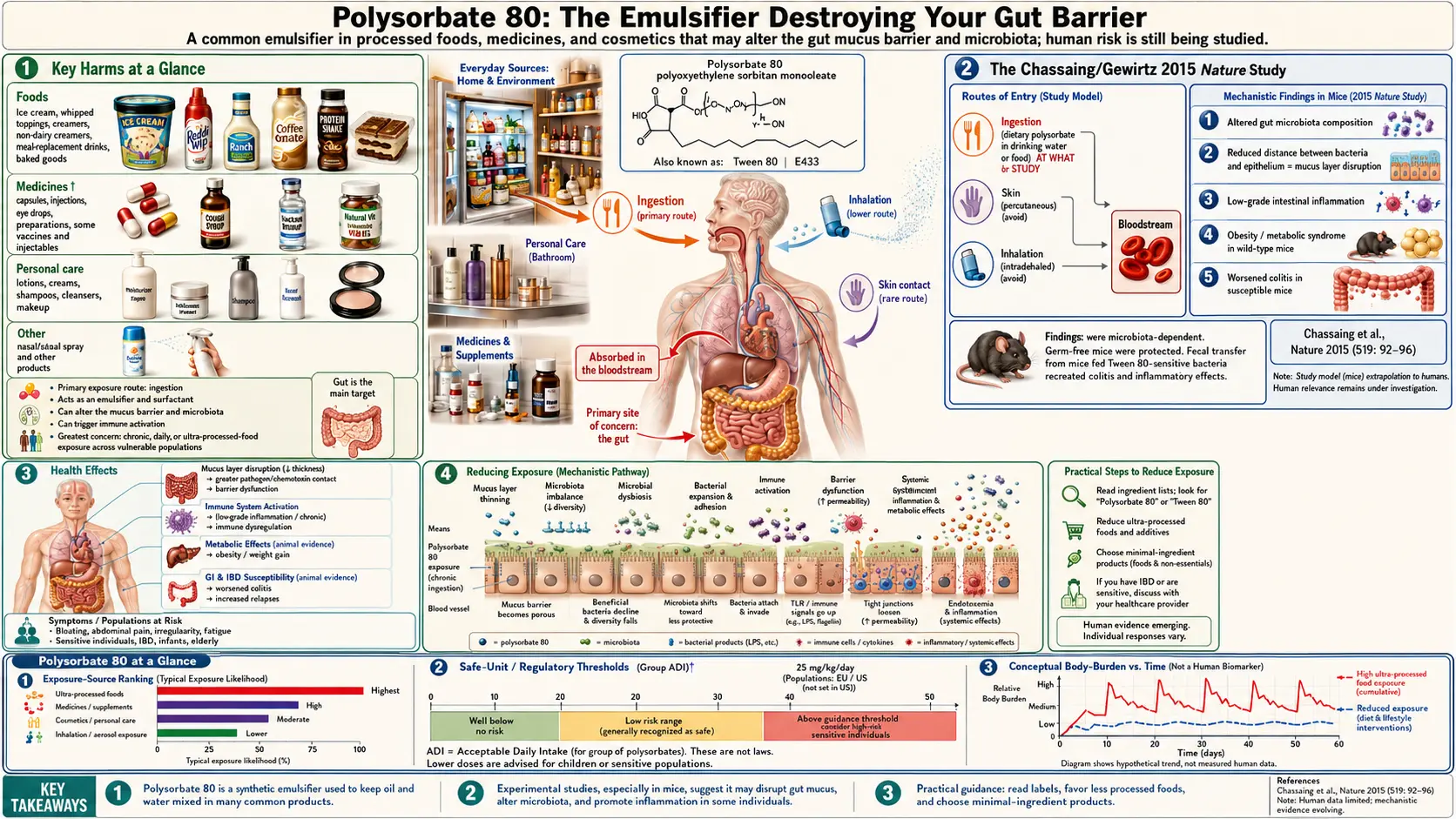
Table of Contents
Key Findings at a Glance
- Mucus layer and bacteria (mice) — in a 2015 Nature study, mice given polysorbate 80 (P80) or carboxymethylcellulose (CMC) at 1.0% in drinking water for 12 weeks had bacteria sitting closer to the gut lining and a thinner mucus layer (Chassaing et al., 2015).
- Colitis (mice) — the same emulsifiers promoted robust colitis in mice genetically prone to it.
- Metabolic syndrome (mice) — wild-type mice developed low-grade inflammation, more body fat and impaired glucose control; for P80, effects appeared at concentrations as low as 0.1%.
- Microbiota changes — P80 altered microbiota composition in mice and increased the pro-inflammatory potential of human gut bacteria grown outside the body (Chassaing et al., 2017).
- Colon tumours (mice) — in a colitis-associated cancer model, P80 or CMC in the diet increased tumour development (Viennois et al., 2017).
- Human evidence is limited — the 2022 controlled-feeding trial tested CMC, not P80. Diet trials comparing high- and low-emulsifier diets have given mixed results, and no human feeding trial of P80 on its own appears in the papers cited here.
- Food and medicine — P80 is a permitted food additive (21 CFR 172.840 in the US; E433 in the EU) and a common ingredient in medicines and some vaccines.
Overview
Polysorbate 80, chemically named polyoxyethylene (20) sorbitan monooleate, is listed as E433 in the European Union. Much of the laboratory and pharmaceutical literature uses the trade name Tween 80 for the same compound. It is a synthetic emulsifier: under the US regulation (21 CFR 172.840), oleic acid is reacted with sorbitol and the product is then reacted with ethylene oxide.
The molecule is amphiphilic (it has both a water-loving and a fat-loving part): the oleic acid tail dissolves in fat droplets while the polyoxyethylene chains extend into the surrounding water, stabilizing the oil-water interface and keeping the two phases from separating. The “(20)” in the chemical name refers to the oxyethylene units in the polyoxyethylene chains.
Beyond food, polysorbate 80 is widely used as a pharmaceutical excipient — a solubilizing agent in vitamin oils, vaccines, anticancer agents, creams and tablets, as described in a 2005 allergy report (Coors et al., 2005). People can therefore be exposed through food and through medicines. The 2015 EFSA re-evaluation noted that such other sources of exposure could not be included in its dietary exposure estimates.
Sources
The US regulation for polysorbate 80 as a direct food additive (21 CFR 172.840) lists specific uses, each with its own maximum level. They include:
- Ice cream and frozen desserts — as an emulsifier, alone or with polysorbate 65, up to 0.1% of the finished frozen dessert
- Shortenings and edible oils — up to 1% of the finished shortening or oil (alone or combined with polysorbate 60)
- Whipped edible oil toppings — up to 0.4% of the finished topping, alone or with certain other emulsifiers
- Gelatin desserts and dessert mixes — as a dispersing agent, up to 0.082% on a dry-weight basis
- Pickles and pickle products — as a solubilizing and dispersing agent, up to 500 parts per million
- Vitamin and vitamin-mineral preparations — with caps of 175 to 475 milligrams of polysorbate 80 from the daily dose, depending on the formulation
- Smaller uses — yeast defoamers, coarse crystal salt, dill oil in canned spiced green beans, cottage cheese creaming mixtures, colors in barbecue sauce, and poultry scald water
- Medicines — a common excipient in oral and injectable drug formulations and in some vaccines
Salad dressings, sauces and baked goods are often named as sources of polysorbate 80 in popular accounts. Those foods are not among the uses listed in 21 CFR 172.840; related emulsifiers such as polysorbate 60 are covered by their own US regulations. In the EU, E433 is authorized for a range of food categories, and EFSA’s 2015 opinion estimated exposure to the polysorbates as a group.
The Chassaing/Gewirtz 2015 Nature Study
A 2015 paper in Nature by Benoit Chassaing, Andrew Gewirtz and colleagues tested two widely used emulsifiers, polysorbate 80 (P80) and carboxymethylcellulose (CMC), in mice. The authors described the doses as “relatively low concentrations.” Their main experiments gave the emulsifiers in drinking water at 1.0% for 12 weeks. The paper notes that P80 is approved by the FDA for use in select foods at up to 1.0%. It also notes that human emulsifier intake is not widely tracked.
What the paper reports:
- Microbiota encroachment — in wild-type mice, bacteria were found closer to the gut lining: the average bacteria-to-epithelium distance fell by more than 50%, some bacteria were in apparent contact with the epithelium, and the change tracked a thinner mucus layer.
- Altered microbiota — composition shifted, including fewer Bacteroidales and more mucus-degrading bacteria such as Ruminococcus gnavus. In IL-10-deficient mice, both emulsifiers markedly reduced microbial diversity and enriched Proteobacteria. Fecal levels of bioactive lipopolysaccharide (LPS) and flagellin rose.
- Metabolic syndrome — wild-type mice gained modest weight and markedly more body fat and had impaired glucose control. The paper links the extra fat to increased food consumption. For P80, as little as 0.1% produced signs of low-grade inflammation and increased body fat, and 0.5% produced mild dysglycemia.
- Colitis in prone mice — in mice genetically prone to colitis (IL-10-deficient and TLR5-deficient strains), the emulsifiers raised fecal lipocalin-2, an inflammation marker, about 10-fold. Robust colitis developed in the IL-10-deficient mice.
- The microbiota was required — germ-free mice given the emulsifiers developed neither low-grade inflammation nor metabolic syndrome, and transferring the microbiota of emulsifier-fed mice into germ-free mice transferred these effects. The metabolic changes persisted for at least 6 weeks after the emulsifiers were stopped.
The authors suggested that dietary emulsifiers may have contributed to the rise in inflammatory bowel disease and metabolic syndrome since the mid-twentieth century. They also wrote that further studies are needed to determine whether CMC, P80 or other emulsifiers affect human health. A correction to the paper was published in 2016.
Proposed Mechanisms
The proposed chain of events comes mostly from mouse and laboratory work:
- Bacterial translocation — a 2013 hypothesis paper cited earlier laboratory evidence that very small concentrations of polysorbate 80 increase bacterial translocation across intestinal epithelia. It proposed that undigested emulsifiers could have this effect especially in the small intestine, where the mucus layer is discontinuous (Roberts et al., 2013).
- Mucus barrier — the inner colon mucus layer normally keeps bacteria away from the epithelium in healthy human colon biopsies. It is penetrable in mouse colitis models and in active ulcerative colitis (Johansson et al., 2014). In the 2015 mouse study, emulsifiers thinned the mucus layer and let bacteria approach the epithelium. In germ-free mice, however, emulsifiers did not reduce mucus thickness. The authors took this to mean the mucus changes are not purely a direct detergent effect of the emulsifier.
- Direct effects on gut bacteria — in a laboratory model holding a human gut microbiota with no live host, P80 and CMC acted directly on the bacteria to raise levels of bioactive flagellin. For P80 the rise came more slowly and went along with changes in species composition. Transferring the treated microbiota to germ-free mice reproduced many of the effects seen in mice fed the emulsifiers (Chassaing et al., 2017). A 2021 study testing 20 emulsifiers in a similar model found lasting effects of P80 and CMC on microbiota composition and function. Some other additives had effects of similar extent, while lecithin had no significant effect in that model (Naimi et al., 2021).
- Endotoxin and metabolism — in separate mouse work, a continuous low-dose infusion of bacterial lipopolysaccharide for 4 weeks increased fasting glucose, insulin and weight gain (Cani et al., 2007). This is one proposed link between gut bacteria crossing the barrier and metabolic effects.
- Tight junctions — a 2015 review hypothesized that emulsifiers and other industrial food additives increase intestinal permeability by opening tight junctions. The review presented this as a hypothesis for future research (Lerner and Matthias, 2015).
Effects Reported in Animal Studies
The effects below were reported in mice. Whether they occur in people eating ordinary diets has not been established:
- Low-grade intestinal inflammation — modestly raised fecal lipocalin-2, shortened colons and subtle signs of chronic inflammation in wild-type mice (Chassaing et al., 2015).
- Metabolic syndrome — increased body fat, more food intake and impaired glucose control (Chassaing et al., 2015).
- Colitis in susceptible mice — robust colitis in IL-10-deficient mice (Chassaing et al., 2015).
- Shorter colons — in a 2020 mouse comparison of four emulsifiers, colon length was lower than in controls. The difference was significant only for P80 and CMC (Sandall et al., 2020).
- Colon tumours — in a colitis-associated colorectal cancer model, regular consumption of P80 or CMC increased tumour development, along with higher microbial lipopolysaccharide and flagellin (Viennois et al., 2017).
Hypothesis papers have proposed emulsifiers as one contributor to the rise of Crohn’s disease (Roberts et al., 2013) and of autoimmune disease (Lerner and Matthias, 2015). A 2009 overview of mucosal bacteria in inflammatory bowel disease noted that household detergents and food emulsifiers became widespread during the same period, and wrote that their effect on colonic mucus has yet to be investigated (Swidsinski et al., 2009).
Human Studies
The best-known human trial in this area did not test polysorbate 80. The 2022 controlled-feeding study in Gastroenterology (Chassaing et al., 2022) tested carboxymethylcellulose only. Healthy adults ate an emulsifier-free diet (n = 9) or the same diet with 15 g per day of CMC added (n = 7) for 11 days. Compared with controls, CMC modestly increased abdominal discomfort after meals, reduced microbiota diversity, and lowered fecal short-chain fatty acids and free amino acids. Two people on CMC showed bacteria encroaching into the normally sterile inner mucus layer.
Other human studies relevant to polysorbate 80 or to emulsifiers as a group:
- Polysorbate 80 and drug absorption (2022) — in 12 adults, polysorbate 80 did not change the absorption of three probe drugs used to test intestinal permeability. The authors concluded it did not disrupt the intestinal membrane. Modest changes in some bile acids suggested a possible effect on the gut microbiota (Metry et al., 2022). This was a pharmacology study, not a diet trial.
- Healthy adults, high- vs low-emulsifier diets (2024) — in a crossover feeding trial of 22 healthy adults, barrier function was better on the high-emulsifier diet in the unstressed state. Under acute stress, intestinal permeability rose on the high-emulsifier diet, with no evidence of inflammation (Fitzpatrick et al., 2024).
- Crohn’s disease, high- vs low-emulsifier diets (2025) — in a double-blind feeding trial, 24 adults with active Crohn’s disease ate a high- or low-emulsifier version of a healthy diet for 4 weeks. Sonographic disease activity fell on both diets, with no statistically significant difference between them. The authors concluded that recommendations to avoid emulsifiers in active Crohn’s disease are not supported by their results (Fitzpatrick et al., 2025).
- Feasibility in Crohn’s disease (2020) — 20 people with stable Crohn’s disease followed a diet restricting all emulsifier classes for 14 days. The authors reported it was feasible, and symptom scores were lower than on participants’ habitual diets. The authors called for trials of its efficacy (Sandall et al., 2020).
- FADiets — a UK controlled dietary study introduced in 2019 tests soya lecithin, not polysorbate 80, in healthy volunteers (Partridge et al., 2019).
Taken together, the effects reported for polysorbate 80 itself come from animal and laboratory studies. Human trials so far have tested CMC alone or whole diets high or low in emulsifiers, and their results differ by population and outcome.
Medicines, Vaccines and Allergy
Polysorbate 80 is used in many medical products. A 2005 report lists vitamin oils, vaccines, anticancer agents and tablets. The same report describes a patient with anaphylactic shock after an intravenous multivitamin product given during pregnancy. Testing identified polysorbate 80 as the cause, and the reaction was found to be nonimmunologic (no polysorbate-specific IgE was detected) (Coors et al., 2005).
- Cross-reactivity with polyethylene glycol (PEG) — PEG and polysorbates are structurally similar. In a 2019 report, two patients with immediate hypersensitivity to PEG 3350 also reacted to polysorbate 80 on skin and provocation testing. The authors wrote that PEG hypersensitivity with cross-reactive polysorbate 80 hypersensitivity may be underrecognized (Stone et al., 2019).
- A vaccine study — in a 2022 study, eight patients with confirmed PEG allergy all tolerated a polysorbate-80-containing adenoviral-vector COVID-19 vaccine. This included two with a positive skin prick test to polysorbate 80. The authors reported that clinical cross-reactivity between PEG and polysorbate 80 did not occur in that setting (Sellaturay et al., 2022).
These reports describe rare reactions in individual patients. They do not give a rate of polysorbate 80 allergy in the general population.
Regulatory Status
- United States (FDA) — polysorbate 80 is regulated as a direct food additive under 21 CFR 172.840, which states that it “may be safely used in food” under prescribed conditions. Each permitted use has its own limit, from 0.1% of finished frozen desserts to 1% of finished shortenings and oils (see Sources). The regulation also sets manufacturing specifications and requires the additive’s own label to bear its name.
- European Union (EFSA) — authorized as E433. In its 2015 re-evaluation of the polysorbates E 432–E 436, EFSA’s food additives panel set a group acceptable daily intake (ADI) of 25 mg/kg body weight per day. The panel based it on a long-term rat study with a no-observed-adverse-effect level equivalent to 2,500 mg/kg body weight per day and an uncertainty factor of 100. It found no concern for genotoxicity, carcinogenicity or developmental toxicity. Its highest exposure estimate, for toddlers, was 24.5 mg/kg body weight per day, “very close to the ADI.” The panel said more usage and analytical data were needed to reduce uncertainty.
- JECFA and the former EU Scientific Committee on Food — as summarized by EFSA, JECFA had set a group ADI of 25 mg/kg body weight per day for polysorbates 20, 40, 60, 65 and 80, and the Scientific Committee on Food a group ADI of 10 mg/kg body weight per day.
- Labeling — polysorbate 80 appears on ingredient lists when added to a food (as “polysorbate 80” or, in the EU, E433). No health warning is required.
The EFSA opinion and the US regulation are listed under Key Research Papers. The emulsifier research described on this page is mostly more recent than these assessments.
Exposure and Labeling
- Where it appears — in the US, polysorbate 80 is permitted only in the food uses listed in 21 CFR 172.840. In ingredient lists it appears as “polysorbate 80” or, in the EU, as E433. Related emulsifiers (polysorbate 60 and 65) are listed under their own names.
- Ultra-processed foods — emulsifiers as a class are used mainly in manufactured foods. Foods prepared from unprocessed ingredients contain no added polysorbate 80.
- Not all emulsifiers behaved alike — in the 2021 laboratory study of 20 emulsifiers, P80 and CMC had lasting effects on a human microbiota, some carrageenans and gums had stark effects, and lecithin had no significant effect (Naimi et al., 2021).
- Medicines — polysorbate 80 in a medicine or vaccine is listed among its inactive ingredients.
Researchers draw different conclusions from this evidence. The authors of the 2021 laboratory study wrote that clinical trials are needed to reduce use of the most detrimental emulsifiers. The authors of the 2025 Crohn’s disease trial concluded that their results do not support recommendations to avoid emulsifiers in active Crohn’s disease. Decisions about diet and medicines in a particular condition belong with a clinician.
Key Research Papers
Key research papers and authoritative sources. Links resolve to DOI, PubMed, or the issuing agency.
- Chassaing B, Koren O, Goodrich JK, et al. Dietary emulsifiers impact the mouse gut microbiota promoting colitis and metabolic syndrome. Nature. 2015;519(7541):92-96. — doi:10.1038/nature14232 (corrigendum: Nature. 2016;536(7615):238, doi:10.1038/nature18000)
- Chassaing B, Van de Wiele T, De Bodt J, et al. Dietary emulsifiers directly alter human microbiota composition and gene expression ex vivo potentiating intestinal inflammation. Gut. 2017;66(8):1414-1427. — doi:10.1136/gutjnl-2016-313099
- Chassaing B, Compher C, Bonhomme B, et al. Randomized controlled-feeding study of dietary emulsifier carboxymethylcellulose reveals detrimental impacts on the gut microbiota and metabolome. Gastroenterology. 2022;162(3):743-756. — doi:10.1053/j.gastro.2021.11.006
- Viennois E, Merlin D, Gewirtz AT, Chassaing B. Dietary emulsifier-induced low-grade inflammation promotes colon carcinogenesis. Cancer Res. 2017;77(1):27-40. — doi:10.1158/0008-5472.CAN-16-1359
- Laudisi F, Stolfi C, Monteleone G. Impact of food additives on gut homeostasis. Nutrients. 2019;11(10):2334. — doi:10.3390/nu11102334
- Naimi S, Viennois E, Gewirtz AT, Chassaing B. Direct impact of commonly used dietary emulsifiers on human gut microbiota. Microbiome. 2021;9(1):66. — doi:10.1186/s40168-020-00996-6
- Roberts CL, Rushworth SL, Richman E, Rhodes JM. Hypothesis: increased consumption of emulsifiers as an explanation for the rising incidence of Crohn's disease. J Crohns Colitis. 2013;7(4):338-341. — doi:10.1016/j.crohns.2013.01.004
- Lerner A, Matthias T. Changes in intestinal tight junction permeability associated with industrial food additives explain the rising incidence of autoimmune disease. Autoimmun Rev. 2015;14(6):479-489. — doi:10.1016/j.autrev.2015.01.009
- Bergsson G, Arnfinnsson J, Steingrimsson O, Thormar H. In vitro killing of Candida albicans by fatty acids and monoglycerides. Antimicrob Agents Chemother. 2001;45(11):3209-3212. — doi:10.1128/AAC.45.11.3209-3212.2001
- Swidsinski A, Loening-Baucke V, Herber A. Mucosal flora in Crohn's disease and ulcerative colitis - an overview. J Physiol Pharmacol. 2009;60 Suppl 6:61-71. — PubMed PMID: 20224153
- Monteleone G, Neurath MF, Ardizzone S, et al. Mongersen, an oral SMAD7 antisense oligonucleotide, and Crohn's disease. N Engl J Med. 2015;372(12):1104-1113. — doi:10.1056/NEJMoa1407250
- Turnbaugh PJ, Ley RE, Mahowald MA, et al. An obesity-associated gut microbiome with increased capacity for energy harvest. Nature. 2006;444(7122):1027-1031. — doi:10.1038/nature05414
- Johansson ME, Gustafsson JK, Holmen-Larsson J, et al. Bacteria penetrate the normally impenetrable inner colon mucus layer in both murine colitis models and patients with ulcerative colitis. Gut. 2014;63(2):281-291. — doi:10.1136/gutjnl-2012-303207
- Cani PD, Amar J, Iglesias MA, et al. Metabolic endotoxemia initiates obesity and insulin resistance. Diabetes. 2007;56(7):1761-1772. — doi:10.2337/db06-1491
- Moussata D, Goetz M, Gloeckner A, et al. Confocal laser endomicroscopy is a new imaging modality for recognition of intramucosal bacteria in inflammatory bowel disease in vivo. Gut. 2011;60(1):26-33. — doi:10.1136/gut.2010.213264
- Fitzpatrick JA, Gibson PR, Taylor KM, et al. The effect of dietary emulsifiers and thickeners on intestinal barrier function and its response to acute stress in healthy adult humans: A randomised controlled feeding study. Aliment Pharmacol Ther. 2024;60(7):863-875. — PubMed PMID: 39072856
- Fitzpatrick JA, Gibson PR, Taylor KM, et al. Clinical Trial: The Effects of Emulsifiers in the Food Supply on Disease Activity in Crohn's Disease: An Exploratory Double-Blinded Randomised Feeding Trial. Aliment Pharmacol Ther. 2025;61(8):1276-1289. — PubMed PMID: 39967287
- Metry M, Krug SA, Karra VK, et al. Lack of an Effect of Polysorbate 80 on Intestinal Drug Permeability in Humans. Pharm Res. 2022;39(8):1881-1890. — PubMed PMID: 35672541
- Sandall AM, Cox SR, Lindsay JO, et al. Emulsifiers Impact Colonic Length in Mice and Emulsifier Restriction is Feasible in People with Crohn's Disease. Nutrients. 2020;12(9):2827. — PubMed PMID: 32942699
- Partridge D, Lloyd KA, Rhodes JM, et al. Food additives: Assessing the impact of exposure to permitted emulsifiers on bowel and metabolic health - introducing the FADiets study. Nutr Bull. 2019;44(4):329-349. — PubMed PMID: 31866761
- Coors EA, Seybold H, Merk HF, et al. Polysorbate 80 in medical products and nonimmunologic anaphylactoid reactions. Ann Allergy Asthma Immunol. 2005;95(6):593-599. — PubMed PMID: 16400901
- Stone CA Jr, Liu Y, Relling MV, et al. Immediate Hypersensitivity to Polyethylene Glycols and Polysorbates: More Common Than We Have Recognized. J Allergy Clin Immunol Pract. 2019;7(5):1533-1540.e8. — PubMed PMID: 30557713
- Sellaturay P, Gurugama P, Harper V, et al. The Polysorbate containing AstraZeneca COVID-19 vaccine is tolerated by polyethylene glycol (PEG) allergic patients. Clin Exp Allergy. 2022;52(1):12-17. — PubMed PMID: 34822190
- EFSA Panel on Food Additives and Nutrient Sources added to Food (ANS). Scientific Opinion on the re-evaluation of polyoxyethylene sorbitan monolaurate (E 432), polyoxyethylene sorbitan monooleate (E 433), polyoxyethylene sorbitan monopalmitate (E 434), polyoxyethylene sorbitan monostearate (E 435) and polyoxyethylene sorbitan tristearate (E 436) as food additives. EFSA J. 2015;13(7):4152. — doi:10.2903/j.efsa.2015.4152
- US Food and Drug Administration. 21 CFR 172.840 — Polysorbate 80. Code of Federal Regulations, Title 21. — eCFR: 21 CFR 172.840
PubMed Topic Searches
Connections
- All Toxins
- Food Additives
- Carrageenan
- Titanium Dioxide
- Artificial Sweeteners
- MSG
- Crohns Disease
- Ulcerative Colitis
- Irritable Bowel Syndrome
- Inflammatory Bowel Disease
- Gut Healing
- Gut Brain Axis
- Gut Microbiome
- Metabolic Syndrome
- Insulin Resistance
- Obesity
- Cancer
- Ultra Processed Foods
- Potassium Bromate
- Genetic Susceptibility to Vaccine Adverse Reactions — the excipient that cross-reacts with PEG in vaccine anaphylaxis