Sodium Benzoate: The Preservative That Can Form Benzene
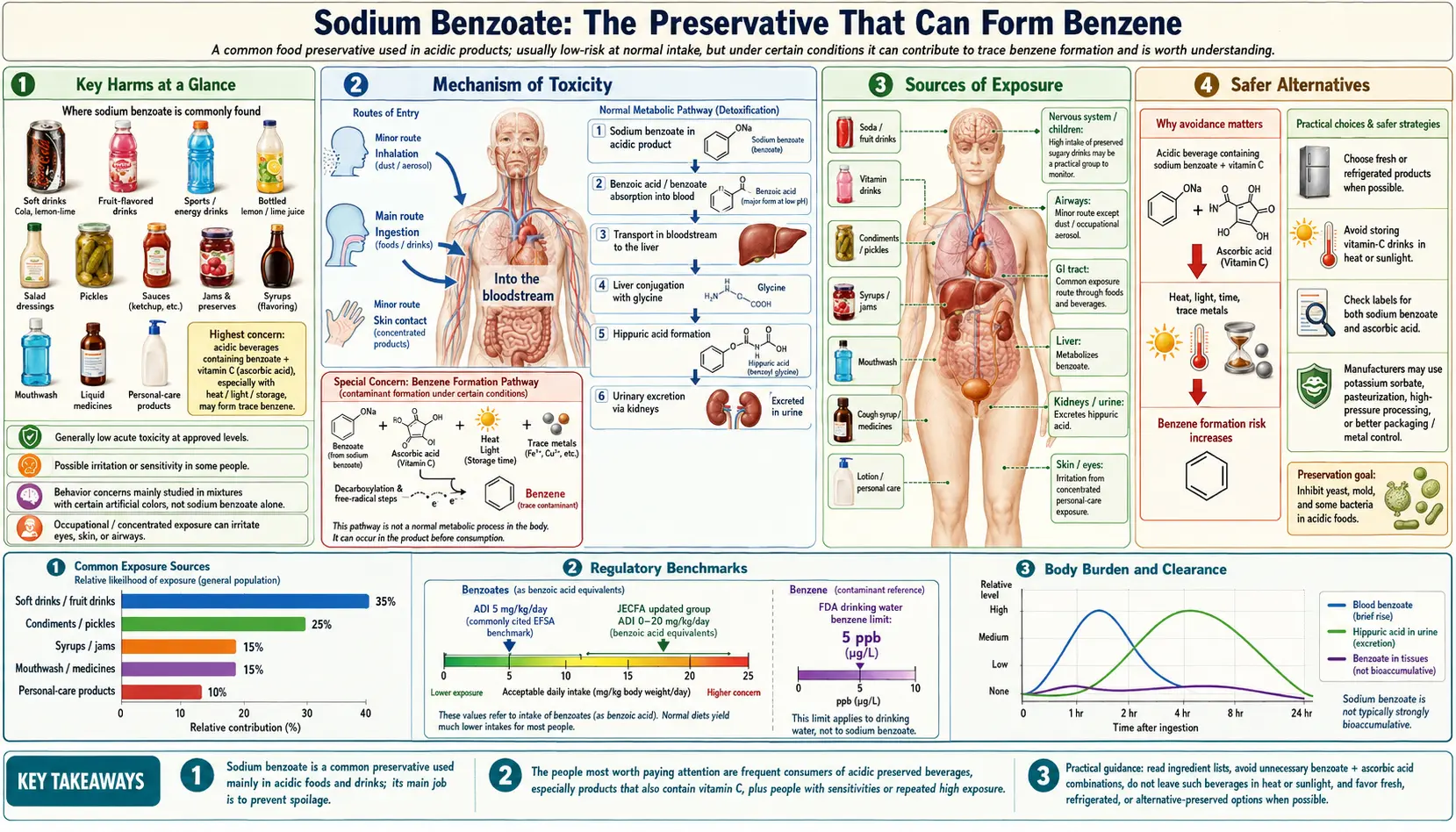
Sodium benzoate (C6H5COONa, E211) is the sodium salt of benzoic acid and a widely used antimicrobial preservative in acidic foods and drinks such as soft drinks, fruit juices, salad dressings, pickles and condiments. In the United States it is listed as Generally Recognized As Safe, and in the European Union it is an authorised food additive. Its best-documented hazard is indirect: in a product that also contains vitamin C (ascorbic acid), a chemical reaction can produce benzene — a compound the International Agency for Research on Cancer (IARC) classifies as carcinogenic to humans (Group 1). In an FDA survey of almost 200 soft drinks and other beverages sampled from 2005 to 2007, most contained no detectable benzene or less than the EPA drinking-water limit of 5 parts per billion (ppb); 10 products were above it, and the manufacturers reformulated them. Sodium benzoate has also been studied in relation to children’s hyperactivity, allergic-type reactions and cell and yeast effects, and it is itself a prescription medicine for a group of rare metabolic disorders.
Table of Contents
Key Findings at a Glance
- Benzene formation with vitamin C — benzoate and ascorbic acid, with trace copper or iron, can form benzene, an IARC Group 1 carcinogen; heat and light speed the reaction, and sugar and EDTA slow it (FDA studies).
- FDA beverage survey, 2005–2007 — of almost 200 samples, most had no detectable benzene or less than 5 ppb; 10 products were above 5 ppb and were reformulated, after which FDA measured less than 1.5 ppb.
- Hyperactivity research — the 2007 Southampton trial found that drinks containing sodium benzoate plus artificial colour mixes raised a combined hyperactivity score; the design cannot separate the preservative from the colours.
- Yeast and cell studies — weak-acid preservatives were mutagenic to the mitochondrial DNA of yeast in a 1999 study, and 1.0–2.0 mg/mL raised micronucleus counts in a cultured human lymphocyte cell line; EFSA’s 2016 re-evaluation found no genotoxicity concern for the food uses.
- Allergic-type reactions — reported in small oral-challenge studies of people with suspected additive intolerance; in a 2014 challenge study of 100 people with chronic urticaria, none reacted on double-blind testing.
- Intake versus the ADI — EFSA set an acceptable daily intake (ADI) of 5 mg per kg of body weight per day and estimated that, in some exposure scenarios, toddlers and children who regularly consume flavoured drinks exceed it.
- Prescription use — combined with sodium phenylacetate, sodium benzoate is an intravenous drug for acute high blood ammonia in urea-cycle disorders.
Overview
Benzoic acid (C6H5COOH) occurs naturally in some foods, including cranberries and cinnamon. The sodium salt does not: the US regulation describes sodium benzoate as produced by neutralizing benzoic acid with sodium bicarbonate, sodium carbonate or sodium hydroxide, and states that “the salt is not found to occur naturally” (21 CFR 184.1733). It is a white, water-soluble powder.
As a preservative, sodium benzoate works best in acidic products. At low pH more of it is present as undissociated benzoic acid, which can cross the membranes of microorganisms and acidify their interior. This makes it useful against yeasts, molds and acid-tolerant bacteria in soft drinks, fruit juices and condiments.
In the body, benzoate is conjugated with the amino acid glycine and excreted in the urine as hippuric acid (Nair 2001). The same pathway is the basis of its medical use in urea-cycle disorders, described below. FDA first learned that benzene could form in some soft drinks containing benzoate and ascorbic acid in 1990, when the soft drink industry informed the agency.
Benzene Formation
Gardner and Lawrence (1993) showed in laboratory solutions that benzoic acid can be decarboxylated to benzene in the presence of ascorbic acid and a transition-metal catalyst (copper or iron). FDA chemists summarize the reaction this way: through a series of reactions a hydroxyl radical forms, and that radical can decarboxylate benzoate to form benzene (Nyman 2008). In outline:
- Ascorbic acid reduces a trace metal ion (copper or iron) present in water or ingredients, and the reduced metal reacts with dissolved oxygen.
- Hydrogen peroxide forms, and its reaction with the reduced metal generates the hydroxyl radical (•OH), a highly reactive oxygen species.
- The hydroxyl radical attacks benzoate; the molecule loses its carboxyl group as carbon dioxide and the remaining ring becomes benzene (C6H6).
According to FDA, elevated temperature and light stimulate these reactions, while sugar and the chelating agent EDTA can inhibit them (Nyman 2008).
Diagram sources: Gardner and Lawrence 1993; Nyman 2008; FDA questions and answers on benzene in beverages.
FDA Testing and Industry Response
An early FDA survey (McNeal 1993) analysed more than 50 foods: foods without added benzoates contained benzene at 2 ng/g or less, and slightly higher levels were present in some foods and beverages containing both ascorbic acid and sodium benzoate. In 2005–2007 FDA sampled almost 200 soft drinks and other beverages. Benzene above 5 ppb was found in a total of 10 products; one of them was a cranberry juice beverage with added ascorbic acid but no added benzoates. The highest single result in FDA’s posted data tables was 88.9 ppb, in a juice drink that was later discontinued. The manufacturers reformulated the products identified as containing more than 5 ppb, if they were still made, and FDA’s retesting of the reformulated products found less than 1.5 ppb. The peer-reviewed report of the survey (Nyman 2008, 199 beverages) gives a range in reformulated beverages from none detected to 1.1 ng/g.
FDA did not ban the combination. Its stated conclusion is that “the levels of benzene found in beverages to date do not pose a safety concern for consumers.”
Mechanism of Toxicity
Benzene Metabolism and Bone Marrow Toxicity
Benzene itself is relatively unreactive; its toxicity comes from metabolism, which begins in the liver with cytochrome P450 enzymes (mainly CYP2E1):
- Benzene → benzene oxide — the first step, producing a reactive epoxide.
- Benzene oxide → phenol — the main route. Phenol is further hydroxylated to catechol and hydroquinone, which can be oxidized in bone marrow to reactive benzoquinones. A review of the glutathione conjugates of quinones (quinone-thioethers) found that they are themselves reactive and may contribute to quinone-mediated toxicity (Monks and Lau 1992).
- Ring opening → trans,trans-muconaldehyde — a reactive ring-opened metabolite that arises from benzene oxide, not from the benzoquinones.
The IARC Working Group (Volume 120, 2018) found strong evidence, including in exposed humans, that benzene is metabolically activated to electrophilic metabolites, induces oxidative stress and oxidative DNA damage, is genotoxic, is immunosuppressive and causes haematotoxicity. At high exposures benzene can suppress the bone marrow, in its severe form causing aplastic anemia; separately, damage to marrow cells is the basis of its link to leukemia.
Mitochondrial Damage (Yeast Research)
This is yeast work. In a 1999 study in baker’s yeast (Saccharomyces cerevisiae), Peter Piper, then at University College London, used superoxide dismutase mutants to show that weak organic acid food preservatives — the group to which benzoate belongs — exert a strong pro-oxidant action on aerobic yeast cells and are mutagenic toward the yeast mitochondrial genome, even at levels that did not inhibit growth. He wrote that this raises the concern that large-scale consumption of these preservatives may generate oxidative stress in the lining of the gastrointestinal tract. That concern has not been tested in people; no human study of mitochondrial DNA damage from dietary sodium benzoate was found for this page.
Oxidative Stress (Animal Research)
In a 2018 mouse study, oral sodium benzoate lowered reduced glutathione and raised malondialdehyde, a marker of lipid oxidation, in the brain, and impaired memory and motor coordination; acetylcholinesterase activity did not change significantly (Khoshnoud 2018). These are animal results, not human findings.
Health Effects Studied
Hyperactivity in Children
The most-cited study is the Southampton trial, published in The Lancet in 2007 by McCann and colleagues: a randomised, double-blinded, placebo-controlled crossover trial in 153 three-year-olds and 144 eight- and nine-year-olds from the general population. The challenge drink contained sodium benzoate plus one of two artificial-colour mixes (A or B), or a placebo drink. The main outcome was one combined hyperactivity score, the global hyperactivity aggregate, built from observed behaviour and ratings by teachers and parents, plus a computerised attention test for the older children.
- 3-year-olds: Mix A had a significant adverse effect compared with placebo (effect size 0.20, 95% CI 0.01–0.39); mix B did not. The mix A result held in children who drank more than 85% of the juice with no missing data (0.32).
- 8/9-year-olds: Among children who drank at least 85% of the drinks with no missing data, both mix A (0.12) and mix B (0.17) had significant adverse effects.
- What it can and cannot show: The authors concluded that “artificial colours or a sodium benzoate preservative (or both)” increase hyperactivity in children in the general population. Because every active drink contained sodium benzoate, the trial cannot attribute the effect to the preservative or to any single colour.
The European Food Safety Authority reviewed the trial in 2008 and concluded that it “provided limited evidence that the mixtures of additives tested had a small effect on the activity and attention of some children,” and that its findings could not be used as a basis for altering the ADI of the colours or of sodium benzoate (EFSA 2008). The EU warning label that followed applies to six colours, not to sodium benzoate (see Regulatory Status). A separate 2014 pilot survey of 475 college students found that self-reported intake of sodium benzoate-rich beverages was associated with more ADHD-related symptoms on a screening questionnaire; as a cross-sectional survey it shows an association, not cause (Beezhold 2014).
Allergic-Type Reactions
Sodium benzoate has been studied as a trigger of non-IgE, allergic-type (“pseudoallergic”) reactions:
- Urticaria (hives) and angioedema — in a 1985 study, 34 patients (17 with asthma, 17 with urticaria) whose histories suggested intolerance were challenged orally with seven compounds, including aspirin and sodium benzoate; 24 reacted to at least one compound, and no serious reaction was observed (Genton 1985). In a 2014 study of 100 patients with chronic idiopathic urticaria challenged with 11 additives including sodium benzoate, 2 reacted on single-blind challenge and neither reacted on double-blind placebo-controlled challenge; the authors concluded that sensitivity to these additives occurs in fewer than 1% of such patients (Rajan 2014).
- Asthma — asthmatic patients with suspected intolerance were among those challenged in the 1985 study; reactions were defined as a 20% fall in peak flow or acute urticaria or angioedema (Genton 1985).
- Skin contact — a cosmetic-ingredient safety review found that benzoic acid and sodium benzoate can produce non-immunologic contact urticaria and immediate contact reactions (wheals, redness, itching), and that benzoic acid was not a sensitizer at 2% (Nair 2001).
Genotoxicity
Results differ between test systems. In a cultured human lymphocyte cell line, sodium benzoate at 1.0, 1.5 and 2.0 mg/mL increased micronucleus formation, and 2.0 mg/mL increased chromosome breaks; it did not cause the superoxide dismutase gene mutation tested (Pongsavee 2015). The 2001 cosmetic-ingredient review described genotoxicity tests as mostly negative with some positive assays, and carcinogenicity studies as negative (Nair 2001). EFSA’s 2016 re-evaluation concluded that use as a food additive “does not raise a concern with respect to genotoxicity” and that the available data did not indicate any carcinogenic potential (EFSA 2016).
Benzene-Related Leukemia Risk
IARC (Volume 120, 2018) found sufficient evidence in humans that benzene causes acute myeloid leukaemia in adults, and positive associations for non-Hodgkin lymphoma, chronic lymphoid leukaemia, multiple myeloma, chronic myeloid leukaemia, acute myeloid leukaemia in children and lung cancer. No study was found for this page that measured cancer risk from benzene in beverages; benzene levels in drinks have varied widely and fell after the reformulations described above, and FDA has concluded that the levels it has found do not pose a safety concern.
Sources of Exposure
- Soft drinks and flavoured drinks — carbonated and non-carbonated drinks are a common use; EFSA identified flavoured drinks as a main contributor where some toddlers and children exceeded the ADI (EFSA 2016).
- Fruit juices and juice drinks — particularly shelf-stable products, whose acidic pH suits benzoate preservation.
- Salad dressings — especially bottled dressings with vinegar or citrus bases.
- Pickles and pickled vegetables — high-acid brines.
- Condiments and sauces — ketchup, hot sauce, soy sauce and other table condiments may contain it.
- Jams and jellies — acidic fruit preserves.
- Cosmetics and personal care products — used as a preservative in lotions, shampoos and similar products; the cosmetic-ingredient review concluded these ingredients could be used safely at concentrations up to 5% (Nair 2001).
- Medicines — used as a preservative in some liquid oral medicines, and as an active ingredient in a prescription drug for urea-cycle disorders (see below).
- Natural occurrence and carry-over — benzoic acid occurs naturally in some foods; when EFSA added carry-over to its exposure estimate, the main food categories contributing to intakes above the ADI were unprocessed fruits and vegetables and flavoured drinks (EFSA 2016).
Regulatory Status
United States
Sodium benzoate is affirmed as Generally Recognized As Safe (GRAS) under 21 CFR 184.1733, for use as an antimicrobial agent and as a flavoring agent and adjuvant. The regulation sets use at “levels not to exceed good manufacturing practice” and states that “current usage results in a maximum level of 0.1 percent in food.” Like any ingredient, it must appear in the ingredient list. After the 2005–2007 benzene survey, the manufacturers of the products found above 5 ppb reformulated them, and FDA concluded that the levels found do not pose a safety concern.
European Union
The EU authorises benzoic acid and its salts (E210–E213) in specified food categories at defined maximum levels. In its 2016 re-evaluation, EFSA took a four-generation rat study as the pivotal study, identified a no-observed-adverse-effect level of 500 mg benzoic acid per kg of body weight per day (the highest dose tested), and derived an ADI of 5 mg/kg body weight per day, expressed as benzoic acid, using an uncertainty factor of 100. It estimated that the ADI was exceeded in a brand-loyal scenario, in particular by toddlers and children who regularly consume flavoured drinks, and, once carry-over was included, by toddlers and children in the non-brand-loyal scenario as well (EFSA 2016).
After the 2007 Southampton trial, Regulation (EC) No 1333/2008 required foods containing any of six colours — sunset yellow (E110), quinoline yellow (E104), carmoisine (E122), allura red (E129), tartrazine (E102) and ponceau 4R (E124) — to carry the warning “may have an adverse effect on activity and attention in children,” applying from July 2010. The warning is tied to the colours; sodium benzoate itself carries no such label. Food dye rules across jurisdictions are covered on the Food Dyes Banned Worldwide page.
Sodium Benzoate as a Medicine
Urea-Cycle Disorders
Sodium phenylacetate and sodium benzoate injection is a prescription drug. Its US label describes it as a nitrogen-binding agent indicated as adjunctive therapy in pediatric and adult patients for the treatment of acute hyperammonemia and associated encephalopathy in patients with deficiencies in enzymes of the urea cycle. Benzoate is conjugated with glycine to form hippuric acid, which is excreted in the urine and so carries nitrogen out of the body. In a 25-year open-label, uncontrolled study of 299 patients with 1,181 episodes of acute hyperammonemia, overall survival was 84% and 96% of episodes were survived; neonates fared worse than older patients (Enns 2007).
Schizophrenia Research (D-Amino Acid Oxidase Inhibition)
This is investigational research, not an approved use. Sodium benzoate inhibits D-amino acid oxidase, an enzyme that breaks down D-amino acids that act at the NMDA receptor. In a randomized, double-blind, placebo-controlled trial at two medical centres in Taiwan, 52 patients with chronic schizophrenia who were stable on antipsychotic medication received 1 g per day of sodium benzoate or placebo as an add-on for six weeks. Benzoate produced a 21% improvement in the PANSS total score and improvements in several symptom and cognitive measures, and was well tolerated. The authors called the results preliminary and said they show promise for D-amino acid oxidase inhibition as an approach for new drug development (Lane 2013). More on the condition is on the Schizophrenia page.
Interaction with Vitamin C
Both ingredients are common, and they are sometimes used in the same product. The factors that change how much benzene forms have been studied mainly by FDA chemists.
Factors That Accelerate Benzene Formation
- Heat — FDA states that exposure to heat and light can stimulate the formation of benzene. In FDA’s accelerated-testing study, storage at 40 °C for 14 days was proposed as the more reliable way to simulate end-of-shelf-life benzene formation (Nyman 2010).
- Ultraviolet light — in 24-hour tests under intense UVA light, benzene increased by as much as 53% in model solutions stored in non-UV-stabilized bottles, and UV-stabilized polyethylene terephthalate (PET) bottles reduced benzene formation by about 13% relative to the non-stabilized bottles (Nyman 2010).
- Trace metals — copper or iron act as the catalyst in the laboratory reaction (Gardner and Lawrence 1993).
Factors That Inhibit Benzene Formation
- EDTA (ethylenediaminetetraacetic acid) — a chelating agent that binds metal ions; FDA chemists report that EDTA can inhibit the reaction (Nyman 2008).
- Sugar — also reported to inhibit the reaction (Nyman 2008).
- Reformulation — the products FDA found above 5 ppb were reformulated, and FDA’s retesting found less than 1.5 ppb. In FDA’s later end-of-shelf-life tests, retail beverages other than cranberry juice did not contain detectable benzene (below 0.05 ng/g) (Nyman 2010).
The published measurements concern benzene formed in the product during storage. Whether the reaction occurs to a meaningful extent after swallowing, for example when a benzoate-preserved drink is consumed with a vitamin C source, has not been measured in the studies cited here.
Alternative Preservation Methods
Food makers use other preservatives and processes in acidic foods and drinks. Each has its own research record:
- Potassium sorbate (E202) — another weak-acid preservative used against yeasts and molds, often alongside sodium benzoate; its research record, including cell-culture and cohort findings, is covered on the Potassium Sorbate page.
- Citric acid — lowers pH, which makes conditions less favourable for microbial growth, and is used together with other preservation methods.
- Nisin — an antimicrobial peptide produced by Lactococcus lactis during fermentation, active against many gram-positive bacteria; see the Nisin page.
- Natamycin (E235) — an antifungal agent produced by Streptomyces natalensis, used mainly where yeasts and molds are the concern; see the Natamycin page.
- Rosemary extract and other plant-derived antioxidants — phenolic antioxidants that slow oxidative spoilage in some foods; they act against oxidation rather than microbes.
- High-pressure processing (HPP) — a non-thermal process that uses very high pressure to inactivate microorganisms without chemical additives; such products usually need refrigeration.
- Modified atmosphere packaging — replacing oxygen with nitrogen or carbon dioxide in the package to slow aerobic spoilage organisms.
Key Research Papers
Key research papers and authoritative sources. Links resolve to DOI, PubMed, or the issuing agency.
- McCann D, Barrett A, Cooper A, et al. Food additives and hyperactive behaviour in 3-year-old and 8/9-year-old children in the community: a randomised, double-blinded, placebo-controlled trial. Lancet. 2007;370(9598):1560-1567. — doi:10.1016/S0140-6736(07)61306-3
- Nair B. Final report on the safety assessment of benzyl alcohol, benzoic acid, and sodium benzoate. International Journal of Toxicology. 2001;20 Suppl 3:23-50. — doi:10.1080/10915810152630729
- Piper PW. Yeast superoxide dismutase mutants reveal a pro-oxidant action of weak organic acid food preservatives. Free Radical Biology and Medicine. 1999;27(11-12):1219-1227. — doi:10.1016/s0891-5849(99)00147-1
- Badawi AF, Stern SJ, Lang NP, Kadlubar FF. Cytochrome P-450 and acetyltransferase expression as biomarkers of carcinogen-DNA adduct levels and human cancer susceptibility. Progress in Clinical and Biological Research. 1996;395:109-140. — PubMed PMID: 8895986 (Editorial note, 2026-10-14: this entry previously linked PMID 8895990, a different chapter in the same volume; corrected against PubMed.)
- McNeal TP, Nyman PJ, Diachenko GW, Hollifield HC. Survey of benzene in foods by using headspace concentration techniques and capillary gas chromatography. Journal of AOAC International. 1993;76(6):1213-1219. — doi:10.1093/jaoac/76.6.1213
- Nishino SF, Spain JC. Oxidative pathway for the biodegradation of nitrobenzene by Comamonas sp. strain JS765. Applied and Environmental Microbiology. 1995;61(6):2308-2313. — doi:10.1128/aem.61.6.2308-2313.1995 (Editorial note, 2026-10-14: this paper concerns bacterial breakdown of nitrobenzene; no statement on this page rests on it.)
- International Agency for Research on Cancer. IARC Monographs on the Evaluation of Carcinogenic Risks to Humans, Volume 29: Some Industrial Chemicals and Dyestuffs: Benzene. Lyon: IARC; 1982. IARC Monographs Vol. 29
- Monks TJ, Lau SS. Toxicology of quinone-thioethers. Critical Reviews in Toxicology. 1992;22(5-6):243-270. — PubMed PMID: 1489507 (Editorial note, 2026-10-14: this entry previously read “Toxicology of quinol-thioethers. Sub-Cellular Biochemistry. 1994;22:83-133” with a DOI that resolves to an unrelated chapter on monomolecular layers; no such Monks and Lau chapter was found in that volume. The entry now gives these authors’ 1992 review, corrected against PubMed and Crossref.)
- Beezhold BL, Johnston CS, Nochta KA. Sodium benzoate-rich beverage consumption is associated with increased reporting of ADHD symptoms in college students: a pilot investigation. Journal of Attention Disorders. 2014;18(3):236-241. — doi:10.1177/1087054712443156
- Pongsavee M. Effect of sodium benzoate preservative on micronucleus induction, chromosome break, and Ala40Thr superoxide dismutase gene mutation in lymphocytes. BioMed Research International. 2015;2015:103512. — doi:10.1155/2015/103512
- Warshaw EM, Nelsen DD, Maibach HI, et al. Positive patch test reactions to sodium benzoate: retrospective analysis of the North American Contact Dermatitis Group data, 1992-2004. Dermatitis. 2009;20(1):33-40. (Editorial note, 2026-10-14: no record of this paper was found in PubMed or Crossref, and the DOI it gave resolves to a different Warshaw paper, on iodopropynyl butylcarbamate; that link was removed. The entry is kept for transparency, and no statement on this page rests on it.)
- Doyle E. Sodium Benzoate/Benzoic Acid. Food Research Institute, University of Wisconsin- Madison. 2006. (Editorial note, 2026-10-14: the briefing’s former link at fri.wisc.edu returns “not found” and no archived copy was found; the link was removed. No statement on this page rests on it.)
- European Food Safety Authority. Opinion of the Scientific Panel on food additives, flavourings, processing aids and materials in contact with food (AFC) on a request from the Commission related to benzoic acid and its salts. EFSA Journal. 2005;3(1):80. (Editorial note, 2026-10-14: no EFSA opinion with this title was found in Crossref, and the DOI given resolves to a 2004 opinion on a list of food-contact substances; that link was removed. EFSA’s re-evaluation of benzoic acid and its salts is the 2016 opinion listed below.)
- US Food and Drug Administration. Data on Benzene in Soft Drinks and Other Beverages. 2007. Updated 2014. FDA Benzene Data
- Burdock GA, Carabin IG, Griffiths JC. Toxicology and pharmacology of sodium benzoate. Food and Chemical Toxicology. 2006;44(5):599-616. (Editorial note, 2026-10-14: no paper with this title was found; the DOI given, 10.1016/j.fct.2006.05.007, resolves to these authors’ “Toxicology and pharmacology of sodium ricinoleate” (2006;44:1689-1698). The link was removed; the entry is kept for transparency, and no statement on this page rests on it.)
- Rowe KS, Rowe KJ. Synthetic food coloring and behavior: a dose response effect in a double-blind, placebo-controlled, repeated-measures study. Journal of Pediatrics. 1994;125(5 Pt 1):691-698. — doi:10.1016/S0022-3476(94)70059-1
- Gardner LK, Lawrence GD. Benzene production from decarboxylation of benzoic acid in the presence of ascorbic acid and a transition-metal catalyst. Journal of Agricultural and Food Chemistry. 1993;41(5):693-695. — doi:10.1021/jf00029a001
- Nyman PJ, Diachenko GW, Perfetti GA, McNeal TP, Hiatt MH, Morehouse KM. Survey results of benzene in soft drinks and other beverages by headspace gas chromatography/mass spectrometry. Journal of Agricultural and Food Chemistry. 2008;56(2):571-576. — PubMed PMID: 18072742
- Nyman PJ, Wamer WG, Begley TH, Diachenko GW, Perfetti GA. Evaluation of accelerated UV and thermal testing for benzene formation in beverages containing benzoate and ascorbic acid. Journal of Food Science. 2010;75(3):C263-C267. — PubMed PMID: 20492277
- US Food and Drug Administration. Questions and Answers on the Occurrence of Benzene in Soft Drinks and Other Beverages. Content current as of 25 February 2022. — FDA
- Code of Federal Regulations. 21 CFR 184.1733 — Sodium benzoate (affirmed as GRAS). — eCFR
- EFSA Panel on Food Additives and Nutrient Sources added to Food (ANS). Scientific Opinion on the re-evaluation of benzoic acid (E 210), sodium benzoate (E 211), potassium benzoate (E 212) and calcium benzoate (E 213) as food additives. EFSA Journal. 2016;14(3):4433. — doi:10.2903/j.efsa.2016.4433
- EFSA Panel on Food Additives, Flavourings, Processing Aids and Food Contact Materials (AFC). Assessment of the results of the study by McCann et al. (2007) on the effect of some colours and sodium benzoate on children’s behaviour. EFSA Journal. 2008;6(3):660. — doi:10.2903/j.efsa.2008.660
- International Agency for Research on Cancer. Benzene. IARC Monographs on the Evaluation of Carcinogenic Risks to Humans, Volume 120. Lyon: IARC; 2018. — IARC Monographs Vol. 120
- Khoshnoud MJ, Siavashpour A, Bakhshizadeh M, Rashedinia M. Effects of sodium benzoate, a commonly used food preservative, on learning, memory, and oxidative stress in brain of mice. Journal of Biochemical and Molecular Toxicology. 2018;32(2):e22022. — PubMed PMID: 29243862
- Genton C, Frei PC, Pécoud A. Value of oral provocation tests to aspirin and food additives in the routine investigation of asthma and chronic urticaria. Journal of Allergy and Clinical Immunology. 1985;76(1):40-45. — PubMed PMID: 2861222
- Rajan JP, Simon RA, Bosso JV. Prevalence of sensitivity to food and drug additives in patients with chronic idiopathic urticaria. Journal of Allergy and Clinical Immunology: In Practice. 2014;2(2):168-171. — PubMed PMID: 24607044
- Enns GM, Berry SA, Berry GT, Rhead WJ, Brusilow SW, Hamosh A. Survival after treatment with phenylacetate and benzoate for urea-cycle disorders. New England Journal of Medicine. 2007;356(22):2282-2292. — PubMed PMID: 17538087
- US National Library of Medicine, DailyMed. Sodium phenylacetate and sodium benzoate injection: prescribing information (indications and usage). — DailyMed
- Lane HY, Lin CH, Green MF, Hellemann G, Huang CC, Chen PW, Tun R, Chang YC, Tsai GE. Add-on treatment of benzoate for schizophrenia: a randomized, double-blind, placebo-controlled trial of D-amino acid oxidase inhibitor. JAMA Psychiatry. 2013;70(12):1267-1275. — PubMed PMID: 24089054
PubMed Topic Searches
Connections
- All Toxins
- Preservatives
- Food Additives
- Vitamin C
- Potassium Sorbate
- ADHD
- Leukemia
- Cancer
- Sodium Nitrite
- Sulfites
- Artificial Sweeteners
- Iron
- Oxidative Stress
- Asthma
- BHA
- TBHQ
- Elimination Diet
- BHT
- Red 40 Allura Red
- Benzene — the Group 1 carcinogen this preservative forms when it reacts with vitamin C in soft drinks.