Acesulfame Potassium (Ace-K): Research Findings and Regulatory Status
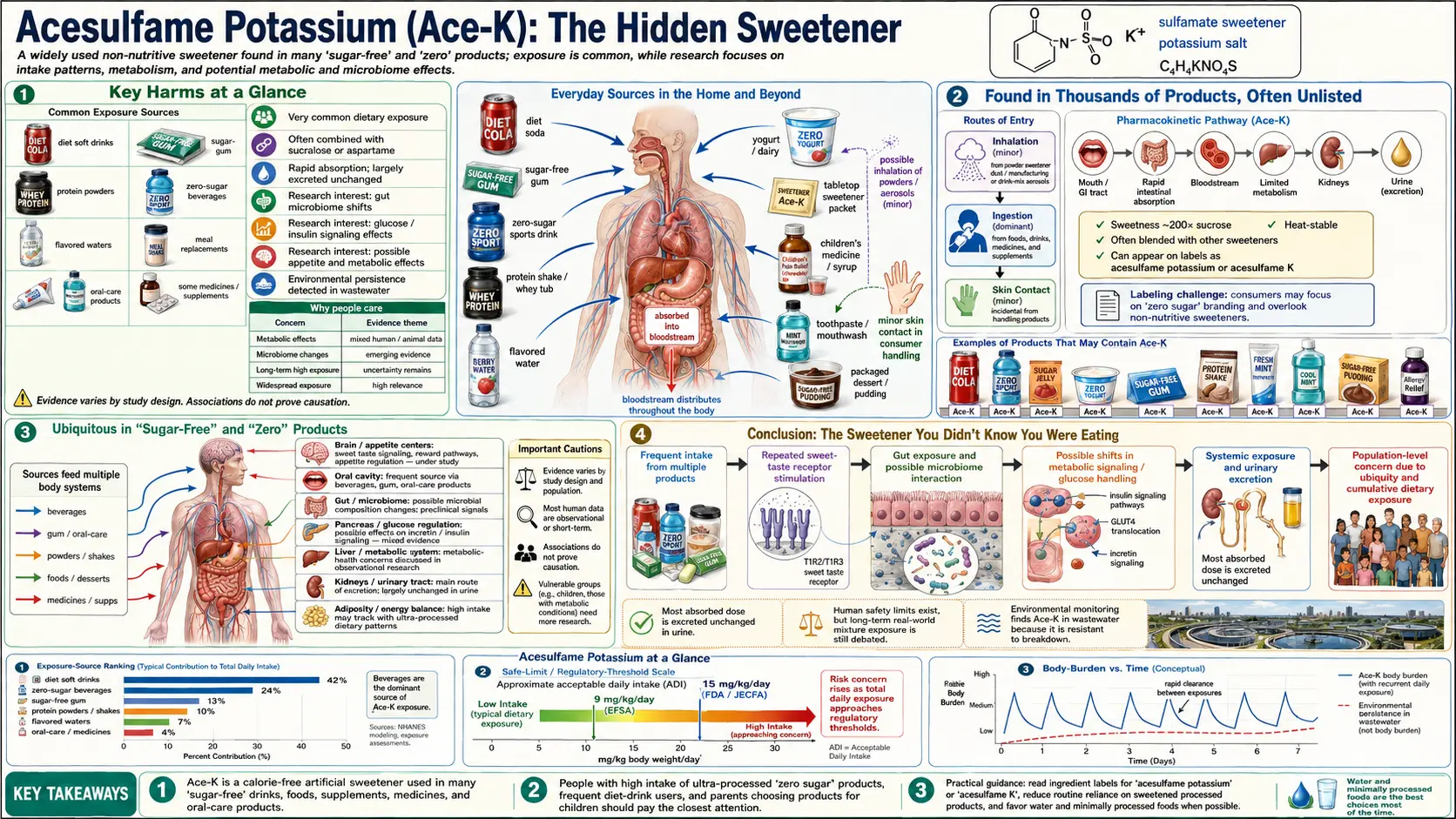
Acesulfame potassium, commonly abbreviated as Ace-K (E 950 in the European Union), is a high-intensity sweetener about 200 times sweeter than sugar. It is used in many diet and “zero” drinks and reduced-sugar foods, usually blended with other sweeteners, so it is less familiar to consumers than the sweeteners it is paired with. The FDA, JECFA and, since its 2025 re-evaluation, the European Food Safety Authority (EFSA) all set its acceptable daily intake at 15 mg/kg body weight. Questions raised about it concern the adequacy of the rodent studies behind its 1988 approval, the solvent used in its manufacture, its transfer to the fetus and to breast milk, mouse studies of the gut microbiome and memory, and cohort associations with cancer and heart disease. No long-term human trial has been carried out. This page sets out what the studies and agencies reported.
Table of Contents
- Key Findings at a Glance
- What Is Acesulfame Potassium?
- Methylene Chloride (Dichloromethane) in Manufacture
- Criticism of the Original Safety Testing
- Where It Is Found
- Thyroid Claims
- Pregnancy and Breastfeeding
- Neurological Findings in Animals
- Long-Term Human Evidence
- Why It Is Widely Used
- The Gut Microbiome Connection
- Safety Thresholds & ADI
- How It Appears on Labels
- Summary
- Key Research Papers
- Connections
- Featured Videos
Key Findings at a Glance
A summary of the main findings and the responses to them. Each is covered in more depth below, with citations in the Key Research Papers section.
- Acceptable daily intake – The FDA and JECFA ADI is 15 mg/kg body weight per day. In its 2025 re-evaluation, the European Food Safety Authority (EFSA) set an ADI of 15 mg/kg, replacing the earlier EU figure of 9 mg/kg.
- Methylene chloride in manufacture – Dichloromethane (methylene chloride) is used as a solvent in the synthesis. EFSA reported dichloromethane in tested samples as below the 1 ppm limit of detection and considered residual solvent unlikely. Its documented human harms come from breathing the solvent, not from food.
- A chlorinated impurity – EFSA identified an in silico genotoxicity concern for one manufacturing impurity, 5-chloro-acesulfame, and recommended a maximum limit of 0.1 mg/kg or appropriate genotoxicity data.
- Criticism of the original testing – A US consumer advocacy group objected in 1988 and 1995 that the long-term rodent cancer studies were inadequate; the FDA denied the objections.
- Placenta and breast milk – Ace-K has been measured in amniotic fluid, cord blood and breast milk. EFSA estimates breast-fed infants’ exposure at 1.6% of the mother’s dose.
- Mouse studies – Ace-K altered the gut microbiome of mice, with body-weight gain in males and not in females (Bian et al., 2017), and 40 weeks of Ace-K impaired memory tests in male mice (Cong et al., 2013).
- NutriNet-Santé cohort – Ace-K intake was associated with cancer (hazard ratio 1.13, 95% CI 1.01 to 1.26) and coronary heart disease (1.40, 1.06 to 1.84). These are observational findings; EFSA rated the human evidence on cancer and cardiovascular disease as low.
What Is Acesulfame Potassium?
Acesulfame potassium is the potassium salt of 6-methyl-1,2,3-oxathiazin-4(3H)-one 2,2-dioxide. Its discovery is usually dated to 1967, at a German chemical company; Clauss and Jensen described the oxathiazinone dioxides as a new group of sweetening agents in 1973. The FDA describes it as about 200 times sweeter than table sugar and approved it in 1988 for specific uses and in 2003 as a general-purpose sweetener.
EFSA’s 2025 re-evaluation reports that Ace-K is almost fully absorbed, is not metabolised and is excreted mainly in urine, with a half-life of 2–4 hours. It is often blended with other sweeteners such as aspartame or sucralose, so people who consume “sugar-free” or “zero” products may take in more than one sweetener at a time.
Methylene Chloride (Dichloromethane) in Manufacture
EFSA’s 2025 re-evaluation states that Ace-K is produced through chemical synthesis in several reaction steps using dichloromethane as a solvent, followed by crystallisation, filtration, recrystallisation and centrifugation. Analyses of dichloromethane in Ace-K samples were reported as below the limit of detection of 1 ppm, and the Panel considered the presence of residual solvents in the product unlikely.
- Cancer classification — IARC classifies dichloromethane as probably carcinogenic to humans (Group 2A; Benbrahim-Tallaa et al., 2014), and the US Environmental Protection Agency’s IRIS assessment (2011) describes it as “likely to be carcinogenic to humans”.
- Consumer and workplace restrictions — In 2019 the EPA prohibited dichloromethane in consumer paint and coating removers because of acute fatalities from exposure, and its April 2024 rule prohibits all consumer uses and most industrial and commercial uses.
- Exposure route — These hazards arise from breathing the solvent, as in paint stripping and coating removal, not from food.
- A related impurity — EFSA notes that a side reaction between sulphur trioxide and dichloromethane can form chlorinating agents that produce the impurity 5-chloro-acesulfame. The EU specifications set a limit of 20 mg/kg for UV-active organic impurities but no limits for individual organic impurities. Based on in silico data, the Panel identified a genotoxicity concern for 5-chloro-acesulfame and recommended a maximum limit of 0.1 mg/kg, or alternatively appropriate genotoxicity data, and recommended that the EU specifications be revised.
Criticism of the Original Safety Testing
The FDA’s 1998 response to objections summarises how the original safety data were judged. The petition included a feeding study in mice and one in rats. The FDA concluded that the mouse study was adequate but the first rat study was inadequate; the petitioner then conducted a second rat study, which the FDA judged adequate, and the agency concluded that the second rat study and the mouse study together showed no association between Ace-K and cancer.
- 1988 objections — A US consumer advocacy group objected to the agency’s conclusions from each of the three long-term rodent studies, sought revocation of the approval, and asked for a public hearing and a stay. In 1992 the FDA concluded that no genuine issues of fact had been raised that would justify a hearing, and denied both the hearing and the stay.
- 1995 objection — The same group objected to the approval of Ace-K in alcoholic beverages, arguing that “technical flaws render several key safety studies inadequate” and that the doses in the second rat study were too low to show that the chemical does not cause cancer, and asked for new long-term cancer studies. In 1998 the FDA overruled the objection, reaffirming that the dosing in that study was appropriate.
- Later testing — The US National Toxicology Program, after a nomination by the same group, fed Ace-K to two strains of genetically modified mice for 40 weeks. It found no neoplasms attributed to Ace-K and no evidence of carcinogenic activity in p53 haploinsufficient mice; it did report a concentration-related increase in micronucleated red blood cells in male, but not female, p53 haploinsufficient mice (National Toxicology Program, 2005).
- EFSA 2025 — EFSA found no new studies suitable for identifying a reference point for adverse effects, and based its ADI on the highest dose tested without adverse effects in a chronic toxicity and carcinogenicity study in rats, a study it considered at moderate risk of bias and one of the two key studies in earlier evaluations.
Where It Is Found
Ace-K is used in many reduced-sugar and “zero” products, often combined with other sweeteners:
- Beverages — Diet and zero-sugar soft drinks and other flavoured drinks, and, in the United States since 1995, alcoholic beverages.
- Sugar-free and “zero” products — Confectionery, yogurt, frozen and refrigerated desserts, and sweet sauces, toppings and syrups.
- Baked goods — The FDA describes Ace-K as heat stable, and approved it in 1994 for baked goods and baking mixes, including frostings, icings and fillings.
- Food supplements — EU rules set separate maximum levels for food supplements in chewable and syrup form. WHO’s 2023 guideline on non-sugar sweeteners does not apply to personal care and hygiene products such as toothpaste, or to medications, that contain them.
Thyroid Claims
Claims that Ace-K disrupts thyroid function in animals could not be tied to a published study. EFSA’s 2025 re-evaluation, which reviewed the animal toxicity data, does not report thyroid effects.
Pregnancy and Breastfeeding
Studies have measured Ace-K reaching the fetus and the breast-fed infant:
- Amniotic fluid and cord blood — Ace-K was present in all 15 cord blood samples tested (maximum 6.5 ng/mL), and 10 of 13 amniotic fluid samples contained at least one non-nutritive sweetener (Halasa et al., 2023). EFSA considered that Ace-K crosses the placenta and enters the fetal circulation.
- Breast milk — In 34 breastfeeding women who drank a 12-ounce diet soda containing 41 mg of Ace-K, Ace-K transferred into breast milk, with a median peak concentration of 945.3 ng/mL (Rother et al., 2018). EFSA estimates the breast-fed infant’s exposure at 1.6% of the mother’s dose.
- Animal findings — Halasa et al. note that in rodents, exposure to non-nutritive sweeteners in the womb has induced metabolic abnormalities, altered offspring gut bacteria and promoted sweet taste preference in adulthood. The authors call for clinical trials of sweetener intake during pregnancy.
- Human outcomes — No randomized trials have evaluated Ace-K during pregnancy. EFSA concluded that it was not possible to conclude whether Ace-K intake is associated with preterm delivery.
Neurological Findings in Animals
Cong et al. (2013, PLOS ONE) gave normal male C57BL/6J mice Ace-K for 40 weeks. The mice showed impaired performance in memory tests (the Morris water maze and a novel object preference test), with no differences in motor function or anxiety. The authors associated this with metabolic changes and altered signalling pathways in hippocampal neurons. Ace-K had a moderate and limited influence on metabolism, altering fasting insulin and leptin levels, pancreatic islet size and lipid levels, without affecting insulin sensitivity or body weight. This was a mouse study, and its relevance to people has not been tested.
Long-Term Human Evidence
No long-term randomized controlled trial has tested Ace-K in people. The human evidence comes from cohort studies and short-term trials:
- Cancer — In the French NutriNet-Santé cohort of 102,865 adults, higher Ace-K intake was associated with increased cancer risk (hazard ratio 1.13, 95% CI 1.01 to 1.26) (Debras et al., 2022, PLOS Medicine).
- Cardiovascular disease — In 103,388 participants of the same cohort, Ace-K was associated with coronary heart disease (hazard ratio 1.40, 95% CI 1.06 to 1.84) (Debras et al., 2022, BMJ). EFSA notes that in this analysis the association of Ace-K with cardiovascular disease overall was not statistically significant (1.18, 0.98 to 1.41).
- EFSA’s weighing — Reviewing 13 human studies, EFSA rated the level of evidence for an effect on cancer and on cardiovascular risk factors and disease as low. Integrating human and animal evidence, it concluded that Ace-K intake is unlikely to be associated with cancer, disturbed glucose or insulin homeostasis, or cardiovascular disease.
- Exposure — EFSA found that the highest estimates of exposure were generally below the ADI in all population groups.
Why It Is Widely Used
Several properties make Ace-K useful to food manufacturers:
- Heat stability — The FDA describes Ace-K as heat stable, unlike aspartame, which loses its sweetness when heated.
- Stability in solution — EFSA found Ace-K stable under various conditions; at a pH below 3, with increasing temperature, it is partly degraded.
- Blending — It is frequently combined with other sweeteners to give a more sugar-like taste.
- Intensity — At about 200 times the sweetness of sugar, small amounts are needed.
The Gut Microbiome Connection
Bian et al. (2017, PLOS ONE) found that Ace-K perturbed the gut microbiome of CD-1 mice after four weeks of treatment. The body-weight gain, shifts in the gut bacterial community, enrichment of bacterial genes related to energy metabolism and faecal metabolomic changes were, in the authors’ words, “highly gender-specific”: Ace-K increased body-weight gain in male mice but not in female mice.
The study was in mice over four weeks; whether Ace-K has the same effects on the human gut microbiome was not tested.
Safety Thresholds & ADI
- FDA ADI — 15 mg/kg body weight/day.
- JECFA ADI — 0–15 mg/kg body weight/day, set in 1991 from a long-term rat study; JECFA’s first ADI, in 1983, was 0–9 mg/kg, based on a 2-year dog study.
- EFSA ADI — 15 mg/kg body weight/day, established in the 2025 re-evaluation and replacing the 9 mg/kg ADI set by the EU Scientific Committee on Food.
- WHO 2023 guideline — A conditional recommendation against using non-sugar sweeteners for weight control, based on low-certainty evidence; it does not apply to people with pre-existing diabetes and is not a toxicological assessment.
How It Appears on Labels
- In ingredient lists it appears as “acesulfame potassium”, “acesulfame K” or “Ace-K”, and in the European Union as E 950.
- It is often listed together with aspartame or sucralose, because the sweeteners are commonly blended.
- In the EU, a salt of aspartame and acesulfame is authorised separately as E 962.
Summary
Acesulfame potassium was approved in the United States in 1988 on the basis of rodent studies that a consumer advocacy group challenged and the FDA defended. Regulators have since kept or raised its ADI: EFSA’s 2025 re-evaluation set it at 15 mg/kg body weight per day, in line with the FDA and JECFA, while recommending tighter specifications for impurities. No long-term human trial exists. Cohort studies report modest associations with cancer and coronary heart disease (hazard ratios of about 1.1 to 1.4) from a design that cannot separate the sweetener from the reasons people choose it, and EFSA rated that evidence as low. Mouse studies report sex-specific microbiome and weight effects and memory impairment that have not been tested in people. Dichloromethane is used in manufacture, but its documented harms come from inhalation, and residues in tested samples were below the limit of detection. WHO’s 2023 guideline concerns weight control: it concludes that non-sugar sweeteners do not confer long-term benefit in reducing body fat. Questions about sweeteners and an individual’s health belong with a clinician.
Key Research Papers
The papers and regulatory documents behind the statements on this page. Links resolve to PubMed records, publisher DOIs, or the originating regulatory body.
Animal, Human and Exposure Studies
- Bian X, Chi L, Gao B, Tu P, Ru H, Lu K. The artificial sweetener acesulfame potassium affects the gut microbiome and body weight gain in CD-1 mice. PLoS One. 2017;12(6):e0178426. Effects were sex-specific; weight gain occurred in males, not females. — PubMed PMID: 28594855
- Debras C, Chazelas E, Srour B, et al. Artificial sweeteners and cancer risk: results from the NutriNet-Santé population-based cohort study. PLoS Medicine. 2022;19(3):e1003950. Acesulfame-K hazard ratio 1.13 (95% CI 1.01 to 1.26). — PubMed PMID: 35324894
- Debras C, Chazelas E, Sellem L, et al. Artificial sweeteners and risk of cardiovascular diseases: results from the prospective NutriNet-Santé cohort. BMJ. 2022;378:e071204. Acesulfame potassium and coronary heart disease, hazard ratio 1.40 (95% CI 1.06 to 1.84). — PubMed PMID: 36638072
- World Health Organization. Use of non-sugar sweeteners: WHO guideline. 2023. Advises against non-sugar sweeteners as a means of weight control. — WHO guideline
- Cong WN, Wang R, Cai H, et al. Long-term artificial sweetener acesulfame potassium treatment alters neurometabolic functions in C57BL/6J mice. PLoS One. 2013;8(8):e70257. — PubMed PMID: 23950916
- Halasa BC, Sylvetsky AC, Conway EM, et al. Non-nutritive sweeteners in human amniotic fluid and cord blood: evidence of transplacental fetal exposure. Am J Perinatol. 2023;40(12):1286-1291. — PubMed PMID: 34500483
- Rother KI, Sylvetsky AC, Walter PJ, Garraffo HM, Fields DA. Pharmacokinetics of sucralose and acesulfame-potassium in breast milk following ingestion of diet soda. J Pediatr Gastroenterol Nutr. 2018;66(3):466-470. — PubMed PMID: 29077645
- National Toxicology Program. NTP toxicology studies of acesulfame potassium (CAS No. 55589-62-3) in genetically modified (FVB Tg.AC hemizygous) mice and carcinogenicity studies of acesulfame potassium in genetically modified [B6.129-Trp53(tm1Brd) (N5) haploinsufficient] mice (feed studies). Natl Toxicol Program Genet Modif Model Rep. 2005;(2):1-113. — PubMed PMID: 18784762
- Clauss K, Jensen H. Oxathiazinone dioxides — a new group of sweetening agents. Angew Chem Int Ed Engl. 1973;12(11):869-876. — doi:10.1002/anie.197308691
Regulatory Assessments
- EFSA Panel on Food Additives and Flavourings (FAF). Re-evaluation of acesulfame K (E 950) as food additive. EFSA J. 2025;23(4):e9317. — PubMed PMID: 40309404
- US Food and Drug Administration. Food additives permitted for direct addition to food for human consumption; acesulfame potassium. Final rule; response to objection. Federal Register. 1998;63(128):36362-36365. — govinfo 98-17701
- FDA — Aspartame and Other Sweeteners in Food (includes acesulfame potassium).
- Benbrahim-Tallaa L, Lauby-Secretan B, Loomis D, et al. Carcinogenicity of perfluorooctanoic acid, tetrafluoroethylene, dichloromethane, 1,2-dichloropropane, and 1,3-propane sultone. Lancet Oncol. 2014;15(9):924-925. — PubMed PMID: 25225686
- US Environmental Protection Agency. Integrated Risk Information System: dichloromethane (2011). — EPA IRIS
- US Environmental Protection Agency. Risk management for methylene chloride. — EPA TSCA page
PubMed Topic Searches
Live queries for further reading.
- PubMed: Acesulfame potassium safety
- PubMed: Acesulfame K and the gut microbiome
- PubMed: Placental transfer
- PubMed: Breast milk
- PubMed: Methylene chloride in occupational cohorts
- PubMed: Residual solvent limits in food additives
- PubMed: Sweeteners and glucose tolerance
- PubMed: Sweeteners and weight loss trials
- PubMed: Sweeteners and thyroid function
- PubMed: Reverse causation in diet-beverage cohorts