Yellow 5 (Tartrazine): Allergies, ADHD, and Controversy
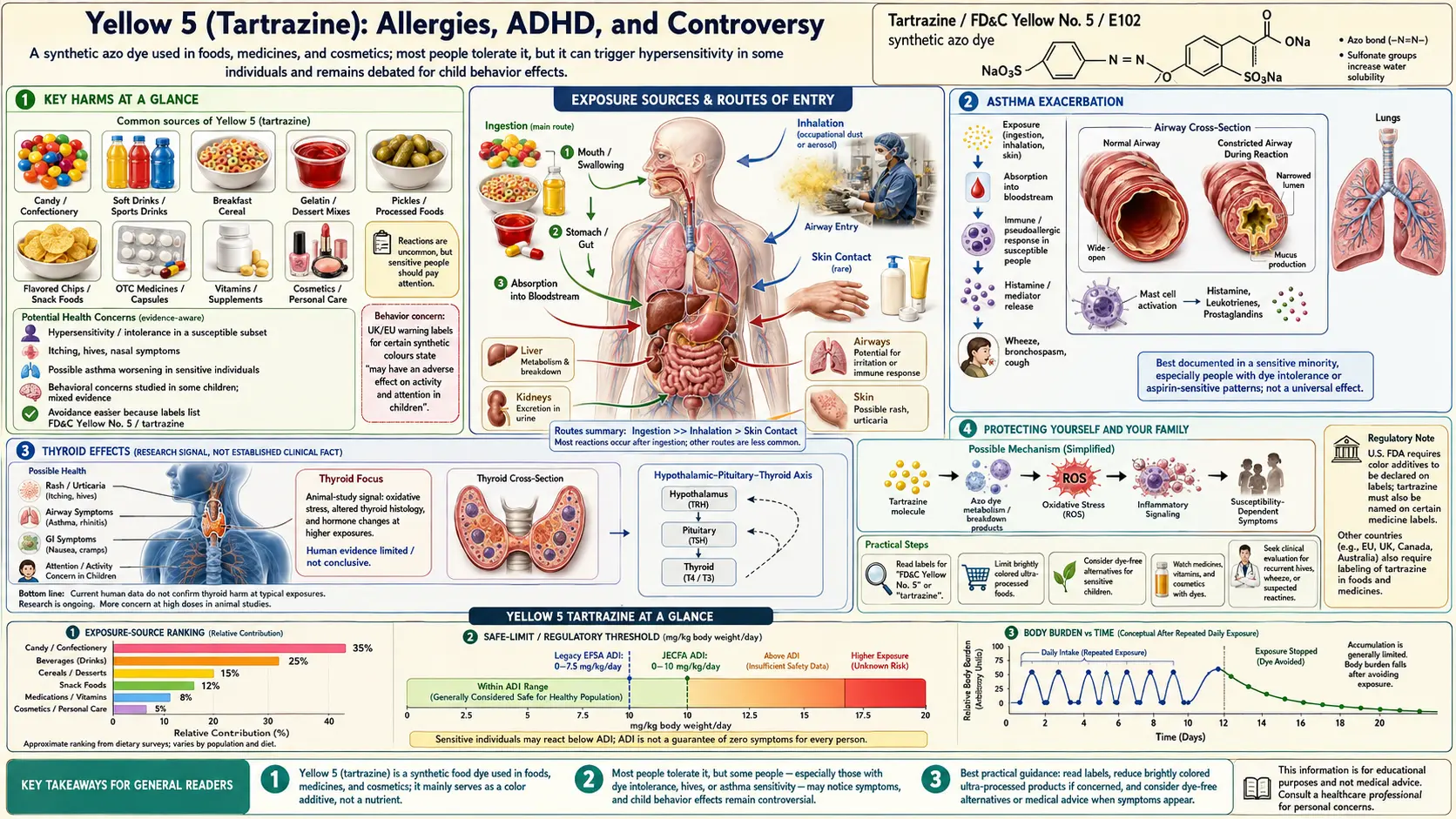
Yellow 5, known chemically as tartrazine and designated E102 in Europe, is a synthetic azo dye that gives a lemon-yellow colour to foods, drinks, medicines and cosmetics. In the United States it is listed as FD&C Yellow No. 5, every batch must be certified by FDA, and it is one of the six remaining synthetic dyes that HHS and FDA announced in April 2025 they would work with industry to remove from the food supply. Tartrazine sensitivity is described in FDA’s required drug-label statement as low in the general population but frequently seen in people with aspirin hypersensitivity; controlled challenge studies have found confirmed reactions to be uncommon. The 2007 Southampton trial, in which tartrazine was one of the colours tested together with a preservative, led the European Union to require a label stating that the colour “may have an adverse effect on activity and attention in children.” Laboratory genotoxicity results are mixed, and certified batches have been found to contain traces of combined benzidine, a known human carcinogen, as a manufacturing impurity. Older lists describe tartrazine as banned in Norway and Austria; both countries apply the EU food-additive regulation, under which tartrazine is authorised with the warning label.
Table of Contents
- Key Findings at a Glance
- Chemical Structure and Properties
- Common Products Containing Yellow 5 (Exposure Routes)
- Aspirin Sensitivity and Tartrazine
- Asthma
- Urticaria and Skin Reactions
- Hyperactivity in Children
- Genotoxicity Research
- Thyroid and Hormone Research
- Benzidine Contamination
- International Regulatory Status
- Safety Thresholds & ADI
- Information for People Sensitive to Tartrazine
- Key Research Papers
- Connections
- Featured Videos
Key Findings at a Glance
- Aspirin sensitivity – US drug labels must state that tartrazine sensitivity, though low in the general population, “is frequently seen in patients who also have aspirin hypersensitivity” (21 CFR 201.20). In a double-blind multicentre study of 156 people with aspirin-induced asthma, 4 reacted (about 2.6%) (Virchow 1988).
- Asthma – A Cochrane review of six randomized trials found that in none of them did tartrazine challenge or avoidance significantly alter asthma outcomes (Ardern 2001).
- Hyperactivity in children – The 2007 Southampton trial (McCann, The Lancet) tested colour mixes given with sodium benzoate; the EU warning label followed. FDA states that most children have no adverse effects but some may be sensitive.
- Urticaria – Among 102 people who reported hives or swelling after tartrazine-containing food, a double-blind challenge reproduced a reaction in one (1%) (Nettis 2003).
- Benzidine – FDA limits free benzidine to 1 part per billion; a 1993 FDA analysis found combined benzidine in 25 of 53 certified batches (Prival 1993). IARC classifies benzidine as carcinogenic to humans (Group 1).
- Norway and Austria – No current ban found: both apply EU Regulation (EC) No 1333/2008, which authorises E102 with the warning label.
- ADI – JECFA 0–10 mg/kg body weight/day (2016); EFSA 7.5 mg/kg (confirmed 2009); FDA 5 mg/kg, as reported in a 2024 review.
Chemical Structure and Properties
FDA’s listing regulation describes FD&C Yellow No. 5 as principally the trisodium salt of 4,5-dihydro-5-oxo-1-(4-sulfophenyl)-4-[4-sulfophenyl-azo]-1H-pyrazole-3-carboxylic acid (CAS 1934-21-0) (21 CFR 74.705). PubChem gives its molecular formula as C16H9N4Na3O9S2.
- Chemical class: A pyrazolone azo dye; the nitrogen–nitrogen double bond (N=N) of the azo group links the two halves of the molecule
- Manufacture: Under 21 CFR 74.705, 4-aminobenzenesulfonic acid (sulfanilic acid) is diazotized with hydrochloric acid and sodium nitrite and coupled with a sulfophenyl pyrazolone carboxylic acid (or its methyl or ethyl ester or a salt); the dye is purified and isolated as the sodium salt. The April 2025 HHS/FDA announcement groups it with the other “petroleum-based synthetic dyes”
- Specifications: The regulation sets limits for named impurities, including 4-aminobiphenyl (5 ppb), aniline (100 ppb), benzidine (1 ppb), lead (10 ppm), arsenic (3 ppm) and mercury (1 ppm), and requires a total colour content of at least 87 percent
- Metabolism: According to EFSA’s summary of earlier assessments, less than 5% of tartrazine is typically absorbed, and absorbed tartrazine is mainly excreted unchanged in urine. The unabsorbed portion is reduced by gut bacteria; small amounts of metabolites such as sulfanilic acid, a pyrazolone metabolite (SCAP) and aniline derivatives are absorbed and excreted in urine (EFSA FEEDAP 2024)
Common Products Containing Yellow 5
FDA lists the typical food uses of FD&C Yellow No. 5 as confections, cereals, snack foods, beverages, condiments, baked goods and yogurt. It is also permitted in drugs and cosmetics.
- Foods and dietary supplements: 21 CFR 74.705 permits it for colouring foods, including dietary supplements, in amounts consistent with good manufacturing practice, except in standardized foods whose standards do not allow added colour
- Commonly cited examples: Product lists often name some citrus soft drinks and sports drinks, candies, brightly coloured breakfast cereals, cheese-flavoured snack foods and boxed macaroni and cheese; formulations vary by product and market, and only the ingredient list shows whether a particular product contains it
- Butter, cheese and ice cream: The regulation names these foods specifically, requiring that they declare FD&C Yellow No. 5 in the ingredient list when they contain it
- Medicines: Over-the-counter and prescription drugs taken by mouth, nasally, rectally or vaginally, or used around the eye, must name “FD&C Yellow No. 5 (tartrazine)” on the label when they contain it (21 CFR 201.20)
- Cosmetics: 21 CFR 74.2705 permits it in cosmetics generally, including cosmetics used around the eye
Aspirin Sensitivity and Tartrazine
Allergic reactions to tartrazine were reported as early as 1959, in a paper on the dye’s use as a colouring agent in steroid tablets (Lockey 1959). A link with aspirin intolerance was then studied in a series of oral challenge studies, which reached different conclusions.
- US drug-label statement: Prescription drugs containing it must carry the warning that it “may cause allergic-type reactions (including bronchial asthma) in certain susceptible persons. Although the overall incidence of FD&C Yellow No. 5 (tartrazine) sensitivity in the general population is low, it is frequently seen in patients who also have aspirin hypersensitivity” (21 CFR 201.20)
- Studies reporting cross-reactivity: In 140 people with asthma challenged with aspirin and/or tartrazine, about a quarter reacted to one of the two (a fall in peak flow of more than 20%); cross-reactivity was statistically significant, and most people who reacted to tartrazine were also sensitive to aspirin (Stenius 1976). In chronic urticaria, a double-blind challenge found tartrazine sensitivity in 2 of 10 patients with aspirin intolerance (Settipane 1976)
- Studies finding reactions rare: In a multicentre study of 156 German, Italian and Polish patients with confirmed aspirin-induced asthma, 4 (all Polish) reacted under double-blind conditions, about 2.6%; 65 who tolerated 25 mg went on to receive 50–3,000 mg with no adverse reactions (Virchow 1988). In 47 patients with asthma and analgesic intolerance, 5 of 141 tartrazine challenges were positive, in 4 patients, and 3 of those were negative when repeated; the authors suggested that the clinical lability of these patients could explain some reactions attributed to tartrazine (Morales 1985). A 2024 review describes the earlier reports of cross-reactivity as later refuted (Amchova 2024)
- Mechanism: Aspirin and other anti-inflammatory drugs inhibit cyclooxygenase, but tartrazine did not inhibit cyclooxygenase in sheep, guinea-pig or human platelet preparations (Gerber 1979) or prostaglandin synthesis in human and rat platelets (Vargaftig 1980). Both groups concluded that any cross-sensitivity is unlikely to work through prostaglandin inhibition
- Reported symptoms: The challenge studies measured falls in lung function; other studies describe urticaria and angioedema (see below)
Asthma
A 2001 Cochrane review searched for randomized trials of tartrazine challenge or tartrazine-free diets in asthma. Six trials met its criteria, only three reported results in a form that could be analysed, and none could be combined; in none of them did tartrazine challenge or avoidance significantly alter asthma outcomes. The reviewers concluded that firm conclusions were not possible and that “routine tartrazine exclusion may not benefit most patients, except those very few individuals with proven sensitivity” (Ardern 2001). In a study of 28 people with chronic asthma, one responded to a double-blind tartrazine challenge, and a month on a tartrazine- and benzoate-free diet brought no improvement, including in those who had reacted to challenge (Tarlo 1982). In ten children whose cough or wheeze had followed orange drinks, 1 mg of tartrazine given double blind did not change baseline lung function, but airway sensitivity to inhaled histamine increased significantly in four (Hariparsad 1984). Challenge studies in people with aspirin-induced asthma are described in the previous section.
Urticaria (Hives) and Skin Reactions
- Chronic urticaria: In 38 patients with chronic urticaria of unknown cause, a double-blind challenge with 0.22 mg of tartrazine found sensitivity in 3 (8%) (Settipane 1976)
- Acute urticaria and angioedema: Among 102 people referred after hives or swelling following a meal or product containing tartrazine, a double-blind placebo-controlled challenge reproduced a reaction in one (1%); the authors suggested that other possible causes be evaluated as well (Nettis 2003)
- Purpura: Case reports describe purpuric skin reactions; in one, flares of progressive pigmented purpura in a patient with hepatitis C and cryoglobulinemia were triggered by tartrazine-containing food on controlled oral challenge (Kalinke 1999)
- Skin and airway sensitisation in handling: In assessing tartrazine as an animal-feed additive, EFSA’s feed panel concluded that the additive should be considered a dermal and respiratory sensitiser for people handling it (EFSA FEEDAP 2024)
Hyperactivity in Children
The 2007 Southampton trial (McCann et al., The Lancet) was a randomised, double-blinded, placebo-controlled crossover trial in 153 three-year-olds and 144 eight- and nine-year-olds from the general population. Children received a drink containing sodium benzoate and one of two artificial-colour mixes, or a placebo; a 2025 review lists one mix as containing tartrazine (E102) with sunset yellow, carmoisine and ponceau 4R (Visternicu 2025). Mix A had a significant adverse effect on a global hyperactivity score in the three-year-olds (effect size 0.20); in the older children who drank at least 85% of the drinks, both mixes did (0.12 and 0.17). The authors concluded that “artificial colours or a sodium benzoate preservative (or both)” increase hyperactivity in children in the general population; because every active drink contained sodium benzoate, the trial cannot attribute the effect to any single colour. Regulation (EC) No 1333/2008 then required foods containing tartrazine and five other colours to state that the colour “may have an adverse effect on activity and attention in children,” from 20 July 2010.
- Earlier Southampton study: In 277 three-year-olds, a one-week diet free of artificial colours and benzoate reduced hyperactive behaviour, and parents rated behaviour as more hyperactive during an active challenge (20 mg colours and 45 mg sodium benzoate daily) than during placebo; clinic testing found no difference (Bateman 2004)
- Meta-analyses: Fifteen trials in children with hyperactive syndromes gave an overall effect size of 0.283, falling to 0.210 when the smallest and lowest-quality trials were excluded (Schab 2004). A 2012 meta-analysis found a small effect in parent reports (g = 0.18, falling to 0.12 after adjustment for publication bias) that was not reliable in studies confined to FDA-approved colours, and estimated that 8% of children with ADHD may have symptoms related to synthetic food colours (Nigg 2012)
- FDA’s position: FDA’s consumer page states that “the totality of scientific evidence indicates that most children have no adverse effects when consuming foods containing color additives, but some evidence suggests that certain children may be sensitive to them”
- Mechanism: No mechanism has been established in humans; a 2025 review of cell and animal studies notes that children may be particularly vulnerable because of higher consumption of yellow- and orange-coloured foods (Visternicu 2025)
Genotoxicity Research
Laboratory studies of whether tartrazine damages DNA have produced mixed results, and the regulatory assessments have changed as newer guideline studies were added.
- Mouse comet assay: A single oral dose caused dose-related DNA damage in the colon and other gastrointestinal organs of mice, at doses close to the ADI in the colon (Sasaki 2002). A later mouse study found no genotoxic effect in the gut micronucleus test at doses up to 2,000 mg/kg and suggested that the earlier transient comet-assay damage did not become stable lesions (Poul 2009)
- Guideline studies: EFSA had expressed concern about possible genotoxicity based mainly on one study not conducted to guidelines. An OECD-guideline study requested in response, by authors from a colour-industry association, industry companies and a contract laboratory, found no genotoxic activity in the bone-marrow micronucleus assay or the comet assay in liver, stomach and colon; JECFA reviewed these data in 2016 and concluded there was no genotoxicity concern (Bastaki 2017). EFSA’s 2024 feed-additive opinion summarises the earlier assessments as finding tartrazine neither carcinogenic nor genotoxic (EFSA FEEDAP 2024)
- Human lymphocytes in the laboratory: Cultured human lymphocytes showed DNA damage on the comet assay at all concentrations tested (0.25–64 mM) (Soares 2015) and increased chromosomal aberrations and micronuclei at the higher concentrations (Atlı Şekeroğlu 2017); another study found no genotoxicity on sister-chromatid exchange but reported that the dye binds DNA and was toxic to the cells at higher concentrations (Mpountoukas 2010)
- Rats: In a study of five permitted additives, rats given ten times the ADI of tartrazine daily for 60 days showed DNA damage on the comet assay in liver and kidney (Abo-El-Sooud 2018)
- Oxidative stress: A 2025 review of cell and animal studies reports increasing evidence that tartrazine can induce oxidative stress, while stating that the evidence remains inconclusive (Visternicu 2025)
- Overall reading: A 2024 review concluded that the genotoxic effect appears at high doses only and is not of concern at dietary exposure levels below the ADI (Amchova 2024)
Thyroid and Hormone Research
Research on tartrazine and hormones is at the laboratory and computer-modelling stage.
- Oestrogen receptor: In a human breast-cancer cell line, tartrazine activated the human oestrogen receptor alpha, with a half-maximal concentration of 160 nM (Axon 2012)
- Computer modelling: A 2026 in silico study predicted possible activity at several nuclear receptors, including thyroid hormone receptors, and noted that individual studies have reported oestrogenic, androgenic and thyroid effects; the authors called for systematic endocrine testing (Hoang 2026)
- Human data: None of these is a human study
Benzidine Contamination
Benzidine is classified by the International Agency for Research on Cancer (IARC) as carcinogenic to humans (Group 1). It is not part of the tartrazine molecule but can occur as a manufacturing impurity, either free or chemically bound in other dye compounds (“combined” benzidine), which can be released by chemical reduction.
- FDA specification: Certified FD&C Yellow No. 5 may contain no more than 1 part per billion of benzidine (21 CFR 74.705)
- US testing: Of 53 batches submitted to FDA for certification in 1990–1991, 25 contained 7–83 ng/g of combined benzidine released by reduction; 23 of the 25 came from the same manufacturer (Prival 1993)
- Canadian testing: Total benzidine in tartrazine and sunset yellow samples ranged from below 5 to 270 ng/g, similar to levels reported in US studies (Lancaster 1999)
- Gut metabolism: The main metabolites of tartrazine itself are sulfanilic acid and a pyrazolone compound (EFSA FEEDAP 2024)
International Regulatory Status
- United States: Listed for food (21 CFR 74.705); every batch must be certified by FDA, and foods must declare it as “FD&C Yellow No. 5” in the ingredient list. No warning is required on food. Drug labels must name it, and prescription drugs must carry the allergic-reaction statement (21 CFR 201.20). In April 2025 HHS and FDA announced work with industry to eliminate it and five other synthetic dyes from the food supply by the end of 2026; FDA’s chemical-review list (updated 2 October 2026) shows it under a “risk management action,” and it remains a listed color additive
- European Union: Authorised as E102. Since 20 July 2010, foods containing it must state the colour’s name or E number followed by “may have an adverse effect on activity and attention in children” (Regulation (EC) No 1333/2008, Article 24 and Annex V). The annex exempts colours used for health marking of meat or for stamping or decorating eggshells, and drinks containing more than 1.2% alcohol
- Norway and Austria: Often listed as banning tartrazine; no current ban was found. Norway applies Regulation (EC) No 1333/2008 through the EEA Agreement (EEA Joint Committee Decision 050/2011), and Austria has been an EU member state since 1995, so the EU authorisation and warning label apply in both
- United Kingdom: Authorised with the same warning. The Food Standards Agency states that it encourages manufacturers to work towards finding alternatives to the six colours and that some manufacturers and retailers have already removed them
- Canada: On Health Canada’s List of Permitted Colouring Agents
Safety Thresholds & ADI
- JECFA – In 2016 JECFA withdrew its earlier ADI of 0–7.5 mg/kg body weight/day and set 0–10 mg/kg, based on reduced body weight in a chronic rat study (EFSA FEEDAP 2024).
- EFSA (2009 re-evaluation) – Confirmed the existing ADI of 7.5 mg/kg body weight/day; in 2013 EFSA found no reason to revise it. Conservative intake estimates (8.1 mg/kg in adults, 13.1 mg/kg in children) exceeded the ADI, while estimates based on maximum reported use levels were below it (Amchova 2024).
- Intolerance at intakes within the ADI – According to a 2025 review, EFSA noted that a fraction of the population may develop intolerance reactions at ADI levels (Visternicu 2025).
- FDA – An ADI of 5 mg/kg body weight/day, confirmed in 2011, as reported in a 2024 review (Amchova 2024); foods must declare it by name, and drug labels carry an additional statement (21 CFR 74.705, 201.20).
- EU warning label (Regulation 1333/2008) – “May have an adverse effect on activity and attention in children.” The label is set by the regulation, not by the EFSA opinion.
Information for People Sensitive to Tartrazine
- Label names: In the US the ingredient list must name it (“FD&C Yellow No. 5”, or an abbreviated name such as “Yellow 5”, which FDA’s consumer page lists as acceptable for certified colours); in the EU and UK it appears as tartrazine or E102, with the warning label
- Medicines: US labels of drugs taken by mouth, nasally, rectally or vaginally, or used around the eye, must state that they contain “FD&C Yellow No. 5 (tartrazine)” (21 CFR 201.20)
- Confirmed sensitivity is uncommon: Double-blind challenges reproduced reactions in about 2.6% of people with aspirin-induced asthma (Virchow 1988) and 1% of people with suspected tartrazine-induced urticaria (Nettis 2003)
- Exclusion diets in asthma: The Cochrane reviewers concluded that routine tartrazine exclusion may not benefit most patients, except the very few with proven sensitivity (Ardern 2001); Morales and colleagues concluded that colour-free diets were not justified unless a challenge test had been positive on at least two occasions (Morales 1985)
- Restriction diets in ADHD: A meta-analysis found that restriction diets reduced ADHD symptoms (g = 0.29) (Nigg 2012)
- Other yellow colours: A 2024 review lists turmeric, carotenoids, annatto, saffron and paprika extracts as natural alternatives (Amchova 2024); FDA’s consumer page gives annatto extract and beta-carotene as examples of colours exempt from batch certification, which still require FDA approval
- FDA’s consumer guidance states that parents who wish to limit color additives in their children’s diet may check the ingredient list on labels. Questions about individual reactions or medicines belong with a clinician.
Key Research Papers
- McCann D, Barrett A, Cooper A, et al. (2007). Food additives and hyperactive behaviour in 3-year-old and 8/9-year-old children in the community: a randomised, double-blinded, placebo-controlled trial. The Lancet 370(9598):1560-1567 — PubMed PMID: 17825405 (Southampton Study)
- EFSA Panel on Food Additives and Nutrient Sources Added to Food (2009). Scientific Opinion on the re-evaluation Tartrazine (E 102). EFSA Journal 7(11):1331 — doi:10.2903/j.efsa.2009.1331 (full text not retrieved for this review; its conclusions are stated here as summarised in EFSA FEEDAP 2024 and Amchova 2024)
- Bateman B, Warner JO, Hutchinson E, et al. (2004). The effects of a double blind, placebo controlled, artificial food colourings and benzoate preservative challenge on hyperactivity in a general population sample of preschool children. Archives of Disease in Childhood 89(6):506-511 — PubMed PMID: 15155391
- Schab DW, Trinh NH (2004). Do artificial food colors promote hyperactivity in children with hyperactive syndromes? A meta-analysis of double-blind placebo-controlled trials. Journal of Developmental and Behavioral Pediatrics 25(6):423-434 — PubMed PMID: 15613992
- Nigg JT, Lewis K, Edinger T, Falk M (2012). Meta-analysis of attention-deficit/hyperactivity disorder or attention-deficit/hyperactivity disorder symptoms, restriction diet, and synthetic food color additives. Journal of the American Academy of Child and Adolescent Psychiatry 51(1):86-97.e8 — PubMed PMID: 22176942
- Lockey SD (1959). Allergic reactions due to F D and C Yellow No. 5, tartrazine, an aniline dye used as a coloring and identifying agent in various steroids. Annals of Allergy 17:719-721 — PubMed PMID: 14417794
- Stenius BS, Lemola M (1976). Hypersensitivity to acetylsalicylic acid (ASA) and tartrazine in patients with asthma. Clinical Allergy 6(2):119-129 — PubMed PMID: 1277437
- Settipane GA, Chafee FH, Postman IM, et al. (1976). Significance of tartrazine sensitivity in chronic urticaria of unknown etiology. The Journal of Allergy and Clinical Immunology 57(6):541-546 — PubMed PMID: 777074
- Gerber JG, Payne NA, Oelz O, et al. (1979). Tartrazine and the prostaglandin system. The Journal of Allergy and Clinical Immunology 63(4):289-294 — PubMed PMID: 429706
- Vargaftig BB, Bessot JC, Pauli G (1980). Is tartrazine-induced asthma related to inhibition of prostaglandin biosynthesis? Respiration 39(5):276-282 — PubMed PMID: 7414107
- Tarlo SM, Broder I (1982). Tartrazine and benzoate challenge and dietary avoidance in chronic asthma. Clinical Allergy 12(3):303-312 — PubMed PMID: 7105394
- Hariparsad D, Wilson N, Dixon C, Silverman M (1984). Oral tartrazine challenge in childhood asthma: effect on bronchial reactivity. Clinical Allergy 14(1):81-85 — PubMed PMID: 6365354
- Morales MC, Basomba A, Pelaez A, et al. (1985). Challenge tests with tartrazine in patients with asthma associated with intolerance to analgesics (ASA-Triad). A comparative study with placebo. Clinical Allergy 15(1):55-59 — PubMed PMID: 3978777
- Virchow C, Szczeklik A, Bianco S, et al. (1988). Intolerance to tartrazine in aspirin-induced asthma: results of a multicenter study. Respiration 53(1):20-23 — PubMed PMID: 3387687
- Ardern KD, Ram FS (2001). Tartrazine exclusion for allergic asthma. Cochrane Database of Systematic Reviews (4):CD000460 — PubMed PMID: 11687081
- Nettis E, Colanardi MC, Ferrannini A, Tursi A (2003). Suspected tartrazine-induced acute urticaria/angioedema is only rarely reproducible by oral rechallenge. Clinical and Experimental Allergy 33(12):1725-1729 — PubMed PMID: 14656361
- Kalinke DU, Wüthrich B (1999). [Purpura pigmentosa progressiva in type III cryoglobulinemia and tartrazine intolerance. A follow-up over 20 years]. Der Hautarzt 50(1):47-51 (in German) — PubMed PMID: 10068932
- Sasaki YF, Kawaguchi S, Kamaya A, et al. (2002). The comet assay with 8 mouse organs: results with 39 currently used food additives. Mutation Research 519(1-2):103-119 — PubMed PMID: 12160896
- Poul M, Jarry G, Elhkim MO, Poul JM (2009). Lack of genotoxic effect of food dyes amaranth, sunset yellow and tartrazine and their metabolites in the gut micronucleus assay in mice. Food and Chemical Toxicology 47(2):443-448 — PubMed PMID: 19095036
- Mpountoukas P, Pantazaki A, Kostareli E, et al. (2010). Cytogenetic evaluation and DNA interaction studies of the food colorants amaranth, erythrosine and tartrazine. Food and Chemical Toxicology 48(10):2934-2944 — PubMed PMID: 20667460
- Soares BM, Araújo TM, Ramos JA, et al. (2015). Effects on DNA repair in human lymphocytes exposed to the food dye tartrazine yellow. Anticancer Research 35(3):1465-1474 — PubMed PMID: 25750299
- Atlı Şekeroğlu Z, Güneş B, Kontaş Yedier S, et al. (2017). Effects of tartrazine on proliferation and genetic damage in human lymphocytes. Toxicology Mechanisms and Methods 27(5):370-375 — PubMed PMID: 28264634
- Bastaki M, Farrell T, Bhusari S, et al. (2017). Lack of genotoxicity in vivo for food color additive Tartrazine. Food and Chemical Toxicology 105:278-284 — PubMed PMID: 28454783
- Abo-El-Sooud K, Hashem MM, Badr YA, et al. (2018). Assessment of hepato-renal damage and genotoxicity induced by long-term exposure to five permitted food additives in rats. Environmental Science and Pollution Research International 25(26):26341-26350 — PubMed PMID: 29981020
- Axon A, May FE, Gaughan LE, et al. (2012). Tartrazine and sunset yellow are xenoestrogens in a new screening assay to identify modulators of human oestrogen receptor transcriptional activity. Toxicology 298(1-3):40-51 — PubMed PMID: 22562034
- Hoang NM, Park K (2026). Integrated approaches to testing and assessment for the endocrine disrupting activity of tartrazine based on adverse outcome pathways and OECD frameworks. Food and Chemical Toxicology 208:115867 — PubMed PMID: 41297657
- Prival MJ, Peiperl MD, Bell SJ (1993). Determination of combined benzidine in FD & C yellow no. 5 (tartrazine), using a highly sensitive analytical method. Food and Chemical Toxicology 31(10):751-758 — PubMed PMID: 8225134
- Lancaster FE, Lawrence JF (1999). Determination of benzidine in the food colours tartrazine and sunset yellow FCF, by reduction and derivatization followed by high-performance liquid chromatography. Food Additives and Contaminants 16(9):381-390 — PubMed PMID: 10755129
- Amchova P, Siska F, Ruda-Kucerova J (2024). Safety of tartrazine in the food industry and potential protective factors. Heliyon 10(18):e38111 — PubMed PMID: 39381230
- EFSA Panel on Additives and Products or Substances used in Animal Feed (FEEDAP), Villa RE, Azimonti G, et al. (2024). Safety and efficacy of a feed additive consisting of tartrazine for its use in baits for freshwater fish (GIFAP). EFSA Journal 22(10):e9021 — PubMed PMID: 39478975
- Visternicu M, Săvucă A, Rarinca V, et al. (2025). Toxicological Effects of Tartrazine Exposure: A Review of In Vitro and Animal Studies with Human Health Implications. Toxics 13(9):771 — PubMed PMID: 41012392
Regulatory Documents
- 21 CFR 74.705: FD&C Yellow No. 5 (identity, specifications, uses, labeling, certification) — eCFR via LII
- 21 CFR 74.2705: FD&C Yellow No. 5 in cosmetics — eCFR
- 21 CFR 201.20: Declaration of presence of FD&C Yellow No. 5 and/or FD&C Yellow No. 6 in certain drugs for human use — eCFR
- HHS/FDA (22 April 2025). HHS, FDA to Phase Out Petroleum-Based Synthetic Dyes in Nation’s Food Supply — FDA press announcement
- FDA. List of Select Chemicals in the Food Supply Under FDA Review (updated 2 October 2026) — FDA
- FDA. Color Additives Questions and Answers for Consumers — FDA
- Regulation (EC) No 1333/2008 on food additives, Article 24 and Annex V (labelling of six food colours) — legislation.gov.uk
- Regulation (EC) No 1333/2008, Article 35 (Article 24 applies from 20 July 2010) — legislation.gov.uk
- EEA Joint Committee Decision No 050/2011, incorporating Regulation (EC) No 1333/2008 into the EEA Agreement — EFTA EEA-Lex
- European Union. Austria: EU member state since 1 January 1995 — European Union
- Food Standards Agency. Food additives (the six colours and the warning label) — GOV.UK
- Health Canada. List of Permitted Colouring Agents (published 20 October 2025) — Government of Canada
- PubChem. Benzidine: IARC classification Group 1, carcinogenic to humans — PubChem CID 7111
- PubChem. Tartrazine: molecular formula — PubChem CID 164825
PubMed Topic Searches
- PubMed topic search: tartrazine hyperactivity children
- PubMed topic search: tartrazine aspirin sensitivity asthma
- PubMed topic search: tartrazine genotoxicity lymphocyte
- PubMed topic search: tartrazine urticaria chronic
- PubMed topic search: azo dye benzidine contamination
- PubMed topic search: food dye ADHD meta-analysis
- PubMed topic search: tartrazine thyroid rat
- PubMed topic search: tartrazine oxidative stress rodent