Sucralose: Research Findings and Regulatory Status
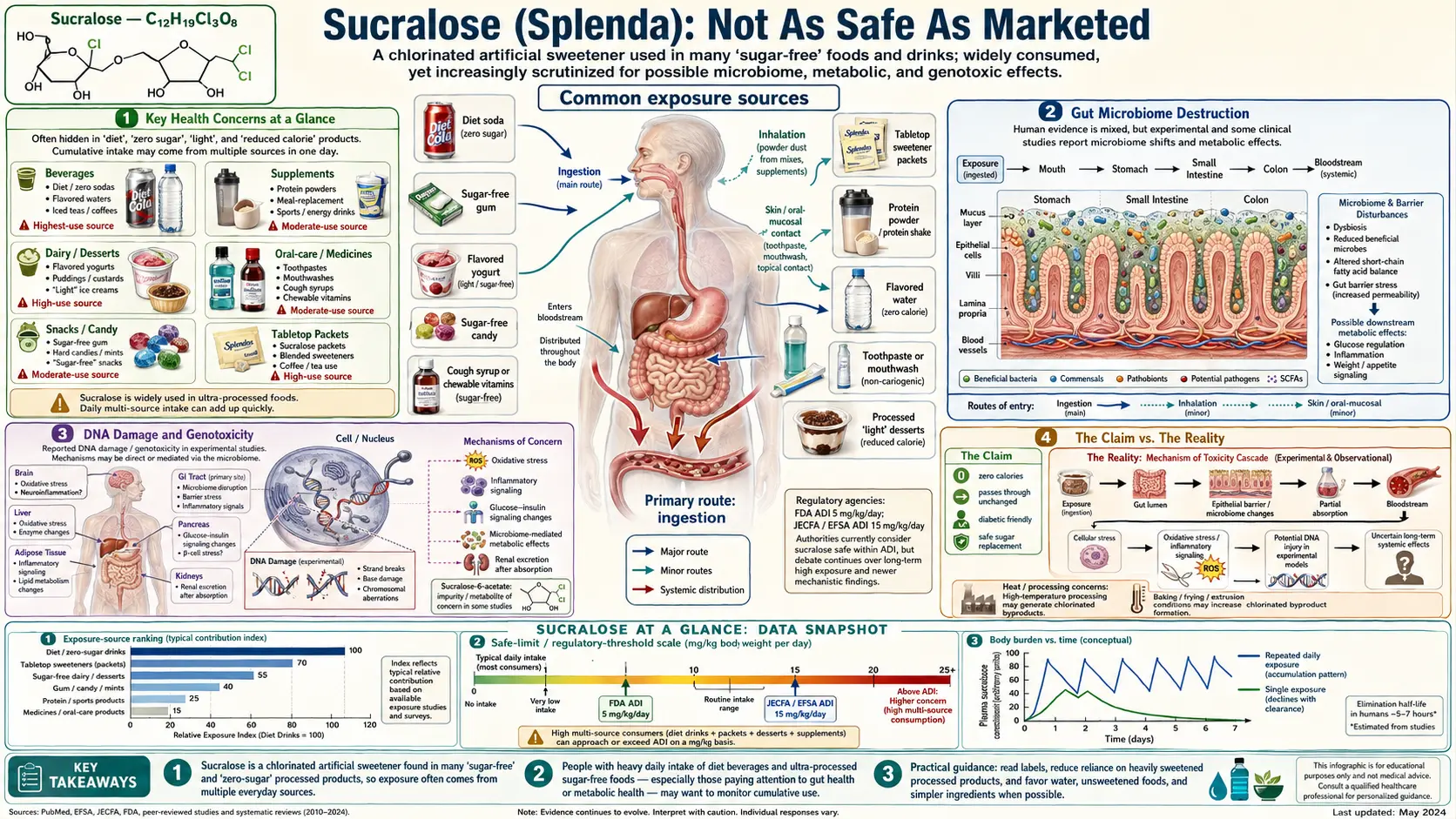
Sucralose is a high-intensity sweetener made by replacing three hydroxyl groups on sucrose (table sugar) with chlorine atoms. The FDA approved it for use in 15 food categories in 1998 and as a general-purpose sweetener in 1999, and describes it as about 600 times sweeter than table sugar. It is sold on its own as a sucralose tabletop sweetener and is used in many reduced-sugar foods and drinks. The FDA, the Joint FAO/WHO Expert Committee on Food Additives (JECFA) and the European Food Safety Authority (EFSA) consider it safe within their acceptable daily intakes (ADIs), and EFSA’s re-evaluation, published in February 2026, kept the EU ADI unchanged. Research since 2008 has reported effects on gut bacteria and on glucose and insulin responses, chlorinated breakdown products when sucralose is heated, and genotoxicity of a related compound, sucralose-6-acetate, in cell assays. Many of these findings come from animal or cell studies, and several have been disputed by regulators or expert panels. This page sets out what each study and agency reported.
Table of Contents
- Key Findings at a Glance
- A Chlorinated Sugar Molecule
- Made from Sugar, but Not Sugar
- Gut Microbiome Findings
- Heating and Chlorinated Breakdown Products
- Thymus Findings in Animal Studies
- Glucose and Insulin Effects
- Genotoxicity Findings
- The Mouse Cancer Study and the Regulatory Responses
- Cooking and Baking: What Is Known and Unknown
- Absorption, Metabolism and Environmental Persistence
- Common Claims and What the Research Reports
- Safety Limits and Regulatory Status
- Key Research Papers
- Connections
- Featured Videos
Key Findings at a Glance
A summary of the main findings and the responses to them. Each is covered in more depth below, with citations in the Key Research Papers section.
- A chlorinated sugar derivative – Three hydroxyl groups on sucrose are replaced with chlorine atoms; a 2013 review describes sucralose as “a synthetic organochlorine sweetener” (Schiffman and Rother).
- Gut bacteria in rats – A 2008 rat study (Abou-Donia et al.) reported lower counts of several groups of fecal bacteria after 12 weeks of a sucralose tabletop sweetener product. A 2009 expert panel found the study deficient, and in 2024 the journal published an expression of concern about the paper.
- Glucose responses in people – In a 2022 randomized trial of 120 healthy adults, two weeks of sucralose or saccharin sachets, at doses below the ADI, significantly impaired glycemic responses (Suez et al., Cell).
- Insulin – Taken 10 minutes before a glucose drink, sucralose produced a 20 ± 8% greater incremental insulin response in 17 obese adults who did not normally use such sweeteners (Pepino et al., 2013). Seven sucralose drinks with, but not without, a carbohydrate over 10 days decreased insulin sensitivity in healthy adults (Dalenberg et al., 2020).
- Heating – Germany’s Federal Institute for Risk Assessment (BfR) concluded in 2019 that above 120 °C sucralose decomposes and loses chlorine, and that chlorinated compounds such as dioxins, dibenzofurans or chloropropanols may form; it stated that the data did not allow a final risk assessment.
- Sucralose-6-acetate – An intermediate and impurity in sucralose manufacture, found at up to 0.67% in recent commercial samples, was genotoxic (clastogenic) in two cell-based assays (Schiffman et al., 2023). EFSA’s 2026 re-evaluation found no safety concern for genotoxicity of sucralose, its impurities and its degradation products.
- A mouse cancer study – A 2016 lifetime study reported a dose-related increase in blood-forming-tissue (hematopoietic) cancers in male Swiss mice; EFSA concluded in 2017 that the data did not support that conclusion.
- Persistence in water – Sucralose passes largely unchanged through water treatment and has been found in drinking water (Mawhinney et al., 2011).
- WHO guideline – In 2023 the World Health Organization issued a conditional recommendation against using non-sugar sweeteners, sucralose among them, for weight control.
A Chlorinated Sugar Molecule
Sucralose is manufactured by selectively replacing three hydroxyl groups (-OH) on the sucrose molecule with three chlorine atoms. The change means the body does not digest it as sugar: in a study of human volunteers given radiolabelled sucralose, most of the dose was recovered in the faeces as essentially unchanged sucralose (Roberts et al., 2000), which is why it supplies essentially no calories.
“Organochlorine” is a broad chemical class. It includes persistent pollutants such as DDT, PCBs and dioxins, but compounds in the class differ widely in their properties, and membership of the class does not on its own show that a compound behaves like those pollutants. The questions the research raises about sucralose concern its metabolism, its breakdown when heated and its persistence in water, each covered below.
Made from Sugar, but Not Sugar
Sucralose is manufactured from sucrose, and marketing for sucralose tabletop sweeteners has emphasised that origin. The finished molecule is a different compound: the chlorine substitutions change how the body handles it, so it is not digested as sugar and is largely excreted unchanged (Roberts et al., 2000).
Schiffman and Rother’s 2013 review of the biological research concluded that, taken together, the findings indicate that sucralose “is not a biologically inert compound”. Regulators have reached a different overall conclusion about its safety at permitted intakes (see Safety Limits and Regulatory Status).
Gut Microbiome Findings
The most-cited rat study is Abou-Donia et al. (2008), published in the Journal of Toxicology and Environmental Health, Part A. Male Sprague-Dawley rats were given a sucralose tabletop sweetener product (1.1% sucralose, with the fillers maltodextrin and glucose) by oral gavage at 100, 300, 500 or 1000 mg/kg for 12 weeks; those doses contained 1.1–11 mg/kg of sucralose (the FDA ADI is 5 mg/kg). The authors reported:
- Fewer fecal bacteria — At the end of the 12 weeks, total anaerobes, bifidobacteria, lactobacilli, Bacteroides, clostridia and total aerobic bacteria were significantly decreased; enterobacteria showed no significant change.
- Higher fecal pH — Fecal pH increased with treatment.
- Higher P-glycoprotein and cytochrome P450 enzymes — Expression of the efflux transporter P-glycoprotein (P-gp) rose 2.43-fold, CYP3A4 2.51-fold and CYP2D1 3.49-fold. The authors note that these proteins are known to limit the bioavailability of orally administered drugs; a 2013 review states that the effect of sucralose on first-pass drug metabolism in humans has not been determined.
- Changes after recovery — After a further 12 weeks without treatment, only total anaerobes and bifidobacteria remained significantly depressed, while fecal pH, P-gp, CYP3A4 and CYP2D1 remained elevated.
- Body weight — The investigators also reported an increase in body weight, as summarised by the 2009 expert panel.
An expert panel (Brusick et al., 2009) reviewed the study and found it “deficient in several critical areas”, concluding that its results “cannot be interpreted as evidence” that the product or sucralose produced adverse effects in male rats, and that the conclusions were “not consistent with published literature and not supported by the data presented”. Two of the study’s authors published a rebuttal in 2012. In 2024 the journal published an expression of concern about the 2008 paper; the PubMed record of the notice gives no reason. Press coverage in 2008 reported that the study was paid for by a sugar-industry trade group.
Suez et al. (2014, Nature) reported that in mice, commonly used non-caloric sweetener formulations drove glucose intolerance through changes in the gut microbiota. The effect was abolished by antibiotics and transferred to germ-free mice by faecal transplant, and the abstract reports similar changes in gut bacteria and glucose intolerance in healthy human subjects. The abstract does not break the human results down by sweetener.
The same group then ran a randomized controlled trial (Suez et al., 2022, Cell) in 120 healthy adults given saccharin, sucralose, aspartame or stevia sachets for 2 weeks, at doses lower than the ADI, compared with controls given the sachet vehicle (glucose) or no supplement. Each sweetener altered the stool and oral microbiome and the plasma metabolome; saccharin and sucralose significantly impaired glycemic responses. Germ-free mice given microbiomes from the trial’s strongest and weakest responders largely reproduced their donors’ glycemic responses. The authors describe the effects as person-specific and call for assessment of their clinical implications.
Heating and Chlorinated Breakdown Products
The FDA’s sweeteners page describes sucralose as heat stable, meaning it stays sweet at baking temperatures. Later studies have examined whether the molecule itself breaks down:
- BfR opinion (2019) — Germany’s Federal Institute for Risk Assessment (opinion No. 012/2019) concluded that when sucralose is heated above 120 °C it decomposes and loses chlorine step by step as the temperature rises; that temperatures of 120–150 °C are reached in industrial food processing and in home cooking and baking; and that chlorinated organic compounds with harmful potential, such as polychlorinated dibenzo-p-dioxins (PCDD), dibenzofurans (PCDF) or chloropropanols, may form. It stated that a final risk assessment was not possible because data on which reaction products form, and in what amounts, were lacking. Until a final assessment, the BfR recommended that consumers and food manufacturers not heat sucralose-containing foods to the temperatures of baking, frying or roasting, or add sucralose only after heating.
- Dioxins with metal oxides — Dong et al. (2013) reported that heating sucralose at high temperatures in stainless-steel or other metal utensils in the presence of rust or metal oxides (Al2O3, Fe2O3, CuO) produced PCDD/Fs, found both in the smoke and in the residue; copper oxide increased the yield.
- Hydrogen chloride and chlorinated aromatics — de Oliveira et al. (2015) found that sucralose decomposition released carbon dioxide and hydrogen chloride, and confirmed chlorinated derivatives including polychlorinated aromatic hydrocarbons; the authors report that hazardous polychlorinated compounds formed even under mild conditions.
- The 119 °C figure — Schiffman and Rother’s 2013 review states that thermal decomposition of sucralose commences at 119 °C with the release of hydrogen chloride and water, citing an earlier thermal study.
- A review by BfR scientists — Eisenreich et al. (2020) concluded that sucralose can be degraded at high temperatures, for example during cooking or baking, and that potentially toxic chlorinated compounds might be generated as a consequence.
EFSA’s 2026 re-evaluation found no genotoxicity concern for sucralose’s degradation products, but could not conclude on the safety of a proposed new use in fine bakery wares because of uncertainties about the formation of chlorinated compounds across the range of baking processes. It recommended that the European Commission consider revising the EU specifications for sucralose.
Thymus Findings in Animal Studies
JECFA’s toxicological monograph on sucralose (then called trichlorogalactosucrose, WHO Food Additives Series 24) records reduced thymus weight in rats fed sucralose at high dietary concentrations — in high-dose males (30,000 ppm) and in all treated groups of females in one study — and lymphoid hypoplasia of the spleen and thymus in males fed 50,000 ppm. The thymus is where T-lymphocytes mature. The Committee related these changes to reduced food intake and body weight on the poorly palatable high-concentration diets rather than to a direct effect on the immune system, and its evaluations record that further immunotoxicity studies were considered desirable. JECFA later allocated a full ADI (WHO Food Additives Series 28).
EFSA’s 2026 re-evaluation likewise used decreased body weight in rats as the reference endpoint, with an adjustment for the poor palatability of sucralose.
Glucose and Insulin Effects
Sucralose supplies no sugar, but several human studies have reported effects on glucose and insulin responses under specific conditions:
- Insulin response to a glucose drink — Pepino et al. (2013, Diabetes Care) studied 17 obese adults who did not use non-nutritive sweeteners and were insulin sensitive. Drinking sucralose 10 minutes before a glucose load, compared with water, led to a higher peak plasma glucose, a 20 ± 8% greater incremental insulin area under the curve, a 22 ± 7% greater peak insulin secretion rate, a 7 ± 4% decrease in insulin clearance and a 23 ± 20% decrease in insulin sensitivity. The study tested sucralose together with glucose, not sucralose alone.
- Sucralose with a carbohydrate — Dalenberg et al. (2020, Cell Metabolism) found that seven sucralose-sweetened drinks consumed with, but not without, a carbohydrate over 10 days decreased insulin sensitivity in healthy adults. The decrease correlated with reduced brain responses to sweet taste on fMRI; taste perception was unchanged, and the carbohydrate alone had no effect.
- Incretin hormones — Pepino et al. found no significant differences in GLP-1, GIP or glucagon responses. Schiffman and Rother’s 2013 review states that both human and rodent studies have shown that sucralose may alter glucose, insulin and GLP-1 levels.
- Glycemic responses and the microbiome — In the 2022 trial of 120 adults (Suez et al.), sucralose and saccharin significantly impaired glycemic responses, with effects that varied from person to person and tracked the microbiome.
Genotoxicity Findings
Research on whether sucralose or related compounds damage DNA has reached differing conclusions:
- Sucralose-6-acetate in cell assays — Schiffman et al. (2023, Journal of Toxicology and Environmental Health, Part B) studied sucralose-6-acetate, an intermediate and impurity in sucralose manufacture; recent commercial sucralose samples contained up to 0.67%. A high-throughput genotoxicity screen and a micronucleus test both indicated that sucralose-6-acetate is genotoxic, and the mechanism was classified as clastogenic (producing DNA strand breaks). The authors estimate that the amount in a single daily sucralose-sweetened drink might far exceed the threshold of toxicological concern for genotoxicity of 0.15 µg per person per day. These were in vitro experiments.
- Gene expression and the intestinal barrier — In the same study, human intestinal epithelium exposed to sucralose-6-acetate showed significantly increased expression of genes associated with inflammation, oxidative stress and cancer. Measurements of transepithelial electrical resistance and permeability in human transverse colon tissue indicated that both sucralose-6-acetate and sucralose impaired intestinal barrier integrity. Sucralose-6-acetate also inhibited two cytochrome P450 enzymes (CYP1A2 and CYP2C19).
- Earlier mutagenicity tests — Schiffman and Rother’s 2013 review reports that sucralose and one of its hydrolysis products were mutagenic at elevated concentrations in several testing methods.
- The regulatory assessments — EFSA’s 2017 statement found no reliable evidence of genotoxicity in living animals, and its 2026 re-evaluation reported that no safety concerns arose for genotoxicity of sucralose, its impurities and its degradation products.
The Mouse Cancer Study and the Regulatory Responses
Researchers at the Ramazzini Institute (Soffritti et al., 2016) fed sucralose to Swiss mice from 12 days of gestation through their natural lifespan, at 0, 500, 2,000, 8,000 and 16,000 ppm in the feed, in 457 males and 396 females. They reported a significant dose-related increase in males bearing malignant tumours and in hematopoietic (blood-forming-tissue) cancers in males, particularly at 2,000 and 16,000 ppm. The paper notes that earlier long-term bioassays in rats and mice, conducted on behalf of the manufacturer, had not shown carcinogenic effects, and the authors called for new bioassays.
At the European Commission’s request, EFSA’s food additives panel assessed the study in 2017. It noted that a design running from gestation to natural death increases background disease and the risk of misclassification, especially without an appropriate concurrent control group or a recent historical database; that there was no dose-response relationship for lymphomas and leukaemias combined; that no mode of action was identified; and that adequate studies in rats and mice had shown no carcinogenic effect. It concluded that the available data did not support the authors’ conclusion that sucralose induced hematopoietic neoplasias in male Swiss mice.
A 2024 paper giving the perspective of experienced pathologists (Elmore et al.) judged that flaws in the design, methods, data evaluation and reporting of the study reduce its value as evidence of a cancer hazard to humans, until it is repeated under Good Laboratory Practice; its first author disclosed being a paid consultant to a beverage-industry trade association.
Cooking and Baking: What Is Known and Unknown
The agencies agree on some points and differ on others:
- Temperatures — The BfR places the start of sucralose decomposition above 120 °C and notes that temperatures of 120–150 °C are reached in home cooking and baking as well as in industrial processing.
- Sweetness versus chemistry — The FDA describes sucralose as heat stable and suitable as a sugar substitute in baked goods; that statement concerns its sweetness. The BfR and EFSA assessments concern the chemical breakdown products.
- Amounts unknown — The BfR stated that data on the identity and amounts of reaction products formed in heated sucralose-containing foods are lacking, so exposure cannot be estimated.
- Baking uses in the EU — EFSA (2026) could not conclude on the safety of extending sucralose use to fine bakery wares, because of uncertainties about chlorinated compounds formed during baking.
Absorption, Metabolism and Environmental Persistence
Early descriptions of sucralose said that it passes through the body unchanged. Later research has added detail:
- Absorption in people — After a single oral dose of radiolabelled sucralose (1 mg/kg) in eight men, a mean of 14.5% (range 8.9–21.8%) of the radioactivity was excreted in urine and 78.3% in the faeces within 5 days. The faecal material was essentially unchanged sucralose; two urinary components with the characteristics of glucuronide conjugates accounted for 2.6% of the dose. The effective half-life of plasma radioactivity was 13 hours (Roberts et al., 2000).
- Metabolism in the gut — Schiffman and Rother’s 2013 review notes that later analysis suggested some sucralose is metabolised in the gastrointestinal tract, and that the identity and safety of these products were not known. In rats given sucralose for 40 days (80.4 mg/kg/day), Bornemann et al. (2018) identified two acetylated metabolites, more lipophilic than sucralose, in urine and faeces. Schiffman et al. (2023) report sucralose-6-acetate in rodent faeces at up to 10% relative to sucralose.
- Sucralose in fat tissue (rats) — In the same rat study, sucralose was found in adipose tissue two weeks after the 40-day feeding period ended, although it was no longer detected in urine or faeces.
- Persistence in water — In 19 US drinking water treatment plants serving more than 28 million people, sucralose was present in the source water of 15 and in the finished water of 13 of the 17 plants where finished water was tested, with low removal (12% on average); it persisted in distribution-system water regardless of residual chlorine or chloramines (Mawhinney et al., 2011).
Common Claims and What the Research Reports
- “Made from sugar” — Sucralose is manufactured from sucrose, but the finished product is a chlorinated compound that the body does not handle as sugar.
- “Passes through the body unchanged” — Most of an oral dose is excreted unchanged (Roberts et al., 2000), but glucuronide conjugates in human urine and acetylated metabolites in rats have been reported (Bornemann et al., 2018).
- “Safe for cooking” — The FDA describes sucralose as heat stable; the BfR (2019) and EFSA (2026) describe unresolved uncertainty about chlorinated compounds formed on heating.
- “Helps with weight management” — The WHO’s 2023 guideline states that replacing free sugars with non-sugar sweeteners does not help with weight control in the long term, and reports that its systematic review found potential long-term associations with type 2 diabetes, cardiovascular disease and mortality in adults.
- “No effect on blood sugar” — Trials have reported effects under specific conditions: with a glucose load (Pepino et al., 2013), with a carbohydrate but not alone (Dalenberg et al., 2020), and over two weeks in some people (Suez et al., 2022).
Regulators conclude that sucralose is safe at intakes within the ADI. Independent studies have raised questions about its effects on gut bacteria and glucose responses, about breakdown products formed on heating and about sucralose-6-acetate; many of those findings come from animal or cell studies, and some have been contested. Questions about sweeteners and an individual’s health belong with a clinician.
Safety Limits and Regulatory Status
- United States (FDA) — Approved in 1998 for 15 food categories and in 1999 as a general-purpose sweetener. ADI: 5 mg/kg body weight per day. The FDA states that it reviewed more than 110 studies, including studies of the reproductive and nervous systems, carcinogenicity and metabolism, and human clinical trials.
- JECFA (FAO/WHO) — After a temporary ADI of 0–3.5 mg/kg, the Committee allocated an ADI of 0–15 mg/kg body weight, applying a safety factor of 100 to the no-observed-effect level of 1500 mg/kg/day in the long-term rat study (WHO Food Additives Series 28).
- European Union (EFSA) — Under Regulation (EU) No 257/2010 the full re-evaluation of sucralose (E 955) was due by December 2020; EFSA’s food additives panel published it in February 2026. The panel derived a reference point of 55 mg/kg body weight per day (benchmark dose lower confidence limit) from decreased body weight in rats and concluded that there was no need to revise the ADI of 15 mg/kg body weight per day set earlier by the EU Scientific Committee on Food. Exposure estimates for current uses did not exceed the ADI, and the panel found no safety concern at the reported uses and use levels. It could not conclude on the proposed extension to fine bakery wares and recommended a revision of the EU specifications for sucralose.
- WHO guideline (2023) — Published on 15 May 2023, the WHO guideline on non-sugar sweeteners makes a conditional recommendation against their use for weight control. It applies to everyone except people with pre-existing diabetes. WHO notes that the recommendation is not based on toxicological assessment and does not replace JECFA’s safety evaluations.
The timeline below sets the main research findings beside the regulatory and journal responses that followed them.
Key Research Papers
The papers and regulatory documents behind the statements on this page. Links resolve to PubMed records, publisher DOIs, or the originating regulatory body.
Biological Issues Overview
- Schiffman SS, Rother KI. Sucralose, a synthetic organochlorine sweetener: overview of biological issues. J Toxicol Environ Health B Crit Rev. 2013;16(7):399-451. — doi:10.1080/10937404.2013.842523
Gut Microbiome and Metabolic Effects
- Suez J, Korem T, Zeevi D, et al. Artificial sweeteners induce glucose intolerance by altering the gut microbiota. Nature. 2014;514:181-186. — doi:10.1038/nature13793
- Abou-Donia MB, El-Masry EM, Abdel-Rahman AA, McLendon RE, Schiffman SS. Splenda alters gut microflora and increases intestinal p-glycoprotein and cytochrome p-450 in male rats. J Toxicol Environ Health A. 2008;71(21):1415-1429. — PubMed PMID: 18800291 — Expression of concern (notice: PubMed PMID: 38466694)
- Pepino MY, Tiemann CD, Patterson BW, Wice BM, Klein S. Sucralose affects glycemic and hormonal responses to an oral glucose load. Diabetes Care. 2013;36(9):2530-2535. — PubMed PMID: 23633524
- Dalenberg JR, Patel BP, Denis R, et al. Short-term consumption of sucralose with, but not without, carbohydrate impairs neural and metabolic sensitivity to sugar in humans. Cell Metab. 2020;31(3):493-502.e7. — PubMed PMID: 32130881
- Suez J, Cohen Y, Valdés-Mas R, et al. Personalized microbiome-driven effects of non-nutritive sweeteners on human glucose tolerance. Cell. 2022;185(18):3307-3328.e19. — PubMed PMID: 35987213
- Brusick D, Borzelleca JF, Gallo M, et al. Expert panel report on a study of Splenda in male rats. Regul Toxicol Pharmacol. 2009;55(1):6-12. — PubMed PMID: 19567260
- Schiffman SS, Abou-Donia MB. Sucralose revisited: rebuttal of two papers about Splenda safety. Regul Toxicol Pharmacol. 2012;63(3):505-508. — PubMed PMID: 22579627
Genotoxicity, Cancer and Thermal Degradation
- Schiffman SS, Scholl EH, Furey TS, Nagle HT. Toxicological and pharmacokinetic properties of sucralose-6-acetate and its parent sucralose: in vitro screening assays. J Toxicol Environ Health B Crit Rev. 2023;26(6):307-341. — PubMed PMID: 37246822
- Soffritti M, Padovani M, Tibaldi E, et al. Sucralose administered in feed, beginning prenatally through lifespan, induces hematopoietic neoplasias in male Swiss mice. Int J Occup Environ Health. 2016;22(1):7-17. — PubMed PMID: 27078173
- EFSA Panel on Food Additives and Nutrient Sources added to Food (ANS). Statement on the validity of the conclusions of a mouse carcinogenicity study on sucralose (E 955) performed by the Ramazzini Institute. EFSA J. 2017;15(5):e04784. — PubMed PMID: 32625489
- Elmore SA, Rehg JE, Schoeb TR, Everitt JI, Bolon B. Pathologists' perspective on the study design, analysis, and interpretation of proliferative lesions in a lifetime rodent carcinogenicity bioassay of sucralose. Food Chem Toxicol. 2024;188:114524. — PubMed PMID: 38428799
- Dong S, Liu G, Hu J, Zheng M. Polychlorinated dibenzo-p-dioxins and dibenzofurans formed from sucralose at high temperatures. Sci Rep. 2013;3:2946. — PubMed PMID: 24126490
- de Oliveira DN, de Menezes M, Catharino RR. Thermal degradation of sucralose: a combination of analytical methods to determine stability and chlorinated byproducts. Sci Rep. 2015;5:9598. — PubMed PMID: 25873245
- Eisenreich A, Gürtler R, Schäfer B. Heating of food containing sucralose might result in the generation of potentially toxic chlorinated compounds. Food Chem. 2020;321:126700. — PubMed PMID: 32278984
- Bundesinstitut für Risikobewertung (BfR). Süßstoff Sucralose: Beim Erhitzen von Lebensmitteln können gesundheitsschädliche Verbindungen entstehen. BfR-Stellungnahme Nr. 012/2019, 9 April 2019. — doi:10.17590/20190409-134500
Absorption, Metabolism and Environment
- Roberts A, Renwick AG, Sims J, Snodin DJ. Sucralose metabolism and pharmacokinetics in man. Food Chem Toxicol. 2000;38 Suppl 2:S31-S41. — PubMed PMID: 10882816
- Bornemann V, Werness SC, Buslinger L, Schiffman SS. Intestinal metabolism and bioaccumulation of sucralose in adipose tissue in the rat. J Toxicol Environ Health A. 2018;81(18):913-923. — PubMed PMID: 30130461
- Mawhinney DB, Young RB, Vanderford BJ, Borch T, Snyder SA. Artificial sweetener sucralose in U.S. drinking water systems. Environ Sci Technol. 2011;45(20):8716-8722. — PubMed PMID: 21879743
Regulatory and Authoritative Resources
- FDA — Aspartame and Other Sweeteners in Food (includes sucralose).
- European Food Safety Authority (EFSA).
- World Health Organization.
- EFSA Panel on Food Additives and Flavourings (FAF). Re-evaluation of sucralose (E 955) as a food additive and evaluation of a new application on extension of use of sucralose (E 955) in fine bakery wares. EFSA J. 2026;24(2):e9854. — PubMed PMID: 41710869
- World Health Organization. Use of non-sugar sweeteners: WHO guideline. Geneva: WHO; 15 May 2023. — WHO publication 9789240073616
- Joint FAO/WHO Expert Committee on Food Additives. Trichlorogalactosucrose (TGS). WHO Food Additives Series 28. — INCHEM monograph
- Joint FAO/WHO Expert Committee on Food Additives. Trichlorogalactosucrose. WHO Food Additives Series 24. — INCHEM monograph