Potassium Sorbate (E202): The 'Safer' Preservative Under Scrutiny
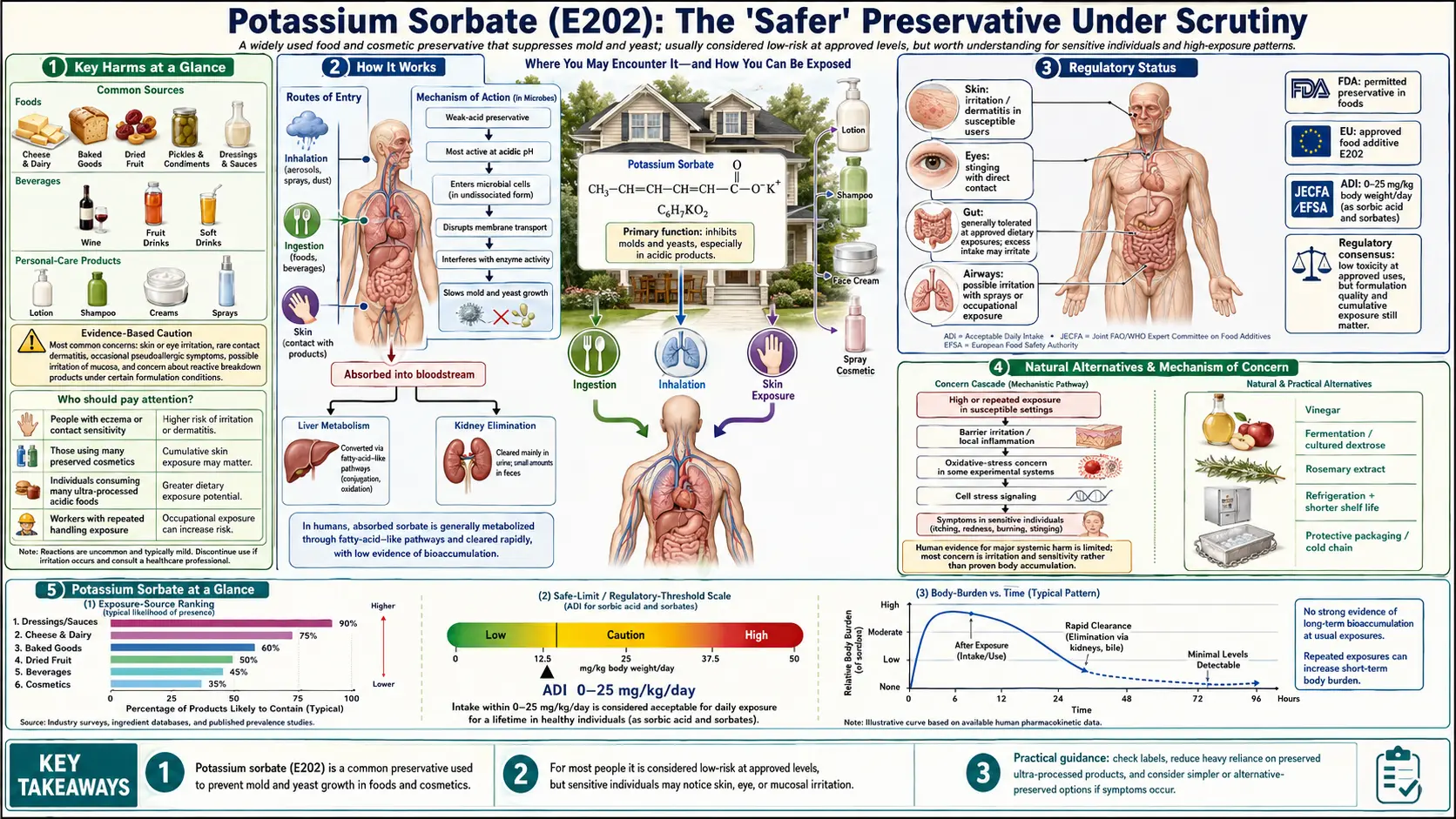
Table of Contents
Key Harms at a Glance
- In-vitro genotoxicity signal – Cell-culture studies report DNA strand breaks, chromosomal aberrations and sister-chromatid exchanges in human lymphocytes, but only at high concentrations (125–1,000 µg/ml in the most-cited study). The micronucleus assay was negative, and the one study that tested the low end found no genotoxicity below 4 mM. EFSA, reviewing in vitro and in vivo genotoxicity assays, found no evidence of genotoxic activity for sorbic acid or potassium sorbate.
- Skin reactions – An uncommon cause of allergic contact dermatitis from topical products and in occupational settings; sorbic acid also causes non-immunologic contact urticaria (a short-lived sting and wheal), including perioral reactions from a salad dressing.
- Gut microbiome — animal and laboratory findings only – Gut bacteria shifted in mice and rats given potassium sorbate for 8–10 weeks, and total bacterial load fell when human stool samples were incubated with it in the laboratory; no human feeding study has tested dietary intakes.
- Cocktail exposure – Often used together with sodium benzoate and other preservatives; no study of the combination's genotoxicity was found, and a 2026 rat study found that combined effects on gut bacteria were often non-additive.
- Migraine – Sometimes listed as a trigger; no controlled study of potassium sorbate and migraine was found in PubMed.
- Cancer and diabetes associations in one cohort – In the French NutriNet-Santé cohort (2026 reports), higher potassium sorbate intake was associated with higher overall and breast cancer incidence and with higher type 2 diabetes incidence. These are observational associations, not proof of cause.
- ADI – JECFA (1974) and the EU Scientific Committee for Food (1996) set a group ADI of 25 mg/kg body weight/day. EFSA has moved twice: it cut the old 25 to a temporary 3 mg/kg bw/day in 2015 over reproductive-toxicity uncertainty, then set 11 mg/kg bw/day in 2019 after a new rat reproductive study.
1. Overview
Potassium sorbate (E202) is the potassium salt of sorbic acid, a naturally occurring unsaturated short-chain fatty acid (2,4-hexadienoic acid). It is one of the most widely used food preservatives, found in a wide range of packaged foods, personal care formulations, and pharmaceutical preparations. Its popularity stems largely from a reputation as being "generally considered safer" than older preservatives such as sodium benzoate or sulfur dioxide — a characterization that rests on its very low toxicity in animal testing. Some cell-culture studies and, more recently, one large French cohort study have raised questions, described below.
The discovery of sorbic acid is usually credited to the German chemist August Wilhelm von Hofmann, who in 1859 obtained it from the oil of rowan berries (Sorbus aucuparia). Commercial production is usually dated to the 1950s, and today it is synthesized industrially rather than extracted from natural sources. Despite its botanical origins, all commercially used potassium sorbate is synthetic.
Potassium sorbate is water-soluble, odorless at low concentrations, and highly stable across a wide range of processing conditions, making it technically versatile. Its safety profile is often cited as favorable. In-vitro genotoxicity studies from 2008 onward have drawn attention, while the EU regulator's own tightening of the acceptable daily intake in 2015 was driven by reproductive-toxicity data, and it relaxed that limit in 2019 when new data arrived.
2. Where It's Found
Potassium sorbate is used across an exceptionally broad range of product categories:
- Cheese and dairy products: Cottage cheese, shredded and sliced cheeses, processed cheese spreads, and sour cream commonly contain potassium sorbate to prevent surface mold growth.
- Wine: Used to prevent refermentation of wines after bottling; the EU wine rules set a maximum of 200 mg/L (Commission Regulation (EC) No 606/2009).
- Baked goods: Cakes, muffins, tortillas, and bread products, particularly those with extended shelf lives.
- Dried fruits: Figs, dates, raisins, and prunes often receive potassium sorbate treatment to suppress mold during extended storage.
- Margarine and spreads: Prevents yeast and mold growth in water-in-oil emulsions.
- Canned fruits and vegetables: Used in pickled products and some acidified canned goods.
- Personal care products: A common preservative in shampoos, conditioners, lotions, creams, and cosmetics.
- Pharmaceutical products: Used as a preservative in liquid oral medications, topical preparations, and ophthalmic solutions.
- Herbal and dietary supplements: Liquid and gel-cap supplements may contain potassium sorbate as a shelf-life extender.
In EFSA's dietary exposure estimates the main contributors were bread and rolls, fine bakery wares and flavoured drinks (processed cheese also featured for toddlers). Those estimates cover food only; exposure from cosmetics and personal-care products is not part of them.
3. How It Works
Potassium sorbate functions primarily as an antifungal agent, inhibiting the growth of molds and yeasts. It is significantly less effective against bacteria, which limits its use in products where bacterial contamination is the primary concern.
The mechanism of action involves multiple pathways:
- Cell membrane disruption: Food-microbiology reviews describe sorbic acid as interfering with the transport proteins embedded in microbial cell membranes, impairing nutrient uptake and waste excretion.
- Enzyme inhibition: Older studies describe inhibition of microbial enzymes, including some involved in energy metabolism.
- Spore germination inhibition: At relevant concentrations, potassium sorbate suppresses the germination of fungal spores rather than killing established cells outright.
Efficacy is strongly pH-dependent. Potassium sorbate works best in acidic conditions; as pH rises toward neutral and alkaline conditions, the proportion of sorbate anion increases while free sorbic acid decreases, substantially reducing antimicrobial activity. This pH sensitivity means it is most effective in acidic foods such as cheese, wine, fermented products, and fruit-based items.
4. Health Effects
The conventional toxicological profile of potassium sorbate appears reassuring. A 1990 toxicology review described a very low level of mammalian toxicity, even in chronic studies at up to 10% of the diet, with no carcinogenic activity (Walker, 1990), and EFSA noted no adverse effects in short-term and subchronic rat and mouse studies of sorbic acid at up to 9,200 mg/kg bw per day. Acute toxicity at dietary concentrations is not a recognized concern.
However, several areas of chronic and subclinical health impact have drawn increasing research attention:
- Genotoxicity: Cell-culture studies (detailed in Section 5) report DNA damage in human lymphocytes at high concentrations. The authors did not show that such concentrations are reached in the blood after eating, and EFSA found no evidence of genotoxic activity.
- Skin sensitization and allergic contact dermatitis: Potassium sorbate and sorbic acid are considered rare skin sensitizers, mainly through cosmetic, personal-care and topical products. Patch-test positive reactions are documented — a Belgian series identified allergic contact dermatitis to potassium sorbate and sorbic acid in topical pharmaceuticals and medical devices (Dendooven and colleagues, Contact Dermatitis, 2021), and occupational sensitisation has been reported, for example in a dairy worker (Le Coz & Abensour, Contact Dermatitis, 2005). The Belgian authors concluded that sensitization is probably underestimated. Separately, sorbic acid causes non-immunologic contact urticaria: in a 1982 Danish report, 18 of 20 kindergarten children developed perioral urticaria after eating a salad dressing, and patch tests traced it to the sorbic acid and benzoic acid it contained (Clemmensen & Hjorth, 1982). These reactions concern skin and lip contact; a 1990 review described intolerance reactions (contact urticaria and pseudo-allergy) as infrequent, with too few reported data to estimate their true incidence (Walker, 1990).
- Migraine: Potassium sorbate is sometimes listed among migraine food triggers, but no controlled study of it as a migraine trigger was found in PubMed.
- Gut microbiome effects — animal and laboratory data, no human feeding study: Potassium sorbate is a weak-acid preservative active against yeasts, moulds and some bacteria (Brul & Coote, 1999), so an effect on gut bacteria is plausible. In healthy mice given 150–1,000 mg/kg for 10 weeks, gut microbiota abundances changed and liver inflammatory-cell infiltration and serum IL-1β rose; these changes eased after a 5-week washout (Xiao et al., 2024). In rats given 300 mg/kg/day in drinking water for 8 weeks, Lactobacillus counts fell (Rezaei et al., 2026). In laboratory fermentations of stool from 6 healthy adults and 6 adults with Crohn's disease, potassium sorbate lowered total bacterial load in both groups (Alessa et al., 2026). No study has tested whether dietary intakes alter the human gut microbiome. A 2019 Food Control paper sometimes cited for Lactobacillus inhibition at 1–5 mM could not be found.
- Cancer and type 2 diabetes — observational associations: In the French NutriNet-Santé cohort of 105,260 adults followed for a mean 7.57 years, higher potassium sorbate intake was associated with higher overall cancer incidence (hazard ratio 1.14, 95% CI 1.04–1.24) and breast cancer incidence (1.26, 1.07–1.49) compared with non-consumers or lower consumers (Hasenböhler et al., BMJ, 2026). In the same cohort (108,723 participants), potassium sorbate was one of the preservatives associated with higher type 2 diabetes incidence (Hasenböhler et al., Nature Communications, 2026). The authors state that confirmation by other studies is needed; associations of this kind do not establish cause.
5. Genotoxicity Research
The genotoxic potential of potassium sorbate has been debated since the late 2000s. The evidence comes from cell-culture studies and points in more than one direction.
Mamur et al. (2010) — Published in Toxicology in Vitro, this is the study most often cited for potassium sorbate genotoxicity. It treated cultured and isolated human lymphocytes with four concentrations — 125, 250, 500 and 1,000 µg/ml. Chromosomal aberrations rose significantly at 500 and 1,000 µg/ml; sister-chromatid exchanges rose at 250–1,000 µg/ml over 24 hours and at all four concentrations over 48 hours; and the comet assay found DNA strand breaks at every concentration after one hour. Two results cut the other way and belong here: the micronucleus assay was negative, and there was no cell-cycle delay. The authors concluded that potassium sorbate is genotoxic to human peripheral blood lymphocytes in vitro — they did not claim that the concentrations tested are reached in human blood after eating. (PubMed 20036729; DOI: 10.1016/j.tiv.2009.12.021)
Mpountoukas et al. (2008) — the study that points the other way. This earlier Food and Chemical Toxicology paper tested potassium sorbate, sodium benzoate and potassium nitrate on human peripheral blood cells and reached the opposite conclusion to Mamur. At 0.02, 0.2 and 2.0 mM, potassium sorbate showed no cytostatic activity at all; a weak effect appeared only at 4 and 8 mM, and SCE genotoxicity likewise appeared only at 4 and 8 mM. No cytotoxicity was seen at any dose. The authors' stated conclusion is that "the preservatives at low concentrations can be considered as non genotoxic under conditions tested." The study is sometimes described as corroborating Mamur or as finding damage at 0.5–2 mM; it does neither. (PubMed 18467014; DOI: 10.1016/j.fct.2008.03.021)
Mamur et al. (2012) — sodium sorbate. The same group tested sodium sorbate, a related salt, on human lymphocytes at 100–800 µg/ml and concluded it was genotoxic in vitro “at the highest concentrations”: sister-chromatid exchanges and micronuclei rose at 400 and 800 µg/ml, and the comet assay showed DNA damage at all concentrations. (PubMed 22373823)
Debate over in vitro relevance: Critics of these studies note that the concentrations used in cell culture experiments are difficult to translate directly to in vivo systemic exposure. Sorbic acid is metabolized by pathways similar to those for other fatty acids (Walker, 1990) and is mainly excreted as expired carbon dioxide (EFSA), and none of the studies above measured blood levels after eating, so whether the concentrations used in vitro are reached in the body is not established. EFSA's 2015 re-evaluation, which reviewed in vitro and in vivo genotoxicity assays, concluded that "the database was sufficiently robust and that there was no evidence of genotoxic activity for sorbic acid or potassium sorbate" (as summarized in its 2019 follow-up). It asked for genotoxicity data only on calcium sorbate; none was supplied, and calcium sorbate (E 203) was removed from the EU additive list in 2018. Separately, the 2015 opinion cut the 1996 group ADI of 25 mg/kg bw/day to a temporary 3 mg/kg bw/day — a tightening driven by reproductive-toxicity data, not by genotoxicity. After an extended one-generation reproductive toxicity study in rats was submitted, the 2019 follow-up opinion (EFSA Journal 17(3):e05625) set a group ADI of 11 mg sorbic acid/kg bw/day, based on a reduction in pup body weight. That is the current EU regulatory position.
The unresolved question is whether the in vitro signals mean anything at realistic long-term dietary exposures. For children, EFSA's figures are the relevant ones: in its most realistic exposure scenario, only toddlers and children in one country exceeded the temporary 3 mg/kg bw/day ADI that applied at the time.
6. Regulatory Status
Potassium sorbate holds approval across all major regulatory jurisdictions:
- United States (FDA): Listed as Generally Recognized As Safe (GRAS) “when used in accordance with good manufacturing practice” (21 CFR 182.3640; sorbic acid is 21 CFR 182.3089 and calcium sorbate 21 CFR 182.3225).
- European Union: Approved as E202 under Regulation (EC) No 1333/2008. EFSA's 2015 re-evaluation kept it authorized but replaced the 25 mg/kg body weight/day group ADI with a temporary 3 mg/kg bw/day; its 2019 follow-up set the current group ADI of 11 mg/kg bw/day (expressed as sorbic acid).
- Organic foods: Potassium sorbate does not appear on the National Organic Program's National List of synthetic substances allowed in processed products labeled “organic” or “made with organic” (7 CFR 205.605), so it is not among the permitted ingredients in USDA organic foods.
- FAO/WHO (JECFA): The Joint FAO/WHO Expert Committee on Food Additives evaluated sorbic acid and its salts in 1974 and allocated a group ADI of 0–25 mg/kg body weight/day, higher than EFSA's current 11.
- Labeling: In the EU, it must be declared as "potassium sorbate" or "E202" in ingredient lists. In the US, it must be listed by name.
7. Combination Effects
Potassium sorbate is rarely used in isolation in commercial food products. Safety assessments evaluate each additive on its own, and some researchers argue that this leaves combinations (“cocktail effects”) untested:
- Potassium sorbate + sodium benzoate: This combination is common in soft drinks, salad dressings, and condiments. The 2008 lymphocyte study tested the two preservatives separately, not together, and no study of their combined genotoxicity was found. In a 2026 rat study, sodium benzoate and potassium sorbate given together shifted gut bacteria, but the combined effects were often non-additive (Rezaei et al., 2026).
- Potassium sorbate + nitrites in cured meats: Sorbate is sometimes used alongside sodium nitrite in processed meat products. Reaction products of sorbic acid and nitrite have been shown to be mutagenic in vitro, but EFSA noted that they were produced under optimal experimental conditions in water and may not form to any major extent in foods, and a 1990 review reported them undetectable under normal conditions of use, even in curing brines (Walker, 1990).
- Cumulative dietary exposure: Given potassium sorbate's presence in both food and personal care products, exposure estimates based on food alone do not include skin exposure from cosmetic products; how much of a topically applied dose is absorbed was not reported in the sources on this page.
8. Reading Labels and Exposure Patterns
- Label names: ingredient lists show it as “potassium sorbate” or, in the EU, “E202”; the related forms appear as “sorbic acid” (E200).
- Organic products: because potassium sorbate is not on the USDA National List, products labeled USDA organic do not contain it.
- Wine: its role is to stop refermentation after bottling, a use tied to wines that still contain fermentable sugar.
- Cheese: it appears on the labels of many packaged shredded and sliced cheeses, where it suppresses surface mould.
- Cosmetics and personal care: other preservatives used in these products include phenethyl alcohol, ethylhexylglycerin, and organic acids.
- Dried fruit: sold both with and without sorbate and sulfite treatment; the ingredient list shows which.
- Baked goods: bread, rolls and fine bakery wares were the largest dietary contributors in EFSA's exposure estimates.
9. Natural Alternatives
Several naturally derived and fermentation-based preservation methods are used in place of potassium sorbate in specific applications:
- Natamycin (E235): A natural antifungal antibiotic from Streptomyces natalensis, used against moulds on cheese surfaces and cured meats. Unlike potassium sorbate, natamycin is used as a surface treatment rather than mixed through the food.
- Fermentation-based preservation: Lactic acid fermentation lowers pH and produces natural antimicrobial metabolites (lactic acid, acetic acid, bacteriocins), providing broad-spectrum preservation without synthetic additives.
- Rosemary extract: Rich in carnosic acid and rosmarinic acid, rosemary extract provides antioxidant and mild antimicrobial activity, approved as a natural food antioxidant (E392) in the EU. Most effective against oxidative spoilage rather than microbial growth.
- Vinegar and organic acids: In acidic products, natural acetic acid (vinegar) or citric acid can substitute part of the antimicrobial function attributed to potassium sorbate.
10. Connections
Key Research Papers
- Mamur S, Yüzbaşıoğlu D, Ünal F, Yılmaz S. Does potassium sorbate induce genotoxic or mutagenic effects in lymphocytes? Toxicology in Vitro. 2010;24(3):790–794. — doi:10.1016/j.tiv.2009.12.021 · PubMed PMID: 20036729
- Mamur S, Yüzbaşıoğlu D, Ünal F, Aksoy H. Genotoxicity of food preservative sodium sorbate in human lymphocytes in vitro. Cytotechnology. 2012;64(5):553–562. — doi:10.1007/s10616-012-9434-5 · PubMed PMID: 22373823
- Mpountoukas P, Vantarakis A, Sivridis E, Lialiaris T. Cytogenetic study in cultured human lymphocytes treated with three commonly used preservatives. Food and Chemical Toxicology. 2008;46(7):2390–2393. — concluded NON-genotoxic at low concentrations. — doi:10.1016/j.fct.2008.03.021 · PubMed PMID: 18467014
- EFSA Panel on Food Additives and Nutrient Sources. Scientific opinion on the re-evaluation of sorbic acid (E 200), potassium sorbate (E 202) and calcium sorbate (E 203) as food additives. EFSA Journal. 2015;13(6):4144. — set a temporary group ADI of 3 mg/kg bw/day, replacing the 1996 ADI of 25. — doi:10.2903/j.efsa.2015.4144
- EFSA Panel on Food Additives and Flavourings (FAF). Opinion on the follow-up of the re-evaluation of sorbic acid (E 200) and potassium sorbate (E 202) as food additives. EFSA Journal. 2019;17(3):e05625. — group ADI 11 mg sorbic acid/kg bw/day; "no evidence of genotoxic activity". — doi:10.2903/j.efsa.2019.5625 · PubMed PMID: 32626251
- Dendooven E, Kerre S, Foubert K, Pieters L, Lambert J, Goossens A, Aerts O. Allergic contact dermatitis from potassium sorbate and sorbic acid in topical pharmaceuticals and medical devices. Contact Dermatitis. 2021;85(2):171–177. — doi:10.1111/cod.13829 · PubMed PMID: 33656744
- Le Coz CJ, Abensour M. Occupational contact dermatitis from potassium sorbate in milk transformation plant. Contact Dermatitis. 2005;53(3):176–177. — doi:10.1111/j.0105-1873.2005.0407i.x · PubMed PMID: 16128766
- Davidson PM, Critzer FJ, Taylor TM. Naturally occurring antimicrobials for minimally processed foods. Annual Review of Food Science and Technology. 2013;4:163–190. — doi:10.1146/annurev-food-030212-182535
- Commission Regulation (EC) No 606/2009 laying down certain detailed rules for implementing Council Regulation (EC) No 479/2008 as regards the categories of grapevine products, the oenological practices and the applicable restrictions. Official Journal of the European Union. 2009.
- JECFA. Sorbic acid. In: WHO Food Additives Series 5. Joint FAO/WHO Expert Committee on Food Additives; 1974. WHO Geneva.
- Brul S, Coote P. Preservative agents in foods: mode of action and microbial resistance mechanisms. International Journal of Food Microbiology. 1999;50(1–2):1–17. — doi:10.1016/S0168-1605(99)00072-0
- Neltner TG, Alger HM, O'Reilly JT, Krimsky S, Bero LA, Maffini MV. Conflicts of interest in approvals of additives to food determined to be generally recognized as safe. JAMA Internal Medicine. 2013;173(22):2032–2036. — doi:10.1001/jamainternmed.2013.10559
- Carocho M, Barreiro MF, Morales P, Ferreira IC. Adding molecules to food, pros and cons: a review on synthetic and natural food additives. Comprehensive Reviews in Food Science and Food Safety. 2014;13(4):377–399. — doi:10.1111/1541-4337.12065
- Walker R. Toxicology of sorbic acid and sorbates. Food Additives and Contaminants. 1990;7(5):671–676. — doi:10.1080/02652039009373932 · PubMed PMID: 2253811
- Clemmensen O, Hjorth N. Perioral contact urticaria from sorbic acid and benzoic acid in a salad dressing. Contact Dermatitis. 1982;8(1):1–6. — doi:10.1111/j.1600-0536.1982.tb04126.x · PubMed PMID: 7067435
- Xiao N, Ruan S, Mo Q, Zhao M, Liu T, Feng F. Effects of potassium sorbate on systemic inflammation and gut microbiota in normal mice: a comparison of continuous intake and washout period. Food and Chemical Toxicology. 2024;184:114443. — doi:10.1016/j.fct.2024.114443 · PubMed PMID: 38211766
- Rezaei A, Habibabad FS, Bina S, Khoshnoud MJ, Haghshenas M, Rashedinia M. Beyond antimicrobial efficacy: complex interactions of sodium benzoate, potassium sorbate, and citrate alter the rat gut microbiome. Journal of the Science of Food and Agriculture. 2026;106(10):5903–5909. — doi:10.1002/jsfa.70703 · PubMed PMID: 42066053
- Alessa H, Quinn ME, Alhomidan L, Ross C, Kainadas S, Brownson E, et al. In vitro effects of twelve food additives on gut microbiome and its fibre fermentation capacity in adults with Crohn's disease in remission and healthy controls. Nutrients. 2026;18(4):668. — doi:10.3390/nu18040668 · PubMed PMID: 41754185
- Hasenböhler A, Javaux G, Payen de la Garanderie M, de Edelenyi FS, Yvroud-Hoyos P, Agaësse C, et al. Intake of food additive preservatives and incidence of cancer: results from the NutriNet-Santé prospective cohort. BMJ. 2026;392:e084917. — doi:10.1136/bmj-2025-084917 · PubMed PMID: 41500678
- Hasenböhler A, Javaux G, Payen de la Garanderie M, Szabo de Edelenyi F, Bourhis L, Agaësse C, et al. Associations between preservative food additives and type 2 diabetes incidence in the NutriNet-Santé prospective cohort. Nature Communications. 2026;16(1):11199. — doi:10.1038/s41467-025-67360-w · PubMed PMID: 41501013
- National Organic Program. National List of Allowed and Prohibited Substances. 7 CFR Part 205. USDA Agricultural Marketing Service. 2023.