Coffee and Type 2 Diabetes: Chlorogenic Acid and Insulin Sensitivity
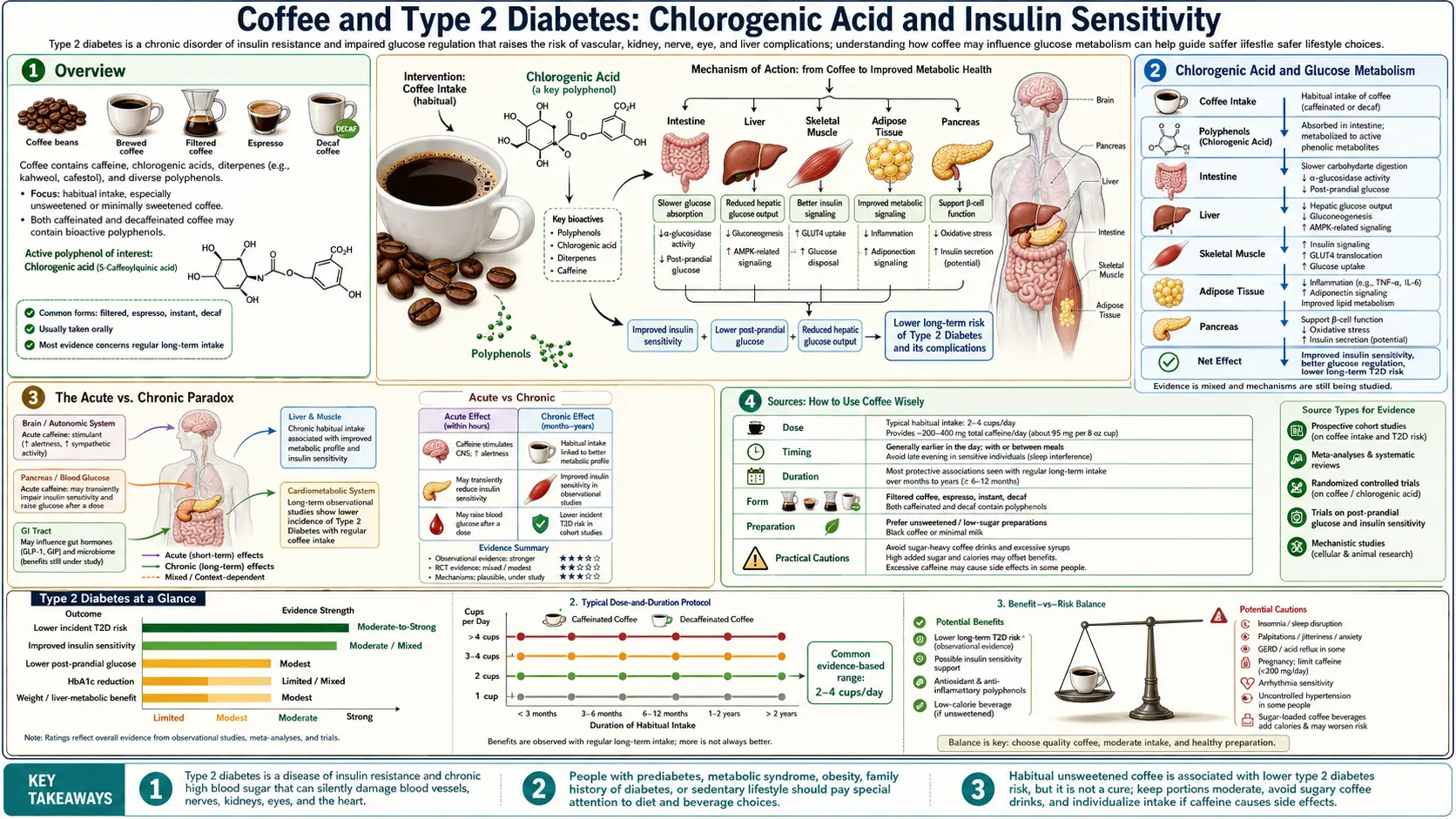
Table of Contents
Overview
Type 2 diabetes is among the most common chronic diseases worldwide, with roughly 540 million adults affected as of the mid-2020s. The relationship between coffee and type 2 diabetes is one of the most consistent inverse associations observed in nutritional epidemiology: regular coffee drinkers have substantially lower rates of developing the disease, and the effect holds across populations, sexes, body-mass categories, and coffee preparation methods. The protective effect is even present in decaffeinated coffee, pointing to compounds beyond caffeine—most notably chlorogenic acid.
The Epidemiological Evidence
The 2014 meta-analysis by Ding and colleagues in Diabetes Care, pooling data from more than 1.1 million participants across 28 prospective studies, found a linear dose-response relationship: each additional cup of caffeinated coffee per day was associated with a 9 percent lower risk of developing type 2 diabetes (relative risk 0.91), and each cup of decaffeinated coffee with a 6 percent lower risk (relative risk 0.94). People drinking six cups per day had about a 33 percent lower risk compared with non-drinkers, with decaffeinated coffee showing a similar protective pattern.
Earlier work by Huxley and colleagues in the 2009 Archives of Internal Medicine review reached similar conclusions, and subsequent cohort studies from Europe, Asia, and North America have continued to confirm the finding. The consistency of the inverse association across such diverse populations is one of the strongest arguments that the effect is real and not an artifact of confounding.
Chlorogenic Acid and Glucose Metabolism
Chlorogenic acid (CGA) is the most abundant polyphenol in coffee, with a typical 8-ounce cup containing between 70 and 350 milligrams depending on bean variety, roast, and brewing method. CGA has been shown in controlled studies to reduce post-meal glucose absorption by inhibiting glucose-6-phosphatase, slow carbohydrate digestion via inhibition of alpha-amylase and alpha-glucosidase, and blunt post-prandial insulin spikes.
Beyond acute effects, CGA appears to modulate gene expression in the liver and muscle. It activates AMP-activated protein kinase (AMPK), a master regulator of energy metabolism, which in turn increases glucose uptake by skeletal muscle and reduces hepatic gluconeogenesis. These are the same pathways targeted by metformin, the first-line pharmacologic treatment for type 2 diabetes, and some researchers have described chlorogenic acid as a mild natural AMP-activated protein kinase activator.
Protection of Pancreatic Beta Cells
A 2023 laboratory study by Ihara and colleagues in the Kobe Journal of Medical Sciences, using MIN6 cells (a mouse pancreatic beta-cell line) and an animal model, found that caffeine improved insulin signaling in beta cells under endoplasmic reticulum stress, and that chlorogenic acid protected the cells by enhancing expression of insulin receptor substrate 2 (IRS-2) via cAMP response element-binding protein (CREB). The protective effect of chlorogenic acid was mediated by easing endoplasmic reticulum stress. These are cell and animal findings, not results in people.
Other preclinical work has shown that coffee polyphenols reduce amyloid deposits characteristic of late-stage beta-cell failure, decrease oxidative stress, and support mitochondrial function within islet cells. These mechanisms may explain why coffee appears to protect against diabetes development rather than merely managing glucose in people who already have it.
Caffeinated vs. Decaffeinated Coffee
A key finding from the Ding meta-analysis and subsequent work is that decaffeinated coffee retains most of the protective effect. Each cup of decaf was associated with a 6 percent reduction in type 2 diabetes risk, compared with 9 percent for caffeinated coffee, and the difference between the two was not statistically significant. This is strong evidence that chlorogenic acid, melanoidins, trigonelline, and other non-caffeine compounds drive the effect, while caffeine contributes only modestly.
This matters for people with caffeine sensitivity, hypertension, anxiety disorders, or pregnancy: in these data, decaf carried most of coffee's metabolic association without the caffeine.
The Acute vs. Chronic Paradox
An apparent paradox in the coffee-diabetes literature is that acute caffeine intake actually impairs insulin sensitivity in short-term metabolic challenge tests, while chronic coffee consumption reduces long-term diabetes risk. The resolution appears to be tolerance: habitual coffee drinkers lose the acute insulin-sensitivity penalty of caffeine within weeks, while the effects of chlorogenic acid and other beneficial compounds accumulate.
Practically, this means that short-term studies showing caffeine transiently raising blood glucose do not by themselves show that coffee is bad for diabetes risk. The long-term cohort data—where the question is whether people who drink coffee develop diabetes over five to twenty years—consistently favors coffee.
What the Research Means in Practice
For adults at risk of type 2 diabetes (family history, overweight, prediabetes, metabolic syndrome), the cohort evidence links regular coffee drinking, including two to four cups per day, caffeinated or decaffeinated, to lower risk. Large amounts of added sugar bring a glycemic load from sweetened coffee drinks that offsets the benefit. Other points from the research:
- Light-to-medium roasts retain slightly more chlorogenic acid than dark roasts.
- For people with elevated low-density lipoprotein (LDL) cholesterol, the relevant fact is that unfiltered coffee raises low-density lipoprotein due to diterpene retention, while filter coffee or espresso retains less of these compounds.
- Spacing coffee 30–60 minutes away from iron or calcium supplements is the timing described to limit reduced mineral absorption.
- In people already on insulin or sulfonylureas, starting or stopping regular coffee consumption may shift insulin sensitivity and with it blood glucose.
Sources
- Ding M et al. (2014). "Caffeinated and decaffeinated coffee consumption and risk of type 2 diabetes: a systematic review and a dose-response meta-analysis." Diabetes Care. PMID: 24459154
- Ihara Y, Asahara SI, Inoue H et al. (2023). "Chlorogenic Acid and Caffeine in Coffee Restore Insulin Signaling in Pancreatic Beta Cells." Kobe Journal of Medical Sciences 69(1):E1-E8. PubMed PMID: 37088693
- Williamson G (2020). "Protection against developing type 2 diabetes by coffee consumption: assessment of the role of chlorogenic acid and metabolites on glycaemic responses." Food and Function 11(6):4826-4833. PubMed PMID: 32484174
- Huxley R et al. (2009). "Coffee, decaffeinated coffee, and tea consumption in relation to incident type 2 diabetes mellitus: a systematic review with meta-analysis." Archives of Internal Medicine. PMID: 20008687
- Bhupathiraju SN, Pan A, Manson JE, Willett WC, van Dam RM, Hu FB (2014). "Changes in coffee intake and subsequent risk of type 2 diabetes: three large cohorts of US men and women." Diabetologia 57(7):1346-1354. — PubMed PMID: 24771089
- Poole R et al. (2017). "Coffee consumption and health: umbrella review of meta-analyses of multiple health outcomes." BMJ. PMID: 29167102
Connections
- All Food
- Caffeine, Adenosine & Why Coffee Stops Working — interactive animation
- Coffee
- Coffee (Food)
- Diabetes
- Type 2 Diabetes — the full disease page behind the risk-reduction evidence on this page.
- Hypertension
- Metabolic Syndrome
- Blood Sugar
- Insulin Resistance
- Hemoglobin A1C
- Fasting Insulin
- Turmeric
- Oxidative Stress
- Iron
- Stress Management
- Coffee Health Benefits
- Coffee & Cardiovascular Health
- Coffee & Kidney Injury
- Fasting
- Cinnamon