Aspartame: Research Findings and Regulatory Status
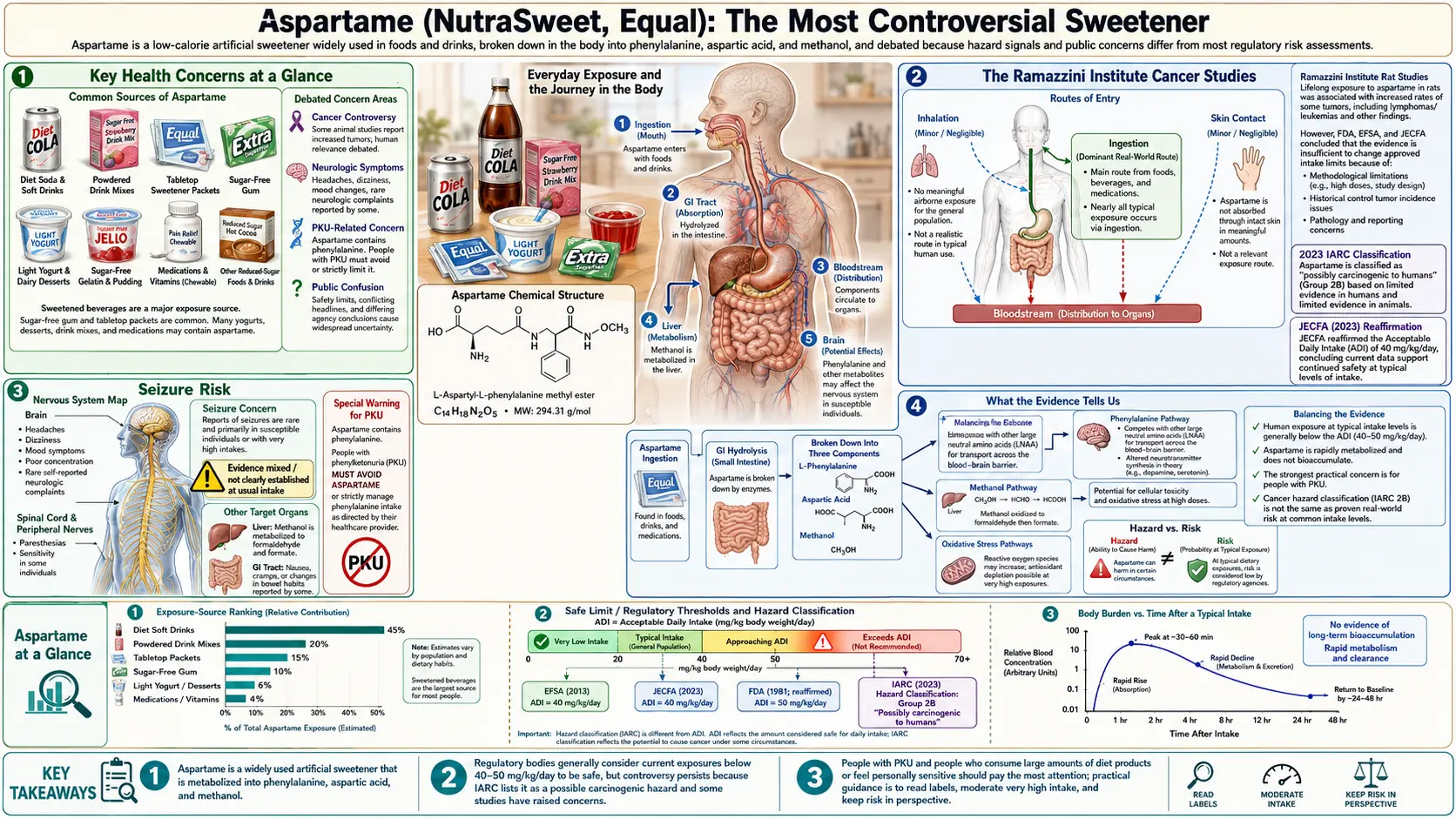
Aspartame is a high-intensity sweetener, about 200 times sweeter than sugar, used in diet soft drinks, tabletop sweeteners, chewing gum, food supplements and some medicines. The FDA first approved it in 1974, approved it for dry foods in 1981 after a contested review, and approved it as a general-purpose sweetener in 1996. In July 2023 the International Agency for Research on Cancer (IARC) classified aspartame as “possibly carcinogenic to humans” (Group 2B), while the Joint FAO/WHO Expert Committee on Food Additives (JECFA) kept the acceptable daily intake (ADI) at 40 mg/kg body weight/day and the FDA stated that it disagrees with IARC’s conclusion. This page sets out what the studies and agencies reported, including the animal studies, the cohort studies and the regulatory history.
Table of Contents
- Key Findings at a Glance
- Chemical Composition
- Breakdown Products: The Methanol-Formaldehyde-Formic Acid Pathway
- The 2023 IARC Classification and the JECFA and FDA Responses
- The Ramazzini Institute Studies and the Regulatory Responses
- US Approval History
- Headaches, Mood and Other Neurological Findings
- Seizure Studies
- Phenylketonuria (PKU) and the Label Requirement
- Where Aspartame Is Used
- EFSA’s 2013 Re-evaluation and Its Critics
- Summary of the Evidence
- Key Research Papers
- Connections
- Featured Videos
Key Findings at a Glance
A summary of the main findings and the responses to them. Each is covered in more depth below, with citations in the Key Research Papers section.
- IARC Group 2B (2023) – The International Agency for Research on Cancer classified aspartame as “possibly carcinogenic to humans” on the basis of limited evidence for cancer in humans (specifically hepatocellular carcinoma, a type of liver cancer), limited evidence in experimental animals and limited mechanistic evidence.
- ADI unchanged (2023) – In the same month, the Joint FAO/WHO Expert Committee on Food Additives (JECFA) kept its acceptable daily intake at 0–40 mg/kg body weight, and the US Food and Drug Administration (FDA) stated that it disagrees with IARC’s conclusion.
- Ramazzini Institute studies – Lifetime feeding studies reported increased lymphomas and leukaemias in rats, stronger effects when exposure began before birth, and liver and lung cancers in male mice. The European Food Safety Authority (EFSA) concluded after each review that there was no reason to revise the ADI.
- Methanol and formaldehyde – Digestion releases methanol, which the body converts to formaldehyde and formic acid. A 1998 rat study reported formaldehyde-derived adducts in tissues; EFSA concluded in 2013 that methanol from aspartame is a small portion of total dietary methanol exposure.
- Headaches – Two double-blind trials in people who reported aspartame-related headaches gave different results: one found more headache days on aspartame (Van den Eeden et al., 1994), the other found no difference from placebo (Schiffman et al., 1987).
- Seizures – Aspartame increased drug-induced seizures in mice; controlled trials in children with epilepsy and in people who reported aspartame-related seizures found no seizures provoked by it.
- Phenylketonuria (PKU) – Aspartame supplies phenylalanine. US labels must carry the statement “PHENYLKETONURICS: CONTAINS PHENYLALANINE” (21 CFR 172.804), and EFSA states that its ADI does not apply to people with PKU.
- NutriNet-Santé cohort – In 102,865 French adults, higher aspartame intake was associated with higher overall cancer risk (hazard ratio 1.15), and in a related analysis with cerebrovascular events (1.17). These are observational findings.
- Contested approval – The FDA Commissioner approved aspartame in 1981 after a public board of inquiry had recommended in 1980 that it not be approved pending further study of brain tumours.
Chemical Composition
Aspartame (L-aspartyl-L-phenylalanine methyl ester) is a dipeptide made of two amino acids, aspartic acid and phenylalanine, with the phenylalanine joined to a methyl group as an ester. The FDA describes it as about 200 times sweeter than table sugar. When it is digested, it is broken down into its three components:
- Phenylalanine — An essential amino acid also found in protein-rich foods. Aspartame raises plasma phenylalanine (Rowan et al., 1995), and researchers have proposed that, because phenylalanine can affect the synthesis of monoamine neurotransmitters in the brain, it could mediate neurological effects (Maher and Wurtman, 1987). People with phenylketonuria cannot properly metabolize it (see below).
- Aspartic acid — An amino acid that also acts as an excitatory neurotransmitter. The hypothesis that aspartic acid from aspartame could overstimulate neurons (excitotoxicity) has been raised by critics; EFSA’s 2013 re-evaluation concluded that aspartame does not harm the brain or nervous system at current intakes.
- Methanol — Released from the methyl ester. Methanol also occurs in fruit and vegetables, and EFSA concluded that methanol from aspartame is a small portion of total exposure to methanol from all sources.
Breakdown Products: The Methanol-Formaldehyde-Formic Acid Pathway
In the body, methanol is oxidized to formaldehyde and then to formic acid. IARC classifies formaldehyde as carcinogenic to humans (Group 1), and formic acid accumulation is the main cause of toxicity in methanol poisoning; the question for aspartame is whether the small amounts it releases matter.
- Heat — The FDA states that aspartame is not heat stable and loses its sweetness when heated, and US rules require tabletop aspartame sweeteners to carry instructions not to use them in cooking or baking (21 CFR 172.804).
- Formaldehyde adducts in rats — Trocho et al. (1998, Life Sciences) gave adult male rats an oral dose of 10 mg/kg aspartame labelled with carbon-14 in its methanol carbon. Six hours later about 5% of the label remained in the body, half of it in the liver; label was found in plasma, liver and kidney, with lower levels in fat, muscle, brain, cornea and retina. Protein and DNA label had the pattern expected of formaldehyde binding. Rats pretreated with 200 mg/kg unlabelled aspartame for 10 days accumulated more label, which the authors interpret as possibly cumulative adduct formation, concluding that aspartame consumption “may constitute a hazard”. This was a rat study.
- The regulatory assessment — EFSA’s 2013 re-evaluation concluded that aspartame and its breakdown products are safe for the general population at the ADI of 40 mg/kg body weight per day, and that the breakdown products are also naturally present in other foods.
The 2023 IARC Classification and the JECFA and FDA Responses
On 14 July 2023 WHO released the results of two separate assessments. IARC, which identifies hazards, classified aspartame as “possibly carcinogenic to humans” (Group 2B). JECFA, which assesses risk at expected intakes, kept the acceptable daily intake it had set earlier.
- Cancer in humans: limited evidence — specifically for hepatocellular carcinoma, a type of liver cancer (Riboli et al., 2023).
- Cancer in experimental animals: limited evidence.
- Mechanisms: limited evidence related to the possible mechanisms for causing cancer.
The IARC Working Group met in Lyon on 6–13 June 2023; its full evaluation was published as volume 134 of the IARC Monographs in 2024.
JECFA kept its previously established ADI of 0–40 mg/kg body weight, within which, it stated, it is safe for a person to consume per day. WHO gave an example: with a can of diet soft drink containing 200 or 300 mg of aspartame, an adult weighing 70 kg would need to drink more than 9–14 cans a day to exceed the ADI, assuming no other intake. WHO officials also called for better studies with longer follow-up and for randomized controlled trials.
The FDA stated that it “disagrees with IARC’s conclusion that these studies support classifying aspartame as a possible carcinogen to humans”, and that FDA scientists had identified significant shortcomings in the studies on which IARC relied. The US ADI is 50 mg/kg body weight per day.
IARC’s classification concerns the strength of the evidence that aspartame can cause cancer (hazard); JECFA’s ADI concerns how much can be consumed (risk).
The Ramazzini Institute Studies and the Regulatory Responses
The Cesare Maltoni Cancer Research Center of the Ramazzini Institute (then the European Ramazzini Foundation) in Bologna, Italy, fed aspartame to rodents from the start of treatment until natural death, rather than ending the studies at a fixed age.
- Rats from 8 weeks of age (2006) — Sprague-Dawley rats (100–150 per sex per group) given aspartame in feed at 0 to 100,000 ppm showed an increased incidence of malignant-tumour-bearing animals, of lymphomas and leukaemias (in females at doses from 400 ppm upward), and of renal pelvis and ureter carcinomas in females. The authors concluded that aspartame is carcinogenic even at 20 mg/kg body weight a day, which they describe as much less than the current ADI (Soffritti et al., 2006).
- Exposure from fetal life (2007) — Rats given aspartame at 400 or 2,000 ppm in feed from the 12th day of fetal life showed a significant increase in lymphomas and leukaemias in males at 2,000 ppm, dose-related increases in lymphomas/leukaemias and mammary cancer in females, and, according to the authors, increased carcinogenic effects when exposure began during fetal life (Soffritti et al., 2007).
- Mice (2010) — Swiss mice treated from the 12th day of gestation showed a dose-related increase in hepatocellular carcinomas and in alveolar/bronchiolar carcinomas in males; no carcinogenic effects were seen in female mice (Soffritti et al., 2010).
- Re-examination of the slides (2021) — Critics had argued that some lesions were inflammatory changes from Mycoplasma infection. An immunohistochemical and morphological re-evaluation by the institute confirmed the original diagnosis of malignancy in 92.3% of the haematopoietic and lymphoid tumours and found no evidence of Mycoplasma infection; six lesions originally diagnosed as lymphoma were reclassified (Landrigan and Straif, 2021).
EFSA reviewed the 2006 rat study and concluded that there was no reason to revise the ADI of 40 mg/kg body weight per day. In 2009, reviewing the prenatal rat study, it concluded that there was no indication that aspartame is genotoxic or carcinogenic and no reason to revise the ADI. In 2011 it concluded that the validity of the mouse study and its statistical approach could not be assessed from the publication, and that, given the generally recognised lack of relevance for human risk assessment of the tumour types seen in Swiss mice when induced by non-genotoxic compounds, the results did not provide a sufficient basis to reconsider its previous evaluations.
US Approval History
The dates below are from the FDA and from a 2019 review of the documentary record by Millstone and Dawson. The developer is described generically.
- 1965 — Aspartame is discovered by a chemist working on an anti-ulcer drug.
- 1973–1974 — The developer petitions the FDA, which in 1974 announces its intention to permit aspartame in dry foods. Before the decision takes effect, independent scientists object that it could cause brain lesions and other harms.
- Mid-1970s — Further objections concern evidence that a series of the developer’s toxicology studies had not been properly conducted and had been misleadingly reported. An FDA task force reviewing three of the studies reports that they had not been properly conducted, but that the differences between raw data and the submitted summaries “were not of such a magnitude that they would significantly alter the conclusions of the studies”. An outside pathology group reviews the other studies.
- Grand jury referral — The FDA’s chief counsel, Richard Merrill, asks the federal prosecutor in Chicago to convene a grand jury; according to Millstone and Dawson, the statute of limitations expired before any prosecution.
- 1980 — A Public Board of Inquiry concludes that aspartame would not increase the risk of brain damage resulting in mental retardation, but that the evidence did not rule out brain tumours, and recommends that aspartame not be approved pending further studies.
- 1981 — FDA Commissioner Arthur Hull Hayes Jr. approves aspartame for dry foods, against the advice of the board of inquiry and of FDA toxicologists, according to Millstone and Dawson.
- 1983 — The FDA approves aspartame in carbonated beverages.
- 1996 — The FDA approves aspartame as a general-purpose sweetener.
Headaches, Mood and Other Neurological Findings
Researchers at the US Centers for Disease Control analysed 231 consumer complaints associated with aspartame and found no clear symptom complex suggesting a widespread public health hazard, but identified some case reports in which symptoms might be attributable to aspartame in commonly consumed amounts (Bradstock et al., 1986). Controlled studies since then include:
- Headaches: more headache days — In a double-blind, randomized crossover trial in people with self-identified headaches after aspartame (about 30 mg/kg a day for 7-day periods), participants reported headaches on 33% of days on aspartame and 24% on placebo (p = 0.04). There was no difference in the length or intensity of headaches, and the difference was largest in those who had been “very sure” beforehand that aspartame triggered their headaches. Of 32 people randomized, 18 completed the full protocol (Van den Eeden et al., 1994).
- Headaches: no difference — In a double-blind crossover trial in 40 people who reported repeated headaches after aspartame, the headache rate after a 30 mg/kg challenge (35%) was not significantly different from placebo (45%) (Schiffman et al., 1987).
- Mood in people with depression — A double-blind crossover study of aspartame 30 mg/kg a day or placebo for 7 days was halted by the Institutional Review Board after 13 people had completed it, because of the severity of reactions among patients with a history of depression. Patients with such a history had significantly more, and more severe, symptoms on aspartame than on placebo; people without that history did not (Walton et al., 1993).
- Mood and cognition in healthy adults — On a high-aspartame diet (25 mg/kg a day) for 8 days, compared with a low-aspartame diet (10 mg/kg a day), participants had more irritable mood and more depression and performed worse on spatial orientation tests; working memory was not affected (Lindseth et al., 2014).
EFSA’s 2013 re-evaluation concluded that aspartame does not harm the brain or the nervous system or affect behaviour or cognitive function in children or adults at current intakes.
Seizure Studies
Anecdotal reports linking aspartame to seizures led to animal and human studies:
- Mice — Oral aspartame (1,000–2,000 mg/kg) increased seizures induced by the convulsant drugs pentylenetetrazole and fluorothyl. Equimolar phenylalanine had the same effect, aspartic acid and methanol did not, and valine, which blocks phenylalanine’s entry into the brain, abolished it (Pinto and Maher, 1988; Maher and Wurtman, 1987).
- Children with absence epilepsy — In 10 children with newly diagnosed, untreated absence seizures, a 40 mg/kg dose of aspartame increased the total time per hour spent in EEG spike-wave discharge compared with a sucrose drink (Camfield et al., 1992).
- Children with epilepsy — In a randomized, double-blind, placebo-controlled crossover study of 10 children with documented seizures, two weeks of aspartame (34 mg/kg a day) made no difference to standard or 24-hour EEG recordings (Shaywitz et al., 1994).
- People who reported aspartame-related seizures — In 18 people monitored by EEG for 5 days, aspartame (50 mg/kg) produced no clinical seizures and was no more likely than placebo to cause seizures (Rowan et al., 1995).
Phenylketonuria (PKU) and the Label Requirement
Phenylketonuria is an inherited (autosomal recessive) disorder in which phenylalanine cannot be properly metabolized and accumulates in the blood and brain. In the United States it occurs in about 1 in 25,000 newborns, according to MedlinePlus Genetics. Because aspartame supplies phenylalanine, US regulations (21 CFR 172.804) require the label of any food containing it to carry, prominently and in bold type, the statement: “PHENYLKETONURICS: CONTAINS PHENYLALANINE.” EFSA states that its ADI does not apply to people with PKU, who require strict adherence to a diet low in phenylalanine.
Carriers of a single PKU gene variant do not have the disorder. In a Brazilian study of 22 obligate carriers and 27 controls, carriers had higher blood phenylalanine and phenylalanine-to-tyrosine ratios than controls, both fasting and 30 minutes after an aspartame load (Silva et al., 1997); the study measured blood levels, not health effects.
Where Aspartame Is Used
Landrigan and Straif (2021) describe aspartame as an ingredient in more than 5,000 food products worldwide. IARC’s 2024 monograph reports that artificially sweetened beverages have historically been the major source of exposure, though less so at present because aspartame is now typically used in mixtures with other sweeteners; that the highest concentrations are found in tabletop sweeteners, chewing gums and food supplements; and that other sources include cosmetics and medicines. Other uses include diet and “zero” soft drinks, flavoured waters, light yogurts, sugar-free desserts and chewable or liquid medicines.
In the United States, every food containing aspartame carries the phenylketonurics statement described above.
EFSA’s 2013 Re-evaluation and Its Critics
EFSA completed a full re-evaluation of aspartame in December 2013. It concluded that the ADI of 40 mg/kg body weight per day is protective for the general population, including infants, children and pregnant women; that its experts had ruled out a potential risk of aspartame causing damage to genes and inducing cancer; that methanol from aspartame is a small portion of total methanol exposure; and that, apart from women with PKU, there was no risk to the developing fetus from phenylalanine derived from aspartame at the ADI.
Millstone and Dawson (2019) analysed the toxicological section of that opinion. Of 81 studies that on their face did not indicate possible harm, the panel deemed 62 reliable; of 73 studies that did indicate possible harm, it deemed all 73 unreliable. The authors conclude that the panel applied more demanding criteria to studies suggesting harm than to studies suggesting safety.
In 2023 JECFA kept its ADI of 0–40 mg/kg body weight, the FDA kept its ADI of 50 mg/kg, and IARC classified aspartame in Group 2B.
Summary of the Evidence
Regulators in the United States and Europe, and JECFA, conclude that aspartame is safe at intakes within the ADI, and the FDA disagrees with IARC’s 2023 classification. IARC found limited evidence of liver cancer in humans and limited evidence in animals. The Ramazzini Institute’s lifetime rodent studies reported cancers at doses below the ADI, findings that EFSA has repeatedly judged insufficient to change its evaluation and that the institute’s 2021 re-examination largely confirmed. Large cohort studies report modest associations with cancer and cerebrovascular events, which cannot by themselves establish cause. Controlled trials on headaches, mood and seizures have given mixed results. Aspartame is a source of phenylalanine for people with PKU, which is why the US label statement is required. Questions about aspartame and an individual’s health belong with a clinician.
Key Research Papers
The papers and regulatory documents behind the statements on this page. Links resolve to PubMed records, publisher DOIs, or the originating regulatory body.
IARC / WHO / JECFA Assessments (2023)
- Riboli E, Beland FA, Lachenmeier DW, et al. Carcinogenicity of aspartame, methyleugenol, and isoeugenol. Lancet Oncol. 2023;24(8):848-850. — PubMed PMID: 37454664
- WHO/IARC/JECFA — Aspartame hazard and risk assessment results released (14 July 2023).
- IARC Monographs on the Identification of Carcinogenic Hazards to Humans.
- IARC Working Group on the Identification of Carcinogenic Hazards to Humans. Aspartame, Methyleugenol, and Isoeugenol. IARC Monographs volume 134. Lyon: International Agency for Research on Cancer; 2024. — PubMed PMID: 39715313
Cancer Epidemiology and Animal Studies
- Landrigan PJ, Straif K. Aspartame and cancer — new evidence for causation. Environmental Health. 2021;20:42. — doi:10.1186/s12940-021-00725-y
- Soffritti M, Belpoggi F, Degli Esposti D, et al. First experimental demonstration of the multipotential carcinogenic effects of aspartame administered in the feed to Sprague-Dawley rats. Environ Health Perspect. 2006;114(3):379-385. — PubMed PMID: 16507461
- Soffritti M, Belpoggi F, Tibaldi E, Esposti DD, Lauriola M. Life-span exposure to low doses of aspartame beginning during prenatal life increases cancer effects in rats. Environ Health Perspect. 2007;115(9):1293-1297. — PubMed PMID: 17805418
- Soffritti M, Belpoggi F, Manservigi M, et al. Aspartame administered in feed, beginning prenatally through life span, induces cancers of the liver and lung in male Swiss mice. Am J Ind Med. 2010;53(12):1197-1206. — PubMed PMID: 20886530
- Debras C, Chazelas E, Srour B, et al. Artificial sweeteners and cancer risk: results from the NutriNet-Santé population-based cohort study. PLoS Med. 2022;19(3):e1003950. — PubMed PMID: 35324894
- Debras C, Chazelas E, Sellem L, et al. Artificial sweeteners and risk of cardiovascular diseases: results from the prospective NutriNet-Santé cohort. BMJ. 2022;378:e071204. — PubMed PMID: 36638072
- Trocho C, Pardo R, Rafecas I, et al. Formaldehyde derived from dietary aspartame binds to tissue components in vivo. Life Sci. 1998;63(5):337-349. — PubMed PMID: 9714421
Neurological Effects and Headache
- Van den Eeden SK, Koepsell TD, Longstreth WT Jr, et al. Aspartame ingestion and headaches: a randomized crossover trial. Neurology. 1994;44(10):1787-1793. — PubMed PMID: 7936222
- Schiffman SS, Buckley CE 3rd, Sampson HA, et al. Aspartame and susceptibility to headache. N Engl J Med. 1987;317(19):1181-1185. — PubMed PMID: 3657889
- Walton RG, Hudak R, Green-Waite RJ. Adverse reactions to aspartame: double-blind challenge in patients from a vulnerable population. Biol Psychiatry. 1993;34(1-2):13-17. — PubMed PMID: 8373935
- Lindseth GN, Coolahan SE, Petros TV, Lindseth PD. Neurobehavioral effects of aspartame consumption. Res Nurs Health. 2014;37(3):185-193. — PubMed PMID: 24700203
- Bradstock MK, Serdula MK, Marks JS, et al. Evaluation of reactions to food additives: the aspartame experience. Am J Clin Nutr. 1986;43(3):464-469. — PubMed PMID: 3953484
- Maher TJ, Wurtman RJ. Possible neurologic effects of aspartame, a widely used food additive. Environ Health Perspect. 1987;75:53-57. — PubMed PMID: 3319565
- Pinto JM, Maher TJ. Administration of aspartame potentiates pentylenetetrazole- and fluorothyl-induced seizures in mice. Neuropharmacology. 1988;27(1):51-55. — PubMed PMID: 3352866
- Camfield PR, Camfield CS, Dooley JM, et al. Aspartame exacerbates EEG spike-wave discharge in children with generalized absence epilepsy: a double-blind controlled study. Neurology. 1992;42(5):1000-1003. — PubMed PMID: 1579221
- Shaywitz BA, Anderson GM, Novotny EJ, et al. Aspartame has no effect on seizures or epileptiform discharges in epileptic children. Ann Neurol. 1994;35(1):98-103. — PubMed PMID: 7506878
- Rowan AJ, Shaywitz BA, Tuchman L, et al. Aspartame and seizure susceptibility: results of a clinical study in reportedly sensitive individuals. Epilepsia. 1995;36(3):270-275. — PubMed PMID: 7614911
Phenylketonuria and Regulatory History
- Silva LC, Pires RF, Coelho JC, Jardim LB, Giugliani R. Evaluation of an aspartame loading test for the detection of heterozygotes for classical phenylketonuria. Clin Genet. 1997;51(4):231-235. — PubMed PMID: 9184243
- Millstone EP, Dawson E. EFSA’s toxicological assessment of aspartame: was it even-handedly trying to identify possible unreliable positives and unreliable negatives? Arch Public Health. 2019;77:34. — PubMed PMID: 31338189
- US Code of Federal Regulations. 21 CFR 172.804 — Aspartame. — eCFR 21 CFR 172.804
- MedlinePlus Genetics. Phenylketonuria. US National Library of Medicine. — MedlinePlus Genetics
Regulatory and Authoritative Resources
- FDA — Aspartame and Other Sweeteners in Food.
- EFSA — Aspartame topic page.
- World Health Organization.
- EFSA Panel on Food Additives and Nutrient Sources added to Food (ANS). Scientific Opinion on the re-evaluation of aspartame (E 951) as a food additive. EFSA J. 2013;11(12):3496. — doi:10.2903/j.efsa.2013.3496
- European Food Safety Authority. EFSA completes full risk assessment on aspartame and concludes it is safe at current levels of exposure. News release, 10 December 2013. — EFSA news release
- EFSA Scientific Panel on Food Additives, Flavourings, Processing Aids and Materials in Contact with Food (AFC). Opinion related to a new long-term carcinogenicity study on aspartame. EFSA J. 2006;356. — doi:10.2903/j.efsa.2006.356
- EFSA. Updated opinion on a request from the European Commission related to the 2nd ERF carcinogenicity study on aspartame, taking into consideration study data submitted by the Ramazzini Foundation in February 2009. EFSA J. 2009;1015. — doi:10.2903/j.efsa.2009.1015
- EFSA. Statement of EFSA on the scientific evaluation of two studies related to the safety of artificial sweeteners. EFSA J. 2011;9(2):2089. — doi:10.2903/j.efsa.2011.2089
PubMed Topic Searches
- PubMed — Aspartame carcinogenicity search.
- PubMed — Soffritti / Ramazzini aspartame lifetime bioassay series.
- PubMed — Aspartame, migraine and headache.
- PubMed: Aspartame, excitotoxicity, and seizure threshold.
- PubMed: Aspartame, depression, and behavioral effects.
- PubMed — Aspartame safety review literature.