Azodicarbonamide (ADA): The Yoga Mat Chemical in Your Bread
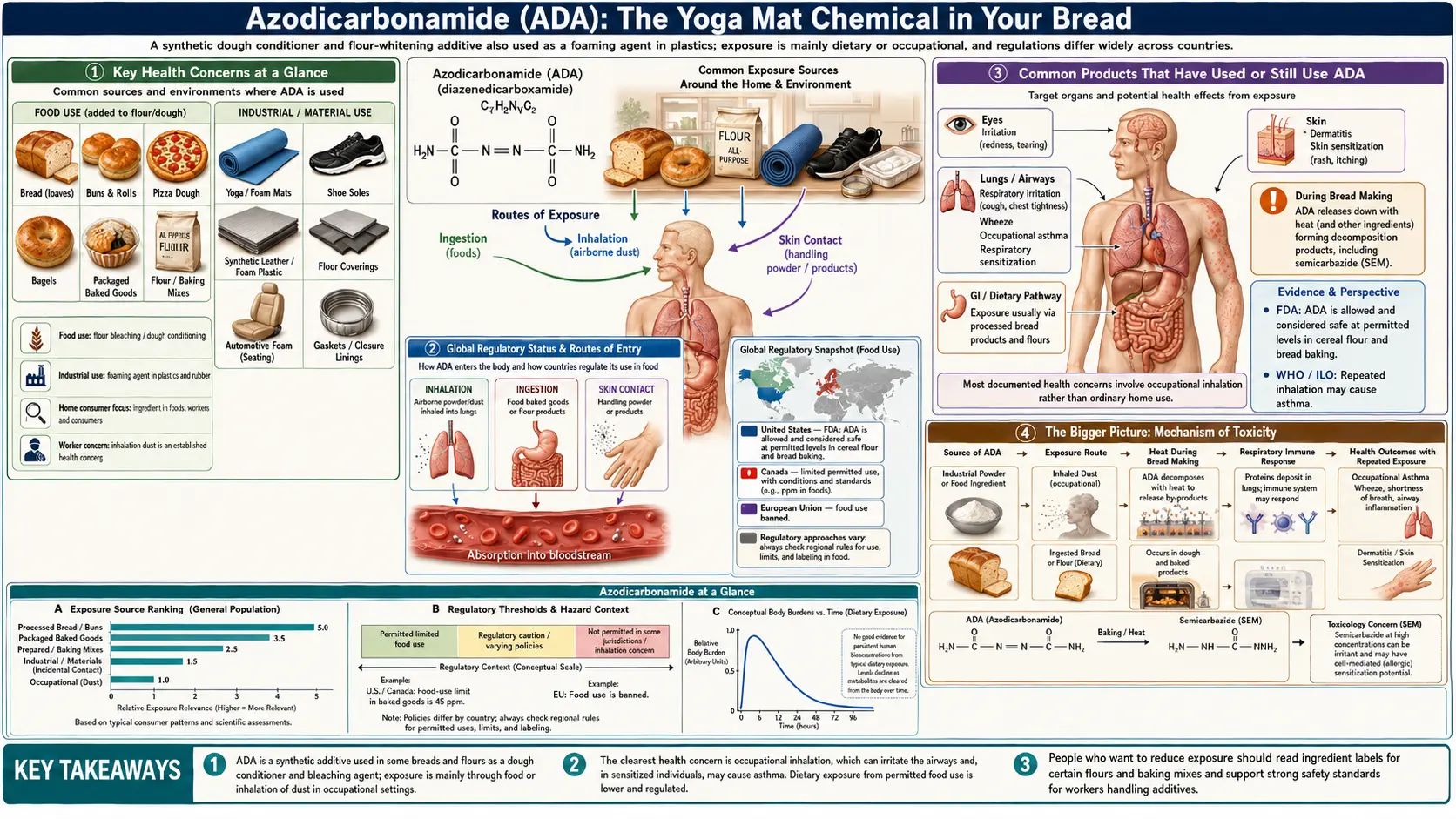
Azodicarbonamide, commonly abbreviated as ADA, is a synthetic chemical compound used in the United States as a dough conditioner and flour bleaching agent in bread and other baked goods. What makes ADA particularly noteworthy — and disturbing — is its dual identity: the same chemical that is added to the bread you eat is also used industrially as a foaming agent in the production of yoga mats, shoe soles, floor mats, and foam plastics. When this fact gained widespread public attention in 2014, it sparked a consumer backlash that forced several major food companies to reformulate. Yet ADA remains legal and in use in the United States, classified as GRAS (Generally Recognized As Safe) by the FDA, while the European Union, Australia, Singapore, and other countries have banned it outright.
When heated during baking, ADA breaks down into semicarbazide (a rodent carcinogen) and trace amounts of urethane (ethyl carbamate, IARC Group 2A — probably carcinogenic to humans). The World Health Organization's Joint FAO/WHO Expert Committee on Food Additives (JECFA) and the European Food Safety Authority (EFSA) have both identified these breakdown products as substances of concern, yet the FDA permits ADA at up to 45 parts per million in flour.
Table of Contents
- Key Health Concerns at a Glance
- What Is Azodicarbonamide?
- Health Concerns
- Decomposition Products: The Real Danger
- Respiratory Health Effects
- Other Health Concerns
- Global Regulatory Status
- The Subway Controversy of 2014
- Common Products That Have Used or Still Use ADA
- Safe Alternatives to ADA
- How to Avoid ADA
- The Bigger Picture
- Research Papers and References
- Connections
- Featured Videos
Key Health Concerns at a Glance
- Carcinogenic breakdown products — Thermal decomposition during baking produces semicarbazide (SEM) and traces of urethane (ethyl carbamate), which IARC classifies as Group 2A ("probably carcinogenic to humans").
- Occupational asthma and respiratory sensitization — The World Health Organization has documented that workplace exposure to ADA causes asthma, allergic respiratory reactions, and contact dermatitis in bakery and plastics workers.
- Genotoxicity — Semicarbazide has been shown in laboratory studies to cause DNA damage and has produced lung and blood-vessel tumors in rodents.
- Endocrine and immune concerns — Animal studies suggest semicarbazide may impair immune function and reproductive parameters at sub-acute doses.
- Banned across the developed world — The European Union, United Kingdom, Australia, New Zealand, and Singapore all prohibit ADA as a food additive; the United States remains an outlier with GRAS approval up to 45 ppm.
- Exposure is chronic and cumulative — Bread, hamburger buns, hot-dog rolls, frozen dough, tortillas, and fast-food bread products consumed daily combine into meaningful lifetime exposure.
- Safe alternatives exist and are already in use — Ascorbic acid (vitamin C), enzyme-based dough improvers, and longer fermentation produce excellent bread without ADA, as practiced throughout Europe.
- Worker paradox — The same compound that requires respirators, ventilation, and skin protection in factories handling it is deemed safe to bake into food.
What Is Azodicarbonamide?
- Chemical identity — azodicarbonamide (chemical formula C2H4N4O2) is a yellow to orange-red crystalline powder. It is a synthetic chemical that does not occur naturally in any food.
- Function in bread — ADA serves two purposes in baking: it acts as a dough conditioner (strengthening gluten and improving dough elasticity) and as a bleaching agent (whitening flour to produce whiter bread). It accelerates the flour aging process, which would otherwise take weeks naturally.
- Function in industrial products — in its industrial application, ADA is used as a chemical blowing agent. When heated, it decomposes and releases gases that create the foamy, spongy texture in products like yoga mats, shoe soles, flip-flops, athletic mats, gaskets, weather stripping, and industrial foam padding.
- The connection — the same chemical property that makes ADA useful in foam production (gas generation when heated) is what makes it functional in bread (the gases help dough rise and create a lighter texture). In both cases, ADA is fundamentally doing the same thing: creating bubbles.
Health Concerns
Decomposition Products: The Real Danger
While ADA itself has some direct toxicity concerns, the greater danger lies in what it breaks down into when heated during baking. ADA's thermal decomposition products include chemicals with established carcinogenic and toxic properties.
- Semicarbazide (SEM) — one of the primary decomposition products of ADA when heated. Semicarbazide has been identified as a carcinogen, causing lung tumors and blood vessel tumors in animal studies. It has also been shown to be genotoxic (capable of damaging DNA). The European Food Safety Authority (EFSA) has identified semicarbazide as a substance of concern due to its carcinogenic potential.
- Urethane (ethyl carbamate) — ADA decomposition during baking can produce urethane, which is classified by IARC as a Group 2A carcinogen ("probably carcinogenic to humans"). Urethane is known to cause cancer in multiple organ systems in animal studies, including the lungs, liver, blood vessels, and lymphatic system.
- Biurea — another ADA decomposition product that persists in the finished bread product. While less studied than semicarbazide, biurea raises concerns about chronic exposure effects.
Respiratory Health Effects
- Occupational asthma — ADA is a recognized respiratory sensitizer. Workers in factories that handle ADA (both bakeries and industrial foam production facilities) have significantly elevated rates of occupational asthma. The World Health Organization has documented that exposure to ADA in the workplace can cause asthma, allergic respiratory reactions, and dermatitis.
- Respiratory irritation — inhaling ADA dust causes irritation of the respiratory tract, coughing, and shortness of breath. The Material Safety Data Sheet (MSDS) for ADA classifies it as a respiratory hazard.
- Skin sensitization — occupational exposure to ADA can cause allergic skin reactions (contact dermatitis) in sensitized individuals.
- The worker paradox — the same substance that factory workers must be protected from with masks, ventilation systems, and protective equipment is considered safe to eat by the FDA when baked into bread.
Other Health Concerns
- Immune system effects — semicarbazide (the ADA breakdown product) has been shown to affect immune function in animal studies, potentially compromising the body's ability to fight infections and disease.
- Reproductive effects — animal studies have suggested that semicarbazide exposure may affect reproductive function, though more research is needed in this area.
- Cumulative exposure — ADA is used in a wide range of bread products consumed daily by millions of Americans. The cumulative exposure to ADA's decomposition products (semicarbazide and urethane) from daily bread consumption has not been adequately studied.
Global Regulatory Status
Countries and Regions That Have Banned ADA
- European Union — ADA is banned as a food additive throughout the EU. Companies that use ADA in food face fines of up to 450,000 euros. The EU ban is based on the precautionary principle and concerns about ADA's decomposition products, particularly semicarbazide.
- Australia — Food Standards Australia New Zealand (FSANZ) does not permit ADA as a food additive. It is classified as a non-permitted substance in food products.
- Singapore — ADA is banned in food under the Singapore Food Regulations, with penalties for non-compliance including fines and imprisonment.
- United Kingdom — banned as part of EU regulations, and the ban has been maintained post-Brexit.
- Many other countries — ADA is not permitted in food in most developed countries, making the United States an outlier in allowing its use.
US FDA Position
- GRAS status — the FDA considers ADA to be Generally Recognized As Safe for use as a dough conditioner at levels up to 45 parts per million (ppm) in flour. This GRAS determination has not been meaningfully revisited despite growing evidence of concerns.
- No plans to ban — as of now, the FDA has not initiated any rulemaking to restrict or ban ADA in food, despite the actions taken by other countries and the documented health concerns.
- The FDA's justification — the agency maintains that ADA is safe at the low concentrations used in bread, and that the amounts of decomposition products formed during baking are below levels that would cause health effects. Critics argue that this assessment does not account for cumulative daily exposure across multiple bread products.
The Subway Controversy of 2014
ADA became a household topic in February 2014 when food blogger Vani Hari (known as the "Food Babe") launched a petition calling on Subway to remove ADA from its bread. The petition went viral after it highlighted the fact that the same chemical in Subway's bread was used to make yoga mats and shoe soles.
- Subway's response — within days of the petition gaining widespread media attention, Subway announced it was in the process of removing ADA from its bread formulations. The company stated that it had already been working on a transition and would complete the removal.
- Industry ripple effect — Subway's announcement prompted several other food companies to review and remove ADA from their products. The publicity surrounding the issue raised consumer awareness about dough conditioners for the first time.
- Industry pushback — the American Bakers Association and some food scientists criticized the campaign, arguing that the "yoga mat chemical" framing was misleading and that ADA was safe at approved levels. However, they could not explain why the EU, Australia, and Singapore had reached different conclusions.
- Lasting impact — while many major brands removed ADA following the controversy, it remains in use by many smaller bakeries and food manufacturers. The episode demonstrated the power of consumer advocacy but also the limitations of relying on voluntary industry action rather than regulatory mandates.
Common Products That Have Used or Still Use ADA
- Commercial white bread — many brands of mass-produced white bread use or have used ADA as a dough conditioner. Always check ingredient labels for "azodicarbonamide."
- Hamburger and hot dog buns — frequently contain ADA, particularly store-brand and fast food varieties.
- Fast food bread products — beyond Subway (which removed it), many other fast food chains use bread products that contain or have contained ADA, including some products from McDonald's, Burger King, Wendy's, Arby's, and others.
- Frozen bread and dough products — some frozen bread, pizza dough, and dinner roll products contain ADA.
- Tortillas and wraps — some flour tortilla brands use ADA as a dough conditioner.
- Breakfast pastries — certain toaster pastries and packaged breakfast items contain ADA.
Safe Alternatives to ADA
As with potassium bromate, the argument that ADA is necessary for producing quality bread is false. Bakeries throughout Europe, Australia, and the rest of the world produce excellent bread without it. Several effective alternatives exist:
- Ascorbic acid (Vitamin C) — an effective dough strengthener and the most widely used ADA replacement. It achieves similar results through a similar oxidation mechanism, without the toxic decomposition products. It is natural, inexpensive, and has no adverse health effects.
- Enzyme-based improvers — naturally derived enzymes such as glucose oxidase and lipase can improve dough strength and bread volume without synthetic chemicals.
- Longer mixing and fermentation — adjusting the baking process to include longer mixing times and fermentation periods can achieve the dough strength and texture that ADA provides, without any chemical additives.
- Calcium peroxide — a milder oxidizing agent that can serve as a flour improver with a better safety profile than ADA.
- DATEM (diacetyl tartaric acid ester of mono- and diglycerides) — a dough strengthener used as an alternative to ADA, though it is also a synthetic additive. It is permitted in both the US and EU.
How to Avoid ADA
- Read ingredient labels — look for "azodicarbonamide" or "ADA" on bread and baked goods labels. If it appears, choose a different product.
- Choose organic bread — USDA organic standards prohibit the use of ADA, so organic bread products are always ADA-free.
- Buy from artisan bakeries — most artisan and small-batch bakeries do not use ADA. Ask about their ingredients if you are unsure.
- Bake your own bread — home baking with unbromated, unbleached flour ensures complete control over ingredients. Basic bread requires only flour, water, yeast, and salt.
- Look for "no ADA" or "no dough conditioners" claims — some brands now market their products as ADA-free in response to consumer demand.
- Choose European imports — bread and baked goods produced in the EU are guaranteed to be ADA-free due to the EU ban.
The Bigger Picture
Azodicarbonamide is yet another example of a substance that is banned in most of the developed world but remains legal in American food. The pattern is consistent: the EU applies the precautionary principle and acts on early evidence of risk, while the FDA maintains that a substance is safe until overwhelming proof of harm forces action — action that often comes decades too late.
The fact that a chemical used to make yoga mats is considered safe to put in bread reveals a fundamental problem with how the United States evaluates food safety. When the same substance requires workplace safety protections for factory workers handling it but is freely added to bread eaten daily by children, something is deeply wrong with the regulatory framework.
Until the FDA acts, consumers must protect themselves by reading labels, choosing ADA-free products, and supporting legislative efforts to ban this unnecessary and potentially dangerous chemical from the American food supply.
Research Papers and References
The following sources document the health concerns surrounding azodicarbonamide and its thermal decomposition products.
Semicarbazide and Urethane (Ethyl Carbamate)
- PubMed — semicarbazide + azodicarbonamide + bread (search)
- PubMed — ethyl carbamate / urethane carcinogenicity (search)
- IARC Monographs — Identification of Carcinogenic Hazards to Humans (urethane is classified Group 2A in Vol 96)
Occupational Asthma and Respiratory Sensitization
- PubMed — azodicarbonamide occupational asthma (search)
- PubMed — azodicarbonamide respiratory sensitization (search)
Regulatory Assessments
- European Food Safety Authority (EFSA) — semicarbazide risk assessments
- FDA Food Additive Status List
External Authoritative Resources
- Center for Science in the Public Interest (CSPI) — Chemical Cuisine guide to food additives
- IARC Monographs on the Identification of Carcinogenic Hazards to Humans
- European Food Safety Authority (EFSA)
- NTP Report on Carcinogens (National Toxicology Program)
Connections
- All Toxins
- Food Additives
- Potassium Bromate
- Brominated Vegetable Oil
- BHA
- BHT
- Banned Additives
- BHA and BHT
- Sodium Nitrite
- Anti Inflammatory Diet
- Detox Protocols
- Asthma
- Vitamin C
- Cancer
- Carrageenan
- Polysorbate 80
- US vs EU Food Safety