BHT (Butylated Hydroxytoluene): Synthetic Antioxidant in Your Food
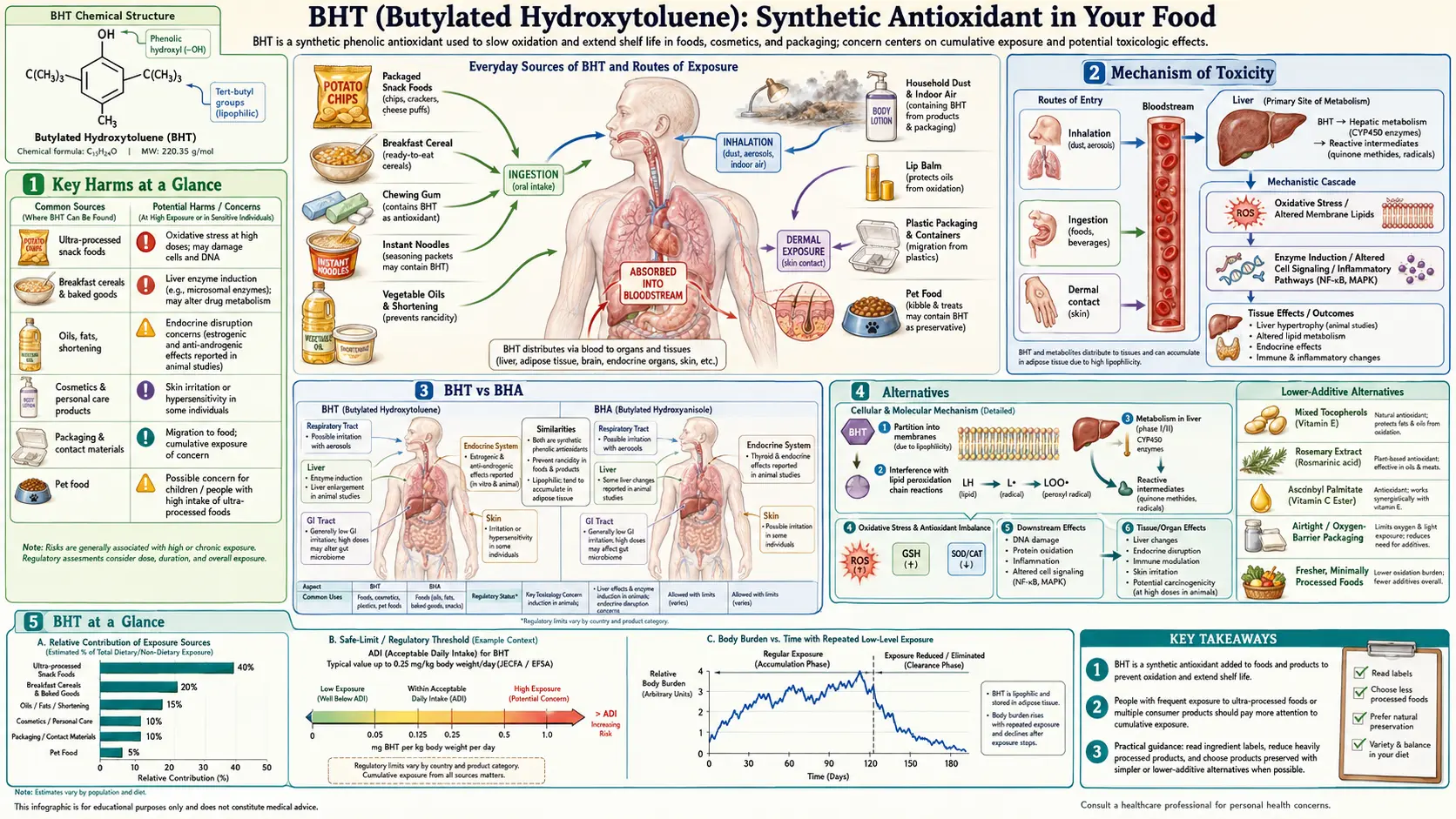
Table of Contents
Key Findings at a Glance
- Tumour effects depend on the model — In rats, BHT promoted bladder tumours started by either of two chemical carcinogens and thyroid tumours started by methylnitrosourea, but inhibited ear-duct tumours (Ito 1986); in mice it enhanced spontaneous liver tumours in one strain but not another (Witschi 1986). The 1979 US government feeding bioassay concluded that BHT was not carcinogenic for the rats and mice tested, and IARC places BHT in Group 3 (not classifiable).
- Lung injury in mice — BHT causes lung injury followed by inflammation in mice (Bauer 2001); laboratory work links this to a reactive metabolite that mouse lung tissue forms and rat lung tissue does not (Bolton 1990).
- Blood clotting and kidneys — High dietary doses reduced blood-clotting factors and caused haemorrhages in rats, and caused kidney damage in mice (Takahashi 1986; Takahashi 1992).
- Liver — Rats fed BHT had increased liver weight, and acute doses of 0.5 to 1.0 g/kg caused some liver and kidney damage in male rats (Lanigan 2002).
- Thyroid — Rats fed BHT had heavier thyroid glands and higher thyroid iodine uptake (Søndergaard 1982).
- Hormone activity in cell tests — BHT acted as a weak anti-androgen in reporter-cell assays (Schrader 2000; Pop 2016).
- Human data — A Dutch cohort study of 120,852 adults found no significant association between usual dietary intake of BHA or BHT and stomach cancer (Botterweck 2000). BHT has been detected in human fat, serum, urine, breast milk and fingernails (Liu 2020).
- Packaging — US rules allow BHT to migrate into food from packaging up to 0.005% of the food (21 CFR 181.24).
Overview
BHT, or butylated hydroxytoluene, is a synthetic phenolic antioxidant with the chemical name 2,6-di-tert-butyl-4-methylphenol. It is listed on food labels as E321 in the European Union and is used to slow the oxidation of fats, oils and fat-containing foods. It is made from petrochemical starting materials.
BHT works by donating a hydrogen atom to free radicals generated during lipid oxidation, interrupting the chain reaction that makes fats rancid and off-flavoured. This extends the shelf life of fat-containing foods, which is why it is used in processed foods, as well as in food packaging, cosmetics and industrial products.
BHT is often used together with BHA (butylated hydroxyanisole), another synthetic antioxidant; several US food-additive limits are set for the two combined (21 CFR 172.115). Both are fat-soluble.
BHT is permitted within set limits in the United States, the European Union and Japan. Most of the evidence of harm comes from animal and cell studies, many at high doses, and in 2026 the US Food and Drug Administration (FDA) placed BHT on its list of food chemicals under review.
Sources
US regulations and published studies describe these uses of BHT:
- Breakfast cereals — US regulations permit BHA and BHT in dry breakfast cereals at up to 50 ppm combined. Some cereals list BHT in the ingredients; others carry a statement such as “BHT added to packaging material to preserve freshness.”
- Potato products — The same regulation sets limits for dehydrated potato shreds, potato flakes, potato granules and sweetpotato flakes (21 CFR 172.115).
- Chewing gum — BHT is one of the antioxidants permitted in chewing gum base, with total antioxidant content not over 0.1% (21 CFR 172.615).
- Fats, oils and shortenings — BHT is generally recognized as safe in food when total antioxidants are not over 0.02% of the fat or oil content (21 CFR 182.3173), and emulsion stabilizers for shortenings may contain up to 200 ppm of BHA and BHT combined (21 CFR 172.115).
- Fatty dry cereal-based foods — A Spanish study identified BHT in the packaging of fatty cereal-based dry foods and measured it in the foods themselves (Lestido-Cardama 2020).
- Food packaging — BHT is listed among antioxidants that may migrate into food from food-packaging material (21 CFR 181.24; see the packaging section below).
- Cosmetics and personal care products — BHT is used in a wide range of cosmetic formulations at concentrations from 0.0002% to 0.5%; it penetrates the skin, but the relatively small amount absorbed remains mainly in the skin (Lanigan 2002).
- Industrial products and dust — Synthetic phenolic antioxidants such as BHT are used in industrial and commercial products and have been found in indoor dust, outdoor air particles, sea sediment and river water (Liu 2020).
A 2020 review reported that BHT has been detected in human fat tissue, serum, urine, breast milk and fingernails, and listed food intake, dust ingestion and personal-care products as exposure pathways (Liu 2020). In a Canadian study, BHT was measured in human body fat at 0.12 ppm, and in rat and monkey feeding studies it showed no progressive accumulation over time (Conacher 1986).
How BHT Is Metabolised
Swallowed BHT is metabolised; the major metabolites in urine are BHT’s carboxylic acid and its glucuronide (Lanigan 2002). Cytochrome P450 enzymes can also oxidise BHT to reactive products, and mechanism research has focused on these rather than on BHT itself:
- BHT quinone methide (QM) — formed by oxidation of BHT in liver microsomes; it binds covalently to glutathione and protein thiols (Bolton 1990). In rats it reduced clotting factors and caused haemorrhages, and it was proposed as the active metabolite behind BHT-induced bleeding (Takahashi 1988).
- Hydroxy-quinone methide (QM-OH) — formed after hydroxylation of one tert-butyl group; it reacted with glutathione faster than QM. Mouse liver and lung microsomes formed it, while rat microsomes formed only traces in the liver and none in the lung, which the authors proposed as the explanation for why BHT lung toxicity is seen in mice (Bolton 1990; Bolton 1991).
- BHT-quinone and BHT hydroperoxide — in test-tube and cultured-cell experiments these metabolites damaged DNA in the presence of copper and caused the DNA fragmentation typical of apoptosis, while the metabolite BHT-aldehyde did not (Oikawa 1998).
Metabolic routes of BHT reported in rat and mouse studies (Lanigan 2002; Bolton 1990; Bolton 1991; Takahashi 1988).
In mice, BHT causes lung injury followed by an inflammatory response, and given repeatedly after a carcinogen it increases the number of lung tumours in certain inbred strains; how strongly each strain’s lungs became inflamed tracked how susceptible it was to this tumour promotion (Bauer 2001).
In rats, short-term repeated high doses produced liver toxicity, and lower doses in subchronic feeding studies increased liver weight and decreased the activity of several liver enzymes (Lanigan 2002).
Rats fed BHT at 500 or 5,000 ppm in the diet for up to 90 days had heavier thyroid glands and increased thyroid iodine uptake, while the half-life of thyroxine was unchanged or slightly prolonged; the authors could not suggest how the effect arises (Søndergaard 1982).
A 1993 review noted no indication that BHA or BHT damage genes directly and concluded that the published findings fit both acting as tumour promoters rather than initiators (Kahl 1993). EFSA’s 2012 re-evaluation concluded that BHT is not of concern for genotoxicity and that any carcinogenicity would have a threshold. The DNA damage reported for BHT metabolites in test-tube experiments (Oikawa 1998) is a separate laboratory finding.
Health Effects
Most of the evidence on BHT comes from animal and cell studies, many at high doses; human data are limited. The following effects have been reported:
- Liver and kidneys — Acute doses of 0.5 to 1.0 g/kg caused some kidney and liver damage in male rats (Lanigan 2002), and mice fed 1.35–5% BHT developed dose-related kidney damage (Takahashi 1992).
- Blood clotting — Rats fed 1.2% BHT in the diet had falling levels of clotting factors II, VII, IX and X within days, and haemorrhages (Takahashi 1986). Mice and guinea pigs did not develop this clotting defect (Takahashi 1992).
- Lung (mice) — Lung injury and inflammation, and increased lung-tumour numbers after a carcinogen in susceptible strains (Bauer 2001).
- Thyroid — Heavier thyroid glands and higher iodine uptake in rats (Søndergaard 1982); the earlier EU Scientific Committee for Food based its acceptable daily intake on thyroid, reproductive and blood effects in the rat.
- Tumours — Promotion of chemically started bladder and thyroid tumours in rats, inhibition of ear-duct tumours (Ito 1986), and strain-dependent enhancement of spontaneous liver tumours in mice (Witschi 1986). In the 1979 feeding bioassay, lung tumours were more frequent in low-dose female mice (16/46 against 1/20 controls) but not in high-dose females (7/50), and the report concluded they could not clearly be related to BHT; no tumours were increased in rats. IARC places BHT in Group 3.
- Reproduction and development — A 2002 cosmetic-ingredient safety review concluded that BHT was not a reproductive or developmental toxin in animals (Lanigan 2002). Two two-generation rat studies found a no-observed-adverse-effect level of 25 mg/kg body weight per day, which EFSA used to set its acceptable daily intake.
- Skin — In a predictive clinical test, undiluted (100%) BHT was a mild irritant and a moderate sensitizer; in provocative skin tests, 1–2% BHT produced positive reactions in a small number of patients. The same review concluded that BHT is safe as used in cosmetics at the low concentrations in use (Lanigan 2002).
- Hormone activity in cell tests — BHT partially inhibited androgen-receptor activation in human reporter cells (Schrader 2000) and was a weak anti-androgen in MDA-kb2 cells (Pop 2016).
- Studies in people — In the Netherlands Cohort Study (120,852 men and women aged 55–69, 6.3 years of follow-up), mean BHT intake was 351 micrograms per day, and no significant association with stomach cancer was found (Botterweck 2000). The 2007 Southampton trial that found food-additive mixtures increased hyperactivity in children tested artificial colours and the preservative sodium benzoate, not BHT (McCann 2007).
Other biological activities have also been reported in the laboratory: BHT inactivated lipid-containing mammalian and bacterial viruses (Snipes 1975), and in some animal models it was associated with fewer tumours (Lanigan 2002). These laboratory findings do not show a benefit in people.
BHT vs BHA
BHT and BHA are both alkylated phenols and are often used together, but the evidence about them differs:
- Structure — BHA is a mixture of two isomers, 3-tert-butyl-4-hydroxyanisole and 2-tert-butyl-4-hydroxyanisole; BHT is 2,6-di-tert-butyl-4-methylphenol.
- Carcinogenicity classification — The US National Toxicology Program lists BHA as “reasonably anticipated to be a human carcinogen,” and IARC classifies it as Group 2B (possibly carcinogenic to humans), on the basis of forestomach tumours in rodents — an organ humans do not have. BHT is in IARC Group 3 (not classifiable) and is not listed in the NTP Report on Carcinogens.
- Lung and blood effects — A 1993 review noted that specific lung toxicity had been seen only with BHT, and that at high doses BHA, BHT and vitamin E all impaired blood clotting in animals, explained by antagonism with vitamin K (Kahl 1993).
- Combined use — US food-additive limits for cereals, potato products and shortening emulsifiers apply to BHA and BHT combined (21 CFR 172.115).
- Regulatory differences — EFSA set an acceptable daily intake of 1.0 mg/kg body weight per day for BHA (2011) and 0.25 mg/kg for BHT (2012). Both appear on Japan’s List of Designated Additives. FDA’s 2026 review list shows BHA under scientific assessment and BHT at an earlier review-of-information stage.
Both have been measured at low levels in human body fat (0.01 ppm BHA and 0.12 ppm BHT in Canadian samples); in rat and monkey feeding studies neither showed progressive accumulation over time (Conacher 1986).
Regulatory Status
BHT is permitted, with limits, in the major jurisdictions, and it is on FDA’s 2026 list of chemicals under review:
- United States (GRAS) — BHT is listed as generally recognized as safe for use in food when the total content of antioxidants is not over 0.02% of the fat or oil content, used in accordance with good manufacturing practice (21 CFR 182.3173).
- United States (food additive) — 21 CFR 172.115 permits BHT, alone or with BHA, in named foods at limits for the two combined: 50 ppm in dry breakfast cereals, dehydrated potato shreds, potato flakes and sweetpotato flakes, 10 ppm in potato granules, and 200 ppm in emulsion stabilizers for shortenings. Chewing gum base may contain up to 0.1% antioxidants (21 CFR 172.615), and BHT migrating from packaging is limited to 0.005% of the food (21 CFR 181.24).
- FDA review (2026) — FDA’s List of Select Chemicals in the Food Supply Under FDA Review (updated 2 October 2026) shows BHT at the review-of-information stage, with a request for information planned.
- European Union — BHT (E 321) is authorised under Regulation (EC) No 1333/2008 only in specified food categories with maximum levels. EFSA’s 2012 re-evaluation set an acceptable daily intake (ADI) of 0.25 mg/kg body weight per day, raised from the earlier EU figure of 0.05 mg/kg, and noted that children’s exposure at the 95th percentile exceeded the ADI in some European countries (Finland and the Netherlands).
- JECFA — The joint FAO/WHO Expert Committee on Food Additives set an ADI of 0–0.3 mg/kg body weight per day (latest evaluation 1996).
- Japan — Butylated hydroxytoluene appears on Japan’s List of Designated Additives, the list of synthetic additives permitted in food.
- IARC — BHT is in Group 3, not classifiable as to its carcinogenicity to humans.
- US National Toxicology Program — The 1979 bioassay fed BHT at 3,000 or 6,000 ppm to F344 rats and B6C3F1 mice and concluded that, under its conditions, BHT was not carcinogenic for either species. BHT is not listed in the NTP Report on Carcinogens.
- Organic foods (US) — BHT is not on the USDA National List of synthetic substances allowed in organic processed foods (7 CFR 205.605), so it is not permitted as an ingredient in certified organic foods.
BHT in Food Packaging
BHT is also used in food-packaging materials. US rules list it among antioxidants that may migrate from food-packaging material into food, with a limit of 0.005% in the food (21 CFR 181.24). This use is distinct from adding BHT directly to the food. Some cereal packages carry a statement that BHT was added to the packaging material to preserve freshness.
Migration into food has been measured. A Spanish study identified BHT in the packaging of fatty cereal-based dry foods, quantified it in composite food samples prepared to match what children and teenagers eat, and estimated that the exposure of 1–17-year-olds did not exceed the established tolerable daily intake (Lestido-Cardama 2020).
A 2020 review lists food intake, household dust and personal-care products as the human exposure pathways for synthetic phenolic antioxidants such as BHT, and notes that breast milk may be an important exposure pathway for breastfed infants (Liu 2020).
Alternatives
Other antioxidants used for the same purpose in fats and fatty foods include:
- Tocopherols (vitamin E, E306–E309) — Appear on labels as “mixed tocopherols”; the USDA organic National List allows tocopherols derived from vegetable oil when rosemary extracts are not a suitable alternative (7 CFR 205.605).
- Rosemary extract (E392) — A plant-derived antioxidant containing carnosic acid and carnosol, used in place of BHA and BHT.
- Ascorbic acid and ascorbyl palmitate (E300, E304) — Water-soluble and fat-soluble forms of vitamin C used as antioxidants.
- Green tea catechins — Epigallocatechin gallate (EGCG) and related polyphenols from green tea have been studied as antioxidants in food applications.
A 1993 review compared BHA, BHT and vitamin E: all three impaired blood clotting in animals at high doses, vitamin E was not carcinogenic, and the authors concluded that the concentrations of BHA and BHT used in food, drugs and cosmetics are probably harmless (Kahl 1993). Questions about individual exposure are for a clinician.
Key Research Papers
Key research papers and authoritative sources. Links resolve to DOI, PubMed, or the issuing agency.
- Lanigan RS, Yamarik TA. Final report on the safety assessment of BHT. Int J Toxicol. 2002;21 Suppl 2:19-94. — doi:10.1080/10915810290096513
- Witschi HP. Enhanced tumour development by butylated hydroxytoluene (BHT) in the liver, lung and gastro-intestinal tract. Food Chem Toxicol. 1986;24(10-11):1127-1130. — doi:10.1016/0278-6915(86)90298-x
- Thompson DC, Perera K, London R. Quinone methide formation from para isomers of methylphenol (cresol), ethylphenol, and isopropylphenol: relationship to toxicity. Chem Res Toxicol. 1995;8(1):55-60. — doi:10.1021/tx00043a007 (Editorial note: this study concerns simpler para-alkylphenols, not BHT itself.)
- Verhagen H, Schilderman PA, Kleinjans JC. Butylated hydroxyanisole in perspective. Chem Biol Interact. 1991;80(2):109-134. — doi:10.1016/0009-2797(91)90019-4 (Editorial note: a review of BHA.)
- Ito N, Hirose M, Fukushima S, et al. Studies on antioxidants: their carcinogenic and modifying effects on chemical carcinogenesis. Food Chem Toxicol. 1986;24(10-11):1071-1082. — doi:10.1016/0278-6915(86)90291-7
- EFSA Panel on Food Additives and Nutrient Sources. Re-evaluation of butylated hydroxytoluene BHT (E 321) as a food additive. EFSA J. 2012;10(3):2588. — doi:10.2903/j.efsa.2012.2588
- National Toxicology Program (National Cancer Institute Carcinogenesis Testing Program). Bioassay of butylated hydroxytoluene (BHT) for possible carcinogenicity. Natl Cancer Inst Carcinog Tech Rep Ser. 1979;150:1-131. — PubMed PMID: 12799712 (Editorial note: corrected in October 2026; this entry previously cited an “NTP TR 459, 1998” BHT study, which could not be found. The BHT bioassay in F344 rats and B6C3F1 mice is Technical Report 150.)
- Gharavi N, El-Kadi AO. tert-Butylhydroquinone is a novel aryl hydrocarbon receptor ligand. Drug Metab Dispos. 2005;33(3):365-372. — doi:10.1124/dmd.104.002253 (Editorial note: concerns TBHQ, not BHT.)
- Oikawa S, Nishino K, Oikawa S, et al. Oxidative DNA damage and apoptosis induced by metabolites of butylated hydroxytoluene. Biochem Pharmacol. 1998;56(3):361-370. — doi:10.1016/s0006-2952(98)00037-9
- Malkinson AM. The genetic basis of susceptibility to lung tumors in mice. Toxicology. 1989;54(3):241-271. — doi:10.1016/0300-483x(89)90062-0
- Kahl R, Kappus H. Toxicology of the synthetic antioxidants BHA and BHT in comparison with the natural antioxidant vitamin E. Z Lebensm Unters Forsch. 1993;196(4):329-338. — PubMed PMID: 8493816
- Strickland PT, Kensler TW. Modulation of aflatoxin B1-induced genotoxicity in mice by butylated hydroxytoluene. Mutat Res. 1981;88(3):261-270. (Editorial note: no record matching this citation was found in PubMed or Crossref when checked in October 2026; nothing on this page relies on it.)
- van Esch GJ. Toxicology of toluene diisocyanate. Arch Toxicol Suppl. 1986;9:136-144. (Editorial note: no paper with this title was found in PubMed or Crossref when checked in October 2026, and the DOI formerly given here resolves to an unrelated paper in the same volume; nothing on this page relies on it.)
- Bauer AK, Dwyer-Nield LD, Malkinson AM. High BHT and low NNK-induced lung tumor multiplicities in mice are associated with decreased levels of oxidized DNA bases. Exp Lung Res. 2000;26(7):491-507. (Editorial note: no record matching this citation was found in PubMed or Crossref when checked in October 2026; the same group’s verified 2001 paper on BHT and lung inflammation is listed below.)
- Nair B. Final report on the safety assessment of benzyl alcohol, benzoic acid, and sodium benzoate. Int J Toxicol. 2001;20 Suppl 3:23-50. — doi:10.1080/10915810152630729 (Editorial note: concerns benzyl alcohol and benzoates, not BHT.)
- Botterweck AA, Verhagen H, Goldbohm RA, Kleinjans J, van den Brandt PA. Intake of butylated hydroxyanisole and butylated hydroxytoluene and stomach cancer risk: results from analyses in the Netherlands Cohort Study. Food Chem Toxicol. 2000;38(7):599-605. — doi:10.1016/s0278-6915(00)00042-9
- Robards K, Prenzler PD, Tucker G, et al. Phenolic compounds and their role in oxidative processes in fruits. Food Chem. 1999;66(4):401-436. — doi:10.1016/S0308-8146(99)00093-X (Editorial note: concerns natural phenolic compounds in fruit, not BHT.)
- Yamamoto T, Imai T, Hasegawa R, et al. Effects of combined administration of antioxidants on the rat thyroid. Toxicol Lett. 1995;75(1-3):161-168. (Editorial note: no record matching this citation was found in PubMed or Crossref when checked in October 2026; the thyroid findings on this page rest on Søndergaard 1982, listed below.)
- Bolton JL, Sevestre H, Ibe BO, Thompson JA. Formation and reactivity of alternative quinone methides from butylated hydroxytoluene: possible explanation for species-specific pneumotoxicity. Chem Res Toxicol. 1990;3(1):65-70. — PubMed PMID: 2131827
- Bolton JL, Thompson JA. Oxidation of butylated hydroxytoluene to toxic metabolites. Factors influencing hydroxylation and quinone methide formation by hepatic and pulmonary microsomes. Drug Metab Dispos. 1991;19(2):467-472. — PubMed PMID: 1676656
- Bauer AK, Dwyer-Nield LD, Keil K, Koski K, Malkinson AM. Butylated hydroxytoluene (BHT) induction of pulmonary inflammation: a role in tumor promotion. Exp Lung Res. 2001;27(3):197-216. — PubMed PMID: 11293324
- Søndergaard D, Olsen P. The effect of butylated hydroxytoluene (BHT) on the rat thyroid. Toxicol Lett. 1982;10(2-3):239-244. — PubMed PMID: 7080091
- Takahashi O. Feeding of butylated hydroxytoluene to rats caused a rapid decrease in blood coagulation factors II (prothrombin), VII, IX and X. Arch Toxicol. 1986;58(3):177-181. — PubMed PMID: 3964081
- Takahashi O. 2,6-di-tert-butyl-4-methylene-2,5-cyclohexadienone (BHT quinone methide): an active metabolite of BHT causing haemorrhages in rats. Arch Toxicol. 1988;62(4):325-327. — PubMed PMID: 3240097
- Takahashi O. Haemorrhages due to defective blood coagulation do not occur in mice and guinea-pigs fed butylated hydroxytoluene, but nephrotoxicity is found in mice. Food Chem Toxicol. 1992;30(2):89-97. — PubMed PMID: 1555799
- Schrader TJ, Cooke GM. Examination of selected food additives and organochlorine food contaminants for androgenic activity in vitro. Toxicol Sci. 2000;53(2):278-288. — PubMed PMID: 10696776
- Pop A, Drugan T, Gutleb AC, Lupu D, Cherfan J, Loghin F, Kiss B. Individual and combined in vitro (anti)androgenic effects of certain food additives and cosmetic preservatives. Toxicol In Vitro. 2016;32:269-277. — PubMed PMID: 26812027
- Conacher HB, Iverson F, Lau PY, Page BD. Levels of BHA and BHT in human and animal adipose tissue: interspecies extrapolation. Food Chem Toxicol. 1986;24(10-11):1159-1162. — PubMed PMID: 3804117
- Liu R, Mabury SA. Synthetic phenolic antioxidants: a review of environmental occurrence, fate, human exposure, and toxicity. Environ Sci Technol. 2020;54(19):11706-11719. — PubMed PMID: 32915564
- Lestido-Cardama A, Rodríguez Bernaldo de Quirós A, Bustos J, Lomo ML, Paseiro Losada P, Sendón R. Estimation of dietary exposure to contaminants transferred from the packaging in fatty dry foods based on cereals. Foods. 2020;9(8):1038. — PubMed PMID: 32752291
- Snipes W, Person S, Keith A, Cupp J. Butylated hydroxytoluene inactivated lipid-containing viruses. Science. 1975;188(4183):64-66. — PubMed PMID: 163494
- McCann D, Barrett A, Cooper A, et al. Food additives and hyperactive behaviour in 3-year-old and 8/9-year-old children in the community: a randomised, double-blinded, placebo-controlled trial. Lancet. 2007;370(9598):1560-1567. — PubMed PMID: 17825405
Regulatory Documents
- FDA. List of Select Chemicals in the Food Supply Under FDA Review (updated 2 October 2026) — FDA
- 21 CFR 182.3173, butylated hydroxytoluene (GRAS chemical preservative) — eCFR
- 21 CFR 172.115, BHT (food additive permitted for direct addition to food) — eCFR
- 21 CFR 172.615, chewing gum base — eCFR
- 21 CFR 181.24, antioxidants migrating from food-packaging material — eCFR
- 7 CFR 205.605, nonagricultural substances allowed in organic processed products — eCFR
- Regulation (EC) No 1333/2008 on food additives, Annex II (E 321) — EUR-Lex
- Japan Food Chemical Research Foundation. List of Designated Additives — FFCR