Rapamycin: The mTOR Inhibitor at the Frontier of Longevity Medicine

Few compounds in the longevity field have generated as much sustained scientific interest as rapamycin (sirolimus), a macrocyclic antibiotic isolated in 1972 from Streptomyces hygroscopicus in soil samples collected on Rapa Nui (Easter Island), from which it takes its name. Originally developed as an antifungal and later repositioned as an immunosuppressant for organ-transplant recipients, rapamycin is now the most-studied pharmacological intervention that reliably extends maximum lifespan in every mammalian species tested, including genetically diverse laboratory mice.
This article explains what rapamycin is, how mTOR inhibition translates into slowed aging, what the human off-label evidence shows, what dosing approaches are used in longevity practice, and the risks and contraindications that belong in any honest discussion of a powerful pharmaceutical. It is not medical advice; rapamycin for non-approved indications should be prescribed and monitored by a qualified clinician.
Table of Contents
- Discovery and Approved Uses
- The mTOR Pathway and Why It Matters for Aging
- Animal Lifespan Data
- Human Off-Label Evidence
- Dosing Approaches in Longevity Practice
- Side Effects and Risks
- Who Should Not Use Rapamycin
- Natural Ways to Modulate mTOR
- Future Directions
- Connections
- Featured Videos
Discovery and Approved Uses
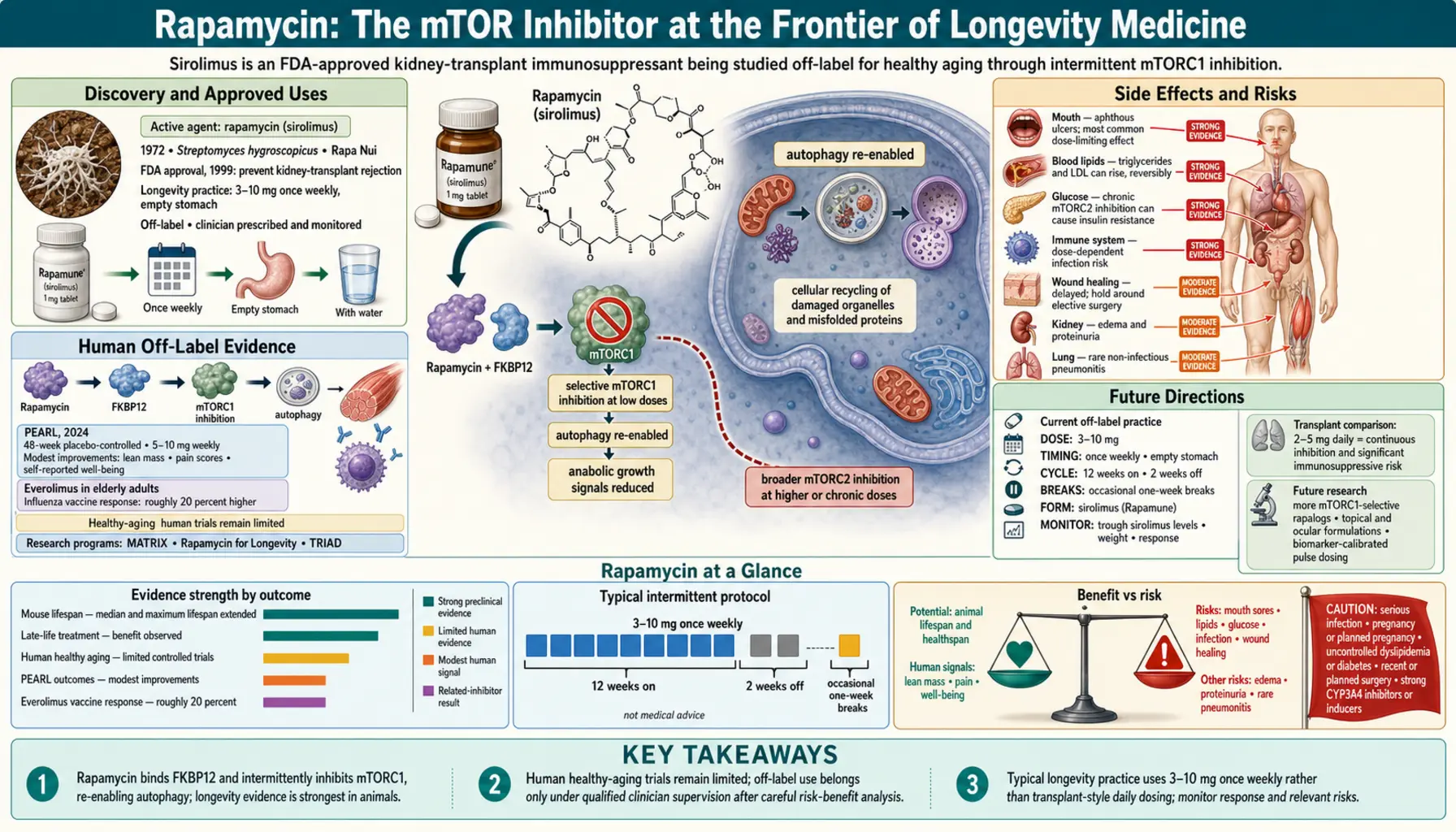
Rapamycin was isolated at Ayerst Laboratories in the early 1970s from Streptomyces hygroscopicus, a soil bacterium collected on Easter Island (Rapa Nui), and was developed largely through the persistence of the scientist Suren Sehgal. First studied as an antifungal, it proved to be a potent immune suppressant and was approved by the FDA in 1999 (as sirolimus, brand name Rapamune) to prevent kidney-transplant rejection; related rapalogs such as everolimus and temsirolimus are used in oncology, and sirolimus-eluting coronary stents reduce restenosis — the fuller story is told in the dedicated History article.
The mTOR Pathway and Why It Matters for Aging
mTOR is a serine/threonine kinase that integrates signals about nutrient availability (particularly amino acids and insulin), energy state, growth factors, and stress. When nutrients are abundant, mTOR drives anabolic processes: protein synthesis, cell growth, lipid synthesis, and cell proliferation. It simultaneously suppresses autophagy, the cellular recycling program that clears damaged organelles and misfolded proteins.
The hyperfunction theory of aging, articulated by Mikhail Blagosklonny, proposes that aging is not primarily driven by accumulated molecular damage but by continued growth-program activation after development is complete — in effect, a failure of the developmental pedal to lift off the accelerator. Intermittent mTOR inhibition re-enables autophagy and mimics the fasted, low-nutrient state that correlates with longevity across species. Rapamycin binds a protein called FKBP12, and this complex selectively inhibits mTOR complex 1 (mTORC1) at low doses, with broader inhibition of mTORC2 at higher or chronic doses.
Animal Lifespan Data
The NIA Interventions Testing Program — a rigorous, multi-site study of candidate longevity compounds in genetically heterogeneous mice — has shown that rapamycin extends both median and maximum lifespan. Benefits have been observed even when treatment is started late in life, a finding that distinguishes rapamycin from most other interventions. Similar lifespan and healthspan benefits have been reported in yeast, fruit flies, nematodes, and dogs (the Dog Aging Project’s TRIAD trial of rapamycin in companion dogs is ongoing). Improvements include preserved cardiac function, better immune response to vaccines in elderly animals, reduced age-related cancers, and improvements in cognition.
Human Off-Label Evidence
Controlled human trials of rapamycin specifically for healthy aging remain limited. The PEARL trial (Participatory Evaluation of Aging with Rapamycin for Longevity), published in 2024, showed modest improvements in lean mass, pain scores, and self-reported well-being in a 48-week placebo-controlled study using 5–10 mg weekly. A trial of the related mTOR inhibitor everolimus in elderly adults boosted immune response to the influenza vaccine by roughly 20 percent. Ongoing trials include MATRIX and the Rapamycin for Longevity study. A growing network of longevity clinicians prescribes rapamycin off-label based on biological-age biomarker trends, functional measures, and patient goals.
Dosing Approaches in Longevity Practice
Transplant doses (2–5 mg daily) produce continuous mTOR inhibition and carry significant immunosuppressive risk. Longevity protocols aim instead for intermittent pulsatile dosing: typical ranges are 3 to 10 mg taken once weekly, on an empty stomach, with the goal of inhibiting mTORC1 transiently without chronic mTORC2 blockade. Some protocols include occasional one-week breaks. Blood-level monitoring (trough sirolimus levels) is used by some clinicians; others dose by weight and response. Cycling — for example, twelve weeks on and two weeks off — is common.
Side Effects and Risks
- Aphthous ulcers (mouth sores). The most common dose-limiting effect; often manageable with dose reduction or topical treatment.
- Dyslipidemia. Triglycerides and LDL cholesterol can rise, reversibly.
- Impaired glucose tolerance. Chronic mTORC2 inhibition can cause insulin resistance.
- Infection risk. Dose-dependent immunosuppression. Intermittent low-dose regimens appear to preserve or even enhance immune function, but this is dose-sensitive.
- Delayed wound healing. Hold rapamycin around elective surgery.
- Edema, proteinuria, and rarely non-infectious pneumonitis. Less common at longevity doses but worth monitoring.
Who Should Not Use Rapamycin
- Active or recurrent serious infections.
- Pregnancy or planned pregnancy.
- Significant uncontrolled dyslipidemia or diabetes without close monitoring.
- Recent surgery or planned surgery in the near term.
- Use with strong CYP3A4 inhibitors (grapefruit, ketoconazole, certain antivirals) or inducers without dose adjustment.
Natural Ways to Modulate mTOR
Lifestyle-based mTOR modulation is the foundation any longevity practitioner will emphasize regardless of whether rapamycin is used. Key levers include:
- Caloric and protein cycling. Periodic fasting or protein restriction transiently lowers mTOR signaling and activates autophagy. See Fasting.
- Resistance training. Transient acute mTOR activation in muscle supports healthy muscle mass — the stimulation you actually want.
- Polyphenols. Resveratrol, fisetin, and curcumin have mild mTOR-modulating effects.
- Adequate sleep. Poor sleep elevates mTOR signaling through cortisol and metabolic dysregulation.
Future Directions
Next-generation rapalogs with greater mTORC1 selectivity, locally active formulations (topical and ocular), and pulse-dosing regimens calibrated by biomarker response are all active research areas. The question of whether rapamycin extends human healthspan will likely be answered over the next decade as the PEARL, MATRIX, and TRIAD programs mature and as larger observational cohorts accumulate. For now, rapamycin occupies the most evidence-supported corner of pharmacological longevity intervention, accessible only through clinician supervision and appropriate for a small minority of individuals after careful risk-benefit analysis.
Research Papers
Selected PubMed topic searches relevant to rapamycin (sirolimus), mTOR inhibition, and longevity applications.
- PubMed: Rapamycin, mTOR, and lifespan
- PubMed: Rapamycin and the Interventions Testing Program
- PubMed: Rapamycin and cellular senescence
- PubMed: Rapamycin, autophagy, and mTORC1
- PubMed: Intermittent rapamycin dosing
- PubMed: Rapamycin and immunosenescence
- PubMed: Rapamycin and cardiovascular aging
- PubMed: Rapamycin and cancer prevention
- PubMed: Rapamycin and neurodegeneration
- PubMed: Sirolimus side effects in transplantation
- PubMed: Rapamycin vs caloric restriction
- PubMed: Everolimus and mTOR biology
Connections
- All Remedies
- Fasting
- Longevity Protocols
- NAD+ & NMN
- Methylene Blue
- Berberine
- GLP-1 Receptor Agonists
- Anti-Inflammatory Diet
- Hemoglobin A1C
- Lipid Panel
- Quercetin
- Fisetin
- Creatine
- Insulin Resistance
- Dementia
- Cancer
- Sleep Hygiene
- Leucine
- Spermidine