Rapamycin Longevity Evidence: Animal to Human
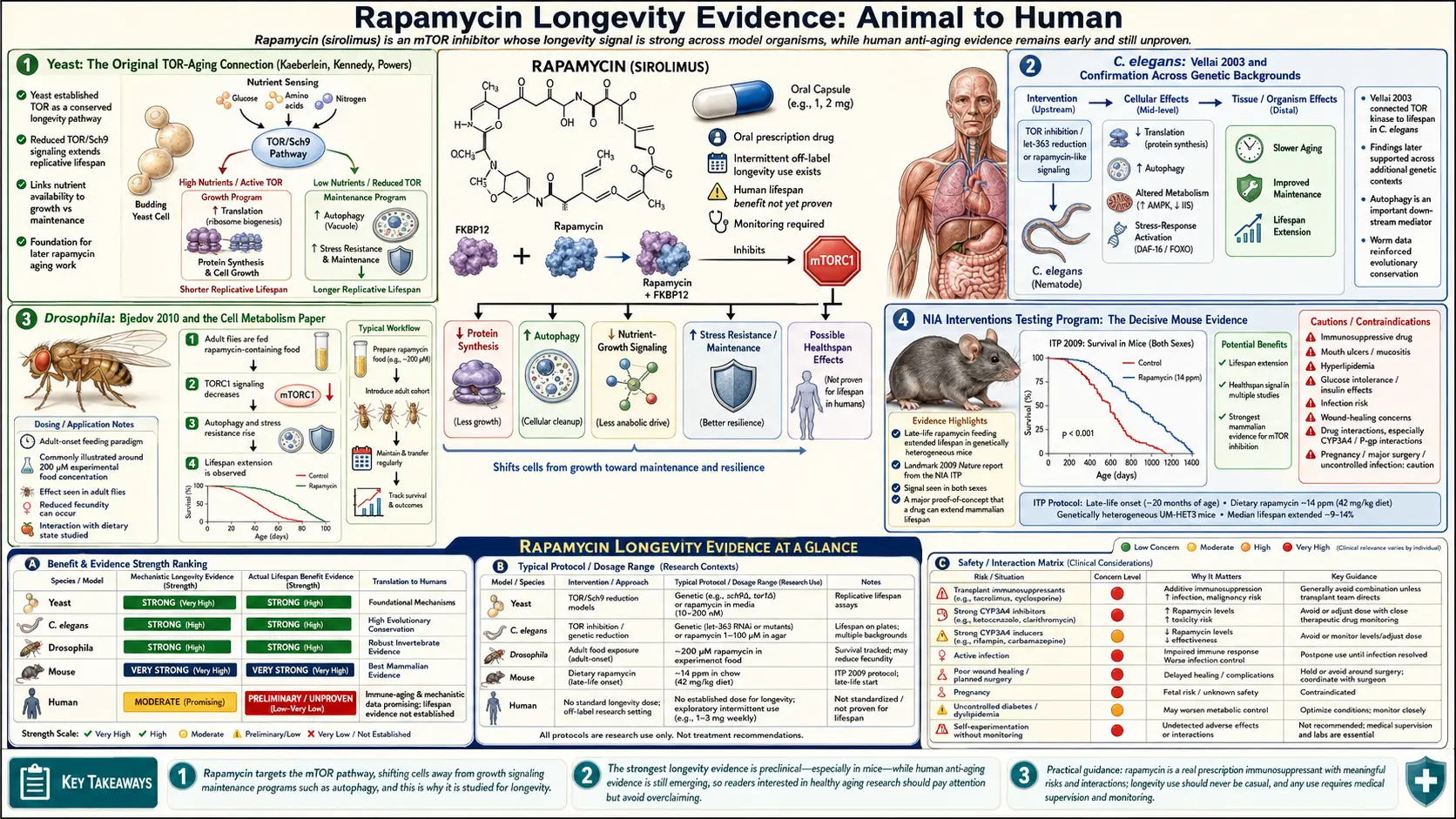
The rapamycin longevity evidence base is qualitatively different from every other candidate geroprotective intervention — not because the effect size is enormous, but because it has been reproduced across an unusual breadth of species, laboratories, dosing regimens, and starting ages. The pipeline begins in 1996 with yeast chronological lifespan extension, continues through worm and fly studies that confirm the mTOR-aging connection across all major invertebrate models, and reaches its decisive turning point with the National Institute on Aging Interventions Testing Program (ITP) result in 2009 — the first pharmacologic intervention ever shown to extend mouse lifespan when started in old age, replicated across three independent laboratory sites in genetically heterogeneous mice. The translation to companion-animal trials (Dog Aging Project), early human surrogate-endpoint trials (Mannick RAD001 elderly immune-function trial 2014/2018), and the still-running PEARL randomized controlled trial in healthy adults represents the most rigorous translational pipeline any candidate longevity drug has undergone. This page walks through that evidence species by species, highlighting what each result establishes and what remains to be confirmed in humans.
Table of Contents
- Yeast: The Original TOR-Aging Connection (Kaeberlein, Kennedy, Powers)
- C. elegans: Vellai 2003 and Confirmation Across Genetic Backgrounds
- Drosophila: Bjedov 2010 and the Cell Metabolism Paper
- NIA Interventions Testing Program: The Decisive Mouse Evidence
- Mouse Dose-Response and Intermittent Dosing Refinements
- The Dog Aging Project and the TRIAD Trial
- Non-Human Primates: What Is and Is Not Known
- Human Evidence Round 1: Mannick et al. 2014 / 2018 Vaccine Response
- PEARL Trial and Other Human Randomized Studies
- Observational Off-Label Cohorts and the AgelessRX Registry
- What Remains Unproven in Humans
- Key Research Papers
- Connections
- Featured Videos
Yeast: The Original TOR-Aging Connection (Kaeberlein, Kennedy, Powers)
The first concrete evidence that the TOR pathway was central to lifespan regulation came from budding yeast (Saccharomyces cerevisiae) studies in the early 2000s. Yeast offers two distinct lifespan measurements: replicative lifespan (the number of daughter cells a mother cell produces before senescence, modeling dividing-cell aging) and chronological lifespan (how long a non-dividing cell remains viable in stationary phase, modeling post-mitotic-cell aging).
Powers et al. published the 2006 Genes & Development paper showing that decreased TOR pathway signaling, either through deletion of TOR1 or through low-dose rapamycin treatment, extended chronological lifespan in yeast. Kaeberlein, Kennedy, and colleagues in parallel showed that TOR/Sch9 inhibition extended replicative lifespan (2005 Science). The combination of replicative and chronological lifespan extension by the same pathway intervention established TOR signaling as a master regulator of yeast aging.
The yeast evidence was important not just for its own sake but because it placed the TOR pathway in the same molecular category as the insulin/IGF-1 pathway, sirtuins, and AMPK — the small set of conserved nutrient-sensing pathways that had already been implicated in lifespan regulation across model organisms. Critically, the same pathway that extended yeast lifespan was directly druggable in mammals with an FDA-approved compound, which set the stage for the mammalian translation effort.
C. elegans: Vellai 2003 and Confirmation Across Genetic Backgrounds
The first metazoan demonstration came in 2003 from Vellai and colleagues in Nature, showing that RNAi knockdown of let-363 (the C. elegans TOR ortholog) more than doubled adult lifespan in Caenorhabditis elegans. Subsequent work by multiple groups confirmed the finding using rapamycin treatment directly: extension of mean and maximum lifespan, with the effect dependent on autophagy genes (atg-7, bec-1) and on the FOXO transcription factor daf-16.
The C. elegans work also established the gene-environment context for TOR inhibition. In worms with mutations in the insulin/IGF-1 receptor (daf-2) — which already live more than twice as long as wild type — rapamycin treatment provides little additional lifespan extension. This suggests partial pathway convergence: TOR signaling and insulin/IGF-1 signaling are not entirely independent. The implication for humans: people with genetically low IGF-1 (centenarians, FOXO3 long-life-allele carriers) may capture less additional benefit from pharmacologic mTOR inhibition than people with high baseline IGF-1.
Drosophila: Bjedov 2010 and the Cell Metabolism Paper
Bjedov et al. published the definitive Drosophila rapamycin study in Cell Metabolism in 2010. Rapamycin extended mean and maximum lifespan in Drosophila melanogaster by 25-30%, with the effect requiring functional autophagy and showing additive interaction with caloric restriction in some tissue contexts. Importantly, the lifespan extension was accompanied by improved healthspan markers: maintained climbing activity, preserved fecundity, and reduced age-related mortality acceleration.
The Drosophila work added a third independent invertebrate confirmation of the mTOR-lifespan connection and contributed mechanistic insights about tissue-specific mTOR inhibition (rapamycin acts on muscle, fat body, and intestine to extend lifespan, with the intestinal effect particularly important). It also confirmed the autophagy dependence: deletion of essential autophagy genes abolished the rapamycin lifespan extension, identifying autophagy as a required mediator rather than an incidental side effect.
NIA Interventions Testing Program: The Decisive Mouse Evidence
The Interventions Testing Program (ITP) is the rigorous gold-standard rodent longevity testing program operated by the National Institute on Aging at three independent sites: the Jackson Laboratory, the University of Michigan, and the University of Texas Health Science Center San Antonio. The ITP is designed to weed out false positives: same protocol, same UM-HET3 four-way genetically heterogeneous mouse stock, blinded data collection, replicated across three labs. Many candidate longevity compounds tested by the ITP have failed to replicate their initial single-laboratory positive results (resveratrol being the most famous example).
Rapamycin entered the ITP pipeline in 2006, with treatment starting at 600 days of age (roughly equivalent to age 60 in humans). The Harrison et al. 2009 Nature paper reported the first results:
- Female mice: 14% median lifespan extension; 9% maximum lifespan extension
- Male mice: 9% median lifespan extension; 14% maximum lifespan extension
- Effect was reproduced at all three sites independently
- This was the first pharmacologic intervention ever shown to extend mouse lifespan when treatment began in old age
Subsequent ITP papers refined the picture:
- Miller et al. 2011 — tested rapamycin against resveratrol and simvastatin in parallel. Only rapamycin extended lifespan. Resveratrol and simvastatin did not.
- Miller et al. 2014 — dose-response study. Higher doses (42 ppm in food) produced larger lifespan extension than the original 14 ppm. Sex differences became more pronounced at high dose: females showed 26% median lifespan extension at high dose, males showed 23%.
- Strong et al. 2016 — tested various compounds in parallel. Rapamycin combined with metformin produced lifespan extension comparable to rapamycin alone; metformin alone showed only modest male-specific effects.
- Strong et al. 2020 — tested acarbose and canagliflozin alongside rapamycin. Acarbose extended lifespan; canagliflozin extended male lifespan; rapamycin remained the most robust.
The ITP rapamycin result is the single most important data point in the entire geroscience field. It is the only pharmacologic intervention that has crossed the high bar of multi-site replicated effect in genetically heterogeneous mice with treatment started in old age. Every other candidate longevity drug is benchmarked against this result.
Mouse Dose-Response and Intermittent Dosing Refinements
Following the ITP results, multiple independent laboratories explored the dose-response and dosing-frequency landscape:
- Anisimov et al. 2010 — showed that rapamycin extends lifespan in cancer-prone mouse strains, partly through reducing cancer incidence and partly through delaying non-cancer mortality.
- Wilkinson et al. 2012 — characterized the broader healthspan benefits of rapamycin in mice: improved cardiac function, reduced age-related immune decline, delayed cataract formation, preserved muscle function.
- Arriola Apelo et al. 2016 — tested intermittent rapamycin dosing (every five days) in female C57BL/6J mice. Lifespan extension was preserved while sparing the metabolic toxicity (insulin resistance) seen with continuous daily dosing. This was the foundational paper for the intermittent-dosing strategy that dominates off-label human use.
- Bitto et al. 2016 — tested transient rapamycin treatment (90 days only) starting in middle age. Lasting lifespan extension was observed even though treatment was discontinued, suggesting that periodic rather than continuous exposure may be sufficient.
The collective mouse evidence supports several practical conclusions: (1) rapamycin extends lifespan in old animals, not just young; (2) intermittent dosing preserves lifespan extension while reducing metabolic side effects; (3) the effect is partially additive with other interventions but partially redundant with caloric restriction; (4) treatment does not need to be lifelong — even time-limited treatment courses produce lasting benefit.
The Dog Aging Project and the TRIAD Trial
The Dog Aging Project, led by Matt Kaeberlein at the University of Washington and Daniel Promislow, is the largest companion-animal longevity research initiative in history. Among its components is the TRIAD trial (Test of Rapamycin in Aging Dogs), a randomized placebo-controlled trial of intermittent low-dose rapamycin in middle-aged large-breed dogs (a population with naturally shorter lifespan and faster age-related decline than small-breed dogs).
Pilot work by Urfer et al. published in GeroScience 2017 tested short-term rapamycin treatment (10 weeks) in 24 middle-aged companion dogs. The primary endpoint was echocardiographic diastolic function. Treated dogs showed measurable improvement in age-related diastolic dysfunction parameters, with no significant adverse effects at the intermittent dosing schedule used. This was the first prospective demonstration in a companion mammal that low-dose intermittent rapamycin produces a measurable improvement in a clinically relevant age-related phenotype.
The TRIAD trial is now extending this with larger sample size, longer treatment duration, and lifespan follow-up. Results will inform whether the mouse-to-dog translation produces effect sizes meaningful enough to support broader recommendations. Importantly, dogs share the human environment, eat varied diets, and develop a similar diversity of spontaneous age-related disease — making them a far more translational species than highly inbred laboratory mouse strains.
Non-Human Primates: What Is and Is Not Known
There is no published primary lifespan data on rapamycin in non-human primates. The lifespan of rhesus monkeys (the standard primate aging model) is approximately 30 years, making lifespan trials extremely expensive and slow. The two major primate caloric-restriction studies (Wisconsin and the National Institute on Aging) took decades to produce informative data, and there is no comparable institutional commitment to a rapamycin primate trial.
What does exist is short-term mechanistic data: marmoset and rhesus monkey studies of mTOR pharmacology, immune response, and biomarker effects, generally consistent with mouse findings but without the lifespan endpoint. The absence of primate lifespan data is one of the legitimate critiques of the off-label longevity use of rapamycin in humans — the inferential leap from rodent lifespan to human lifespan, with no intermediate primate data, is large.
Practical implication: the human case for rapamycin rests on three pillars: (1) the robustness of the mouse evidence across the ITP, (2) the mechanistic conservation of the TOR pathway across all eukaryotes, and (3) early human surrogate-endpoint trials (vaccine response, immune function). It does not rest on direct evidence that any healthy human has lived longer because of rapamycin treatment — such evidence would require decades to accumulate.
Human Evidence Round 1: Mannick et al. 2014 / 2018 Vaccine Response
The most important human evidence for the rapamycin-as-geroprotector hypothesis comes from a pair of trials led by Joan Mannick, then at Novartis, using the rapalog RAD001 (everolimus) and the more selective compound RTB101 (later renamed dactolisib analog).
Mannick et al. 2014 (Science Translational Medicine): 218 healthy adults aged 65 or older were randomized to one of three RAD001 regimens or placebo for six weeks, then given influenza vaccine. The primary endpoint was antibody titer response to vaccine four weeks later. Results:
- The 0.5 mg daily and 5 mg weekly regimens both produced approximately 20% improvement in antibody response compared to placebo
- Reduction in PD-1-positive exhausted T-cell subsets was observed in the treatment arms
- Side effects were modest at these low intermittent doses: mouth ulcers, mild lipid changes
- The effect was largest in the subjects with the most age-related decline at baseline
This was the first prospective demonstration in humans that a low-dose mTOR inhibitor regimen produces a functional reversal of an age-related deficit (immunosenescence as measured by vaccine response). The endpoint is a validated functional surrogate of immune aging, and the magnitude of the effect — comparable to the difference between a typical 50-year-old and a typical 80-year-old in vaccine response — was clinically meaningful.
Mannick et al. 2018 (Science Translational Medicine): The follow-up trial used RTB101 (a TORC1-selective compound) and a different regimen, with respiratory tract infection over the following year as the endpoint. Results showed reduced laboratory-confirmed respiratory infection incidence in elderly subjects receiving RTB101, consistent with broader immune restoration beyond just vaccine response.
The Mannick trials are the cornerstone of the human rapamycin evidence base. They are not lifespan trials, but they demonstrate that the same molecular mechanism that extends mouse lifespan can produce clinically meaningful effects on age-related functional deficits in humans at low intermittent doses comparable to what off-label longevity users are taking.
PEARL Trial and Other Human Randomized Studies
The Participatory Evaluation of Aging with Rapamycin for Longevity (PEARL) trial is a randomized placebo-controlled trial of intermittent rapamycin in healthy adults aged 50-85, led by AgelessRx and academic collaborators. Endpoints include physical function tests, body composition, metabolic markers, and quality-of-life measures over 48 weeks. Results are being reported in stages through 2025-2026.
Kraig et al. 2018 published a smaller earlier safety and feasibility trial in Experimental Gerontology, using 1 mg daily rapamycin for 8 weeks in healthy older adults. The primary endpoints were tolerability and adverse-event detection. Results were favorable: no serious adverse events, lipid elevation was transient and modest, no significant new-onset glucose dysregulation.
Several ongoing human trials are listed at ClinicalTrials.gov investigating rapamycin or rapalogs for specific age-related conditions: cardiac diastolic function in older adults, periodontitis in elderly subjects, skin aging endpoints, sarcopenia. The cumulative human safety database at low intermittent doses now includes hundreds of subjects with no serious safety signal beyond the known mouth-ulcer and lipid-elevation profile.
Important note: there is currently no completed randomized trial demonstrating that rapamycin extends human lifespan or healthspan. Such a trial would require decades. The case for off-label longevity use therefore rests on the totality of the evidence base across species, the conservation of mechanism, and the favorable surrogate-endpoint findings in elderly humans — not on direct human longevity outcome data.
Observational Off-Label Cohorts and the AgelessRX Registry
Off-label rapamycin prescribing for longevity by individual clinicians has grown significantly since approximately 2015, particularly through telehealth platforms such as AgelessRx (founded specifically for this and related off-label longevity prescriptions), and through individual concierge medicine practices. Several investigators have published descriptive analyses of these cohorts:
- Kaeberlein and colleagues have surveyed off-label users to characterize dosing patterns, side effects, and self-reported outcomes
- The Modern Aging surveys have collected similar self-reported data with larger samples
- An open-label observational cohort tracked clinically meaningful endpoints (biomarker changes, quality of life) over multiple years
The observational data is consistent with the controlled-trial data on tolerability: mouth ulcers in 20-30% of users (dose-dependent), mild lipid elevation in some users, no excess infection signal at low intermittent doses, and a favorable subjective effect on energy and recovery from exercise reported by many users. These observational data are not a substitute for randomized trial evidence but do provide reassurance about real-world tolerability at the doses being prescribed off-label.
Caveats: observational cohorts of self-selected longevity-motivated patients are confounded by every other longevity intervention these patients tend to adopt (high-quality diet, exercise, sleep optimization, sauna, cold exposure). Attributing any observed health improvement to rapamycin specifically is not possible from observational data. The PEARL trial and similar randomized studies are essential to isolate the rapamycin-specific contribution.
What Remains Unproven in Humans
An honest summary of what the rapamycin literature does and does not yet support in humans:
- Supported by direct human evidence: short-term intermittent low-dose rapamycin/rapalog regimens are well tolerated in healthy elderly adults; they improve influenza vaccine response by approximately 20%; they reduce respiratory infection incidence; they modestly elevate lipids and may cause mouth ulcers but do not cause serious adverse events.
- Supported by inference from rodent and dog data: intermittent low-dose rapamycin extends maximum lifespan in mice when started in middle or old age; the mechanism (mTORC1 inhibition) is highly conserved across all eukaryotes; the same pathway is targeted by every other reproducibly lifespan-extending intervention.
- Not yet directly demonstrated in humans: lifespan extension. Healthspan extension. Reduced incidence of cardiovascular disease, cancer, or dementia. Improvement in objective cognitive function. Reduction in all-cause mortality.
- Active subjects of ongoing trials: functional performance, body composition, metabolic markers, biological age (DNAm clocks), inflammatory markers, cardiac diastolic function in humans.
The honest position for anyone considering off-label use is: the case is strong but not proven. The decision is a personal cost-benefit assessment that weighs the reproducible animal evidence, the favorable human safety data at low intermittent doses, the mechanistic plausibility, the known side effects, and the absence of direct human longevity outcome evidence. The decision should be made in consultation with a physician familiar with off-label longevity prescribing — the Dosing & Cycling deep-dive covers the typical regimens prescribed by such physicians, and the Side Effects & Monitoring deep-dive covers the lab and clinical monitoring such use entails.
Key Research Papers
- Harrison DE et al. (2009). Rapamycin fed late in life extends lifespan in genetically heterogeneous mice. Nature. — PubMed
- Miller RA et al. (2011). Rapamycin, but not resveratrol or simvastatin, extends life span of genetically heterogeneous mice. — PubMed
- Miller RA et al. (2014). Rapamycin-mediated lifespan increase in mice is dose and sex dependent and metabolically distinct from dietary restriction. — PubMed
- Bitto A et al. (2016). Transient rapamycin treatment can increase lifespan and healthspan in middle-aged mice. eLife. — PubMed
- Arriola Apelo SI et al. (2016). Intermittent administration of rapamycin extends the life span of female C57BL/6J mice. Journals of Gerontology. — PubMed
- Mannick JB et al. (2014). mTOR inhibition improves immune function in the elderly. Science Translational Medicine. — PubMed
- Mannick JB et al. (2018). TORC1 inhibition enhances immune function and reduces infections in the elderly. Science Translational Medicine. — PubMed
- Urfer SR et al. (2017). A randomized controlled trial to establish effects of short-term rapamycin treatment in 24 middle-aged companion dogs. GeroScience. — PubMed
- Vellai T et al. (2003). Influence of TOR kinase on lifespan in C. elegans. Nature. — PubMed
- Bjedov I et al. (2010). Mechanisms of life span extension by rapamycin in the fruit fly Drosophila melanogaster. Cell Metabolism. — PubMed
- Powers RW et al. (2006). Extension of chronological life span in yeast by decreased TOR pathway signaling. Genes & Development. — PubMed
- Wilkinson JE et al. (2012). Rapamycin slows aging in mice. Aging Cell. — PubMed
- Anisimov VN et al. (2010). Rapamycin extends maximal lifespan in cancer-prone mice. American Journal of Pathology. — PubMed
- Kraig E et al. (2018). A randomized control trial to establish the feasibility and safety of rapamycin treatment in older humans. Experimental Gerontology. — PubMed
PubMed Topic Searches
- PubMed: ITP rapamycin mouse lifespan
- PubMed: Rapamycin human aging trials
- PubMed: Dog Aging Project rapamycin
- PubMed: mTOR inhibitor immunosenescence
- PubMed: Intermittent rapamycin dosing
Connections
- All Remedies
- Rapamycin Overview
- Rapamycin Benefits Hub
- mTOR Inhibition Mechanism
- Dosing & Cycling
- Side Effects & Monitoring
- Metformin (TAME Trial)
- Caloric Restriction
- Intermittent Fasting
- Senolytics
- NAD+ / NMN / NR
- Resveratrol
- Biological Age (DNAm Clocks)
- IGF-1 Testing
- Geriatrics
- Immunosenescence