Immune Boosting — Benefits Deep Dive
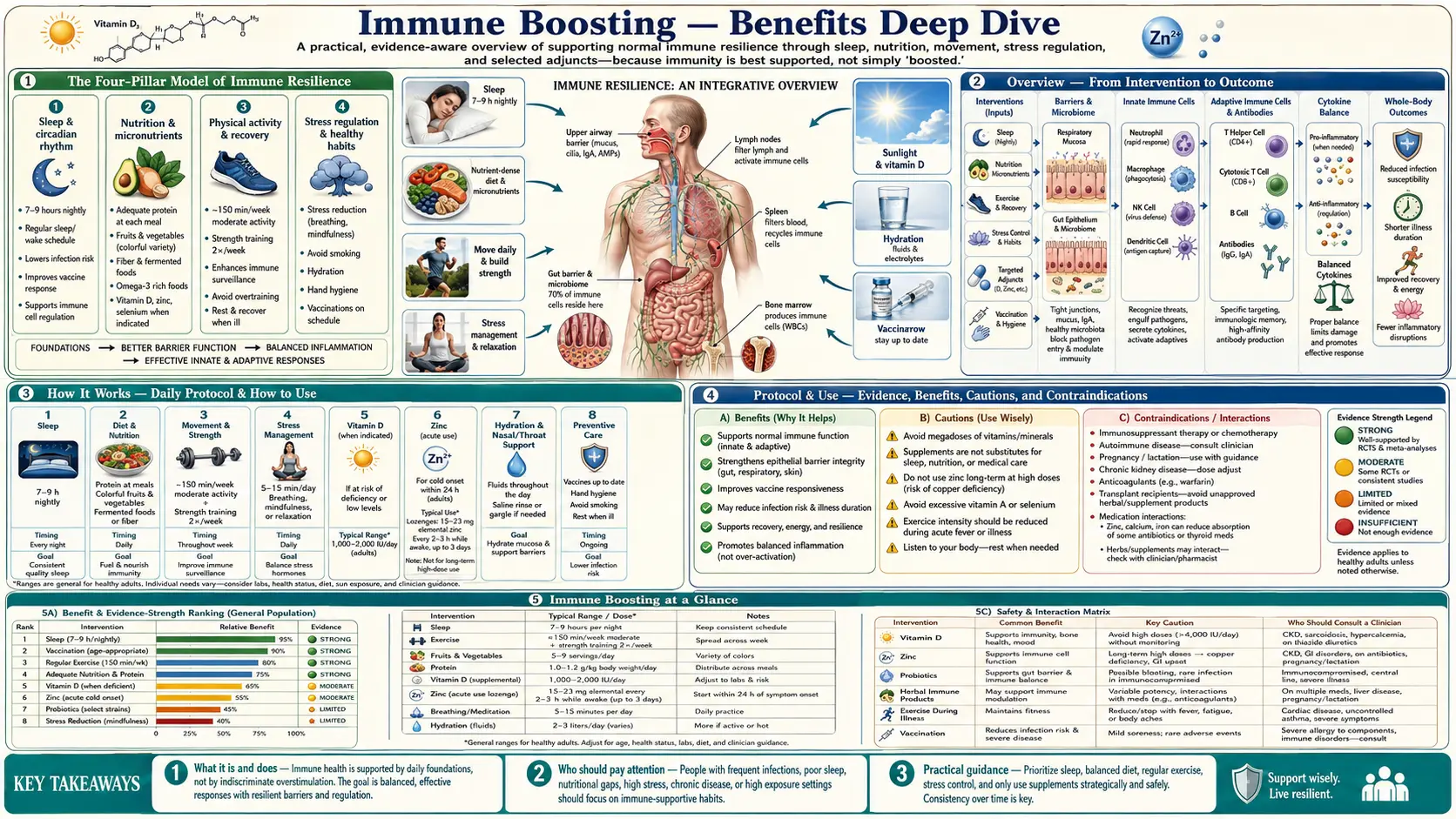
Resilient immunity is not built from a single supplement or a winter-only "immune boost." It emerges from the steady interaction of four pillars: the fat-soluble vitamins (D3 paired with K2) that orchestrate the innate immune response and the differentiation of regulatory T cells, the redox-active minerals (zinc and selenium) that catalyze antiviral defense and antioxidant enzymes, the circadian and HPA-axis hygiene (sleep and cortisol) that determines whether the immune system is in build-mode or breakdown-mode, and the adaptogenic herbs (Ashwagandha, Astragalus, Reishi, Rhodiola) that bidirectionally modulate stress and immunity. These four deep-dive pages walk through the mechanism and the practical regimen for each pillar.
Deep-Dive Articles
Vitamin D and K2
How 1,25-dihydroxyvitamin D acts as a steroid hormone through VDR/RXR signaling, induces the antimicrobial peptide cathelicidin (LL-37) and defensins, supports Treg-driven mucosal tolerance, and why K2 (menaquinone MK-7) is the indispensable directional partner that prevents calcification of the vascular and soft-tissue compartments while sending calcium to bone. Target 25(OH)D ranges, MK-7 dosing, the Vitamin A / D / K2 triumvirate, and why winter respiratory-infection rates track latitude and serum 25(OH)D.
Zinc and Selenium
Zinc as the cofactor for >300 enzymes and the master regulator of T-cell and NK-cell maturation, ionic zinc's direct antiviral effect on RNA polymerase activity, the zinc lozenge protocol shortening rhinovirus colds, copper balance during chronic supplementation, and selenium's role in glutathione peroxidase, thioredoxin reductase, and selenoprotein P. The Keshan disease story, the Brazil-nut dosing problem, and why selenium status determines viral mutation rates in vivo (Beck's mouse-coxsackievirus model).
Sleep and Cortisol
Why a single night of restricted sleep cuts NK cell activity by 70%, the bidirectional cytokine-sleep loop driven by IL-1 and TNF-alpha, the elegant Cohen rhinovirus-inoculation experiments showing 4-fold higher infection rates in short sleepers, cortisol's diurnal rhythm and its T-helper-1-to-T-helper-2 shift, the immune cost of chronic HPA-axis overdrive, and a practical sleep-hygiene + cortisol-regulation regimen.
Herbal Adaptogens
The Soviet-era origin of the adaptogen concept (Lazarev, Brekhman), the modern definition (bidirectional homeostatic effect on stress and immunity), and the four canonical immune-relevant adaptogens: Ashwagandha (withanolides, cortisol reduction, NK activity), Astragalus (astragalosides, Th1 induction, IL-2/IFN-gamma), Reishi mushroom (beta-glucans pattern-recognition activation), and Rhodiola (salidroside, fatigue mitigation, sIgA). Dosing, standardization markers, contraindications, and how to layer them.
Table of Contents
- Deep-Dive Articles
- The Four-Pillar Model of Immune Resilience
- Research Papers: Vitamin D and K2
- Research Papers: Zinc and Selenium
- Research Papers: Sleep and Cortisol
- Research Papers: Herbal Adaptogens
- Research Papers: Cross-Cutting (Innate & Adaptive Integration)
- External Authoritative Resources
- Connections
- Featured Videos
The Four-Pillar Model of Immune Resilience
The contemporary supplement market frames immune health as a problem of adding the right pill at the right moment — elderberry at the first sniffle, echinacea at the airport, a megadose of Vitamin C when the family gets sick. The biology says something different. The immune system is a continuously remodeling tissue, with daily turnover of neutrophils, weekly turnover of monocytes, lifelong renewal of memory T and B cells, and a constant background hum of innate sensing through pattern-recognition receptors. The question is not "what do I take when I feel a tickle in my throat" — it is "what environment have I given my immune system to remodel itself in over the past three months."
That environment can be usefully decomposed into four pillars, each addressed by one of the deep-dive pages below.
- Fat-soluble vitamins (D and K2) — Vitamin D acts as a steroid hormone through the VDR/RXR nuclear-receptor complex, with response elements in the promoters of antimicrobial peptide genes (cathelicidin / LL-37, beta-defensin 2) and immune-regulatory genes (IL-10, FoxP3). K2 (MK-7 menaquinone) prevents the calcium that D mobilizes from depositing in the wrong places — arteries, kidneys, soft tissue — by activating matrix Gla protein. These two vitamins are an inseparable directional pair.
- Redox minerals (zinc and selenium) — Zinc is the structural cofactor of >300 enzymes and a master regulator of T-cell maturation; selenium is the catalytic atom in glutathione peroxidase and thioredoxin reductase, the two enzymes that determine whether oxidative stress damages or signals. Together they govern both the cytotoxic capacity of innate immune cells and the antioxidant capacity that keeps that cytotoxicity from collaterally damaging host tissue.
- Sleep and HPA-axis tone — A single night of restricted sleep reduces NK-cell activity by ~70%, and chronic short sleep approximately quadruples the rate of rhinovirus infection after standardized viral challenge (the Cohen experiments at Carnegie Mellon). Cortisol's diurnal rhythm sets the daily Th1/Th2 balance and, when chronically elevated, drives a sustained immunosuppressive Th2-dominant state that increases susceptibility to viral infection and slows wound healing.
- Herbal adaptogens — Bidirectional homeostatic modulators that buffer the stress response and condition the immune system rather than activating it once. The four with the strongest evidence in adult immune contexts are Ashwagandha (cortisol reduction, NK activity), Astragalus (Th1 induction, IL-2 and IFN-gamma), Reishi (beta-glucan pattern-recognition activation), and Rhodiola (fatigue mitigation, sIgA).
None of the four pillars works in isolation. Vitamin D without K2 risks vascular calcification at higher doses. Zinc without copper balance produces a copper-deficiency anemia. Adaptogens without sleep are pushing on a closed door. The integration of all four is what builds the resilient baseline that determines how a body responds to the next pathogen, the next stressor, the next chronic challenge.
Research Papers: Vitamin D and K2
- Liu PT et al. (2006). Toll-like receptor triggering of a vitamin D-mediated human antimicrobial response. Science. — PubMed: Liu Science 2006 (cathelicidin)
- Martineau AR et al. (2017). Vitamin D supplementation to prevent acute respiratory tract infections: systematic review and meta-analysis. BMJ. — PubMed: Martineau BMJ 2017
- Cantorna MT et al. (2015). Vitamin D, regulatory T cells, and the immune response. Journal of Immunology. — PubMed: Cantorna Treg review
- Holick MF (2007). Vitamin D deficiency. NEJM. — PubMed: Holick NEJM 2007
- Schurgers LJ et al. (2007). Vitamin K-containing dietary supplements: comparison of synthetic vitamin K1 and natto-derived menaquinone-7. Blood. — PubMed: Schurgers MK-7 bioavailability
- Geleijnse JM et al. (2004). Dietary intake of menaquinone is associated with reduced risk of coronary heart disease: Rotterdam Study. Journal of Nutrition. — PubMed: Rotterdam K2 trial
- Jeffery LE et al. (2009). 1,25-Dihydroxyvitamin D3 and IL-2 combine to inhibit Th1 cytokine production and promote Treg. Journal of Immunology. — PubMed: Jeffery VDR/IL-2
- Aranow C (2011). Vitamin D and the immune system. Journal of Investigative Medicine. — PubMed: Aranow review 2011
- Ginde AA et al. (2009). Association between serum 25-hydroxyvitamin D level and upper respiratory tract infection. Archives of Internal Medicine. — PubMed: Ginde Arch Intern Med 2009
- van Ballegooijen AJ et al. (2017). The synergistic interplay between vitamins D and K for bone and cardiovascular health. International Journal of Endocrinology. — PubMed: D/K2 synergy review
Research Papers: Zinc and Selenium
- Prasad AS (2008). Zinc in human health: effect of zinc on immune cells. Molecular Medicine. — PubMed: Prasad Mol Med 2008
- Hemilä H, Chalker E (2017). Zinc acetate lozenges for the common cold: systematic review and meta-analysis. JRSM Open. — PubMed: Hemilä zinc lozenge meta-analysis
- te Velthuis AJ et al. (2010). Zn(2+) inhibits coronavirus and arterivirus RNA polymerase activity in vitro. PLoS Pathogens. — PubMed: te Velthuis Zn RdRp inhibition
- Rayman MP (2012). Selenium and human health. Lancet. — PubMed: Rayman Lancet 2012
- Beck MA et al. (2001). Selenium deficiency and viral infection. Journal of Nutrition. — PubMed: Beck selenium/coxsackievirus mutation
- Wessels I et al. (2017). Zinc as a gatekeeper of immune function. Nutrients. — PubMed: Wessels zinc/immunity
- Hoffmann PR, Berry MJ (2008). The influence of selenium on immune responses. Molecular Nutrition & Food Research. — PubMed: Hoffmann selenium/immunity
- Read SA et al. (2019). The role of zinc in antiviral immunity. Advances in Nutrition. — PubMed: Read zinc antiviral
- Avery JC, Hoffmann PR (2018). Selenium, selenoproteins, and immunity. Nutrients. — PubMed: Avery selenoprotein review
- Eby GA, Davis DR, Halcomb WW (1984). Reduction in duration of common colds by zinc gluconate lozenges in a double-blind study. Antimicrobial Agents and Chemotherapy. — PubMed: Eby original zinc lozenge trial
Research Papers: Sleep and Cortisol
- Cohen S et al. (2009). Sleep habits and susceptibility to the common cold. Archives of Internal Medicine. — PubMed: Cohen sleep/cold 2009
- Prather AA et al. (2015). Behaviorally assessed sleep and susceptibility to the common cold. Sleep. — PubMed: Prather actigraphy/cold 2015
- Irwin MR et al. (1996). Partial night sleep deprivation reduces natural killer and cellular immune responses. FASEB Journal. — PubMed: Irwin NK 1996
- Besedovsky L et al. (2019). The sleep-immune crosstalk in health and disease. Physiological Reviews. — PubMed: Besedovsky sleep-immune review
- Dhabhar FS (2014). Effects of stress on immune function: the good, the bad, and the beautiful. Immunologic Research. — PubMed: Dhabhar stress/immunity review
- Glaser R, Kiecolt-Glaser JK (2005). Stress-induced immune dysfunction: implications for health. Nature Reviews Immunology. — PubMed: Glaser/Kiecolt-Glaser NRI 2005
- Lange T et al. (2010). Effects of sleep and circadian rhythm on the human immune system. Annals of the NY Academy of Sciences. — PubMed: Lange circadian immunity 2010
- Spiegel K et al. (2002). Effect of sleep deprivation on response to immunization. JAMA. — PubMed: Spiegel JAMA vaccine response
- Dimitrov S et al. (2019). Gαs-coupled receptor signaling and sleep regulate integrin activation of human antigen-specific T cells. Journal of Experimental Medicine. — PubMed: Dimitrov sleep/integrin
- Elenkov IJ, Chrousos GP (1999). Stress, cytokine patterns and susceptibility to disease. Best Practice & Research Clinical Endocrinology & Metabolism. — PubMed: Elenkov Th1/Th2 shift
Research Papers: Herbal Adaptogens
- Panossian A, Wikman G (2010). Effects of adaptogens on the central nervous system and the molecular mechanisms associated with their stress-protective activity. Pharmaceuticals. — PubMed: Panossian adaptogen review
- Chandrasekhar K et al. (2012). A prospective, randomized double-blind, placebo-controlled study of safety and efficacy of a high-concentration full-spectrum extract of Ashwagandha root in reducing stress and anxiety in adults. Indian Journal of Psychological Medicine. — PubMed: Chandrasekhar Ashwagandha
- Block KI, Mead MN (2003). Immune system effects of echinacea, ginseng, and astragalus: a review. Integrative Cancer Therapies. — PubMed: Block Astragalus review
- Wachtel-Galor S et al. (2011). Ganoderma lucidum (Lingzhi or Reishi): a medicinal mushroom. Herbal Medicine: Biomolecular and Clinical Aspects. — PubMed: Wachtel-Galor Reishi
- Olsson EM et al. (2009). A randomised, double-blind, placebo-controlled, parallel-group study of the standardised extract SHR-5 of the roots of Rhodiola rosea in the treatment of subjects with stress-related fatigue. Planta Medica. — PubMed: Olsson Rhodiola SHR-5
- Mishra LC et al. (2000). Scientific basis for the therapeutic use of Withania somnifera (Ashwagandha): a review. Alternative Medicine Review. — PubMed: Mishra Ashwagandha review
- Auyeung KK et al. (2016). Astragalus membranaceus: a review of its protection against inflammation and gastrointestinal cancers. American Journal of Chinese Medicine. — PubMed: Auyeung Astragalus 2016
- Lin ZB (2005). Cellular and molecular mechanisms of immuno-modulation by Ganoderma lucidum. Journal of Pharmacological Sciences. — PubMed: Lin Reishi immunomodulation
- Panossian A, Wagner H (2005). Stimulating effect of adaptogens: an overview with particular reference to their efficacy following single dose administration. Phytotherapy Research. — PubMed: Panossian/Wagner 2005
- Kelly GS (2001). Rhodiola rosea: a possible plant adaptogen. Alternative Medicine Review. — PubMed: Kelly Rhodiola adaptogen
Research Papers: Cross-Cutting (Innate & Adaptive Integration)
- Calder PC et al. (2020). Optimal nutritional status for a well-functioning immune system is an important factor to protect against viral infections. Nutrients. — PubMed: Calder optimal nutrition
- Maggini S et al. (2018). Immune function and micronutrient requirements change over the life course. Nutrients. — PubMed: Maggini micronutrients across life
- Childs CE et al. (2019). Diet and immune function. Nutrients. — PubMed: Childs diet/immunity
- Bermon S et al. (2017). Consensus statement on immunonutrition and exercise. Exercise Immunology Review. — PubMed: Bermon exercise immunonutrition
- Belkaid Y, Hand TW (2014). Role of the microbiota in immunity and inflammation. Cell. — PubMed: Belkaid/Hand microbiota/immunity
- Round JL, Mazmanian SK (2009). The gut microbiota shapes intestinal immune responses during health and disease. Nature Reviews Immunology. — PubMed: Round/Mazmanian microbiota
- Carr AC, Maggini S (2017). Vitamin C and immune function. Nutrients. — PubMed: Carr Vitamin C/immunity
- Saavedra JM, Tschernia A (2002). Human studies with probiotics and prebiotics: clinical implications. British Journal of Nutrition. — PubMed: Saavedra probiotics
- Cohen S et al. (1991). Psychological stress and susceptibility to the common cold. NEJM. — PubMed: Cohen NEJM 1991 (psych stress)
- Pae M et al. (2012). The role of nutrition in enhancing immunity in aging. Aging and Disease. — PubMed: Pae aging immunity
External Authoritative Resources
- Linus Pauling Institute — Immunity In Depth — comprehensive micronutrient-immunity resource
- NIH Office of Dietary Supplements — Fact Sheets (Vitamin D, Zinc, Selenium, K)
- WHO — Healthy Diet Fact Sheet
- CDC — Sleep and Sleep Disorders / Sleep Hygiene
- PubMed — Combined micronutrient + sleep + immunity
Connections
- All Remedies
- Immune Boosting Regimen (Main Page)
- Vitamin D and K2
- Zinc and Selenium
- Sleep and Cortisol
- Herbal Adaptogens
- Vitamin D3
- Vitamin K2
- Vitamin A for Immune Function
- Vitamin C
- Zinc
- Selenium
- Ashwagandha
- Astragalus
- Reishi Mushroom
- Rhodiola Rosea