GLP-1 Receptor Agonists — Benefits Deep Dive
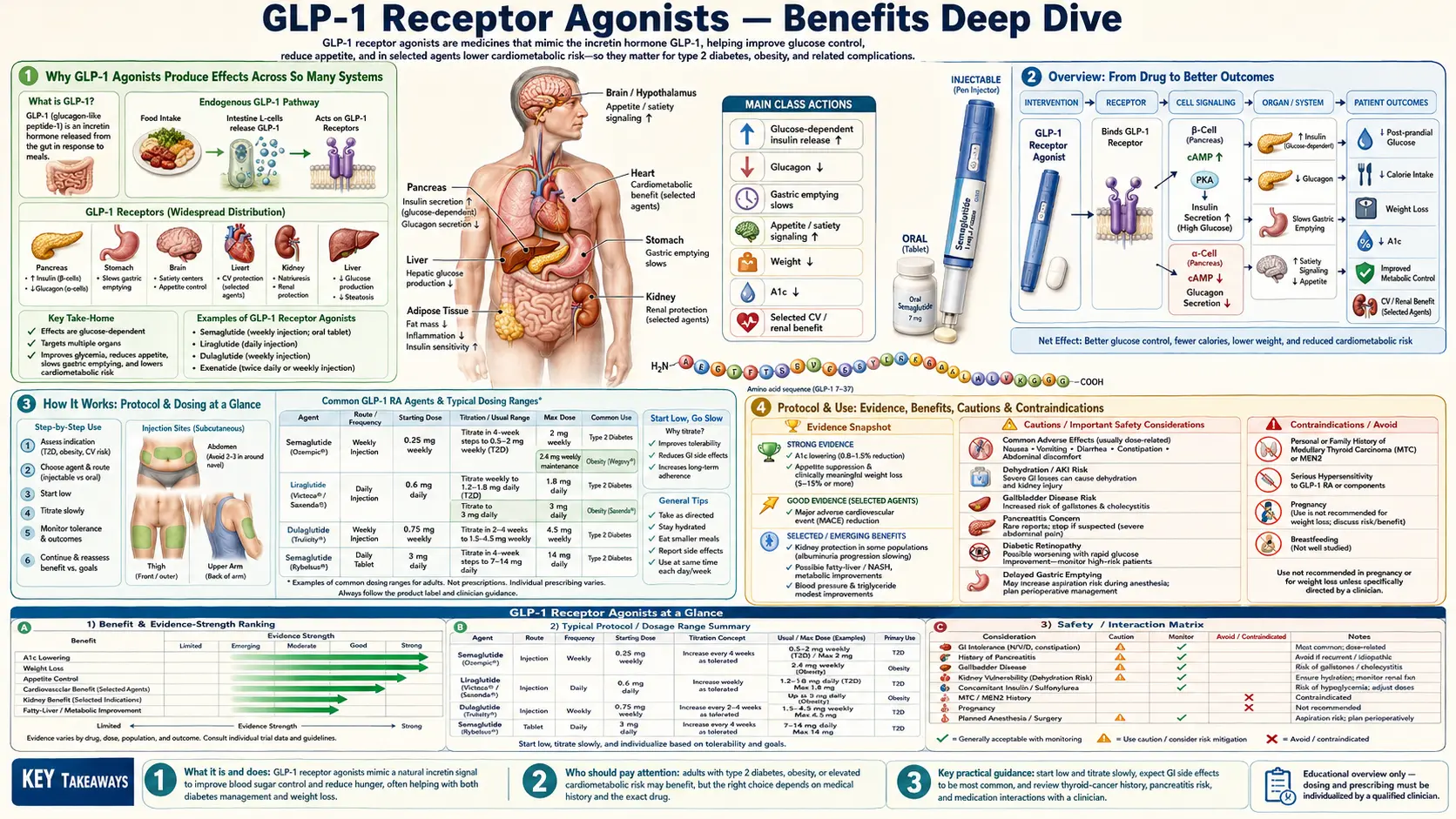
GLP-1 receptor agonists (semaglutide / Ozempic / Wegovy, tirzepatide / Mounjaro / Zepbound, liraglutide / Victoza / Saxenda) are the most consequential metabolic drug class introduced in a generation. By mimicking the gut-derived incretin hormone glucagon-like peptide 1, they simultaneously lower fasting and post-prandial glucose, suppress glucagon, slow gastric emptying, and act on hypothalamic appetite centers to reduce caloric intake. Phase-3 trials show 15–22% mean body weight reduction at 68 weeks (STEP-1, SURMOUNT-1), with cardiovascular and renal outcome benefits documented in LEADER, SUSTAIN-6, REWIND, and FLOW. This deep-dive cluster covers the receptor mechanism, the pivotal weight-loss and cardiovascular trials, the side-effect and contraindication profile (medullary thyroid carcinoma, pancreatitis, gastroparesis, NAION, the post-discontinuation rebound problem), and the food and lifestyle strategies that boost endogenous GLP-1 secretion as a complement or alternative to injectable therapy.
Deep-Dive Articles
Mechanism & Insulin Response
How the GLP-1 receptor (a Gs-coupled GPCR on pancreatic beta cells, hypothalamic neurons, and gastric smooth muscle) drives glucose-dependent insulin secretion, suppresses glucagon, slows gastric emptying, and reduces food intake. Why "glucose-dependent" is the key safety feature versus sulfonylureas, the differences between native GLP-1 (1–2 minute half-life) and engineered agonists (24-hour to 7-day half-life), and where tirzepatide's dual GIP/GLP-1 agonism produces the additional weight loss seen in SURMOUNT-1.
Weight Loss Studies
The STEP-1 (semaglutide 2.4 mg, 14.9% mean weight loss at 68 weeks), STEP-3, STEP-5, SURMOUNT-1 (tirzepatide 15 mg, 22.5% mean weight loss), SCALE Obesity (liraglutide 3.0 mg), and SELECT (cardiovascular outcomes) trials. The composition of weight lost (fat vs lean mass), the rebound phenomenon when therapy stops, the cardiovascular benefit (20% MACE reduction in SELECT), and the renal outcome data from FLOW.
Side Effects & Cautions
Nausea and vomiting (40–75% of patients during titration), the FDA black-box warning for medullary thyroid carcinoma (MTC) and the MEN-2 contraindication, pancreatitis signals, gastroparesis and pre-operative aspiration risk, the lean-mass loss problem, gallbladder disease, NAION (non-arteritic anterior ischemic optic neuropathy) signal, suicidal ideation reports, mood and addictive-behavior effects, and the high relapse rate (~two thirds of weight regained within a year) after discontinuation.
Natural GLP-1 Boosting Foods
The fermentable-fiber → short-chain fatty acid (butyrate, propionate, acetate) → L-cell GLP-1 secretion pathway, the protein-leverage effect (whey isolate, casein, egg, fish, lean beef), bitter compounds and TGR5 bile acid receptor agonists (coffee, hops, gentian, berberine), omega-3 GPR120 signaling (salmon, sardines, herring), prebiotic foods (inulin, resistant starch, beta-glucan), the role of meal sequencing, polyphenols (EGCG, curcumin, resveratrol), and fermented foods. Where evidence is strong vs preliminary, and what to expect realistically vs an injectable.
Interactive Visualization Hunger, Leptin & Why Diets Fight Back Watch the hunger neurons and the fullness neurons fight it out — then lose weight and see leptin fall, hunger climb and metabolism drop. It isn’t willpower. It’s a defended system. Launch →
Table of Contents
- Deep-Dive Articles
- Why GLP-1 Agonists Produce Effects Across So Many Systems
- Research Papers: Mechanism & Receptor Biology
- Research Papers: Weight Loss & Body Composition
- Research Papers: Cardiovascular & Renal Outcomes
- Research Papers: Safety, Side Effects, and Contraindications
- Research Papers: Endogenous GLP-1 Stimulation & Diet
- External Authoritative Resources
- Connections
- Featured Videos
Why GLP-1 Agonists Produce Effects Across So Many Systems
Most diabetes drugs act on a single tissue or a single biochemical step (metformin on hepatic gluconeogenesis, sulfonylureas on pancreatic beta-cell ATP-sensitive potassium channels, SGLT2 inhibitors on renal glucose reabsorption). GLP-1 receptor agonists are different because the GLP-1 receptor itself is expressed across multiple organ systems, and each tissue produces a distinct physiological response when the receptor is activated. The four sub-pages map to the four most clinically consequential tissue domains.
- Pancreatic beta-cell — glucose-dependent insulin secretion. GLP-1 receptor activation potentiates insulin release only when blood glucose is elevated, because it amplifies a step that depends on glucose-driven ATP production. This is why GLP-1 agonists rarely cause hypoglycemia alone (sulfonylureas and insulin do). The mechanism is detailed in Mechanism & Insulin Response.
- Hypothalamic appetite center — reduced caloric intake. GLP-1 receptors on neurons in the arcuate nucleus, paraventricular nucleus, and nucleus tractus solitarius transmit a satiety signal that reduces meal size and frequency. This is the primary driver of the 15–22% body-weight reduction documented in the phase-3 weight-loss trials.
- Gastric smooth muscle — delayed gastric emptying. GLP-1 slows the rate at which a meal leaves the stomach, extending the feeling of fullness and blunting the post-prandial glucose excursion. This is also the mechanism underlying the dominant adverse-effect cluster — nausea, vomiting, gastroparesis, and pre-operative aspiration risk — addressed in Side Effects & Cautions.
- Cardiovascular, renal, and hepatic tissue — outcome benefits beyond glycemic control. GLP-1 receptors on cardiomyocytes, vascular endothelium, renal tubular cells, and hepatocytes mediate anti-inflammatory and anti-fibrotic effects that translate to the documented MACE reduction (LEADER, SUSTAIN-6, REWIND, SELECT), kidney protection (FLOW), and improvement in MASH/NASH.
The therapeutic complication is that the GLP-1 receptor is also expressed in the C-cells of the rodent thyroid (driving the FDA black-box warning for medullary thyroid carcinoma), the exocrine pancreas (the disputed pancreatitis signal), and the gallbladder (cholelithiasis). The food-based endogenous GLP-1 stimulation approach — using fermentable fiber, protein, bitter compounds, and omega-3 to drive native L-cell secretion — produces a much smaller weight-loss effect (typically 2–5% rather than 15–22%) but avoids the side-effect profile entirely.
Research Papers: Mechanism & Receptor Biology
- Holst JV, the physiology of the incretin hormones (Physiol Rev 2007) — PubMed: Holst incretin physiology 2007
- Drucker DJ, mechanisms of action and therapeutic application of GLP-1 (Cell Metab 2018) — PubMed: Drucker GLP-1 mechanisms 2018
- Nauck MA et al., reduced incretin effect in type 2 diabetes (Diabetologia 1986) — PubMed: Nauck incretin effect T2D
- Baggio LL & Drucker DJ, biology of incretins (Gastroenterology 2007) — PubMed: Baggio Drucker incretin biology
- Mojsov S et al., GLP-1 as insulin-releasing hormone (J Clin Invest 1987) — Search PubMed
- Knudsen LB & Lau J, discovery of liraglutide and semaglutide (Front Endocrinol 2019) — Search PubMed
- Lau J et al., engineering of semaglutide for once-weekly administration (J Med Chem 2015) — PubMed: Lau semaglutide design 2015
- Coskun T et al., tirzepatide a dual GIP/GLP-1 agonist (Mol Metab 2018) — PubMed: Coskun tirzepatide design
- Secher A et al., the arcuate nucleus is a primary site of action for liraglutide (J Clin Invest 2014) — PubMed: Secher arcuate nucleus liraglutide
- Vilsboll T et al., GLP-1 reduces post-prandial glucose excursion (Diabetologia 2003) — Search PubMed
Research Papers: Weight Loss & Body Composition
- Wilding JPH et al., STEP-1 trial semaglutide 2.4 mg weekly (NEJM 2021) — PubMed: Wilding STEP-1 NEJM 2021
- Jastreboff AM et al., SURMOUNT-1 trial tirzepatide for obesity (NEJM 2022) — PubMed: Jastreboff SURMOUNT-1 NEJM 2022
- Pi-Sunyer X et al., SCALE Obesity liraglutide 3.0 mg (NEJM 2015) — PubMed: Pi-Sunyer SCALE Obesity 2015
- Wadden TA et al., STEP-3 trial semaglutide with intensive behavioral therapy (JAMA 2021) — PubMed: Wadden STEP-3
- Garvey WT et al., STEP-5 trial 104-week semaglutide for obesity (Nat Med 2022) — PubMed: Garvey STEP-5
- Rubino D et al., STEP-4 trial weight regain after semaglutide withdrawal (JAMA 2021) — PubMed: Rubino STEP-4 withdrawal
- Wilding JPH et al., one-year follow-up STEP-1 extension weight regain (Diabetes Obes Metab 2022) — PubMed: STEP-1 extension regain
- Aronne LJ et al., SURMOUNT-4 tirzepatide continuation vs withdrawal (JAMA 2024) — PubMed: Aronne SURMOUNT-4
- Davies M et al., STEP-2 semaglutide in type 2 diabetes (Lancet 2021) — PubMed: Davies STEP-2 Lancet
- Look AHEAD Research Group, intensive lifestyle vs medication comparison context — PubMed: Look AHEAD trial
Research Papers: Cardiovascular & Renal Outcomes
- Lincoff AM et al., SELECT trial semaglutide cardiovascular outcomes in obesity (NEJM 2023) — PubMed: Lincoff SELECT NEJM 2023
- Marso SP et al., LEADER liraglutide cardiovascular outcomes in T2D (NEJM 2016) — PubMed: Marso LEADER NEJM 2016
- Marso SP et al., SUSTAIN-6 semaglutide cardiovascular outcomes (NEJM 2016) — PubMed: Marso SUSTAIN-6 NEJM 2016
- Gerstein HC et al., REWIND dulaglutide cardiovascular outcomes (Lancet 2019) — PubMed: Gerstein REWIND Lancet 2019
- Perkovic V et al., FLOW trial semaglutide renal outcomes in T2D + CKD (NEJM 2024) — PubMed: Perkovic FLOW NEJM 2024
- Sattar N et al., meta-analysis cardiovascular outcomes GLP-1 RAs (Lancet Diabetes 2021) — Search PubMed
- Newsome PN et al., semaglutide for NASH phase-2 trial (NEJM 2021) — PubMed: Newsome NASH 2021
- Loomba R et al., tirzepatide for MASH (NEJM 2024 SYNERGY-NASH) — PubMed: Loomba SYNERGY-NASH
- Kosiborod MN et al., STEP-HFpEF semaglutide in obesity-related heart failure (NEJM 2023) — PubMed: Kosiborod STEP-HFpEF
- Husain M et al., PIONEER 6 oral semaglutide cardiovascular safety (NEJM 2019) — PubMed: Husain PIONEER 6
Research Papers: Safety, Side Effects, and Contraindications
- Bjerre Knudsen L et al., GLP-1 and rodent thyroid C-cell tumors (Endocrinology 2010) — Search PubMed
- Bezin J et al., GLP-1 RAs and thyroid cancer French cohort (Diabetes Care 2023) — Search PubMed
- Singh S et al., GLP-1 RAs and acute pancreatitis case-control (JAMA Intern Med 2013) — PubMed: Singh GLP-1 pancreatitis
- Sodhi M et al., GLP-1 RAs and adverse GI events (JAMA 2023) — PubMed: Sodhi adverse GI JAMA 2023
- Sherwin M et al., GLP-1 RAs and residual gastric content pre-anesthesia Search PubMed
- Hathaway JT et al., semaglutide and NAION risk (JAMA Ophthalmol 2024) — PubMed: Hathaway NAION JAMA Ophthalmol
- Wilding JPH et al., STEP-1 extension weight regain after discontinuation (Diabetes Obes Metab 2022) — PubMed: STEP-1 regain
- McGowan BM et al., lean-mass loss with semaglutide (Diabetes Obes Metab 2024) — Search PubMed
- Faillie JL et al., GLP-1 RAs and gallbladder disease meta-analysis (JAMA Intern Med 2022) — PubMed: Faillie gallbladder meta-analysis
- EMA review of GLP-1 RAs and suicidal ideation signal Search PubMed
Research Papers: Endogenous GLP-1 Stimulation & Diet
- Tolhurst G et al., short-chain fatty acids stimulate GLP-1 via FFAR2 (Diabetes 2012) — Search PubMed
- Cani PD et al., oligofructose increases endogenous GLP-1 (Diabetes 2009) — Search PubMed
- Karra E et al., whey protein and post-prandial GLP-1 in humans (Diabetologia 2009) — Search PubMed
- Thomsen C et al., dietary fat type and GLP-1 secretion (Am J Clin Nutr 1999) — Search PubMed
- Iwasaki Y et al., bitter taste receptors and gut GLP-1 (Cell Metab 2018) — Search PubMed
- Thomas C et al., TGR5 bile acid receptor on L-cells (Cell Metab 2009) — PubMed: Thomas TGR5 L-cell
- Yu Y et al., berberine and GLP-1 secretion (Phytomedicine 2018) — Search PubMed
- Hirasawa A et al., GPR120 omega-3 receptor and GLP-1 (Nat Med 2005) — Search PubMed
- Shukla AP et al., food order and post-prandial glucose (Diabetes Care 2015) — PubMed: Shukla food order
- Reimer RA et al., dietary fiber and L-cell GLP-1 secretion (Endocrinology 2017) — Search PubMed
External Authoritative Resources
- FDA — Semaglutide drug safety information (updated label, REMS, warnings)
- American Diabetes Association — Type 2 diabetes overview
- CDC — National Diabetes Statistics Report
- Endocrine Society clinical practice guidelines (obesity pharmacotherapy)
- PubMed — all GLP-1 receptor agonist research (~30,000+ papers)
Connections
- All Remedies
- Hunger, Leptin & Why Diets Fight Back — interactive animation
- GLP-1 Receptor Agonists (Hub)
- Mechanism & Insulin Response
- Weight Loss Studies
- Side Effects & Cautions
- Natural GLP-1 Boosting Foods
- Type 2 Diabetes
- Insulin Resistance
- Metabolic Syndrome
- Obesity
- NAFLD / MASH
- Heart Failure
- Berberine
- Intermittent Fasting
- Salmon (Omega-3 GPR120)
- Eggs (Protein satiety)
- Bone Broth