Low FODMAP — The Monash Protocol for IBS
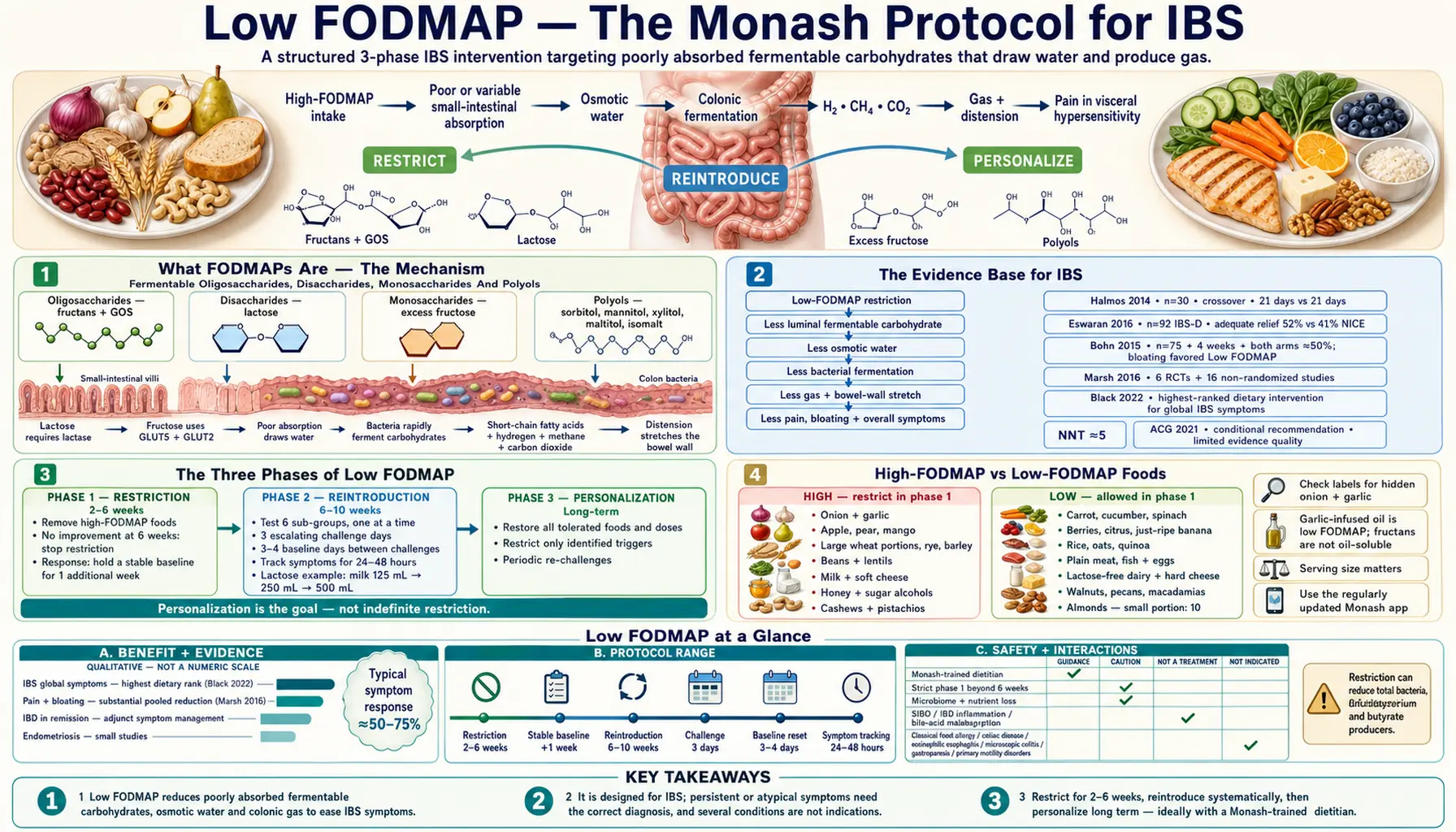
The Low FODMAP diet, developed at Monash University in Melbourne by Peter Gibson, Susan Shepherd, and Jane Muir starting in the early 2000s, is the most evidence-based dietary intervention for irritable bowel syndrome. Multiple randomized controlled trials and meta-analyses (Halmos 2014, Eswaran 2016, Black 2022 network meta-analysis) show approximately 50-75% symptom-response rates — comparable to or exceeding pharmacotherapy. Unlike most "elimination diets" which target speculatively-blamed foods, Low FODMAP targets a specific mechanism: short-chain fermentable carbohydrates that are poorly absorbed in the small intestine, draw water into the small bowel osmotically, then reach the colon where bacterial fermentation produces gas, distension, and pain in patients with visceral hypersensitivity. The protocol is a 3-phase structured intervention — restriction (2-6 weeks), systematic reintroduction by FODMAP sub-group, and long-term personalization — ideally done with a registered dietitian to avoid the over-restriction trap. This page walks through the science, the food list, the structured reintroduction sub-groups, and the personalization phase that turns a temporary intervention into sustainable long-term eating.
Table of Contents
- What FODMAPs Are — The Mechanism
- The Evidence Base for IBS
- The Three Phases of Low FODMAP
- High-FODMAP vs Low-FODMAP Foods
- The Six Reintroduction Sub-Groups
- The Role of a Registered Dietitian
- Beyond IBS — SIBO, IBD, Endometriosis
- Microbiome Concerns and the Over-Restriction Trap
- Practical Tools (Monash App, FODMAP Friendly Certification)
- Key Research Papers
- Connections
- Featured Videos
What FODMAPs Are — The Mechanism
FODMAP is an acronym for Fermentable Oligosaccharides, Disaccharides, Monosaccharides, And Polyols. These are short-chain carbohydrate molecules that share two clinically relevant properties:
- Poor or variable absorption in the small intestine — either because they require a digestive enzyme that some individuals lack (lactose requires lactase), because they exceed the saturation point of their dedicated transporter (fructose requires GLUT5 and GLUT2 transporters which saturate at modest doses), or because the human small intestine lacks the enzymes to hydrolyze them at all (fructans, galacto-oligosaccharides, and polyols).
- Rapid fermentation by colonic bacteria — once they reach the colon, gut bacteria ferment them into short-chain fatty acids, hydrogen gas, methane, and carbon dioxide. In a healthy gut, this fermentation contributes beneficially to colonocyte energy and microbiome diversity. In patients with visceral hypersensitivity (the core neurobiological feature of IBS), the gas distension and the resulting bowel-wall stretching produce disproportionate pain and discomfort.
The specific FODMAP categories and their major dietary sources:
- Oligosaccharides (fructans and galacto-oligosaccharides / GOS): Wheat, rye, barley, onions, garlic, leeks, asparagus, artichokes, chicory root (inulin), legumes (beans, lentils, chickpeas), cashews, pistachios.
- Disaccharides (lactose): Milk, soft cheese (ricotta, cottage cheese), yogurt, ice cream. Hard aged cheese (cheddar, parmesan) is low in lactose. Note: lactose is only a FODMAP for individuals with reduced lactase activity, which is the majority of humans outside Northwest Europe.
- Monosaccharides (excess fructose, defined as fructose in excess of glucose): Apples, pears, mangoes, watermelon, high-fructose corn syrup, honey, agave. Fruits with balanced fructose:glucose ratios (berries, citrus, banana) are low FODMAP.
- Polyols (sugar alcohols): Sorbitol (stone fruits — cherries, peaches, plums; apples), mannitol (mushrooms, cauliflower), xylitol, maltitol, isomalt (in "sugar-free" candies and gum — the major cause of "diet candy diarrhea").
The Monash researchers' insight was that grouping these by mechanism (rather than by chemical class as traditionally taught) and restricting them together produces a single coherent intervention that addresses the multiple food triggers IBS patients report. Before FODMAP, an IBS patient might be told "avoid milk" if lactose intolerant, or "avoid apples" if fructose-sensitive, or "avoid wheat" for unclear reasons — without recognition that all three are variations on the same osmotic-and-fermentative theme.
The Evidence Base for IBS
The Low FODMAP diet has the strongest evidence base of any dietary intervention for IBS. Key studies:
- Halmos EP et al. 2014 (PMID 24076059): The pivotal randomized crossover trial. 30 IBS patients consumed a low-FODMAP diet for 21 days, then a typical Australian diet for 21 days, with washout periods. Symptom severity scores were substantially lower on the low-FODMAP diet, and the response was reproducible across patients.
- Eswaran SL et al. 2016 (PMID 27725652): US-based RCT comparing low-FODMAP to modified NICE IBS dietary guidelines in 92 patients with diarrhea-predominant IBS. 52% on low-FODMAP achieved adequate relief vs 41% on NICE guidelines.
- Bohn L et al. 2015 (PMID 26244706): Swedish RCT, 75 IBS patients randomized to low-FODMAP vs traditional IBS dietary advice for 4 weeks. Both arms improved by approximately 50% on validated symptom scores, with low-FODMAP being slightly more effective for bloating specifically.
- Marsh A et al. 2016 (PMID 26976734): First major meta-analysis. Six RCTs and 16 non-randomized intervention studies. Substantial reduction in pain, bloating, and overall symptom scores on low-FODMAP across pooled data.
- Black CJ et al. 2022 (PMID 34376515): Network meta-analysis comparing dietary interventions for IBS. Low-FODMAP ranked highest of all dietary interventions for global symptom improvement and ranked above several pharmaceutical interventions including antispasmodics.
The number-needed-to-treat (NNT) for meaningful symptom improvement is approximately 5 — that is, treating 5 IBS patients with the low-FODMAP diet produces 1 additional responder who would not have improved on a control diet. This NNT is competitive with most pharmaceutical IBS interventions including rifaximin (NNT approximately 10-11 for IBS-D), linaclotide, lubiprostone, and tricyclic antidepressants.
The American College of Gastroenterology 2021 IBS management guidelines conditionally recommend a low-FODMAP trial for patients with IBS, noting "limited" evidence quality due to methodological limitations of dietary blinding but acknowledging consistent positive results across studies.
The Three Phases of Low FODMAP
The Monash protocol is explicitly three phases, and skipping any phase substantially reduces the intervention's value. The phases are:
Phase 1: Restriction (2-6 weeks)
- Eliminate all high-FODMAP foods. The Monash app and Monash-certified resources provide the definitive food list. Restriction is binary: high-FODMAP foods are off, low-FODMAP foods are on.
- Duration is the shortest interval needed to assess response — 2 weeks if response is dramatic, up to 6 weeks for slower responders. Beyond 6 weeks, the diet should not continue without progressing to reintroduction, due to microbiome and nutritional concerns.
- If no improvement at 6 weeks, FODMAPs are not the trigger. The patient should discontinue restriction and pursue alternative diagnoses or treatments.
- If improvement is achieved, hold the restriction for an additional week to establish a stable symptom baseline before beginning reintroductions.
Phase 2: Reintroduction (6-10 weeks)
- Systematically reintroduce each FODMAP sub-group (fructans, GOS, lactose, fructose, sorbitol, mannitol) individually. Test one sub-group at a time across 3 days, then return to baseline restriction for 3-4 days before the next challenge.
- Each sub-group challenge uses a representative test food at three escalating doses (typically day 1: small, day 2: moderate, day 3: large). For example, the lactose challenge might use milk (250ml whole milk on day 1 if tolerated, 500ml on day 2 if tolerated, 750ml on day 3 if tolerated).
- Track symptoms in a structured journal during and for 24-48 hours after each challenge.
- The output of phase 2 is a personalized list of which sub-groups trigger symptoms and at what threshold doses.
Phase 3: Personalization (long-term)
- The patient reintroduces all tolerated foods at all tolerated doses, restricting only the specific FODMAP sub-groups that triggered symptoms during phase 2 reintroduction.
- Periodic re-challenges are encouraged — FODMAP tolerance can change over time, especially after addressing underlying conditions like SIBO, gastritis, or chronic stress.
- Some patients eventually find they can tolerate small amounts of formerly-trigger FODMAPs but not large amounts — the "dose threshold" model. Personalization respects these individual thresholds.
The personalization phase is the goal — not the restriction phase. A patient on indefinite phase 1 restriction is not "doing FODMAP correctly" — they are missing the entire point of the intervention, which is to identify their personal triggers and eat a maximally varied diet within those constraints.
High-FODMAP vs Low-FODMAP Foods
The definitive food list is maintained by Monash University and updated regularly as new foods are tested in their laboratory. The Monash FODMAP Diet app is the gold-standard reference. A simplified summary of the most consequential categories:
High-FODMAP (restrict in phase 1):
- Vegetables: Onion, garlic (the two biggest offenders, included in nearly all commercial broths, soups, sauces, and seasonings), leek, shallot, asparagus, artichoke, cauliflower, mushroom, sugar snap pea, Brussels sprouts in large portions, beetroot.
- Fruits: Apple, pear, mango, watermelon, peach, plum, cherry, dried fruit (raisins, prunes, dates), apricot, blackberry.
- Grains: Wheat in large amounts (bread, pasta, couscous), rye, barley. Note: small amounts of wheat (less than approximately 25g/day) are tolerated by many.
- Legumes: Chickpeas, kidney beans, black beans, lentils (especially red and large portions of green), baked beans, soy beans.
- Dairy: Milk (cow, goat, sheep), soft cheese (ricotta, cottage cheese, cream cheese), yogurt (most varieties), ice cream.
- Sweeteners: Honey, high-fructose corn syrup, agave, sorbitol, mannitol, xylitol, isomalt, maltitol (the "-itol" sugar alcohols in sugar-free candy and gum).
- Nuts: Cashews, pistachios.
Low-FODMAP (allowed in phase 1):
- Vegetables: Carrots, cucumber, lettuce, spinach, kale (small portions), bell pepper, eggplant, zucchini, tomato, potato, sweet potato (small portions), parsnip, scallion green tops (the white bulb is high FODMAP), bok choy, green beans.
- Fruits: Bananas (just-ripe, not over-ripe), berries (strawberry, blueberry, raspberry), citrus (orange, lemon, lime, mandarin), grapes, kiwi, pineapple, papaya, dragon fruit.
- Grains: Rice (white or brown), oats, quinoa, corn, sourdough wheat bread in small portions (the long fermentation degrades fructans), gluten-free bread and pasta (most are low FODMAP).
- Animal protein: All plain meat, poultry, fish, seafood, eggs. Processed meats may contain garlic and onion — check labels.
- Dairy: Lactose-free milk and yogurt, hard aged cheese (cheddar, parmesan, swiss), butter, ghee.
- Sweeteners: Table sugar (sucrose), maple syrup (small portions), stevia, glucose, dextrose, rice malt syrup.
- Nuts: Almonds (small portions, 10), walnuts, pecans, macadamia, peanuts (small portions).
The single largest practical challenge is garlic and onion. They are nearly ubiquitous in restaurant cooking, prepared foods, and "natural flavors" labels. Garlic-infused oil is low FODMAP (the fructans are not oil-soluble), which provides one workaround — cook with garlic-infused olive oil to get garlic flavor without the FODMAP load.
The Six Reintroduction Sub-Groups
The Monash reintroduction protocol divides FODMAPs into six sub-groups, each tested independently. The standard order and representative test foods:
- Lactose: Test with milk (whole cow's milk, 125ml day 1, 250ml day 2, 500ml day 3). Failure indicates lactose intolerance — the patient should restrict dairy or use lactase enzyme supplements with dairy.
- Excess Fructose: Test with honey (1 teaspoon day 1, 2 teaspoons day 2, 1 tablespoon day 3) or mango (small portion escalating). Failure indicates fructose malabsorption.
- Sorbitol: Test with stone fruit (1/2 cup blackberries or 5 dried apricot halves). Failure indicates sorbitol intolerance and predicts trouble with sugar-free candies and gum.
- Mannitol: Test with mushroom (1/2 cup chopped) or cauliflower (1/4 cup). Failure typically co-occurs with sorbitol failure but not always.
- Fructans: Test with wheat (one slice of regular bread day 1, two slices day 2, three slices day 3) or garlic (1/4 clove day 1, 1/2 clove day 2, 1 clove day 3). Often the most consequential single trigger and the hardest to avoid in normal eating. Wheat fructans are often the actual driver of "gluten sensitivity" in non-celiac populations (Biesiekierski 2013 PMID 23648697 found that some self-identified gluten-sensitive patients respond to FODMAP restriction rather than to gluten elimination per se).
- Galacto-Oligosaccharides (GOS): Test with cashews (small handful day 1, larger day 2, larger day 3) or chickpeas. GOS intolerance is the legume trigger — identification means the patient should soak/sprout legumes thoroughly, use the Beano enzyme (alpha-galactosidase) before legume meals, or restrict portion sizes.
Each sub-group challenge takes 3 days of escalating doses followed by 3-4 days of return to baseline restriction. The full reintroduction phase therefore takes approximately 6-10 weeks depending on response patterns.
An important interpretation guideline: a positive reaction means symptoms returned to or exceeded the patient's pre-restriction baseline. Mild fleeting bloating that resolves within a few hours is usually not a true positive. Significant abdominal pain, multiple loose stools, or symptoms that meaningfully impair daily function are true positives.
The Role of a Registered Dietitian
The Monash University position is unambiguous: Low FODMAP should be done with the guidance of a Monash-trained FODMAP dietitian whenever possible. The reasons are practical:
- Pre-restriction nutritional assessment — baseline calcium intake (likely to drop with dairy elimination), fiber intake (likely to drop with the elimination of high-FODMAP fiber sources), iron, B-vitamin status if grains are heavily restricted.
- Phase 1 supervision — avoiding the common error of under-eating from food anxiety, avoiding nutrient deficits, identifying hidden FODMAP sources in commercial products.
- Phase 2 challenge design — selecting appropriate test foods, escalating doses, and especially interpreting equivocal results.
- Phase 3 personalization — producing a personalized food list and re-challenge schedule.
- Recognition of when Low FODMAP is not the right intervention — many gastroenterologists run Low FODMAP as a default "let's try this" intervention even when the symptom pattern suggests SIBO, microscopic colitis, bile-acid malabsorption, or another condition for which Low FODMAP is not appropriate.
For patients without dietitian access, the Monash University FODMAP app (paid, regularly updated, definitive food list) is the next-best resource. The free patient resources from Monash, the IBS UK Network, and the American College of Gastroenterology are also reliable. Direct-to-consumer "FODMAP food list" handouts of unknown provenance often contain outdated or incorrect information — Monash periodically re-tests foods and reclassifies them as understanding improves.
Beyond IBS — SIBO, IBD, Endometriosis
Low FODMAP was developed for IBS but has been studied in several related conditions:
- SIBO (small intestinal bacterial overgrowth) — symptom overlap with IBS is substantial, and many SIBO patients improve symptomatically on Low FODMAP. However, the underlying SIBO is not treated by dietary restriction — rifaximin or herbal antimicrobials are usually still needed. See our SIBO page for the broader treatment framework.
- Inflammatory bowel disease (Crohn's, ulcerative colitis) — Low FODMAP can reduce functional symptoms in IBD patients in remission (the IBS-overlap component), but does not treat the underlying inflammation. A growing body of evidence suggests it may be useful as adjunctive symptom management.
- Endometriosis — small studies have shown symptom benefit, though the mechanism (visceral hypersensitivity overlap, gut-pelvic interaction) is incompletely understood.
- Functional dyspepsia — some symptomatic overlap with IBS, and Low FODMAP can help when symptoms include lower-abdominal bloating and altered bowel habit.
- Bile-acid malabsorption — not treated by Low FODMAP; the actual treatment is bile acid sequestrants (cholestyramine, colesevelam). This is an important differential because Low FODMAP non-response in IBS-D should prompt consideration of bile-acid malabsorption.
Low FODMAP is not indicated for, and may worsen, the following: classical food allergies, celiac disease (the treatment is gluten avoidance, not FODMAP restriction), eosinophilic esophagitis, microscopic colitis, gastroparesis, and primary motility disorders.
Microbiome Concerns and the Over-Restriction Trap
The most legitimate criticism of Low FODMAP is its effect on the gut microbiome during the restriction phase. Several studies have shown:
- Reduction in total bacterial abundance during phase 1 restriction (Halmos 2015)
- Specific reduction in Bifidobacterium species (Staudacher 2017 PMID 28625832 showed this could be partially offset by co-administered Bifidobacterium probiotic)
- Reduction in butyrate-producing bacteria, with potential implications for colonocyte health
- Some evidence of partial recovery during the reintroduction and personalization phases
The microbiome concerns are the primary reason the Monash protocol explicitly limits phase 1 to 6 weeks maximum and emphasizes that the personalization phase — not the restriction phase — is the intended long-term state. Patients who remain on strict Low FODMAP for months or years are exposing themselves to potential microbiome and nutritional harm without continued benefit (since by definition they have already responded to the intervention).
The over-restriction trap is real and common. The pattern: patient improves dramatically on phase 1, becomes anxious about reintroducing any high-FODMAP food, never completes phase 2, remains on indefinite restriction. This pattern shares features with orthorexia and warrants attention. A dietitian-supported reintroduction is the best defense against this trap.
Practical Tools (Monash App, FODMAP Friendly Certification)
The most useful practical tool is the Monash FODMAP Diet app (paid, approximately $10 USD, regularly updated). The app provides:
- A traffic-light system for every tested food (green = low FODMAP at standard serving, yellow = caution at larger serving, red = high FODMAP)
- Specific serving sizes that move a food from green to red (for example, almonds are green at 10 nuts and red at a handful)
- Sub-group identification (which specific FODMAP category each food contains)
- Recipe collections, food-diary tools, and grocery-list features
For packaged foods, two certification schemes exist: FODMAP Friendly (independent Australian certification) and Monash Low FODMAP Certified (Monash University's own certification). Either logo on a packaged product means the product has been laboratory-tested and certified to fall under the Low FODMAP threshold at the stated serving size. In US grocery stores, look for these certifications particularly on broths, sauces, snack bars, and baking mixes — categories where hidden onion and garlic are pervasive.
Reliable Low FODMAP recipe sources include Kate Scarlata RD (US-based dietitian, comprehensive blog and cookbooks), Patsy Catsos RD (early US Low FODMAP educator), the Monash University recipe collection, and the FODMAP Everyday community.
Key Research Papers
- Halmos EP et al. (2014). A diet low in FODMAPs reduces symptoms of irritable bowel syndrome. Gastroenterology. — PubMed: PMID 24076059
- Staudacher HM et al. (2014). Mechanisms and efficacy of dietary FODMAP restriction in IBS. Nature Reviews Gastroenterology & Hepatology. — Search PubMed
- Eswaran SL et al. (2016). A Randomized Controlled Trial Comparing the Low FODMAP Diet vs Modified NICE Guidelines in US Adults With IBS-D. American Journal of Gastroenterology. — PubMed: PMID 27725652
- Bohn L et al. (2015). Diet low in FODMAPs reduces symptoms of irritable bowel syndrome as well as traditional dietary advice. Gastroenterology. — Search PubMed
- Marsh A et al. (2016). Does a diet low in FODMAPs reduce symptoms associated with functional gastrointestinal disorders? A systematic review and meta-analysis. European Journal of Nutrition. — PubMed: PMID 26976734
- Schumann D et al. (2018). Low fermentable, oligo-, di-, mono-saccharides and polyol diet in the treatment of irritable bowel syndrome: a systematic review and meta-analysis. Nutrition. — Search PubMed
- Staudacher HM et al. (2017). A Diet Low in FODMAPs Reduces Symptoms in Patients With Irritable Bowel Syndrome and a Probiotic Restores Bifidobacterium Species. Gastroenterology. — PubMed: PMID 28625832
- Hill P, Muir JG, Gibson PR (2017). Controversies and Recent Developments of the Low-FODMAP Diet. Gastroenterology & Hepatology. — Search PubMed
- Tuck CJ, Muir JG, Barrett JS, Gibson PR (2014). Fermentable oligosaccharides, disaccharides, monosaccharides and polyols: role in irritable bowel syndrome. Expert Review of Gastroenterology & Hepatology. — Search PubMed
- Black CJ et al. (2022). Efficacy of a low FODMAP diet in irritable bowel syndrome: systematic review and network meta-analysis. Gut. — PubMed: PMID 34376515
- Whelan K et al. (2018). The low FODMAP diet in the management of irritable bowel syndrome: an evidence-based review of FODMAP restriction, reintroduction and personalisation in clinical practice. Journal of Human Nutrition and Dietetics. — PubMed: PMID 29336079
- Biesiekierski JR et al. (2013). No effects of gluten in patients with self-reported non-celiac gluten sensitivity after dietary reduction of fermentable, poorly absorbed, short-chain carbohydrates. Gastroenterology. — PubMed: PMID 23648697
PubMed Topic Searches
- PubMed: Low FODMAP and IBS
- PubMed: FODMAP reintroduction protocol
- PubMed: Fructans vs gluten sensitivity
- PubMed: FODMAP and microbiome
- PubMed: FODMAP and SIBO
Connections
- All Remedies
- Elimination Diet (Main Hub)
- Benefits Deep-Dive Hub
- Whole30
- Carnivore Reset
- Reintroduction Phase
- Irritable Bowel Syndrome
- SIBO
- Crohn's Disease
- Celiac Disease
- Food
- Peppermint (Peppermint Oil for IBS)
- Ginger
- Immune Boosting
- Vitamin D3