Elimination Diet — Benefits Deep Dive
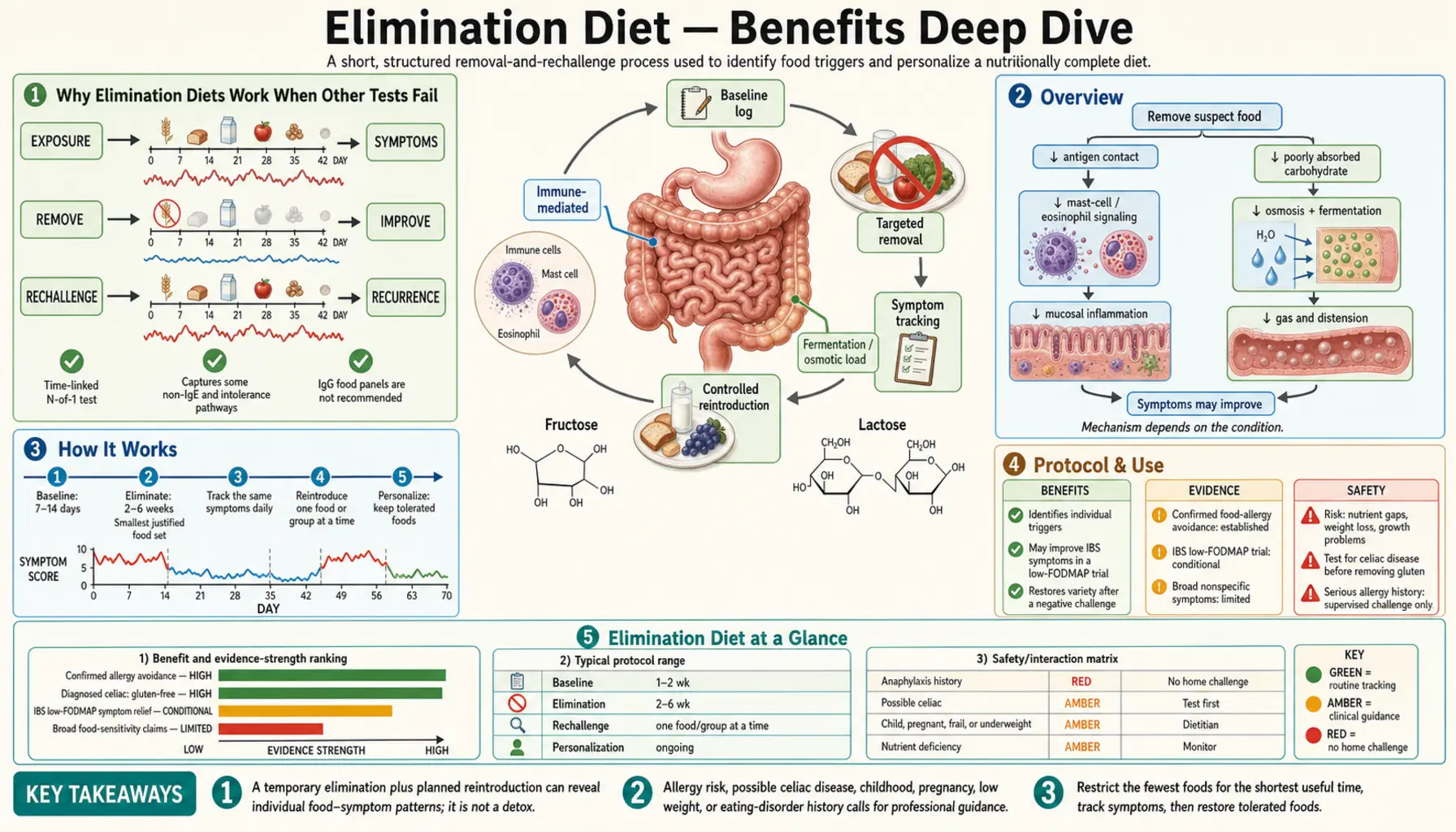
The elimination diet is the original n-of-1 experiment in clinical nutrition — the only reliable, low-tech method for identifying food triggers of symptoms that conventional medicine often cannot pin down: irritable bowel syndrome, eczema, migraine, joint pain, brain fog, chronic fatigue, eosinophilic esophagitis, and atopic conditions in children. Unlike IgE allergy testing (which catches only true immediate hypersensitivity) or IgG food panels (which lack clinical validity per the AAAAI), an elimination-then-reintroduction protocol uses the patient's own symptoms as the readout. Four deep-dive pages below explore the four most clinically validated protocols — Whole30 as the popular structured 30-day reset, Low FODMAP as the Monash-University-developed IBS-specific protocol with the strongest evidence base, Carnivore Reset as the most aggressive elimination tier reserved for severe refractory cases, and the Reintroduction Phase — which is arguably more important than the elimination itself, because it is the reintroduction that produces the diagnostic information.
Deep-Dive Articles
Whole30
The Hartwig-Urban 30-day structured elimination of grains, legumes, dairy, sugar (including most sweeteners), alcohol, and processed seed oils. Originated in 2009 as a Paleo-adjacent reset; now the most widely-followed structured elimination program in the United States. Strengths: simple rules, large community, abundant recipes. Limitations: no formal reintroduction structure built in, may not be specific enough for true food-triggered conditions, and the "no weighing yourself" rule frustrates patients with metabolic goals.
Low FODMAP
The Monash University protocol that has become first-line dietary therapy for irritable bowel syndrome. Eliminates short-chain fermentable carbohydrates (Fermentable Oligo-, Di-, Mono-saccharides, And Polyols) for 2-6 weeks, then systematically reintroduces them by sub-group (fructans, lactose, fructose, polyols, GOS) to identify personal triggers. Strongest evidence base of any dietary intervention for IBS — multiple RCTs show ~70% response rates with symptom reduction comparable to or exceeding pharmacotherapy.
Carnivore Reset
The most aggressive elimination tier — meat, salt, water only (some variants include eggs and dairy). Popularized by Shawn Baker, Mikhaila Peterson, and others as a "diagnostic ceiling" elimination diet for severe autoimmune, gastrointestinal, and neuropsychiatric conditions that have not responded to milder protocols. Case-series and self-reported data are striking; controlled-trial evidence is essentially absent. Discussed here as a tool of last resort with careful framing of the long-term unknowns.
Reintroduction Phase
The single most under-appreciated phase of any elimination protocol — the reintroduction is where the diagnostic information lives. Single-food challenges every 3-7 days, symptom tracking with a structured journal, distinguishing immediate (within 2 hours) from delayed (24-72 hours) reactions, recognizing the "nocebo" trap of expectation bias, and knowing when a food deserves permanent exclusion vs occasional inclusion. Without a disciplined reintroduction, an elimination diet becomes a permanent restriction by default.
Table of Contents
- Deep-Dive Articles
- Why Elimination Diets Work When Other Tests Fail
- Research Papers: Whole30 & Paleo-Style Eliminations
- Research Papers: Low FODMAP for IBS
- Research Papers: Carnivore & Aggressive Eliminations
- Research Papers: Reintroduction Methodology
- Research Papers: Cross-Cutting (IgG Testing, Food Allergy, Eosinophilic Esophagitis)
- External Authoritative Resources
- Connections
- Featured Videos
Why Elimination Diets Work When Other Tests Fail
The clinical motivation for elimination diets is the gap between two failure modes of conventional food-reaction testing. IgE skin-prick and serum-specific IgE tests reliably identify classical immediate-type hypersensitivity — the peanut, shellfish, or tree-nut allergy that produces hives, lip swelling, or anaphylaxis within minutes of ingestion. These tests are excellent for what they measure. But they miss the much larger universe of food-symptom relationships that are not IgE-mediated: the lactose intolerance that triggers bloating four hours after ice cream, the gluten sensitivity that produces brain fog the next morning, the FODMAP-driven IBS flare that builds over 12 hours, the histamine-rich aged-cheese migraine, the egg-driven eczema flare in an atopic toddler.
At the other extreme, IgG food-sensitivity panels (Cyrex, Pinnertest, EverlyWell, and similar direct-to-consumer offerings) measure the wrong thing. IgG to food antigens is a normal immunological response to dietary exposure — high IgG against eggs typically means a patient has been eating eggs, not that eggs are causing harm. The American Academy of Allergy, Asthma, and Immunology (AAAAI), the European Academy of Allergy and Clinical Immunology (EAACI), and the Canadian Society of Allergy and Clinical Immunology have all issued position statements against IgG food testing for diagnosing food sensitivities. The Choosing Wisely campaign lists IgG food panels as a test to avoid.
This leaves a diagnostic gap: how do you identify true food triggers of delayed-onset, non-IgE-mediated symptoms? The answer, recognized for over a century, is the elimination diet. The patient's own symptoms become the assay. The protocol has three phases:
- Elimination — remove the suspect food (or food category) for long enough that any symptoms it was causing fully resolve. Typically 2-6 weeks depending on protocol and symptom type. Skin conditions can take 4-8 weeks; gut symptoms often respond within 7-14 days.
- Stabilization & symptom-baseline — once symptoms have improved or resolved, hold the elimination for at least an additional week so the patient has a clear "feeling well" baseline to which to compare.
- Reintroduction — reintroduce one food at a time, in adequate quantity, with a 3-7 day washout between challenges, tracking symptoms in a structured journal. A clear symptom flare within the expected reaction window (immediate, 2-24 hours, or 24-72 hours depending on the food) implicates that food. A negative challenge means the food can stay in the diet.
The strength of this approach is that the patient is their own n-of-1 experiment — no panel of biomarkers will ever be as sensitive or specific as the patient's own carefully tracked symptoms. The weaknesses are real and worth naming: it requires patient discipline, it can take weeks to months, the elimination phase is socially and logistically disruptive, expectation bias (placebo and nocebo) can muddy reintroduction interpretation, and there is a real risk of over-restriction if the reintroduction phase is skipped or done sloppily. The four deep-dive pages below address how the major elimination-diet protocols handle these tradeoffs.
Research Papers: Whole30 & Paleo-Style Eliminations
- Hartwig M, Hartwig D. The Whole30: The 30-Day Guide to Total Health and Food Freedom — popularization context PubMed: Whole30 literature
- Konijeti GG et al. Efficacy of the Autoimmune Protocol Diet for Inflammatory Bowel Disease — PubMed: PMID 28858071
- Chandrasekaran A et al. The Autoimmune Protocol Diet Modifies Intestinal RNA Expression in Inflammatory Bowel Disease Search PubMed
- Manheimer EW et al. Paleolithic nutrition for metabolic syndrome: systematic review and meta-analysis Search PubMed
- Frassetto LA et al. Metabolic and physiologic improvements from consuming a paleolithic, hunter-gatherer type diet — PubMed: PMID 19209185
- Lindeberg S et al. A Palaeolithic diet improves glucose tolerance more than a Mediterranean-like diet in individuals with ischaemic heart disease — PubMed: PMID 17583796
- Jonsson T et al. A Paleolithic diet is more satiating per calorie than a Mediterranean-like diet in individuals with ischemic heart disease — PubMed: PMID 21118562
- Otten J et al. A heterogeneous response of liver and skeletal muscle fat to the combination of a Paleolithic diet and exercise Search PubMed
- Boers I et al. Favourable effects of consuming a Palaeolithic-type diet on characteristics of the metabolic syndrome — PubMed: PMID 25304296
- Mellberg C et al. Long-term effects of a Palaeolithic-type diet in obese postmenopausal women — PubMed: PMID 24473459
Research Papers: Low FODMAP for IBS
- Halmos EP et al. A diet low in FODMAPs reduces symptoms of irritable bowel syndrome — PubMed: PMID 24076059
- Staudacher HM et al. Mechanisms and efficacy of dietary FODMAP restriction in IBS Search PubMed
- Eswaran SL et al. A Randomized Controlled Trial Comparing the Low FODMAP Diet vs Modified NICE Guidelines in US Adults With IBS-D — PubMed: PMID 27725652
- Bohn L et al. Diet low in FODMAPs reduces symptoms of irritable bowel syndrome as well as traditional dietary advice Search PubMed
- Marsh A et al. Does a diet low in FODMAPs reduce symptoms associated with functional gastrointestinal disorders? A meta-analysis — PubMed: PMID 25982757
- Schumann D et al. Low fermentable, oligo-, di-, mono-saccharides and polyol diet in the treatment of irritable bowel syndrome: a systematic review and meta-analysis Search PubMed
- Staudacher HM et al. A diet low in FODMAPs reduces symptoms in patients with irritable bowel syndrome and a probiotic restores Bifidobacterium species — PubMed: PMID 28625832
- Hill P, Muir JG, Gibson PR. Controversies and Recent Developments of the Low-FODMAP Diet Search PubMed
- Tuck CJ, Muir JG, Barrett JS, Gibson PR. Fermentable oligosaccharides, disaccharides, monosaccharides and polyols: role in irritable bowel syndrome Search PubMed
- Black CJ et al. Efficacy of a low FODMAP diet in irritable bowel syndrome: systematic review and network meta-analysis — PubMed: PMID 34376515
Research Papers: Carnivore & Aggressive Eliminations
- Lennerz BS et al. Behavioral Characteristics and Self-Reported Health Status among 2029 Adults Consuming a "Carnivore Diet" — PubMed: PMID 34934897
- O'Hearn A. Can a carnivore diet provide all essential nutrients? Search PubMed
- Konner M, Eaton SB. Paleolithic nutrition: twenty-five years later Search PubMed
- O'Keefe SJ et al. Fat, fibre and cancer risk in African Americans and rural Africans — PubMed: PMID 25919227
- McClellan WS, Du Bois EF. Clinical calorimetry: prolonged meat diets with a study of kidney function and ketosis — the Stefansson 1930 Bellevue Hospital study PubMed: McClellan/Du Bois 1930
- Yancy WS Jr et al. A low-carbohydrate, ketogenic diet versus a low-fat diet to treat obesity and hyperlipidemia Search PubMed
- Volek JS et al. Comparison of energy-restricted very low-carbohydrate and low-fat diets on weight loss and body composition in overweight men and women — PubMed: PMID 15533250
- Hyde PN et al. Dietary carbohydrate restriction improves metabolic syndrome independent of weight loss Search PubMed
- Saslow LR et al. A Randomized Pilot Trial of a Moderate Carbohydrate Diet Compared to a Very Low Carbohydrate Diet in Overweight or Obese Individuals with Type 2 Diabetes Mellitus or Prediabetes Search PubMed
- Athinarayanan SJ et al. Long-Term Effects of a Novel Continuous Remote Care Intervention Including Nutritional Ketosis for the Management of Type 2 Diabetes — PubMed: PMID 31231311
Research Papers: Reintroduction Methodology
- Tuck CJ et al. Re-challenging FODMAPs: the low FODMAP diet phase two — PubMed: PMID 28244664
- Whelan K et al. The low FODMAP diet in the management of irritable bowel syndrome: an evidence-based review of FODMAP restriction, reintroduction and personalisation in clinical practice — PubMed: PMID 29336079
- Niec AM, Frankum B, Talley NJ. Are adverse food reactions linked to irritable bowel syndrome? Search PubMed
- Nowak-Wegrzyn A et al. Work Group report: oral food challenge testing — PubMed: PMID 19500710
- Sampson HA et al. Standardizing double-blind, placebo-controlled oral food challenges: American Academy of Allergy, Asthma & Immunology — European Academy of Allergy and Clinical Immunology PRACTALL consensus report Search PubMed
- Bischoff S, Crowe SE. Gastrointestinal food allergy: new insights into pathophysiology and clinical perspectives Search PubMed
- Skypala IJ et al. The development of a standardised diet history tool to support the diagnosis of food allergy Search PubMed
- Kelso JM. Unproven Diagnostic Tests for Adverse Reactions to Foods Search PubMed
- Carr S et al. CSACI Position statement on the testing of food-specific IgG Search PubMed
- Stapel SO et al. Testing for IgG4 against foods is not recommended as a diagnostic tool: EAACI Task Force Report Search PubMed
Research Papers: Cross-Cutting (IgG Testing, Food Allergy, Eosinophilic Esophagitis)
- Lucendo AJ et al. Empiric 6-food elimination diet induced and maintained prolonged remission in patients with adult eosinophilic esophagitis — PubMed: PMID 23375693
- Kagalwalla AF et al. Effect of six-food elimination diet on clinical and histologic outcomes in eosinophilic esophagitis — PubMed: PMID 16860614
- Molina-Infante J et al. Step-up empiric elimination diet for pediatric and adult eosinophilic esophagitis: The 2-4-6 study — PubMed: PMID 29074457
- Atkins D, Furuta GT. Mucosal immunology, eosinophilic esophagitis, and other intestinal inflammatory diseases Search PubMed
- Bredenoord AJ et al. Eosinophilic esophagitis: clinical presentation, diagnosis, and treatment Search PubMed
- Sicherer SH, Sampson HA. Food allergy: A review and update on epidemiology, pathogenesis, diagnosis, prevention, and management Search PubMed
- Boyce JA et al. Guidelines for the Diagnosis and Management of Food Allergy in the United States: Summary of the NIAID-Sponsored Expert Panel Report — PubMed: PMID 21134576
- Catassi C et al. Diagnosis of Non-Celiac Gluten Sensitivity (NCGS): The Salerno Experts' Criteria — PubMed: PMID 26096570
- Biesiekierski JR et al. No effects of gluten in patients with self-reported non-celiac gluten sensitivity after dietary reduction of fermentable, poorly absorbed, short-chain carbohydrates — PubMed: PMID 23648697
- Skypala IJ. Food-Induced Anaphylaxis: Role of Hidden Allergens and Cofactors Search PubMed
External Authoritative Resources
- Monash University FODMAP Program — the source institution for the Low FODMAP diet, including the certified food app and clinician training
- American College of Gastroenterology — IBS Patient Resources
- AAAAI Position Statement on IgG Food Testing
- Whole30 Official Program Resources — rules, food lists, reintroduction guidance
- PubMed — All research on elimination diet
Connections
- All Remedies
- Elimination Diet (Main Hub)
- Whole30
- Low FODMAP
- Carnivore Reset
- Reintroduction Phase
- Irritable Bowel Syndrome
- SIBO
- Celiac Disease
- Crohn's Disease
- Eczema
- Migraine
- Rheumatoid Arthritis
- Food
- Immune Boosting