Robert Edwards: IVF, and the Millions of People Who Exist Because of It
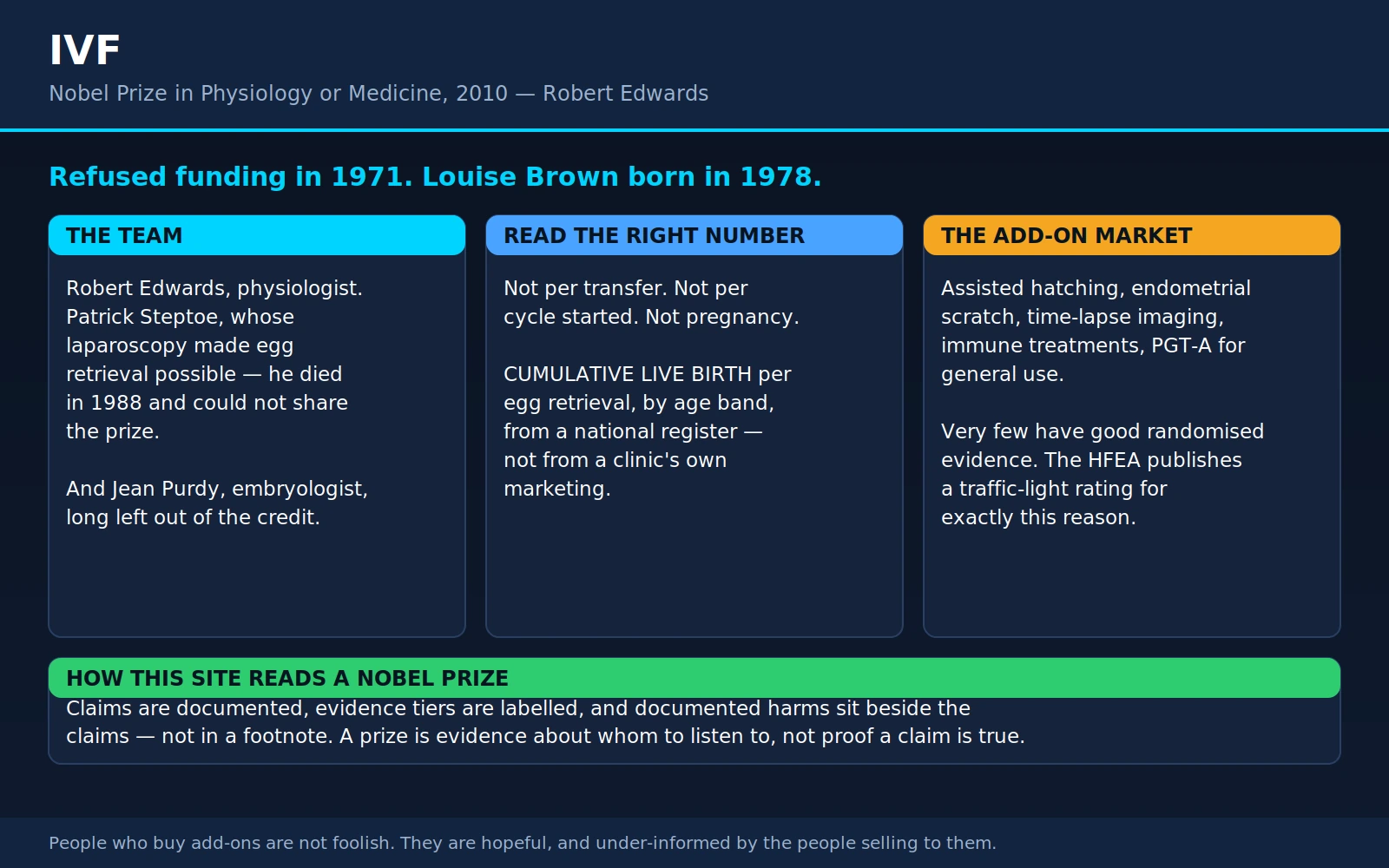
If you have arrived here in the middle of trying to have a child, or after a diagnosis that has just changed what you thought your life would look like, this page is written for you. It covers the history — because the history explains why some of the arguments around IVF are still so heated — but the two sections you probably need most are honest success rates and add-ons. Those are the two places where the information you are given is most likely to be shaped by someone who is selling you something.
Table of Contents
- The Prize and the Partnership
- What Infertility Meant
- The Science That Had to Come First
- 1968–1978: Cambridge to Oldham
- Louise Brown, 25 July 1978
- The Opposition, Taken Seriously
- How IVF Actually Works Now
- Honest Success Rates
- Risks, Stated Fairly
- Add-Ons: The Market Built on Hope
- What Is Genuinely Improving
- Where Mainstream Medicine Agrees — and What Remains Debated
- Key Research Papers
- Connections
- Featured Videos
1. The Prize and the Partnership
The 2010 Nobel Prize in Physiology or Medicine went to one person: Robert Geoffrey Edwards (1925–2013), a Cambridge physiologist, "for the development of in vitro fertilization." He was eighty-five, and too unwell to travel to Stockholm; his family received the award on his behalf. He had been waiting for it for thirty-two years.
Edwards was not a clinician. He was born in Batley in Yorkshire, grew up in Manchester, served in the British Army at the end of the Second World War, and came to biology sideways — through an agricultural science degree at Bangor and then a PhD in Edinburgh on mouse embryology. What he was extraordinarily good at was the unglamorous physiology of eggs: what an oocyte does after it leaves the ovary, how long it takes to do it, and what has to be true of the fluid around it for any of that to work. That is a subject you can spend a decade on without producing a single headline. Edwards spent a decade on it.
The other half of the partnership was Patrick Christopher Steptoe (1913–1988), a gynaecologist at Oldham General Hospital in industrial Lancashire — about as far from a prestige research post as British medicine got. Steptoe had spent years championing laparoscopy, keyhole surgery through a fibre-optic instrument, at a time when most British surgeons regarded it as a gimmick. He published a textbook on it in 1967. It was precisely that unfashionable skill that made the whole enterprise possible: to fertilise a human egg you first have to get one, and before ultrasound-guided retrieval existed, the only way to take a ripening egg out of a living ovary without a laparotomy was through a laparoscope.
Edwards read Steptoe's work, telephoned him, and they met in London in 1968. For the next decade Edwards drove a round trip of more than three hundred miles from Cambridge to Oldham, repeatedly, carrying culture media in a flask.
Steptoe died in March 1988, twenty-two years before the prize. The Nobel is not awarded posthumously, and so he could not share it. Edwards said in the years afterwards, in various forms, that the work had never been his alone.
Jean Purdy
There was a third member of the team, and for a long time she was left out of the story almost entirely.
Jean Marian Purdy (1945–1985) trained as a nurse and became the team's embryologist. She joined Edwards in 1968 and worked on the project until her death from cancer at thirty-nine. She ran the laboratory at Oldham, kept the notebooks, handled the cultures, and was the first person to see the cell division of the embryo that became Louise Brown. She is a named co-author on the major papers — including the 1980 pair in the British Journal of Obstetrics and Gynaecology that laid out how the pregnancies had actually been established. She was, in the ordinary sense of the word, a co-founder of clinical IVF.
When a commemorative plaque was proposed at the Oldham hospital site, it named Steptoe and Edwards. Edwards objected, in writing, to the health authority — more than once — arguing that Purdy had contributed as much as either of them and that leaving her name off was simply wrong. He was refused. The correspondence survives, and its rediscovery in recent years did more than anything else to put her back in the account.
Historians of the field have since gone through the original Oldham laboratory notebooks in detail and reassessed her role directly (Johnson and Elder, 2015). She is now increasingly named alongside Edwards and Steptoe wherever the origin of IVF is described. It is worth saying plainly why this matters beyond fairness to one woman: the sanitised version of this story — two great men, one breakthrough — is also the version that makes the science look easier and cleaner than it was. The notebooks show something else. They show years of failure, recorded in careful handwriting, by three people.
2. What Infertility Meant
Before the technique, the human situation.
Lesley Brown, who would become the first woman to give birth after IVF, had blocked fallopian tubes. Her eggs were normal. Her husband's sperm were normal. Her uterus was normal. The tubes — two channels a few millimetres wide — had been scarred shut, probably by infection, and so the egg and the sperm could never meet. She had been trying to conceive for nine years.
For that specific and extremely common problem, twentieth-century medicine had essentially nothing to offer. Tubal surgery worked sometimes and often did not. Otherwise the answer was: adopt, or accept it. Millions of people accepted it.
What that acceptance cost is easy to underestimate from the outside, and this is worth stating carefully because it goes to the heart of why Edwards persisted. Involuntary childlessness has been documented, consistently and across cultures, as one of the most distressing experiences that can happen to an adult who wanted children. It is chronic, it is often invisible to friends and colleagues, it arrives monthly, and in many societies it carried — and still carries — blame, usually aimed at the woman. It reshapes marriages, extended families and finances. Studies of people in fertility treatment routinely find rates of depressive and anxiety symptoms comparable to those seen in people living with serious chronic illness.
There was, and is, a counter-argument, and it deserves to be stated at full strength rather than waved away. Infertility does not kill anyone. In a world where children were dying of malaria and measles, and where health budgets are finite, was this the right problem for a national research council to fund? Was it a medical problem at all, or a social one — a want rather than a need? Should scarce resources go to a condition whose sufferers can, after all, live long and otherwise healthy lives?
That argument is not stupid, and versions of it are still made when public funding of IVF is debated. Two answers are usually given. The first is that medicine has never in practice restricted itself to mortality: it treats cataracts, cleft palate, chronic pain, depression, disfigurement and deafness, none of which are principally about dying. Suffering is the currency, not death. The second is empirical: the burden turned out to be measurable. Once anyone actually asked, using the same instruments used for cancer and cardiac disease, involuntary childlessness scored as a major impairment of quality of life. It looked less like a preference and more like a disease of a functioning system.
Where the counter-argument still has real force is in allocation — in a country deciding how many publicly funded cycles it can offer, and to whom. That is a genuine and unresolved policy question, and it is discussed in section 12. It is a different question from whether the research should ever have been done.
3. The Science That Had to Come First
People sometimes imagine the invention of IVF as a single clever afternoon: put an egg and some sperm in a dish, wait. Attempts along those lines had in fact been made since the 1940s, most famously by John Rock and Miriam Menkin in Boston, and they had produced ambiguous results that nobody could reliably repeat. The reason they failed is the reason Edwards's contribution was a decade of physiology and not a stunt.
The timing problem
An egg released from the ovary is not immediately fertilisable. It has to complete a maturation process — resuming a cell division that has been paused since before the woman was born — and only at the end of that process is it ready. In laboratory animals, that process is fast. In the mouse it takes roughly half a day.
Everyone assumed humans would be broadly similar, because that is how comparative biology usually goes. Everyone was wrong, and the error was fatal to the early attempts: eggs were being inseminated hours before they were capable of being fertilised, and what looked like fertilisation was often degenerating tissue.
Edwards worked this out by taking ovarian tissue removed during gynaecological surgery, culturing the immature eggs, and simply watching them, hour after hour, in mouse, sheep, cow, pig, rhesus monkey and human side by side. His 1965 paper in Nature reported the answer: the human oocyte takes on the order of a day and a half — roughly thirty-six to forty hours, and far longer than the mouse — to reach the stage at which it can be fertilised. That single measurement, unspectacular as it looks, is the foundation the entire field rests on. Every modern IVF clinic still times its trigger injection and its egg collection around it.
The sperm problem
The second obstacle was that fresh human sperm, taken straight from an ejaculate and dropped onto an egg, will not fertilise it. Sperm must first undergo capacitation, a set of changes in the sperm membrane and its motion that normally happen during the hours it spends travelling through the female reproductive tract. This had been discovered independently in the early 1950s by Colin Austin and Min Chueh Chang, and it meant that in vitro fertilisation required in vitro capacitation — reproducing in a dish an environment nobody had characterised.
Edwards worked on this with Barry Bavister, a young researcher who had developed a culture medium for hamster sperm with an unusually high pH. Applied to human gametes, it worked. The 1969 paper in Nature by Edwards, Bavister and Steptoe reported the early stages of fertilisation of human oocytes in vitro — sperm penetrating the egg, the second polar body extruded, pronuclei forming. It is the first credible demonstration of human fertilisation outside the body, and it caused an immediate uproar.
The culture problem
The third obstacle was the fluid itself. An embryo in a fallopian tube sits in a solution whose composition changes as it travels. Getting a human embryo through its first divisions in a dish meant guessing at salts, energy substrates, amino acids, protein source, pH, temperature and oxygen concentration, and then finding out over days whether the guess was wrong. This work has never really stopped; the sequential and single-step media used in laboratories today are the descendants of it, and improvements in culture are among the least visible and most consequential advances in the field.
By 1970 the team could take a human egg, mature it, fertilise it and grow the embryo to the eight-cell stage and beyond. What they could not do — for another eight years — was get one to implant.
4. 1968–1978: Cambridge to Oldham
The working pattern was this. Steptoe, at Oldham, would identify a patient with tubal disease, stimulate her ovaries, and collect eggs by laparoscopy. Edwards and Purdy would fertilise them and culture the embryos. Steptoe would transfer an embryo back. Nothing would happen. They would do it again.
Between 1970 and 1977 they performed well over a hundred embryo transfers. They achieved a handful of biochemical pregnancies and, in 1976, one pregnancy that implanted in the wrong place — an ectopic, in a damaged tube, which had to be removed. That was the state of the project after eight years: one lost pregnancy, in the wrong location.
The Medical Research Council says no
In 1971 Edwards and Steptoe applied to Britain's Medical Research Council for long-term programme support. They were refused.
This is one of the more striking facts in the history of twentieth-century medicine, and it is well documented, because the MRC's files were later opened and analysed in detail (Johnson and colleagues, 2010). The refusal was not casual. The referees and the committee raised concerns about the safety of any child produced, about whether the work was ethically acceptable, about whether the clinical need justified it, and — a recurring theme — about Edwards's willingness to talk to journalists and appear on television, which was read as self-promotion rather than as public engagement. Edwards himself believed that a general distaste for the subject was doing much of the work underneath the stated reasons.
The consequences were concrete. Without a research grant, the project ran on Steptoe's National Health Service clinical time at a district general hospital, on Edwards's Cambridge salary, and on private donations — including sustained support from an American benefactor. Purdy's post depended on the same precarious money. When people ask why it took ten years, part of the answer is that the establishment declined to pay for it.
The insight that changed everything
The failures had a pattern, and by 1977 Edwards had read it. They had been stimulating the ovaries with hormones to get several eggs per cycle, which is efficient. But the same drugs appeared to be disturbing the hormonal environment of the uterus, so that even a good embryo arrived at a lining that was not ready for it.
So they gave up efficiency. They switched to the natural cycle: no stimulation at all, one egg, collected at exactly the right moment in the woman's own cycle. Getting that moment right required measuring the surge of luteinising hormone that precedes ovulation, in frequent urine samples, around the clock — which was only practical because Rosalyn Yalow and Solomon Berson's radioimmunoassay had made it possible to measure hormones at vanishingly small concentrations. Steptoe would then operate whenever the surge said so, including in the middle of the night.
It is a very unusual kind of scientific decision: to make your method slower, harder and less productive per attempt, on the theory that the body's own signalling was better than yours. It was right.
5. Louise Brown, 25 July 1978
Lesley Brown, thirty, and her husband John, a lorry driver, had been referred to Steptoe after nine years without a pregnancy and a failed attempt at tubal surgery. In November 1977 a single egg was collected from Lesley's natural cycle at Oldham. It was fertilised in Purdy's laboratory and cultured to eight cells. Steptoe transferred it, late in the evening, some two and a half days later.
It implanted.
The pregnancy was watched with an intensity no pregnancy had ever received. Lesley Brown was admitted under a false name to keep reporters out. The Daily Mail bought exclusive rights to the family's story, which made every other newspaper in Britain desperate; there were photographers on the hospital roof and journalists posing as relatives. At 11:47 p.m. on 25 July 1978, at Oldham General Hospital, Louise Joy Brown was delivered by caesarean section, weighing five pounds twelve ounces. She was healthy.
The scientific report that followed was two paragraphs long. Steptoe and Edwards published it in The Lancet as a letter: "Birth after the reimplantation of a human embryo." It is one of the shortest papers ever to found a medical specialty, and it gives almost nothing away — the full method was not published until the two 1980 papers with Purdy.
The press called Louise a "test-tube baby," and the label stuck for a generation. The family disliked it, and so did Edwards, for a straightforward reason: it was wrong. There was no test tube. There was a small glass dish, and the embryo was in it for two and a half days out of a nine-month pregnancy. But the phrase carried an implication that mattered — that this was a manufactured child, something other than a human being conceived by two parents — and the Browns spent years pushing back against it. Louise Brown herself has spent much of her adult life doing the same, gently and publicly. She later had two sons, both conceived without assistance.
Her sister Natalie, born in 1982, was among the earliest IVF children, and in 1999 became the first person conceived by IVF to give birth — which quietly answered one of the loudest fears of 1978.
Edwards and Steptoe opened Bourn Hall Clinic, near Cambridge, in 1980 — the world's first IVF clinic, and the first place where the technique was taught systematically to other teams. Within a decade it was being done on every continent.
6. The Opposition, Taken Seriously
It would be easy, and dishonest, to present the objections to IVF as prudish noise that history has since swept away. They were serious objections, made by serious people, and several of them have not been answered so much as absorbed into a regulatory compromise. A reader deciding what they themselves think deserves the arguments at their strongest.
The moral status of the embryo
This is the central objection and everything else follows from it. IVF creates human embryos outside the body. In practice it creates more of them than are transferred, because that is what makes the treatment tolerable — the alternative is a fresh surgical egg collection for every attempt. The surplus embryos are frozen; some are later transferred, some are donated, some are used in research where that is permitted, and some are allowed to perish.
If a human embryo has the full moral status of a person from the moment of fertilisation, then that is not a regrettable side-effect. It is the routine destruction of human beings, carried out at scale, for the benefit of others. Nothing about a successful outcome changes it. This is the position of the Catholic Church, set out in the Congregation for the Doctrine of the Faith's instructions Donum Vitae (1987) and Dignitas Personae (2008), and it is held with complete internal consistency. It is not a position that can be refuted by pointing at happy families.
Catholic teaching adds a second and separable objection: that procreation should not be separated from the marital act, so that even a hypothetical IVF that destroyed no embryos would still be wrong. This one is much less widely shared outside Catholicism, and it is worth distinguishing from the first, because people often argue past each other by conflating them.
When Edwards was awarded the Nobel Prize in 2010, the president of the Pontifical Academy for Life publicly criticised the decision, citing the large numbers of embryos created, frozen and destroyed since 1978 and the emergence of a market in human eggs. That criticism was widely reported at the time and the Church's position has not changed. It is reported here as fact, not endorsed or rebutted.
Other traditions reached different conclusions. Many Jewish and Islamic authorities permit IVF within marriage using the couple's own gametes, while views on donor gametes, surrogacy and embryo disposal differ considerably both between and within those traditions. Protestant denominations range from broad acceptance to positions close to the Catholic one. There is no single "religious view" of IVF, and it is a mistake — commonly made in both directions — to talk as though there were.
"Playing God" and the slippery slope
The two other objections most often heard in 1978 were that scientists were arrogating a power that was not theirs, and that a technique for helping infertile couples would inevitably become a technique for selecting children.
The first is often dismissed as vague, but it has a defensible core: an anxiety about irreversibility, about a small number of people making a decision on behalf of everyone, and about a technique being adopted before anyone knows the long-term consequences for the children produced. That is a reasonable thing to worry about in advance, even if the answer turns out to be reassuring.
The second was not vague at all, and it was partly right. IVF did become the necessary platform for embryo selection. Preimplantation genetic testing exists because IVF exists. So does egg donation, sex selection where it is legal, embryo screening for adult-onset disease risk, and the commercial products discussed in section 10. The people who predicted this in the 1970s were not being hysterical. Where they were wrong was in assuming the slope could not be terraced — that no society would be able to permit one use and prohibit another.
Warnock, and the invention of embryo regulation
Britain's answer was to appoint the philosopher Mary Warnock to chair a Committee of Inquiry into Human Fertilisation and Embryology, which reported in 1984. It is a genuinely impressive document, and its central move was to refuse the two easy answers. It did not declare the embryo a person, and it did not declare it mere tissue. It proposed instead that the embryo was owed respect, that this respect was not absolute, and that research on it should be permitted — but only up to fourteen days after fertilisation, and only under licence.
Fourteen days is the point around which the primitive streak appears, after which the embryo can no longer divide into twins and the earliest neural development begins. Warnock was explicit that the line was a practical convention rather than a metaphysical discovery: what a society needs, when it cannot agree on first principles, is a boundary that is clear, defensible and enforceable.
The recommendations became the Human Fertilisation and Embryology Act 1990 and created the Human Fertilisation and Embryology Authority (HFEA), which licenses every clinic and every research project in the United Kingdom, publishes national outcome data, and — as it turned out decades later — became the main institutional check on the sale of unproven treatments. Many countries have adopted something similar; some are far more permissive; the United States regulates laboratories and reporting but has no comparable national licensing body for embryo research or clinical practice. The result is that the rules governing what may be done to an embryo depend heavily on which country you are in.
7. How IVF Actually Works Now
The modern cycle bears a family resemblance to Oldham in 1977 and differs in almost every detail. Here is what actually happens, and what each step is for.
Ovarian stimulation (roughly 8–14 days)
In a natural cycle, one follicle wins and the rest die. Stimulation overrides that: daily injections of follicle-stimulating hormone, with or without luteinising hormone activity, rescue a cohort of follicles that would otherwise have been lost, so that instead of one egg you may collect five, ten or twenty. A second drug — usually a GnRH antagonist in modern protocols, sometimes an agonist — is given to stop the body ovulating on its own before the eggs can be collected.
The dose is chosen from your age, your antral follicle count on ultrasound and your anti-Müllerian hormone level. The aim is not the maximum number of eggs. It is enough eggs, at acceptable risk.
Monitoring
Every few days, a transvaginal ultrasound counts and measures the growing follicles, often with a blood oestradiol level. This is how the dose gets adjusted and how the team spots an over-response early enough to change plan. Edwards had to do the equivalent with urine assays, by hand, at three in the morning.
The trigger
When enough follicles have reached size, a single injection completes the eggs' final maturation — the process Edwards measured in 1965. Retrieval is scheduled about thirty-six hours later, which is the practical descendant of that measurement. The trigger drug is either hCG, which mimics the natural LH surge, or a GnRH agonist, which prompts the body's own surge. That choice matters for safety and is discussed in section 9.
Egg retrieval
A needle is passed through the vaginal wall under ultrasound guidance and each follicle is aspirated. It takes fifteen to thirty minutes under sedation or light anaesthesia, and you go home the same day. Steptoe's laparoscopy — a general anaesthetic and abdominal incisions — was replaced by this in the mid-1980s, and it is one of the great unremarked improvements in the field's safety and tolerability.
Fertilisation
Two options. In conventional IVF, each egg is placed in a drop of medium with tens of thousands of prepared sperm and left to it — essentially Edwards's method. In ICSI (intracytoplasmic sperm injection), a single sperm is picked up in a glass needle and injected directly into the egg. ICSI was reported by Gianpiero Palermo and colleagues in Brussels in 1992 and transformed the treatment of severe male-factor infertility, where conventional insemination simply fails.
ICSI is the right tool for male-factor problems. It is now used in a majority of cycles worldwide, including many where the sperm are normal, and there is no good evidence that it improves outcomes in that setting. If it is proposed to you and the sperm parameters are normal, it is fair to ask why.
Embryo culture
Fertilised eggs are cultured in an incubator for three days (to the cleavage stage, six to eight cells) or five to six days (to the blastocyst, a hollow ball of a hundred-odd cells with the first two distinct cell types). Growing to blastocyst is a selection process as much as a growth process: embryos with serious problems tend to stop before they get there, so the ones that arrive are a better bet. The trade-off is that if only one or two embryos are available, extended culture risks having nothing to transfer at all.
Transfer
A fine catheter is passed through the cervix and the embryo is released into the uterine cavity. It takes a few minutes, needs no anaesthetic, and is usually done under ultrasound guidance. Progesterone is given afterwards to support the lining. A pregnancy test follows around nine to fourteen days later.
Freezing
Surplus good embryos are frozen by vitrification, a technique that turns the water inside the cell to glass rather than ice, so no crystals form to tear the membranes. This is not a minor technical footnote — it is the change that reorganised the whole treatment, and it is covered in section 11.
Why one embryo, and why freeze everything
For the first thirty years of IVF, transferring two, three or four embryos was normal, because it raised the chance that one would take. It also produced twins and triplets at rates never seen in natural conception, and this was, for a long time, treated as a happy bonus rather than what it actually is.
A twin pregnancy is a high-risk pregnancy. Compared with a singleton it carries substantially higher risks of preterm birth, low birthweight, pre-eclampsia, gestational diabetes, caesarean delivery, neonatal intensive care admission, cerebral palsy and perinatal death. Triplets are considerably worse again. Multiple pregnancy is, by a wide margin, the largest avoidable harm that IVF has caused, and nearly all of it was iatrogenic — caused by the treatment decision, not the underlying infertility.
The Cochrane review of embryo numbers (Pandian and colleagues, 2013) set out the arithmetic that resolved this. Transferring one embryo instead of two lowers the live birth rate from a single fresh cycle. But transferring one, and then transferring a frozen one later if the first does not work, produces a cumulative live birth rate comparable to double transfer — with a dramatically lower multiple pregnancy rate. You do not lose babies. You lose twins.
The related freeze-all strategy — freezing every embryo and transferring in a later, unstimulated cycle — grew from the same logic Edwards used in 1977: high hormone levels during stimulation may not be ideal for the uterine lining. The Cochrane review of fresh versus frozen transfer (Wong and colleagues, 2017) found no clear difference in cumulative live birth between the strategies, with a lower risk of ovarian hyperstimulation in the freeze-all approach. Freeze-all is therefore a reasonable option, particularly for women at high risk of hyperstimulation, rather than a superior default for everyone.
Elective single embryo transfer, combined with reliable freezing, is a real and substantial safety victory. In countries that adopted it as policy, IVF twin rates fell sharply while birth rates held. If a clinic offers you a double transfer, ask specifically about your cumulative chance with sequential single transfers, and about the risks of a twin pregnancy to you and to both babies.
8. Honest Success Rates
This is the number people most need and are most often given in a misleading form. Read this section before you read any clinic's website.
Ask for the right metric
The same clinic, with the same patients and the same results, can honestly quote wildly different percentages depending on what it divides by. The main variants:
- Per embryo transfer — the highest-looking number, because it excludes every cycle that was cancelled, every cycle where no eggs were collected, and every cycle where no embryo was suitable to transfer. Those failures happened to real patients and are simply not in the denominator.
- Per cycle started — more honest, since it counts everyone who began stimulation.
- Per egg retrieval, cumulative — counts the fresh transfer and every frozen transfer from that same egg collection. This is the number that answers the question you are actually asking: if I go through one round of injections and one retrieval, what is my chance of a baby?
- Clinical pregnancy versus live birth — pregnancy rates are always higher than birth rates, because some pregnancies miscarry. Only one of those two numbers is a child.
The metric worth asking for, every time, is cumulative live birth per egg retrieval, broken down by age band, using your own eggs. Anything else is either less relevant or more flattering, and usually both.
Per cycle and across cycles are different questions
The largest study to make this distinction clearly used the UK national register: Smith and colleagues analysed more than a quarter of a million cycles in about 157,000 women and published the result in JAMA in 2015. Approximate figures, and they should be read as approximate:
- Roughly 30% of women had a live birth from their first cycle.
- The chance per cycle stayed above about 20% through the fourth cycle — it did not fall off a cliff after one or two failures.
- By the sixth cycle, the cumulative live birth rate was around 65% under the most optimistic assumption and around 42% under the most conservative one.
That last pair of numbers is the most useful thing in the paper. The two estimates differ by more than twenty percentage points, and they differ only in how you count the women who stopped treatment — whether you assume the people who dropped out would have done as well as those who continued, or that they would all have failed. The truth is in between and nobody knows exactly where. When a clinic quotes you a single confident cumulative figure with no such caveat, that is information about the clinic.
The practical lesson is genuinely encouraging, though: persistence pays, up to a point. One failed cycle says much less about your prognosis than most people assume.
Age is the dominant variable
Nothing else in IVF comes close. Success falls steeply with the age of the person providing the eggs, because the proportion of eggs carrying the wrong number of chromosomes rises steeply with age, and an embryo with the wrong chromosome number usually does not implant or does not continue.
Rather than quote precise percentages that vary by country, year and register, here is the shape, and it is consistent everywhere it has been measured. Live birth rates per retrieval are broadly similar through the early thirties; they begin a clear decline in the mid-to-late thirties; they fall sharply after forty; and by the mid-forties, with a woman's own eggs, they are very low — low enough that clinics in some countries decline to treat, and that donor eggs become the realistic route for those who want to continue. Donor-egg cycles track the age of the donor, not the recipient, which is itself the clearest possible demonstration of where the limiting factor lies.
Male age has an effect too, on sperm DNA quality and on some outcomes, but it is far weaker and far more gradual.
Why clinic-advertised figures are usually not comparable
When researchers actually audited what fertility clinics publish, the results were not reassuring. A review of national clinic websites by Wilkinson, Vail and Roberts, published in BMJ Open in 2017, found that success rates were advertised inconsistently — different denominators, pregnancy rates presented where birth rates were meant, no indication of statistical uncertainty, and figures selected in ways that made cross-clinic comparison unreliable.
None of this requires anyone to lie. A small clinic that treats mostly young women with a single blocked tube will have better raw numbers than a large one that accepts women of forty-three after four failed cycles elsewhere — and the second clinic may be better. Selection dominates. There are also natural fluctuations: a clinic doing a few hundred cycles a year can move several percentage points from chance alone, which is why a headline "our success rate rose to 58%" often means nothing at all.
What to do instead
- Get your figures from a national register, not from a clinic: the HFEA in the United Kingdom, SART and the CDC ART reports in the United States, and the equivalent national or regional registries elsewhere.
- Look at your age band, using your own eggs, as cumulative live birth per egg retrieval.
- Ask the clinic directly, in writing: how many cycles did you start in this age band last year, how many reached transfer, and how many resulted in a live birth?
- Treat any figure without a denominator as advertising.
- Ask your own clinician for a personalised estimate that accounts for your diagnosis, your AMH and antral follicle count, your BMI, and any previous cycles — and ask what would change their mind about continuing.
9. Risks, Stated Fairly
IVF is a safe treatment by the standards of medicine generally. That is not the same as a risk-free one, and the risks are worth knowing precisely, because vague fear is harder to live with than accurate information.
Ovarian hyperstimulation syndrome
OHSS is the one serious complication that the treatment itself causes. Overstimulated ovaries release factors that make blood vessels leak; fluid moves into the abdomen and occasionally the chest; in severe cases the blood thickens, the kidneys suffer and clots can form. Mild forms — bloating, discomfort, nausea — are common and self-limiting. Severe OHSS requires admission and, very rarely, has been fatal.
The good news is real and specific. Modern antagonist protocols allow the hCG trigger to be replaced with a GnRH agonist trigger, which produces a short LH surge instead of a long-lived hormonal signal. The Cochrane review by Youssef and colleagues (2014) found that the agonist trigger substantially reduces OHSS — but also lowers the live birth rate in fresh transfer cycles using a woman's own eggs, because it compromises the luteal phase. The solution that emerged was to combine the agonist trigger with a freeze-all strategy and transfer later, which keeps the safety benefit without the cost. Together with individualised dosing and better identification of high responders, this has made severe OHSS much rarer than it was in the 1990s.
What you should know as a patient: if you have polycystic ovaries, a high AMH or a high antral follicle count, you are at higher risk, and you should ask specifically what protocol is being used to protect you. And you should know the warning signs after retrieval — rapid weight gain, a swollen and painful abdomen, breathlessness, reduced urine output, calf pain — and who to call, at any hour.
Multiple pregnancy
Covered in section 7, and repeated here because it belongs on any honest risk list: this remains the largest avoidable harm associated with IVF, and the fix — single embryo transfer — is entirely within the control of the clinic and the patient.
Perinatal outcomes, and the confounding problem
Singleton babies conceived by IVF or ICSI have, on average, modestly higher rates of preterm birth, low birthweight, being small for gestational age, and perinatal mortality than spontaneously conceived singletons, along with a small excess of congenital anomalies. This was established by the systematic review and meta-analysis of Pandey and colleagues in Human Reproduction Update in 2012 and has been broadly confirmed since.
Now the crucial qualification, which is routinely dropped from both the alarmed and the reassuring versions of this. The comparison is between IVF-conceived babies and babies of fertile parents — and the parents differ in more than the treatment. Subfertility is itself associated with worse obstetric outcomes. When researchers compare instead with babies born to subfertile couples who conceived spontaneously after a delay, or compare siblings within the same family where one was conceived by IVF and one was not, much of the excess risk shrinks or disappears. That does not make it vanish entirely, and some of it may be procedural, but it means the honest statement is: a modest excess risk, much of which appears attributable to the underlying infertility rather than to the laboratory.
The absolute numbers also matter. These are small increases on top of small baseline risks. The overwhelming majority of IVF babies are born healthy at term, and the several million now grown to adulthood have not shown the population-level problems that were feared in 1978.
One related finding is worth knowing because it is counterintuitive: frozen embryo transfers appear to produce fewer preterm and low-birthweight babies than fresh transfers, but somewhat more large-for-gestational-age babies. This is one of the reasons the field's enthusiasm for freeze-all is measured rather than absolute.
Imprinting disorders
Imprinting disorders are rare conditions — Beckwith-Wiedemann syndrome, Silver-Russell syndrome, Angelman syndrome — caused by faults in the chemical marks that determine whether a gene is expressed from the mother's or the father's copy. Those marks are laid down and remodelled at exactly the point in development when IVF embryos are in culture, which is a biologically reasonable place to worry.
A comprehensive meta-analysis by Cortessis and colleagues (2018) found a genuine association between conception by assisted reproduction and several of these disorders, with relative risks elevated by a factor of several. This is a real signal and should not be dismissed.
It should also be put in scale. These conditions are extremely rare at baseline — Beckwith-Wiedemann syndrome affects roughly one in ten to fifteen thousand births. Multiplying a very small number by a few leaves a small number. In absolute terms, the great majority of children conceived by IVF will never be affected, and no prospective parent should weigh this the way they would weigh a common risk. It matters most as a reason to keep laboratory conditions under scrutiny and to keep following these children.
The psychological and financial burden
This belongs in a risk section and is usually left out of one.
IVF is emotionally punishing in a way that is difficult to convey in advance. It runs on a two-week rhythm of hope and loss, repeated. It involves daily injections, frequent early-morning clinic visits, intimate procedures, and a schedule that intrudes on work and on every social plan. It puts strain on couples, often asymmetrically, because the physical burden is not shared equally. Anxiety and depressive symptoms are common during treatment, and grief after a failed cycle is real grief, however invisible it is to other people. Studies of why people stop treatment consistently find that emotional burden — not cost, and not a doctor's advice — is among the most common reasons.
The financial burden is equally real and wildly variable. In countries with public funding the number of funded cycles differs by region; elsewhere a single cycle can cost as much as a car, and add-ons (see below) can add substantially to that. People remortgage houses and empty retirement savings for this. That is not irrational when the thing being bought is a child, but it makes the honest discussion of success rates and unproven extras a financial matter as well as a medical one.
Practical things that help: agree in advance, while you are calm, how many cycles you will attempt before reassessing; ask about counselling early rather than as a last resort, since licensed clinics in many countries are required to offer it; and find a peer support organisation, because talking to people who have been through it is disproportionately effective compared with almost anything else.
10. Add-Ons: The Market Built on Hope
This section is the reason this page exists in its present form.
An IVF add-on is an optional extra offered alongside standard treatment, usually at extra cost, usually presented as improving your chance of a baby. The market for them is large and growing, and the great majority of them have never been shown to increase live birth rates.
Before anything else, a word about the people who buy them. It is easy to write about this market in a tone of contempt, and the contempt inevitably lands on the patients. It should not. If you have had three failed cycles, and someone with a medical degree tells you there is something else that might work, and it costs money you can just about find, then paying for it is not gullibility. It is what a reasonable person does under uncertainty when the stakes are a child. The problem is not the patient's judgement. The problem is that the information environment is built by people with a financial interest in the answer.
What the evidence actually shows
The landmark audit was published in The BMJ in 2016 by Heneghan and colleagues, who went through UK fertility centre websites systematically, catalogued the claims made for the interventions on offer, and then looked for the evidence behind them. What they found was that the overwhelming majority of these interventions had no support from randomised trials or systematic reviews showing an improvement in live birth rates, and that most of the claims made on clinic websites carried no reference at all. A companion analysis of the same websites reached the same conclusion.
That paper is a large part of why the HFEA traffic-light rating system exists. The HFEA now publishes a public rating for each common add-on, based on what randomised evidence exists for improving the chance of a live birth. The scale was expanded from three colours to five in 2023, distinguishing between interventions with no evidence of effectiveness, conflicting evidence, insufficient evidence, and those with a potential safety concern. When the ratings were last revised, no add-on carried the top rating for improving live birth rates for IVF patients in general. That is a remarkable statement about an entire commercial category, and it is published by the national regulator, free, at hfea.gov.uk/treatments/treatment-add-ons. If you take one practical thing from this page, take that link. It applies well beyond the United Kingdom, because the underlying evidence is the same everywhere.
The common ones, individually
- Assisted hatching — thinning or opening the embryo's outer shell before transfer. Studied for decades. Reviews find it may raise clinical pregnancy rates without clear evidence of improved live birth, and it is not recommended as routine.
- Endometrial scratch — deliberately injuring the uterine lining in the cycle before transfer, on the theory that repair makes it more receptive. Small early studies looked promising. A large randomised trial and then an individual participant data meta-analysis pooling the raw data from many trials (van Hoogenhuijze and colleagues, 2023) found no overall benefit on live birth. This is a clean example of a promising add-on being properly tested and failing.
- Time-lapse imaging — an incubator that photographs embryos continuously so they can be assessed without being removed. Plausible, elegant, and not shown to improve live birth rates compared with conventional culture and assessment. It may be entirely reasonable for a laboratory to use it; charging you extra for it is a different question.
- PGT-A for general use — biopsying each embryo and screening for chromosome number, then transferring only "euploid" embryos. The multicentre randomised STAR trial (Munné and colleagues, 2019) found no significant improvement in ongoing pregnancy per transfer across the study population as a whole; a benefit appeared in a subgroup of women aged 35 to 40, which is a subgroup finding and should be treated as a hypothesis rather than a result. PGT-A also carries genuine costs: biopsy is invasive, mosaic and inconclusive results create agonising decisions, and embryos that would have produced healthy babies can be discarded. It is a very different proposition from PGT-M.
- Endometrial receptivity arrays (ERA and similar) — a biopsy claimed to identify a personalised "window of implantation" so transfer can be re-timed. Randomised evidence has not demonstrated improved live birth rates, and the test requires an extra cycle and an extra biopsy.
- Immunological treatments — intralipid infusions, corticosteroids, intravenous immunoglobulin, TNF-alpha inhibitors and similar, offered on the theory that the immune system is rejecting the embryo. Evidence of benefit for unselected patients is absent, and several of these are not benign: steroids and immunoglobulin carry real risks in pregnancy, and the infusions are expensive.
- Reproductive immunology testing — typically natural killer cell testing on a blood sample. Peripheral blood NK cells are not the same population as uterine NK cells and do not reliably reflect them; there is no validated threshold, and therefore no validated treatment decision that can follow from the result.
- Growth hormone, DHEA and similar adjuvants for poor responders — evidence remains weak and inconsistent; these are reasonable subjects for trials rather than for invoices.
- Hyaluronan-containing transfer media ("embryo glue") — included here as the honourable exception. Reviews of randomised trials have found evidence of an increase in live birth rates with hyaluronic-acid-containing adherence compounds. It is one of the very few extras with a genuine evidence base, which makes it a useful benchmark: this is what a supported add-on looks like, and most of the others do not look like it.
Five questions worth asking
- What is this rated on the HFEA add-ons list, and if it is not green, why are you recommending it to me?
- Is there a randomised controlled trial showing it increases live births — not pregnancies, not implantation, not embryo quality — in patients like me?
- What does it cost, and is any part of the cost refundable if the cycle is cancelled?
- What are the risks and the downsides, including embryos that might be discarded because of it?
- If I decline it, does anything else about my treatment change?
A good clinic will answer all five without defensiveness, and some will tell you frankly that an add-on is unproven and that they offer it because patients ask. That honesty is worth more than the add-on.
None of this is an argument against IVF. IVF itself is one of the best-evidenced interventions in modern medicine: it has been tested, registered, audited nationally, and it demonstrably produces children who would not otherwise exist. The add-on market is a growth on top of a treatment that works — and separating the two is the single most valuable thing a patient can learn to do.
11. What Is Genuinely Improving
Against the add-ons, here is where the field has actually moved, and where the evidence supports the optimism.
Vitrification
Freezing an embryo was demonstrated early — the first human pregnancy from a frozen and thawed embryo was reported by Trounson and Mohr in Nature in 1983, five years after Louise Brown. But slow-freezing was unreliable, and eggs in particular, being large and full of water, survived it poorly.
Vitrification changed that. By using high concentrations of cryoprotectant and cooling at enormous speed, the cell's water is converted to a glass-like state without ever forming ice crystals. The systematic review and meta-analysis by Rienzi and colleagues in Human Reproduction Update in 2017 compared vitrification with slow-freezing across oocytes, cleavage-stage embryos and blastocysts, and found vitrification clearly superior on survival, which is why global guidance moved to it.
The consequences run through everything else on this page. Reliable freezing is what makes elective single embryo transfer sensible, because the surplus embryos are genuinely still available. It is what makes freeze-all strategies possible, which is what makes the safe agonist trigger usable. It is what makes egg banking — and therefore egg donation and fertility preservation — practical. One laboratory technique, quietly, enabled most of the field's safety improvements of the last twenty years.
Fertility preservation before cancer treatment
Chemotherapy and radiotherapy can destroy the ovarian reserve, and until recently a young person diagnosed with cancer often lost their fertility as an unremarked side-effect of surviving. The American Society of Clinical Oncology's guideline update (Oktay and colleagues, 2018) establishes that clinicians should discuss the possibility of infertility with patients of reproductive age as early as possible, before treatment starts, and that embryo and oocyte cryopreservation are established methods rather than experimental ones.
The practical implication for patients and families is simple and time-critical: if you or someone you love is facing cancer treatment and might one day want children, raise fertility preservation at the first oncology appointment, not the fifth. The window is often only a couple of weeks.
PGT-M for serious single-gene conditions
It is important not to let the disappointing evidence for PGT-A discredit PGT-M, which is a different test asked to answer a different question. In PGT-M, a couple who both carry a known serious genetic condition — cystic fibrosis, Huntington's disease, spinal muscular atrophy, Tay-Sachs, a BRCA variant, thalassaemia — have their embryos tested for that specific known mutation, so that an unaffected embryo can be transferred.
Here the target is defined in advance, the test is answering a yes/no question about a specific sequence, and the benefit is not statistical but categorical: a family with a one-in-four risk of a fatal childhood disease can have a child without it. This is one of the clearest goods to come out of the platform Edwards built — and it is also, unavoidably, exactly the selection capability that the critics of 1978 predicted. Both things are true.
In vitro maturation
IVM returns to Edwards's original 1965 experiment and asks whether it can be made clinical: collect immature eggs with little or no ovarian stimulation, and mature them in the laboratory instead of in the body. If it worked reliably it would remove the injections, the cost of the drugs and the risk of hyperstimulation at a stroke.
It is not there yet — success rates remain below conventional IVF — but the work is serious and ongoing, particularly in women with polycystic ovaries, who are both the highest-risk group for hyperstimulation and the richest source of immature eggs. Randomised trials of newer biphasic maturation protocols have been published, and researchers have begun looking directly at the epigenetic profiles of babies born after IVM, which is exactly the right question to ask early rather than late.
Gains already banked
Several improvements are so thoroughly absorbed that they are no longer discussed: ultrasound-guided retrieval replacing laparoscopy under general anaesthetic; antagonist protocols shortening treatment from weeks to days; individualised dosing based on ovarian reserve testing; milder stimulation for appropriate patients; and national registries that publish outcomes clinic by clinic. Together these have made IVF shorter, safer and more comparable than it was a generation ago.
12. Where Mainstream Medicine Agrees — and What Remains Debated
Broad agreement
- IVF works, and is the appropriate treatment for tubal factor infertility, severe male-factor infertility, and infertility that persists after other treatments have been tried.
- ICSI is the right technique for male-factor infertility and confers no demonstrated benefit where sperm parameters are normal.
- Single embryo transfer should be the default in most situations, with surplus embryos vitrified for later use.
- Vitrification is superior to slow-freezing.
- Severe OHSS is largely preventable with antagonist protocols, agonist triggers and freeze-all in high responders.
- Cumulative live birth per egg retrieval, by age band, is the correct outcome measure — and clinic-advertised rates should not be compared directly.
- Most commercially offered add-ons lack evidence of improving live birth rates.
- The age of the person providing the eggs is the dominant determinant of success.
Genuinely debated
- The moral status of the embryo. Unresolved, and probably not resolvable by evidence. The regulatory settlement in most countries is a compromise that satisfies nobody completely, which is arguably what a compromise on this question should look like.
- The fourteen-day rule. Warnock's line held for nearly forty years partly because no laboratory could culture an embryo that long anyway. That is no longer true. Some scientists now argue the limit should be extended — to twenty-eight days, say — to study a period of development in which many miscarriages and congenital anomalies originate. Others argue that the rule's value lies precisely in its stability: a bright line that moves once will move again, and public trust in embryo research rests on it not moving. The International Society for Stem Cell Research revised its guidance in 2021 to move the question out of the "prohibited" category and into case-by-case specialised review, which has intensified the debate rather than settling it.
- Mitochondrial donation. For women carrying serious mitochondrial DNA disease, techniques that replace the mitochondria in an egg or zygote can prevent transmission. The United Kingdom became the first country to permit it under licence, and births from that programme have now been reported. It remains contested because it is a germline modification, heritable down the female line, and because different jurisdictions have reached opposite conclusions about permitting it.
- Access and funding. This is where the strongest ethical arguments now sit. Public funding of IVF varies enormously between and within countries — the number of funded cycles in the UK differs by region, US insurance coverage depends on state mandates and employer, and in much of the world IVF is available only to the wealthy. The result is a treatment whose availability tracks income rather than need. Eligibility criteria based on age, BMI, existing children, relationship status or sexual orientation are contested everywhere they are applied.
- Elective egg freezing. Vitrification made it possible; marketing made it a product. The debates are about how honestly the age-dependent odds are communicated, how many people who freeze eggs ever use them, and whether framing it as empowerment obscures the workplace conditions that make it attractive.
- Regulating add-ons. Some argue for prohibiting the sale of unproven extras outright; others that competent adults may spend their own money on a long shot, provided the evidence is disclosed honestly. The traffic-light system is an attempt at the second approach, and whether disclosure alone is sufficient protection is an open question.
- Donor anonymity. Consumer genetic-testing databases have made anonymity effectively unenforceable regardless of what a donor was promised, and policy is still adjusting to a fact that technology decided.
The count
Estimates of how many people have now been born through IVF and related techniques come from international registry bodies that aggregate national reporting, and they are estimates — reporting is incomplete in much of the world. The commonly cited cumulative total passed eight million around 2018 and has been reported above twelve million since. In several countries assisted reproduction now accounts for somewhere between roughly two and ten per cent of all births, depending on the country.
Whatever the exact figure, the order of magnitude is not in doubt, and it is worth pausing on what it means. It is a population the size of a large nation, every member of which exists because a physiologist spent ten years measuring how long a human egg takes to ripen, a provincial gynaecologist refused to give up an unfashionable surgical technique, and an embryologist kept the notebooks. The Medical Research Council would not fund it.
13. Key Research Papers
- Edwards RG. Maturation in vitro of mouse, sheep, cow, pig, rhesus monkey and human ovarian oocytes. Nature, 1965;208(5008):349–351. The measurement the whole field rests on — human oocytes mature far more slowly in culture than rodent oocytes, which is why earlier attempts at human IVF had inseminated eggs too early.
- Edwards RG, Bavister BD, Steptoe PC. Early stages of fertilization in vitro of human oocytes matured in vitro. Nature, 1969;221(5181):632–635. The first credible demonstration of human fertilisation outside the body, using capacitation conditions developed with Bavister.
- Steptoe PC, Edwards RG. Birth after the reimplantation of a human embryo. The Lancet, 1978;2(8085):366. The announcement of Louise Brown's birth — a letter of two paragraphs that founded a medical specialty.
- Edwards RG, Steptoe PC, Purdy JM. Establishing full-term human pregnancies using cleaving embryos grown in vitro. British Journal of Obstetrics and Gynaecology, 1980;87(9):737–756. The full method at last, two years after the birth — and Jean Purdy's name on it. Its companion paper on the clinical aspects appears at pages 757–768 of the same issue.
- Johnson MH, Franklin SB, Cottingham M, Hopwood N. Why the Medical Research Council refused Robert Edwards and Patrick Steptoe support for research on human conception in 1971. Human Reproduction, 2010;25(9):2157–2174. An archival reconstruction of the funding refusal, and a case study in how research establishments respond to work they find distasteful.
- Johnson MH, Elder K. The Oldham Notebooks: an analysis of the development of IVF 1969–1978. V. The role of Jean Purdy reassessed. Reproductive Biomedicine & Society Online, 2015;1(1):46–57. The laboratory notebooks read directly, restoring the third member of the team to the record.
- Trounson A, Mohr L. Human pregnancy following cryopreservation, thawing and transfer of an eight-cell embryo. Nature, 1983;305(5936):707–709. The first pregnancy from a frozen embryo — the beginning of everything that single embryo transfer now depends on.
- Palermo G, Joris H, Devroey P, Van Steirteghem AC. Pregnancies after intracytoplasmic injection of single spermatozoon into an oocyte. The Lancet, 1992;340(8810):17–18. ICSI, which made severe male-factor infertility treatable.
- Smith ADAC, Tilling K, Nelson SM, Lawlor DA. Live-birth rate associated with repeat in vitro fertilization treatment cycles. JAMA, 2015;314(24):2654–2662. The national-register analysis behind section 8: per-cycle rates hold up over several attempts, and the optimistic and conservative cumulative estimates differ enough to matter.
- Wilkinson J, Vail A, Roberts SA. Direct-to-consumer advertising of success rates for medically assisted reproduction: a review of national clinic websites. BMJ Open, 2017;7(1):e012218. What clinics actually publish, and why the figures are not comparable across clinics.
- Pandian Z, Marjoribanks J, Ozturk O, Serour G, Bhattacharya S. Number of embryos for transfer following in vitro fertilisation or intra-cytoplasmic sperm injection. Cochrane Database of Systematic Reviews, 2013;(7):CD003416. The evidence base for elective single embryo transfer: repeated single transfers match double transfer for cumulative live birth, with far fewer multiple pregnancies.
- Wong KM, van Wely M, Mol F, Repping S, Mastenbroek S. Fresh versus frozen embryo transfers in assisted reproduction. Cochrane Database of Systematic Reviews, 2017;3(3):CD011184. The freeze-all question: comparable cumulative live birth, lower hyperstimulation risk.
- Youssef MA, Van der Veen F, Al-Inany HG, Mochtar MH, Griesinger G, Nagi Mohesen M, Aboulfoutouh I, van Wely M. Gonadotropin-releasing hormone agonist versus HCG for oocyte triggering in antagonist-assisted reproductive technology. Cochrane Database of Systematic Reviews, 2014;(10):CD008046. Why the agonist trigger prevents OHSS, and why it is paired with freeze-all rather than fresh transfer.
- Pandey S, Shetty A, Hamilton M, Bhattacharya S, Maheshwari A. Obstetric and perinatal outcomes in singleton pregnancies resulting from IVF/ICSI: a systematic review and meta-analysis. Human Reproduction Update, 2012;18(5):485–503. The perinatal risk estimates, and the reason confounding by underlying subfertility has to be part of any honest reading of them.
- Cortessis VK, Azadian M, Buxbaum J, Sanogo F, Song AY, Sriprasert I, Wei PC, Yu J, Chung K, Siegmund KD. Comprehensive meta-analysis reveals association between multiple imprinting disorders and conception by assisted reproductive technology. Journal of Assisted Reproduction and Genetics, 2018;35(6):943–952. A real signal, on conditions whose absolute rarity is the other half of the story.
- Heneghan C, Spencer EA, Bobrovitz N, et al. Lack of evidence for interventions offered in UK fertility centres. The BMJ, 2016;355:i6295. The audit of clinic websites that led directly to the traffic-light rating of add-ons.
- Munné S, Kaplan B, Frattarelli JL, et al. Preimplantation genetic testing for aneuploidy versus morphology as selection criteria for single frozen-thawed embryo transfer in good-prognosis patients: a multicenter randomized clinical trial. Fertility and Sterility, 2019;112(6):1071–1079.e7. The STAR trial: no overall benefit from PGT-A in the study population, with a subgroup signal that remains a hypothesis.
- van Hoogenhuijze NE, Lahoz Casarramona G, Lensen S, et al. Endometrial scratching in women undergoing IVF/ICSI: an individual participant data meta-analysis. Human Reproduction Update, 2023;29(6):721–740. A promising add-on tested properly on pooled raw data, and found not to help.
- Rienzi L, Gracia C, Maggiulli R, LaBarbera AR, Kaser DJ, Ubaldi FM, Vanderpoel S, Racowsky C. Oocyte, embryo and blastocyst cryopreservation in ART: systematic review and meta-analysis comparing slow-freezing versus vitrification. Human Reproduction Update, 2017;23(2):139–155. The evidence that moved global practice to vitrification, and with it most of the field's safety gains.
- Oktay K, Harvey BE, Partridge AH, et al. Fertility preservation in patients with cancer: ASCO clinical practice guideline update. Journal of Clinical Oncology, 2018;36(19):1994–2001. Discuss fertility before cancer treatment begins, not after — the window is short.
- Chambers GM, Dyer S, Zegers-Hochschild F, de Mouzon J, Ishihara O, Banker M, Mansour R, Kupka MS, Adamson GD. International Committee for Monitoring Assisted Reproductive Technologies world report: assisted reproductive technology, 2014. Human Reproduction, 2021;36(11):2921–2934. How the global counts are assembled, and how incomplete national reporting still is.
Live PubMed Searches
- In vitro fertilisation history: Edwards and Steptoe
- Cumulative live birth rate, IVF, by age
- IVF add-ons: the evidence
- Single embryo transfer outcomes
- ART perinatal outcomes
14. Connections
- Notable Doctors — the full index of physicians and scientists profiled on this site.
- Nobel Prize in Physiology or Medicine — the complete roll of laureates, including the 2010 award to Edwards.
- Shinya Yamanaka — induced pluripotent stem cells, which offered a route to pluripotent cells without destroying embryos, and so bear directly on the argument in section 6.
- Rosalyn Yalow — radioimmunoassay made it possible to measure the LH surge, which is precisely what let Steptoe collect a single egg at the right moment in a natural cycle.
- Watson, Crick and Wilkins — the structure of DNA, without which preimplantation genetic testing would be unimaginable.
- Barbara McClintock — another researcher whose recognition arrived decades after the work, and whose subject was how genomes actually behave.
- Prizes That Aged Badly — the counterpoint: Nobel awards that did not survive later evidence.
- Reproductive Medicine — the site's full section on fertility, pregnancy and gynaecological conditions.
- Infertility — causes, investigation and the treatment options that come before and alongside IVF.
- Female Infertility — tubal, ovulatory and uterine causes, including the blocked tubes that IVF was invented to bypass.
- Male Infertility — the indication for ICSI, and about half of all infertility.
- Polycystic Ovary Syndrome — the commonest ovulatory cause of infertility, and the group at highest risk of ovarian hyperstimulation.
- Endometriosis — a major cause of infertility; see also Fertility and Endometriosis.
- Premature Ovarian Insufficiency — why ovarian reserve, not chronological age alone, drives IVF outcomes.
- Recurrent Pregnancy Loss — the condition for which unproven immunological add-ons are most often sold.
- Hypothyroidism — a treatable and frequently missed contributor to subfertility and miscarriage.
- TSH (Thyroid-Stimulating Hormone) — part of the standard workup before fertility treatment.
- Folate and Pregnancy — supplementation should begin before conception, including before an embryo transfer.
- Endocrinology — the hormone systems that every step of an IVF cycle manipulates.
- Genetics — the background to PGT-M, PGT-A and imprinting disorders.