Hospital Protocols and Remdesivir: The Bryan Ardis Critique of Early-Pandemic Standard of Care
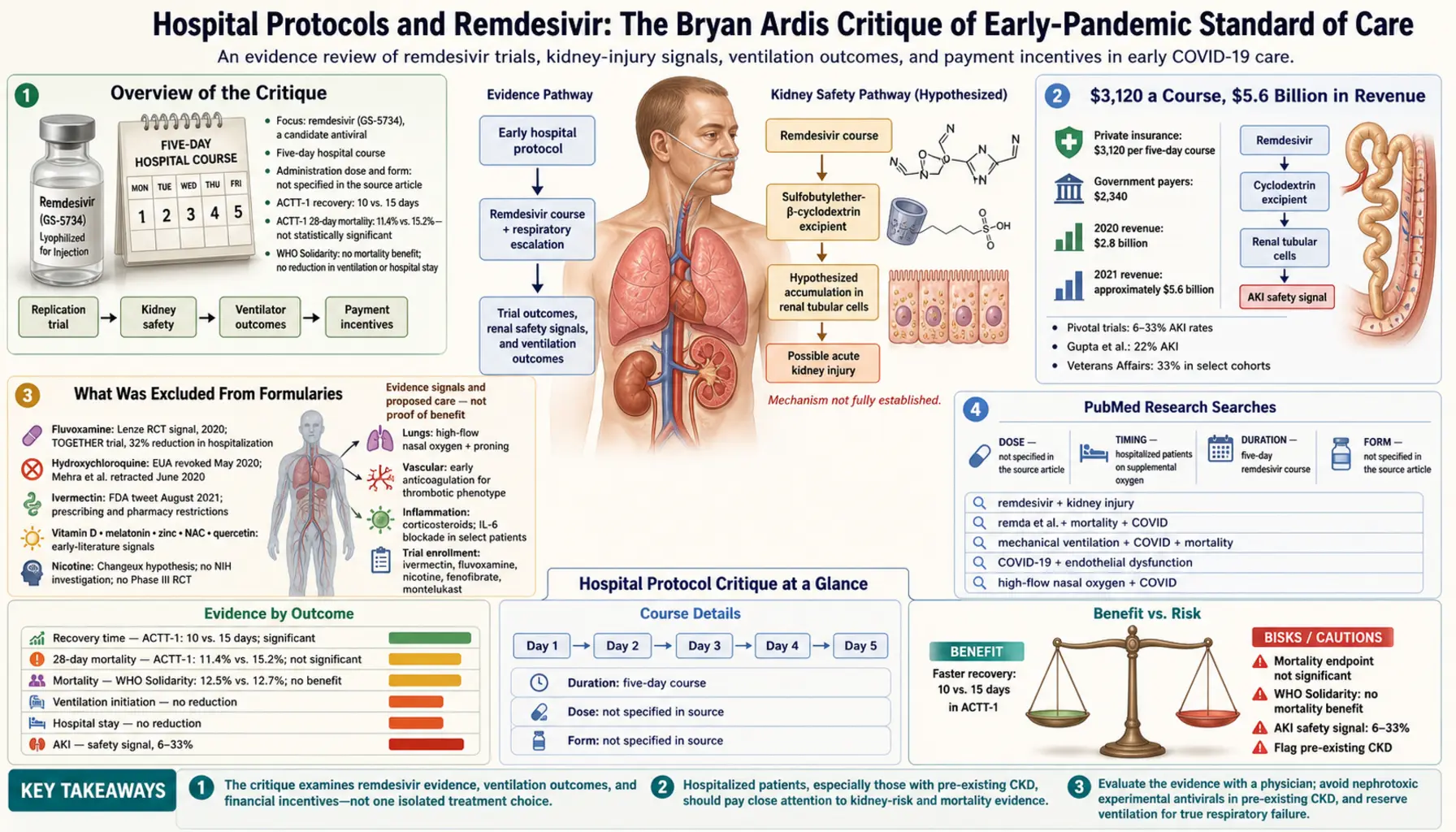
Table of Contents
- Overview of the Critique
- Remdesivir Failed in Ebola
- ACTT-1: The Endpoint Switch
- WHO Solidarity Trial: No Mortality Benefit
- The Acute Kidney Injury Signal
- $3,120 a Course, $5.6 Billion in Revenue
- Ventilator Mortality — The 88% Number
- Cameron Kyle-Sidell and the “Wrong Disease” Observation
- CARES Act Bonus Payments
- What Was Excluded From Formularies
- Whistleblower Nurses and Frontline Reports
- The Systemic Reading: Protocol as Bonus
- What Should Have Been Standard of Care, in Dr. Ardis’s View
- The Accountability Question
- Dr. Ardis’s Own Work
- Key Research Papers
- Connections
- Featured Videos
1. Overview of the Critique
The Ardis hospital-protocol critique can be summarized in four propositions:
- The flagship antiviral (remdesivir) failed its replication trial. The pivotal ACTT-1 trial showed a non-significant mortality readout. The much larger WHO Solidarity trial showed no mortality benefit, no reduction in ventilation, no reduction in length of stay. The drug was nevertheless protocol-mandated as standard of care across U.S. hospitals.
- The flagship antiviral has a clear nephrotoxic signal. WHO Uppsala VigiBase data showed acute kidney injury at 6–33% of treated patients across pivotal trials. The French ANSM issued a formal warning. The U.S. FDA did not change its EUA.
- The dominant respiratory intervention (early intubation and mechanical ventilation) was associated with extreme mortality. A New York City hospital-system series reported 88% mortality among ventilated COVID patients. Cameron Kyle-Sidell’s clinical observations argued that the underlying pathology was not classical ARDS and that the ventilator strategy was contributing to harm.
- The financial architecture rewarded the most aggressive interventions. The CARES Act’s 20% Medicare add-on for inpatient COVID admissions and the standardized DRG-207 payment for mechanical-ventilation cases created institutional incentives that aligned with, rather than against, the protocol that was producing the highest mortality.
Dr. Ardis ties each of these propositions to primary sources. The sections below set out each one as he presents it.
2. Remdesivir Failed in Ebola
Remdesivir (originally GS-5734) was developed by its manufacturer as a candidate antiviral, screened against multiple RNA virus families before being put through clinical trials in Ebola virus disease in the Democratic Republic of Congo. The PALM trial (Mulangu et al., NEJM 2019) randomized 681 Ebola-positive patients across four arms: ZMapp, remdesivir, REGN-EB3, and MAb114. The remdesivir arm showed:
- 53.1% 28-day mortality — the highest of all four arms
- Worse outcomes than the comparator monoclonal antibodies REGN-EB3 (33.5%) and MAb114 (35.1%)
- The Data Safety Monitoring Board recommended dropping the remdesivir arm early
In Dr. Ardis’s telling, the drug was effectively shelved as a failed Ebola antiviral. It had no FDA approval for any indication when the COVID-19 pandemic began. Within weeks of the pandemic declaration, the manufacturer repurposed it as a candidate COVID-19 antiviral — the same molecule that had just produced the worst arm of an Ebola randomization.
3. ACTT-1: The Endpoint Switch
The Adaptive COVID-19 Treatment Trial (ACTT-1, NCT04280705) was the pivotal U.S. trial of remdesivir in COVID-19, sponsored by NIAID. In Dr. Ardis’s account, the original trial design specified 28-day mortality as the primary endpoint, and mid-trial — with the trial under way and a clean read on mortality available — the primary endpoint was changed to time to recovery.
The Beigel et al. final report (NEJM, October 2020) documented:
- Time to recovery: 10 days remdesivir vs. 15 days placebo (statistically significant)
- 28-day mortality: 11.4% remdesivir vs. 15.2% placebo — a numerical difference, but the 95% confidence interval crossed unity (HR 0.73, 95% CI 0.52–1.03). Not statistically significant on mortality — the endpoint Dr. Ardis identifies as the original primary endpoint.
As Dr. Ardis frames it, the narrative emerging from ACTT-1 was “remdesivir speeds recovery,” the narrative that did not emerge was “remdesivir does not save lives,” and the endpoint switch is what allowed the first narrative to dominate. From a regulatory-science standpoint, mid-trial endpoint changes are permissible but require pre-registration and statistical justification; ACTT-1 made its change in plain view, and the documents are publicly available.
4. WHO Solidarity Trial: No Mortality Benefit
The WHO Solidarity trial (Pan et al., NEJM 2021) was the largest pragmatic trial of repurposed antivirals in COVID-19, enrolling 11,330 patients across 30 countries. It was specifically designed to test whether ACTT-1’s recovery-time finding translated into mortality benefit at scale. The results:
- Death rates: remdesivir 12.5% vs. control 12.7%. Rate ratio 1.00, 95% CI 0.91–1.11. No mortality benefit.
- Initiation of ventilation: no reduction.
- Hospital length of stay: no reduction.
The WHO formally recommended against routine remdesivir use for hospitalized COVID-19 patients in November 2020 on the basis of this data. The U.S. NIH treatment guidelines, by contrast, continued to include remdesivir as standard of care for hospitalized patients on supplemental oxygen. For Dr. Ardis, the discrepancy between the WHO position and the U.S. position is itself a significant data point.
5. The Acute Kidney Injury Signal
The pharmacovigilance signal for acute kidney injury with remdesivir was visible from October 2020 onward in WHO Uppsala VigiBase data. The French ANSM (Agence nationale de sécurité du médicament) issued a formal pharmacovigilance warning. The peer-reviewed analysis includes:
- Charan et al. (Expert Rev Clin Pharmacol 2021): AKI signal disproportionality across multiple databases.
- Veterans Affairs pharmacovigilance: AKI signal at 33% in select cohorts.
- Pivotal trial data: 6–33% AKI rates across the manufacturer’s original trials, listed in the FDA briefing memo.
The mechanism is not fully established but is hypothesized to involve the cyclodextrin excipient (sulfobutylether-β-cyclodextrin) accumulating in renal tubular cells, a known nephrotoxicity profile of cyclodextrin in patients with reduced renal function. The package insert was updated in 2021 to include AKI as a possible adverse event but the EUA was not modified to require pre-treatment renal screening.
Dr. Ardis states the case this way: a 78-year-old patient with stage-3 chronic kidney disease should never have received a five-day course of a drug with a 33% AKI signal as standard of care. That this happened — and, in his account, continues to happen — is the case study at the heart of his argument.
6. $3,120 a Course, $5.6 Billion in Revenue
The manufacturer set the U.S. price for a five-day remdesivir course at $3,120 for private insurance, $2,340 for government payers. The manufacturer’s total revenue from remdesivir:
- 2020: $2.8 billion
- 2021: $5.6 billion (approximately)
- 2022 onward: declining as off-EUA use and nirmatrelvir–ritonavir availability shifted the market
As Dr. Ardis tells it, this revenue was generated from a drug whose pivotal trial had failed its primary mortality endpoint, whose much larger replication trial had shown no clinical benefit on any major outcome, and whose pharmacovigilance signal included a 6–33% rate of acute kidney injury. The financial scale of remdesivir is, in the Ardis reading, the strongest single piece of evidence that hospital-formulary decisions during the early pandemic were not made on a clinical-evidence basis alone.
7. Ventilator Mortality — The 88% Number
Mechanical ventilation was the second pillar of the early-pandemic protocol. The mortality rates documented in published case series:
- A New York City hospital system (Richardson et al., JAMA 2020): of the 320 ventilated patients whose outcome was known when the study closed (1,151 were ventilated in the 5,700-patient cohort), 88% died.
- Wuhan ICU cohort (Yang et al., Lancet Respir Med 2020): 86% mortality among ventilated patients.
- UK ICNARC report (April 2020): mortality >65% in ventilated patients across the early UK first wave.
- Italy first-wave ICU data: similar 65–88% range.
For comparison, ARDS mortality on mechanical ventilation in the pre-COVID era was 30–45% (the LUNG-SAFE study, JAMA 2016). COVID ventilator mortality was approximately double the historical baseline. The early consensus interpretation was “COVID is a particularly severe form of ARDS.” The Ardis interpretation, building on the Kyle-Sidell observation, is that the wrong disease was being treated with the wrong machine.
8. Cameron Kyle-Sidell and the “Wrong Disease” Observation
Cameron Kyle-Sidell, MD, an emergency-and-critical-care physician at Maimonides Medical Center in Brooklyn, was one of the first frontline physicians to publicly question the early-COVID ventilator protocol. His March/April 2020 video and subsequent writing argued:
- Patients were arriving with profound hypoxemia (SpO2 in the 70s) but without the high work of breathing typical of severe ARDS.
- Lung compliance on imaging and ventilator mechanics did not match classical ARDS.
- The clinical picture more closely resembled high-altitude pulmonary edema (HAPE) or a primary microvascular / endothelial pathology than a primary alveolar one.
- Aggressive ventilator pressures and PEEP — the standard ARDS-management strategy — were producing iatrogenic lung injury rather than rescuing oxygenation.
Kyle-Sidell’s observation aligned with the subsequent published work of Ackermann et al. (NEJM 2020) showing severe pulmonary endothelial injury and microthrombi as primary pathology, and with the Pretorius lab’s microclot work. In Dr. Ardis’s reading, the picture that emerged in retrospect is consistent with the α7-nAChR-mediated endothelial pathology that he and Changeux describe: not a primary parenchymal viral cytopathic effect but a receptor-mediated thrombo-inflammatory injury.
If Kyle-Sidell was right, the standard ventilator protocol — designed for ARDS — was the wrong tool. High-flow nasal oxygen, aggressive proning, anticoagulation, anti-inflammatory therapy, and (in the Ardis framing) α7-nAChR-targeted intervention would have been the appropriate strategy. As Dr. Ardis sees it, the 88% mortality is what happens when you treat the wrong disease with the right machine.
9. CARES Act Bonus Payments
The CARES Act of March 2020 created several distinct revenue streams for hospitals tied to COVID-19 admissions:
- 20% Medicare DRG add-on for any inpatient admission with a primary or secondary COVID-19 diagnosis. Standard DRG payment plus a 20% inflated rate.
- DRG 207 (mechanical ventilation 96+ hours): standardized payment of approximately $39,000–$42,000 per case, with the 20% add-on applied on top, often producing a >$50,000 case payment.
- Provider Relief Fund (PRF) distributions tied to admission volume, with COVID-positive admissions weighted preferentially.
- FDA-fast-tracked drugs receiving Medicare reimbursement through New COVID-19 Treatments Add-on Payment (NCTAP), specifically benefiting remdesivir.
Hospitals had real costs from PPE, ICU surge capacity, and staff overtime, and the CARES Act payments were designed to keep hospitals solvent during a crisis. Dr. Ardis argues that the structure of the incentives nonetheless aligned with the most aggressive treatment pathway: PCR-positive admission → remdesivir initiation → ventilator escalation → DRG-207 billing. In his account, the protocol that was producing the highest mortality was also the protocol that was producing the highest revenue per case.
The Association of American Physicians and Surgeons (AAPS) published a 2021 analysis estimating the cumulative bonus payments per ventilated COVID-19 case at $13,000–$50,000 above the otherwise-applicable DRG. Whether or not any individual physician was motivated by the bonus, Dr. Ardis sees the system-level incentive as unmistakable.
10. What Was Excluded From Formularies
In Dr. Ardis’s account, while remdesivir was being mandated as standard of care, a parallel set of decisions excluded a range of low-cost, off-patent agents from hospital formularies:
- Hydroxychloroquine: EUA revoked June 2020 after a study built on a data company’s database (Mehra et al. retracted, The Lancet, June 2020). State boards of pharmacy in Idaho, Texas, Ohio, and elsewhere issued guidance discouraging or restricting outpatient HCQ prescribing for COVID-19.
- Ivermectin: the FDA’s “You are not a horse” tweet, August 2021. State medical boards threatened licensure action against prescribers. Pharmacies refused to fill prescriptions.
- Fluvoxamine: the Lenze RCT showed signal in 2020; the TOGETHER trial showed 32% reduction in hospitalization. Never integrated into U.S. hospital protocols at scale.
- Vitamin D, melatonin, zinc, NAC, quercetin: each backed by signals in the early-pandemic literature; not formulary protocol items in most U.S. hospitals.
- Nicotine: the Changeux hypothesis from a Pasteur Institute Wolf Prize laureate; not investigated by U.S. NIH; no Phase III RCT funded; no formulary integration anywhere.
The pattern Dr. Ardis draws from this: the agents that were excluded from formularies were the off-patent or non-patentable ones, and the agent that was protocol-mandated, despite failing its replication trial, was the on-patent one with a $3,120-per-course revenue stream. In his reading, a regulator making decisions on a clinical-evidence basis would not have produced this pattern; a regulator making decisions on a regulatory-capture basis would.
11. Whistleblower Nurses and Frontline Reports
Several frontline-clinician accounts of the early-pandemic protocol environment have been published or recorded:
- Erin Olszewski, RN: a hospital in Queens, NYC. Her 2020 documentary footage and testimony described patients being placed on ventilators against family wishes, intubated when high-flow nasal oxygen would have been adequate, and dying in numbers her clinical experience had never seen.
- Nicole Sirotek, RN: traveling ICU nurse in NYC, March-April 2020. Her widely circulated video described what she perceived as systematic mismanagement.
- Anonymous accounts compiled by AAPS, Brownstone Institute, and various clinician advocacy organizations.
These accounts are first-hand, contemporaneous reports from licensed clinicians on the front line, published or recorded outside the peer-reviewed literature. The Ardis protocol critique treats them as part of the evidentiary record alongside the published mortality data; in his view, reports of this kind have historically been a useful early signal of systemic problems, even when the institutional response is dismissive.
12. The Systemic Reading: Protocol as Bonus
The Ardis systemic-level reading: the early-pandemic protocol was an emergent property of three forces:
- An EUA regulator (FDA) under intense political pressure to be seen to authorize a treatment, with liability immunity protecting authorized products under the PREP Act.
- A reimbursement system (CMS / CARES Act) designed to keep hospitals afloat in a crisis, but structured in a way that systematically rewarded the most aggressive intervention pathway.
- A medical guideline community (NIH and an infectious-disease specialty society) that adopted the EUA-authorized agent into protocol despite its failed replication trial, and that simultaneously moved aggressively against off-patent alternatives.
In his account, the result was not a conspiracy in the cinematic sense. It was a system whose components, each acting on its own logic, produced an integrated protocol that maximized revenue and minimized institutional liability while producing exceptional mortality. Patients died inside that system. The Ardis case is that this is not exonerated by the absence of cinematic conspiracy; it is indicted by the presence of structural incentive alignment.
13. What Should Have Been Standard of Care, in Dr. Ardis’s View
The protocol Dr. Ardis holds should have been standard of care for hospitalized COVID-19 patients in spring 2020, given what is now known:
- High-flow nasal oxygen as first-line respiratory support; aggressive proning; mechanical ventilation reserved for true respiratory failure.
- Early anticoagulation for the documented thrombotic phenotype.
- Corticosteroids (the RECOVERY trial result showing dexamethasone mortality benefit; this was rapidly adopted).
- Vitamin D, vitamin C, zinc, melatonin at supportive doses.
- Trial enrollment for repurposed agents: ivermectin, fluvoxamine, nicotine, fenofibrate, montelukast.
- Avoidance of nephrotoxic experimental antivirals in patients with pre-existing CKD.
- Cytokine-targeted therapy (IL-6 blockade) in select patients with high inflammatory markers.
This is approximately the FLCCC MATH+ protocol that Pierre Kory and Paul Marik proposed. In Dr. Ardis’s account, it was approximately the protocol that Eastern European countries with looser FDA-equivalent regulators adopted, with mortality outcomes that were substantially better than the U.S.-style protocol despite far less expensive resource intensity. In his view, that comparison group exists; it just is not the comparison the U.S. medical establishment elects to make.
14. The Accountability Question
The accountability question Dr. Ardis raises:
- If a clinician at the bedside knew remdesivir had a 33% AKI signal and prescribed it anyway to a patient with stage-3 CKD, what is the medical-ethics implication?
- If a hospital pharmacy committee adopted remdesivir as standard of care without engaging the WHO Solidarity result, what is the institutional implication?
- If a federal agency (NIH, FDA) maintained remdesivir as part of treatment guidelines after the WHO recommendation against it, what is the regulatory implication?
- If a payment system (CMS) created bonuses that aligned with the highest-mortality protocol, what is the policy implication?
In Dr. Ardis’s view, these are not rhetorical questions; they are questions a serious post-mortem of pandemic care requires answering. The Ardis position is that the answers will not be flattering to American medicine, which is why the post-mortem has been institutionally avoided. His work is, among other things, an attempt to force the post-mortem into public view.
Dr. Ardis’s Own Work
Dr. Bryan Ardis’s nicotine protocol and the reasoning behind it, in his own words — his show, the interviews in which he lays it out, and his book.
- The Dr. Ardis Show — official site
- The Dr. Ardis Show, 28 August 2023 — “Venom Industrial Complex: Weaponizing Venoms” — the 7 mg, six-day nicotine instruction and the long-hauler symptom list.
- The Dr. Ardis Show podcast archive, April 2024 — his nicotine presentation “The Other ‘N’ Word.”
- Myers Detox Podcast #607 — “Nicotine Can Reverse Brain Fog, Inflammation, Dementia, and Chronic Illness” with Dr. Bryan Ardis — full transcript.
- Cosmic Reality Podcast, May 2024 — Dr. Ardis on nicotine and snake venom
- Bryan Ardis, Moving Beyond the COVID-19 Lies: Restoring Health & Hope for Humanity (Harvest Creek Publishing, 2024; ISBN 978-1-961641-22-8) — library record.
- His nicotine protocols, documented by a reader site — the prevention, long-hauler and vaccine-injury instructions from his “How to Use Nicotine” handout.
On this site: Nicotine Patch Protocol · The Leitzke cases · Cobra venom and nicotine · Pyrazines · Nightshade nicotine and Parkinson’s
Key Research Papers
- Mulangu S, Dodd LE, Davey RT Jr, et al. A Randomized, Controlled Trial of Ebola Virus Disease Therapeutics (PALM). N Engl J Med. 2019;381:2293-2303. — doi:10.1056/NEJMoa1910993
- Beigel JH, Tomashek KM, Dodd LE, et al. Remdesivir for the Treatment of Covid-19 — Final Report (ACTT-1). N Engl J Med. 2020;383:1813-1826. — doi:10.1056/NEJMoa2007764
- WHO Solidarity Trial Consortium. Repurposed antiviral drugs for Covid-19 — Interim WHO Solidarity Trial Results. N Engl J Med. 2021;384:497-511. — doi:10.1056/NEJMoa2023184
- Richardson S, Hirsch JS, Narasimhan M, et al. Presenting Characteristics, Comorbidities, and Outcomes Among 5700 Patients Hospitalized With COVID-19 in the New York City Area. JAMA. 2020;323(20):2052-2059. — doi:10.1001/jama.2020.6775
- Ackermann M, Verleden SE, Kuehnel M, et al. Pulmonary Vascular Endothelialitis, Thrombosis, and Angiogenesis in Covid-19. N Engl J Med. 2020;383:120-128. — doi:10.1056/NEJMoa2015432
- Yang X, Yu Y, Xu J, et al. Clinical course and outcomes of critically ill patients with SARS-CoV-2 pneumonia in Wuhan, China: a single-centered, retrospective, observational study. Lancet Respir Med. 2020;8(5):475-481. — doi:10.1016/S2213-2600(20)30079-5
- Charan J, Kaur R, Bhardwaj P, et al. Rapid review of suspected adverse drug events due to remdesivir in the WHO database; findings and implications. Expert Rev Clin Pharmacol. 2021;14(1):95-103. — doi:10.1080/17512433.2021.1856655
- Gupta AK, Parker BM, Priyadarshi V, Parker J. Cardiac Adverse Events With Remdesivir in COVID-19 Infection. Cureus. 2020;12(10):e11132. — doi:10.7759/cureus.11132
PubMed Topic Searches
- PubMed: Remdesivir and kidney injury
- PubMed: Remdesivir and COVID mortality
- PubMed: Mechanical ventilation and COVID mortality
- PubMed: COVID-19 and endothelial dysfunction
- PubMed: Ivermectin and COVID-19 meta-analyses
- PubMed: Fluvoxamine and COVID-19
- PubMed: HCQ and COVID-19 meta-analyses
- PubMed: High-flow nasal oxygen and COVID
Connections
- All Remedies
- Dr. Bryan Ardis Hub
- Zinc
- Vitamin C
- Moving Beyond the COVID-19 Lies (Book)
- Vaccine-Injury Recovery
- Nicotine Hypothesis
- Nicotine Patch Protocol
- Tobacco Suppression History
- Snake-Venom Hypothesis
- Detox and Recovery
- Nicotinic Acetylcholine Receptors
- Detox Protocols
- Liver Cleansing
- Vitamin D3
- Acute Kidney Injury
- NAC (N-Acetylcysteine)
- Post-Viral Triggers (CFS/ME)