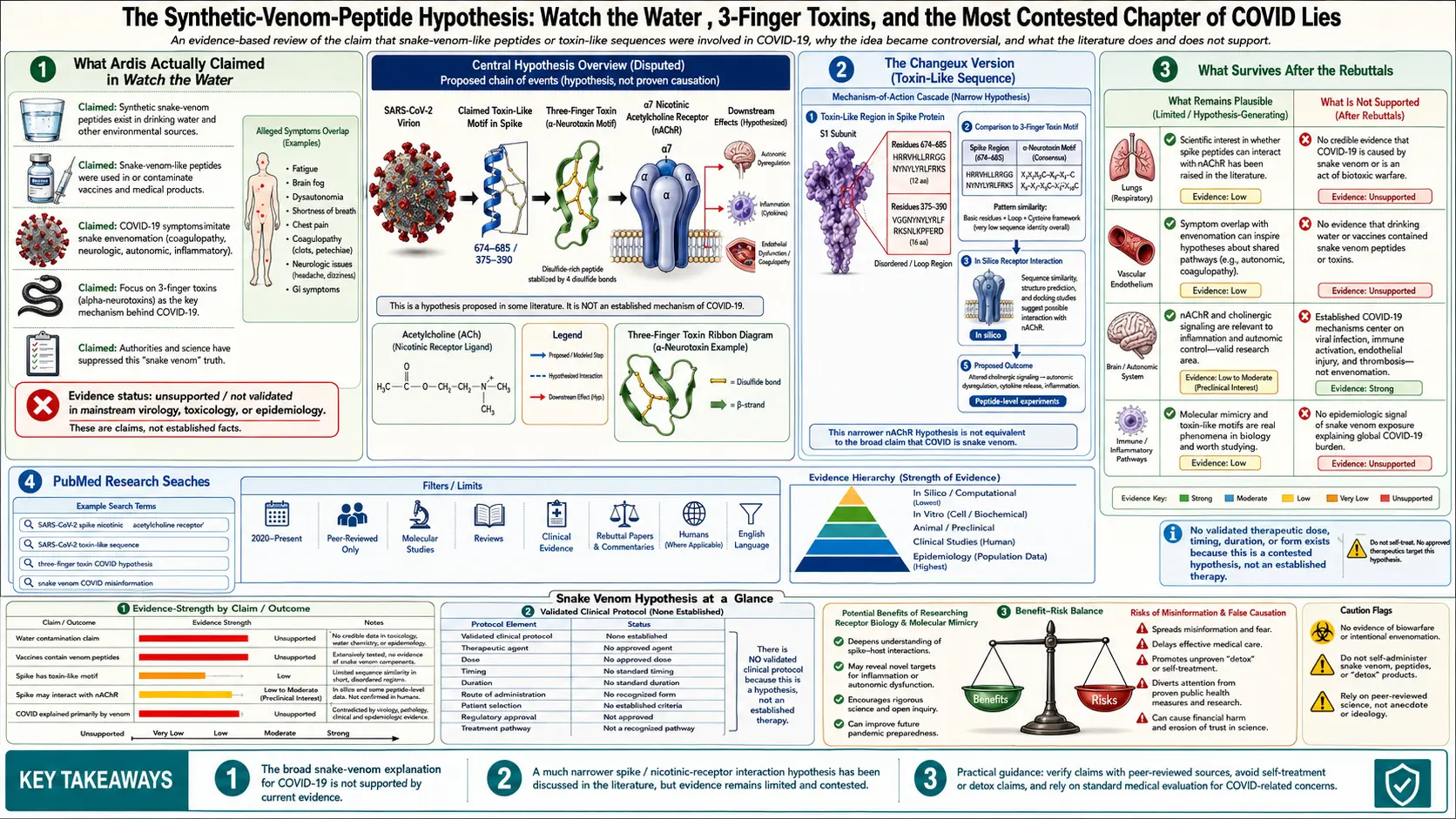
The Synthetic-Venom-Peptide Hypothesis: Watch the Water, 3-Finger Toxins, and Dr. Ardis’s Venom Argument
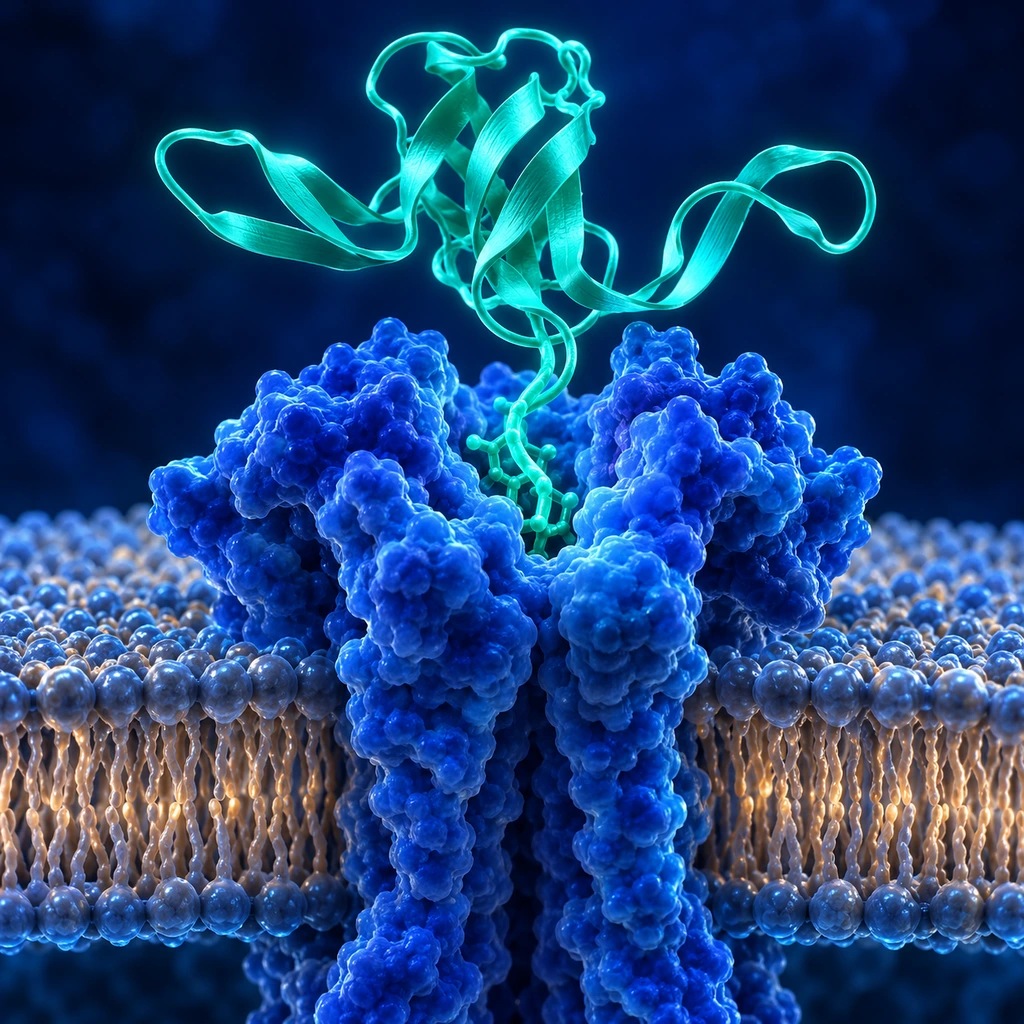

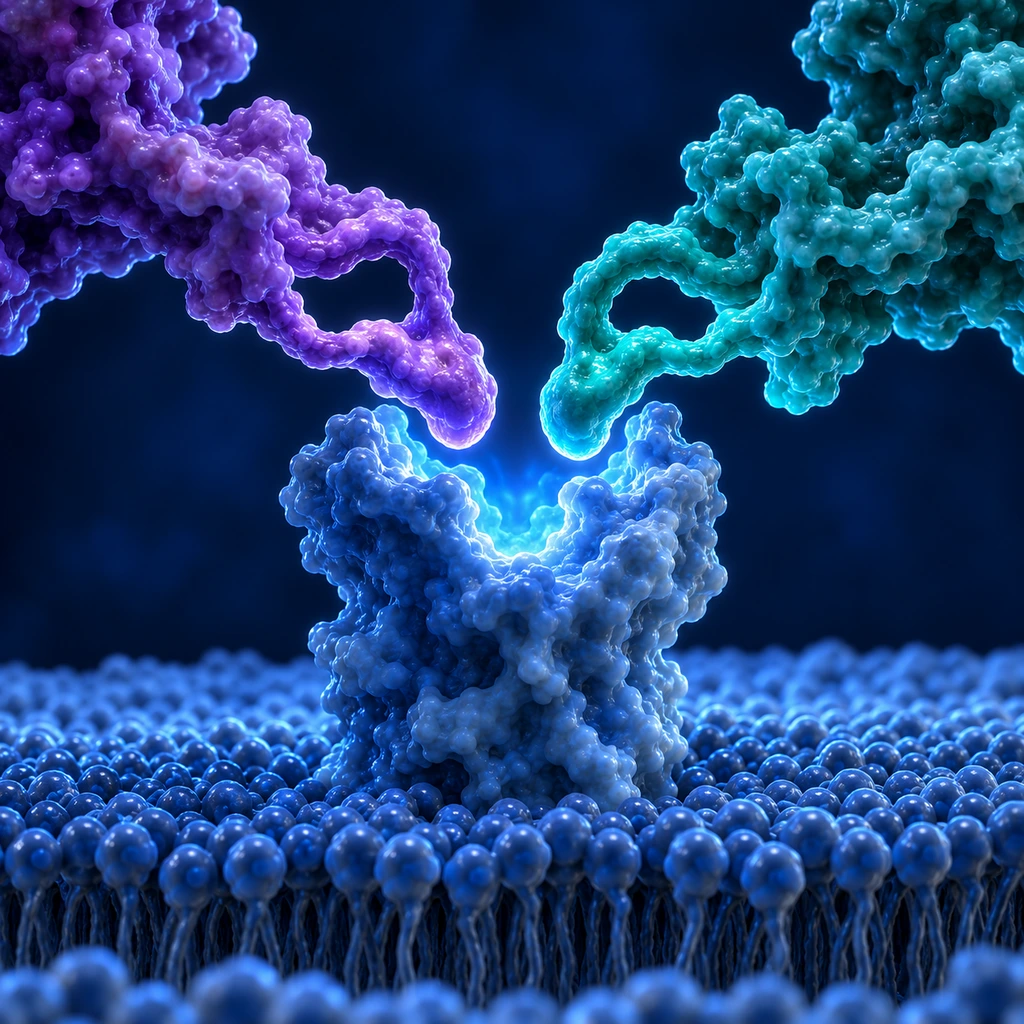
Table of Contents
- What Dr. Ardis Says in Watch the Water
- Three-Finger Toxins: A 5-Minute Primer
- 3FTx Receptor Promiscuity Beyond nAChRs
- Where Spike and 3FTx Look Alike
- The Changeux Version (Toxin-Like Sequence)
- The Ardis Version (Synthetic Venom Peptide)
- The Water-Supply Idea
- Dr. Ardis’s Conclusion: The Receptor Argument Stands
- Dr. Ardis’s Own Work
- Key Research Papers
- Connections
- Featured Videos
1. What Dr. Ardis Says in Watch the Water
The 2022 documentary Watch the Water, produced by Stew Peters and featuring Dr. Bryan Ardis as the principal interviewee, sets out his argument as four claims, each building on the one before:
- Structural homology. The receptor-binding domain of the SARS-CoV-2 spike protein contains amino-acid loop motifs that bear structural similarity to three-finger toxins (3FTx) found in elapid (cobra, krait, mamba) snake venoms.
- Functional convergence. Both 3FTx peptides and the spike RBD interact with nicotinic acetylcholine receptors and produce ion-channel and inflammatory effects through receptor-level mechanisms.
- Engineered origin. Dr. Ardis goes further: he says the spike protein was deliberately designed using 3FTx scaffolds — that the receptor-binding domain is, in his framing, a “synthetic venom peptide” manufactured under instruction by mRNA platforms or by gain-of-function research.
- Environmental delivery. The documentary’s fourth claim: that snake-derived peptides may have entered the environmental supply chain through municipal water systems, and that king-cobra-related peptides may have been weaponized at scale.
Dr. Ardis grounds the first two claims in peer-reviewed structural biology — the papers set out in sections 4 and 5. The third and fourth carry his argument further, to where the peptide came from and how it could reach people (sections 6 and 7).
This page follows the four claims in turn. In Dr. Ardis’s account, the receptor-pharmacology argument — the spike engaging the nicotinic receptor — is the basis of his nicotine protocol, and it stands apart from the engineered-origin argument about where the spike came from (section 8).
2. Three-Finger Toxins: A 5-Minute Primer
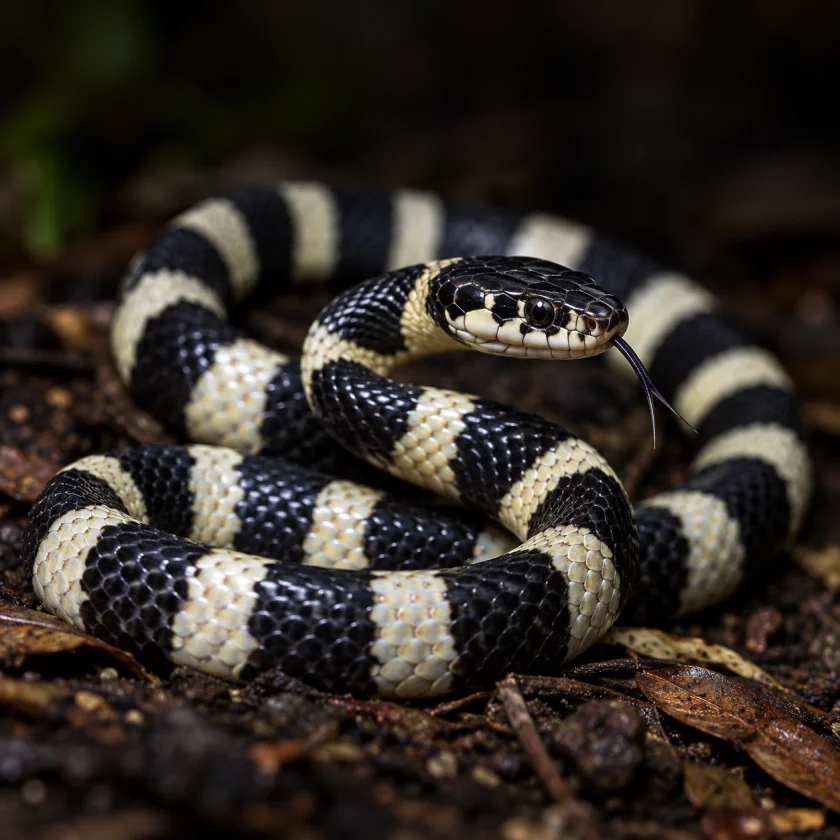
Three-finger toxins (3FTx) are a family of small (60–75 amino-acid) snake-venom peptides defined by a characteristic fold: three β-stranded loops projecting from a disulfide-rich central core, looking under crystallography like three outstretched fingers from a tight central palm. The fold is exceptionally stable, evolutionarily ancient, and biochemically versatile.
The 3FTx family includes:
- α-Bungarotoxin (krait, Bungarus multicinctus): competitive antagonist of muscle α1- and neuronal α7-nAChRs; Kd ~10−9 M; used as a research probe for 50 years.
- α-Cobratoxin (Thai cobra, Naja kaouthia): similar receptor target and profile.
- Mamba toxins (Dendroaspis spp.): fasciculins target acetylcholinesterase, others target muscarinic receptors and L-type calcium channels (calciseptine).
- Cardiotoxins: cytolytic 3FTx peptides that disrupt cell membranes through a non-receptor mechanism.
- Lynx1, SLURP-1, SLURP-2: endogenous human three-finger-fold proteins that modulate human nAChRs. Mammals make their own 3FTx-fold molecules.
The endogenous human 3FTx proteins are an important point. The fold is not an exotic snake-only architecture — it is part of the human proteome. Lynx1 in particular is a GPI-anchored membrane protein that sits next to nAChRs in the brain and modulates their gating. The structural biology of nAChR engagement by a 3FTx loop is, in evolutionary terms, normal mammalian receptor pharmacology.
3. 3FTx Receptor Promiscuity Beyond nAChRs
The 3FTx fold has been recruited evolutionarily to bind many different receptor targets:
- Nicotinic acetylcholine receptors (α-bungarotoxin, cobratoxin)
- Muscarinic acetylcholine receptors (mamba MT1/MT2/MT3/MT7 toxins)
- Acetylcholinesterase (fasciculins)
- L-type voltage-gated calcium channels (calciseptine)
- Adrenergic receptors (mambin)
- Acid-sensing ion channels (ASICs) (mambalgin) — a notable analgesic with no nAChR activity
- Cell membranes directly (cytotoxins / cardiotoxins) — via the same scaffold
The fold is a small, stable, modular peptide chassis on which nature has tinkered to produce dozens of distinct pharmacological agents. From a protein-engineering standpoint, the 3FTx fold is exactly the kind of scaffold a modern peptide biologist would reach for if they wanted to build a stable receptor-binding peptide for almost any neuronal or immune target. That observation is part of the “why this scaffold for an engineered virus?” question Dr. Ardis asks.
4. Where Spike and 3FTx Look Alike

Dr. Ardis draws on a body of peer-reviewed structural-biology work. What those papers report:
- Loop architecture. The receptor-binding domain (RBD) of the SARS-CoV-2 spike presents a hairpin loop (the receptor-binding motif, RBM, residues ~437–508) that engages ACE2. This loop has structural features — aromatic residues at key positions, a disulfide-stabilized fold — reminiscent of the finger-loop II of 3FTx peptides.
- Sequence motifs. Lagoumintzis, Farsalinos, and colleagues (2021) identified spike-RBD residues that align in primary sequence with conserved 3FTx aromatic residues (W148/Y184 of the receptor pocket; Y472/F490/L455 of spike).
- nAChR docking. Computational docking studies (Oliveira 2020, Lagoumintzis 2021, Tillu 2021) place the spike RBD in the α7 ligand-binding pocket using the same aromatic-cage interactions a 3FTx loop would use.
- In-vitro work. Some in-vitro biochemistry reports that spike protein and spike-derived peptides can be displaced from immune-cell surfaces by nAChR antagonists, consistent with receptor-level binding.
Dr. Ardis reads these shared features broadly: in his view, the spike is a 3FTx-derived peptide. Changeux reads them narrowly, as some 3FTx-like features at some residues. The next two sections set out each version in turn.
5. The Changeux Version (Toxin-Like Sequence)
Jean-Pierre Changeux’s April 2020 nicotinic-hypothesis paper (Changeux et al., Comptes Rendus Biologies, 2020) used the phrase “a toxin-like sequence” to describe the spike RBM. This is the narrower version of the homology claim, and the paper’s argument runs: the spike has features in common with 3FTx loops; that homology is what allows it to engage α7-nAChR; the engagement is mechanistically relevant to COVID pathology; therefore receptor-targeted intervention (nicotine occupancy) is therapeutically interesting.
Changeux’s framing makes no claim about the origin of the virus, no claim about deliberate engineering, no claim about water-supply contamination. It is a pure structural-biology observation translated into a pharmacological hypothesis, published in a peer-reviewed journal by a Wolf Prize laureate from a flagship French research institution.
6. The Ardis Version (Synthetic Venom Peptide)
Dr. Ardis takes the Changeux observation further. In Watch the Water and in his talks, his argument runs:
- The spike RBM is not just “toxin-like.” It is, in functional terms, a synthetic three-finger toxin — a peptide that engages nicotinic and other receptors with venom-like specificity.
- The mRNA platforms therefore instruct the human body to produce, over a multi-day window, a venom-like peptide endogenously. Vaccinated patients are, in this framing, manufacturing a venom analog from the inside.
- Wild-type SARS-CoV-2 infection produces the same peptide via viral replication. The pathology of the infection is, mechanistically, partly venom-receptor pathology.
- The historical precedent for receptor-targeted peptide weapons is well-documented: α-bungarotoxin and cobratoxin have been studied for decades as biological-weapons candidates because of their precise receptor targeting and lethality at sub-microgram doses. The Soviet biological-weapons program documented in Ken Alibek’s Biohazard (1999) included peptide-toxin research.
- If 3FTx peptides have been weaponizable for half a century, and if the SARS-CoV-2 spike is functionally a 3FTx-like peptide, then the inference that the virus is the product of deliberate peptide engineering — not necessarily by snake venom directly, but by reverse-engineering snake-venom scaffolds — is at least worth investigating.
This is the “synthetic venom peptide” framing. Dr. Ardis moves from the structural homology to an engineered origin along two lines: he points to gain-of-function records and Wuhan Institute of Virology documentation as evidence of deliberate engineering, and he argues that the homology is unlikely to have arisen naturally.
7. The Water-Supply Idea

In Watch the Water, Dr. Ardis raises the possibility that king-cobra-derived peptides may have been introduced into municipal water systems as a delivery vector for the “venom-like agent.” He points in particular to:
- The published literature on snake-venom peptides surviving aqueous conditions.
- A 2019 paper on king-cobra venom peptide engineering for therapeutic purposes.
- Reports of unusual taste, odor, or chlorine adjustments at municipal water plants in 2020.
- The pre-existing public-health concern about pharmaceutical residues in drinking water.
In his telling, the water is a question of delivery — how a venom-like agent could reach people at scale. It is one of three routes his argument names, beside the mRNA platforms and the infection itself (section 6), and in his account all three end at the same receptor, the subject of section 8.
8. Dr. Ardis’s Conclusion: The Receptor Argument Stands
Dr. Ardis’s conclusion, and the point his nicotine protocol is built on: the case for nicotine as a competitive nAChR antagonist of spike-mediated injury rests on the receptor itself. Whatever route brings the spike to the α7 receptor, in his account nicotine competes with it for the same site.
In his account, the case needs four steps:
- The α7-nAChR exists and is expressed on the relevant tissues.
- SARS-CoV-2 spike interacts with that receptor — the interaction described by Changeux, Lagoumintzis and Farsalinos — and that engagement disrupts the cholinergic anti-inflammatory pathway and contributes to the cytokine-storm phenotype of severe COVID.
- Nicotine occupies the same receptor site, the subject of 150 years of pharmacology.
- Nicotine occupancy is therapeutically meaningful — the step his nicotine protocol puts into practice.
None of the four steps depends on how the spike was made, so in his argument the receptor case stands on its own: the therapeutic argument is independent of the origin argument.
Dr. Ardis’s Own Work
Dr. Bryan Ardis’s nicotine protocol and the reasoning behind it, in his own words — his show, the interviews in which he lays it out, and his book.
- The Dr. Ardis Show — official site
- The Dr. Ardis Show, 28 August 2023 — “Venom Industrial Complex: Weaponizing Venoms” — the 7 mg, six-day nicotine instruction and the long-hauler symptom list.
- The Dr. Ardis Show podcast archive, April 2024 — his nicotine presentation “The Other ‘N’ Word.”
- Myers Detox Podcast #607 — “Nicotine Can Reverse Brain Fog, Inflammation, Dementia, and Chronic Illness” with Dr. Bryan Ardis — full transcript.
- Cosmic Reality Podcast, May 2024 — Dr. Ardis on nicotine and snake venom
- Bryan Ardis, Moving Beyond the COVID-19 Lies: Restoring Health & Hope for Humanity (Harvest Creek Publishing, 2024; ISBN 978-1-961641-22-8) — library record.
- His nicotine protocols, documented by a reader site — the prevention, long-hauler and vaccine-injury instructions from his “How to Use Nicotine” handout.
On this site: Nicotine Patch Protocol · The Leitzke cases · Cobra venom and nicotine · Pyrazines · Nightshade nicotine and Parkinson’s
Key Research Papers
- Changeux JP, Amoura Z, Rey FA, Miyara M. A nicotinic hypothesis for COVID-19 with preventive and therapeutic implications. C R Biol. 2020;343(1):33-39. — doi:10.5802/crbiol.8
- Lagoumintzis G, Chasapis CT, Alexandris N, et al. Nicotinic cholinergic system and COVID-19: in silico identification of an interaction between SARS-CoV-2 and nicotinic receptors. Food Chem Toxicol. 2021;149:112009. — doi:10.1016/j.fct.2021.112009
- Andersen KG, Rambaut A, Lipkin WI, Holmes EC, Garry RF. The proximal origin of SARS-CoV-2. Nat Med. 2020;26(4):450-452. — doi:10.1038/s41591-020-0820-9
- Bourne Y, Talley TT, Hansen SB, Taylor P, Marchot P. Crystal structure of a Cbtx-AChBP complex reveals essential interactions between snake α-neurotoxins and nicotinic receptors. EMBO J. 2005;24:1512-1522. — doi:10.1038/sj.emboj.7600620
- Kini RM, Doley R. Structure, function and evolution of three-finger toxins: mini proteins with multiple targets. Toxicon. 2010;56(6):855-867. — doi:10.1016/j.toxicon.2010.07.010
- Tsetlin V. Snake venom α-neurotoxins and other ‘three-finger’ proteins. Eur J Biochem. 1999;264(2):281-286. — doi:10.1046/j.1432-1327.1999.00623.x
- Farsalinos K, Niaura R, Le Houezec J, et al. Editorial: Nicotine and SARS-CoV-2. Toxicology Reports. 2020;7:658-663. — doi:10.1016/j.toxrep.2020.04.012
PubMed Topic Searches
- PubMed: Three-finger toxin and nicotinic receptor
- PubMed: Spike protein and nAChR
- PubMed: α-bungarotoxin and receptor
- PubMed: Cobratoxin and nAChR
- PubMed: Lynx1 / SLURP and nicotinic receptor
- PubMed: SARS-CoV-2 spike RBD structure
- PubMed: 3FTx as therapeutic peptide
- PubMed: Convergent evolution and receptor-binding peptides
Connections
- All Remedies
- Dr. Bryan Ardis Hub
- Nicotinic Acetylcholine Receptors
- Moving Beyond the COVID-19 Lies (Book)
- Vaccine-Injury Recovery
- Nicotine Hypothesis
- Nicotine Patch Protocol
- Tobacco Suppression History
- Hospital Protocol Critique
- Detox and Recovery
- Detox Protocols
- NAC (N-Acetylcysteine)
- Methylene Blue
- Vitamin C
- Vitamin D3
- Liver Cleansing
- Cobra Venom and Nicotine
- D-Dimer and Snake Venom
- Snake Venom Phosphodiesterase in the Karikó–Weissman Papers
Featured Videos