The Ardis Detox Layer: N-acetyl-cysteine (NAC), Dandelion Root, Pine Needle, Methylene Blue & the Spike-Clearance Stack
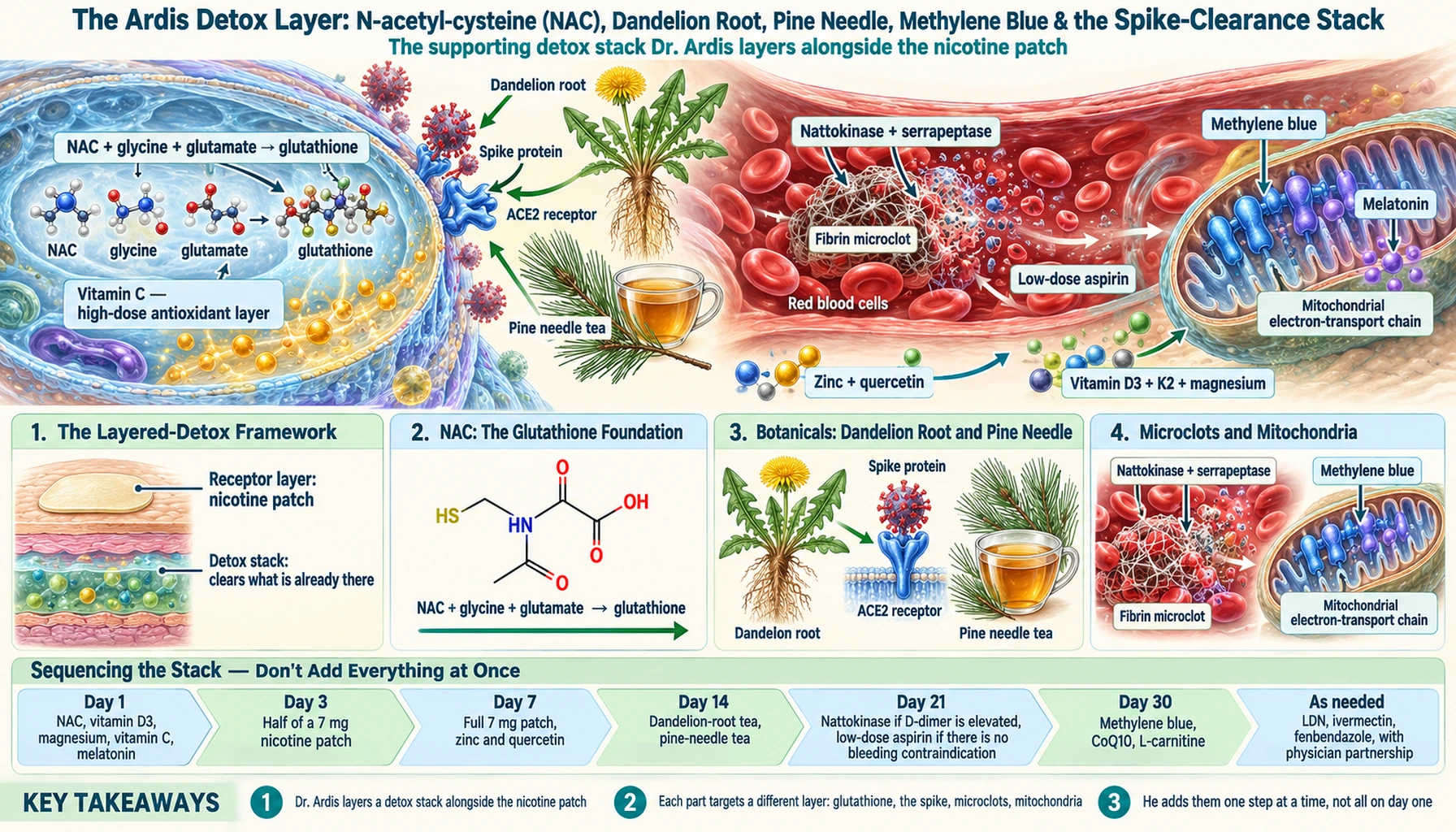
Table of Contents
- The Layered-Detox Framework
- NAC: The Glutathione Foundation
- Vitamin C: The High-Dose Antioxidant Layer
- Dandelion Root: Spike-Binding Botanical
- Pine Needle Tea & Shikimic Acid
- Nattokinase & Serrapeptase: Microclot Dissolution
- Low-Dose Aspirin
- Methylene Blue: Mitochondrial Bypass
- Fenbendazole: The Cancer-Immunology Layer
- Ivermectin: Off-Label Antiviral & Anti-Inflammatory
- Melatonin: High-Dose Anti-Inflammatory
- Zinc & Quercetin: The Ionophore Pair
- Vitamin D3, K2, Magnesium
- The Chelation Question
- Sequencing the Stack — Don’t Add Everything at Once
- Dr. Ardis’s Own Work
- Key Research Papers
- Connections
- Featured Videos
1. The Layered-Detox Framework
As Dr. Ardis describes it, the detox layer sits underneath nicotine receptor-saturation therapy and aims to address four pathophysiological targets in spike-mediated illness:
- Glutathione depletion — the master cellular antioxidant is consumed by spike-induced oxidative stress.
- Persistent spike protein — circulating and exosomal spike beyond the acute window.
- Microclot formation — amyloid-fibrin microclots resistant to ordinary fibrinolysis (Pretorius lab).
- Mitochondrial dysfunction — reduced electron-transport efficiency, drop in ATP production, fatigue phenotype.
The detox layer addresses each in turn. In his telling, the receptor-saturation layer (nicotine) prevents further spike-mediated injury at the cell surface, and the detox layer cleans up the damage already done.
2. NAC: The Glutathione Foundation
N-acetylcysteine (NAC) is the most consistently emphasized supplement across the entire post-COVID and post-vaccination protocol literature. Mechanism:
- Direct precursor to glutathione, the principal intracellular antioxidant. NAC + glycine + glutamate → glutathione (Sekhar et al., Diabetes Care 2011).
- Direct mucolytic and disulfide-bond-cleaving activity — the original FDA approval was for acetaminophen overdose (where NAC restores glutathione) and as a mucolytic.
- Anti-inflammatory effects via NF-κB suppression.
Dosing: 600 mg twice daily on empty stomach is the conservative therapeutic dose. The Ardis protocol uses 600–1,800 mg daily. Higher doses (3,600+ mg) are tolerated but may produce GI upset.
Notes: the FDA briefly attempted to remove NAC from supplement status in 2020–2021, citing its IND status for acetaminophen overdose. This regulatory move was widely interpreted as an attempt to suppress its COVID-era use; the position was eventually reversed. NAC remains widely available OTC. Full discussion at NAC.
3. Vitamin C: The High-Dose Antioxidant Layer
Vitamin C is the second pillar of the antioxidant layer:
- Oral dose: 2–5 g daily, divided through the day to minimize GI symptoms. Liposomal vitamin C improves bioavailability and reduces GI dose-limit.
- IV vitamin C: 25–75 g infusion in select cases. The MATH+ protocol used IV vitamin C in hospitalized COVID-19 patients. Outpatient IV-C clinics exist in most metropolitan areas.
- Mechanism: direct antioxidant; cofactor for collagen synthesis and norepinephrine production; immune-cell function; transient pro-oxidant tumoricidal effect at very high IV doses.
For long-term use, whole-food vitamin C (acerola, camu camu, rose hip) is preferred by many functional-medicine practitioners over isolated ascorbic acid. See Vitamin C.
4. Dandelion Root: Spike-Binding Botanical
Dandelion (Taraxacum officinale) was identified in a 2021 in-vitro study by Tran et al. — which tested an aqueous extract of dandelion leaves — as a potential inhibitor of SARS-CoV-2 spike RBD binding to ACE2. First posted as a preprint and published later in 2021 in Pharmaceuticals, the study generated significant attention in the post-COVID-recovery community and was incorporated into multiple recovery protocols.
- Dosing: 1–2 cups of strong dandelion-root tea daily (1 tablespoon roasted root steeped 10 min in 8 oz hot water), or 500–1,000 mg standardized extract twice daily.
- Mechanism candidates: the polyphenols and terpenoids in T. officinale bind spike RBD residues in molecular docking, plausibly competing with ACE2 docking.
- Additional benefits: hepatobiliary support (traditional indication), mild diuretic, gut-microbiome modulator.
- Cautions: dandelion is a member of the Asteraceae family; ragweed-allergic patients may cross-react. Mild interactions with potassium-sparing diuretics and lithium.
Dandelion-root tea is one of the safest supplemental layers in the Ardis protocol. Alongside the in-vitro spike-binding mechanism, it brings the hepatobiliary and gut-microbiome benefits listed above.
5. Pine Needle Tea & Shikimic Acid
Pine-needle tea is a traditional respiratory and immune remedy across multiple cultures (Indigenous North American, Korean solip-cha, Russian khvoya, ancient Greek/Roman). It is rich in shikimic acid, the precursor used industrially to synthesize the antiviral oseltamivir, and in a range of phenolic compounds (quercetin, ferulic acid, etc.).
- Preparation: 1 tablespoon of fresh white pine (Pinus strobus), eastern-white pine, or Korean red pine needles, steeped 10–15 min in 8 oz nearly-boiling water. Drink 1–2 cups daily.
- Avoid: Norway pine, Ponderosa pine, Lodgepole pine, Yew (Taxus — not a true pine; toxic), Cypress, Cedar. Identification is critical.
- Pregnancy: not recommended; some pine species contain abortifacient compounds.
- Mechanism: shikimic acid antiviral and anti-inflammatory effects; suberic and other phenolic anti-oxidants.
In Dr. Ardis’s telling, pine-needle tea is the kind of low-cost, low-tech intervention that has been deliberately sidelined by a pharmaceutical-industrial complex that profits more from $3,120 antivirals than from herb-of-the-hedgerow remedies. The historical case for its safety is strong.
6. Nattokinase & Serrapeptase: Microclot Dissolution
The amyloid-fibrin microclots described by Pretorius and colleagues in long-COVID and post-vaccination patients are resistant to ordinary fibrinolysis. Two enzymes show in-vitro activity against this clot phenotype:
- Nattokinase (from fermented soybeans): 2,000 FU twice daily on empty stomach. Documented fibrinolytic activity (Sumi et al., Experientia 1987). Supportive evidence in cardiovascular literature.
- Serrapeptase (silkworm enzyme): 80,000–120,000 SPU daily on empty stomach. Anti-inflammatory and fibrinolytic.
- Combined dosing: typically morning empty stomach, far from meals (other proteins compete for proteolytic action).
- Cautions: bleeding risk with concurrent anticoagulants; hold or partner with a physician if on warfarin, DOACs, or chronic aspirin. Stop 1 week prior to surgery.
The Pretorius lab has published clinical case series on protocols using nattokinase + apixaban + clopidogrel in long-COVID with documented microclot reduction on imaging. Direct anticoagulant + antiplatelet + nattokinase combinations are physician-supervised; OTC use of nattokinase alone is straightforward.
7. Low-Dose Aspirin
Low-dose aspirin (81 mg daily) is the most-studied antiplatelet agent in medicine and a reasonable supportive layer for the microclot phenotype. Mechanism: irreversible COX-1 inhibition in platelets, reducing thromboxane A2 production and platelet aggregation.
- Dose: 81 mg with food once daily.
- Indications in this context: elevated D-dimer, documented or suspected microclot phenotype, post-vaccination cardiovascular symptoms.
- Cautions: bleeding risk (major if >65 with comorbidities), peptic ulcer disease, concurrent anticoagulation, asthma with aspirin sensitivity. The recent USPSTF de-escalation of routine primary-prevention aspirin reflects elderly bleeding risk; in the recovery context, the indication is different.
See Aspirin for full discussion.
8. Methylene Blue: Mitochondrial Bypass
Methylene blue is a 19th-century synthetic dye that has been used as a pharmaceutical agent for over a century. In the recovery context, it is used for its mitochondrial electron-transport bypass activity at low doses (0.5–4 mg/kg), which can rescue cellular energetics in tissues with damaged Complex IV / cytochrome-c oxidase.
- Dose: 5–15 mg morning, working up to 20 mg morning + afternoon if tolerated. USP-grade or pharmaceutical-grade only — aquarium-grade and industrial methylene blue contain heavy metal impurities and must not be used.
- Sourcing: several reputable supplement companies sell pharmaceutical-grade liquid methylene blue. Compounding pharmacies can produce higher-purity preparations.
- Side effects: blue-green urine is normal and harmless. Mild diuresis common. Tongue and stool can transiently discolor.
- Critical contraindications: SSRIs, SNRIs, MAOIs, tricyclic antidepressants, tramadol — methylene blue is itself an MAOI and combination produces serotonin syndrome. Wash out 2 weeks from discontinuing serotonergic agents before starting. G6PD deficiency is also a contraindication.
See Methylene Blue for the full mechanism, dosing, and safety discussion.
9. Fenbendazole: The Cancer-Immunology Layer
Fenbendazole is a benzimidazole anthelmintic licensed for veterinary use. It has been studied for repurposed oncological use after the Joe Tippens case (a small-cell lung-cancer survivor whose remission was attributed to fenbendazole) gained popular attention. Mechanism candidates: tubulin disruption, glucose-uptake inhibition in cancer cells, p53 stabilization.
- Dosing in cancer protocols: 222 mg daily, 3 days on, 4 days off, alongside vitamin E, curcumin, CBD oil per the Tippens protocol.
- In the post-COVID context: Ardis discusses fenbendazole primarily for patients with new-onset oncological signals after vaccination or persistent long-COVID with immune dysregulation, not as a routine recovery agent.
- Sourcing: veterinary fenbendazole preparations are widely available; pharmacist-compounded formulations exist.
- Cautions: hepatotoxicity has been reported with prolonged daily use; pulse dosing is preferred. Drug interactions are minimal but caution with CYP3A4 substrates.
See Fenbendazole for the full evidence review.
10. Ivermectin: Off-Label Antiviral & Anti-Inflammatory
Ivermectin is a Nobel-Prize-winning macrocyclic lactone (the 2015 Nobel Prize in Physiology or Medicine went to Satoshi Ōmura and William Campbell for its discovery) with a 30-year human safety record across more than 4 billion doses for parasitic infections. In-vitro and clinical data have been put forward in support of its use in COVID-19.
- FLCCC outpatient protocol: 0.4–0.6 mg/kg daily for 5 days for acute illness.
- FLCCC long-COVID / PVS protocol: 0.2–0.4 mg/kg every 1–2 days in cycles.
- Mechanism candidates: direct in-vitro antiviral activity at concentrations higher than typical plasma levels; nuclear-import-receptor inhibition (importin α/β); anti-inflammatory effects at clinically achievable concentrations.
- Legal status: varies by jurisdiction. India, parts of Latin America, parts of Eastern Europe have permissive regulatory environments. The U.S. has been restrictive toward off-label COVID prescribing.
- Cautions: known safety profile in adults; standard adverse events are mild GI symptoms and dizziness. Drug interactions with strong CYP3A4 inhibitors. Pregnancy data are limited.
This page is documentation; actual decisions about ivermectin use are between patient and physician within applicable law.
11. Melatonin: High-Dose Anti-Inflammatory
Melatonin’s role in recovery protocols is anti-inflammatory and mitochondrial-protective, far beyond its sleep-promoting reputation. The Reiter laboratory has documented:
- Direct antioxidant activity (free-radical scavenger)
- Mitochondrial-membrane stabilization
- Anti-inflammatory effects via NLRP3 inflammasome suppression
- Anti-coagulant effects at higher doses
Dosing in recovery protocols: 5–20 mg at bedtime. Far higher than the 0.3–3 mg conventional sleep dose. Safety profile is excellent — high-dose melatonin (up to 1 g daily in select studies) has been administered without significant adverse events. Subjective “next-day grogginess” is the dose-limiting factor for most users.
12. Zinc & Quercetin: The Ionophore Pair
Zinc has direct antiviral activity at the level of viral RNA polymerase inhibition. The challenge with zinc supplementation is that intracellular delivery is rate-limiting — zinc ions do not cross cell membranes easily. Ionophores carry zinc into cells.
- Quercetin: a polyphenol flavonoid that acts as a zinc ionophore. 500 mg twice daily.
- Zinc: 25–50 mg daily as zinc picolinate, glycinate, or citrate. Avoid zinc oxide (poorly absorbed) and zinc gluconate lozenges with daily use (intranasal zinc has been associated with anosmia).
- Copper balance: chronic zinc >50 mg/day depletes copper. Add 2–4 mg copper daily for any course longer than 2–3 months.
- Other ionophores: hydroxychloroquine (the original COVID rationale), EGCG (green tea), clioquinol.
See Zinc.
13. Vitamin D3, K2, Magnesium
The vitamin D / K2 / magnesium triad is foundational across all the post-COVID recovery protocols:
- Vitamin D3: 5,000 IU daily for most adults. Target serum 25-OH-D 50–80 ng/mL. (The Endocrine Society recommends 30+ ng/mL; functional-medicine practitioners target higher.)
- K2 (MK-7): 100–200 mcg daily with the D3 to direct calcium to bone rather than vasculature.
- Magnesium: 400–600 mg daily (glycinate, threonate, taurate; avoid oxide). Required for vitamin D activation. Deficiency is widespread.
See Vitamin D3, Magnesium.
14. The Chelation Question
Heavy-metal chelation (EDTA, DMSA, DMPS) is not part of the standard Ardis protocol. The reasoning:
- Aggressive chelation can mobilize stored metals faster than excretion can clear them, producing acute redistribution toxicity.
- Most post-COVID and post-vaccination injury is not heavy-metal-driven; aggressive chelation does not address the receptor-mediated and microclot mechanisms.
- Where indicated (documented heavy-metal burden on provoked-urine testing), chelation should be physician-supervised by a clinician with specific training.
Gentle natural-binders (chlorella, modified citrus pectin, activated charcoal in select uses) are reasonable supplemental layers and are part of the broader detox-protocol literature. See Detox Protocols for the broader Phase-I/II/III liver-detoxification framework that contextualizes the Ardis layer.
15. Sequencing the Stack — Don’t Add Everything at Once
The single most common mistake patients make with the Ardis protocol is starting all 12 supplements on day one. Realistic sequencing:
- Day 1: NAC, vitamin D3, magnesium, vitamin C, melatonin. Establish tolerance.
- Day 3: Add nicotine patch (half of 7 mg). Establish tolerance.
- Day 7: Step nicotine to full 7 mg. Add zinc + quercetin.
- Day 14: Add dandelion-root tea, pine-needle tea (if appropriate species available and identifiable).
- Day 21: Add nattokinase if D-dimer elevated. Add low-dose aspirin if no bleeding contraindication.
- Day 30 / Phase 3: Layer methylene blue (if not on serotonergic medications), CoQ10, L-carnitine for mitochondrial support.
- As needed: LDN, ivermectin, fenbendazole based on clinical phenotype and physician partnership.
This sequencing allows tolerance assessment at each step and avoids the “something in this protocol made me feel worse but I can’t tell which one” trap.
Dr. Ardis’s Own Work
Dr. Bryan Ardis’s nicotine protocol and the reasoning behind it, in his own words — his show, the interviews in which he lays it out, and his book.
- The Dr. Ardis Show — official site
- The Dr. Ardis Show, 28 August 2023 — “Venom Industrial Complex: Weaponizing Venoms” — the 7 mg, six-day nicotine instruction and the long-hauler symptom list.
- The Dr. Ardis Show podcast archive, April 2024 — his nicotine presentation “The Other ‘N’ Word.”
- Myers Detox Podcast #607 — “Nicotine Can Reverse Brain Fog, Inflammation, Dementia, and Chronic Illness” with Dr. Bryan Ardis — full transcript.
- Cosmic Reality Podcast, May 2024 — Dr. Ardis on nicotine and snake venom
- Bryan Ardis, Moving Beyond the COVID-19 Lies: Restoring Health & Hope for Humanity (Harvest Creek Publishing, 2024; ISBN 978-1-961641-22-8) — library record.
- His nicotine protocols, documented by a reader site — the prevention, long-hauler and vaccine-injury instructions from his “How to Use Nicotine” handout.
On this site: Nicotine Patch Protocol · The Leitzke cases · Cobra venom and nicotine · Pyrazines · Nightshade nicotine and Parkinson’s
Key Research Papers
- Sekhar RV, McKay SV, Patel SG, et al. Glutathione synthesis is diminished in patients with uncontrolled diabetes and restored by dietary supplementation with cysteine and glycine. Diabetes Care. 2011;34(1):162-167. — doi:10.2337/dc10-1006
- Pretorius E, Vlok M, Venter C, et al. Persistent clotting protein pathology in Long COVID/PASC. Cardiovasc Diabetol. 2021;20(1):172. — doi:10.1186/s12933-021-01359-7
- Sumi H, Hamada H, Tsushima H, Mihara H, Muraki H. A novel fibrinolytic enzyme (nattokinase) in the vegetable cheese Natto. Experientia. 1987;43(10):1110-1111. — doi:10.1007/BF01956052
- Reiter RJ, Ma Q, Sharma R. Treatment of Ebola and other infectious diseases: melatonin ‘goes viral’. Melatonin Res. 2020;3(1):43-57. — doi:10.32794/mr11250047
- Wrapp D, Wang N, Corbett KS, et al. Cryo-EM structure of the 2019-nCoV spike in the prefusion conformation. Science. 2020;367(6483):1260-1263. — doi:10.1126/science.abb2507
- Tran HTT, Gigl M, Le NPK, Dawid C, Lamy E. In vitro effect of Taraxacum officinale leaf aqueous extract on the interaction between ACE2 cell surface receptor and SARS-CoV-2 spike protein D614 and four mutants. Pharmaceuticals (Basel). 2021;14(10):1055. — PubMed PMID: 34681279
PubMed Topic Searches
- PubMed: NAC, glutathione, and COVID
- PubMed: Dandelion root and SARS spike
- PubMed: Nattokinase and fibrin
- PubMed: Methylene blue and mitochondria
- PubMed: Melatonin, inflammation, coronavirus
- PubMed: Quercetin and zinc ionophore
- PubMed: Vitamin D and COVID mortality
- PubMed: Fenbendazole and cancer
- PubMed: Ivermectin and long-COVID
Connections
- All Remedies
- Zinc
- Methylene Blue
- NAC (N-Acetylcysteine)
- Vitamin C
- Fenbendazole
- Aspirin
- Vitamin D3
- Magnesium
- Detox Protocols
- Dr. Bryan Ardis Hub
- Liver Cleansing
- Dandelion
- Nattokinase
- Quercetin
- NAC and Glutathione
- Post-Viral Triggers (CFS/ME)
- Vaccine-Injury Recovery
- Hospital Protocol Critique
- The Leitzke Long-COVID Cases