Cobra Venom and Nicotine: Dr. Ardis on the Receptor They Share
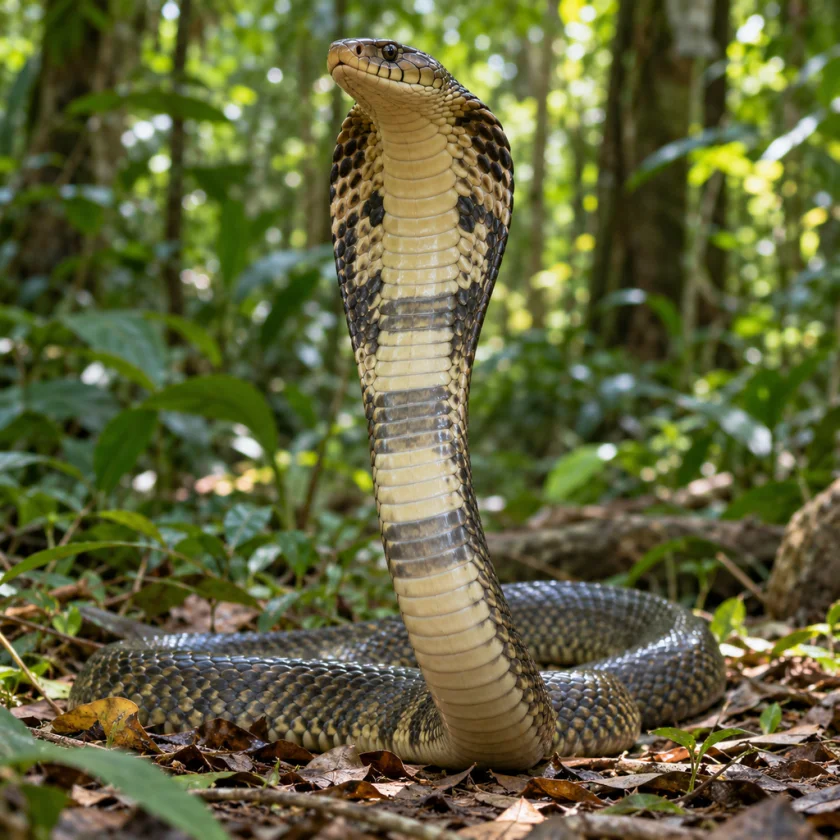


Table of Contents
- What Dr. Ardis Says, in His Own Words
- What Cobra Venom Does at the Receptor
- The Crystal Structure That Showed It
- The Pasteur Institute Link
- Why He Says Nicotine Wins the Receptor
- Computer Modelling of Nicotinic Agonists
- What He Recommends as a Result
- Glossary
- Dr. Ardis’s Own Work
- Key Research Papers
- Connections
- Featured Videos
1. What Dr. Ardis Says, in His Own Words
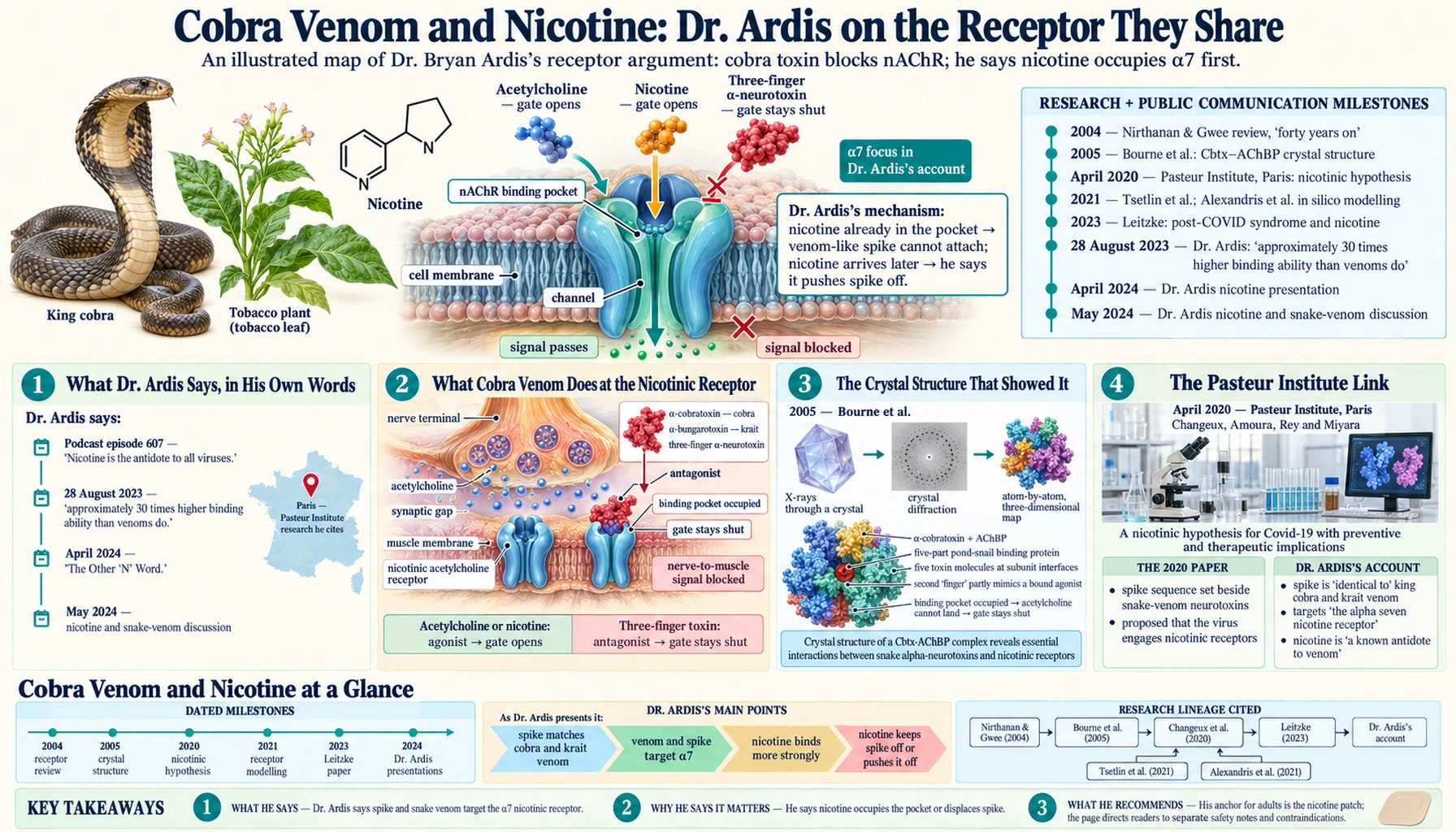
Dr. Bryan Ardis links a snake venom, a virus and nicotine through one receptor on the surface of our cells. His shortest summary, from the Myers Detox Podcast (episode 607): “Nicotine is the antidote to all viruses.”
The venom enters his argument through the spike protein of the COVID-19 virus. Citing French researchers, he says spike proteins are “identical to two things. The king cobra’s venom, and another snake outta China called the krait snake.” The spike, he says, targets “the alpha seven nicotine receptor.”
He also points to the word itself: “virus” is Latin for poison, or venom. And he calls nicotine “a known antidote to venom.”
Put together, his argument runs in four steps:
- The spike protein matches cobra and krait venom, according to the French researchers he cites.
- Venom and spike both go for the same nicotinic receptor, the alpha-7 (α7) type.
- Nicotine binds that receptor far more strongly than venom does — with “approximately 30 times higher binding ability,” in his words (section 5).
- So nicotine keeps the venom-like spike off the receptor, or pushes it off.
The sections below take those steps in turn.
2. What Cobra Venom Does at the Nicotinic Receptor
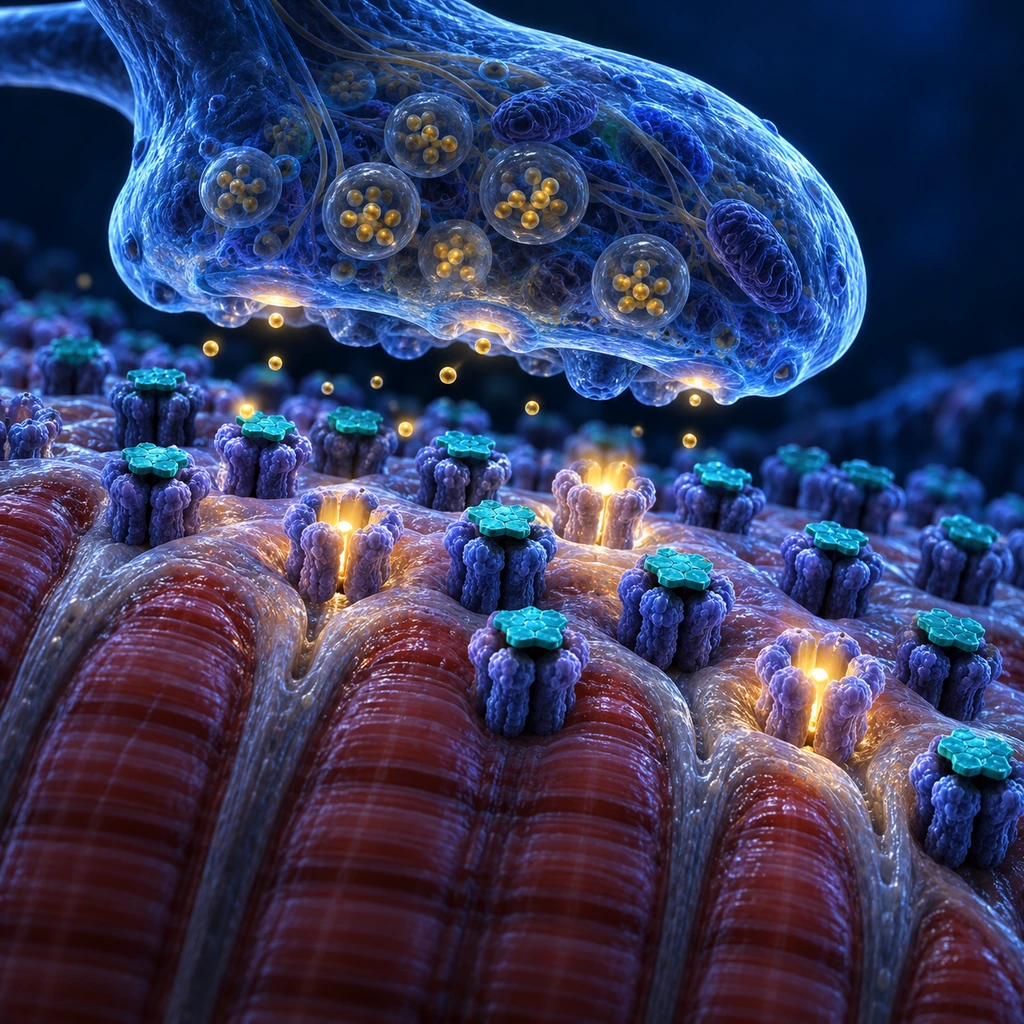
Nerves pass messages with a chemical messenger called acetylcholine. Where a nerve meets a muscle, acetylcholine crosses a tiny gap and lands on a receptor on the muscle’s surface. That receptor is a gate: when acetylcholine settles into its binding pocket, the gate opens and the signal goes through.
The gate is the nicotinic acetylcholine receptor, nAChR for short. It is named for nicotine, which fits the same pocket. There are several types, and the one Dr. Ardis focuses on is alpha-7 (α7). The site’s neuromuscular junction animation shows the nerve-to-muscle handoff step by step.
Cobra and krait venoms carry small proteins called three-finger α-neurotoxins, named for their folded shape: three loops that spread like fingers from a palm. The best-studied are α-cobratoxin, from cobra venom, and α-bungarotoxin, from krait venom.
These toxins bind the nicotinic acetylcholine receptor. They settle into the pocket acetylcholine uses, but instead of opening the gate they hold it shut, so the nerve’s message does not get through. A 2004 review by Nirthanan and Gwee looked back over forty years of research on exactly this pairing of toxin and receptor.
A 2021 review by Tsetlin and colleagues adds a twist, right in its title: three-finger proteins come “from snakes and humans,” and both kinds act on nicotinic receptors. The human body makes its own proteins with the same shape.
Acetylcholine and nicotine switch the receptor on; the three-finger toxin fills the same pocket and holds the gate shut.
3. The Crystal Structure That Showed It
A crystal structure is an atom-by-atom, three-dimensional map of molecules, worked out by passing X-rays through a crystal of them. It is the closest thing science has to a photograph of two molecules locked together.
In 2005, Bourne and colleagues solved the crystal structure of α-cobratoxin, a cobra three-finger neurotoxin, bound to a nicotinic-receptor binding protein — a five-part protein from a pond snail that has the same binding pockets as the receptor. The structure shows all five toxin molecules seated at the interfaces between the protein’s five subunits, and the tip of each toxin’s second “finger” partly mimicking a bound agonist. That protein, AChBP (acetylcholine-binding protein), closely resembles the part of the receptor where acetylcholine binds, which is why it can stand in for the receptor.
The paper’s title names what the picture revealed: “essential interactions between snake alpha-neurotoxins and nicotinic receptors.” In plain words:
- The cobra toxin docks in the receptor’s binding pocket — the spot where acetylcholine, and nicotine, land.
- With the toxin in place the pocket is taken, so acetylcholine has nowhere to land and the gate stays shut.
For Dr. Ardis’s argument, this is the key image: a cobra toxin seated in the receptor’s pocket, the very spot he says nicotine should occupy first.
4. The Pasteur Institute Link

Dr. Ardis credits French researchers with the spike–venom comparison. In 2020, a team including Jean-Pierre Changeux of the Pasteur Institute in Paris published “A nicotinic hypothesis for Covid-19 with preventive and therapeutic implications” in Comptes Rendus Biologies.
The paper set a stretch of the spike protein’s sequence beside snake-venom neurotoxins and proposed that the virus engages nicotinic receptors. As the title says, the authors drew preventive and therapeutic implications from that idea.
How Dr. Ardis’s account builds on it:
| Point | The 2020 paper | Dr. Ardis’s account |
|---|---|---|
| The comparison | A spike sequence set beside snake-venom neurotoxins | The spike is “identical to” king cobra and krait venom |
| The receptor | The virus engages nicotinic receptors | The spike targets “the alpha seven nicotine receptor” |
| What follows | “Preventive and therapeutic implications” | Nicotine, “a known antidote to venom” |
A 2023 paper by Marco Leitzke makes the receptor point in its own words. The spike, it says, “attaches not only to ACE-2 receptors but also shows … sections highly affine to nicotinic acetylcholine receptors (nAChRs).” ACE-2 is the receptor the virus is best known for using; “highly affine” means the spike binds the nicotinic receptor strongly.
5. Why Dr. Ardis Says Nicotine Wins the Receptor
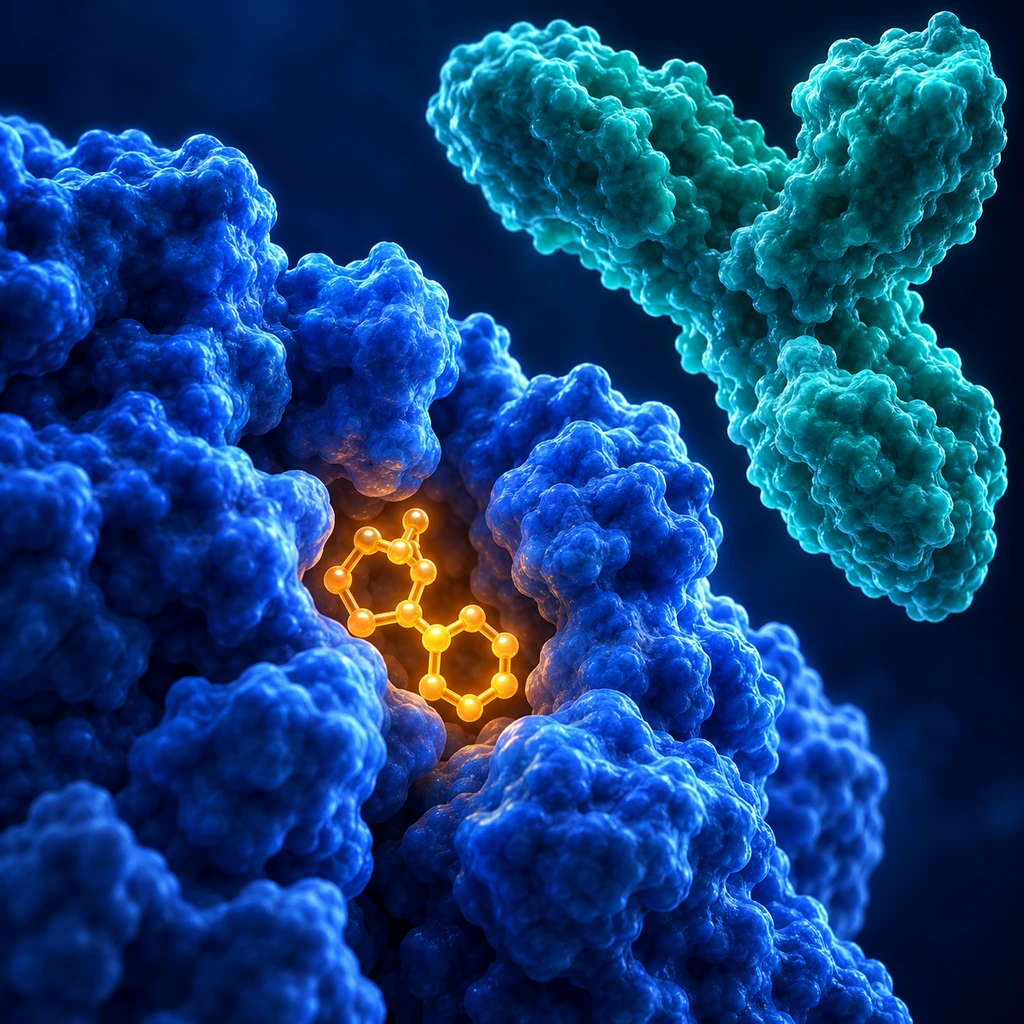
If venom, spike and nicotine all compete for one pocket, the question is which one holds it. Dr. Ardis’s answer is nicotine. On The Dr. Ardis Show of 28 August 2023, he said nicotine binds alpha-7 receptors with “approximately 30 times higher binding ability than venoms do.”
In his account, that strength works two ways. If nicotine is already in place, the venom or spike cannot attach. If the spike got there first, nicotine displaces it.
He compares it to potassium iodide filling the thyroid’s iodine receptors. In his picture, nicotine fills the alpha-7 receptor in the same way, leaving the venom nowhere to attach.
Leitzke’s 2023 paper makes a separate comparison, with acetylcholine rather than venom: nicotine “shows an up to 30-fold higher affinity” to nicotinic receptors “than acetylcholine (ACh).” Affinity means how tightly a molecule holds on to its receptor.
From there the paper states its hypothesis: nicotine “could displace the virus from nAChR attachment and pave the way for unimpaired cholinergic signal transmission” — cholinergic meaning carried by acetylcholine. Its mechanism figure tells the same story in order:
- The virus attaches to nicotinic receptors, “displacing the natural ligand (ACh).”
- “Due to the high affinity of nicotine to nAChRs, the virus is extruded from the attachment to nAChRs by nicotine.”
- Antibodies then capture the released virus.
The paper is open access: full text on PubMed Central.
6. Computer Modelling of Nicotinic Agonists and the Virus
A 2021 study in Toxicology Reports by Alexandris, Lagoumintzis, Chasapis and colleagues took the receptor question to the computer. Its title sets out the work: “In silico evaluation of nicotinic acetylcholine receptor agonists as potential therapeutic interventions.” In silico means done by computer modelling rather than in a test tube or a person, and an agonist is a molecule that switches the receptor on — Leitzke’s paper calls nicotine “the agonist ligand nicotine.” The study is the modelling side of the receptor question at the centre of Dr. Ardis’s argument.
7. What Dr. Ardis Recommends as a Result
Because he sees venom-like spike protein sitting on nicotine receptors, Dr. Ardis’s answer is to supply nicotine. His anchor is the nicotine patch, worn on the skin. The full protocol, with the site’s safety notes, is on the Nicotine Patch Protocol page; the outline below is for adults, from his protocol handout.
| Purpose | What Dr. Ardis recommends (adults) |
|---|---|
| Long COVID (“long-hauler”) | One 7 mg patch a day for at least one week, or until symptoms resolve. Or one 2 mg piece of gum, chewed 10+ minutes, four times a day for at least two weeks. |
| COVID-19 vaccine injury | “Follow Long-Hauler COVID protocol above.” |
| Prevention | A 14 mg patch cut into six equal pieces, one piece a day on the rib cage or upper arm. Or one 2 mg piece of gum twice a day. |
| New to nicotine | About 1 mg a day for a week (a 7 mg patch cut into strips), then about 3 mg. He says he has worn “three and a half milligrams every day for three and a half years.” |
| Dizzy or nauseated | Cut the piece in half. |
| Who should not | “Those who have seizures… You should not take nicotine. It’s on the box.” |
His handout explains why some people do better on the patch, and the reason comes straight from the receptor argument: “Every cell in your body has nicotine receptors including the gut… a few people, when chewing and swallowing nicotine gum get nauseous and vomit or get loose stools. This is because so much of the venom spike proteins are attached to the nicotine receptors that line your entire bowel lining… If this happens, please switch to nicotine patches. The nicotine skips the bowels and gets absorbed into your bloodstream through your skin.”
For long COVID he cites Marco Leitzke’s case reports: “six days of a seven milligram nicotine patch,” and “on the third day, half of all their symptoms disappeared.” The four cases are set out on the Leitzke long-COVID cases page. Leitzke’s paper itself concludes that randomized, double-blinded studies of the approach “seem feasible.”
He also recommends an organic tobacco-leaf foot soak several times a week. Liquid made from tobacco leaves is concentrated; skin contact with wet tobacco is the cause of green-tobacco sickness in harvesters, so keep any such liquid away from children and pets. Used and unused patches are poisonous to children and pets.
8. Glossary
| Term | Plain meaning |
|---|---|
| Three-finger toxin | A small snake-venom protein folded into three loops, like three fingers. Cobra and krait venoms carry them. |
| α-cobratoxin | A three-finger toxin from cobra venom. A 2005 crystal structure showed it bound to a nicotinic-receptor binding protein (section 3). |
| α-bungarotoxin | A three-finger toxin from krait venom that binds nicotinic receptors. |
| Nicotinic acetylcholine receptor (nAChR) | A gate on the cell surface that opens when acetylcholine binds; named for nicotine, which binds it too. In Dr. Ardis’s words, “Every cell in your body has nicotine receptors.” |
| α7 (alpha-7) | One type of nicotinic receptor — the one Dr. Ardis says the spike targets and nicotine protects. |
| Agonist | A molecule that fits a receptor and switches it on. Acetylcholine and nicotine are agonists at the nicotinic receptor. |
| Antagonist | A molecule that fits a receptor but keeps it switched off, shutting out the body’s own messenger. The three-finger α-neurotoxins work this way. |
| Affinity | How tightly a molecule holds on to its receptor. |
Dr. Ardis’s Own Work
- The Dr. Ardis Show — official site
- The Dr. Ardis Show, 28 August 2023 — “Venom Industrial Complex: Weaponizing Venoms” — the episode behind his “approximately 30 times” statement.
- The Dr. Ardis Show podcast archive, April 2024 — his nicotine presentation “The Other ‘N’ Word.”
- Myers Detox Podcast #607, “Nicotine Can Reverse Brain Fog, Inflammation, Dementia, and Chronic Illness” with Dr. Bryan Ardis · transcript
- Cosmic Reality Podcast, May 2024 — “Dr. Ardis on Nicotine, Snake Venom & Bible Messaging”
- Book: Bryan Ardis, Moving Beyond the COVID-19 Lies: Restoring Health & Hope for Humanity (Harvest Creek Publishing, 2024; ISBN 978-1-961641-22-8) — library record
- His nicotine protocols as documented by a reader site
Key Research Papers
- Nirthanan S, Gwee MC (2004). Three-finger alpha-neurotoxins and the nicotinic acetylcholine receptor, forty years on. J Pharmacol Sci. 94(1):1-17. — PubMed PMID: 14745112
- Bourne Y, Talley TT, Hansen SB, Taylor P, Marchot P (2005). Crystal structure of a Cbtx-AChBP complex reveals essential interactions between snake alpha-neurotoxins and nicotinic receptors. EMBO J. 24(8):1512-1522. — PubMed PMID: 15791209
- Changeux JP, Amoura Z, Rey FA, Miyara M (2020). A nicotinic hypothesis for Covid-19 with preventive and therapeutic implications. C R Biol. 343(1):33-39. — PubMed PMID: 32720486
- Tsetlin VI, Kasheverov IE, Utkin YN (2021). Three-finger proteins from snakes and humans acting on nicotinic receptors: Old and new. J Neurochem. 158(6):1223-1235. — PubMed PMID: 32648941
- Alexandris N, Lagoumintzis G, Chasapis CT, et al. (2021). Nicotinic cholinergic system and COVID-19: In silico evaluation of nicotinic acetylcholine receptor agonists as potential therapeutic interventions. Toxicol Rep. 8:73-83. — PubMed PMID: 33425684
- Leitzke M (2023). Is the post-COVID-19 syndrome a severe impairment of acetylcholine-orchestrated neuromodulation that responds to nicotine administration? Bioelectronic Medicine. 9:2. — PubMed PMID: 36650574
PubMed Topic Searches
Connections
Featured Videos