Quercetin: Food Sources, Research Evidence, Absorption and Safety
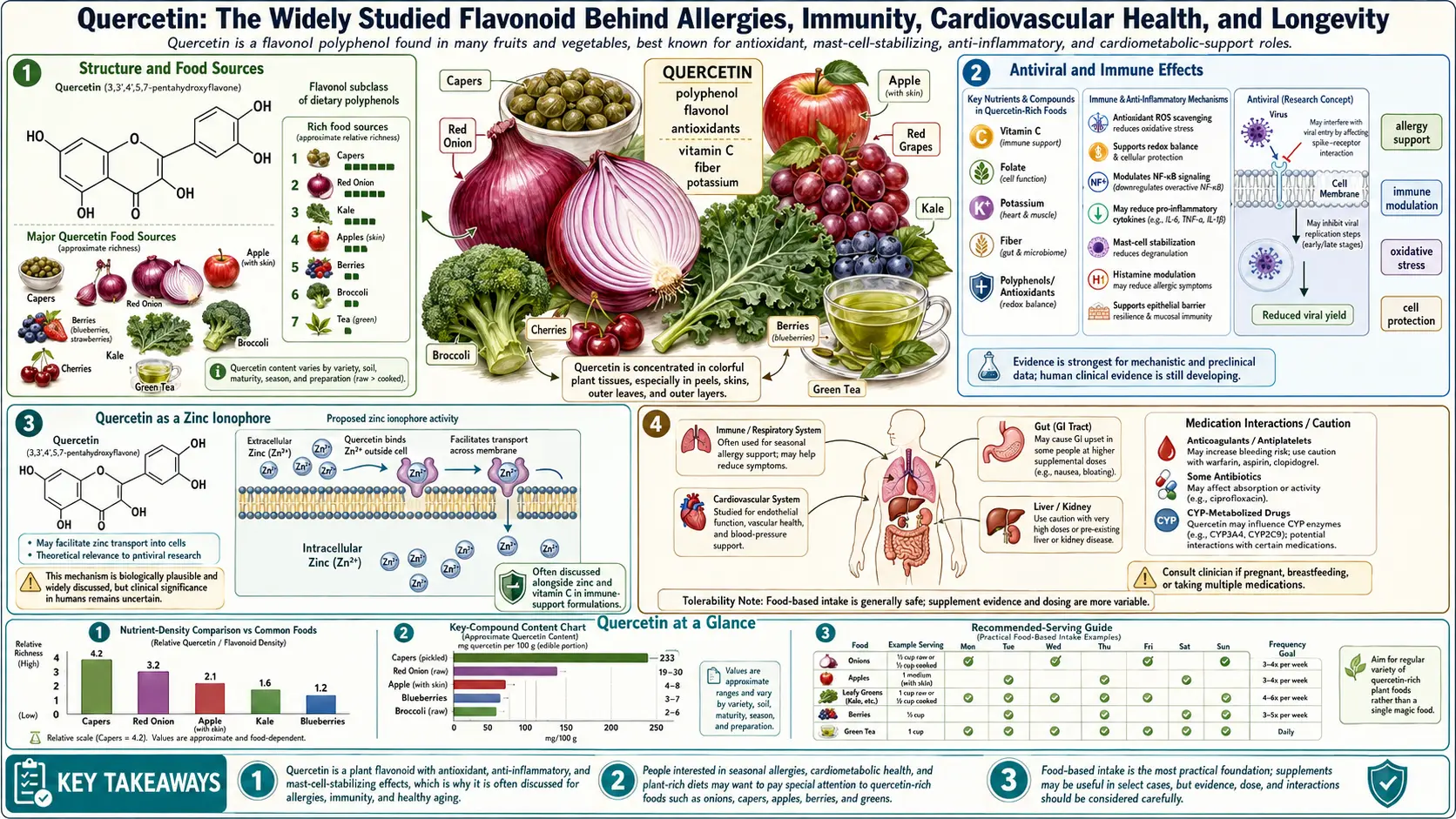
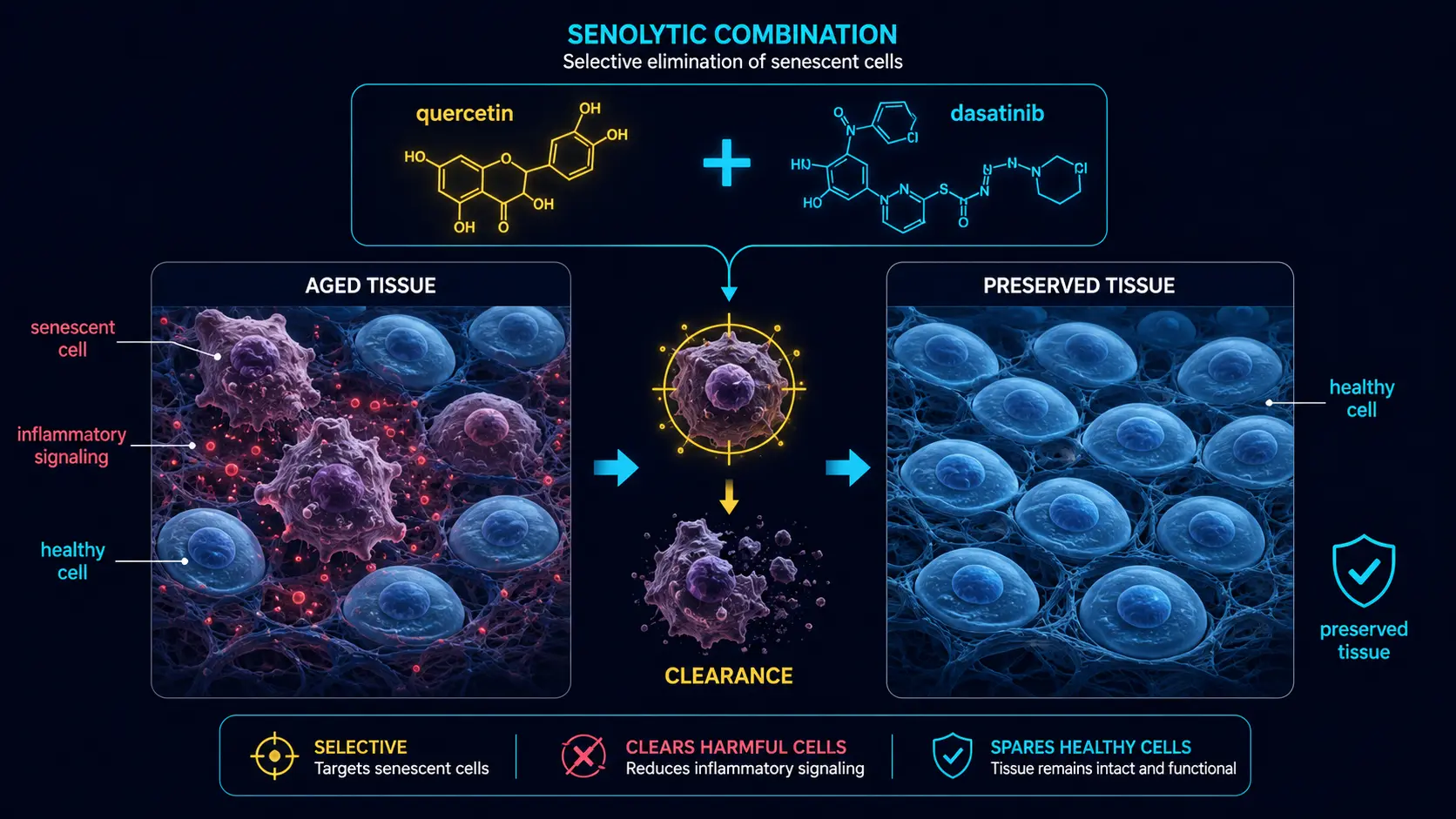
Quercetin is a flavonol, one of the subclasses of flavonoids; a 2016 meta-analysis describes it as the most abundant dietary flavonol (Serban 2016). Foods with measured quercetin content include capers, onions, kale, elderberries, cranberries, buckwheat, asparagus, blueberries, apples, broccoli, tea and red wine (USDA Flavonoid Database, 2018). It has been studied in cell, animal and human research on mast cells and allergy, blood pressure and viral infections, and more recently as one half of the dasatinib-plus-quercetin (D+Q) combination studied as a senolytic — a drug that selectively clears senescent cells (Zhu 2015; Kirkland and Tchkonia 2020).
This article summarizes the food sources, what the human studies in each research area found and did not find, how well different forms are absorbed, the doses the studies used, and the reported safety findings and drug interactions. Each research area is covered in more detail on the Quercetin Benefits deep-dive pages.
Interactive Visualization Inflammation — fire the cascade and watch it resolve Follow injury through prostaglandins and leukotrienes to swelling — then watch omega-3-derived resolvins actively switch it off, and see what an NSAID really trades away. Launch → Interactive Visualization Histamine, Mast Cells & Allergy — trigger a mast cell yourself Arm a mast cell with IgE, let the allergen cross-link it, and watch histamine burst out to raise a wheal — then block the H1 receptor and see symptoms fall while histamine still pours out. Launch →Table of Contents
Structure and Food Sources
Quercetin belongs to the flavonol class of flavonoids (USDA Flavonoid Database, 2018). In plants it is mostly bound to sugars as glycosides: onions contain glucose conjugates of quercetin, apples contain both glucose and non-glucose quercetin glycosides, and quercetin-3-rutinoside (rutin) is the major quercetin glycoside in tea (Hollman 1997). Isoquercitrin is quercetin-3-O-glucoside (Makino 2009).
Mean quercetin content in the USDA Database for the Flavonoid Content of Selected Foods (Release 3.3, 2018), in mg per 100 g of edible portion:
- Capers, raw — 233.84 (3 samples), the highest mean quercetin value in the database; capers, canned — 172.55 (20 samples)
- Onions, red, raw — 39.21; onions, raw — 20.30; spring onions or scallions, raw — 10.68
- Elderberries, raw — 26.77; cranberries, raw — 16.64; highbush blueberries, raw — 7.67; apples, raw, with skin — 4.01 (without skin — 1.05)
- Kale, raw — 22.58; asparagus, raw — 13.98; broccoli, raw — 3.26
- Buckwheat — 15.38
- Black tea, brewed — 2.19; red table wine — 1.04
Values vary widely between samples: the 400 samples of raw onions in the database ranged from 1.50 to 90.75 mg/100 g. How much a food contributes also depends on how much of it is eaten: in the Zutphen Elderly Study of Dutch men, the main sources of flavonoid intake were tea (61%), onions (13%) and apples (10%) (Hertog 1993).
Mast Cells and Allergy Research
Most of the mast-cell research is laboratory work. In cultured human mast cells, quercetin and cromolyn (both at 100 µM) inhibited the release of histamine and prostaglandin D2; quercetin was more effective than cromolyn against IL-8 and TNF release, inhibited the rise in cytosolic calcium and the activation of NF-κB, and worked when added before the trigger, whereas cromolyn lost its effect unless added together with it (Weng 2012).
The human allergy trials are small placebo-controlled studies in Japanese adults with pollen allergy. In 20 people with Japanese cedar pollinosis taking two 100 mg capsules a day of enzymatically modified isoquercitrin (EMIQ) for 8 weeks of the pollen season, total eye-symptom and eye-itching scores were lower than with placebo, while the nasal-symptom scores only tended to be lower without reaching significance (Kawai 2009). In 66 adults taking 200 mg/day of quercetin in a lecithin phytosome formulation for 4 weeks, several questionnaire scores, including eye itching, sneezing and nasal discharge, improved compared with placebo (Yamada 2022).
Antiviral Research
In cell culture, quercetin reduced the infectivity and replication of herpes simplex virus type 1, poliovirus, parainfluenza virus type 3 and respiratory syncytial virus (Kaul 1985), and inhibited the entry of influenza A virus, interacting with the HA2 subunit of its hemagglutinin (Wu 2015).
The two human trials of upper respiratory tract infection (URTI) point in different directions. In 40 trained male cyclists, 1000 mg/day taken for three weeks before, during and for two weeks after a three-day period of intensive cycling was followed by fewer URTIs in the two weeks after the exercise than placebo (1 of 20 vs 9 of 20), without changes in the immune measures studied (Nieman 2007). In a 12-week trial in 1,002 community adults aged 18–85, 500 or 1000 mg/day had no significant effect on URTI rates or symptoms overall; in a separate analysis of 325 participants aged 40 or older who rated themselves in the fitter half of the group, the 1000 mg group had 36% lower URTI severity and 31% fewer sick days than placebo (Heinz 2010).
Blood Pressure and Cardiovascular Research
Meta-analyses of randomized trials report small average reductions in systolic blood pressure: 3.04 mmHg across 7 trials with 587 patients, significant in trials using 500 mg/day or more and not significant below that dose (Serban 2016); 3.09 mmHg across 17 trials with 896 participants (Huang 2020); and, in a 2023 umbrella review of meta-analyses, 1.9 mmHg, with no effect on diastolic pressure or lipids and certainty of evidence ranging from very low to moderate (Arabi 2023). In one crossover trial, 730 mg/day for 28 days lowered systolic and diastolic pressure by 7 and 5 mmHg in 22 people with stage 1 hypertension and did not change blood pressure in 19 people with prehypertension (Edwards 2007).
In 12 healthy men, a single 200 mg dose raised plasma nitric-oxide products and lowered endothelin-1 (Loke 2008). Quercetin prevents LDL oxidation in vitro (Hollman 1996), but 50–150 mg/day for two weeks did not change oxidized LDL in 35 healthy volunteers (Egert 2008). A lipid meta-analysis of 5 trials found no clinically relevant effect on plasma lipids apart from a reduction in triglycerides (Sahebkar 2017). In the Zutphen Elderly Study, which followed 805 men aged 65–84 for five years, higher flavonoid intake was associated with lower coronary heart disease mortality (relative risk 0.42 for the highest vs the lowest third of intake); this is an observational association (Hertog 1993).
Senolytic Use with Dasatinib
Zhu and colleagues (2015) found raised pro-survival networks in senescent cells and tested drugs against them: dasatinib eliminated senescent human fat-cell progenitors, quercetin was more effective against senescent human endothelial cells and mouse bone-marrow stem cells, and the dasatinib + quercetin (D+Q) combination reduced senescent-cell burden in aged, irradiated and progeroid mice; in old mice, cardiac function and carotid vascular reactivity improved 5 days after a single dose. In a later mouse study, intermittent oral D+Q alleviated physical dysfunction and increased post-treatment survival by 36% (Xu 2018). In a screen of 10 flavonoids in senescent mouse and human fibroblasts, fisetin was the most potent senolytic (Yousefzadeh 2018).
The human data are small open-label pilots of the combination, not of quercetin alone. In 14 people with idiopathic pulmonary fibrosis, dasatinib 100 mg/day plus quercetin 1250 mg/day, three days a week for three weeks, was followed by improved physical function (6-minute walk distance, gait speed, chair-stand time) while pulmonary function was unchanged; one serious adverse event was reported, and respiratory symptoms, skin irritation or bruising, and gastrointestinal discomfort were the most frequent non-serious events (Justice 2019). In 9 people with diabetic kidney disease, a 3-day course of dasatinib 100 mg plus quercetin 1000 mg reduced senescent-cell markers in fat tissue and skin 11 days later (Hickson 2019). Kirkland and Tchkonia (2020) list dasatinib, quercetin, fisetin and navitoclax as the first senolytic drugs, note trials under way or beginning in conditions including diabetes, idiopathic pulmonary fibrosis, Alzheimer’s disease and osteoporosis, and write that until those studies are done it is too early for senolytics to be used outside clinical trials.
Quercetin as a Zinc Ionophore
Dabbagh-Bazarbachi and colleagues (2014) showed that quercetin and epigallocatechin gallate (EGCG), like the drug clioquinol, rapidly raised labile zinc inside mouse liver-cancer (Hepa 1-6) cells and carried zinc across the membrane of artificial liposomes — the behaviour of a zinc ionophore. Separately, te Velthuis and colleagues (2010) found that zinc inhibits the RNA polymerase of SARS-coronavirus and equine arteritis virus in vitro, and that zinc combined with the ionophore pyrithione blocked their replication in cell culture; quercetin was not part of that study. None of these papers tested quercetin’s zinc-carrying action in people.
Forms, Absorption and Doses Studied
Quercetin’s poor solubility and low oral absorption are described as its major drawbacks (Riva 2019). Findings on different forms:
- Food forms — in nine volunteers, quercetin from apples and from pure rutin was 30% as bioavailable as quercetin from onions (Hollman 1997). In twelve volunteers, peak plasma levels after buckwheat tea or rutin were lower and later than after an onion supplement or quercetin-4′-O-glucoside, and only quercetin glucuronides, no free quercetin, were detected in plasma (Graefe 2001).
- Enzymatically modified isoquercitrin (EMIQ) — in people, its absorption was significantly higher than that of isoquercitrin or rutin (Murota 2010); in rats, its bioavailability was 35%, compared with 12% for isoquercitrin and 2.0% for quercetin aglycone (Makino 2009).
- Lecithin phytosome formulation — in a 12-volunteer crossover study whose authors are employees of the formulation’s manufacturer, it produced plasma quercetin levels up to 20 times those usually obtained with unformulated quercetin (Riva 2019).
- Review of methods — a 2025 systematic review of 31 human studies reported that quercetin-3-O-oligoglucosides were about 20-fold more bioavailable than quercetin aglycone and the lecithin phytosome 20.1-fold, and that adding dietary fats and fibre increased bioavailability about 2-fold (Liu 2025). In nine overweight adults given 1095 mg of quercetin aglycone, a high-fat breakfast raised peak plasma quercetin by 45% and the area under the curve by 32% compared with a fat-free breakfast (Guo 2013).
Reported elimination half-lives differ between studies: 16.8 hours after fried onions in two subjects (Hollman 1996), 28 hours after onions and 23 hours after apples in nine subjects (Hollman 1997), and about 11 hours for all four preparations tested in twelve subjects (Graefe 2001). In healthy volunteers taking 150 mg/day, the median peak plasma quercetin concentration was 431 nmol/L, with high variation between people (Egert 2008); the cultured mast-cell experiments above used 100 µM (Weng 2012).
Doses used in the studies above include 50–150 mg/day (Egert 2008), 200 mg/day (Yamada 2022), two 100 mg capsules of EMIQ a day (Kawai 2009), 730 mg/day (Edwards 2007), 500 or 1000 mg/day (Heinz 2010), 1000 mg/day (Nieman 2007) and, in the senolytic pilots, 1000–1250 mg of quercetin together with dasatinib on short intermittent schedules (Hickson 2019; Justice 2019). Isolated quercetin is marketed as a supplement mostly as the free aglycone, frequently in daily doses of up to 1000 mg, above usual dietary intake (Andres 2018).
Safety and Interactions
- A 2018 safety review found that adverse effects of supplemental quercetin in human intervention studies were rarely reported and mild, and that adequate data on long-term use (more than 12 weeks) of high doses (1000 mg or more) are not available (Andres 2018).
- From animal studies, the same review identified possible concerns: enhancement of nephrotoxic effects in a previously damaged kidney, and promotion of tumour development, especially in estrogen-dependent cancer (Andres 2018).
- Drug metabolism and transport in human studies: 500 mg/day for 13 days lowered blood levels of the CYP3A substrate midazolam, which the authors interpret as induction of CYP3A activity, seen in carriers of the CYP3A5*1 allele (Duan 2012); 1500 mg/day for a week showed a trend toward lower midazolam exposure (Nguyen 2015); quercetin lowered levels of the P-glycoprotein substrate talinolol in some volunteers, and the authors wrote that a clinically relevant interaction cannot be ruled out (Nguyen 2014); and 500 mg/day for 14 days raised pravastatin exposure by 24% by inhibiting the OATP1B1 transporter (Wu 2012).
- Cyclosporine, an immunosuppressant with a narrow therapeutic window: given together with quercetin, its oral bioavailability fell (area under the curve down 56% in pigs and 43% in rats), and the authors called for close monitoring when quercetin is combined with cyclosporine or other drugs handled by P-glycoprotein or CYP3A4 (Hsiu 2002).
- Platelets: in a pilot human study, platelet aggregation was inhibited 30 and 120 minutes after 150 or 300 mg of quercetin-4′-O-glucoside (Hubbard 2004).
- Decisions about supplements and medicines belong with a clinician.
Key Research Papers
- Haytowitz DB, Wu X, Bhagwat S (2018). USDA Database for the Flavonoid Content of Selected Foods, Release 3.3. U.S. Department of Agriculture, Agricultural Research Service, Nutrient Data Laboratory. — USDA Flavonoid Database, Release 3.3 (PDF)
- Serban MC, Sahebkar A, Zanchetti A, et al. (2016). Effects of Quercetin on Blood Pressure: A Systematic Review and Meta-Analysis of Randomized Controlled Trials. Journal of the American Heart Association 5(7):e002713. — PubMed PMID: 27405810
- Hollman PC, vd Gaag M, Mengelers MJ, et al. (1996). Absorption and disposition kinetics of the dietary antioxidant quercetin in man. Free Radical Biology & Medicine 21(5):703–7. — PubMed PMID: 8891673
- Hollman PC, van Trijp JM, Buysman MN, et al. (1997). Relative bioavailability of the antioxidant flavonoid quercetin from various foods in man. FEBS Letters 418(1-2):152–6. — PubMed PMID: 9414116
- Makino T, Shimizu R, Kanemaru M, et al. (2009). Enzymatically modified isoquercitrin, alpha-oligoglucosyl quercetin 3-O-glucoside, is absorbed more easily than other quercetin glycosides or aglycone after oral administration in rats. Biological & Pharmaceutical Bulletin 32(12):2034–40. — PubMed PMID: 19952424
- Hertog MG, Feskens EJ, Hollman PC, et al. (1993). Dietary antioxidant flavonoids and risk of coronary heart disease: the Zutphen Elderly Study. The Lancet 342(8878):1007–11. — PubMed PMID: 8105262
- Weng Z, Zhang B, Asadi S, et al. (2012). Quercetin is more effective than cromolyn in blocking human mast cell cytokine release and inhibits contact dermatitis and photosensitivity in humans. PLoS ONE 7(3):e33805. — PubMed PMID: 22470478
- Kawai M, Hirano T, Arimitsu J, et al. (2009). Effect of enzymatically modified isoquercitrin, a flavonoid, on symptoms of Japanese cedar pollinosis: a randomized double-blind placebo-controlled trial. International Archives of Allergy and Immunology 149(4):359–68. — PubMed PMID: 19295240
- Yamada S, Shirai M, Inaba Y, Takara T (2022). Effects of repeated oral intake of a quercetin-containing supplement on allergic reaction: a randomized, placebo-controlled, double-blind parallel-group study. European Review for Medical and Pharmacological Sciences 26(12):4331–4345. — PubMed PMID: 35776034
- Kaul TN, Middleton E, Ogra PL (1985). Antiviral effect of flavonoids on human viruses. Journal of Medical Virology 15(1):71–9. — PubMed PMID: 2981979
- Wu W, Li R, Li X, et al. (2015). Quercetin as an Antiviral Agent Inhibits Influenza A Virus (IAV) Entry. Viruses 8(1):6. — PubMed PMID: 26712783
- Nieman DC, Henson DA, Gross SJ, et al. (2007). Quercetin reduces illness but not immune perturbations after intensive exercise. Medicine & Science in Sports & Exercise 39(9):1561–9. — PubMed PMID: 17805089
- Heinz SA, Henson DA, Austin MD, et al. (2010). Quercetin supplementation and upper respiratory tract infection: A randomized community clinical trial. Pharmacological Research 62(3):237–42. — PubMed PMID: 20478383
- Huang H, Liao D, Dong Y, Pu R (2020). Effect of quercetin supplementation on plasma lipid profiles, blood pressure, and glucose levels: a systematic review and meta-analysis. Nutrition Reviews 78(8):615–626. — PubMed PMID: 31940027
- Arabi SM, Shahraki Jazinaki M, Chambari M, et al. (2023). The effects of Quercetin supplementation on cardiometabolic outcomes: An umbrella review of meta-analyses of randomized controlled trials. Phytotherapy Research 37(11):5080–5091. — PubMed PMID: 37654199
- Edwards RL, Lyon T, Litwin SE, et al. (2007). Quercetin reduces blood pressure in hypertensive subjects. Journal of Nutrition 137(11):2405–11. — PubMed PMID: 17951477
- Loke WM, Hodgson JM, Proudfoot JM, et al. (2008). Pure dietary flavonoids quercetin and (-)-epicatechin augment nitric oxide products and reduce endothelin-1 acutely in healthy men. American Journal of Clinical Nutrition 88(4):1018–25. — PubMed PMID: 18842789
- Egert S, Wolffram S, Bosy-Westphal A, et al. (2008). Daily quercetin supplementation dose-dependently increases plasma quercetin concentrations in healthy humans. Journal of Nutrition 138(9):1615–21. — PubMed PMID: 18716159
- Sahebkar A (2017). Effects of quercetin supplementation on lipid profile: A systematic review and meta-analysis of randomized controlled trials. Critical Reviews in Food Science and Nutrition 57(4):666–676. — PubMed PMID: 25897620
- Zhu Y, Tchkonia T, Pirtskhalava T, et al. (2015). The Achilles' heel of senescent cells: from transcriptome to senolytic drugs. Aging Cell 14(4):644–58. — PubMed PMID: 25754370
- Xu M, Pirtskhalava T, Farr JN, et al. (2018). Senolytics improve physical function and increase lifespan in old age. Nature Medicine 24(8):1246–1256. — PubMed PMID: 29988130
- Justice JN, Nambiar AM, Tchkonia T, et al. (2019). Senolytics in idiopathic pulmonary fibrosis: Results from a first-in-human, open-label, pilot study. EBioMedicine 40:554–563. — PubMed PMID: 30616998
- Hickson LJ, Langhi Prata LGP, Bobart SA, et al. (2019). Senolytics decrease senescent cells in humans: Preliminary report from a clinical trial of Dasatinib plus Quercetin in individuals with diabetic kidney disease. EBioMedicine 47:446–456. — PubMed PMID: 31542391 (corrigendum: PubMed PMID: 31982828)
- Yousefzadeh MJ, Zhu Y, McGowan SJ, et al. (2018). Fisetin is a senotherapeutic that extends health and lifespan. EBioMedicine 36:18–28. — PubMed PMID: 30279143
- Kirkland JL, Tchkonia T (2020). Senolytic drugs: from discovery to translation. Journal of Internal Medicine 288(5):518–536. — PubMed PMID: 32686219
- Dabbagh-Bazarbachi H, Clergeaud G, Quesada IM, et al. (2014). Zinc ionophore activity of quercetin and epigallocatechin-gallate: from Hepa 1-6 cells to a liposome model. Journal of Agricultural and Food Chemistry 62(32):8085–93. — PubMed PMID: 25050823
- te Velthuis AJ, van den Worm SH, Sims AC, et al. (2010). Zn(2+) inhibits coronavirus and arterivirus RNA polymerase activity in vitro and zinc ionophores block the replication of these viruses in cell culture. PLoS Pathogens 6(11):e1001176. — PubMed PMID: 21079686
- Riva A, Ronchi M, Petrangolini G, et al. (2019). Improved Oral Absorption of Quercetin from Quercetin Phytosome®, a New Delivery System Based on Food Grade Lecithin. European Journal of Drug Metabolism and Pharmacokinetics 44(2):169–177. — PubMed PMID: 30328058 (the authors are employees of the formulation’s manufacturer)
- Murota K, Matsuda N, Kashino Y, et al. (2010). alpha-Oligoglucosylation of a sugar moiety enhances the bioavailability of quercetin glucosides in humans. Archives of Biochemistry and Biophysics 501(1):91–7. — PubMed PMID: 20638359
- Liu L, Barber E, Kellow NJ, Williamson G (2025). Improving quercetin bioavailability: A systematic review and meta-analysis of human intervention studies. Food Chemistry 477:143630. — PubMed PMID: 40037045
- Guo Y, Mah E, Davis CG, et al. (2013). Dietary fat increases quercetin bioavailability in overweight adults. Molecular Nutrition & Food Research 57(5):896–905. — PubMed PMID: 23319447
- Graefe EU, Wittig J, Mueller S, et al. (2001). Pharmacokinetics and bioavailability of quercetin glycosides in humans. Journal of Clinical Pharmacology 41(5):492–9. — PubMed PMID: 11361045
- Andres S, Pevny S, Ziegenhagen R, et al. (2018). Safety Aspects of the Use of Quercetin as a Dietary Supplement. Molecular Nutrition & Food Research 62(1). — PubMed PMID: 29127724
- Duan KM, Wang SY, Ouyang W, et al. (2012). Effect of quercetin on CYP3A activity in Chinese healthy participants. Journal of Clinical Pharmacology 52(6):940–6. — PubMed PMID: 21680781
- Nguyen MA, Staubach P, Wolffram S, Langguth P (2015). The Influence of Single-Dose and Short-Term Administration of Quercetin on the Pharmacokinetics of Midazolam in Humans. Journal of Pharmaceutical Sciences 104(9):3199–207. — PubMed PMID: 25988261
- Nguyen MA, Staubach P, Wolffram S, Langguth P (2014). Effect of single-dose and short-term administration of quercetin on the pharmacokinetics of talinolol in humans - Implications for the evaluation of transporter-mediated flavonoid-drug interactions. European Journal of Pharmaceutical Sciences 61:54–60. — PubMed PMID: 24472704
- Wu LX, Guo CX, Chen WQ, et al. (2012). Inhibition of the organic anion-transporting polypeptide 1B1 by quercetin: an in vitro and in vivo assessment. British Journal of Clinical Pharmacology 73(5):750–7. — PubMed PMID: 22114872
- Hsiu SL, Hou YC, Wang YH, et al. (2002). Quercetin significantly decreased cyclosporin oral bioavailability in pigs and rats. Life Sciences 72(3):227–35. — PubMed PMID: 12427482
- Hubbard GP, Wolffram S, Lovegrove JA, Gibbins JM (2004). Ingestion of quercetin inhibits platelet aggregation and essential components of the collagen-stimulated platelet activation pathway in humans. Journal of Thrombosis and Haemostasis 2(12):2138–45. — PubMed PMID: 15613018
PubMed Topic Searches
- PubMed: Quercetin, mast cells, and allergy
- PubMed: Quercetin and blood pressure (randomized trials)
- PubMed: Quercetin and endothelial function
- PubMed: Quercetin antiviral activity
- PubMed: Quercetin as a zinc ionophore
- PubMed: Dasatinib + quercetin senolytic trials
- PubMed: Quercetin phytosome and bioavailability
- PubMed: Quercetin and NF-κB inflammation
- PubMed: Quercetin and LDL oxidation
- PubMed: Quercetin in diabetic kidney disease (senolytic)
- PubMed: Quercetin and allergic rhinitis
- PubMed: Dietary flavonol intake and cardiovascular mortality
Connections
- Fluoride Chelation — part of the antioxidant stack
- Histamine, Mast Cells & Allergy — interactive animation
- Inflammation & How It Resolves — interactive animation
- Rutin
- Hesperidin
- Luteolin
- Apigenin
- EGCG
- Zinc
- Fisetin
- Vitamin C
- Hypertension
- Allergies
- Immune Boosting
- Spermidine
- Longevity Protocols
- Cold and Flu Treatments
- Kidney Disease
- Blueberries
- Green Tea
- Broccoli
- Cancer
- Asthma
- Metabolic Syndrome
- Oxidative Stress
- MCAS
- Conditions on this site that reference this page: Urticaria (Hives) · Nasal Polyps · Sinusitis · Hemochromatosis · Cromolyn and Ketotifen Protocols for MCAS · H1 and H2 Blocker Stacks for MCAS · Hereditary Alpha-Tryptasemia (HαT) · MCAS Hormone Sensitivity