 — May 28, 2026
· Active Forms, Reversible Biology, and Genotype-Tuned Minerals
— May 28, 2026
· Active Forms, Reversible Biology, and Genotype-Tuned Minerals
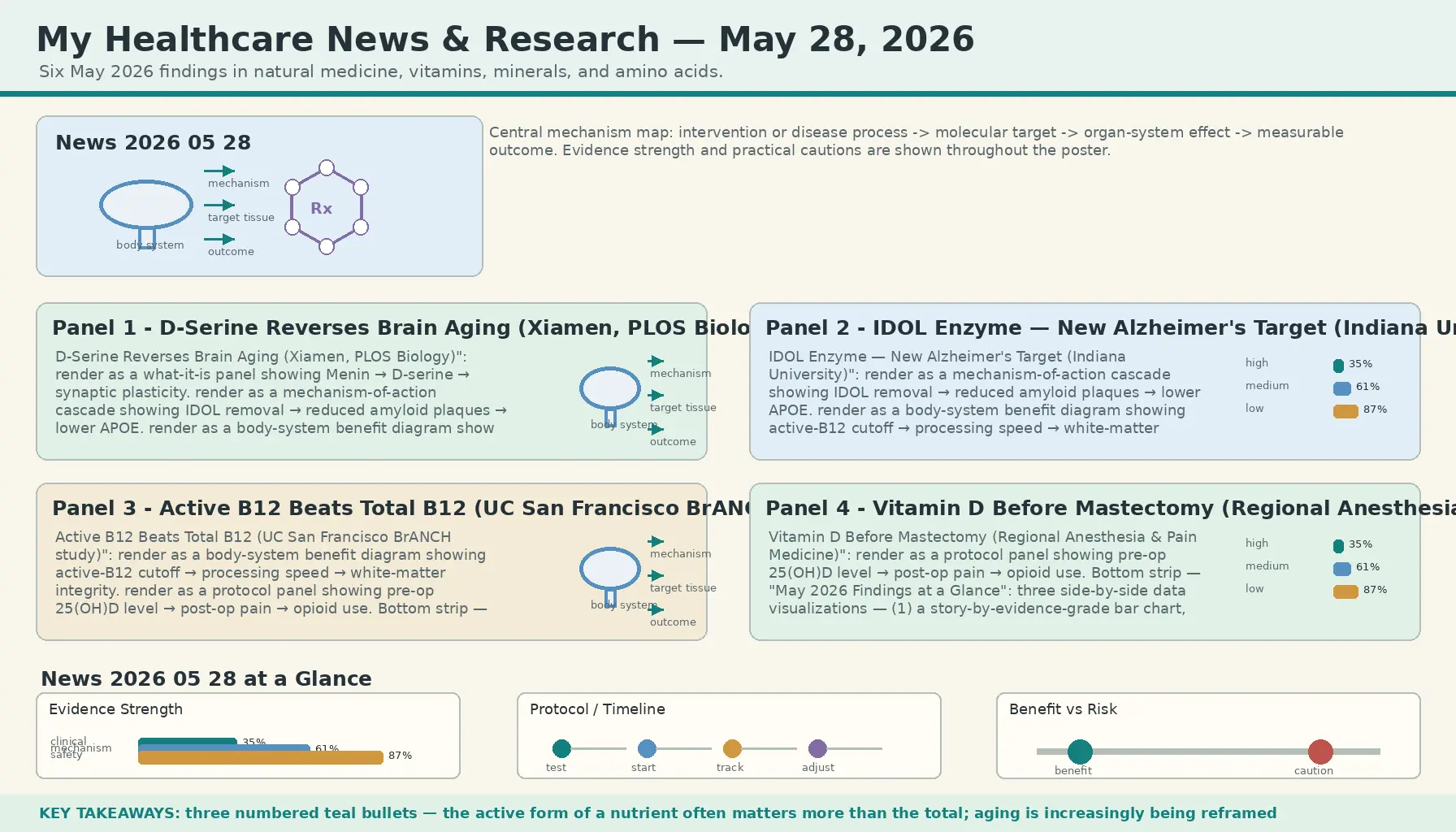
This edition pulls together six findings on vitamins, minerals, amino acids, and the biology of aging. Only one of the six papers — the vitamin D and surgery study — was first published in May 2026; the others appeared between March 2023 and February 2026 and are summarized here from the papers themselves. Three threads run through them: the active form of a nutrient can track health measures differently from the total amount in the blood; in mice, several markers of aging moved in both directions when one hypothalamic protein was lowered or restored; and researchers are asking whether genetic variation explains why people respond differently to the same mineral dose — a question the evidence has not yet answered. Two of the six are mouse studies, two are observational studies of a few hundred people, and two are a narrative review and an opinion article paired with a systematic review. None has been translated into clinical practice.
Table of Contents
- 1. D-Serine and Menin — A Brain-Aging Switch in Mice
- 2. IDOL Enzyme — A Proposed Alzheimer's Drug Target in Mice
- 3. “Normal” B12 May Not Be Enough — The Active-B12 Story
- 4. Vitamin D Status Before Surgery and Postoperative Pain
- 5. Zinc and Selenium — Deficiency, Excess, and the Genotype Question
- 6. Creatine Across the Lifespan — An Opinion Article and a Systematic Review
- Key Research Papers
- PubMed Topic Searches
- Connections
- Featured Videos
1. D-Serine and Menin — A Brain-Aging Switch in Mice
A team at Xiamen University in China (first author Lige Leng, senior author Jie Zhang) published this study in PLOS Biology in March 2023. It concerns a protein most clinicians know as a tumor-suppressor gene product — menin, encoded by MEN1, the gene whose loss-of-function mutations cause multiple endocrine neoplasia type 1. The paper examines a different role for menin, in the ventromedial hypothalamus (VMH) of the aging mouse brain.
The team began with an observation: of seven brain regions compared between young (3-month-old) and old (20-month-old) mice, menin fell most with age in the hypothalamus. To test whether that decline mattered, they deleted menin from VMH neurons — in mice bred without it there, and in middle-aged mice by gene transfer. The authors describe the result as premature aging: by about 10 months of age the knockout mice showed learning and memory deficits in maze tests, reduced bone mass, smaller muscle fibers, thinner skin, and a shortened lifespan.
Then they ran the experiment in the opposite direction, raising menin in the VMH of 20-month-old mice with a gene-transfer (AAV) vector. Thirty days after the injection, skin thickness, bone mass, and tail-tendon collagen cross-linking — standard aging markers in mice — had improved; learning, memory, and balance on behavioral tests also improved, and the treated mice lived longer than controls.
The authors trace part of the effect to D-serine, an unusual amino acid that serves as a co-agonist of the NMDA glutamate receptor. NMDA receptors are central to synaptic plasticity, learning, and memory; they require both glutamate and a co-agonist (glycine or D-serine) to open. In mice lacking VMH menin, the expression of phosphoglycerate dehydrogenase (PHGDH) — the first, rate-limiting enzyme of serine synthesis — fell, and so did hypothalamic D-serine; the authors report that menin binds the promoter region of the PHGDH gene. When the team gave 22-month-old mice D-serine in their drinking water (about 100 mg/kg body weight for 3 weeks), without changing menin, the authors report that the cognitive decline was rescued.
D-serine itself is not a new molecule. It has been tested in schizophrenia: double-blind studies used 30 mg/kg/day (about 2 g/day), and a 4-week open-label trial in 42 patients tested 30, 60, and 120 mg/kg/day. A 2021 cross-species safety review reports that kidney injury (acute tubular necrosis) is common in rats given doses above 500 mg/kg but has not been reported in mice or rabbits, and that across published human studies one participant had abnormal kidney values related to D-serine, which resolved within a few days of stopping. The Xiamen paper places D-serine in a geroscience context, as a downstream signal of an aging-related pathway in mice.
Two limitations stand out. This is a mouse study; the human VMH differs from the mouse VMH, and the timescale of human aging dwarfs the mouse lifespan that defines the experiment. And no drug that raises menin activity exists for humans — the menin-targeting drug in clinical use, revumenib, approved in the US on 15 November 2024 for relapsed or refractory acute leukemia with a KMT2A translocation, is an inhibitor, mechanistically opposite to what the Xiamen paper suggests would help an aging brain. D-serine is the one part of the pathway that has already been given to people in clinical trials.
Dedicated articles cover D-serine and menin as the hypothalamic aging switch. The DOI for the Xiamen paper is 10.1371/journal.pbio.3002033.
2. IDOL Enzyme — A Proposed Alzheimer's Drug Target in Mice
A team at the Indiana University School of Medicine (first author Hande Karahan, senior author Jungsu Kim) published this study in Alzheimer’s & Dementia in December 2025; the university’s news summary followed in February 2026. It concerns an enzyme called IDOL — inducible degrader of the LDL receptor, an E3 ubiquitin ligase that tags the LDL receptor for destruction. In an amyloid-producing mouse model (5XFAD), deleting IDOL from neurons raised brain LDL-receptor levels, lowered brain APOE protein levels, and reduced amyloid accumulation and plaques; deleting it from microglia had none of these effects. Neuronal IDOL deletion also raised two Reelin receptors (APOER2 and VLDLR) involved in synaptic function. The rationale comes from earlier mouse work the authors cite: raising LDL-receptor levels — by overexpressing the receptor, or by deleting IDOL throughout the body, as the group’s own 2015 study reported — lowered APOE and amyloid. The authors propose that APOE and amyloid-β are taken up together through these receptors, so more receptor means more clearance of APOE-bound amyloid-β.
The approach differs from the two recently approved monoclonal antibodies, lecanemab and donanemab, which bind amyloid-β that has already aggregated — lecanemab binds soluble protofibrils, and donanemab was designed to clear amyloid plaque — and remove it. The IDOL approach is upstream: by raising LDL-receptor levels on neurons, it aims to limit how much amyloid accumulates in the first place.
APOE4, the ε4 allele of apolipoprotein E, raises late-onset Alzheimer’s risk in people who carry one or two copies. Whether reducing IDOL would matter more for APOE4 carriers is an open question. The paper’s discussion notes that APOE isoforms differ in how they bind the LDL receptor and in cholesterol efflux (APOE4 is the least efficient at efflux), but the study did not compare human APOE variants.
The work is preclinical; no IDOL inhibitor has been reported in human trials. Two questions the findings leave open: (1) IDOL also regulates the LDL receptor outside the brain — the 2009 study that described it placed it in the pathway controlling cholesterol uptake — so what would whole-body IDOL inhibition do to lipoprotein metabolism? and (2) what would long-term LDL-receptor upregulation in the brain do over decades?
A dedicated IDOL Enzyme article covers the topic in more depth. The Indiana University news summary is at medicine.iu.edu/news/2026/02.
3. “Normal” B12 May Not Be Enough — The Active-B12 Story
This study comes from the UC San Francisco Brain Aging Network for Cognitive Health (BrANCH) cohort and was published in Annals of Neurology in February 2025. It enrolled 231 healthy older adults (median age 71.2) and measured both total serum vitamin B12 and its active fraction — holotranscobalamin (holoTC), the B12 bound to transcobalamin, which cells can take up. Median total B12 was 414.8 pmol/L, well above the US deficiency cutoff of 148 pmol/L — a cutoff the authors note was calculated as three standard deviations below the US population average rather than from clinical observations. Two participants fell below it, and removing them did not change the results.
Testing included visual evoked potentials, processing-speed tests, and brain MRI. Lower B12, especially lower holoTC, was associated with delayed visual evoked potentials, slower processing speed (in an age-dependent manner), and larger volumes of white-matter hyperintensities on MRI. At the other end of the range, higher holo-haptocorrin — the biologically inactive fraction — correlated with serum tau, a marker of neurodegeneration. The authors conclude that healthy older people show neurological changes at both ends of the measurable “normal” B12 range and that the findings challenge current understanding of optimal serum B12 levels. The analysis was cross-sectional, so it shows associations, not cause and effect.
The biology behind the distinction: approximately one-quarter of circulating B12 is bound to transcobalamin and available to the body’s cells, according to a 2011 review of the holoTC test. Most of the rest is bound to haptocorrin, which, as the UCSF authors describe it, can bind only liver-cell receptors that take B12 back for degradation and excretion in bile. A total B12 test measures both pools together, so a reassuring total can contain a low active fraction — the hypothesis the UCSF team set out to test.
Four blood markers are used in assessing B12 insufficiency:
- Total B12 — the first-line test in the British Society for Haematology’s 2014 guideline. In the UCSF cohort, values in the normal range did not rule out the neurological associations described above.
- Holotranscobalamin (holoTC) — the active fraction. The same guideline describes it as having potential as a first-line test, with an indeterminate “grey area”, and states that definitive cut-off points are not possible given differing methods, so local reference ranges should be established. One published diagnostic algorithm treats holoTC between 23 and 75 pmol/L as a grey zone in which MMA testing is added.
- Methylmalonic acid (MMA) — rises when cells lack B12; the guideline uses it as a second-line test to clarify functional deficiency. Published studies have used upper limits of about 270–300 nmol/L, and limits vary by laboratory.
- Homocysteine — rises in both B12 and folate insufficiency; the guideline describes it as helpful as a second-line test but less specific than MMA.
The Herrmann–Obeid algorithm pairs holoTC as a first-line marker with MMA as a second-line marker. A normal MCV (mean corpuscular volume on the blood count) does not exclude a neurological problem: in a 1988 series of 141 patients with neuropsychiatric abnormalities caused by B12 deficiency, 40 (28%) had no anemia or enlarged red cells.
A 2017 American Family Physician review lists risk factors that may warrant screening: gastric or small-intestine resections (including bariatric surgery), inflammatory bowel disease, use of metformin for more than four months or of proton pump inhibitors or H2 blockers for more than 12 months, a vegan or strict vegetarian diet, and age over 75; the same review states that screening average-risk adults is not recommended. Pernicious anemia, an autoimmune condition marked by chronic atrophic gastritis, is described as the most common cause of B12 deficiency worldwide. The Active B12 (Holotranscobalamin) Testing deep-dive covers reference ranges, treatment thresholds, and how the test is requested. The UCSF news release is at ucsf.edu/news/2025/02/429491.
4. Vitamin D Status Before Surgery and Postoperative Pain
A prospective observational study at Fayoum University Hospital in Egypt, published online in Regional Anesthesia & Pain Medicine on 19 May 2026, followed 184 women having elective unilateral modified radical mastectomy for breast cancer between September 2024 and April 2025. They were grouped by preoperative 25-hydroxyvitamin D: 92 deficient (below 30 nmol/L, roughly 12 ng/mL) and 92 sufficient (30 nmol/L or above), with baseline characteristics well balanced between the groups. In multivariable analysis, deficiency was associated with about three times the odds of moderate-to-severe pain at some point in the first 24 hours after surgery (adjusted odds ratio 3.12, 95% CI 1.58–6.13). Deficient patients also received more fentanyl during surgery (mean difference 8.04 µg) and more tramadol afterward (mean difference 112.17 mg). Because the study was observational, it shows an association; it did not test whether giving vitamin D before surgery changes pain.
A 2017 review of vitamin D in pain management describes the proposed mechanisms as anti-inflammatory effects — reduced cytokine and prostaglandin release — and effects on T-cell responses, and concludes that more randomized, placebo-controlled studies are needed before firm conclusions can be drawn.
The study leaves open whether correcting a deficiency before surgery would reduce pain. Raising a low level takes weeks rather than days: the Endocrine Society’s 2011 guideline gave a regimen for deficient adults of 50,000 IU of vitamin D once a week for 8 weeks, or its equivalent of 6,000 IU daily, to reach a 25(OH)D level above 30 ng/mL (75 nmol/L), followed by 1,500–2,000 IU daily. The Society’s 2024 guideline on vitamin D for disease prevention found no clinical-trial evidence supporting routine 25(OH)D screening in the general population, suggests against routine testing in people without an established indication, and, for adults over 50 for whom vitamin D is indicated, suggests daily dosing rather than intermittent high doses; its questions concerned disease prevention in general populations rather than surgery.
The study enrolled only women having mastectomy. Whether the association holds for orthopedic procedures, cardiac surgery (including post-bypass acute kidney injury), or major abdominal surgery was not tested here.
Safety findings differ by condition. In sarcoidosis, where vitamin D can be activated outside the kidney, a 2020 review describes hypercalcemia and hypercalciuria with supplementation as “real possibilities”. In primary hyperparathyroidism with coexisting vitamin D deficiency, a 2021 meta-analysis found that supplementation lowered parathyroid hormone without causing hypercalcemia or hypercalciuria. Magnesium and vitamin K2, often discussed alongside vitamin D, are covered in the Surgical Recovery deep-dive. The Fayoum study is registered as a prospective observational study at ClinicalTrials.gov NCT06551688.
5. Zinc and Selenium — Deficiency, Excess, and the Genotype Question
A narrative review by a group of Polish clinicians, published in Cureus in February 2026, evaluated the evidence on zinc, selenium, and vitamin C in immune function. Its central finding is about limits: zinc deficiency increases susceptibility to infection, but supplementation benefits mainly people with deficient or high-risk status; selenium may enhance immune function in deficient people but has a narrow therapeutic window; and routine high-dose vitamin C offers limited benefit in healthy people. The review cites evidence that zinc can shorten a common cold by about 2.25 days without significantly lowering infection rates in people who are not deficient, and describes a “U-shaped” dose-response in which both deficiency and excess impair immune function.
The review treats the gut as a research frontier. In its closing section it states that emerging evidence suggests zinc and selenium significantly modulate the gut microbiota, which in turn trains systemic immune responses, and it calls for metagenomic studies of how supplementation changes microbial diversity and gut-barrier integrity — presenting this as a question for future studies rather than an established effect in people.
The review also names nutrigenomics as a future direction: identifying variants in genes for zinc transport or selenoprotein synthesis “could explain the heterogeneous responses observed in clinical trials”. It does not name specific genes. Separate studies have examined several candidates, mostly in small groups:
- SLC30A8 (ZnT8) — a zinc transporter in insulin-producing beta cells. Carriers of a common variant (R325W) have a lower early insulin response to glucose and a higher risk of type 2 diabetes. In 55 healthy Old Order Amish adults given 50 mg of elemental zinc twice daily for 14 days (above the US upper intake level), the early insulin response rose by 14–15% in carriers, more than in non-carriers.
- SLC39A8 (ZIP8) — a manganese transporter. A common variant (rs13107325), found almost only in people of European ancestry, is associated with serum manganese levels, body-mass index, Crohn’s disease, blood-pressure traits, and schizophrenia; rare damaging variants cause a congenital disorder of glycosylation.
- GPX1 (glutathione peroxidase 1) — a selenium-dependent antioxidant enzyme. A small pilot study of Brazil-nut intake suggested that the Pro198Leu variant may affect selenium status and GPx activity; a trial in 227 UK pregnant women found no association between the GPx1 variant and selenium status.
- SELENOP (selenoprotein P) — the major selenium transport protein in plasma. In the same pregnancy trial, carriers of the A allele of one variant (rs3877899) better maintained selenium status during pregnancy, and their plasma glutathione peroxidase activity rose more with 60 µg/day of selenium; the variant explained 5–8% of the variation in these measures.
None of these studies compared genotype-guided dosing with standard dosing, and there are no validated genotype cutpoints for setting zinc or selenium doses; the Cureus review presents genotype-based supplementation as a direction for future research. The direct evidence for genotype-tuned mineral dosing is therefore absent at present, and the gene associations above are small, mostly single-study findings.
The established limits are set for whole populations. The tolerable upper intake level for zinc in adults is 25–40 mg/day depending on the authority (40 mg/day in the United States); for selenium the upper intake level is 400 µg/day. The Cureus review notes that prolonged high-dose zinc interferes with copper absorption and can lead to copper deficiency, which itself impairs immune function and causes neutropenia. A 2012 Lancet review of selenium describes an “inextricable U-shaped link” between selenium status and health: additional selenium may benefit people with low status, while people with adequate-to-high status might be affected adversely.
6. Creatine Across the Lifespan — An Opinion Article and a Systematic Review
Two recent papers address creatine monohydrate beyond sport. An April 2025 opinion article in Frontiers in Nutrition by nine authors, most of them creatine researchers, is titled “Creatine supplementation is safe, beneficial throughout the lifespan, and should not be restricted”; it argues that legislation restricting the sale of creatine to children and adolescents is not based on scientific evidence, and its competing-interest statement discloses industry funding, consulting, or advisory roles for several of the authors. A systematic review in Nutrition Reviews (February 2026 issue) took a narrower look at cognition in older adults.
That review found six studies of creatine and cognition in adults aged 55 and over, with 1,542 participants in total: two double-blind supplementation trials and four cross-sectional studies that estimated dietary creatine. Five of the six reported a positive relationship, mainly for memory and attention, but only one study was rated good quality (two fair, three poor). The authors conclude that the limited evidence suggests creatine may be associated with cognitive benefits in generally healthy older adults and that high-quality trials are needed. An earlier systematic review (2018) of six randomized trials in 281 healthy people found evidence that short-term memory and intelligence/reasoning may improve, conflicting results in other domains, no change in young people, and a better memory response in vegetarians than in meat-eaters; it suggested potential benefit for aging and stressed individuals.
On dosing, the International Society of Sports Nutrition’s 2017 position stand describes two approaches used in trials: about 0.3 g/kg/day for 5–7 days followed by 3–5 g/day, or 3–5 g/day from the start, which raises muscle creatine stores over a 3–4 week period, with less support for early performance effects. The position stand reports that clinical evidence has not shown other forms tested — creatine citrate, ethyl ester, buffered, and nitrate forms among them — to promote greater creatine retention than creatine monohydrate, which it describes as the most extensively studied form.
On safety, a 2025 analysis of 685 clinical trials found side effects reported at similar rates with creatine and placebo, with no significant differences in markers of kidney function. Creatine does raise serum creatinine: a 2025 meta-analysis found a small increase that its authors attribute to metabolic turnover rather than kidney impairment, with no significant change in filtration rate, and a 2026 meta-analysis of randomized trials found serum creatinine about 0.13 mg/dL higher with no difference in urea or eGFR, while calling for trials longer than a year. Because eGFR is calculated from serum creatinine, a creatine-related rise can make creatinine-based estimates harder to interpret, which matters most for people with established kidney disease. Creatine also retains a small amount of water; early loading studies reported about 0.5–1.0 L of short-term fluid retention.
Open questions include whether creatine has a role in depression, and whether any cognitive benefit in older adults extends to people with mild cognitive impairment or dementia — populations both systematic reviews name as priorities for future trials. The papers discussed in this section are the opinion article at PMC12053822 and the systematic review at PMID 40971619.
Key Research Papers
Primary papers for the six stories, then supporting literature. Each entry was checked against its PubMed record on 12 October 2026; several earlier entries had wrong titles, years or authors and were corrected.
Primary Studies This Edition Covers
- Leng L, Yuan Z, Su X, Chen Z, Yang S, Chen M, et al. (2023). Hypothalamic Menin regulates systemic aging and cognitive decline. PLOS Biology 21(3):e3002033. — DOI: 10.1371/journal.pbio.3002033
- Karahan H, Hartigan K, Al-Amin MM, John SK, McCord B, Wijeratne HRS, et al. (2025). Deletion of neuronal Idol ameliorates Alzheimer’s disease-related pathologies via APOE receptors. Alzheimer’s & Dementia 21(12):e70949. Indiana University School of Medicine summary: medicine.iu.edu/news/2026/02/alzheimers-drug-discovery-pathway-2026 — PubMed PMID: 41384508
- Beaudry-Richard A, Abdelhak A, Saloner R, Sacco S, Montes SC, Oertel FC, et al. (2025). Vitamin B12 levels association with functional and structural biomarkers of central nervous system injury in older adults. Annals of Neurology 97(6):1190-1204. UCSF news release: ucsf.edu/news/2025/02/429491 — PubMed PMID: 39927551
- Abdelhady MA, Boulos ML, Hamed MA, Masry DH, Ragab SG, Ragab MH (2026). Association between preoperative vitamin D level and postoperative pain in patients undergoing breast cancer surgery: a prospective observational study. Regional Anesthesia & Pain Medicine, published online 19 May 2026, rapm-2025-107495. Registration: ClinicalTrials.gov NCT06551688 — PubMed PMID: 42156166
- Skrzypska N, Glowacka-Kaminska W, Wróblewska J, Wojtczak O, Zagaja K, Tarczykowski J, et al. (2026). Between deficiency and excess: the dual role of selected dietary supplements in immune health. Cureus 18(2):e104014. — PubMed PMID: 41878172
- Kreider RB, Jagim AR, Antonio J, Kalman DS, Kerksick CM, Stout JR, et al. (2025). Creatine supplementation is safe, beneficial throughout the lifespan, and should not be restricted (opinion article). Frontiers in Nutrition 12:1578564. Full text: PMC12053822 — PubMed PMID: 40331098
- Marshall S, Kitzan A, Wright J, Bocicariu L, Nagamatsu LS (2026). Creatine and cognition in aging: a systematic review of evidence in older adults. Nutrition Reviews 84(2):333-344. — PubMed PMID: 40971619
Supporting Literature
- Mothet JP, Parent AT, Wolosker H, Brady RO Jr, Linden DJ, Ferris CD, et al. (2000). D-serine is an endogenous ligand for the glycine site of the N-methyl-D-aspartate receptor. Proceedings of the National Academy of Sciences USA 97(9):4926-4931. — PubMed PMID: 10781100
- Kantrowitz JT, Malhotra AK, Cornblatt B, Silipo G, Balla A, Suckow RF, et al. (2010). High dose D-serine in the treatment of schizophrenia. Schizophrenia Research 121(1-3):125-130. — PubMed PMID: 20541910
- Madeira C, Lourenco MV, Vargas-Lopes C, Suemoto CK, Brandão CO, Reis T, et al. (2015). D-serine levels in Alzheimer’s disease: implications for novel biomarker development. Translational Psychiatry 5:e561. — PubMed PMID: 25942042
- Zelcer N, Hong C, Boyadjian R, Tontonoz P (2009). LXR regulates cholesterol uptake through Idol-dependent ubiquitination of the LDL receptor. Science 325(5936):100-104. — PubMed PMID: 19520913
- van Dyck CH, et al. Lecanemab in Early Alzheimer's Disease. NEJM. 2023;388:9–21. PMID 36449413. — PubMed PMID: 36449413
- Sims JR, Zimmer JA, Evans CD, Lu M, Ardayfio P, Sparks J, et al. (2023). Donanemab in early symptomatic Alzheimer disease: the TRAILBLAZER-ALZ 2 randomized clinical trial. JAMA 330(6):512-527. — PubMed PMID: 37459141
- Nexo E, Hoffmann-Lücke E (2011). Holotranscobalamin, a marker of vitamin B-12 status: analytical aspects and clinical utility. American Journal of Clinical Nutrition 94(1):359S-365S. (Replaces an entry credited to “Refsum H, et al., Am J Clin Nutr 2011”, for which no matching paper was found.) — PubMed PMID: 21593496
- Stabler SP (2013). Clinical practice. Vitamin B12 deficiency. New England Journal of Medicine 368(2):149-160. — PubMed PMID: 23301732
- Smith AD, Refsum H (2016). Homocysteine, B vitamins, and cognitive impairment. Annual Review of Nutrition 36:211-239. (Earlier listed as “Vitamin B12 and Cognitive Decline, 2018”; corrected to the authors’ Annual Review of Nutrition paper.) — PubMed PMID: 27431367
- Holick MF, et al. Evaluation, Treatment, and Prevention of Vitamin D Deficiency: Endocrine Society Clinical Practice Guideline. JCEM. 2011. PMID 21646368. — PubMed PMID: 21646368
- Helde-Frankling M, Björkhem-Bergman L (2017). Vitamin D in pain management. International Journal of Molecular Sciences 18(10):2170. — PubMed PMID: 29057787
- Bouillon R, Marcocci C, Carmeliet G, Bikle D, White JH, Dawson-Hughes B, et al. (2019). Skeletal and extraskeletal actions of vitamin D: current evidence and outstanding questions. Endocrine Reviews 40(4):1109-1151. — PubMed PMID: 30321335
- Rayman MP. Selenium and human health. Lancet. 2012;379(9822):1256–1268. PMID 22381456. — PubMed PMID: 22381456
- Prasad AS. Zinc in human health: effect of zinc on immune cells. Mol Med. 2008;14(5-6):353–357. PMID 18385818. — PubMed PMID: 18385818
- Kreider RB, et al. International Society of Sports Nutrition position stand: safety and efficacy of creatine supplementation. J Int Soc Sports Nutr. 2017. PMID 28615996. — PubMed PMID: 28615996
- Avgerinos KI, et al. Effects of creatine supplementation on cognitive function of healthy individuals: A systematic review of randomized controlled trials. Exp Gerontol. 2018. PMID 29704637. — PubMed PMID: 29704637
- Kennedy BK, et al. Geroscience: Linking Aging to Chronic Disease. Cell. 2014;159(4):709–713. PMID 25417146. — PubMed PMID: 25417146
- Zhang G, Li J, Purkayastha S, Tang Y, Zhang H, Yin Y, et al. (2013). Hypothalamic programming of systemic ageing involving IKK-β, NF-κB and GnRH. Nature 497(7448):211-216. — PubMed PMID: 23636330
- Meftah A, Hasegawa H, Kantrowitz JT (2021). D-serine: a cross species review of safety. Frontiers in Psychiatry 12:726365. — PubMed PMID: 34447324
- Syed YY (2025). Revumenib: first approval. Drugs 85(4):577-583. — PubMed PMID: 40072775
- Choi J, Gao J, Kim J, Hong C, Kim J, Tontonoz P (2015). The E3 ubiquitin ligase Idol controls brain LDL receptor expression, ApoE clearance, and Aβ amyloidosis. Science Translational Medicine 7(314):314ra184. — PubMed PMID: 26582899
- Herrmann W, Obeid R (2013). Utility and limitations of biochemical markers of vitamin B12 deficiency. European Journal of Clinical Investigation 43(3):231-237. — PubMed PMID: 23330849
- Herrmann W, Obeid R, Schorr H, Geisel J (2003). Functional vitamin B12 deficiency and determination of holotranscobalamin in populations at risk. Clinical Chemistry and Laboratory Medicine 41(11):1478-1488. — PubMed PMID: 14656029
- Devalia V, Hamilton MS, Molloy AM; British Committee for Standards in Haematology (2014). Guidelines for the diagnosis and treatment of cobalamin and folate disorders. British Journal of Haematology 166(4):496-513. — PubMed PMID: 24942828
- Lindenbaum J, Healton EB, Savage DG, Brust JC, Garrett TJ, Podell ER, et al. (1988). Neuropsychiatric disorders caused by cobalamin deficiency in the absence of anemia or macrocytosis. New England Journal of Medicine 318(26):1720-1728. — PubMed PMID: 3374544
- Langan RC, Goodbred AJ (2017). Vitamin B12 deficiency: recognition and management. American Family Physician 96(6):384-389. — PubMed PMID: 28925645
- Oo TH (2019). Diagnostic difficulties in pernicious anemia. Discovery Medicine 28(155):247-253. — PubMed PMID: 32053765
- Demay MB, Pittas AG, Bikle DD, Diab DL, Kiely ME, Lazaretti-Castro M, et al. (2024). Vitamin D for the prevention of disease: an Endocrine Society clinical practice guideline. Journal of Clinical Endocrinology & Metabolism 109(8):1907-1947. — PubMed PMID: 38828931
- Gianella F, Hsia CC, Sakhaee K (2020). The role of vitamin D in sarcoidosis. Faculty Reviews 9:14. — PubMed PMID: 33659946
- Song A, Zhao H, Yang Y, Liu S, Nie M, Wang O, et al. (2021). Safety and efficacy of common vitamin D supplementation in primary hyperparathyroidism and coexistent vitamin D deficiency and insufficiency: a systematic review and meta-analysis. Journal of Endocrinological Investigation 44(8):1667-1677. — PubMed PMID: 33453021
- Maruthur NM, Clark JM, Fu M, Linda Kao WH, Shuldiner AR (2015). Effect of zinc supplementation on insulin secretion: interaction between zinc and SLC30A8 genotype in Old Order Amish. Diabetologia 58(2):295-303. — PubMed PMID: 25348609
- Costas J (2018). The highly pleiotropic gene SLC39A8 as an opportunity to gain insight into the molecular pathogenesis of schizophrenia. American Journal of Medical Genetics Part B 177(2):274-283. — PubMed PMID: 28557351
- Bonaventura E, Barone R, Sturiale L, Pasquariello R, Alessandrì MG, Pinto AM, et al. (2021). Clinical, molecular and glycophenotype insights in SLC39A8-CDG. Orphanet Journal of Rare Diseases 16(1):307. — PubMed PMID: 34246313
- Cardoso BR, Busse AL, Hare DJ, Cominetti C, Horst MA, McColl G, et al. (2016). Pro198Leu polymorphism affects the selenium status and GPx activity in response to Brazil nut intake. Food & Function 7(2):825-833. — PubMed PMID: 26661784
- Mao J, Vanderlelie JJ, Perkins AV, Redman CW, Ahmadi KR, Rayman MP (2016). Genetic polymorphisms that affect selenium status and response to selenium supplementation in United Kingdom pregnant women. American Journal of Clinical Nutrition 103(1):100-106. — PubMed PMID: 26675765
- Bonham M, O’Connor JM, McAnena LB, Walsh PM, Downes CS, Hannigan BM, et al. (2003). Zinc supplementation has no effect on lipoprotein metabolism, hemostasis, and putative indices of copper status in healthy men. Biological Trace Element Research 93(1-3):75-86. — PubMed PMID: 12835492
- Vincent JL, Forceville X (2008). Critically elucidating the role of selenium. Current Opinion in Anaesthesiology 21(2):148-154. — PubMed PMID: 18443480
- Kreider RB, Gonzalez DE, Hines K, Gil A, Bonilla DA (2025). Safety of creatine supplementation: analysis of the prevalence of reported side effects in clinical trials and adverse event reports. Journal of the International Society of Sports Nutrition 22(sup1):2488937. — PubMed PMID: 40198156
- Naeini EK, Eskandari M, Mortazavi M, Gholaminejad A, Karevan N (2025). Effect of creatine supplementation on kidney function: a systematic review and meta-analysis. BMC Nephrology 26(1):622. — PubMed PMID: 41199218
- Tsiaras A, Loufopoulos G, Theodoridis X, Liakopoulos V, Poulia KA, Chourdakis M (2026). The effect of creatine supplementation on kidney function: a systematic review and meta-analysis of randomized controlled trials. Journal of Renal Nutrition, published online 24 April 2026. — PubMed PMID: 42035842
PubMed Topic Searches
- PubMed: menin hypothalamus aging D-serine
- PubMed: IDOL APOE Alzheimer ubiquitin ligase
- PubMed: holotranscobalamin cognitive decline white matter
- PubMed: vitamin D preoperative postoperative pain opioid
- PubMed: zinc selenium nutrigenomics immune SLC30A8
- PubMed: creatine monohydrate cognition older adults
- PubMed: reversal brain aging biological age
- PubMed: D-serine as an endogenous ligand of the NMDA receptor glycine site
- PubMed: D-serine for the treatment of schizophrenia
- PubMed: D-serine levels in Alzheimer’s disease
- PubMed: LXR, Idol and ubiquitination of the LDL receptor
- PubMed: Donanemab in early symptomatic Alzheimer disease
- PubMed: Holotranscobalamin and total B12 in assessing cobalamin status
- PubMed: Vitamin B12 deficiency
- PubMed: Vitamin B12 and cognitive decline
- PubMed: Helde-Frankling and Björkhem-Bergman (vitamin D and pain)
- PubMed: Skeletal and extraskeletal actions of vitamin D
- PubMed: Hypothalamic programming of systemic ageing (IKK-β, NF-κB, GnRH)
- PubMed: zinc selenium immune nutrigenomics 2026
Connections
- D-Serine — The Brain's Memory Amino Acid
- Menin — The Hypothalamic Aging Switch
- Alzheimer's Disease
- IDOL Enzyme — Alzheimer's Drug Target
- Vitamin B12
- Active B12 (Holotranscobalamin) Testing
- B12 and Nervous System
- Vitamin D3
- Vitamin D and Surgical Recovery
- Vitamin B1 (Thiamine)
- B1 and Children's Eye Health
- Zinc
- Selenium
- Vitamin C
- Creatine
- Longevity Protocols
- Neurology
- Psychiatry
- Lab Tests
- May 11, 2026 — Methylene Blue and the Kidneys
- April 27, 2026
- News Archive