— April 27, 2026
· Gut, Brain, and the Bacteria Between


Table of Contents
- A Week of Surprising Findings: Gut, Brain, and the Bacteria Between Them
- Harvard Links a Common Gut Microbe to Depression Through a Hidden Inflammation Trigger
- Virgin Olive Oil Intake Linked to Better Cognitive Change and a More Diverse Gut Microbiome
- A Routine Blood Ratio Linked to Later Dementia Risk
- SuperAgers: Why Some 80-Year-Olds Have the Memory of 50-Year-Olds
- Vitamin B7 Lets Cancer Cells Bypass Glutamine Addiction
- A Fish Oil Caveat: EPA Linked to Impaired Brain-Vessel Repair After Repeated Mild Head Injuries in Mice
- What the Findings Show
- Key Research Papers
- Related Articles on MyHealthcare.com
- Featured Videos
A Week of Surprising Findings: Gut, Brain, and the Bacteria Between Them
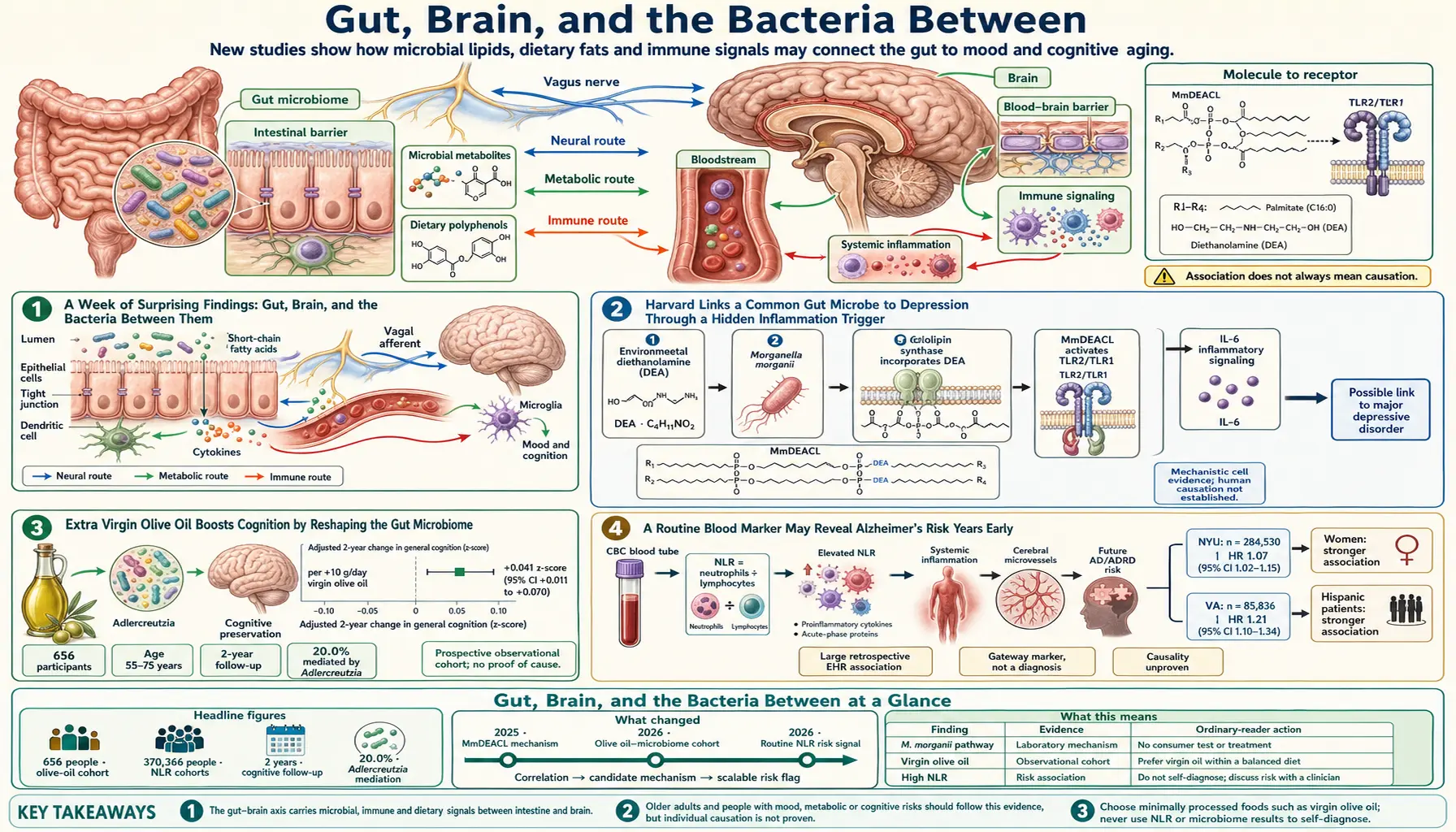
Read only the headlines, and the past seven days of research coverage look scattered: a Harvard paper on gut bacteria and depression, a two-year olive oil study out of Spain, a blood-count ratio and dementia risk, a 25-year research program on 80-year-olds with extraordinary memories, a metabolic biology paper on biotin and cancer cells, and a counterintuitive finding about fish oil and repeated head injury in mice. Some of the papers were published months earlier; the press coverage arrived this week. Read together, they tell a single story. Six independent research groups, working on six different questions, kept landing in the same place — the molecular conversation between the food we eat, the microbes that live with us, the immune signals our bodies generate, and the brains those signals reach.
Today’s edition pulls those six threads together. None of these findings, on its own, changes clinical practice. Taken as a set, they add to a growing research theme: that inputs such as food, the microbiome, sleep, social connection and micronutrient status are associated with chronic-disease and brain-aging outcomes. The federal policy version of this story was covered in the April 12 edition on the 2025–2030 Dietary Guidelines and the hospital nutrition mandate. Today’s edition is the laboratory complement.
Harvard Links a Common Gut Microbe to Depression Through a Hidden Inflammation Trigger
The most striking paper comes from a Harvard Medical School and Broad Institute team studying Morganella morganii, a bacterium known as an opportunistic pathogen that also lives in the human gut. The paper, published in the Journal of the American Chemical Society in January 2025, starts from a multifactorial association study that, in the authors’ words, detected a “probable causal connection” between the prevalence of M. morganii in the gut microbiome and the incidence of major depressive disorder. The new work asks the follow-up question: what, exactly, is the bacterium doing?
The answer, the researchers report, is chemistry. Using bioassay-guided fractionation, they isolated bacterial metabolites that trigger pro-inflammatory immune responses. The metabolites are unusual phospholipids that resemble cardiolipins, a normal membrane lipid, except that diethanolamine (DEA) — an industrially produced micropollutant — replaces the central glycerol. These chimeric molecules activate the TLR2/TLR1 immune receptors and induce pro-inflammatory cytokines, especially IL-6. The experiments were laboratory immune assays; the abstract reports no animal or human test of mood. The finding raises the possibility that the same gut microbe may behave differently depending on which environmental chemicals it has access to.
The finding offers a concrete molecular candidate for the “gut–brain inflammation” hypothesis of depression. It also places environmental toxin exposure in the picture as a possible co-factor — not the bacterium alone, not the chemical alone, but the combination of the two inside a single host. The authors write that the mechanism is supported by other studies and has implications for conditions other than depression. The paper does not test any treatment, diet or probiotic.
The paper does not establish that M. morganii causes most depression. What it does is identify a specific chemical interaction inside a specific bacterium that produces a specific inflammatory signal. Related background is covered on the probiotics, fermented foods, and bacteria reference pages.
Virgin Olive Oil Intake Linked to Better Cognitive Change and a More Diverse Gut Microbiome
A separate study, published in Microbiome in January 2026 by a team led from Universitat Rovira i Virgili in Spain, looked at the other direction: diet, microbes and cognitive health. It is a prospective cohort study — an observational analysis, not a randomized comparison of oils — of 656 participants in the PREDIMED-Plus trial, aged 55 to 75 (mean age 65.0, 47.9% women), all with overweight or obesity and metabolic syndrome and cognitively healthy at baseline. Participants gave stool samples and completed a food-frequency questionnaire at baseline and neuropsychological tests at baseline and after two years. In the authors’ multivariable models, higher consumption of virgin olive oil was associated with improved cognitive function over the two years and a more diverse gut microbiota at baseline. Higher consumption of common olive oil was linked to lower microbial alpha diversity and faster cognitive decline.
The distinction between olive oil types matters in this study. In the paper, “virgin olive oil” covers extra virgin and virgin grades, while “common olive oil” is described as mostly refined olive oil or olive–pomace oil with a minimal amount of virgin oil, and so a lower content of phytochemicals despite a similar fat profile. A mediation analysis suggested that the gut microbiota, and particularly the genus Adlercreutzia, may mediate part of the association between virgin olive oil and positive change in general cognitive function. The authors call for further high-quality and clinical cohort studies.
Because the design is observational, the study shows association, not cause. The abstract does not report a median daily amount of olive oil. Olive oil is also central to the Mediterranean diet studied in PREDIMED and follow-on research.
A Routine Blood Ratio Linked to Later Dementia Risk
The third paper, published in Alzheimer’s & Dementia in April 2026, used electronic health records from NYU Langone (284,530 patients) and the Veterans Health Administration (85,836 patients), 2011 to 2023. It asked whether the neutrophil-to-lymphocyte ratio (NLR) — calculated from the white-cell differential of a standard complete blood count (CBC) — at baseline was associated with later diagnoses of Alzheimer’s disease and related dementias, identified by diagnosis codes at least six months after baseline. Higher NLR was associated with higher risk in both systems (NYU hazard ratio 1.07, 95% CI 1.02–1.15; VA hazard ratio 1.21, 95% CI 1.10–1.34), after adjustment for demographic and clinical variables and with death treated as a competing risk.
Neutrophils are the body’s first-responder white blood cells. Their count is non-specific — an infection or a chronic inflammatory state can move it — so a single high reading is not a diagnosis. Spline analysis in the paper showed a continuous dose–response relationship, and subgroup analyses showed higher risk among female and Hispanic patients. The authors interpret the findings as highlighting the role of systemic inflammation and neutrophil-mediated pathways in neurodegeneration.
The ratio comes from a test that is already routine, which is why the finding drew attention. The paper reports an association in health records; it does not test whether NLR improves existing dementia risk scores, and it does not test any intervention to lower NLR or C-reactive protein (CRP).
Record-based cohort studies show association, not cause. A slightly elevated ratio in one person is not a prediction that the person will develop dementia; the hazard ratios describe risk across large populations.
SuperAgers: Why Some 80-Year-Olds Have the Memory of 50-Year-Olds
If the neutrophil paper sketches a risk pathway, the SuperAgers research sketches a protective one. The Northwestern University SuperAging Program, summarized in a 25-year review in Alzheimer’s & Dementia (2025), defines “superagers” as people aged 80 or older whose delayed word-recall scores are at least equal to those of people 20 to 30 years younger. The review notes that on one common word-list test, the average delayed recall score at age 80 (5 of 15) is about half that at ages 56 to 66 (9 of 15).
The program’s authors describe superagers as a distinct neurobiological phenotype as well as a cognitive one. Their cortical volumes do not differ from those of adults 20 to 30 years younger, and a region of the cingulate gyrus is thicker than in younger adults. At the cellular level, superagers have fewer Alzheimer’s-type changes, larger entorhinal neurons, fewer inflammatory microglia in white matter, better preserved cholinergic innervation, and a greater density of von Economo neurons. The authors write that post-mortem findings support both resistance to and resilience against the neuropathologic changes of aging.
An earlier study from the same program (PLoS One, 2017; 31 superagers and 19 cognitively average peers) found that superagers reported greater levels of positive relations with others on a psychological well-being questionnaire, while the groups did not differ on the other five well-being scales. The authors suggested this social feature could conceivably relate to the thicker anterior cingulate and higher density of von Economo neurons. The relationship is correlational, not proven causal. Related research on social isolation and sleep is covered elsewhere on the site.
The review’s authors write that deeper characterization of the superaging phenotype may one day lead to interventions that enhance resistance and resilience to brain aging; no such intervention has been tested yet.
Vitamin B7 Lets Cancer Cells Bypass Glutamine Addiction
Many cancer cells depend heavily on glutamine, an amino acid they use for energy and biosynthesis; the paper calls glutamine addiction “a hallmark of several cancers.” Glutaminase inhibitors have been studied as potential anticancer drugs. A University of Lausanne team, publishing in Molecular Cell in March 2026, asked how cells manage to grow when glutamine is limited, and found that cells can bypass glutamine dependence by a route that runs on vitamin B7.
Combining metabolic tracers, nutrient supplementation and a genome-wide CRISPR-Cas9 screen in cultured cells, the team reported that biotin (vitamin B7) lets cells bypass glutamine dependence by activating the enzyme pyruvate carboxylase. They also found that the tumor-suppressor gene FBXW7 maintains pyruvate carboxylase expression by preventing accumulation of c-MYC and a cluster of transcriptional repressors at the enzyme’s promoter, so that cells avoid glutamine addiction. The authors describe the work as highly relevant to FBXW7-associated cancer mutations.
This is preclinical, cell-based work. It does not test biotin intake, biotin-containing foods or B-complex vitamins in people with cancer, and it is not evidence that removing biotin from the diet treats cancer. Biotin deficiency in humans causes hair, skin and neurological symptoms. The value of the finding, as the paper frames it, is the pathway it identifies.
The paper sits inside a broader research conversation about individual vitamins as metabolic regulators rather than only deficiency-prevention nutrients. A separate prespecified ancillary study of the COSMOS randomized trial, published in Nature Medicine in March 2026 (958 participants, two years), reported that a daily multivitamin-multimineral modestly slowed the rate of increase of two second-generation epigenetic aging clocks compared with placebo, while cocoa extract had no effect on the five clocks tested. The authors write that the clinical relevance of these small effects still has to be determined.
A Fish Oil Caveat: EPA Linked to Impaired Brain-Vessel Repair After Repeated Mild Head Injuries in Mice
Not every supplement-and-brain story was positive. A team at the Medical University of South Carolina, with collaborators including the Boston University CTE Center, published in Cell Reports in March 2026 a study of repetitive mild traumatic brain injury, which precedes chronic traumatic encephalopathy (CTE). In a mouse fish-oil diet model, the omega-3 fatty acid EPA accumulated in the brain at baseline and was selectively depleted after repeated injury. That pattern coincided with matrix remodeling, endothelial degeneration and impaired neurovascular function. In metabolically adapted endothelial cells, EPA selectively impaired reparative function, and postmortem human CTE brain tissue showed parallel vascular and metabolic gene-expression changes.
The finding is counterintuitive because omega-3 fatty acids are, as the paper notes, widely promoted as neuroprotective. The authors write that their findings “challenge the assumption of uniform omega-3 neuroprotection after brain injury.” The study concerns injured brain tissue in an animal model; it does not address omega-3 intake for other purposes.
The paper does not test fish oil in people with concussion. What it reports is context dependence: in this mouse model, the same fatty acid was associated with different effects in injured and uninjured brain tissue.
Research on omega-3 intake from cold-water fish, walnuts, flax and supplements for cardiovascular and metabolic outcomes is a separate body of evidence that this paper does not examine.
What the Findings Show
None of the six papers tests a change in prescriptions, supplements or diet in the people it studied. Gathered by theme, the findings are as follows.
Gut and Brain
- In a cohort of 656 older Spanish adults with metabolic syndrome, higher virgin olive oil intake was associated with better two-year cognitive change, and higher common (mostly refined) olive oil intake with faster decline; the genus Adlercreutzia appeared as a possible mediator. The design is observational.
- Phospholipids made by Morganella morganii that incorporate the industrial micropollutant diethanolamine activated TLR2/TLR1 receptors and IL-6 production in laboratory assays.
Inflammation and Long-Term Brain Health
- A higher baseline neutrophil-to-lymphocyte ratio was associated with later Alzheimer’s and related dementia diagnoses in two large health-record cohorts, with higher risk among female and Hispanic patients. Inflammatory markers such as CRP were not the subject of the paper.
- Superagers aged 80+ show fewer Alzheimer’s-type brain changes, a thicker cingulate region, and more von Economo neurons; an earlier study from the program linked superaging with more positive social relationships. These findings are correlational.
Supplements
- The EPA finding comes from a mouse model of repeated mild head injury plus cell and postmortem tissue work; it was not a trial of fish oil in people with concussion. Decisions about supplements after a head injury belong with the clinician managing that injury.
- The biotin paper is cell-based work on how cells bypass glutamine dependence; it does not report biotin as a cancer treatment, and it did not test biotin intake in people.
- The COSMOS ancillary analysis reported small effects of a daily multivitamin on two epigenetic clocks over two years; its authors state that clinical relevance is still undetermined.
Key Research Papers
The primary papers behind the six stories, in story order, plus two background papers. Each entry was checked against its PubMed record and abstract.
- Bang S, Shin YH, Park SM, Deng L, Williamson RT, Graham DB, et al. (2025). Unusual Phospholipids from Morganella morganii Linked to Depression. Journal of the American Chemical Society 147(4):2998-3002. — PubMed PMID: 39818770
- Ni J, Nishi SK, Babio N, Belzer C, Vioque J, Corella D, et al. (2026). Total and different types of olive oil consumption, gut microbiota, and cognitive function changes in older adults. Microbiome 14(1):68. — PubMed PMID: 41578342
- He T, Betensky RA, Osorio RS, Swinnerton K, Zheng C, Jacobs T, et al. (2026). Neutrophil inflammation metrics are associated with the risk of future dementia in large data from NYU Langone Hospitals and the Veterans Health Administration. Alzheimer’s & Dementia 22(4):e71335. — PubMed PMID: 41930609
- Weintraub S, Gefen T, Geula C, Mesulam MM (2025). The first 25 years of the Northwestern University SuperAging Program. Alzheimer’s & Dementia 21(8):e70312. — PubMed PMID: 40772536
- Cook Maher A, Kielb S, Loyer E, Connelley M, Rademaker A, Mesulam MM, et al. (2017). Psychological well-being in elderly adults with extraordinary episodic memory. PLoS One 12(10):e0186413. — PubMed PMID: 29059208
- Lisci M, Vericel F, Liu Y, Gallart-Ayala H, Ivanisevic J, Skinner OS, Jourdain AA (2026). Functional nutrient-genetic profiling reveals biotin and FBXW7 are essential to bypass glutamine addiction. Molecular Cell 86(5):901-916.e10. — PubMed PMID: 41747732
- Li S, Hamaya R, Zhu H, Chen BH, Pereira AC, Ivey KL, et al. (2026). Effects of daily multivitamin-multimineral and cocoa extract supplementation on epigenetic aging clocks in the COSMOS randomized clinical trial. Nature Medicine 32(3):1012-1022. — PubMed PMID: 41803341
- Karakaya E, Berber B, Eskiocak O, Edwards J, Barker RB, Jamil S, et al. (2026). Eicosapentaenoic acid reprograms cerebrovascular metabolism and impairs repair after brain injury, with relevance to chronic traumatic encephalopathy. Cell Reports 117135. — PubMed PMID: 41887219
News Coverage
- Harvard scientists link gut bacteria to depression through hidden inflammation trigger — ScienceDaily summary of the Morganella morganii / diethanolamine LPS paper.
- Scientists say this type of olive oil could boost brain power — ScienceDaily summary of the two-year extra virgin olive oil and cognition trial.
- A simple blood test could reveal Alzheimer’s risk years early — ScienceDaily summary of the neutrophil and dementia cohort study.
- These 80-year-olds have the memory of 50-year-olds. Scientists now know why. — ScienceDaily summary of the SuperAgers cohort findings.
- This missing vitamin could stop cancer cells in their tracks — ScienceDaily summary of the biotin and cancer-cell metabolism paper.
- Fish oil may be hurting your brain, new study finds — ScienceDaily summary of the EPA and mild traumatic brain injury study.
- ScienceDaily — Health & Medicine — ongoing peer-reviewed press releases.
- ScienceDaily — Alternative Medicine — complementary medicine and natural products coverage.
PubMed Topic Searches
- PubMed: Morganella morganii and depression
- PubMed: Virgin olive oil, gut microbiota and cognition
- PubMed: Neutrophil-to-lymphocyte ratio and dementia
- PubMed: SuperAgers
Related Articles on MyHealthcare.com
- April 12, 2026 — The Week That Reshaped American Food & Health Policy
- Bacteria — Reference Index
- Depression
- Alzheimer’s Disease
- Dementia
- Cancer
- Vitamin B7 (Biotin)
- Inflammatory Markers (CRP, Neutrophils)
- Complete Blood Count (CBC)
- Omega-3 Fatty Acids
- Probiotics
- Fermented Foods
- Food & Nutrition
- Vitamins
- Lab Tests
Featured Videos