⚠ Evidence warning: Clinical trials or other evidence do not support the claim that holoTC is part of routine B12 assessment in the UK and much of Europe. This page keeps it as a report of what people, websites or other media say.
Active B12 (Holotranscobalamin) Testing
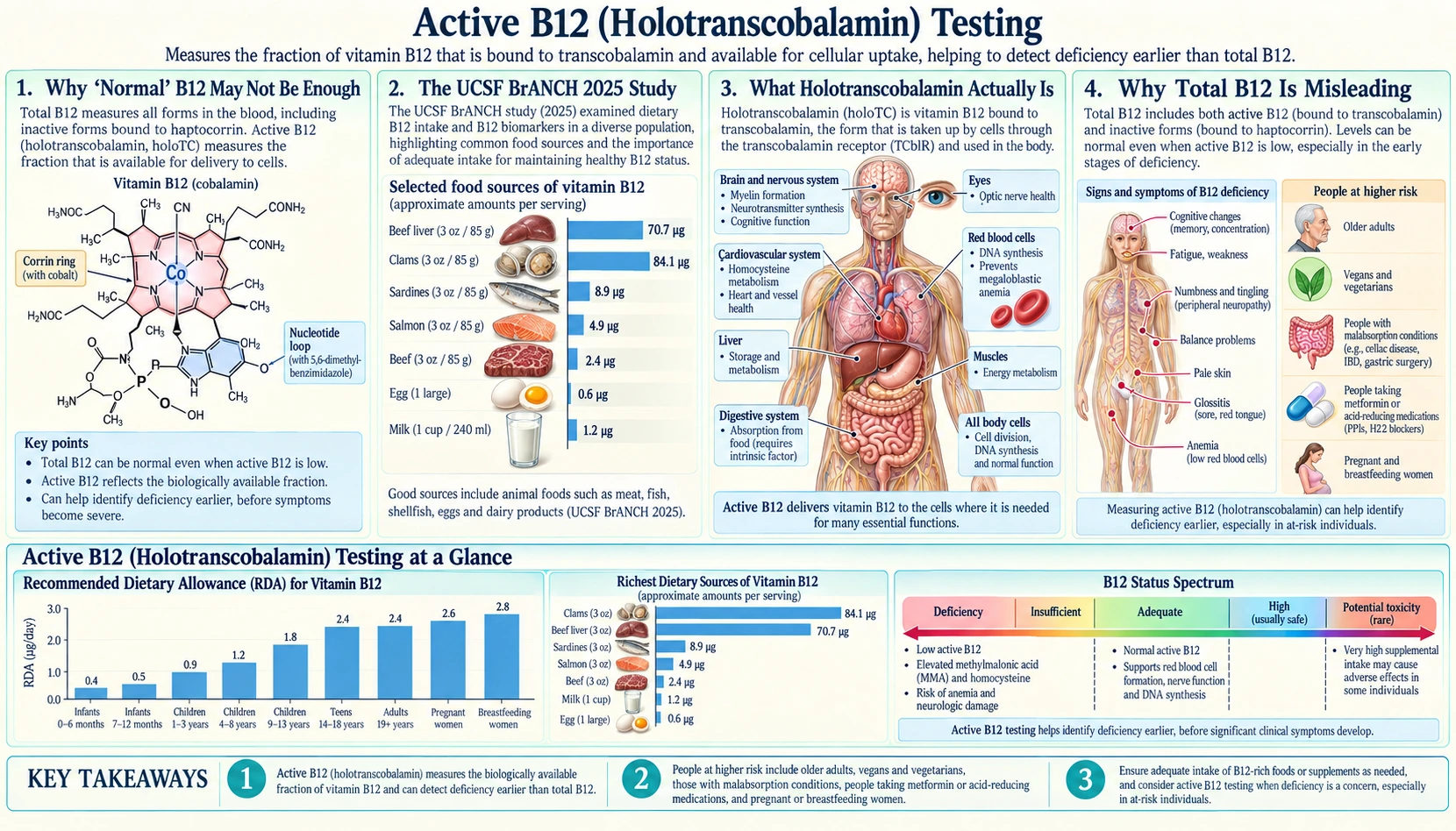
Table of Contents
- Why "Normal" B12 May Not Be Enough
- The UCSF BrANCH 2025 Study
- What Holotranscobalamin Actually Is
- Why Total B12 Is Misleading
- The Four-Tier B12 Panel
- Reference Ranges and Interpretation
- Who the Active B12 Test Tells the Most About
- Logistics: How to Order It, Cost, Reliability
- Treatment When holoTC Is Low
- Key Research Papers
- Featured Videos
Why "Normal" B12 May Not Be Enough
A standard B12 blood test can come back at 450 pmol/L, well inside the normal range, and be read as reassuring. That number can still give a false sense of security.
The standard serum B12 test measures total B12 in your blood — which sounds straightforward, but there is a catch. B12 travels in the bloodstream attached to two very different carrier proteins. One of them actually delivers B12 into your cells. The other does not. The routine test counts both together and cannot tell you which fraction you actually have.
This matters most for your brain, spinal cord, and peripheral nerves — all tissues that depend on a steady supply of usable B12 for myelin synthesis, DNA repair, and neurotransmitter metabolism. When the cell-deliverable fraction runs low, those tissues silently suffer even while your total B12 looks reassuringly normal on paper.
Shortage without symptoms is common. A 2017 expert review in Nature Reviews Disease Primers reports that subclinical (no-symptom) B12 deficiency affects between 2.5% and 26% of the general population, depending on the definition used, although its clinical relevance is unclear and the exact cut-offs for deficiency remain debated.
The test that measures only the cell-deliverable fraction is called the holotranscobalamin (holoTC) test — also marketed as the "Active B12" test. It is increasingly available through major commercial labs and has been available in Europe for over a decade. This article explains what it measures, who it tells the most about, and how low results are treated.
The UCSF BrANCH 2025 Study
A landmark paper published by researchers at the University of California, San Francisco in early 2025 put the active B12 question squarely on the clinical map for cognitive health.
The study, published in Annals of Neurology, was a one-time snapshot (a cross-sectional study) of 231 healthy older volunteers (median age 71.2) who had blood drawn for both total B12 and holotranscobalamin. Their median total B12 was 414.8 pmol/L — comfortably above the standard clinical cutoff of 148 pmol/L. By every conventional measure, these people were "B12-sufficient."
Despite that, lower B12 — especially lower active B12 (holoTC) — was linked to:
- Slower visual nerve signals (a delay in visual evoked potentials; p=0.023)
- Slower processing speed on neuropsychological testing, in an age-dependent manner (standardized β −2.39; p=0.006)
- More white-matter lesions on brain magnetic resonance imaging (MRI) (β −0.21; p=0.039), a marker of small-vessel cerebrovascular injury that correlates with future dementia risk
Low total B12 was linked to these changes too, but the link was strongest for low holoTC. The authors also found that a high level of the "inactive" fraction (holo-haptocorrin) went with higher blood levels of tau, a marker of nerve-cell damage (β 0.22; p=0.015), and they describe neurological changes "at both ends" of the measurable normal B12 range. The findings suggest that the brain is sensitive to the deliverable fraction of B12, and that the standard test misses a clinically meaningful window of insufficiency in older adults who appear normal by current criteria. Because each person was measured only once, the study cannot show that raising holoTC prevents these changes.
The study was covered in a UCSF news release titled "Healthy vitamin B12 levels may not be enough to ward off neurological decline" (February 2025). The authors wrote that the findings challenge current understanding of optimal serum B12 levels. It is a wake-up call for clinicians and patients alike: normal is not always normal.
What Holotranscobalamin Actually Is
To understand holoTC, you need to understand how B12 gets from your food into your cells — because the journey is surprisingly complicated.
After B12 is absorbed in the small intestine (with the help of intrinsic factor secreted by the stomach), it enters the bloodstream and immediately binds to carrier proteins. There are two:
- Transcobalamin II (TC II) — a transport protein that carries B12 to receptors on virtually every cell in the body. When B12 is bound to TC II, the resulting complex is called holotranscobalamin (holoTC). This is the biologically active fraction — the only form that can actually enter cells and be used.
- Haptocorrin (HC) — also called transcobalamin I or R-binder. Roughly 80% of circulating B12 is bound to haptocorrin. Cells do not have receptors for the haptocorrin-B12 complex. This fraction cannot enter cells and serves no known metabolic function. Its physiological role is poorly understood; it may act as a B12 reservoir or have roles in innate immunity. In the 2025 UCSF study, higher holo-haptocorrin went with higher blood tau, a marker of nerve-cell damage, so this fraction may not be neutral.
The upshot: only about 20% of the B12 in your blood is "active." The standard total B12 test measures all of it — 80% inert haptocorrin-bound B12 plus 20% active holoTC — blending them into a single number that can mask a genuine shortage of the deliverable fraction.
HoloTC is a small molecule that turns over rapidly. When B12 intake or absorption drops, holoTC falls first — often within days — while total B12 may remain in the normal range for months. This makes holoTC an earlier and more sensitive marker of depleting B12 status.
Why Total B12 Is Misleading
There are several physiological situations in which total B12 is elevated, normal, or borderline — yet the patient is functionally B12-deficient at the cellular level:
- Liver disease: The liver stores large amounts of B12 and releases it when damaged. Hepatitis, cirrhosis, and non-alcoholic fatty liver disease can release stored B12 into the bloodstream, raising total B12 while the metabolically active fraction is unchanged or even low.
- Myeloproliferative disorders: Conditions like polycythemia vera and chronic myelogenous leukemia cause marked overproduction of haptocorrin by myeloid cells, driving total B12 extremely high — sometimes into the thousands of pmol/L — while holoTC is not proportionally elevated.
- Medications: High-dose oral B12 supplements rapidly raise serum total B12 but the increase in holoTC may lag; someone recently started on supplements may test "normal" before cellular repletion is achieved.
- Normal aging: Gastric acid production declines with age. Atrophic gastritis (common after 60) impairs food-bound B12 absorption. Absorption of crystalline B12 from supplements is better preserved, but many older adults rely on food sources. HoloTC often falls before total B12 crosses below the standard cutoff.
- Genetic variants in TC II: Rare polymorphisms in the transcobalamin gene can reduce TC II levels, meaning less B12 is transported in the active fraction even when total B12 looks adequate.
The clinical consequence: a patient with total B12 of 300 pmol/L (technically "normal" by most lab ranges) could have holoTC of 30 pmol/L — below the deficiency threshold — and be developing subacute combined degeneration of the spinal cord while their chart notes say "B12 WNL."
The Four-Tier B12 Panel
No single B12 biomarker is perfect. The most complete picture comes from combining four complementary tests, each measuring a different step in the B12 supply chain:
- Total serum B12 — the standard screen. Catches severe deficiency. Misses functional deficiency when haptocorrin-bound B12 is disproportionately high. Still useful as the entry point.
- Holotranscobalamin (holoTC / Active B12) — measures the cell-deliverable fraction directly. Falls before total B12 crosses the lower limit. The best early marker of B12 depletion and the most logistically straightforward upgrade to the standard test.
- Methylmalonic acid (MMA) — a metabolite that accumulates when B12 inside cells is insufficient. B12 is required as a cofactor for the enzyme methylmalonyl-CoA mutase; when B12 is low, methylmalonic acid builds up in blood and urine. Methylmalonic acid is the most cell-specific functional marker of B12 deficiency — it tells you whether the B12 that is getting into cells is actually adequate for biochemistry. Elevated methylmalonic acid with normal or borderline holoTC strongly confirms intracellular deficiency.
- Homocysteine — another metabolite that rises when B12 (and/or folate) is insufficient. B12 is needed (along with folate and B6) to convert homocysteine to methionine. Elevated homocysteine raises cardiovascular and neurological risk independently. However, homocysteine is less specific for B12 deficiency than methylmalonic acid because it also rises with folate deficiency, renal impairment, and certain genetic polymorphisms (e.g., methylenetetrahydrofolate reductase, MTHFR).
In practice, the most useful upgrade from the standard test is adding holoTC + methylmalonic acid. Together, they give you both the supply (holoTC) and the functional consequence (methylmalonic acid). Homocysteine adds value when cardiovascular risk stratification is also desired.
Reference Ranges and Interpretation
Reference ranges vary somewhat by laboratory, but the following are widely used in clinical research and European clinical practice. The British Society for Haematology guideline (2014) states that there is no "gold standard" test for B12 deficiency, that definitive cut-off points are not possible because testing methods differ (it calls for local reference ranges), and that holoTC has potential as a first-line test but an indeterminate "grey area" may still exist — so the ranges below are a rough guide.
Holotranscobalamin (holoTC)
- Below 35 pmol/L: Likely deficient. Cellular B12 delivery is inadequate; metabolic consequences are probable.
- 35–50 pmol/L: Grey zone. Borderline; risk of functional deficiency rises especially with any additional stressor (illness, poor diet, malabsorption). Confirm with methylmalonic acid.
- 50–70 pmol/L: Low-normal. Adequate for most adults but worth monitoring in high-risk groups (elderly, vegans, proton pump inhibitor users).
- Above 70 pmol/L: Sufficient. No evidence of B12 supply limitation.
Methylmalonic Acid (MMA)
- Below 270 nmol/L (serum) or below 3.6 mmol/mol creatinine (urine): Normal.
- 270–750 nmol/L: Mildly elevated; consistent with subclinical intracellular B12 insufficiency.
- Above 750 nmol/L: Significantly elevated; commonly treated as B12 deficiency even if total B12 is normal.
- Note: methylmalonic acid is also elevated in renal impairment (creatinine is usually checked alongside methylmalonic acid) and in methylmalonic acidemia (a rare inborn error of metabolism).
Total Serum B12 (for context)
- Most labs use 148–221 pmol/L (200–300 pg/mL) as the lower cutoff, but many researchers argue this is too low and that values below 300 pmol/L warrant further evaluation in high-risk individuals.
How the pieces fit together
- Low holoTC + elevated methylmalonic acid: Read as confirmed intracellular B12 deficiency, which is usually treated.
- Low holoTC + normal methylmalonic acid: Read as early depletion before metabolic consequences; supplementation and a repeat test are the usual next steps.
- Normal holoTC + elevated methylmalonic acid: Rare; possible causes include renal impairment, methylmalonic acidemia, or a TC II variant.
- Normal holoTC + normal methylmalonic acid + normal total B12: B12 status is adequate.
Who the Active B12 Test Tells the Most About
HoloTC testing adds the most value when there is a reason to doubt that the standard total B12 is telling the whole story. Adding holoTC (often together with methylmalonic acid) is most informative in these groups:
- Vegans and strict vegetarians: No dietary B12 from animal products means the only source is supplements or fortified foods. Even with supplements, absorption varies. HoloTC is the earliest warning that intake or absorption is failing.
- Adults over 60: Gastric acid and intrinsic factor production decline with age. The UCSF BrANCH study enrolled adults with a median age of 71 and found nerve and brain changes linked to lower B12, especially lower holoTC, in people whose total B12 was within the normal range.
- Proton pump inhibitor users: Omeprazole, pantoprazole, esomeprazole, and related drugs suppress gastric acid for months or years in many patients. Gastric acid is needed to cleave B12 from food proteins. Long-term proton pump inhibitor use is associated with declining B12 stores.
- Metformin users: The most widely prescribed diabetes medication interferes with B12 absorption in the distal ileum by a calcium-dependent mechanism. Guidelines recommend B12 monitoring in long-term metformin users, and holoTC is a more sensitive marker than total B12.
- Gastric bypass or sleeve gastrectomy patients: The loss of stomach tissue dramatically reduces intrinsic factor production and gastric acid. Lifelong B12 monitoring is standard of care after bariatric surgery.
- Atrophic gastritis: Chronic inflammation that destroys acid-secreting parietal cells also destroys intrinsic-factor-secreting cells. Often asymptomatic for years before overt deficiency develops.
- Autoimmune pernicious anemia: Antibodies attack intrinsic factor or parietal cells, causing near-complete failure of B12 absorption from food. Requires lifelong injectable or high-dose oral B12. HoloTC helps monitor whether current therapy is achieving adequate cellular delivery.
- Anyone with unexplained neurological symptoms: Numbness, tingling, balance problems, cognitive slowing, or unexplained depression — especially when total B12 is in the normal-but-not-optimal range (148–300 pmol/L).
- Family history of pernicious anemia or B12 deficiency: Autoimmune pernicious anemia clusters in families; some practitioners use holoTC for early screening in these families.
Logistics: How to Order It, Cost, Reliability
Lab names and ordering
In the United States the active B12 test is offered by large commercial reference laboratories, listed under names such as "Holotranscobalamin (Active B12)," "Holotranscobalamin II" or "Active B12." Order codes vary by region, so it is usually ordered by name, and it can be added on to a standard metabolic or B-vitamin panel.
In the UK and much of Europe, holoTC is part of routine B12 assessment and is widely available through the UK National Health Service (NHS) and private labs.
In the UK, the British Society for Haematology guideline (2014) states that serum B12 remains the first-line test, with methylmalonic acid as a second-line test; it says holoTC has potential as a first-line test but an indeterminate "grey area" may still exist, and that the availability of second-line tests is limited. HoloTC is usually measured on an automated immunoassay analyser.
Self-pay cost
Without insurance, holoTC typically runs $30–$90 through direct-to-consumer lab services. Adding methylmalonic acid brings the self-pay total to roughly $60–$140, depending on the platform. Both tests are often covered by insurance when ordered by a physician for an appropriate indication (B12 deficiency workup, neurological symptoms, bariatric post-op monitoring).
Fasting requirements
Fasting is NOT required for holoTC or methylmalonic acid. You can eat and drink normally before the draw. This is a practical advantage over many metabolic panels.
Sample stability and timing
HoloTC is stable in serum for up to 48 hours at 4°C and can be frozen for longer storage. Samples do not need to be processed immediately, making the test reliable even at labs that batch-ship specimens. Methylmalonic acid samples are also stable at refrigerator temperature for 24–48 hours.
Results taken while on B12 supplements are still clinically meaningful, and stopping supplements before a test can cause harm in people who depend on them. Noting the supplement dose on the lab requisition helps whoever reads the result.
Reliability and assay variability
The automated immunoassay for holoTC is reported to have a coefficient of variation below 5% and good agreement across labs using the same platform. However, results from different lab platforms are not always directly comparable, so results tracked over time are most comparable when they come from the same lab. The methylmalonic acid assay by tandem mass spectrometry (LC-MS/MS) is highly accurate and widely standardized.
Treatment When holoTC Is Low
A low holoTC (below 35 pmol/L, or 35–50 pmol/L with elevated methylmalonic acid) is usually treated with B12 repletion. The route and dose depend on why the level is low.
When absorption is intact
If malabsorption is not the cause (dietary deficiency, increased demand), high-dose oral B12 is effective and convenient:
- Methylcobalamin or cyanocobalamin, 1000–2000 mcg daily. At these doses, about 1% is absorbed passively (without intrinsic factor), which is enough to correct most dietary deficiencies. Methylcobalamin is the neurologically active form preferred by many practitioners and patients.
- Sublingual methylcobalamin (dissolving under the tongue) has slightly better absorption kinetics than swallowed tablets in some studies, though the clinical difference is modest.
When absorption is impaired
Pernicious anemia, severe atrophic gastritis, or post-bariatric anatomy require bypassing gut absorption entirely:
- Intramuscular (IM) hydroxocobalamin or cyanocobalamin: 1000 mcg IM daily for 1 week, then weekly for 4 weeks, then monthly for life (UK BNF / NICE protocol). Hydroxocobalamin is preferred over cyanocobalamin in the UK because it has a longer half-life and is retained better.
- Intranasal cyanocobalamin is a U.S. Food and Drug Administration-approved alternative for maintenance in pernicious anemia, though compliance and absorption vary.
Monitoring after treatment
Follow-up testing of holoTC and methylmalonic acid is commonly done at 8–12 weeks after starting therapy. This timeframe allows for meaningful cellular repletion and metabolic normalization. Total B12 will rise quickly (often within 2–4 weeks) and is not the best endpoint. Normalization of methylmalonic acid confirms that cells are receiving adequate B12. HoloTC rising above 70 pmol/L confirms adequate delivery.
If methylmalonic acid remains elevated at 12 weeks despite high-dose oral supplementation, this points to ongoing malabsorption, and intramuscular therapy is the usual next step.
Neurological symptoms
The British Society for Haematology guideline (2014) states that when a test result does not match strong clinical features of deficiency, treatment should not be delayed, to avoid neurological impairment. People with neurological symptoms (numbness, balance issues, cognitive slowing) are often treated straight away, with follow-up labs to confirm. Neurological injury from B12 deficiency can be partially or fully reversible if caught early, but becomes permanent if prolonged. Earlier is always better.
Key Research Papers
- Beaudry-Richard A, Abdelhak A, Saloner R, et al. "Vitamin B12 Levels Association with Functional and Structural Biomarkers of Central Nervous System Injury in Older Adults." Annals of Neurology 2025; 97(6):1190–1204. The UCSF BrANCH cross-sectional study (n=231, median age 71.2): low B12, especially low holoTC, was linked to slower visual evoked potentials, slower processing speed and larger white-matter hyperintensity volumes; high holo-haptocorrin was linked to higher serum tau. — PubMed PMID: 39927551
- Hannibal L, Lysne V, Bjørke-Monsen AL, et al. "Biomarkers and Algorithms for the Diagnosis of Vitamin B12 Deficiency." Frontiers in Molecular Biosciences 2016; 3:27. Reviews the usefulness and limitations of total B12, holoTC, homocysteine and MMA, and the algorithms used to diagnose B12 deficiency. — PubMed PMID: 27446930
- Allen LH et al. "Biomarkers of nutrition for development (BOND): vitamin B-12 review." Journal of Nutrition 2018; 148(Suppl 4):1995S–2027S. Comprehensive evidence review of all B12 biomarkers across the lifespan; recommends holoTC plus MMA as the optimal assessment strategy. — PubMed PMID: 30500928
- Devalia V et al. "Guidelines for the diagnosis and treatment of cobalamin and folate disorders." British Journal of Haematology 2014; 166(4):496–513. UK national guidelines covering indications for holoTC testing, interpretation, and treatment protocols for pernicious anemia and other causes of B12 deficiency. — PubMed PMID: 24942828
- Carmel R. "Diagnosis and management of clinical and subclinical cobalamin deficiencies: why controversies persist in the age of sensitive metabolic testing." Biochimie 2013; 95(5):1047–1055. Discusses why subclinical deficiency remains underdiagnosed and how functional markers like MMA and holoTC change clinical decision-making. — PubMed PMID: 23416723
- Stabler SP. "Clinical practice. Vitamin B12 deficiency." New England Journal of Medicine 2013; 368(2):149–160. The definitive NEJM clinical practice review covering epidemiology, pathophysiology, diagnosis (including MMA and holoTC), and management of B12 deficiency across clinical settings. — PubMed PMID: 23301732
- Green R et al. "Vitamin B12 deficiency." Nature Reviews Disease Primers 2017; 3:17040. Authoritative primer on the full spectrum of B12 deficiency — from biochemistry to brain imaging — including a discussion of why standard serum B12 fails to capture subclinical deficiency and what better biomarkers look like. — PubMed PMID: 28660890
PubMed Topic Searches
Connections
- All Vitamins
- Methylmalonic Acid Test — the other early-deficiency marker, compared
- Vitamin B12’s Impossible Journey — interactive animation
- Vitamin B12 — Main Hub
- B12 and the Nervous System
- B12 Deficiency Diagnosis
- Lab Tests Index
- Postural Orthostatic Tachycardia Syndrome — Salt and Hydration Protocol
- Mast Cell Activation Syndrome — Natural Mast Cell Stabilizers
- EDS — gastrointestinal (GI) Involvement
- Taurine
- Minerals Index
- Fibromyalgia — Nutrient Gaps (Magnesium, D, B12)
- Neurology Diseases
- Natural Remedies
- Small Intestinal Bacterial Overgrowth (Gut Dysbiosis)
- Endocrinology Diseases
- May 28, 2026 News