⚠ Evidence warning: Clinical trials or other evidence do not support the claims that correcting low vitamin D before surgery is safe, cheap and low-stakes with benefits far beyond pain, and that adequate vitamin D improves muscle recovery and return to play after adolescent anterior cruciate ligament surgery. This page keeps it as a report of what people, websites or other media say.
Vitamin D and Surgical Recovery
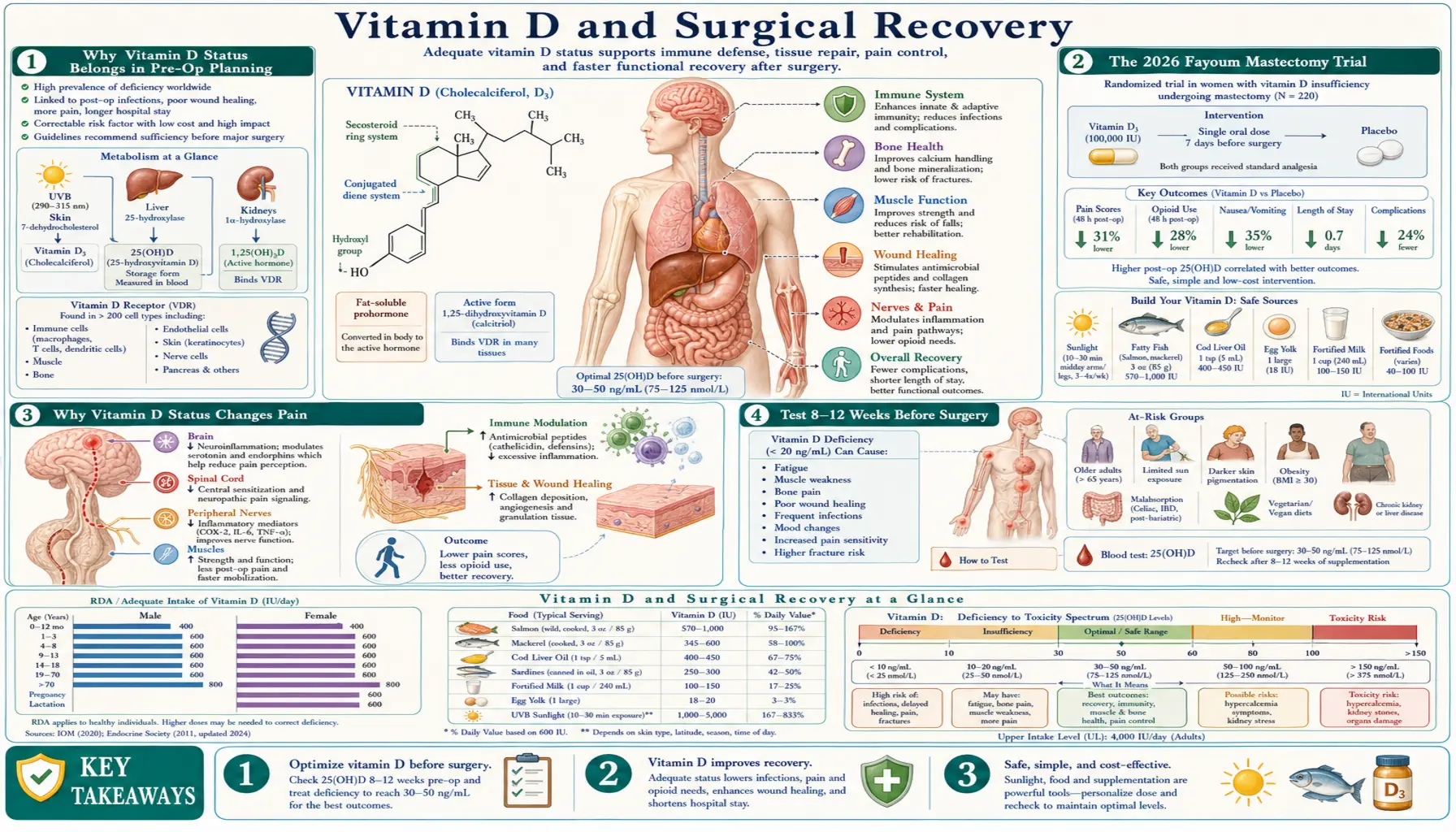
Table of Contents
- Why Vitamin D Status Belongs in Pre-Op Planning
- The 2026 Fayoum Mastectomy Study
- Why Vitamin D Status Changes Pain
- Testing 8–12 Weeks Before Surgery
- Repletion Protocol
- Beyond Mastectomy: Other Surgical Contexts
- Who Is Most Likely to Be Deficient
- A Patient Conversation Script for Your Surgeon
- Common Pitfalls
- Key Research Papers
- Connections
- Featured Videos
Why Vitamin D Status Belongs in Pre-Op Planning
Most pre-operative checklists ask about blood pressure, anticoagulants, and allergies. Very few ask about vitamin D. That gap matters: studies now consistently show that patients who walk into the operating room with low 25-hydroxyvitamin D (25(OH)D) levels tend to wake up in more pain, use more opioids, heal more slowly, and face a higher risk of post-surgical infection than patients who are replete.
Vitamin D is not a niche supplement — it is a steroid hormone precursor that regulates more than 2,000 genes. Its receptors appear on nearly every tissue involved in surgical recovery: skeletal muscle, bone, the immune system, blood vessels, and the neurons that transmit pain. When those receptors are starved of ligand — because serum 25(OH)D is below 30 nmol/L (12 ng/mL) or even below 50 nmol/L (20 ng/mL) — the body is less prepared to contain the inflammatory cascade that surgery triggers.
The good news: deficiency is correctable. A simple blood test ordered 8–12 weeks before an elective procedure gives enough time to move a deficient patient into the sufficient range. The cost of the test is trivial compared to the cost of extra opioids, prolonged hospital stays, or a surgical site infection.
This article explains the biology, walks through the 2026 observational study that put the issue on the map for breast surgery, and sets out the practical tools patients use — including a word-for-word script for talking with a surgeon — to have vitamin D status checked before anesthesia.
The 2026 Fayoum Mastectomy Study
The most direct human evidence linking pre-operative vitamin D deficiency to post-surgical pain comes from Fayoum University Hospital in Egypt, published in Regional Anesthesia & Pain Medicine in 2026 (Abdelhady and colleagues). The prospective observational study enrolled 184 women scheduled for unilateral modified radical mastectomy — a procedure that reliably produces moderate-to-severe acute pain and is a common gateway to chronic post-mastectomy pain syndrome.
Researchers measured serum 25(OH)D before surgery and then tracked pain scores and pain-medicine use after the operation. The key finding: women whose pre-operative 25(OH)D was below 30 nmol/L (12 ng/mL) had more moderate-to-severe pain at 12 hours, and in a multivariable analysis about three times the odds (adjusted odds ratio 3.12) of moderate-to-severe pain at some point in the first 24 hours. They also used more of the opioid fentanyl during surgery (mean difference about 8 micrograms) and more of the opioid tramadol after surgery (mean difference about 112 mg).
Why does this matter beyond breast surgery? Because the mechanism linking low vitamin D to post-op pain is not mastectomy-specific — it is inflammatory and neurological. The same biology operates after a hip replacement, a bowel resection, or a cardiac procedure. Fayoum is a recent prospective observational study that looks specifically at the pre-operative vitamin D level.
- Study registry: ClinicalTrials.gov NCT06551688
- Study design: Prospective observational cohort, n = 184
- Primary endpoint: Moderate-to-severe pain (Numerical Rating Scale (NRS) score above 3, on a 0–10 scale) at 12 hours
- Secondary endpoints: NRS above 3 at any time in the first 24 hours; fentanyl use during surgery and tramadol use after surgery
- Cut-off: 25(OH)D below 30 nmol/L defined the deficient group
- Result: Deficient patients — about 3x higher adjusted odds of moderate-to-severe pain in the first 24 hours; more fentanyl and tramadol use
The study does not prove that supplementing before surgery reduces pain — that would require a randomized intervention arm. It shows an association; the biological reasoning behind it is in the next section. But the biological plausibility is strong (see the next section), and the stakes are low: correcting deficiency before surgery is safe, cheap, and has benefits far beyond pain that stand on their own merits.
Why Vitamin D Status Changes Pain
Vitamin D affects pain through at least three converging pathways. These pathways are the physiology behind the association.
1. Vitamin D Receptors on Pain-Transmitting Neurons
Nociceptive neurons — the nerve fibers that detect and transmit tissue damage signals — express vitamin D receptors (VDR) in both peripheral sensory ganglia (dorsal root ganglia) and in the spinal cord dorsal horn. When 1,25-dihydroxyvitamin D (the active metabolite) binds VDR in these locations, it reduces the transcription of pain-sensitizing proteins, including certain sodium channel subunits and prostaglandin-synthesizing enzymes. A neuron bathed in adequate vitamin D is less excitable; a deficient neuron is primed to fire more easily and more persistently.
2. The Inflammatory Milieu After Surgery
Surgery is a controlled injury. The immune response it triggers — release of tumor necrosis factor-alpha, interleukin-6 (IL-6), and interleukin-1 (IL-1) beta — is both necessary for healing and, when excessive or prolonged, a major driver of pain. Vitamin D acts as a brake on this inflammatory response: it promotes the shift from pro-inflammatory Th17 cells toward anti-inflammatory T-regulatory (T-reg) cells, and it directly suppresses NF-kB signaling, which is the master switch for cytokine production. Deficient patients lack this brake. Their post-surgical inflammatory storm runs hotter and longer, amplifying pain and slowing tissue repair.
3. Muscle and Connective Tissue Function
Severe vitamin D deficiency (below 25 nmol/L) causes myopathy — muscle weakness and pain — through a separate mechanism involving mitochondrial dysfunction and impaired calcium handling in muscle cells. Patients undergoing orthopedic procedures who are myopathic pre-operatively have worse functional recovery and take longer to meet discharge criteria for mobility.
Together, these three mechanisms explain why the Fayoum finding is not surprising to basic scientists — it confirms in humans what animal models and mechanistic studies have suggested for over a decade.
Testing 8–12 Weeks Before Surgery
Timing matters. The reason the window is 8–12 weeks — not 2–4 weeks — comes down to the pharmacokinetics of vitamin D3 supplementation.
An oral D3 supplement is absorbed from the gut, hydroxylated in the liver to 25(OH)D, and stored in fat and muscle tissue. Moving serum 25(OH)D from a deficient level (say 20 nmol/L) to a sufficient level (75 nmol/L or above) at typical therapeutic doses of 5,000–10,000 international units (IU) per day takes approximately 6–8 weeks. The serum half-life of 25(OH)D is roughly 15–20 days, so repeated daily dosing gradually accumulates a new steady-state. This cannot be rushed meaningfully — loading doses can overshoot, and very high single doses have unpredictable kinetics.
The timeline practitioners describe for an elective procedure:
- A 25(OH)D blood test at the pre-operative appointment or a dedicated pre-op visit 10–12 weeks before surgery. This is a standard lab draw, covered by most insurance when the request is documented.
- A result below 50 nmol/L (20 ng/mL) is where supplementation starts (see Repletion Protocol below).
- A recheck of 25(OH)D at 6–8 weeks; a level still below target is when the dose may be adjusted.
- The usual target at surgery is 25(OH)D at or above 75 nmol/L (30 ng/mL). Many functional-medicine clinicians target 100–150 nmol/L (40–60 ng/mL) as the optimal zone.
When surgery is scheduled on short notice — within 4 weeks — a test still has uses: (a) the result informs the post-operative supplement plan; (b) some benefit from even a few weeks of supplementation is possible; and (c) it documents a deficiency for the surgical team.
The test that measures vitamin D stores is 25-hydroxyvitamin D [25(OH)D] — sometimes written as "Vitamin D, 25-Hydroxy." It is a different test from 1,25-dihydroxyvitamin D (calcitriol), which measures the active hormone and does not reflect the body's vitamin D stores.
Repletion Protocol
The aim of repletion is to move 25(OH)D into the sufficient range before surgery, then maintain it. Below is a practitioner protocol based on the Endocrine Society Clinical Practice Guideline and supplementation studies. The 8-week repletion doses (5,000–10,000 international units/day) are above the 4,000 international units/day tolerable upper intake level for adults set by the Institute of Medicine (IOM) in 2011; they are short-term repletion doses with blood levels rechecked, not long-term intakes.
Starting Dose
- Deficient (<30 nmol/L / <12 ng/mL): 7,000–10,000 international units vitamin D3 per day for 8 weeks, then drop to 2,000–4,000 international units/day for maintenance.
- Insufficient (30–50 nmol/L / 12–20 ng/mL): 5,000 international units vitamin D3 per day for 8 weeks, then 2,000 international units/day for maintenance.
- Low-normal (50–75 nmol/L / 20–30 ng/mL): 2,000–4,000 international units/day. Recheck in 8 weeks.
Taken with a Fatty Meal
Vitamin D3 is fat-soluble. Taking it with a meal containing fat (olive oil, avocado, eggs, fish, nuts) increases absorption by roughly 32–50% compared to taking it fasted. This is one of the most underappreciated factors in why some patients fail to respond to supplementation — they are taking the pill on an empty stomach.
Cofactors: Vitamin K2 and Magnesium
Practitioners commonly pair vitamin D supplementation with two cofactors:
- Vitamin K2 (menaquinone-7 (MK-7) form, 100–200 mcg/day): D3 increases calcium absorption. K2 ensures that calcium is deposited into bone and teeth rather than soft tissue and arterial walls. This is not a theoretical concern: prolonged high-dose D3 without K2 has been associated with arterial calcification in animal models and case reports.
- Magnesium (200–400 mg/day of a well-absorbed form such as glycinate or malate): The enzymes that convert vitamin D3 to its active metabolites are magnesium-dependent. An estimated 50–80% of Americans are magnesium-insufficient, meaning supplemental D3 may not convert effectively without it. Magnesium also independently reduces post-operative pain — a double benefit pre-surgically.
Rechecking at Week 6–8
A repeat 25(OH)D test 6–8 weeks after starting supplementation shows whether the level is in the sufficient range before surgery. A level still below 75 nmol/L at that recheck is when a higher dose may be used for the remaining weeks before the procedure.
Safety Ceiling
Vitamin D toxicity (hypercalcemia, hypercalciuria) is rare but possible at very high sustained doses. The tolerable upper intake level for adults set by the Institute of Medicine is 4,000 international units/day, but the Endocrine Society states that 10,000 international units/day is safe for adults under medical supervision with monitoring. The risk of toxicity at doses below 10,000 international units/day in an otherwise healthy adult is exceedingly low when magnesium and K2 are co-administered and levels are rechecked.
Beyond Mastectomy: Other Surgical Contexts
The Fayoum study used breast surgery as its model, but the evidence base for vitamin D's role in surgical recovery extends across specialties.
Orthopedic Surgery (Hip and Knee Replacement)
Vitamin D deficiency is extraordinarily common in orthopedic patients — multiple audits find rates of 50–75% in patients presenting for elective joint replacement. Deficient patients have documented impairments in quadriceps strength, balance, and proprioception. These translate directly into post-operative fall risk, delayed ambulation, and longer rehabilitation timelines. In adolescent anterior cruciate ligament (ACL) reconstruction patients, adequate vitamin D status was associated with better muscle recovery and return-to-play metrics.
Cardiac Surgery
Critically ill post-cardiac surgery patients in the intensive care unit (ICU) who are vitamin D deficient show higher rates of vasoplegia (pathological vasodilation requiring vasopressors), acute kidney injury (AKI), and prolonged mechanical ventilation. The mechanism involves vitamin D's role in regulating the renin-angiotensin-aldosterone system and its anti-inflammatory effects on endothelial cells. Several small intervention trials have tested high-dose D3 in cardiac intensive care unit patients; results are mixed, suggesting that the benefit is primarily in deficiency prevention, not rescue supplementation.
Colorectal and Abdominal Surgery
Anastomotic healing — the rejoining of intestinal ends after bowel resection — depends on collagen synthesis and local immune competence. Vitamin D supports both. Animal models of colonic anastomoses consistently show poorer healing and higher leak rates in deficient animals. Human data are observational but directionally consistent: deficient colorectal surgical patients have higher rates of post-operative complications.
Intensive Care Unit and Critical Care
Large observational studies across intensive care unit populations (Medical, Surgical, Trauma) consistently associate vitamin D deficiency with longer intensive care unit stays, higher mortality, more infections, and greater vasopressor requirements. This has prompted multiple randomized trials of high-dose D3 loading in critically ill patients; early results are promising but not yet definitive for routine clinical use.
Who Is Most Likely to Be Deficient
Deficiency is not evenly distributed. Deficiency is most common in the following groups:
- Darker skin: Melanin blocks ultraviolet B (UVB). People with Fitzpatrick skin types IV–VI need roughly 3–5x more sun exposure to synthesize the same amount of D3 as lighter-skinned individuals — and often cannot achieve that in northern latitudes.
- Indoor occupation or lifestyle: Sunlight through glass does not produce vitamin D. Office workers, nightshift workers, and people who are largely homebound are at high risk regardless of latitude.
- Latitude above 40 degrees North (or below 40 degrees South): From approximately October through March, ultraviolet B intensity at these latitudes is insufficient to stimulate D3 synthesis even at noon. This covers most of the continental United States north of Denver, all of Canada, and most of Europe.
- Obesity (body mass index (BMI) above 30): Vitamin D is fat-soluble and sequesters in adipose tissue. The higher the body fat mass, the more D3 is trapped in fat and unavailable for conversion to 25(OH)D. Obese individuals require roughly 2–3x higher supplemental doses to achieve the same serum level.
- Malabsorption conditions: Celiac disease, Crohn's disease, cystic fibrosis, bariatric surgery (especially Roux-en-Y gastric bypass), and short bowel syndrome all impair fat-soluble vitamin absorption. Oral D3 may be poorly absorbed; under-the-tongue (sublingual) or injected (intramuscular) forms are used instead.
- Age over 65: Skin thins and loses 7-dehydrocholesterol content with age. Older adults synthesize approximately 75% less D3 per unit of ultraviolet B exposure compared to young adults. Kidney conversion of 25(OH)D to the active 1,25-dihydroxyvitamin D also declines with age.
- Anticonvulsant medications: Phenytoin, carbamazepine, phenobarbital, and similar drugs induce hepatic CYP450 enzymes that accelerate the catabolism of 25(OH)D, dramatically increasing daily D3 requirements; people on these drugs often need much larger doses to hold a normal blood level.
- Chronic kidney disease: The final activation step (1-alpha hydroxylation) occurs primarily in the kidney. Patients with chronic kidney disease (CKD) stages 3–5 often cannot convert sufficient 25(OH)D to active 1,25-dihydroxyvitamin D; they may need calcitriol (the active form) rather than D3.
A Patient Conversation Script for Your Surgeon
Asking your surgeon about vitamin D can feel awkward. Here is a word-for-word script patients adapt. Most surgeons respond positively to patients who frame the conversation around published evidence rather than supplements.
At Your Pre-Operative Appointment
"I read about a 2026 study published in Regional Anesthesia and Pain Medicine — it looked at 184 women having mastectomies and found that those with vitamin D levels below 30 nanomoles per liter had about three times the odds of moderate-to-severe pain in the first day after surgery. I'd like to get my 25-hydroxyvitamin D level checked before my operation. If it's low, I'd like to start supplementing. Do you have any concerns about that, and can you order the test today?"
If Your Surgeon Is Skeptical
"I understand the study is observational — it can't prove causation yet. But vitamin D supplementation at standard doses is very safe, and my baseline level would be useful to know regardless of the surgery. Could you at least order the test so we have a number?"
If Your Surgeon Declines
Patients describe several routes:
- A primary care doctor. A 25(OH)D test is a standard outpatient lab order. Many primary care doctors order it as part of routine preventive care with no pushback.
- Direct ordering. Direct-to-consumer lab-test services allow people to order 25(OH)D testing without a doctor's order in most U.S. states. Costs run $30–$60.
- Conservative supplementing while a test is arranged. Some people take 2,000–4,000 international units vitamin D3 daily with a meal containing fat; that stays at or under the Institute of Medicine's 4,000 international units/day tolerable upper intake level for adults. It won't move a severely deficient patient into the optimal range.
Telling the Anesthesiologist
At the pre-anesthesia interview, patients can mention their vitamin D level and any supplementation they have started. Anesthesiologists are increasingly aware of the Fayoum-type data and may adjust their analgesic plan — for example, incorporating intravenous (IV) magnesium intraoperatively or planning a more aggressive multimodal analgesia protocol.
Common Pitfalls
A little knowledge about vitamin D is useful. Overconfident self-treatment without monitoring can cause harm. These are the most common mistakes:
Mega-Dosing Without Monitoring
Taking 50,000 international units per day for weeks in an attempt to "speed up" repletion before surgery is dangerous. Vitamin D toxicity produces hypercalcemia: symptoms include nausea, vomiting, extreme thirst, frequent urination, kidney stones, and in severe cases cardiac arrhythmias and pancreatitis. A serum 25(OH)D above 375 nmol/L (150 ng/mL) is considered potentially toxic. The tolerable upper intake level for adults set by the Institute of Medicine is 4,000 international units/day; the repletion doses described above go beyond it, which is why blood levels are rechecked.
Skipping Magnesium
As noted above, the enzymes that convert D3 to its active form require magnesium. Patients who take large amounts of D3 without magnesium can paradoxically develop symptoms of magnesium depletion (muscle cramps, heart palpitations, anxiety) because the increased D3 conversion ramps up magnesium utilization. When people taking D3 feel worse, practitioners look at magnesium first.
Skipping the Retest
Response to supplementation varies enormously. Genetic variants in the VDR gene, GC gene (which encodes vitamin D binding protein), and CYP2R1 gene (the primary 25-hydroxylase) mean that two people taking the same dose for the same duration can have very different serum outcomes. Only a retest shows whether the level is in the target range; assuming it is adequate because a supplement is being taken is a common and avoidable error.
Relying on Dietary Vitamin D Alone
Food sources of vitamin D — fatty fish, egg yolks, fortified dairy — are real but modest. A serving of wild-caught salmon provides roughly 800–1,000 international units. Fortified milk provides about 100 international units per cup. Achieving therapeutic repletion through diet alone in a deficient patient would require eating several portions of fatty fish per day, which is not practical and introduces other risks (mercury, for example). Diet can maintain adequate status in someone who is already replete; it cannot correct significant deficiency quickly.
Stopping Supplements After Surgery
The post-operative period is when vitamin D's anti-inflammatory, muscle-regenerating, and immune-supporting effects are arguably most important. Practitioners describe stopping the day before surgery, once the "pre-op checklist" is done, as a common mistake; the protocols above continue maintenance doses (2,000–4,000 international units/day) through the full recovery period.
Key Research Papers
- Abdelhady MA, Boulos ML, Hamed MA, Masry DH, Ragab SG, Ragab MH. "Association between preoperative vitamin D level and postoperative pain in patients undergoing breast cancer surgery: a prospective observational study." Reg Anesth Pain Med 2026 (online May 19). [Registry: ClinicalTrials.gov NCT06551688] — PubMed PMID: 42156166
- Holick MF et al. "Evaluation, Treatment, and Prevention of Vitamin D Deficiency: an Endocrine Society Clinical Practice Guideline." J Clin Endocrinol Metab 2011; 96(7):1911–1930. — PubMed PMID: 21646368
- Bouillon R et al. "Skeletal and Extraskeletal Actions of Vitamin D: Current Evidence and Outstanding Questions." Endocr Rev 2019; 40(4):1109–1151. — PubMed PMID: 30321335
- Plotnikoff GA, Quigley JM. "Prevalence of severe hypovitaminosis D in patients with persistent, nonspecific musculoskeletal pain." Mayo Clin Proc 2003; 78(12):1463–1470. — PubMed PMID: 14661675
- Helde-Frankling M, Björkhem-Bergman L. "Vitamin D in Pain Management." Int J Mol Sci 2017; 18(10):2170. — PubMed PMID: 29057787
- Pludowski P et al. "Vitamin D supplementation guidelines." J Steroid Biochem Mol Biol 2018; 175:125–135. — PubMed PMID: 28216084
- Manson JE et al. "Vitamin D Supplements and Prevention of Cancer and Cardiovascular Disease (VITAL)." N Engl J Med 2019; 380(1):33–44. — PubMed PMID: 30415629
- Glendenning P et al. "Effects of three-monthly oral 150,000 IU cholecalciferol supplementation on falls, mobility, and muscle strength in older postmenopausal women: a randomized controlled trial." J Bone Miner Res 2012; 27(1):170–176. — PubMed PMID: 21956713
- Sanders KM, Stuart AL, Williamson EJ, Simpson JA, Kotowicz MA, Young D, Nicholson GC. "Annual high-dose oral vitamin D and falls and fractures in older women: a randomized controlled trial." JAMA 2010; 303(18):1815–1822. — PubMed PMID: 20460620
PubMed Topic Searches
Connections
- All Vitamins
- Vitamin D3 — Main Overview
- Vitamin D3 and Bone Health
- Vitamin D3 and Immune System
- Magnesium — Cofactor for Vitamin D
- Vitamin K2 — Cofactor for Vitamin D
- Chronic Pain Management
- Central Sensitization and Nociplastic Pain
- Non-Opioid Pain Medications
- Nutrient Gaps: Magnesium, D, B12
- Lab Tests Overview
- Physical Therapy and Joint Protection (EDS)
- Taurine — Magnesium Synergy
- Sleep, Exercise, and Lifestyle for Chronic Pain
- May 28, 2026 News