Zinc: History and Discovery
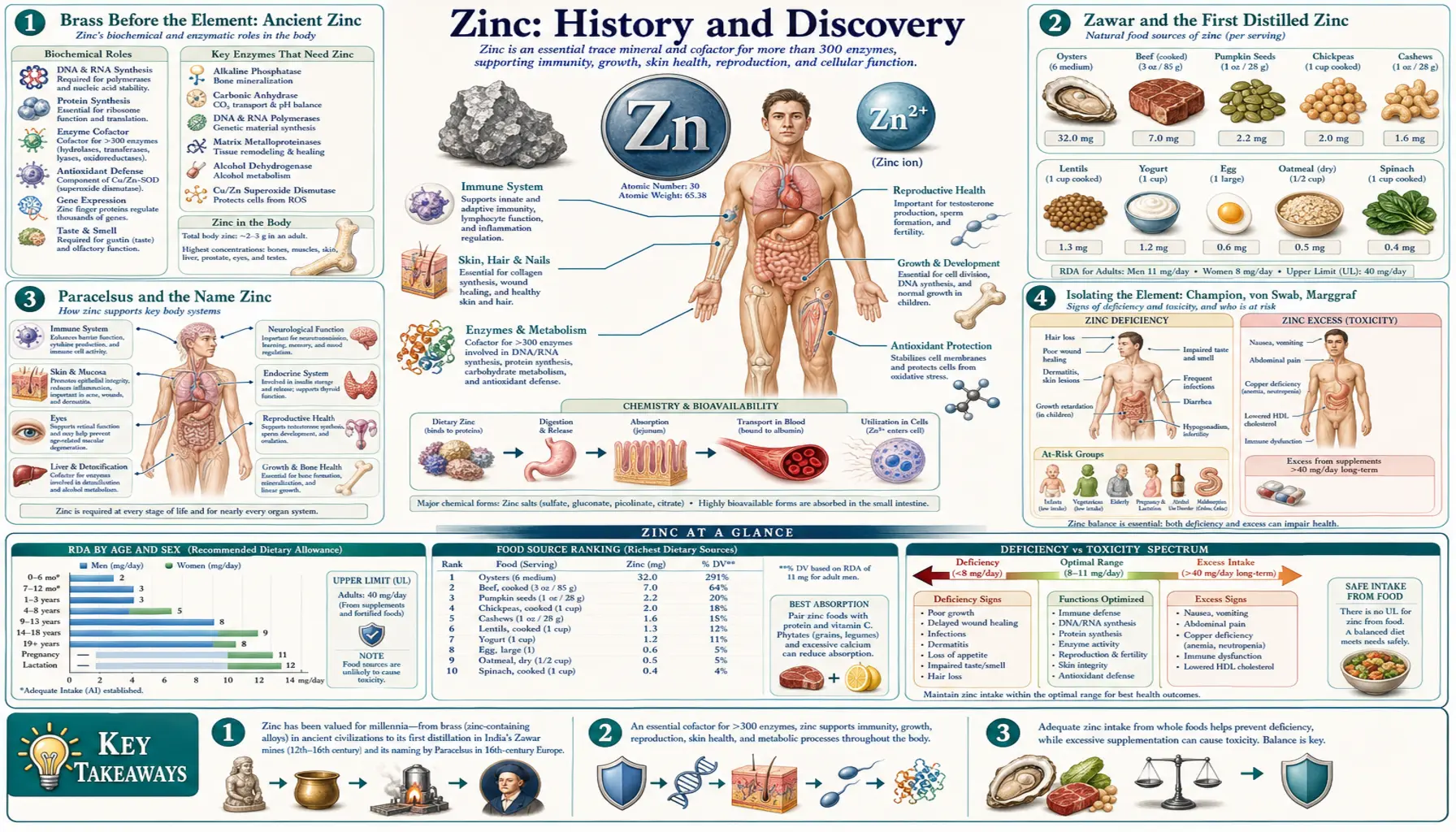
Zinc has one of the most unusual histories of any element in the human body, because it was useful to people for thousands of years before anyone knew it existed. Ancient metalworkers were alloying zinc ores into brass long before chemistry had a word for the metal, and craftsmen in India were distilling nearly pure zinc centuries before Europe managed the same feat. The element itself was finally isolated and described in the West in the eighteenth century. Yet the discovery that mattered most for health came much later still: not until 1961 did a physician named Ananda Prasad show that a lack of zinc in the diet could leave human beings stunted and sexually immature — a finding that turned a metallurgical curiosity into one of the most important trace nutrients known. This article tells both stories, the chemistry and the biology, and is careful to mark where the record is firm and where it is debated.
Table of Contents
- Brass Before the Element: Ancient Zinc
- Zawar and the First Distilled Zinc
- Paracelsus and the Name "Zinc"
- Isolating the Element: Champion, von Swab, Marggraf
- The First Zinc Enzyme (1940)
- Ananda Prasad and Human Zinc Deficiency (1961)
- Acrodermatitis Enteropathica: A Lethal Clue (1973–1974)
- From Discovery to Essential Nutrient
- Research Papers and References
- Connections
- Featured Videos
Brass Before the Element: Ancient Zinc
Zinc is one of a small group of metals that were used in everyday objects long before anyone recognized them as distinct elements — and that gap, between use and discovery, is the most striking thing about its early history. The reason is brass. Brass is an alloy of copper and zinc, and ancient smiths could make it without ever isolating zinc itself, simply by heating copper together with zinc-bearing ores such as calamine. Brass objects survive from deep antiquity: analyses of ancient artefacts from the Near East have found brass containing more than twenty percent zinc dating to well over two thousand years ago. The metal was, in effect, hiding inside a familiar yellow alloy.
This is why it is misleading to credit any single ancient people with "discovering" zinc. What ancient cultures across the Mediterranean, the Near East, and Asia possessed was the practical knowledge to make brass — not the chemical concept of zinc as one of the elements. The recognition that brass owed its colour and properties to a hidden metal, and that this metal could be obtained on its own, came much later. The honest summary is that zinc's usefulness is ancient, but its identity as an element is a story of the early modern period.
Zawar and the First Distilled Zinc
The crucial technical breakthrough — producing metallic zinc on its own, rather than as part of brass — belongs to the Indian subcontinent. Zinc is awkward to smelt because it boils at a relatively low temperature (about 907 °C), well below the heat needed to free it from its ore; left in an open furnace, the metal simply vaporizes and burns away. The solution was distillation: heating the ore in a sealed clay retort and condensing the zinc vapour into liquid metal in a cooler chamber. This is genuinely difficult, and India appears to have mastered it first.
The key site is Zawar, in the Aravalli hills of Rajasthan, widely described by archaeologists and metallurgists as the world's oldest known centre of large-scale zinc smelting and distillation. The dating of the earliest activity at Zawar is given differently by different sources — some accounts of mining and metalwork at the site reach back many centuries BCE, while the well-documented industrial-scale distillation of nearly pure zinc is generally placed in roughly the early-to-mid second millennium CE (often cited from around the 9th century CE onward, with the great retort-furnace operations flourishing later). Because these figures genuinely vary in the literature, this page treats Zawar as the earliest documented home of zinc distillation without fixing a single precise start date. What is not in doubt is the priority: the controlled distillation of metallic zinc was achieved in India well before it was reproduced in Europe, and Indian zinc was traded widely.
Paracelsus and the Name "Zinc"
The modern name of the metal is usually traced to the Swiss-born physician and alchemist Paracelsus (Theophrastus von Hohenheim, 1493–1541), who in the sixteenth century referred to the metal as zincum (also written zinken) in his writings on minerals. Paracelsus is often described as the first European to state clearly that this was a new metal in its own right, distinct from the familiar metals of antiquity — an important conceptual step even though he did not isolate it in any modern sense.
The origin of the word itself is not certain. The most commonly cited explanation is that it derives from the German Zinke, meaning a tooth, point, or prong, a reference to the sharp, needle-like crystals that metallic zinc forms when it cools. Other derivations have been proposed, and reference works present the etymology as probable rather than settled. This page follows that cautious view: the "tooth-like crystal" explanation is the usual one, but it is reported as the leading interpretation, not as proven fact.
Isolating the Element: Champion, von Swab, Marggraf
Europe's rediscovery of zinc as a separable metal unfolded over a few decades of the eighteenth century, and it involves more than one name — which is why credit for the "discovery" is partly a matter of definition. Three figures stand out, and it is fairest to present them together rather than crown a single winner.
In Britain, William Champion (1709–1789) patented a commercial process to extract zinc from calamine in a vertical retort smelter in 1738, and an industrial zinc works was established at Bristol shortly afterwards. In Sweden, the chemist Anton von Swab (1703–1768) is recorded as having distilled zinc from calamine around 1742, a few years before the work for which the element's discovery is most often credited. That credit conventionally goes to the German chemist Andreas Sigismund Marggraf (1709–1782), who in 1746 produced metallic zinc by heating a mixture of calamine and charcoal in a closed vessel, deliberately excluding copper so that no brass could form.
Why is Marggraf so often called the discoverer when others isolated the metal earlier? The usual answer is the quality of his description. Marggraf documented the process and the resulting metal in unusually careful, reproducible detail, establishing on a clear scientific basis that zinc was a distinct metal obtainable from its ore. In the history of chemistry, careful public description often counts for as much as priority of action. This page therefore credits Marggraf with the definitive scientific identification of zinc in 1746, while naming Champion and von Swab as genuine and earlier contributors to its isolation — a shared story, not a solo one. The metal is denoted in chemistry by the symbol Zn and sits at atomic number 30.
The First Zinc Enzyme (1940)
For nearly two centuries after Marggraf, zinc was a metal of industry and metallurgy — useful for brass, for protecting iron from rust (galvanizing), and for early batteries — but it had no recognized place in living things. The bridge from chemistry to biology was built in 1940, when the Cambridge biochemists David Keilin and Thaddeus Mann showed that the enzyme carbonic anhydrase — the protein that helps blood carry carbon dioxide — contained zinc at its active site and required that zinc to work. Carbonic anhydrase thus became the first known zinc metalloenzyme.
This was a pivotal moment, because it proved that zinc was not merely tolerated by the body but was chemically essential to a vital enzyme. It opened the question that the rest of this history answers: if living tissue needs zinc to run even one indispensable enzyme, what happens to a person who does not get enough? The number of known zinc-dependent proteins has since grown enormously — the body uses zinc in hundreds of enzymes and in thousands of "zinc-finger" gene-regulating proteins — but in 1940 carbonic anhydrase stood alone as the first proof of principle.
Ananda Prasad and Human Zinc Deficiency (1961)
The discovery that defines zinc's importance to health was made by the physician Ananda S. Prasad. Working in Iran in the late 1950s — he first encountered the puzzle around 1958 at the request of the physician James A. Halsted — Prasad examined young men with a baffling cluster of problems: severe stunting (some grown men looked like children of about ten), failure to mature sexually, anaemia, an enlarged liver and spleen, and a habit of eating clay (geophagia). Their diet was dominated by unleavened bread, with very little meat.
The conventional explanation was iron-deficiency anaemia, but Prasad noticed something that did not fit: iron deficiency on its own does not stunt growth or arrest puberty. Reasoning that another essential metal must be missing, he proposed zinc. In 1961 he and his colleagues published the landmark paper — Prasad AS, Halsted JA, Nadimi M, "Syndrome of iron deficiency anemia, hepatosplenomegaly, hypogonadism, dwarfism and geophagia," in the American Journal of Medicine — which raised, for the first time, the possibility that human zinc deficiency could account for this dwarfing syndrome.
Prasad then moved to a US naval research unit in Cairo, Egypt, joining a nutrition group led by William J. Darby, and studied similar patients drawn from villages of the Nile delta. There the case was strengthened into proof: the patients were shown to be zinc-deficient, and — decisively — treating them with zinc produced what diet and iron alone could not. Young men given zinc grew markedly taller and at last went through puberty, developing the body hair and sexual maturity that had eluded them. A trace metal once known only to chemists and brass-founders had been shown to be necessary for a human child to grow into an adult. Prasad spent the rest of a long career mapping the consequences of this discovery, later estimating that marginal zinc deficiency affects a large share of the world's population; a detailed historical account of this work by his colleague Harold H. Sandstead, "Human Zinc Deficiency: Discovery to Initial Translation," lays out the timeline.
Acrodermatitis Enteropathica: A Lethal Clue (1973–1974)
A second strand of the story came from an entirely different direction: a rare and, until then, frequently fatal childhood disease called acrodermatitis enteropathica. Affected infants suffered a triad of severe rashes around the mouth, hands, and groin, stubborn diarrhoea, and hair loss, and many died young. For decades its cause was a mystery, and it was treated — with limited success — using an iodine-containing drug.
In the early 1970s the British dermatologist E. J. Moynahan, together with his colleague P. M. Barnes, made the connection that solved it: the children were profoundly zinc-deficient, and giving them zinc by mouth reversed the disease, often dramatically. Moynahan's 1974 report in The Lancet described acrodermatitis enteropathica as "a lethal inherited human zinc-deficiency disorder." The underlying defect was later understood to be an inherited failure to absorb zinc properly from the gut. This discovery did two things at once: it gave a once-deadly disease a simple, life-saving treatment, and it provided striking independent confirmation of Prasad's thesis that human beings genuinely depend on dietary zinc.
From Discovery to Essential Nutrient
Through the 1960s and 1970s the evidence converged from these two directions — the dwarfism studies in the Middle East and the acrodermatitis cases in paediatric clinics — and the scientific and public-health communities accepted what would once have sounded improbable: that zinc is an essential nutrient for humans, not merely an industrial metal that happens to be present in the body. The formal milestone usually cited is 1974, when zinc was assigned its first Recommended Dietary Allowance in the eighth edition of the United States Recommended Dietary Allowances, published by the National Research Council — the point at which zinc joined the official list of nutrients people are advised to obtain in defined amounts.
From that foundation the modern understanding grew quickly. Researchers found that the body holds only a few grams of zinc with no large reserve, so a steady dietary supply matters; that plant compounds called phytates (abundant in the unleavened wholemeal bread of Prasad's original patients) bind zinc and block its absorption, explaining why deficiency clustered where it did; and that zinc underpins immune defence, wound healing, growth, taste and smell, and reproduction. The detailed biology of all of this is covered on the main Zinc page and in the Zinc Benefits articles. The arc of the history is worth pausing on: a metal hidden inside ancient brass, distilled first in India, named by a Renaissance alchemist, isolated by eighteenth-century chemists, and finally — only within living memory — revealed to be something a human body cannot do without.
Research Papers and References
The list below gives the key documented sources for zinc's discovery as an element and, especially, for the discovery of human zinc deficiency. Author names, titles, and journals are written as plain text; only a stable DOI, PMID, or archive link is hyperlinked, and each opens in a new tab. Historical figures named in the article above (Paracelsus, Marggraf, Champion, and von Swab) are reported from standard histories of chemistry rather than from a single citable paper.
- Prasad AS, Halsted JA, Nadimi M. Syndrome of iron deficiency anemia, hepatosplenomegaly, hypogonadism, dwarfism and geophagia. American Journal of Medicine. 1961;31:532-546. — PMID: 14488490
- Sandstead HH. Human zinc deficiency: discovery to initial translation. Advances in Nutrition. 2013;4(1):76-81. — PMID: 23319126, doi:10.3945/an.112.003186
- Moynahan EJ. Acrodermatitis enteropathica: a lethal inherited human zinc-deficiency disorder. The Lancet. 1974;2(7877):399-400. — doi:10.1016/S0140-6736(74)91772-3
- Keilin D, Mann T. Carbonic anhydrase. Purification and nature of the enzyme. Biochemical Journal. 1940;34(8-9):1163-1176. — doi:10.1042/bj0341163
- Human zinc deficiency — discovery and history — PubMed: Prasad and the discovery of human zinc deficiency
- Zinc as an essential trace element — PubMed: zinc essentiality in human nutrition
External Authoritative Resources
- PubMed Central — Sandstead, "Human Zinc Deficiency: Discovery to Initial Translation" (full text)
- NIH Office of Dietary Supplements — Zinc
- PubMed — All research on zinc deficiency and human health