Zinc: Food Sources & Daily Intake
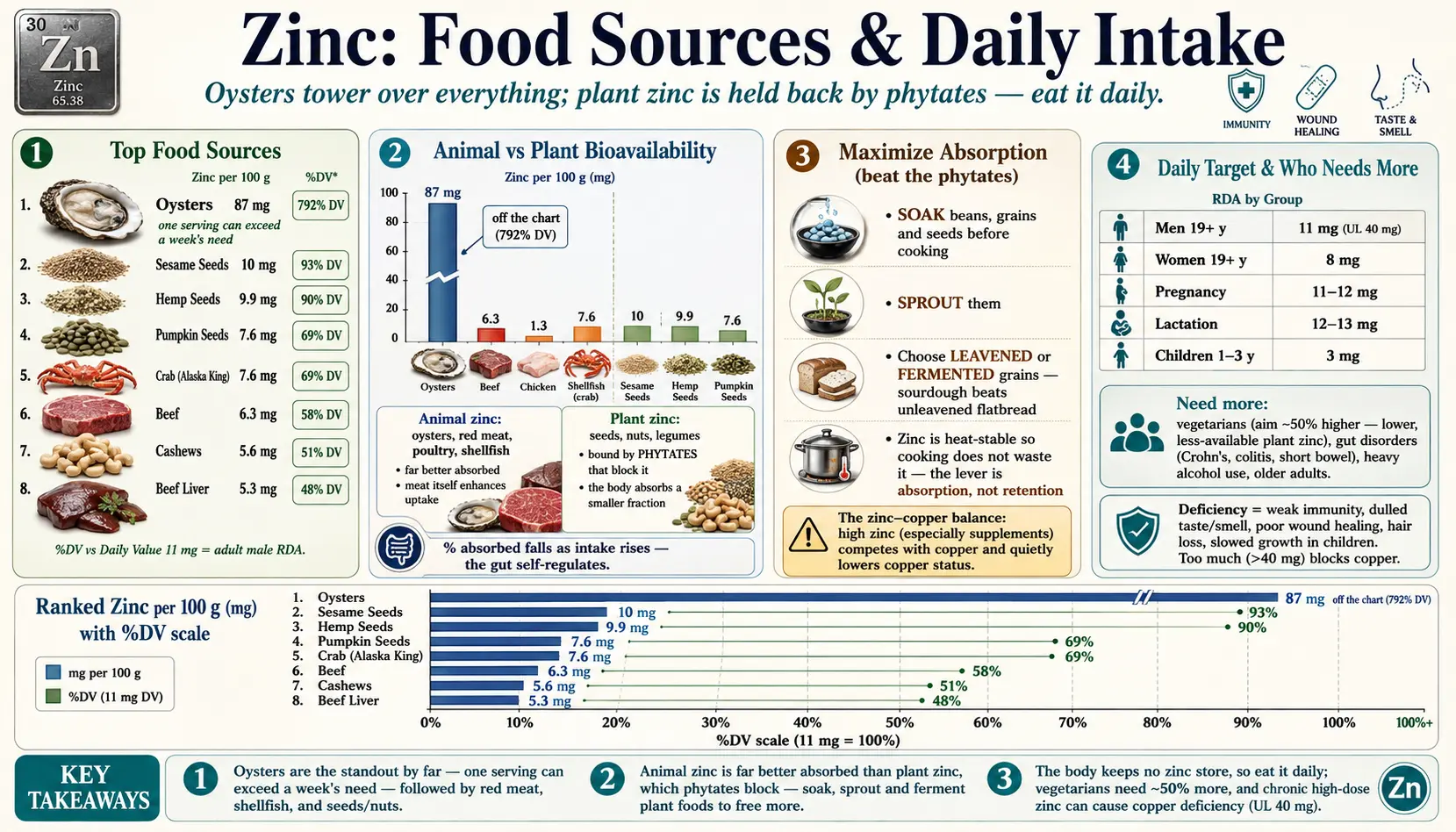
Zinc is an essential mineral the body cannot store, so a steady daily supply matters. It is the workhorse behind roughly a hundred enzymes and is needed for immune defense, wound healing, protein and DNA synthesis, growth, and a normal sense of taste and smell. The richest sources are animal foods — oysters tower over everything else, followed by red meat, poultry and shellfish — while seeds, nuts and legumes are useful plant sources whose zinc is held back somewhat by phytates.
| Zinc: Food Sources & Daily Intake | ||||||
|---|---|---|---|---|---|---|
| Rank | Food (serving) | Per 100 g | %DV / 100g | Glucose | Fructose | Notes |
| 1 | Oysters 3 oz / 85 g | 87 mg | 🟢 792% | — | — | By far the richest food source of zinc — one serving can exceed a whole week’s need. |
| 2 | Sesame Seeds 1 oz / 28 g | 10 mg | 🟢 93% | — | — | |
| 3 | Hemp Seeds 1 oz / 28 g | 9.9 mg | 🟢 90% | 0.2 | 0.3 | |
| 4 | Pumpkin Seeds 1 oz / 28 g | 7.6 mg | 🟢 69% | 0.1 | 0.1 | The richest plant source; soaking or roasting helps. |
| 5 | Crab (Alaska King) 3 oz / 85 g | 7.6 mg | 🟢 69% | — | — | |
| 6 | Beef Meat 3 oz / 85 g | 6.3 mg | 🟢 58% | 0 | 0 | Red meat supplies most of the highly absorbable zinc in a typical diet. |
| 7 | Cashews 1 oz / 28 g | 5.6 mg | 🟢 51% | — | — | |
| 8 | Beef Liver 3 oz / 85 g | 5.3 mg | 🟡 48% | 0 | 0 | Liver is one of the most nutrient-dense animal foods. |
| 9 | Lamb 3 oz / 85 g | 4.7 mg | 🟡 42% | 0 | 0 | |
| 10 | Chicken Organ Meats 3 oz / 85 g | 4.7 mg | 🟡 42% | — | — | Nutrient-dense organ meat (giblets). |
| 11 | Pork Organ Meats 3 oz / 85 g | 4.2 mg | 🟡 38% | — | — | Nutrient-dense organ meat. |
| 12 | Lobster 3 oz / 85 g | 4.0 mg | 🟡 37% | 0 | 0 | |
| 13 | Turkey (Dark Meat) 3 oz / 85 g | 3.5 mg | 🟡 32% | 0 | 0 | |
| 14 | Almonds 1 oz / 28 g | 3.3 mg | 🟡 30% | 0.0 | 0.0 | |
| 15 | Beef Organ Meats 3 oz / 85 g | 2.8 mg | 🟡 26% | 0 | 0 | Nutrient-dense organ meat. |
| 16 | Cheddar Cheese 1 oz / 28 g | 2.6 mg | 🟡 24% | — | — | |
| 17 | Brown Rice 1 cup / 195 g | 0.7 mg | ⚪ 6% | 0 | 0 | Common staple. |
Table of Contents
- How to Read These Tables
- Recommended Intakes & Upper Limits
- Bioavailability & Absorption
- Cooking & Storage
- Vegetarian & Vegan Sources
- Who Needs to Pay Attention
- Data Sources & References
- Connections
- Featured Videos
How to Read These Tables
- No body store — eat it daily. Unlike iron or vitamin A, the body keeps no specialized zinc reserve, so intake needs to be reasonably consistent rather than topped up occasionally.
- %DV vs RDA. The %DV column compares a serving against the FDA Daily Value of 11 mg. Your personal target (the RDA) is 11 mg for men and 8 mg for women, rising in pregnancy and lactation — see the second table.
- Per 100 g vs per serving. Per-100 g lets you compare foods fairly; the serving size shown beside each food is what you actually eat. A single serving of oysters or a modest portion of beef covers a full day with room to spare.
Recommended Intakes & Upper Limits
Your personal target depends on age, sex and pregnancy. The Daily Value used for the %DV column above is a single label figure; the table below is the age-specific guidance.
| Life stage | RDA / AI (mg/day) | Upper limit (mg/day) |
|---|---|---|
| Infants 0–6 mo | 2* (AI) | 4 |
| Infants 7–12 mo | 3 | 5 |
| Children 1–3 y | 3 | 7 |
| Children 4–8 y | 5 | 12 |
| Children 9–13 y | 8 | 23 |
| Males 14–18 y | 11 | 34 |
| Males 19+ y | 11 | 40 |
| Females 14–18 y | 9 | 34 |
| Females 19+ y | 8 | 40 |
| Pregnancy | 11–12 | 34–40 |
| Lactation | 12–13 | 34–40 |
Bioavailability & Absorption
How much zinc you actually absorb depends heavily on the rest of the meal. Zinc from animal foods is far better absorbed than zinc from plants, partly because meat itself enhances uptake and partly because plant foods carry phytates — compounds in whole grains, legumes, nuts and seeds that bind zinc and block it. The body also self-regulates: as intake rises the percentage absorbed falls, and the gut adjusts its own zinc losses to keep the whole body in balance. One interaction worth knowing is the zinc–copper balance: high zinc intakes (especially from supplements) compete with copper and can quietly push copper status down, which is why long-term high-dose zinc and copper are often paired.
Cooking & Storage
Zinc is a stable mineral — it is not destroyed by heat, light or air the way fragile vitamins are, so ordinary cooking does not waste it. The bigger lever is absorption, not retention. Traditional food-preparation steps that break down phytate free up more of the zinc already present: soaking beans, grains and seeds before cooking, sprouting them, and leavening or fermenting bread (sourdough beats unleavened flatbread). These do not add zinc, but they let you keep more of what the food contains.
Vegetarian & Vegan Sources
Plant-based eaters can meet their needs, but it takes a little planning because plant zinc is both lower and less available. Lean on the strongest plant sources: pumpkin, hemp and sesame seeds, cashews and almonds, and legumes such as chickpeas and lentils. Then improve what you absorb by soaking and sprouting legumes, grains and seeds, and by choosing leavened or fermented grain products over unleavened ones — all of which cut phytate. Because absorption is lower, vegetarians may need as much as 50% more zinc than the standard RDA, so aim toward the higher end of the range.
Who Needs to Pay Attention
Deficiency shows up as weakened immunity and frequent infections, a dulled sense of taste or smell, poor wound healing, hair loss, appetite loss, and — in children — slowed growth. Those most at risk include people with gut disorders (Crohn’s, ulcerative colitis, short bowel), heavy alcohol use, older adults with marginal diets, and strict vegetarians. The opposite problem matters too: chronically high zinc blocks copper, and intakes well above the UL can cause copper deficiency with its own anemia and nerve problems. The adult UL is 40 mg/day from food plus supplements combined — easy to overshoot with high-dose lozenges or supplements, not with food.
Data Sources & References
- NIH Office of Dietary Supplements — Zinc Fact Sheet (DV, RDA, UL)
- Linus Pauling Institute — Zinc Micronutrient Information Center
- PubMed — King JC et al., Zinc homeostasis in humans
- PubMed — Zinc bioavailability and homeostasis (phytate and absorption)
Connections
- All Minerals
- Zinc (Main Page)
- Zinc Benefits
- Zinc History
- Copper (zinc–copper balance)
- Iron (competes for absorption)
- Vitamin A (zinc mobilizes its stores)