Selenosis (Selenium Toxicity): Symptoms, Causes, and Risks
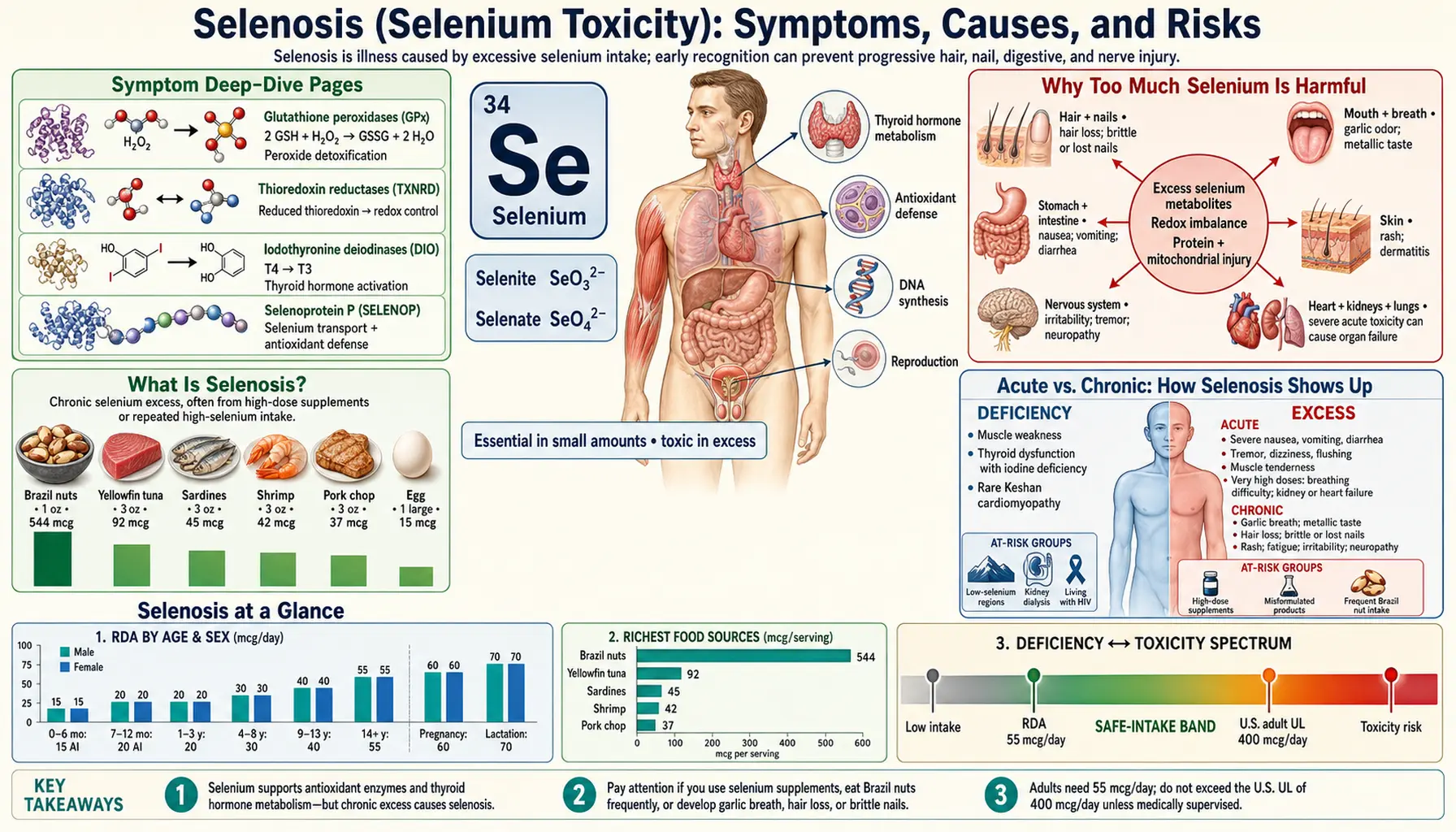
Selenium is a trace mineral your body genuinely needs — but only in tiny amounts, and the gap between “enough” and “too much” is narrower than for almost any other nutrient. Selenosis is the name for selenium toxicity: the cluster of problems that appear when intake climbs far above what the body can use. Here is the most important thing to understand up front: in most of the world chronic selenosis is uncommon, and when it does happen it is almost always driven by something specific — an over-dosed or mislabeled supplement, repeatedly eating very large amounts of Brazil nuts, or living where the soil is unusually selenium-rich. You essentially cannot get selenium poisoning from an ordinary, varied diet. The classic warning signs are oddly distinctive: a persistent garlic-like odor on the breath and skin, hair that becomes brittle and falls out, nails that thicken or develop ridges and break, an upset stomach, and — in more severe cases — tingling, numbness, or other nerve problems. A single massive overdose is a different, more acute danger and can be life-threatening. This hub explains what selenosis is and the dose where it begins, why excess selenium is harmful, what causes it, how it is diagnosed and treated, and when to seek care — with deep-dive pages for each of the main symptoms. Selenium supplements are easy to overdo; more is not better, and high-dose products deserve real caution.
Symptom Deep-Dive Pages
Hair & Nail Loss
The most recognized sign of chronic selenosis — why excess selenium makes hair brittle and shed and nails ridge, thicken, and break, what the pattern looks like, and why it can take weeks to reverse.
Garlic Breath
The strange garlic-like odor on the breath and skin that is one of the earliest clues to selenium excess — the volatile selenium compound that causes it and why it is a distinctive, if not exclusive, warning sign.
Stomach Upset
Nausea, vomiting, diarrhea, and abdominal pain — the early and very common gastrointestinal effects of too much selenium, why they appear quickly after a high dose, and why they are easy to mistake for other causes.
Nerve Problems
Tingling, numbness, and other neurological effects reported in more significant selenium excess — what is known and not known about how selenium affects nerves, and why this is a less common but more concerning sign.
Table of Contents
- Symptom Deep-Dive Pages
- What Is Selenosis?
- Why Too Much Selenium Is Harmful
- Acute vs. Chronic: How Selenosis Shows Up
- Common Causes of Selenium Excess
- How Selenosis Is Diagnosed
- How Selenium Excess Is Treated
- When to Seek Care / Red Flags
- Key Research Papers
- Connections
- Featured Videos
What Is Selenosis?
Selenium is an essential trace mineral: your body builds it into about two dozen proteins — including the glutathione peroxidase enzymes that protect cells from oxidative damage, and the deiodinase enzymes that activate thyroid hormone. The catch is that the body needs only a trace of it. The recommended dietary allowance for adults is about 55 micrograms (mcg) per day, and the daily amount considered safe even over the long term — the tolerable upper intake level (UL) set by the U.S. and many other authorities — is 400 mcg per day. Selenosis is the name for the harm that develops when selenium intake rises well above what the body can safely use. The word combines selenium with the suffix “-osis,” meaning a condition or disease state.
What makes selenium unusual among nutrients is how narrow the safe window is. For many vitamins and minerals there is a wide cushion between the amount you need and the amount that causes trouble. For selenium that cushion is comparatively thin: the helpful dose and the harmful dose are only about a factor of ten apart. That is why selenium is sometimes described as having a “U-shaped” or “double-edged” relationship with health — too little is a problem (see the Selenium Deficiency hub), and so is too much, with the healthiest place being the modest middle.
It helps to think in three bands of daily intake:
- Adequate (about 55–200 mcg/day) — The amount most people get from a varied diet, or from a sensible supplement. This range supports the body's selenium-dependent enzymes without harm.
- Above the upper limit (sustained intakes over ~400 mcg/day) — The zone where chronic selenosis becomes a real risk if maintained for weeks to months. The classic signs — garlic breath, hair loss, brittle nails — tend to emerge here and become clearer as intake climbs higher (roughly 800–1,000 mcg/day and above in the historical data).
- Acute overdose (a single very large dose, on the order of grams) — A medical emergency that is entirely different from the slow chronic picture. This is the territory of swallowed industrial selenium salts or grossly mislabeled products, and it can be rapidly life-threatening.
One honest, reassuring point belongs at the top: for most people eating an ordinary, varied diet, selenosis is not a realistic worry. Food alone almost never delivers a toxic dose. The well-documented cases of chronic selenosis come from specific, identifiable situations — soil so rich in selenium that local crops carry far too much (as in parts of historical China and a region of India), manufacturing errors that put hundreds of times the labeled dose into a supplement, and the habit of eating large quantities of Brazil nuts, which are by far the most selenium-dense food on earth. Knowing the cause is usually knowing the cure.
Why Too Much Selenium Is Harmful
If selenium is an antioxidant nutrient, why does an excess cause damage? The answer is one of biology's recurring lessons: the same chemistry that makes selenium useful in small amounts makes it harmful in large amounts. Selenium is highly reactive. At the right dose it sits inside enzymes doing controlled, beneficial work; at the wrong dose that reactivity turns destructive.
Researchers describe a few overlapping mechanisms, and it is fair to say the full picture is still being worked out:
- It hijacks your proteins. Selenium's chemistry is very similar to sulfur's, and sulfur is everywhere in the body — especially in the amino acids cysteine and methionine that give proteins their shape. When selenium is in excess, it can be mistakenly slotted in where sulfur belongs, and it can react with the sulfur-containing (thiol) groups that hold proteins in their proper folded shape. Disrupt those bonds and the protein can misfold or stop working. This is thought to be a major reason why selenosis hits keratin-rich tissues first: hair and nails are built almost entirely from sulfur-bonded keratin, so they are unusually vulnerable to a mineral that interferes with sulfur chemistry. That is the link to the brittle hair and ridged, breaking nails covered on the Hair & Nail Loss page.
- It flips from antioxidant to pro-oxidant. In excess, selenium compounds can begin generating reactive oxygen species rather than neutralizing them — the precise opposite of selenium's protective day job — causing oxidative stress inside cells.
- It produces a smelly, telltale byproduct. To get rid of a selenium overload, the body methylates it and breaks it down to volatile compounds, chiefly dimethyl selenide, which is exhaled and released through the skin. That volatile compound is what produces the distinctive garlic odor of selenosis — not a sign of damage in itself, but a visible (or rather, smellable) marker that the body is overloaded and working hard to dump the excess. See the Garlic Breath page.
The organs and tissues most affected reflect these mechanisms. The earliest and most consistent signs are in hair and nails (keratin) and the gastrointestinal tract (nausea, vomiting, diarrhea — see Stomach Upset). With higher or more sustained exposure, the nervous system can be affected, producing tingling, numbness, and other neurological complaints (see Nerve Problems and the broader page on Peripheral Neuropathy). In severe acute poisoning, far more dangerous effects on the heart, lungs, liver, and kidneys can occur. There is also a subtler, important harm seen in large clinical trials: long-term selenium supplementation in already-replete people has been linked to an increased risk of type 2 diabetes, a reminder that “more” can do harm even short of classic selenosis (see Diabetes and the research below).
Acute vs. Chronic: How Selenosis Shows Up
Unlike some mineral excesses that stay silent until they are dangerous, selenosis usually does announce itself — but how it shows up depends entirely on whether the exposure is a slow build-up or a sudden flood. These are really two different conditions sharing one name, and telling them apart matters.
Chronic selenosis is the gradual, more common form. It develops over weeks to months of intake above the safe upper limit — a daily over-dosed supplement, a region with selenium-rich soil, or a steady Brazil-nut habit. Because it builds slowly, the body has time to display its classic, almost characteristic, sequence of signs:
- Garlic-like breath and body odor — often one of the earliest clues, from exhaled dimethyl selenide.
- Hair changes and hair loss — hair becomes dry and brittle and sheds; this is among the most reliable signs of chronic excess.
- Nail changes — nails thicken, develop white spots or ridges, become brittle, and can fall off.
- Gastrointestinal upset — nausea, diarrhea, a metallic taste.
- Skin rashes and a general unwell feeling — fatigue and irritability are often reported.
- Neurological symptoms — with more significant or prolonged exposure, numbness, tingling, or pain in the hands and feet.
Acute selenium poisoning is the sudden, far more dangerous form — a single very large dose, usually from swallowing an industrial selenium compound or a grossly mislabeled product. It does not wait for hair and nails. Within minutes to hours it can cause severe vomiting and diarrhea, a strong garlic breath, low blood pressure, a fast or abnormal heartbeat, difficulty breathing, and in the worst cases cardiovascular collapse, organ failure, and death. Acute selenium overdose is a medical emergency — it is the reason the gap between a therapeutic and a toxic intake should be respected.
The practical upshot: if symptoms crept in over weeks alongside a supplement or a dietary habit, the picture is chronic selenosis, and the fix usually begins with simply stopping the source. If a large amount was swallowed at once and the person is acutely ill, that is an emergency — see the red-flags section below.
Common Causes of Selenium Excess
Selenosis does not appear out of nowhere — it almost always has a findable source, which is exactly why it is usually preventable and reversible. The causes fall into a few clear groups.
- Over-supplementation — the most common cause in the developed world. Selenium is sold in countless multivitamins, “antioxidant” formulas, thyroid-support products, and standalone tablets. It is genuinely easy to overdo, especially by stacking several products that each contain selenium, or by taking a high-dose product daily on the mistaken belief that more is better. Most supplements provide modest, safe amounts — but the habit of layering them, or chasing high doses, is what tips people over the upper limit.
- Manufacturing errors — rare but dramatic. The most striking modern outbreak occurred in the United States in 2008, when a liquid dietary supplement was mistakenly manufactured with roughly 200 times the labeled amount of selenium. More than 200 people developed acute selenium toxicity — hair loss, nail changes, nausea, fatigue, and joint pain — from a product they trusted (the MacFarquhar study below documents it). It is a powerful reminder that supplement potency is not always what the label says.
- Brazil nuts — the one food that can do it. Brazil nuts are by far the richest natural source of selenium — a single nut can contain 70–90 mcg or more, sometimes much more, depending on where it grew. A small handful can exceed the daily upper limit. Eating them occasionally is fine and even a smart way to top up selenium, but eating many every day, for weeks, has produced selenosis. They are the exception that proves the rule that diet rarely causes toxicity. (See the Selenium food sources page.)
- Selenium-rich soil (geographic / environmental). Selenium enters the food chain through soil, so where you live shapes your intake. In a few seleniferous regions — historically parts of Enshi County in China, and a region of Punjab, India — the soil is so selenium-rich that locally grown crops and grains carry far too much, causing endemic, community-wide selenosis. The classic Chinese cases studied by Yang and colleagues defined much of what we know about chronic human selenium toxicity.
- Occupational and industrial exposure. Selenium and its compounds are used in glass manufacturing, electronics, pigments, and metal refining. Workers can be exposed by inhaling selenium dust or fumes or through skin contact. Inhaled hydrogen selenide and selenium dioxide are particularly irritating to the lungs and airways. This is a toxicology concern more than a nutritional one — for the broader topic of toxic-metal and mineral exposure, see Toxic Minerals.
- Accidental or intentional ingestion of selenium salts. Concentrated selenium compounds — including sodium selenite and selenious acid found in some gun-bluing solutions and industrial products — are the usual cause of acute, life-threatening poisoning. These are not nutritional exposures; they are poisonings, and they behave like the acute emergency described above.
A practical pattern emerges from this list: chronic selenosis is overwhelmingly a story of supplements, Brazil nuts, or unusual geography, while the acute, dangerous cases come from concentrated industrial selenium. In nearly every instance, the first and most effective step is identifying and removing the source.
How Selenosis Is Diagnosed
Diagnosing selenium toxicity rests on two pillars: the story (what the person has been taking, eating, or exposed to) and measuring selenium in the body. Because the classic signs — garlic breath, hair loss, brittle nails — are distinctive but not exclusive, the history often does much of the work.
The clinical history is central. A clinician will ask carefully about supplements (all of them, including multivitamins and “natural” products), diet (especially Brazil nuts), where the person lives, and any occupational exposure. A pattern of brittle hair and nails, a garlic odor, and an upset stomach in someone taking a high-dose selenium product is often enough to strongly suspect selenosis before any test comes back.
Measuring selenium then confirms it. Several samples can be used, each with strengths:
- Blood (serum or plasma) selenium — reflects recent intake. The usual normal range is roughly 70–150 nanograms per milliliter (ng/mL), though reference ranges vary by laboratory and region; values well above this support a diagnosis of excess.
- Whole-blood selenium — reflects intake over a somewhat longer period than serum.
- Urine selenium — the kidneys are a main route of excretion, so a 24-hour urine collection can show how much selenium the body is dumping.
- Hair and nail selenium — because hair and nails grow slowly and concentrate selenium, they can serve as a record of longer-term exposure, which is useful for documenting chronic selenosis.
It is worth noting that selenium is not part of a standard routine blood panel. A Comprehensive Metabolic Panel checks electrolytes, kidney, and liver markers but does not include selenium — it must be ordered specifically, often through a specialized laboratory. In an acute poisoning, doctors will also check the things selenium can damage: an ECG for heart rhythm, and kidney and liver function tests. The aim of testing is both to confirm the diagnosis and to gauge how high the level is, which guides how urgently to act.
How Selenium Excess Is Treated
The good news about selenium toxicity is that, caught in time, it is usually very manageable — and the single most important treatment is also the simplest. As with the cause, the treatment splits cleanly into the chronic and the acute.
For chronic selenosis, the cornerstone of treatment is to stop the source. In the great majority of cases — the over-dosed supplement, the daily bag of Brazil nuts — simply discontinuing the excess selenium allows the body to clear it over time and the symptoms to resolve. The body is good at excreting selenium once the flood stops, mainly through urine and the exhaled, garlicky dimethyl selenide. Recovery is not instant: because hair and nails grow slowly, the brittle hair and damaged nails take weeks to months to grow out and look normal again, even though the underlying excess corrects much sooner. Practical steps include:
- Stopping all selenium-containing supplements and reading every label to find hidden sources (multivitamins, antioxidant blends, thyroid formulas).
- Cutting back the dietary source — for the Brazil-nut cases, reducing to an occasional nut rather than a daily handful.
- Patience and reassurance — the hair and nails recover as they regrow; this is expected and a sign things are improving, not worsening.
- Follow-up testing in some cases, to confirm selenium levels are falling back toward normal.
Acute selenium poisoning is a medical emergency and is managed in a hospital. There is no specific antidote for selenium, so care is supportive and aimed at the body systems under threat:
- Stabilizing the basics — supporting breathing, blood pressure, and heart rhythm, with continuous monitoring.
- Intravenous fluids — to maintain circulation and help the kidneys excrete selenium.
- Treating complications — managing dangerous heart rhythms, low blood pressure, and any lung, liver, or kidney injury as they arise.
- Decontamination — in some swallowed-poison cases, measures to limit further absorption may be considered early, guided by a poison-control center.
An important honesty note about chelation: people sometimes assume that, as with lead or mercury, a chelating drug can pull selenium out. The evidence here is limited and not clearly beneficial — chelation is not an established, routine treatment for selenium toxicity, and some agents have not helped or have raised concerns. Acute selenium poisoning should always be managed with the help of a poison-control center or medical toxicologist, who can advise on the latest approach. In the United States, Poison Control can be reached at 1-800-222-1222.
When to Seek Care / Red Flags
Most chronic selenosis is not an emergency — it is a problem of slowly stopping the source and letting the body recover. But two situations call for prompt medical attention, and one calls for an emergency response. Use these as your guide.
Call Poison Control or seek emergency care immediately if a large amount of selenium has been swallowed — for example, a child getting into selenium tablets, an industrial or gun-bluing product being ingested, or a sudden severe reaction after a high dose. In the United States, call Poison Control at 1-800-222-1222 right away, and call emergency services (911) if the person is seriously ill. Go to the emergency department for any of these signs of acute poisoning:
- Severe, repeated vomiting or diarrhea after a large selenium dose, especially with a strong garlic breath.
- Trouble breathing, chest tightness, or a cough after inhaling selenium fumes or dust.
- A racing, pounding, or irregular heartbeat, fainting, or severe lightheadedness — signs the heart or blood pressure may be affected.
- Confusion, severe weakness, or collapse.
Make a (non-emergency) medical appointment if you have the slower signs of chronic excess, particularly if you take selenium supplements or eat Brazil nuts regularly:
- A persistent garlic-like odor on your breath or skin that you cannot explain by food.
- Unusual hair loss, or hair that has turned brittle and dry.
- Brittle, ridged, or thickened nails, white spots, or nails that are breaking or lifting.
- New numbness, tingling, or pain in the hands or feet — possible nerve involvement (see Nerve Problems).
- Ongoing nausea, fatigue, irritability, or skin rashes alongside a known high selenium intake.
A simple, sensible rule covers almost everyone: do not exceed 400 mcg of selenium per day from all sources combined, and be honest with yourself about how many selenium-containing products you are taking. If you are unsure whether your intake is too high, that is a perfect question for your doctor or pharmacist — and a selenium blood test can settle it. Remember that the slow signs reverse once the source is removed; the urgent danger is the acute overdose, which should never be managed at home.
Key Research Papers
- Yang G, Wang S, Zhou R, et al. (1983). Endemic selenium intoxication of humans in China. The American Journal of Clinical Nutrition;37(5):872-881. — DOI: 10.1093/ajcn/37.5.872
- MacFarquhar JK, Broussard DL, Melstrom P, et al. (2010). Acute Selenium Toxicity Associated With a Dietary Supplement. Archives of Internal Medicine;170(3):256-261. — DOI: 10.1001/archinternmed.2009.495
- Hadrup N, Ravn-Haren G (2020). Acute human toxicity and mortality after selenium ingestion: A review. Journal of Trace Elements in Medicine and Biology;58:126435. — DOI: 10.1016/j.jtemb.2019.126435
- Rayman MP (2000). The importance of selenium to human health. The Lancet;356(9225):233-241. — DOI: 10.1016/S0140-6736(00)02490-9
- Rayman MP (2012). Selenium and human health. The Lancet;379(9822):1256-1268. — DOI: 10.1016/S0140-6736(11)61452-9
- Stranges S, Marshall JR, Natarajan R, et al. (2007). Effects of Long-Term Selenium Supplementation on the Incidence of Type 2 Diabetes: a randomized trial. Annals of Internal Medicine;147(4):217-223. — DOI: 10.7326/0003-4819-147-4-200708210-00175
- Clark LC, Combs GF, Turnbull BW, et al. (1996). Effects of Selenium Supplementation for Cancer Prevention in Patients With Carcinoma of the Skin: a randomized controlled trial. JAMA;276(24):1957-1963. — DOI: 10.1001/jama.1996.03540240035027
- Lippman SM, Klein EA, Goodman PJ, et al. (2009). Effect of Selenium and Vitamin E on Risk of Prostate Cancer and Other Cancers (SELECT). JAMA;301(1):39-51. — DOI: 10.1001/jama.2008.864
- Klein EA, Thompson IM, Tangen CM, et al. (2011). Vitamin E and the Risk of Prostate Cancer (SELECT, updated). JAMA;306(14):1549-1556. — DOI: 10.1001/jama.2011.1437
- Vinceti M, Filippini T, Del Giovane C, et al. (2018). Selenium for preventing cancer. Cochrane Database of Systematic Reviews;Issue 1:CD005195. — DOI: 10.1002/14651858.CD005195.pub4
- Stoffaneller R, Morse NL (2015). A Review of Dietary Selenium Intake and Selenium Status in Europe and the Middle East. Nutrients;7(3):1494-1537. — DOI: 10.3390/nu7031494
- National Institutes of Health, Office of Dietary Supplements. Selenium — Health Professional Fact Sheet (tolerable upper intake levels and toxicity). — NIH Office of Dietary Supplements
PubMed Topic Searches
- PubMed — Selenosis and selenium toxicity in humans
- PubMed — Selenium toxicity: hair and nail loss
- PubMed — Acute selenium poisoning and supplement overdose
- PubMed — Selenium tolerable upper intake level and safety
- PubMed — Selenium supplementation and type 2 diabetes risk
Connections
- All Minerals
- Selenosis: Hair & Nail Loss
- Selenosis: Garlic Breath
- Selenosis: Stomach Upset
- Selenosis: Nerve Problems
- Selenium Overview
- Selenium Deficiency Hub
- Selenium Benefits Hub
- Selenium Food Sources
- Toxic Minerals
- Comprehensive Metabolic Panel
- Peripheral Neuropathy
- Alopecia (Hair Loss)
- Diabetes
- Hashimoto's Thyroiditis
- Iodine
- Zinc