Selenosis (Selenium Toxicity): Garlic Breath
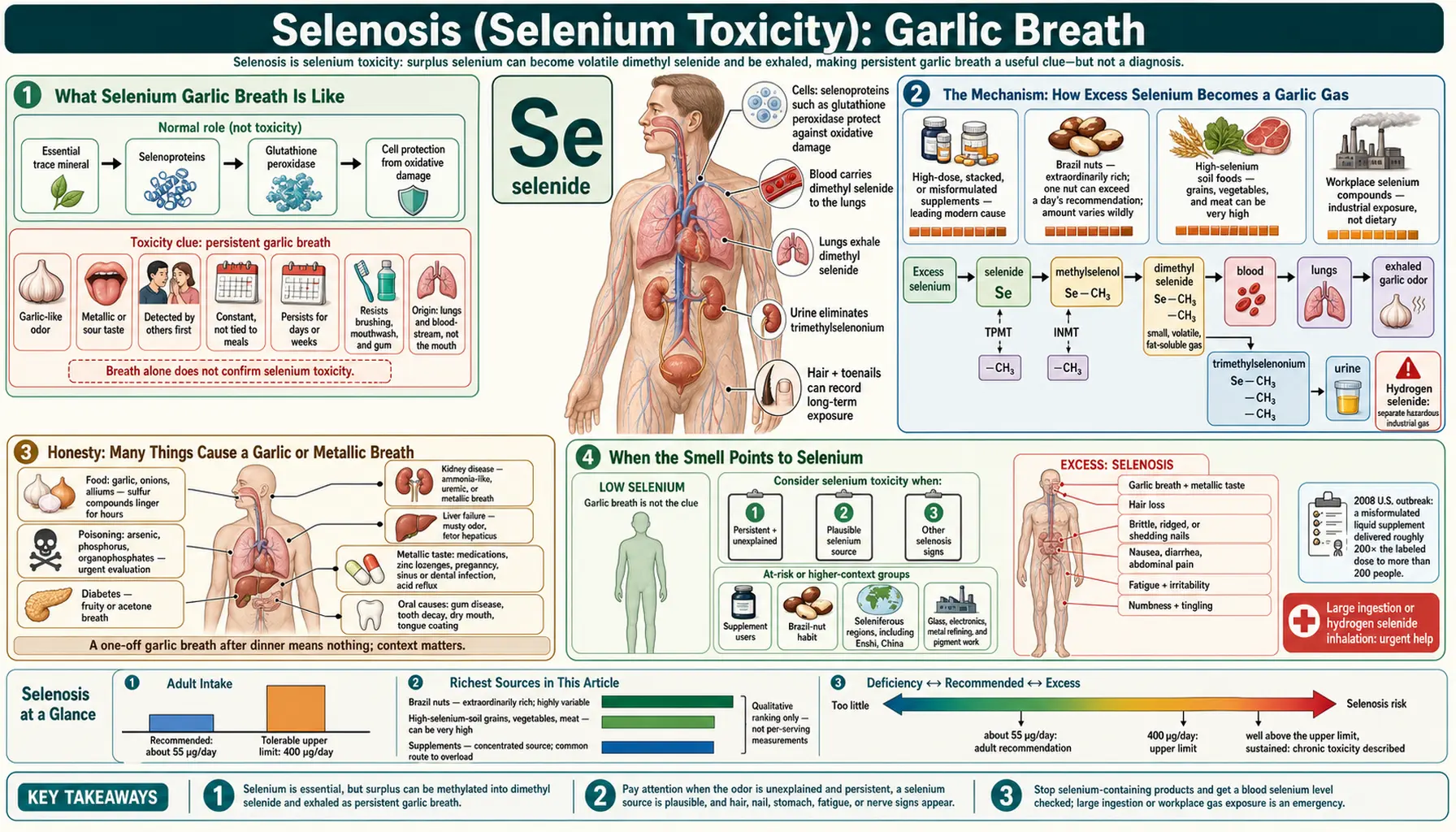
A persistent garlic or sour-metallic smell on the breath — noticeable to other people even when you have eaten no garlic at all — is one of the oldest and most distinctive warning signs of selenosis, the medical name for selenium toxicity. The odor comes from a real, measurable chemical: when the body is carrying more selenium than it can safely use, it methylates the surplus into a volatile gas called dimethyl selenide and breathes it out, the way garlic's own sulfur compounds leave on the breath. It is genuinely useful as a clue, because few other things smell quite like it. But it is also easy to misread — ordinary garlic, certain other exposures, and even a few rare metabolic conditions can produce a similar breath — and on its own it proves nothing. This page explains what the smell actually is, the chemistry that creates it, why it is far from unique to selenium, when it should make you think of selenium specifically, and what to do about it.
Table of Contents
- What Selenium Garlic Breath Is Like
- The Mechanism: How Excess Selenium Becomes a Garlic Gas
- Honesty: Many Things Cause a Garlic or Metallic Breath
- When the Smell Points to Selenium
- Common Causes of Selenium Overload
- Getting Checked
- How Selenium Excess Is Managed
- When to Seek Care / Red Flags
- Key Research Papers
- Connections
- Featured Videos
What Selenium Garlic Breath Is Like
People who develop selenosis — and those around them — tend to describe the breath in remarkably consistent terms. The hallmark is a garlic-like odor that has nothing to do with what you ate. Often it is paired with a metallic or sour taste in the mouth that does not go away with brushing, mouthwash, or chewing gum. The combination is striking enough that, historically, it was one of the first features clinicians and public-health workers looked for in regions where selenium poisoning occurred.
What it tends to feel like in practice:
- Detected by others first. Because we adapt to our own smells, the garlic odor is frequently noticed by a partner, family member, co-worker, or dentist before the affected person is aware of it.
- Constant, not tied to meals. Unlike the garlic breath you get from a meal — which fades over hours — selenium breath lingers day after day, because the body keeps making and exhaling the gas as long as the selenium burden stays high.
- A garlicky or “sour-metallic” character. Some describe it as classic garlic; others as a sharper, sour, or chemical-metallic note. There is often a matching metallic taste at the back of the mouth.
- Resistant to oral hygiene. It is not coming from the teeth, gums, or tongue coating, so the usual fixes for bad breath do little. That stubbornness is itself a clue that the smell originates in the lungs, from the bloodstream, rather than the mouth.
It is worth being clear about scale: in everyday life this is an uncommon finding. Most people will never encounter it, because it requires a sustained selenium intake far above normal. When the smell does appear and persists, though, it deserves attention — it is a sign that selenium handling has been pushed past its comfortable limit, and it usually travels in company with other features of selenosis such as hair and nail changes or stomach upset.
The Mechanism: How Excess Selenium Becomes a Garlic Gas
The garlic breath of selenosis is not vague or psychosomatic — it is the smell of a specific molecule the body manufactures on purpose. Understanding it starts with how the body normally disposes of selenium it does not need.
Selenium is an essential trace mineral: in the right small amount it is built into selenoproteins such as glutathione peroxidase that protect cells from oxidative damage (covered on the main Selenium page). But the gap between “enough” and “too much” is one of the narrowest of any nutrient. Once the body's selenoproteins are full, the surplus has to go somewhere, and the body's chief safety valve is methylation — tacking methyl (−CH3) groups onto selenium to turn it into forms that are easier to get rid of.
The pathway runs in steps. Excess selenium is first reduced to selenide, then methylated once to methylselenol, again to dimethyl selenide, and a third time to trimethylselenonium. The body uses two different routes for these final products. Trimethylselenonium is water-soluble and leaves in the urine. Dimethyl selenide is a small, volatile, fat-soluble gas — so when the blood carrying it passes through the lungs, it simply diffuses into the air sacs and is breathed out, exactly the way alcohol or the sulfur compounds from a clove of garlic appear on the breath. Recent work has mapped the very enzymes responsible — the methyltransferases TPMT and INMT — which add these methyl groups and shunt selenium toward exhalation and urinary excretion when intake runs high.
An analogy. Think of the body as a small workshop with a limited number of jobs that need selenium. When deliveries match the work, everything is used and there is no leftover to smell. When deliveries pile up far beyond the workload, the workshop has to dump the excess — and one of its disposal chutes vents a gas straight up the chimney (the lungs). The garlic smell is that chimney working overtime. Crucially, it appears only when intake is high enough that ordinary urinary disposal can't keep pace and the volatile route is recruited — which is why a faint, constant garlic breath is a marker of genuine selenium overload, not of normal selenium nutrition.
The same volatile chemistry explains a related, much more dangerous scenario: a different gas, hydrogen selenide, is a hazardous industrial selenium compound that can be inhaled directly in certain workplaces and is acutely toxic to the lungs. That is a separate exposure from the dimethyl selenide your own body exhales, but it is worth knowing the two exist, because both involve gaseous selenium.
Honesty: Many Things Cause a Garlic or Metallic Breath
Distinctive as it is, a garlic or metallic breath is not proof of selenium toxicity, and it would be a mistake to treat it as such. The single most common cause, by an enormous margin, is the obvious one: actually eating garlic, onions, or other alliums, whose own sulfur compounds (and a volatile relative of selenium's gas) linger on the breath for hours after a meal. Before thinking about anything exotic, the first question is simply what you have eaten.
Beyond food, a range of unrelated conditions can produce a garlicky, metallic, or chemical breath odor:
- Other element poisonings. A garlic-like breath is classically associated with acute arsenic poisoning, and with phosphorus and certain organophosphate (pesticide) exposures. These are emergencies in their own right and have nothing to do with selenium — one reason an unexplained garlic breath should be evaluated rather than self-diagnosed.
- Metabolic and organ problems. Poorly controlled diabetes (a fruity or acetone breath), advanced kidney disease (an ammonia-like, “uremic” or metallic breath), and liver failure (a musty odor called fetor hepaticus) all change how the breath smells.
- A metallic taste from many sources. The metallic taste that often accompanies the smell is itself extremely non-specific — it is caused by numerous medications (some antibiotics, metformin, certain blood-pressure drugs, chemotherapy), zinc lozenges, pregnancy, sinus and dental infections, and acid reflux, among others.
- Ordinary oral causes. Gum disease, tooth decay, dry mouth, and tongue coating cause the great majority of everyday bad breath — though, as noted above, these usually improve with oral hygiene, whereas true selenium breath does not.
The honest bottom line: a one-off garlic breath after dinner means nothing, and even a persistent metallic taste has dozens of mundane explanations. The smell becomes meaningful as a selenium clue only when it is unexplained, persistent, and accompanied by the right context and other signs — which is what the next section is about.
When the Smell Points to Selenium
A garlic or metallic breath shifts from “probably nothing” toward “think about selenium” when several things line up at once. The pattern that should raise suspicion is:
- It is unexplained and won't quit. You have not been eating garlic or onions, you have ruled out an obvious dental cause, and the smell persists for days or weeks rather than hours.
- There is a plausible selenium source. Most real selenosis today comes from supplements — a high-dose selenium product, a misformulated batch, or stacking several supplements and a Brazil-nut habit on top of one another. A clear over-supply is the most important clue of all.
- Other features of selenosis are present. Selenium breath rarely travels alone. Look for company: brittle, ridged, or shedding nails and hair loss; nausea, diarrhea, or abdominal pain; fatigue and irritability; and, in more advanced cases, numbness, tingling, or other nerve symptoms. The garlic breath and metallic taste are often among the earliest of this cluster to appear.
When all three align — an unexplained persistent garlic breath, a real source of excess selenium, and one or more other selenosis signs — the smell is no longer just curious; it is a reasonable prompt to stop any selenium-containing product and get a selenium level checked. By contrast, a garlic breath with none of that context is almost always something far more ordinary. The skill is in reading the smell alongside the story, never on its own.
Common Causes of Selenium Overload
To produce a garlic breath, selenium has to be coming in at a level the body must work hard to dispose of. For perspective, the recommended intake for adults is about 55 micrograms (µg) per day, and the tolerable upper limit is 400 µg/day; chronic toxicity has been described with sustained intakes well above that. The usual ways people get there:
- High-dose or misformulated supplements. This is the leading modern cause. The most famous example is a 2008 U.S. outbreak in which a misformulated liquid dietary supplement delivered roughly 200 times the labeled selenium dose to more than 200 people, causing widespread hair loss, nail changes, fatigue, and the characteristic garlic breath. Even correctly made high-potency selenium pills can cause selenosis if taken in excess or combined with other selenium sources.
- Brazil nuts. Brazil nuts are extraordinarily selenium-rich — a single nut can contain more than a day's worth, and the amount varies wildly from nut to nut. Eating a large handful daily, especially on top of a supplement, is a realistic route to overload.
- High-selenium environments (geographic seleniferous areas). In a few parts of the world the soil is so selenium-rich that locally grown grains, vegetables, and the meat of animals raised there carry very high selenium. Endemic human selenosis — complete with garlic breath, hair loss, and nail damage — was documented in seleniferous regions of Enshi, China, where daily intakes reached the hundreds to over a thousand micrograms. Such endemic cases are now uncommon but historically important.
- Industrial and occupational exposure. Workers in glass manufacturing, electronics, metal refining, certain pigments, and related industries can be exposed to selenium compounds — including, in some settings, the acutely toxic gas hydrogen selenide. This is a distinct, workplace-driven route rather than dietary excess.
Identifying which source applies matters, because the fix is almost always to find and remove it — and for most people in most places, that means scrutinizing the supplement shelf and the snack bowl first.
Getting Checked
You cannot confirm selenium toxicity by the breath alone — it has to be measured. Fortunately the testing is straightforward, and it works best when it is paired with a careful history of everything you take.
The cornerstone is a blood selenium level (serum or whole-blood selenium), a simple blood draw that tells the clinician whether your current selenium burden is genuinely high. Because selenium also leaves in the urine, a urine selenium measurement is sometimes added to gauge how much you are excreting. Where there has been long-term excess, hair and toenail selenium are especially useful: nails and hair lock in selenium as they grow, so they act as a slow biological recorder of exposure over the preceding months — the very tissues that famously show damage in selenosis also carry a chemical record of it.
Alongside the selenium measurements, a clinician will usually order a routine blood panel — a Comprehensive Metabolic Panel checks kidney and liver function, blood sugar, and electrolytes, which both helps assess the situation and rules out the other causes of a metallic or garlicky breath discussed above (uncontrolled diabetes, kidney failure, liver disease). If arsenic or another element poisoning is a realistic possibility given the history, specific testing for those is done as well, since a garlic breath is shared between them. The most valuable single step, though, costs nothing: a complete inventory of every supplement, multivitamin, and “wellness” product, plus questions about Brazil nuts and any workplace exposure. The source is usually found in that conversation.
How Selenium Excess Is Managed
The reassuring part is that, once the source is removed, the body's own methylation-and-excretion machinery does most of the work. There is no specific antidote routinely used for chronic selenosis; the treatment is to stop the oversupply and let selenium fall back into range, with medical support tailored to how severe things are.
- Remove the source first. This is the single most important step and often the only one needed for mild cases: stop the selenium supplement (or the misformulated product), cut out Brazil nuts and selenium-fortified products, and address any occupational exposure. Once intake drops, the body keeps clearing the surplus through urine and exhaled dimethyl selenide.
- Let levels normalize over time. As the burden falls, the garlic breath and metallic taste usually fade, and gastrointestinal symptoms settle. Nail and hair changes take longer — because they are recorded in tissue that has already grown, they grow out over weeks to months rather than resolving immediately.
- Supportive care as needed. A clinician manages symptoms while levels come down — hydration and anti-nausea measures for stomach upset, attention to any nerve symptoms, and monitoring of organ function. Severe acute overdoses (very large single ingestions, or inhalation of hydrogen selenide gas) are medical emergencies handled in hospital, sometimes with poison-control guidance and intensive support.
- Recheck levels. Repeat blood (and sometimes urine or nail) selenium testing confirms that the level is genuinely coming down and that the right source was removed.
The broader lesson for prevention is the one the narrow safety margin demands: more selenium is not better. Routine high-dose selenium supplementation offers no proven benefit for people who are already replete, carries real risk, and — as large trials have prompted researchers to revisit — the upper limit itself may warrant caution. For nearly everyone, an ordinary varied diet supplies plenty, and a garlic breath is a sign to take selenium away, not to add more.
When to Seek Care / Red Flags
A faint garlic breath after a garlicky meal needs nothing more than time. But certain situations warrant prompt medical attention — and a few are genuine emergencies that mean call for urgent help right away, by emergency services or poison control rather than waiting for a routine appointment:
- A large accidental or intentional selenium ingestion — for example swallowing a high-dose product in quantity, or any selenium ingestion in a child. Contact poison control immediately; acute selenium overdose can cause low blood pressure, breathing difficulty, and heart-rhythm problems.
- Suspected inhalation of selenium fumes or gas at work (hydrogen selenide), especially with cough, shortness of breath, chest tightness, or eye and airway irritation — this is an acute emergency.
- An unexplained, persistent garlic or metallic breath that won't clear — particularly alongside new hair loss, brittle or shedding nails, ongoing nausea or diarrhea, unusual fatigue, or numbness and tingling. This cluster warrants a doctor's visit and a selenium level, and prompts a search for the source.
- A garlic breath with features that suggest a different poisoning — for instance abrupt severe vomiting and diarrhea, confusion, or collapse, which can point to arsenic or another toxic exposure that also smells of garlic. When the picture is acute and severe, treat it as an emergency regardless of which element is to blame.
The practical rule: an isolated garlicky breath is almost always benign, but a persistent unexplained one — especially with a selenium source and other selenosis signs — should be checked, and any large ingestion or workplace fume exposure is an emergency that should not wait. When in doubt, getting a selenium level is quick, and finding the source is usually the whole solution.
Key Research Papers
- Yang GQ, Wang SZ, Zhou RH, Sun SZ (1983). Endemic selenium intoxication of humans in China. The American Journal of Clinical Nutrition;37(5):872-881. — DOI: 10.1093/ajcn/37.5.872
- Longnecker MP, Taylor PR, Levander OA, et al. (1991). Selenium in diet, blood, and toenails in relation to human health in a seleniferous area. The American Journal of Clinical Nutrition;53(5):1288-1294. — DOI: 10.1093/ajcn/53.5.1288
- MacFarquhar JK, Broussard DL, Melstrom P, et al. (2010). Acute Selenium Toxicity Associated With a Dietary Supplement. Archives of Internal Medicine;170(3):256-261. — DOI: 10.1001/archinternmed.2009.495
- Morris JS, Crane SB (2013). Selenium Toxicity from a Misformulated Dietary Supplement, Adverse Health Effects, and the Temporal Response in the Nail Biologic Monitor. Nutrients;5(4):1024-1057. — DOI: 10.3390/nu5041024
- Huang Z, Wang Q, Gao J, et al. (2013). Daily Dietary Selenium Intake in a High Selenium Area of Enshi, China. Nutrients;5(3):700-710. — DOI: 10.3390/nu5030700
- Fukumoto Y, Kyono Y, Shibukawa Y, et al. (2024). Differential molecular mechanisms of substrate recognition by selenium methyltransferases, INMT and TPMT, in selenium detoxification and excretion. Journal of Biological Chemistry;300(2):105599. — DOI: 10.1016/j.jbc.2023.105599
- Rayman MP (2012). Selenium and human health. The Lancet;379(9822):1256-1268. — DOI: 10.1016/S0140-6736(11)61452-9
- Fairweather-Tait SJ, Bao Y, Broadley MR, et al. (2011). Selenium in Human Health and Disease. Antioxidants & Redox Signaling;14(7):1337-1383. — DOI: 10.1089/ars.2010.3275
- Vinceti M, Filippini T, Wise LA (2018). Environmental Selenium and Human Health: an Update. Current Environmental Health Reports;5(4):464-485. — DOI: 10.1007/s40572-018-0213-0
- Burk RF, Hill KE (2015). Regulation of Selenium Metabolism and Transport. Annual Review of Nutrition;35:109-134. — DOI: 10.1146/annurev-nutr-071714-034250
- Cheng WH (2021). Revisiting Selenium Toxicity. The Journal of Nutrition;151(4):747-748. — DOI: 10.1093/jn/nxaa433
PubMed Topic Searches
- PubMed — Selenosis and garlic breath
- PubMed — Dimethyl selenide exhalation and methylation
- PubMed — Selenium supplement toxicity (hair and nails)
- PubMed — Endemic selenium intoxication (Enshi, China)
- PubMed — Selenium upper intake level and safety
Connections
- All Minerals
- Selenium Toxicity (Selenosis) Hub
- Selenosis and Hair & Nail Loss
- Selenosis and Stomach Upset
- Selenosis and Nerve Problems
- Selenium Deficiency Hub
- Selenium Overview
- Selenium Food Sources
- Iodine
- Zinc
- Kidney Disease
- Dermatology (Skin, Hair & Nails)
- Comprehensive Metabolic Panel