Hypermagnesemia (High Magnesium): Slow Heart Rate
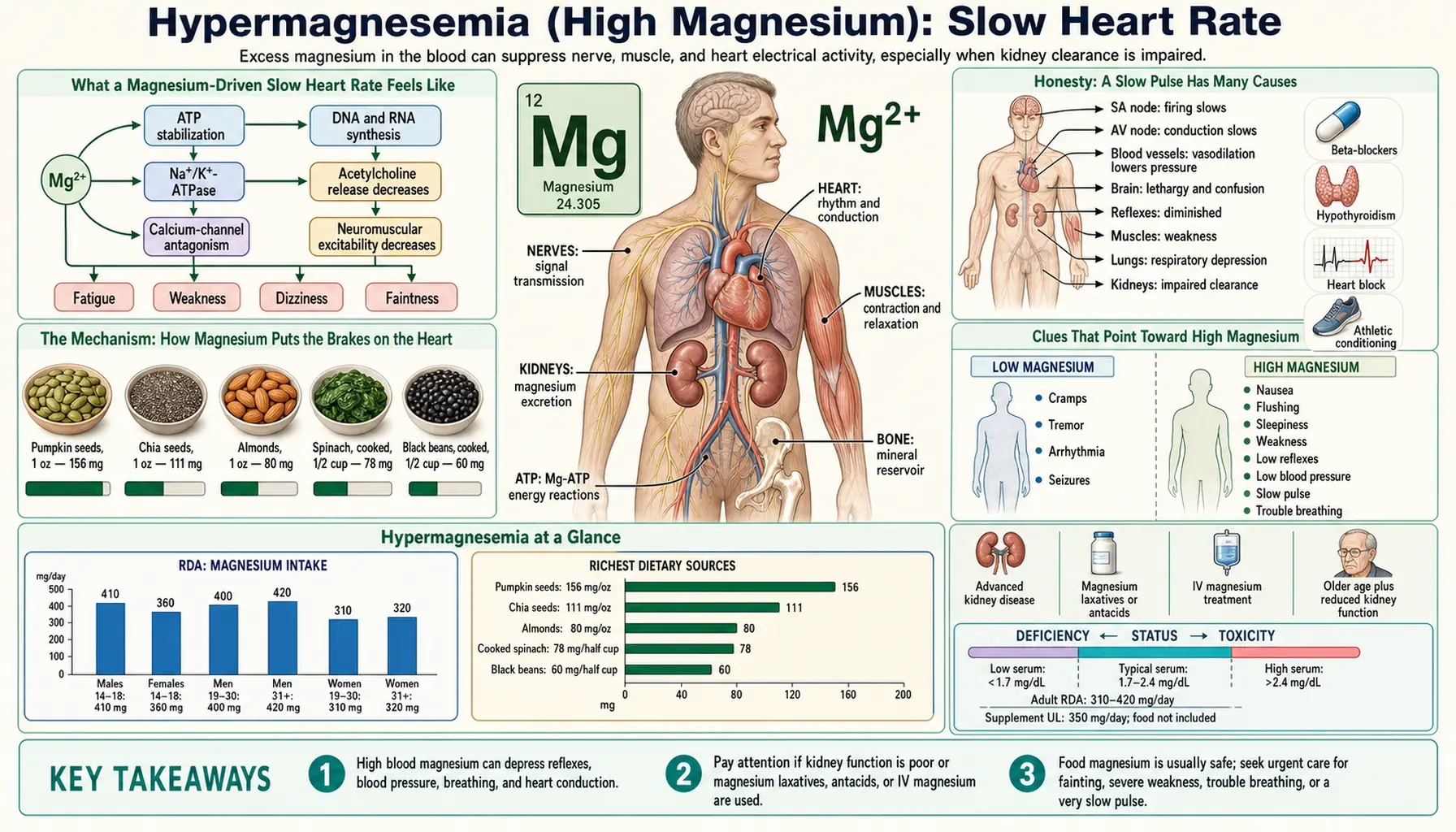
When magnesium climbs too high in the blood — a condition called hypermagnesemia — one of its earliest cardiac effects is to slow the heart down. The pulse becomes lazy and unhurried, the electrical signal lingers a little longer at each relay station, and on a tracing the spaces between beats stretch out. Two things are worth saying plainly at the outset. First, a slow heart rate has dozens of ordinary causes — athletic fitness, sleep, common medications — and high magnesium is an uncommon one. Second, when high magnesium is the cause, it almost never happens by accident in a healthy person: it takes a large magnesium load (laxatives, antacids, an intravenous infusion) usually landing on kidneys that cannot keep up. This page explains the slow heartbeat specifically — how it feels, the mechanism behind it, why magnesium is rarely the culprit, and the point at which a slow pulse becomes an emergency.
Interactive Visualization Magnesium — the mineral that makes ATP work Bare ATP is useless and enzymes reject it. Watch magnesium clamp the phosphates and switch it on, plug the NMDA channel, and let a cramping muscle finally let go. Launch →
Table of Contents
- What a Magnesium-Driven Slow Heart Rate Feels Like
- The Mechanism: How Magnesium Puts the Brakes on the Heart
- Honesty: A Slow Pulse Has Many Causes
- Clues That Point Toward High Magnesium
- Common Causes of High Magnesium
- Getting Checked
- How High Magnesium Is Corrected
- When to Seek Care / Red Flags
- Key Research Papers
- Connections
- Featured Videos
What a Magnesium-Driven Slow Heart Rate Feels Like
The first thing to understand is that a mildly slow heart rate often feels like nothing at all. A pulse in the 50s is common in fit and relaxed people, and even when magnesium is the reason, the early slowing rarely registers as a symptom. So the absence of any feeling is no reassurance that the heart rate is normal — in significant hypermagnesemia, the slowing may be discovered only when someone takes a pulse or runs an electrocardiogram (ECG).
When a slow heart rate — doctors call it bradycardia, meaning a resting rate under about 60 beats per minute — does produce symptoms, they come from too little blood being pumped to the brain and body. The pattern is recognizable:
- Fatigue and sluggishness. A heavy, worn-out feeling, low on energy, as if the body's engine is idling too low. This overlaps with the broader tiredness and drowsiness that high magnesium can cause.
- Lightheadedness or dizziness. A swimmy, faint feeling, especially on standing, because the slow pulse cannot raise output quickly when more blood is suddenly needed.
- Breathlessness on exertion. Getting winded climbing stairs or walking uphill, because the heart cannot speed up to match the demand of activity.
- A pulse that feels slow or “skipped.” Some people can feel their own heartbeat plodding, or notice long, uneven gaps between beats when they check their wrist or neck.
- Near-fainting or fainting. In more severe slowing, a graying-out of vision, cold sweat, or an actual faint (syncope) — a sign the brain is briefly being starved of blood and a clear reason to seek help.
A key contrast worth holding onto: the slow, weak, low-output feeling of bradycardia is the opposite of a racing or pounding heart. High magnesium pushes the rate down, not up. It also tends to travel with the other hallmarks of magnesium excess — low blood pressure and flushing and muscle weakness with fading reflexes — rather than appearing on its own. When a slow pulse arrives as part of that cluster, magnesium becomes a more plausible explanation, as the next sections explain.
The Mechanism: How Magnesium Puts the Brakes on the Heart
To understand why magnesium slows the heart, it helps to picture the heart's electrical system as a relay race. A natural pacemaker in the right atrium — the sinoatrial (SA) node — fires the starting signal. That signal sweeps across the upper chambers to a second relay station, the atrioventricular (AV) node, which briefly holds the baton before passing it down to the pumping chambers below. The rate at which the SA node fires, and the speed at which the AV node passes the signal along, together set the heartbeat. Magnesium leans on both.
Magnesium is a natural calcium blocker at the cellular level. The pacemaker cells of the SA node and the conducting cells of the AV node depend on calcium channels to generate and forward their electrical signals — calcium flowing into these cells is what drives each spontaneous beat and pushes the baton through the AV relay. Magnesium competes with calcium at those channels and damps the calcium current. When magnesium in the blood rises, that damping grows stronger, with two visible results:
- The SA node fires more slowly — the starting gun goes off less often, so the resting heart rate falls. This is the bradycardia.
- The AV node passes the baton more slowly — the relay station holds the signal longer before sending it on. On an ECG this shows up as a lengthening PR interval, the measurable gap between the atria firing and the ventricles responding. If magnesium climbs high enough, the AV node can drop a beat entirely, or stop conducting altogether — a heart block.
This same calcium-blocking action is precisely why magnesium has a recognized, useful role in cardiology: given intravenously under monitoring, it can calm certain fast or chaotic rhythms, and it is the treatment of choice for a dangerous arrhythmia called torsades de pointes. The slow heart rate of hypermagnesemia is simply that beneficial effect carried too far — the right action at the wrong dose. The thread running through magnesium's whole cardiovascular story is that it relaxes and slows: it widens blood vessels (lowering blood pressure), quiets over-excitable tissue, and eases the heart's electrical pace.
An analogy. Think of calcium as the accelerator pedal for the heart's pacemaker and relay stations, and magnesium as a foot resting lightly on the brake. At a normal magnesium level the brake barely touches — the heart keeps its own brisk, responsive pace. As magnesium rises, the brake presses harder: first the car coasts (the rate eases down), then it crawls (the PR interval stretches), and at very high levels the engine can stall at the relay (heart block). Take the foot off the brake — bring magnesium back into range — and the heart accelerates back to its normal rhythm, usually within hours.
Because this braking effect strengthens steadily as the level climbs, the slow heart rate is dose-related. Serum magnesium normally sits around 1.7–2.4 mg/dL (about 0.7–1.0 mmol/L). Symptoms are unusual until magnesium roughly doubles. As a rough guide drawn from clinical reports: a sluggish pulse and a lengthening PR interval tend to emerge in the range above about 5–7 mg/dL, often alongside loss of deep tendon reflexes; and dangerous slowing, heart block, and the risk of cardiac arrest cluster at very high levels above roughly 10–12 mg/dL. These numbers vary between individuals and are a guide, not a strict threshold.
Honesty: A Slow Pulse Has Many Causes
It would be misleading to treat a slow heart rate as a sign of high magnesium. It is not. Bradycardia is extremely common, and the overwhelming majority of slow pulses have nothing to do with magnesium at all. High magnesium is, in fact, an uncommon cause — worth knowing about, but well down the list. Before magnesium is even considered, the far more frequent explanations include:
- Normal physiology and fitness. Endurance athletes and many healthy people have resting rates in the 40s or 50s, and everyone's heart rate falls during sleep. This is normal and healthy, not a problem to fix.
- Medications. This is the big one. Beta-blockers (such as metoprolol or atenolol), certain calcium-channel blockers (diltiazem, verapamil), digoxin, and some others deliberately or incidentally slow the heart. A slow pulse in someone on these drugs is usually about the drug.
- Problems with the heart's own wiring. With age the SA node and conduction system can wear out (“sick sinus syndrome” or age-related arrhythmia and heart block). Damage from a heart attack can do the same.
- An underactive thyroid. Hypothyroidism slows the whole metabolism, the heart rate included.
- Other electrolyte and metabolic states. High potassium (hyperkalemia), low body temperature (hypothermia), and raised pressure inside the skull can all slow the heart — and severe hyperkalemia and hypermagnesemia frequently travel together, because the same failing kidneys retain both.
The practical upshot: a slow pulse warrants a thoughtful look at the much commoner causes — especially the medication list — before magnesium is suspected. Magnesium rises to the top of the list only in a specific context, which the next section spells out.
Clues That Point Toward High Magnesium
High magnesium becomes a believable explanation for a slow heart rate when the situation fits — chiefly when a large magnesium load meets kidneys that cannot clear it. The features that nudge magnesium up the list of suspects are:
- Kidney disease plus a magnesium source. This is the classic setup. The kidneys are the body's only meaningful route for getting rid of magnesium, so in someone with chronic kidney disease or acute kidney injury, even an ordinary dose of a magnesium-containing laxative or antacid can accumulate to dangerous levels.
- A symptom cluster, not slowing alone. Hypermagnesemia rarely produces an isolated slow pulse. It usually arrives with companions: low blood pressure with warm flushing, nausea and drowsiness, and a telltale loss of the deep tendon reflexes (the knee-jerk fades) that goes along with muscle weakness. A slow heart rate embedded in that picture is far more suggestive of magnesium than a slow pulse on its own.
- A recent magnesium exposure. A bowel prep, generous use of milk of magnesia or magnesium-oxide laxatives for constipation, magnesium-containing antacids, or an intravenous magnesium infusion — especially in obstetrics for preeclampsia — raises the index of suspicion sharply.
- A bradycardia that does not fit the usual story. A new slow pulse in someone not on a rate-slowing drug, without athletic conditioning, who has one of the risk factors above, is the kind that should prompt a magnesium level alongside the routine workup.
Notice the through-line: magnesium is rarely the lone explanation and almost never strikes a person with healthy kidneys and no magnesium source. When the slow pulse comes with low blood pressure, drowsiness, and disappearing reflexes in someone with kidney disease who has been taking magnesium, the diagnosis can come together quickly — and it is confirmed with a simple blood test.
Common Causes of High Magnesium
Because healthy kidneys excrete excess magnesium so efficiently, hypermagnesemia almost always requires either an unusually large magnesium load, impaired kidney function, or — most dangerously — both together. The recurring scenarios are:
- Magnesium-containing laxatives and antacids. This is the most common avoidable cause. Milk of magnesia, magnesium-oxide and magnesium-citrate laxatives, magnesium-based bowel preparations, and magnesium antacids can deliver a large load. Documented case series describe severe and even fatal hypermagnesemia from such products — usually in older adults, people with constipation taking them daily, or those with reduced kidney function. Even some patients with apparently normal kidneys have been pushed too high by very heavy laxative use.
- Reduced kidney function. Chronic kidney disease and acute kidney injury blunt the body's only major route for clearing magnesium, so a magnesium load that a healthy person would shrug off can accumulate to harmful levels. Kidney impairment is the single biggest amplifier of every other cause.
- Intravenous magnesium therapy. Magnesium sulfate is given intravenously for genuine medical reasons — to prevent and treat seizures in preeclampsia and eclampsia, and sometimes for severe asthma or certain arrhythmias. Because the infusion bypasses the gut and goes straight into the bloodstream, it can raise magnesium quickly, which is exactly why obstetric protocols monitor reflexes, breathing, urine output, and the heart rate closely and keep intravenous calcium on hand as an antidote.
- Massive oral overdose. Swallowing a very large amount of a magnesium product at once — an accidental or intentional overdose, or repeated dosing of a cathartic — can overwhelm even reasonable kidneys.
- Rare contributors. Less commonly, conditions such as adrenal insufficiency (Addison's disease), severe dehydration, or, in newborns, treatment given to the mother around delivery can raise magnesium. These are uncommon and usually layered on top of one of the causes above.
Pinning down the source matters, because the fix follows the cause: stopping a laxative or antacid, adjusting an intravenous infusion, treating the underlying kidney disease, or removing magnesium directly are very different actions. A first, high-yield step is simply to review what the person has been taking — the medicine cabinet and the laxative shelf are where the answer usually lies.
Getting Checked
Confirming high magnesium as the reason for a slow heart rate is quick, and it rests on a blood test paired with an ECG.
The first step is a blood magnesium level. Serum magnesium is not part of the standard Comprehensive Metabolic Panel and must be ordered specifically, so a doctor has to think of it — which is exactly why the context clues above matter. The same blood draw that checks magnesium typically also reports kidney function (creatinine), potassium, and calcium, all of which help explain why magnesium climbed and whether other electrolytes are contributing to the slow pulse. A level above the normal range (about 1.7–2.4 mg/dL) confirms hypermagnesemia, and the height of the number tracks roughly with the severity of the cardiac effects.
The second step is an electrocardiogram (ECG), which shows how much the magnesium is affecting the heart's electrical system in real time. The classic findings climb in step with the level: a slowing rate, then a lengthening PR interval and widening QRS complex as conduction is dragged out, and at dangerous levels the dropped beats of heart block. The ECG also helps separate magnesium's effect from look-alikes such as high potassium, and it gauges urgency: a markedly prolonged PR interval or any degree of heart block signals that treatment cannot wait. A simple bedside finding — checking the deep tendon reflexes, which fade and then disappear as magnesium rises — gives a quick, no-equipment read on how high the level has climbed.
How High Magnesium Is Corrected
Treatment of significant hypermagnesemia is done under medical supervision and moves on parallel tracks — stop the magnesium going in, protect the heart, and get magnesium out — followed by addressing the cause. As the level falls, the slow heart rate, low blood pressure, and weakness all lift, usually within hours, because magnesium's brake on the calcium channels eases off once the level drops.
- Stop all magnesium intake. The first and simplest step: discontinue magnesium-containing laxatives, antacids, supplements, and any intravenous infusion. In milder cases with working kidneys, this alone — with time and fluids — lets the body clear the excess.
- Protect the heart with calcium. When the heart rate is dangerously slow, blood pressure is dropping, or the ECG shows heart block, intravenous calcium (calcium gluconate or chloride) is the antidote. Calcium directly opposes magnesium at the channels, restoring conduction and heart rate within minutes — it buys time while magnesium is removed.
- Support the rate and circulation. Intravenous fluids help the kidneys flush magnesium; a diuretic may be added if the kidneys still respond. If the heart rate is critically slow, temporary measures such as atropine or, rarely, a temporary pacemaker can support it until magnesium falls.
- Remove magnesium with dialysis. For severe hypermagnesemia — especially in someone with kidney failure who cannot excrete it — dialysis is the fastest and most definitive way to strip magnesium out of the blood, and it can be lifesaving.
- Treat the cause. Lowering the level once is not enough if the source persists: stopping the offending laxative or antacid for good, adjusting an intravenous protocol, or managing the underlying kidney disease so it does not happen again.
For people living with chronic kidney disease, prevention is the real work — avoiding magnesium-containing laxatives and antacids unless a clinician specifically approves them, and knowing that “natural” or over-the-counter does not mean safe when the kidneys cannot clear what comes in.
When to Seek Care / Red Flags
Most slow heart rates are harmless and need only a routine, non-urgent check — particularly in a fit person who feels well. But certain features mean seek care right away, by emergency services rather than a routine appointment:
- Fainting or near-fainting with a slow pulse — a blackout, graying vision, or collapse signals the brain is being starved of blood and needs urgent evaluation.
- A very slow pulse with severe symptoms — a heart rate that feels markedly slow together with chest pain, severe breathlessness, or confusion.
- A slow pulse with the magnesium cluster — slowing accompanied by warm flushing, a drop in blood pressure, profound drowsiness, or muscle weakness, especially in someone with kidney disease who has been taking magnesium laxatives or antacids. This combination warrants an urgent magnesium level.
- Trouble breathing — in severe hypermagnesemia the muscles of breathing weaken; shallow or labored breathing alongside a slow pulse is a true emergency.
- Known kidney disease plus a new magnesium product — if you have reduced kidney function and have started a magnesium-containing laxative or antacid and feel unwell, get a prompt magnesium check even if the symptoms are mild.
The dangerous pattern is a slow heart rate combined with fainting, breathing trouble, or the broader signs of magnesium excess — because at that point magnesium's brake on the heart's electrical system may be approaching heart block or arrest. When in doubt, be seen: confirming or ruling out hypermagnesemia takes one blood test and an ECG, and the antidote — intravenous calcium — works fast.
Key Research Papers
- de Baaij JHF, Hoenderop JGJ, Bindels RJM (2015). Magnesium in Man: Implications for Health and Disease. Physiological Reviews;95(1):1-46. — DOI: 10.1152/physrev.00012.2014
- Van Laecke S (2018). Hypomagnesemia and hypermagnesemia. Acta Clinica Belgica;74(1):41-47. — DOI: 10.1080/17843286.2018.1516173
- Mordes JP, Wacker WE (1977). Excess magnesium. Pharmacological Reviews;29(4):273-300. — DOI: 10.1016/s0031-6997(25)00067-5
- Reinhart RA (1991). Clinical correlates of the molecular and cellular actions of magnesium on the cardiovascular system. American Heart Journal;121(5):1513-1521. — DOI: 10.1016/0002-8703(91)90160-j
- Campbell TJ (2000). Update on the Use of Magnesium as an Antiarrhythmic Drug. Cardiac Electrophysiology Review;4(3-4):251-254. — DOI: 10.1023/a:1026543431623
- Tosto F, Magro G, Laterza V, Romozzi M (2024). Neurological manifestations of hypermagnesemia: a narrative review. Acta Neurologica Belgica;125(2):283-298. — DOI: 10.1007/s13760-024-02653-3
- Felsenfeld AJ, Levine BS, Rodriguez M (2015). Pathophysiology of Calcium, Phosphorus, and Magnesium Dysregulation in Chronic Kidney Disease. Seminars in Dialysis;28(6):564-577. — DOI: 10.1111/sdi.12411
- Kaye P, O’Sullivan I (2002). The role of magnesium in the emergency department. Emergency Medicine Journal;19(4):288-291. — DOI: 10.1136/emj.19.4.288
- Gerard SK, Hernandez C, Khayam-Bashi H (1988). Extreme hypermagnesemia caused by an overdose of magnesium-containing cathartics. Annals of Emergency Medicine;17(7):728-731. — DOI: 10.1016/s0196-0644(88)80624-3
- Onishi S, Yoshino S (2006). Cathartic-induced Fatal Hypermagnesemia in the Elderly. Internal Medicine;45(4):207-210. — DOI: 10.2169/internalmedicine.45.1482
- Mori H, Suzuki H, Hirai Y, et al. (2019). Clinical features of hypermagnesemia in patients with functional constipation taking daily magnesium oxide. Journal of Clinical Biochemistry and Nutrition;65(1):76-81. — DOI: 10.3164/jcbn.18-117
- Duley L, Farrell B, Neilson JP (1999). Magnesium sulphate: a review of clinical pharmacology applied to obstetrics. BJOG: An International Journal of Obstetrics & Gynaecology;106(2):180-181. — DOI: 10.1111/j.1471-0528.1999.tb08222.x
PubMed Topic Searches
- PubMed — Hypermagnesemia, bradycardia, and cardiac conduction
- PubMed — Hypermagnesemia, heart block, and the ECG
- PubMed — Laxative and antacid hypermagnesemia in kidney disease
- PubMed — Magnesium sulfate toxicity and monitoring in obstetrics
- PubMed — Magnesium, calcium channels, and heart rate
Connections
- All Minerals
- Magnesium: The Mineral That Makes ATP Work — interactive animation
- Hypermagnesemia Symptom Hub
- Hypermagnesemia and Muscle Weakness
- Hypermagnesemia and Low Blood Pressure & Flushing
- Hypermagnesemia and Nausea & Drowsiness
- Magnesium Overview
- Magnesium and Heart Health
- Magnesium and Muscle Function
- Food Sources of Magnesium
- Calcium (the magnesium antidote)
- Potassium
- Arrhythmia
- Kidney Disease
- Hypothyroidism
- Preeclampsia
- Heart Palpitations
- Comprehensive Metabolic Panel