Hypermagnesemia (High Magnesium): Nausea and Drowsiness
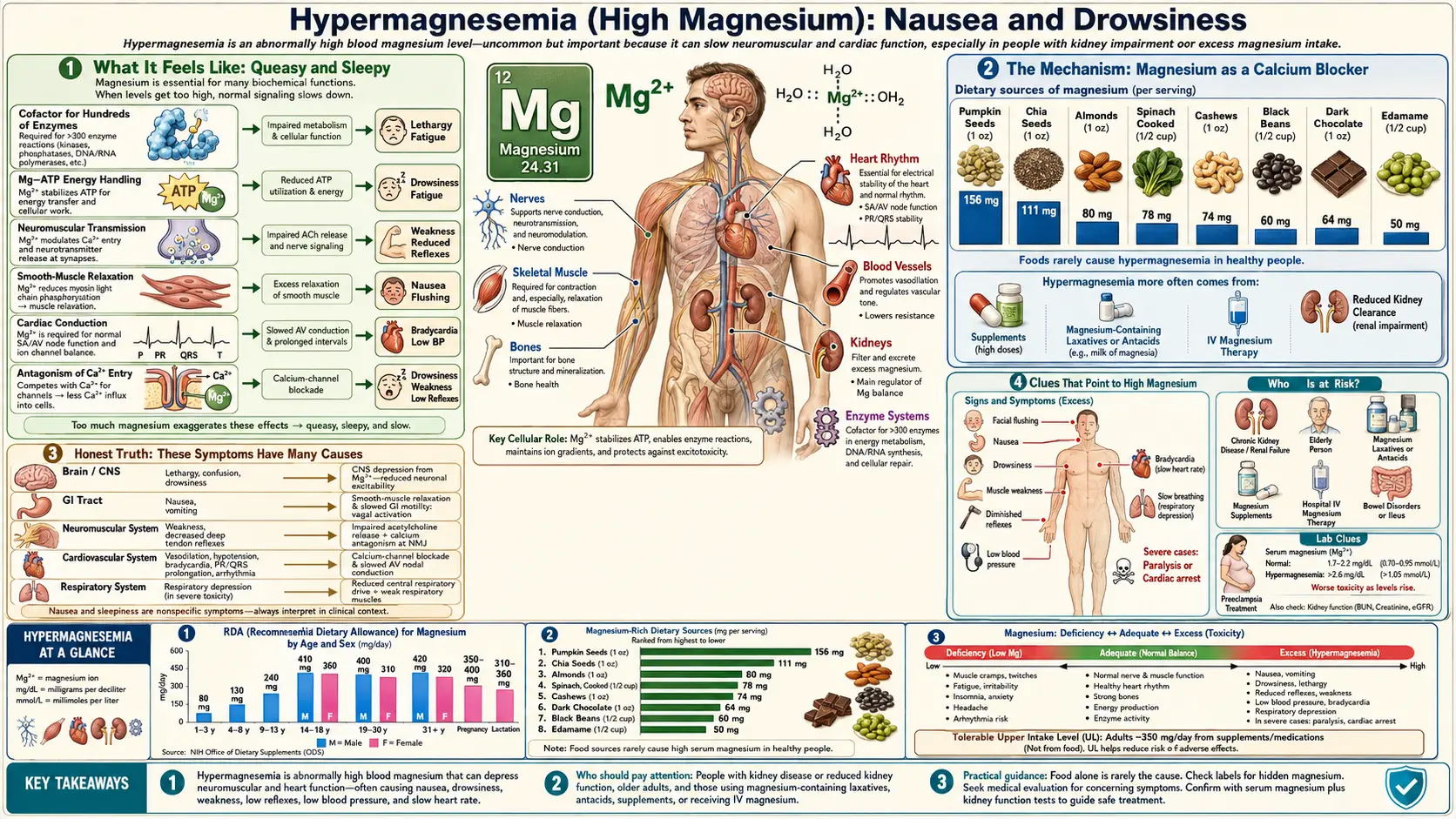
When magnesium climbs too high in the blood — a condition called hypermagnesemia — two of the very first signs are often nausea and an overwhelming drowsiness: a queasy stomach, sometimes vomiting, and a heavy, sedated sleepiness that feels like being slowly switched off. These are, in fact, the body's earliest whispers that magnesium is building up faster than the kidneys can clear it. But here is the honest truth that runs through this whole page: nausea and drowsiness are two of the most non-specific symptoms in all of medicine — caused by hundreds of everyday things — and high magnesium is an uncommon reason for them. They point at hypermagnesemia mainly when the setup is right: poor kidney function plus a magnesium-containing laxative or antacid, or a hospital magnesium drip. This page explains how the symptoms feel, the calcium-blocking mechanism behind them, why they are so easy to mistake for something else, the specific clues that should raise suspicion, and exactly when sleepiness becomes an emergency.
Interactive Visualization Magnesium — the mineral that makes ATP work Bare ATP is useless and enzymes reject it. Watch magnesium clamp the phosphates and switch it on, plug the NMDA channel, and let a cramping muscle finally let go. Launch →
Table of Contents
- What It Feels Like: Queasy and Sleepy
- The Mechanism: Magnesium as a Calcium Blocker
- Honest Truth: These Symptoms Have Many Causes
- Clues That Point to High Magnesium
- Common Causes of High Magnesium
- Getting Checked
- How High Magnesium Is Corrected
- When to Seek Care / Red Flags
- Key Research Papers
- Connections
- Featured Videos
What It Feels Like: Queasy and Sleepy
Mild hypermagnesemia frequently causes nothing at all and is found only on a blood test. When symptoms do begin, nausea and drowsiness are usually among the very first, appearing as magnesium rises out of the normal range. They tend to creep in together rather than arriving as a single dramatic event.
The nausea of high magnesium has a recognizable character:
- A steady, low-grade queasiness rather than the sharp, cramping waves of a stomach bug. Many people describe it as a persistent “off” feeling in the stomach, with a loss of appetite that comes on for no obvious reason.
- Vomiting in the more pronounced cases. As the level climbs, the queasiness can tip over into actual vomiting. There is a cruel irony here when the cause is a magnesium laxative: the same product is producing both diarrhea below and nausea above.
- Flushing alongside it. Nausea from high magnesium often travels with a warm, red flushing of the skin (covered on the companion page, Hypermagnesemia and Low Blood Pressure & Flushing), because magnesium relaxes blood vessels at the same time it unsettles the gut.
The drowsiness is, if anything, the more telling of the two, and it has a distinctive heaviness:
- Profound, sedated sleepiness — not ordinary tiredness but the feeling of being chemically slowed down, as if a sedative were taking hold. People nod off mid-sentence, struggle to stay awake, and feel mentally foggy and slow to respond.
- Lethargy and weakness blending in. The drowsiness shades into a whole-body lethargy and a draining of muscle strength — the muscle weakness of hypermagnesemia often arrives hand in hand with the sleepiness, because the same mechanism quiets both nerve and muscle.
- A worrying slide toward stupor. In serious hypermagnesemia the drowsiness can deepen into confusion, an inability to be roused normally, and ultimately a depressed level of consciousness — the point at which it stops being a symptom to note and becomes an emergency to act on.
This sedation is true central-nervous-system depression — a slowing of the brain and nerves — which is different from the breathless exhaustion of anemia or the wired fatigue of poor sleep. It is the kind of drowsiness that makes people and their families say afterward, “it was like they were being switched off.”
The Mechanism: Magnesium as a Calcium Blocker
To understand why high magnesium makes you queasy and sleepy, it helps to know what magnesium does to nerves and muscles in the first place. The single most useful idea is this: magnesium behaves as a natural calcium blocker. Calcium is the “go” signal of the body — it triggers nerves to fire and muscles to contract — and magnesium quietly stands in calcium's way, dialing those signals down. In normal amounts that braking action keeps nerves and muscles from over-firing. In excess, the brake is pressed too hard, and the whole system slows.
Three specific actions explain the symptoms:
- It blocks the release of the nerve–muscle messenger. At the junction where a nerve tells a muscle to move, the nerve releases a chemical called acetylcholine, and that release depends on calcium flowing into the nerve ending. Magnesium competes with calcium and reduces that flow, so less messenger is released. The result is weaker, slower nerve-to-muscle signaling — the basis of the lethargy and muscle weakness, and a key reason deep tendon reflexes fade as magnesium rises.
- It quiets the brain through NMDA receptors. Magnesium sits inside a class of excitatory brain receptors (the NMDA receptors) like a plug, blocking the flow that normally keeps neurons alert. More magnesium means a more thoroughly plugged, less excitable brain — a sedative-like effect that produces the heavy drowsiness, the mental fog, and, at high levels, the slide toward stupor. It is the same calming pathway that makes magnesium useful as a medical sedative in obstetrics; in toxicity it simply goes too far.
- It slows gut and smooth muscle. The gut wall is muscle too, and magnesium's calcium-blocking, muscle-relaxing effect there disturbs the normal rhythm of the stomach and intestine. That sluggish, relaxed gut — together with magnesium's direct effect on the brain's nausea pathways — is what produces the queasiness and vomiting.
An analogy. Picture every nerve and muscle in your body as a car with calcium on the accelerator and magnesium resting on the brake pedal. Normally the two are balanced and you move smoothly. Pour in too much magnesium and it is as if a heavy weight settles onto the brake: the engine still runs, but the car slows, the steering goes mushy, and eventually it can roll to a stop. The drowsiness is the brain slowing; the nausea is the gut's motor easing off; the weakness is the muscles failing to answer the accelerator. Lift the weight — bring magnesium back down — and the car responds normally again, often within hours.
Honest Truth: These Symptoms Have Many Causes
It would be misleading to let anyone walk away thinking that nausea and drowsiness usually mean high magnesium. They almost never do. These are two of the most non-specific symptoms in medicine — the everyday currency of countless ordinary, harmless, and treatable conditions — and hypermagnesemia is well down the list of causes. Honesty here matters, because chasing a rare cause while ignoring a common one helps no one.
Far more common explanations for nausea include:
- Viral gastroenteritis (“stomach flu”) and food-borne illness.
- Pregnancy — one of the most common causes of nausea in anyone who could be pregnant.
- Medications and their side effects — opioids, antibiotics, chemotherapy, and many others.
- Migraine, motion sickness, and inner-ear disorders.
- Acid reflux, gallbladder disease, and other gut conditions (see Nausea & Vomiting).
And far more common explanations for drowsiness include:
- Simple sleep deprivation and poor sleep quality.
- Sedating medications — sleep aids, antihistamines, opioids, alcohol.
- Low thyroid function, depression, and ordinary fatigue.
- Infections, low blood sugar, and other metabolic upsets.
Crucially, when high magnesium is the cause of drowsiness, it is rarely acting alone. Hypermagnesemia tends to develop alongside other electrolyte problems and, very often, alongside the kidney disease that allowed magnesium to accumulate — and advanced kidney failure causes its own drowsiness through the buildup of other wastes (uremia). Untangling how much of the sleepiness is “the magnesium” versus “the failing kidneys” is exactly why a doctor looks at the whole blood panel, not a magnesium level in isolation. The takeaway is simple: nausea and drowsiness are a reason to look, not a diagnosis — and high magnesium earns serious suspicion only when the clues in the next section line up.
Clues That Point to High Magnesium
Because nausea and drowsiness are so common, the art is in recognizing the context that makes hypermagnesemia plausible. The story matters more than the symptom. High magnesium climbs the list of suspects when one or more of these are present:
- Reduced kidney function plus a magnesium product. This is the classic, dangerous combination. The kidneys are the body's only meaningful route for getting rid of magnesium, so when they are impaired, even an ordinary over-the-counter magnesium laxative or antacid can stack up to toxic levels. New nausea and sleepiness in someone with chronic kidney disease who has been taking milk of magnesia or a magnesium-containing antacid should prompt a magnesium check.
- A magnesium drip in the hospital. In obstetric care, intravenous magnesium sulfate is given to women with preeclampsia or to slow preterm labor, and predictable early signs of rising magnesium are nausea, flushing, drowsiness, and the fading of reflexes. These are expected and closely monitored; here the clue is the infusion itself.
- The companions arrive together. Hypermagnesemia rarely produces a lone symptom. When nausea and drowsiness come bundled with flushing and low blood pressure, muscle weakness with diminished reflexes, or a slow heart rate, the cluster is far more suggestive than any one symptom alone.
- Big, deliberate ingestions. A large bowel-prep dose, heavy chronic laxative use, or ingestion of Epsom salt (magnesium sulfate) — occasionally as a folk remedy — can raise magnesium enough to cause symptoms even when the kidneys are normal, especially if the gut is inflamed or obstructed and absorbs more than usual.
If none of these fit — no kidney problem, no magnesium products, no infusion — then nausea and drowsiness are almost certainly something else, and the search should start with the common causes above.
Common Causes of High Magnesium
Healthy kidneys clear excess magnesium so efficiently that significant hypermagnesemia is genuinely uncommon in people with normal kidney function. It usually takes either failing kidneys, a large magnesium load, or both. The common setups are:
- Kidney disease — the single biggest factor. Reduced kidney function is the dominant reason magnesium accumulates, because the kidneys are the body's main exit route for it. People with advanced chronic kidney disease, those on dialysis, and people with acute kidney injury are at the highest risk, and even a modest extra magnesium load can tip them over.
- Magnesium-containing laxatives and antacids. This is the most common avoidable trigger. Milk of magnesia (magnesium hydroxide), magnesium citrate bowel preparations, and magnesium-based antacids deliver a large magnesium load to the gut. In someone with impaired kidneys — or with a very large dose — that load can produce dangerous, even fatal, hypermagnesemia. Published case reports repeatedly describe exactly this: an elderly or kidney-impaired person taking over-the-counter magnesium laxatives who becomes nauseated, drowsy, and then critically ill.
- Intravenous magnesium therapy. In obstetrics, magnesium sulfate is given by drip to treat preeclampsia and eclampsia and to protect a preterm baby's brain. It is safe and valuable under careful monitoring, but it is a deliberate, controlled state of high magnesium, and the early symptoms — nausea, flushing, drowsiness, loss of reflexes — are watched for precisely because they signal the level is rising.
- Epsom salt and large supplemental doses. Epsom salt is magnesium sulfate; ingesting it (rather than using it in a bath) can raise blood magnesium, and rare cases of severe toxicity have occurred even with normal kidneys after a large ingestion. Routine oral magnesium supplements at sensible doses do not cause this in healthy people, but excess intake from supplements and medicines is the recognized route to overload.
- Bowel disease that increases absorption. Conditions that inflame or slow the gut — severe constipation, bowel obstruction, active inflammatory bowel disease — can increase how much of an ingested magnesium load is absorbed and how long it lingers, raising the risk from a product that might otherwise pass through.
Identifying which cause is at work matters, because the fix differs sharply: stopping a laxative, adjusting an infusion, or treating kidney disease are very different interventions. A first, powerful step is simply reviewing the medication list and the medicine cabinet for anything containing magnesium.
Getting Checked
Confirming high magnesium is quick and inexpensive, and it rests on a blood test interpreted alongside kidney function and the clinical story.
The key measurement is the serum magnesium level, a simple blood draw. Normal is roughly 1.7–2.2 mg/dL (about 0.7–0.95 mmol/L). Magnesium is not always on a standard panel, so a clinician often has to order it specifically — one reason hypermagnesemia is occasionally missed when nausea and drowsiness are blamed on something else. The level tends to track loosely with symptoms: nausea, flushing, and drowsiness with the loss of deep tendon reflexes tend to appear in the mild-to-moderate range, while very high levels threaten breathing and the heart. Because people and situations vary, these are guides, not strict cut-offs — and the trend and the clinical picture matter as much as a single number.
Magnesium is rarely interpreted alone. A clinician will usually pair it with a Comprehensive Metabolic Panel (CMP) to assess kidney function (creatinine), calcium, sodium, and potassium — both because kidney impairment is the usual permissive cause, and because magnesium disturbances often travel with other electrolyte problems that can themselves cause nausea and drowsiness. A bedside check of the deep tendon reflexes is a useful, immediate clue: as magnesium rises, reflexes characteristically diminish and then disappear, and their loss is one of the earliest objective warning signs — especially during a magnesium infusion. If the level is high, an electrocardiogram (ECG) may be done to look for the heart-slowing and conduction changes of more serious hypermagnesemia.
How High Magnesium Is Corrected
Treatment depends entirely on how high the magnesium is and how sick the person is. Mild hypermagnesemia in someone with working kidneys often needs nothing more than stopping the source. Serious, symptomatic hypermagnesemia is a medical emergency treated under close supervision. As magnesium falls back toward normal, the nausea settles and the drowsiness lifts, often within hours, because the calcium-blocking brake is released.
- Stop the source. The essential first step is to halt every source of magnesium: discontinue magnesium-containing laxatives, antacids, and supplements, and stop or adjust any magnesium infusion. In a person with normal kidneys and only mild elevation, this alone is often enough — the kidneys clear the excess on their own.
- Protect the heart and reverse the effects with calcium. When magnesium is dangerously high — causing a slow heart, very low blood pressure, severe weakness, or trouble breathing — intravenous calcium (calcium gluconate or chloride) is given. Calcium is magnesium's direct counterpart: it does not lower the magnesium level, but it immediately opposes magnesium's effects on the heart, nerves, and muscles, buying crucial time.
- Help the kidneys clear it. If the kidneys still work, intravenous fluids and sometimes a diuretic can speed magnesium's removal in the urine.
- Dialysis for severe cases or kidney failure. When the kidneys cannot clear magnesium — as in advanced kidney disease — or when the level is critically high, dialysis removes magnesium quickly and definitively, and is the treatment of choice in severe toxicity.
For the people most at risk — those with chronic kidney disease — prevention is the real work, and it is straightforward: avoid magnesium-containing laxatives and antacids unless a doctor specifically approves them, read product labels for magnesium, and ask a pharmacist before taking an over-the-counter remedy. Many serious cases begin with an everyday product that no one realized was a problem.
When to Seek Care / Red Flags
Most nausea and drowsiness is not high magnesium and not an emergency. But certain features — particularly in someone with the risk factors above — mean get help right away, by emergency services rather than a routine appointment:
- Drowsiness deepening toward unrousable. Sleepiness that progresses to confusion, an inability to stay awake or be woken normally, or a depressed level of consciousness is a medical emergency, full stop — whatever the cause.
- Trouble breathing. Slow, shallow, or labored breathing can mean magnesium is depressing the muscles of respiration; this is one of the most dangerous effects of severe hypermagnesemia and demands immediate care.
- A very slow or irregular heartbeat, or fainting. A heart rate that feels slow or skipping, lightheadedness, or fainting can signal magnesium's effect on the heart and circulation (see Hypermagnesemia and Slow Heart Rate and Low Blood Pressure & Flushing).
- Known kidney disease plus a magnesium product and new symptoms. If you have reduced kidney function, have been taking a magnesium-containing laxative or antacid, and develop new nausea, drowsiness, or weakness, get a magnesium level checked promptly — even if the symptoms seem mild.
- Symptoms during a magnesium infusion. For someone receiving intravenous magnesium (for example, in pregnancy), worsening drowsiness, loss of reflexes, or breathing difficulty should be reported to the care team at once; these infusions are monitored precisely for this reason.
The dangerous pattern is deepening drowsiness combined with slow or labored breathing or a slow heartbeat, because at that point magnesium is depressing the body's most vital functions. When in doubt — especially with kidney disease or a known magnesium exposure — be seen: confirming or ruling out hypermagnesemia takes one quick blood test, and catching it early is the whole point.
Key Research Papers
- Aal-Hamad AH, Al-Alawi AM, Kashoub MS, Falhammar H (2023). Hypermagnesemia in Clinical Practice. Medicina (Kaunas);59(7):1190. — DOI: 10.3390/medicina59071190
- Van Laecke S (2024). Magnesium Disorders: Core Curriculum 2024. American Journal of Kidney Diseases;83(6):803-815. — DOI: 10.1053/j.ajkd.2023.10.017
- Jahnen-Dechent W, Ketteler M (2012). Magnesium basics. Clinical Kidney Journal;5(Suppl 1):i3-i14. — DOI: 10.1093/ndtplus/sfr163
- de Baaij JHF, Hoenderop JGJ, Bindels RJM (2015). Magnesium in Man: Implications for Health and Disease. Physiological Reviews;95(1):1-46. — DOI: 10.1152/physrev.00012.2014
- Blaine J, Chonchol M, Levi M (2015). Renal Control of Calcium, Phosphate, and Magnesium Homeostasis. Clinical Journal of the American Society of Nephrology;10(7):1257-1272. — DOI: 10.2215/CJN.09750913
- Yamaguchi H, Shimada H, Yoshita K, et al. (2018). Severe hypermagnesemia induced by magnesium oxide ingestion: a case series. CEN Case Reports;8(1):31-37. — DOI: 10.1007/s13730-018-0359-5
- Khairi T, Amer S, Spitalewitz S, Alasadi L (2014). Severe Symptomatic Hypermagnesemia Associated with Over-the-Counter Laxatives in a Patient with Renal Failure and Sigmoid Volvulus. Case Reports in Nephrology;2014:560746. — DOI: 10.1155/2014/560746
- Si GF, Ge YX, Lv XP, et al. (2024). Case report: Near-fatal hypermagnesemia resulting from the use of Epsom salts in a patient with normal renal function. Frontiers in Medicine;11:1416956. — DOI: 10.3389/fmed.2024.1416956
- The Magpie Trial Collaborative Group (2002). Do women with pre-eclampsia, and their babies, benefit from magnesium sulphate? The Magpie Trial: a randomised placebo-controlled trial. The Lancet;359(9321):1877-1890. — DOI: 10.1016/S0140-6736(02)08778-0
- Smith JM, Lowe RF, Fullerton J, et al. (2013). An integrative review of the side effects related to the use of magnesium sulfate for pre-eclampsia and eclampsia management. BMC Pregnancy and Childbirth;13:34. — DOI: 10.1186/1471-2393-13-34
- Fawcett WJ, Haxby EJ, Male DA (1999). Magnesium: physiology and pharmacology. British Journal of Anaesthesia;83(2):302-320. — DOI: 10.1093/bja/83.2.302
- Guerrera MP, Volpe SL, Mao JJ (2009). Therapeutic uses of magnesium. American Family Physician;80(2):157-162. — PubMed
PubMed Topic Searches
- PubMed — Hypermagnesemia symptoms, nausea, and lethargy
- PubMed — Hypermagnesemia from laxatives and antacids in renal failure
- PubMed — Magnesium sulfate side effects in preeclampsia
- PubMed — Magnesium, NMDA receptors, and CNS depression
- PubMed — Treatment of hypermagnesemia (calcium, dialysis)
Connections
- All Minerals
- Magnesium: The Mineral That Makes ATP Work — interactive animation
- Hypermagnesemia Symptom Hub
- Hypermagnesemia and Muscle Weakness
- Hypermagnesemia and Low Blood Pressure & Flushing
- Hypermagnesemia and Slow Heart Rate
- Magnesium Deficiency Hub
- Magnesium Overview
- Magnesium and Sleep
- Magnesium and Muscle Function
- Calcium
- Potassium
- Kidney Disease
- Nausea & Vomiting
- Fatigue
- Loss of Appetite
- Comprehensive Metabolic Panel