Iodine: History and Discovery
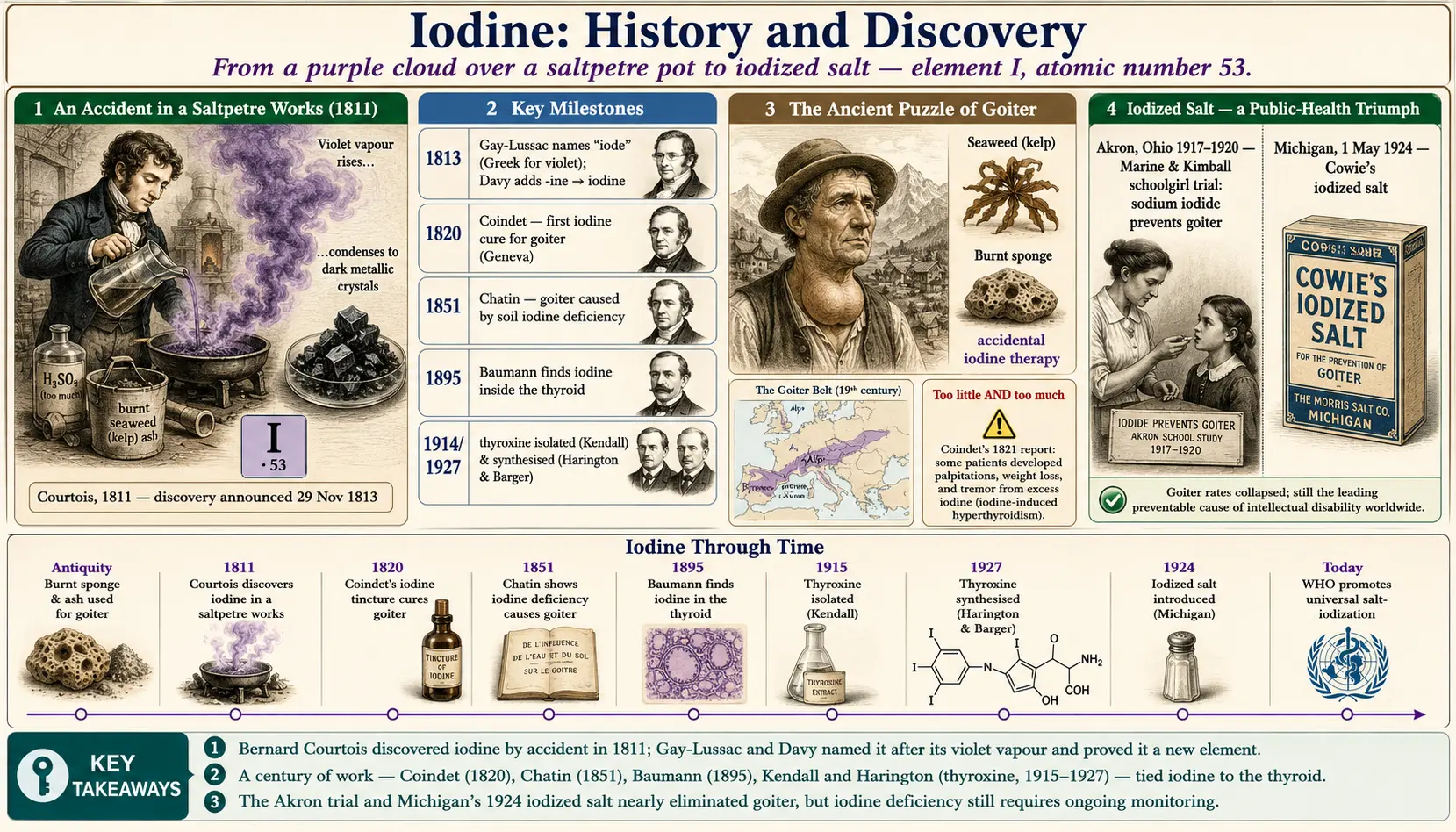
Iodine has one of the more memorable origin stories in all of chemistry: it was found by accident, in 1811, when a French saltpetre maker named Bernard Courtois poured a little too much acid onto the ash of burnt seaweed and watched a cloud of beautiful violet vapour rise from the pot. That purple cloud gave the element its name. But the discovery of iodine the element is only half the story. The other half — arguably the more important half for human health — is the slow, century-long discovery of why our bodies cannot do without it: the link between iodine and the thyroid gland, the recognition that iodine-poor soils breed the neck-swelling disease called goiter, and the public-health triumph of iodized salt. This article tells both stories, naming the real people and dates behind each step, and being careful to mark the places where the historical record is debated rather than settled.
Table of Contents
- An Accident in a Saltpetre Works (1811)
- Naming the Violet Element — and a Priority Dispute
- The Ancient Puzzle of Goiter
- Coindet and the First Iodine Cure (1820)
- Chatin and the Soil-Deficiency Idea (1851)
- Iodine Found Inside the Thyroid (1895)
- Isolating and Building the Thyroid Hormone
- The Akron Trial and the Coming of Iodized Salt
- A Solved Problem That Never Quite Stays Solved
- Research Papers and References
- Connections
- Featured Videos
An Accident in a Saltpetre Works (1811)
The story begins not in a laboratory but in a factory. Bernard Courtois (1777–1838) ran a works that produced saltpetre — potassium nitrate, the key ingredient of gunpowder. During the Napoleonic Wars, France needed enormous quantities of saltpetre, and the traditional source — wood ash — was running short. Manufacturers turned instead to the ashes of seaweed (kelp) gathered along the coasts of Normandy and Brittany, leaching out the useful salts and discarding the rest.
In 1811, while working with this seaweed ash, Courtois added too much sulfuric acid to the residue. A striking violet vapour rose from the vessel and condensed into glittering, dark, metallic-looking crystals on the cold surfaces nearby. Courtois recognised that he had found something new and unusual, but he was a manufacturer without the time or resources to study it fully. He shared samples with chemists who could — a decision that, as the next section shows, led to a tangle over who deserved the credit.
What is not in dispute is that Courtois was the first human being to isolate the substance. Both of the famous chemists who later studied it — Joseph Louis Gay-Lussac in France and Humphry Davy in England — publicly acknowledged Courtois as the true discoverer of the new element. His discovery was announced to the wider scientific world at a meeting of the Institut de France in Paris on 29 November 1813. It is one of the rare cases where the original discoverer is named clearly and without serious doubt, even though he never became famous and his saltpetre business later failed.
Naming the Violet Element — and a Priority Dispute
The new substance needed a name, and the name it got points straight back to that first purple cloud. Joseph Louis Gay-Lussac proposed calling it iode, from the Ancient Greek word meaning "violet" or "violet-coloured," after the colour of its vapour. The English form — iodine — came from Humphry Davy, who added the ending -ine so that the word would match chlorine and (later) fluorine, the other members of what we now call the halogen family. So the everyday name carries a small fossil of the discovery itself: every time we say "iodine," we are describing the colour of the gas that astonished Courtois.
Behind the tidy naming lies a genuine historical quarrel. In late 1813, Davy was travelling through Paris and obtained a sample of Courtois's substance. Both Davy and Gay-Lussac set to work on it almost simultaneously, each racing to characterise it and to establish that it was a brand-new chemical element rather than a compound. The result was a sharp priority dispute between the two men — and, by extension, between French and British science — over who had first proved iodine's elemental nature. Gay-Lussac published a long, thorough study of iodine; Davy argued that he had grasped its essential nature first.
The fairest summary, and the one most histories settle on, is this: Courtois discovered the element; Gay-Lussac and Davy independently and nearly simultaneously established that it was a new element and worked out its chemistry; and the question of which of those two deserves more credit for that second step is a real and never fully resolved dispute, not a settled fact. We name all three men here and leave the priority quarrel marked as a quarrel.
The Ancient Puzzle of Goiter
To understand why iodine matters to medicine, we have to back up to a disease that had puzzled and afflicted people for thousands of years: goiter, the visible swelling of the thyroid gland at the front of the neck. Goiter was common in particular places — mountain valleys such as the Alps and the Pyrenees, and inland regions far from the sea — and in its severe forms during pregnancy it was linked to cretinism, a condition of stunted growth and profound intellectual disability in children. For most of history nobody knew the cause, and folk remedies abounded. One of the oldest and most telling was the use of seaweed and burnt sponge to treat neck swellings, a practice recorded in various traditional medical systems. We now know that sea sponges and seaweed are naturally rich in iodine, so these old remedies were, in effect, accidental iodine therapy — though the people using them had no way of knowing why they sometimes worked.
This is the crucial backdrop to the medical history of iodine. The moment a pure, identifiable form of iodine became available after 1811, it was almost inevitable that someone would connect this new element to the old burnt-sponge cure for goiter. That someone was a physician in Geneva, and his work opens the second great chapter of the iodine story: not the discovery of the element, but the discovery of what it does inside the human body.
Coindet and the First Iodine Cure (1820)
The Swiss physician Jean-François Coindet (1774–1834) practised in Geneva, a city ringed by goiter-prone Alpine country, where he served for many years as a senior doctor at the Geneva hospital. Coindet reasoned that since burnt sponge and seaweed — the traditional goiter remedies — were now known to contain iodine, the newly isolated element itself might be the active ingredient. He tried giving iodine directly to patients with goiter, and the results were dramatic: he reported a marked shrinking of the swellings, in some cases within little more than a week.
Coindet made his findings public on 21 July 1820 in a memoir presented in Geneva, describing iodine as a new remedy against goiter. This is the first well-documented use of iodine as a deliberate medical treatment for the disease, and it spread quickly across Europe. But the story carries an important early warning about dosage. Because iodine was cheap and needed no prescription, some people reasoned that if a little helped, more would help more — and they took far too much. Patients developed racing hearts, tremor, weight loss, and agitation. Coindet himself reported these alarming reactions in 1821. What he had stumbled onto was iodine-induced overactivity of the thyroid (hyperthyroidism) — the first recorded sign that iodine is a powerful substance with a genuine too-much as well as a too-little. That double-edged quality runs through the rest of iodine's medical history right up to the present day.
Chatin and the Soil-Deficiency Idea (1851)
Coindet had shown that iodine treats goiter, but he had not explained why some places suffered from it so badly and others did not. The answer came from a French chemist and botanist, Adolphe Chatin. In a series of reports beginning around 1851, Chatin measured the iodine content of air, water, soil, and food across different regions and proposed a bold idea: that goiter and cretinism were caused by a lack of iodine in the environment of inland and mountainous areas, where iodine had been leached from the soil and was scarce in the local food and water.
This was a genuinely radical claim for its time. In the mid-nineteenth century, very few scientists accepted the notion that a disease could be caused by the absence of something rather than the presence of a poison or a germ. Chatin's deficiency hypothesis was, in fact, largely rejected and even formally criticised by a scientific commission of the day, and it fell out of favour for decades. Yet he turned out to be essentially right: the modern understanding of goiter as primarily an iodine-deficiency disorder vindicates Chatin's core insight. He is now widely credited as the first to publish the idea that environmental iodine deficiency causes goiter — a reminder that being correct and being believed are not always the same thing.
Iodine Found Inside the Thyroid (1895)
For most of the nineteenth century the link between iodine and goiter was clinical and circumstantial — iodine cured the swelling, and iodine-poor regions had more of it — but nobody had shown a direct chemical connection between iodine and the thyroid gland itself. That connection was made by the German biochemist Eugen Baumann (1846–1896). In 1895, Baumann discovered that iodine is a normal constituent of the thyroid gland — that healthy thyroid tissue naturally contains iodine, concentrated there as part of its ordinary function. Shortly afterward, in 1896, he isolated an iodine-containing material from thyroid tissue (processing very large quantities of animal glands) and called it iodothyrin.
It is hard to overstate how important this finding was. It transformed iodine from a useful drug into an essential body chemical. Suddenly the whole picture made sense: the thyroid needs iodine to do its job; without enough iodine the gland cannot function properly and swells in its struggle to cope; and iodine-poor environments therefore produce goiter. Baumann's work is the hinge on which iodine's status turned — from something that happened to help a neck swelling, to a nutrient woven into human physiology. The next question followed naturally: what exactly is the iodine-containing substance the thyroid makes, and can it be isolated in pure form?
Isolating and Building the Thyroid Hormone
Answering that question took the first three decades of the twentieth century and the work of chemists on both sides of the Atlantic. The first breakthrough belongs to Edward Calvin Kendall (1886–1972), a biochemist at the Mayo Clinic in Rochester, Minnesota. Working with thousands of pounds of animal thyroid glands, Kendall succeeded in isolating the thyroid's active iodine-containing compound in pure, crystalline form — an achievement he dated to late 1914 and reported in 1915. He later named the substance thyroxine. (It is worth being precise about credit here: Kendall went on to win a share of the 1950 Nobel Prize in Physiology or Medicine, but that prize was awarded for his later work on the adrenal hormone cortisone, together with Philip Hench and Tadeus Reichstein — not for thyroxine. We mention this because the two are easy to confuse.)
Isolating thyroxine showed what the molecule was made of — it was strikingly rich in iodine — but not exactly how its atoms were arranged. That final step was taken in Britain by the chemist Charles Robert Harington (1897–1972). In 1926 Harington worked out the chemical structure of thyroxine, and in 1927, together with George Barger, he synthesised it from scratch in the laboratory, confirming the structure beyond doubt. Making the hormone artificially was a landmark of synthetic chemistry, and it had an enormously practical payoff: it opened the door to manufacturing standardised, reliable thyroid medication rather than relying on ground-up animal glands of uncertain strength.
By the late 1920s, then, the scientific chain was complete and unbroken: iodine is an element (Courtois, 1811); iodine cures goiter (Coindet, 1820); goiter is caused by environmental iodine deficiency (Chatin, 1851); iodine is a normal part of the thyroid (Baumann, 1895); the thyroid's active compound is thyroxine (Kendall, isolated 1914); and thyroxine is an iodine-rich molecule that can be built atom by atom (Harington and Barger, 1927). What remained was to turn all this hard-won knowledge into something that could protect whole populations.
The Akron Trial and the Coming of Iodized Salt
The leap from understanding iodine to preventing iodine deficiency on a national scale happened in the United States, in a part of the country so afflicted that it was nicknamed the "goiter belt" — the Great Lakes states and the upper Midwest, where the soils and freshwater were notably poor in iodine. The key scientific groundwork was laid by David Marine (1880–1976), a pathologist who had become convinced that iodine deficiency was behind the region's epidemic of goiter.
Together with Oliver P. Kimball, Marine ran a large, carefully designed prevention study among schoolgirls in Akron, Ohio, between roughly 1917 and 1920. Several thousand girls took part. Those given small, periodic doses of sodium iodide developed almost no new goiters, while a large fraction of the untreated comparison group did. The contrast was stark and convincing, and the results, published around 1920, provided the hard evidence that iodine supplementation could prevent goiter safely and cheaply at a population level.
That evidence led, within a few years, to one of the great public-health interventions of the twentieth century: iodized salt. The campaign centred on Michigan, at the heart of the goiter belt, where the pediatrician David Murray Cowie championed the idea of adding iodine to ordinary table salt — a food almost everyone ate every day. After working with the Michigan State Medical Society and local salt producers, iodized salt went on sale in Michigan on 1 May 1924. It spread rapidly; by later that year a major national salt company was distributing iodized salt across the country. The effect was profound and lasting: goiter rates in the affected regions fell dramatically, and a disease that had blighted whole communities for generations became, in much of the developed world, a rarity. Iodized salt is still considered one of the simplest and most cost-effective public-health measures ever adopted.
A Solved Problem That Never Quite Stays Solved
It would be satisfying to end the history in 1924, with the problem solved. The reality is more interesting. Iodine deficiency was never eliminated worldwide — the World Health Organization and its partners have run global salt-iodization programmes for decades precisely because large populations remained at risk, and iodine deficiency is still regarded as the leading preventable cause of intellectual disability in the world. The history of iodine is therefore not a closed chapter but an ongoing public-health effort, country by country.
Even in nations that adopted iodized salt long ago, iodine status is not fixed forever. Dietary habits change — people switch to processed and restaurant foods that often use non-iodized salt, or cut back on table salt for blood-pressure reasons, or move toward specialty salts that carry no added iodine. These shifts can quietly erode a population's iodine intake over time, which is why public-health bodies continue to monitor iodine status rather than assuming the problem was settled a century ago. This is the modern, evolving side of the story; the detailed physiology, the modern dietary sources, the safety considerations, and the role of cofactors such as selenium are taken up in depth on the main Iodine page and in the companion Iodine Benefits articles.
The arc of this history carries a simple, human lesson. A purple cloud over a saltpetre pot in 1811 had nothing obvious to do with the swollen necks of Alpine villagers or the dull, struggling minds of deficient children. It took more than a hundred years, and a chain of named, careful people — Courtois, Gay-Lussac and Davy, Coindet, Chatin, Baumann, Kendall, Harington and Barger, Marine and Kimball, Cowie — to connect that cloud to a pinch of fortified salt that has quietly protected billions of people since. Knowing that chain is the best argument for valuing both halves of the story: the chemistry that found the element, and the medicine that found its purpose.
Research Papers and References
The list below combines peer-reviewed historical reviews of iodine and iodine-deficiency research with curated PubMed topic-search links. The original primary works named in this article — Courtois's discovery (announced 1813), Coindet's 1820 goiter memoir, Chatin's reports from 1851, Baumann's 1895 finding, Kendall's 1915 isolation of thyroxine, and Harington and Barger's 1927 synthesis — are described in the text as historical sources. Author names, titles, and journals below are given as plain text; only the stable DOI, PMID, or archive link is hyperlinked, and each opens in a new tab.
- Zimmermann MB. Research on iodine deficiency and goiter in the 19th and early 20th centuries. The Journal of Nutrition. 2008;138(11):2060-2063. — doi:10.1093/jn/138.11.2060 · PMID: 18936198
- Zimmermann MB. Iodine deficiency. Endocrine Reviews. 2009;30(4):376-408. — doi:10.1210/er.2009-0011 Search PubMed
- Leung AM, Braverman LE, Pearce EN. History of U.S. iodine fortification and supplementation. Nutrients. 2012;4(11):1740-1746. — doi:10.3390/nu4111740 · PMID: 23201844
- Harington CR, Barger G. Chemistry of thyroxine. III. Constitution and synthesis of thyroxine. Biochemical Journal. 1927;21(1):169-183 (reprinted as a Nutrition classics commentary). — PMID: 3528945
- Sawin CT. Discoverers of Thyroid Landmarks: Jean-François Coindet (1774-1834) and the treatment of goiter with iodine. American Thyroid Association historical archive. — ATA: Coindet and iodine treatment of goiter (PDF)
- Iodine deficiency — history of discovery and prevention PubMed: iodine deficiency, goiter, and iodized-salt history
- Discovery of iodine and the thyroid hormones PubMed: history of iodine and thyroxine discovery
External Authoritative Resources
- NIH Office of Dietary Supplements — Iodine
- World Health Organization — Iodine deficiency
- PubMed — History of iodine and the thyroid