Peripheral Blood Smear
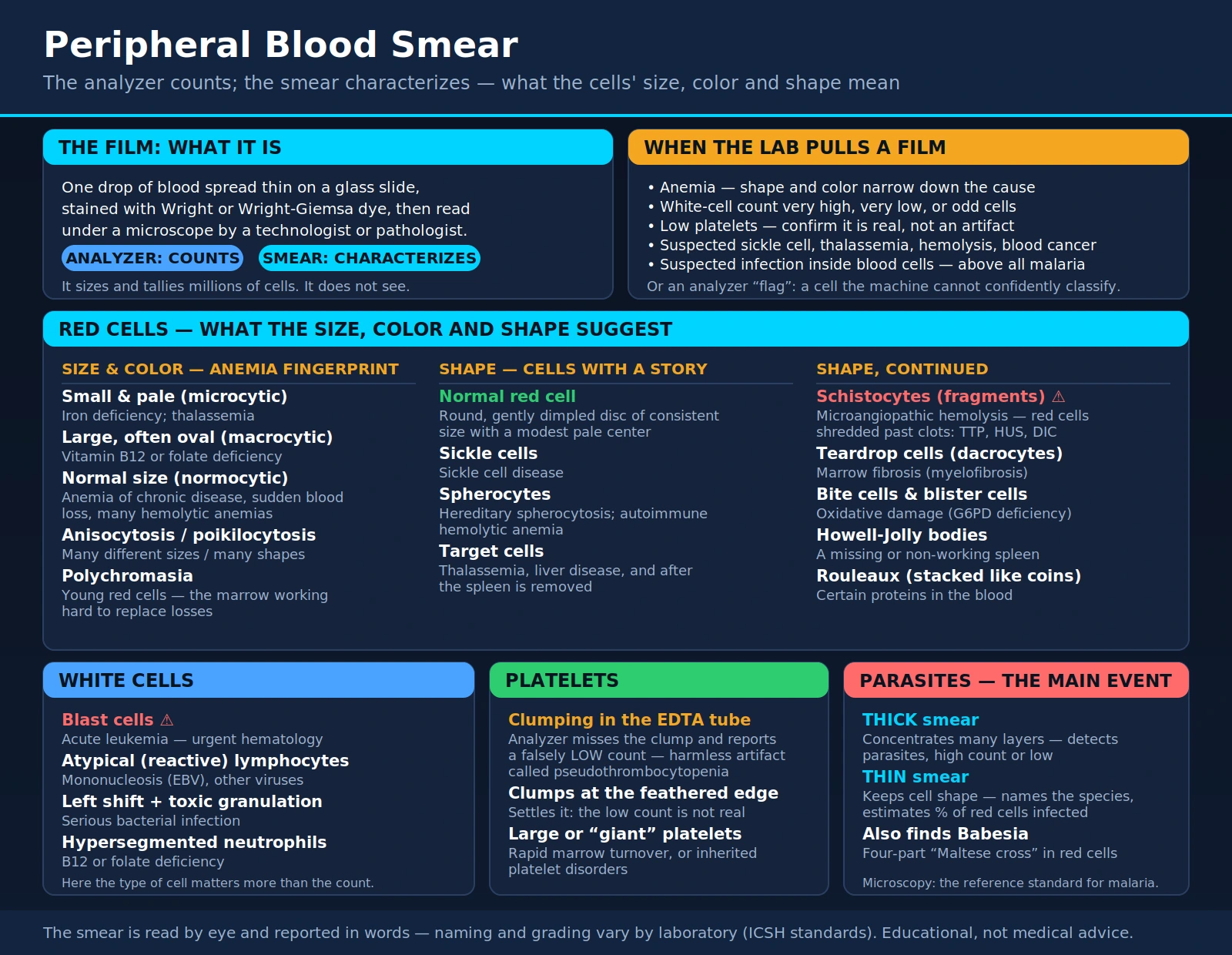
A peripheral blood smear — also called a blood film — is one of the oldest and most human tests in all of medicine. A single drop of your blood is spread into a thin layer on a glass slide, stained with dye, and examined under a microscope by a trained technologist or pathologist. Instead of just counting your blood cells the way an automated machine does, a person actually looks at them — at the size, shape, color, and character of your red cells, white cells, and platelets. It is the visual complement to the automated Complete Blood Count (CBC): the analyzer tells you how many, and the smear tells you what they look like. That distinction matters, because many blood problems announce themselves through the appearance of the cells long before anything else does. This page explains, in plain language, what a blood smear is, why your doctor might order one, and the remarkable range of things a skilled eye can read from a stained slide — including finding malaria parasites hiding inside red cells.
Table of Contents
- What a Blood Smear Is
- Why Your Doctor Orders One
- What Red Blood Cells Can Reveal
- What White Blood Cells Can Reveal
- What Platelets Can Reveal
- The Special Case: Finding Parasites
- How the Smear Is Made and Read
- Related Tests
- When to Talk to a Doctor
- Research Papers
- Connections
- Featured Videos
What a Blood Smear Is
The procedure itself is simple and unglamorous. A drop of blood — usually taken from the same tube drawn for your CBC, sometimes straight from a finger-stick — is placed near one end of a glass slide. A second slide is used to drag that drop across the surface, leaving behind a smear that is thick at one end and thins out to a single-cell-deep "feathered edge" at the other. The slide is then dried and dipped in a stain (most commonly a Wright or Wright-Giemsa stain) that turns the otherwise colorless cells into a palette of pinks, purples, and blues. Only then does it go under the microscope.
What the examiner is doing is fundamentally different from what a machine does. An automated hematology analyzer is superb at counting — it can size and tally millions of cells in seconds and report averages with great precision. But it does not truly see. It cannot recognize a sickle cell as a sickle cell, spot a single leukemia cell among thousands of normal ones, or notice a parasite curled inside a red cell. The smear is where human pattern recognition takes over: the analyzer counts, and the smear characterizes. Reviewing the film lets a trained eye judge the size, shape, and color of red cells; sort and describe the white cells one by one; and confirm that platelets are genuinely present in normal numbers. In short, the smear turns a page of numbers into a picture.
Why Your Doctor Orders One
Most blood smears are not ordered on their own — they arrive as a follow-up. In a typical modern lab, the CBC runs first on an automated analyzer, and the smear is triggered when something about those results does not add up. That trigger can be a frankly abnormal number (a very low hemoglobin, a strikingly high or low white-cell count, a low platelet count) or a more subtle "flag" the analyzer raises when it encounters a cell it cannot confidently classify. When the machine essentially says "I am not sure what I am looking at," a person is asked to look instead.
The common reasons a smear is requested include:
- Investigating anemia — when the blood is low in hemoglobin and the doctor wants to know why, the shape and color of the red cells narrow the possibilities dramatically.
- Abnormal white-cell counts — a count that is very high, very low, or accompanied by unusual cells needs a human differential to sort out infection, inflammation, or something more serious.
- Low platelets — to confirm the low count is real and not a laboratory artifact (more on this below).
- Suspected blood disorders — when a doctor is thinking about conditions such as sickle cell disease, thalassemia, a hemolytic anemia, or a blood cancer.
- Suspected infection with an organism that lives in blood cells — above all, malaria.
A useful way to think about it: the CBC is the screening test that scans everyone quickly, and the smear is the closer look the lab takes when the screen raises a question worth answering with human eyes. Formal laboratory guidelines even lay out criteria for exactly when a stained film should be reviewed rather than reported on machine numbers alone.
What Red Blood Cells Can Reveal
Red blood cells are where the smear is most eloquent, because so many diseases leave a signature in their size, color, and shape. Healthy red cells are remarkably uniform: round, gently dimpled discs of consistent size with a modest pale center. Departures from that norm are clues.
Size and color: the anemia fingerprint
Two features — how big the red cells are and how much hemoglobin (color) they carry — sort anemia into broad families:
- Small and pale (microcytic, hypochromic). Red cells that are smaller than normal with an enlarged pale center point strongly toward iron deficiency, the world's most common anemia, and toward thalassemia. On the film the cells look shrunken and washed-out, with only a thin rim of color.
- Large, often oval (macrocytic). Red cells that are larger than normal, sometimes distinctly oval, suggest a vitamin B12 or folate deficiency. These "oval macrocytes" frequently travel with hypersegmented neutrophils among the white cells — a combination that is close to a signature of that kind of deficiency.
- Normal-sized (normocytic). Red cells of ordinary size accompany anemias of chronic disease, sudden blood loss, and many hemolytic anemias, and push the search toward other clues.
Shape: cells with a story
Certain red-cell shapes are so characteristic that a single glance can reorient the whole investigation:
- Sickle cells — rigid, crescent- or banana-shaped red cells are the hallmark of sickle cell disease, caused by an abnormal hemoglobin that polymerizes and deforms the cell.
- Spherocytes — small, round, densely stained cells that have lost their pale center. They appear in hereditary spherocytosis and in autoimmune hemolytic anemia, where the spleen has been nibbling away at the cell membrane.
- Target cells — cells with a bull's-eye of color in the middle, seen in thalassemia, liver disease, and after the spleen is removed.
- Schistocytes (fragments) — jagged, broken pieces of red cell. These are among the most important findings on any smear, because they signal microangiopathic hemolysis: red cells being physically shredded as they squeeze past tiny clots or damaged vessels. A significant number of schistocytes raises the alarm for serious, sometimes emergency conditions such as thrombotic thrombocytopenic purpura (TTP), hemolytic uremic syndrome (HUS), and disseminated intravascular coagulation (DIC). Their identification and counting are formally standardized precisely because so much hangs on getting them right.
- Teardrop cells (dacrocytes) — red cells pulled into a teardrop shape as they are squeezed out of a marrow that is scarred or crowded, classically in marrow fibrosis (myelofibrosis).
- And more — "bite cells" and blister cells hint at oxidative damage (as in G6PD deficiency); Howell-Jolly bodies (small dark dots inside red cells) suggest a missing or non-working spleen; rouleaux (red cells stacked like coins) can accompany certain proteins in the blood.
The examiner also notes overall variation — the general terms are anisocytosis (cells of many different sizes) and poikilocytosis (cells of many different shapes) — and looks for young red cells (polychromasia), a hint that the marrow is working hard to replace losses.
What White Blood Cells Can Reveal
On the smear, the white cells get a manual differential: the examiner sorts them by eye into their families — neutrophils, lymphocytes, monocytes, eosinophils, basophils — and, crucially, notices any cells that should not be there at all. This is one of the places where the human eye still decisively outperforms the machine, because the most important white-cell findings are not about numbers but about the type of cell present.
The findings that make an examiner sit up include:
- Blast cells — large, immature cells that normally stay locked inside the bone marrow. Finding blasts circulating in the blood is a red-flag finding that can indicate acute leukemia and prompts urgent hematology involvement. Modern classification of these leukemias still begins with what the cells look like on the film, alongside genetic testing.
- Atypical (reactive) lymphocytes — enlarged, activated-looking lymphocytes that are the classic footprint of infectious mononucleosis (Epstein-Barr virus) and other viral infections. These are reassuring in context — a reaction, not a cancer — and telling them apart from blasts is exactly the kind of judgment a person makes better than a machine.
- A "left shift" and toxic changes — in serious bacterial infection the marrow ships out younger neutrophils (a left shift), and those cells often show toxic granulation, Döhle bodies, and vacuoles — visible signs that the immune system is fighting hard.
- Hypersegmented neutrophils — neutrophils with too many nuclear lobes, a quiet but reliable sign of B12 or folate deficiency that ties back to the large red cells described above.
What Platelets Can Reveal
Platelets are the smallest of the three cell lines, and the smear plays a special role in judging them — because the automated count can be fooled. The most common trap is platelet clumping. In some people, the anticoagulant (EDTA) used in the collection tube causes platelets to stick together in clumps. The analyzer sees a clump and does not recognize it as platelets, so it reports a falsely low count — a harmless laboratory artifact called pseudothrombocytopenia. A quick look at the smear settles the question immediately: if clumps of platelets are visible at the feathered edge, the low number is an artifact, not a real problem — and the patient is spared an unnecessary and worrying workup.
The smear also confirms a genuinely low platelet count (thrombocytopenia) when the platelets truly are sparse, and it flags unusually large or "giant" platelets, which can appear when the marrow is turning platelets over rapidly or in certain inherited platelet disorders. In every case, the value of the film is the same: it tells you whether the machine's number can be trusted, and it adds description the number alone cannot.
The Special Case: Finding Parasites
There is one setting where the blood smear is not a follow-up but the main event: diagnosing malaria. When Plasmodium parasites infect a person, they take up residence inside the red blood cells, where they grow and multiply. Under the microscope, on a well-stained film, they can be seen directly — small ring-shaped forms and other stages sitting within the red cells. For more than a century the stained blood smear has been the reference standard for malaria diagnosis, and in much of the world it still is.
The technique uses two kinds of film working together:
- A thick smear concentrates many layers of blood into a small area and is used to detect parasites and to judge whether the count is high or low — it is the sensitive screen.
- A thin smear (the ordinary single-layer film) preserves the shape of individual red cells and parasites and is used to identify the species and to estimate the percentage of red cells infected, which guides how severe the case is and how it is treated.
The same approach can reveal babesia, the tick-borne parasite of babesiosis, which also lives inside red cells and can form a distinctive four-part "Maltese cross." Rapid antigen tests and DNA-based tests now assist with malaria diagnosis, but microscopy remains valuable precisely because a trained eye can name the species and count the parasites — information a simple yes/no test does not give. If you want the fuller clinical picture, see our page on Malaria.
How the Smear Is Made and Read
From your side, there is almost nothing to it. The blood is usually the same specimen already drawn for your CBC, so a smear rarely means an extra needle, and there is no special preparation, fasting, or recovery involved. The work happens afterward, in the lab.
A technologist spreads the film using the wedge technique described earlier, dries it, and stains it. Reading then proceeds in stages: a scan at low magnification to survey the overall picture and find the ideal reading area just behind the feathered edge, followed by careful examination at high power and under oil immersion, where individual cells come into sharp focus. If anything unusual or worrying turns up, a pathologist reviews the slide and issues an interpretation.
Why keep a human in the loop at all in an age of fast, precise machines? Because counting and recognizing are different skills. The analyzer is unbeatable at the first — it sizes and tallies enormous numbers of cells quickly and reproducibly. But recognizing a lone blast, distinguishing a reactive lymphocyte from a malignant one, spotting a scattering of schistocytes, or catching a parasite inside a red cell is pattern recognition, and that is where experience and the human eye still matter. The machine gives the numbers; the smear gives the meaning. The two are partners, not rivals.
Related Tests
The smear almost never travels alone. It is one instrument in a small orchestra of blood tests, and its findings usually point to the next one:
- Complete Blood Count (CBC) — the automated companion that comes first and provides the counts and averages the smear then interprets.
- Reticulocyte count — measures how fast the marrow is making new red cells, answering whether an anemia is due to underproduction or to loss and destruction.
- Bone marrow examination — when the smear suggests the trouble lies in the factory itself (as with blasts or teardrop cells), a marrow sample is often the definitive next step.
- Iron studies, ferritin, B12 and folate — to pin down the cause once size and color have sorted the anemia into a family.
- Haptoglobin, LDH, and bilirubin — the hemolysis panel that supports what schistocytes or spherocytes suggest on the film.
When to Talk to a Doctor
The most important thing to understand about a peripheral blood smear is that it is almost always part of a bigger workup that your doctor orders and interprets — not a stand-alone test you would request or read yourself. Its results are descriptive; their meaning comes entirely from the clinical picture around them. A note of "occasional target cells" or "mild anisocytosis" on a report can be completely minor, while other findings demand swift action.
Talk with your doctor when:
- Your CBC was abnormal and a smear was performed — ask what the film showed and how it fits with your symptoms.
- You are being evaluated for anemia, unexplained fatigue, easy bruising or bleeding, recurring infections, or exposure to malaria while traveling.
- A report mentions findings such as blasts, schistocytes, or parasites, which typically prompt prompt, sometimes urgent, follow-up.
Used well, the blood smear is one of medicine's great bargains: inexpensive, fast, and astonishingly informative in the right hands. But it is a window, not a verdict. Your doctor combines what the slide shows with your history, your examination, and other tests to reach the actual diagnosis. This page is here to help you understand that window — it is educational, and not a substitute for professional medical advice.
Research Papers
- Bain BJ. Diagnosis from the Blood Smear. New England Journal of Medicine. 2005;353(5):498-507. doi:10.1056/NEJMra043442 — the classic clinical review of how much can be learned by looking directly at a stained film.
- Gulati G, Song J, Florea AD, Gong J. Purpose and Criteria for Blood Smear Scan, Blood Smear Examination, and Blood Smear Review. Annals of Laboratory Medicine. 2013;33(1):1-7. doi:10.3343/alm.2013.33.1.1 — spells out exactly when a stained film should be reviewed rather than reported on machine numbers alone.
- Ford J. Red blood cell morphology. International Journal of Laboratory Hematology. 2013;35(3):351-357. doi:10.1111/ijlh.12082 — a practical guide to reading the size, color, and shape of red cells.
- Palmer L, Briggs C, McFadden S, Zini G, et al. ICSH recommendations for the standardization of nomenclature and grading of peripheral blood cell morphological features. International Journal of Laboratory Hematology. 2015;37(3):287-303. doi:10.1111/ijlh.12327 — the international standard for naming and grading what is seen on a film.
- Urrechaga E, Hoffmann JJML, Izquierdo S, Escanero JF. Differential diagnosis of microcytic anemia: the role of microcytic and hypochromic erythrocytes. International Journal of Laboratory Hematology. 2015;37(3):334-340. doi:10.1111/ijlh.12290 — how small, pale red cells help separate iron deficiency from thalassemia.
- Perrotta S, Gallagher PG, Mohandas N. Hereditary spherocytosis. The Lancet. 2008;372(9647):1411-1426. doi:10.1016/S0140-6736(08)61588-3 — the disorder behind spherocytes, in which the film is a central diagnostic clue.
- Zini G, d'Onofrio G, Briggs C, Erber W, et al. ICSH recommendations for identification, diagnostic value, and quantitation of schistocytes. International Journal of Laboratory Hematology. 2012;34(2):107-116. doi:10.1111/j.1751-553X.2011.01380.x — why counting fragmented red cells accurately matters so much.
- George JN, Nester CM. Syndromes of Thrombotic Microangiopathy. New England Journal of Medicine. 2014;371(7):654-666. doi:10.1056/NEJMra1312353 — the emergency conditions (TTP, HUS, and related) heralded by schistocytes on the smear.
- Arber DA, Orazi A, Hasserjian R, et al. The 2016 revision to the World Health Organization classification of myeloid neoplasms and acute leukemia. Blood. 2016;127(20):2391-2405. doi:10.1182/blood-2016-03-643544 — the framework for the leukemias whose diagnosis often begins with blasts seen on a film.
- Tangpukdee N, Duangdee C, Wilairatana P, Krudsood S. Malaria Diagnosis: A Brief Review. The Korean Journal of Parasitology. 2009;47(2):93-102. doi:10.3347/kjp.2009.47.2.93 — overview of microscopy as the long-standing reference standard for malaria.
- Mathison BA, Pritt BS. Update on Malaria Diagnostics and Test Utilization. Journal of Clinical Microbiology. 2017;55(7):2009-2017. doi:10.1128/JCM.02562-16 — where thick and thin films still fit alongside rapid and molecular tests.
- Vannier E, Krause PJ. Human Babesiosis. New England Journal of Medicine. 2012;366(25):2397-2407. doi:10.1056/NEJMra1202018 — the tick-borne parasite that, like malaria, is often first spotted inside red cells on a smear.
Connections
- All Lab Tests
- Complete Blood Count (CBC)
- Reticulocyte Count
- Iron Panel
- Ferritin Test
- Haptoglobin
- Hematology (Blood Disorders)
- Anemia
- Sickle Cell Disease
- Thalassemia
- Malaria
- Vitamin B12