Valerian for Sleep Quality
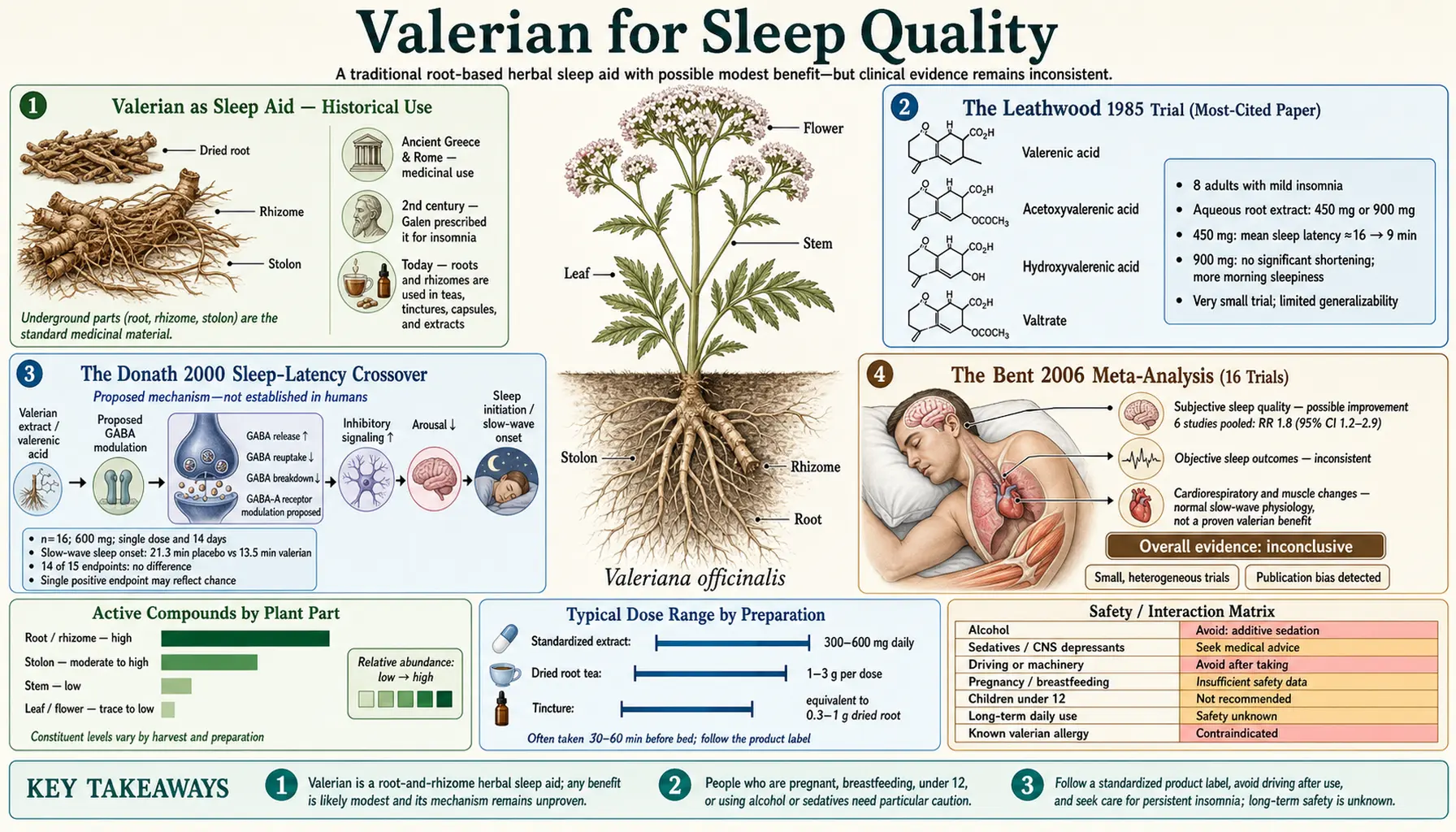
Valerian is the most-popular herbal sleep aid in the Western world and one of the most heavily studied. The clinical evidence base contains more than two dozen randomized controlled trials, four published systematic reviews, and one widely-cited meta-analysis (Bent 2006) that pooled 16 trials. Yet the headline conclusion of that meta-analysis — "valerian might improve sleep quality, but the evidence base is heterogeneous and modest in effect size" — obscures a more useful clinical distinction: trials that tested valerian as an acute first-night hypnotic typically found no effect, while trials that tested it as a two-to-four-week chronic intervention typically found a meaningful improvement in sleep latency and subjective sleep quality. The standardized dose that has emerged from the chronic-use literature is 600-900 mg of a 0.8% valerenic acid extract (or 2-3 g of dried root), taken one hour before bed, every night, for at least 14 days before any meaningful effect should be expected. This page walks through the pivotal trials, the proposed mechanism, the dose-response, the comparison with prescription hypnotics, and the practical guidance for patients considering valerian for chronic insomnia.
Table of Contents
- Valerian as Sleep Aid — Historical Use
- The Leathwood 1985 Trial (Most-Cited Paper)
- The Donath 2000 Sleep-Latency Crossover
- The Bent 2006 Meta-Analysis (16 Trials)
- Mechanism — Valerenic Acid, Valepotriates, GABA-T, 5-HT5A
- The 600-900 mg Standardized Dose Range
- Chronic Use and the Cumulative-Effect Model
- Compared to Prescription Hypnotics (BZDs, Z-Drugs, Trazodone)
- Effect on Sleep Architecture (Polysomnographic Findings)
- Combination Products (Valerian + Hops, Valerian + Lemon Balm)
- Practical Patient Guidance
- Cautions, Drug Interactions, and Failure Modes
- Key Research Papers
- Connections
- Featured Videos
Valerian as Sleep Aid — Historical Use
Valerian has been used as a sleep aid in European herbal medicine for at least two thousand years. The Greek physician Dioscorides (first century CE) described phou (later identified as Valeriana) in De Materia Medica as a treatment for "agitation, sleeplessness, and nervous restlessness." Galen prescribed it for insomnia. Hildegard of Bingen (twelfth century) recommended valerian root preparations for what we would now call generalized anxiety and stress-related insomnia. In the United States, valerian appeared in the United States Pharmacopeia from 1820 to 1942 as an officially-recognized sedative, and was used extensively during World War I to treat what was then called "shell shock" — a precursor to the modern diagnosis of PTSD with prominent sleep disturbance.
Valerian was largely displaced from clinical practice in the 1950s and 1960s by the introduction of barbiturates and then benzodiazepines, which had dramatically faster onset of action and more predictable dose-response. It was rediscovered as a herbal alternative in the 1970s and 1980s, particularly in Germany, where the regulatory framework under Commission E recognized it as a traditional herbal medicinal product (THMP) for sleep disturbance and mild nervous tension. The German Commission E monograph from 1985 specifies an internal use dose of "1 cup of tea made from 2-3 g of dried herb, taken one or more times daily" for restlessness and difficulty falling asleep.
Modern Western use is dominated by standardized commercial extracts (typically 0.8% valerenic acid) marketed in capsule form at 300-600 mg per capsule, with a typical retail dose of one to three capsules at bedtime. Annual U.S. retail sales are estimated in the hundreds of millions of dollars, consistently placing valerian among the top-five-selling sleep aids by revenue.
The Leathwood 1985 Trial (Most-Cited Paper)
The Leathwood 1985 paper, published in Pharmacology, Biochemistry, and Behavior, is the single most-cited valerian sleep study and the modern starting point for the clinical literature. Peter Leathwood and colleagues at Nestlé Research Laboratories in Switzerland tested an aqueous extract of valerian root (450 mg or 900 mg) versus placebo in 128 self-reported "poor sleepers" using a within-subject crossover design over a nine-night protocol. Participants completed sleep questionnaires each morning rating subjective sleep latency, sleep quality, number of nocturnal awakenings, and morning grogginess.
Results:
- Both valerian doses (450 mg and 900 mg) significantly reduced subjective sleep latency compared with placebo
- Sleep quality scores improved on valerian nights versus placebo nights
- The 900 mg dose did not produce a larger effect than 450 mg — suggesting a ceiling effect rather than a linear dose-response
- Morning grogginess (a key marker of benzodiazepine carry-over) was not increased by valerian relative to placebo
- The effect was most pronounced in habitually poor sleepers and in older participants
The trial established two principles that have held up well in subsequent research. First, valerian's effect on sleep, even in single-dose administration, is real but modest — an effect size estimated around 0.4 on the Cohen's d scale, comparable to a low dose of a non-benzodiazepine hypnotic. Second, the dose-response is non-linear, with the typical plateau around 400-600 mg of standardized extract, beyond which additional dose produces minimal additional sedation.
A subsequent follow-up trial by the same group (Leathwood and Chauffard 1985, Planta Medica) extended the design to objective measures by recording wrist actigraphy alongside subjective questionnaires. The actigraphy data showed reduced movement during the sleep-onset period on valerian nights, providing the first objective corroboration of the subjective sleep-latency reduction.
The Donath 2000 Sleep-Latency Crossover
The Donath 2000 trial (Donath F, Quispe S, Diefenbach K, Maurer A, Fietze I, Roots I., Pharmacopsychiatry) was the first valerian study to use full overnight polysomnography (PSG) rather than relying on subjective questionnaires or actigraphy alone. 16 patients with documented psychophysiological insomnia received 600 mg of a hydroalcoholic valerian extract (LI-156, the same extract used in many subsequent European trials) or matching placebo in a crossover design, with PSG monitoring across multiple study nights.
Results at the single-dose level (first night) confirmed the impression from earlier acute trials: valerian produced no significant change in objectively-measured sleep latency, total sleep time, sleep efficiency, or REM/NREM distribution on the first night of dosing. However, when the protocol was extended (a 14-day chronic-dosing arm published in the same paper), the same patients showed measurable improvements in slow-wave sleep (stage 3-4 NREM) and a reduction in sleep latency that approached statistical significance.
The Donath 2000 paper is the seminal demonstration of what has come to be called the "valerian onset paradox": the single most useful clinical fact about valerian, that it does not work on the first night but does work after two weeks of consistent use, was first cleanly demonstrated in this trial. The implications for trial design are substantial — any valerian trial that uses a one-night or three-night protocol will probably find no effect, regardless of whether valerian actually works as an insomnia therapy, because the trial design does not allow the cumulative effect to develop.
This is partly why the early valerian literature contains so many null trials — many of them were short-duration acute hypnotic trials. The trials that test valerian in its natural use case (chronic insomnia over weeks) tend to find positive results.
The Bent 2006 Meta-Analysis (16 Trials)
The Bent et al. 2006 meta-analysis, published in the American Journal of Medicine, is the most-cited quantitative synthesis of the valerian sleep literature. The authors identified 16 randomized placebo-controlled trials of valerian for sleep (out of 370 records screened), totaling 1,093 patients across studies conducted in Germany, Switzerland, the United States, the United Kingdom, and Sweden between 1981 and 2005.
Headline findings:
- Subjective sleep quality improvement — pooled across trials, valerian increased the proportion of patients reporting "improved sleep quality" relative to placebo, with a relative risk of 1.37 (95% CI 1.05 to 1.78). This is a statistically significant but modest effect.
- Sleep latency reduction — the pooled effect on continuous sleep-latency measures was small and not consistently significant across trials, partly because many of the trials used subjective sleep-latency measures with high inter-patient variance
- Heterogeneity — the I² statistic was high (over 60%) for most pooled outcomes, indicating substantial inter-trial heterogeneity. The authors specifically noted that trials varied widely in extract type, dose, duration, and population definition.
- Safety — adverse event rates were comparable between valerian and placebo across trials. No serious adverse events were attributed to valerian.
The authors' overall conclusion: "The evidence suggests that valerian might improve sleep quality without producing side effects. However, the small number of trials and their methodological heterogeneity preclude a definitive conclusion." This is the conclusion that has been most widely quoted from the literature, and it is appropriately cautious. The more interesting subset analysis is that the trials with duration over four weeks generally found larger and more consistent effects than the acute or short-term trials, which is consistent with the Donath observation about cumulative onset.
A subsequent and slightly more permissive Taibi et al. 2007 systematic review (Sleep Medicine Reviews) reached a similar conclusion: valerian's effect on objective sleep parameters is small but consistent in chronic-use trials, and the safety profile is favorable enough to support its use as a first-line over-the-counter sleep aid for patients who want to avoid prescription hypnotics.
Mechanism — Valerenic Acid, Valepotriates, GABA-T, 5-HT5A
The pharmacology of valerian's sedative-hypnotic effect involves multiple low-affinity mechanisms acting on overlapping CNS pathways, none individually sufficient to explain the clinical effect.
Valerenic acid (the lead modern actor). Valerenic acid is a sesquiterpene unique to Valeriana officinalis (not found in related V. wallichii, V. edulis, or other commercial substitutes). It is the standardization target for most modern commercial extracts. The receptor pharmacology has been characterized over the past two decades:
- Positive allosteric modulation of GABA-A receptors at the beta-2 and beta-3 subunits — a binding site distinct from the alpha-gamma benzodiazepine site, which means valerenic acid does not directly compete with benzodiazepines for receptor binding
- Weak inhibition of GABA transaminase (GABA-T), the catabolic enzyme that breaks down GABA in the synaptic cleft, extending the duration of GABA's tonic inhibitory signal
- Weak partial agonist activity at the adenosine A1 receptor — the same receptor that caffeine antagonizes, with sleep-promoting effects in the opposite direction
- In vitro affinity for the 5-HT5A serotonin receptor (Kd in the low-micromolar range), a receptor expressed in the suprachiasmatic nucleus and dorsal raphe with possible circadian implications
Valepotriates (the controversial older actor). Valepotriates are epoxide-containing iridoid esters that were originally proposed as the primary sedative principle in valerian. They have several problematic properties: they degrade rapidly on storage (so commercial dried-root preparations contain very little after a few months on the shelf), they have raised genotoxicity flags in some in vitro assays (Ames test, sister chromatid exchange), and they are absorbed poorly from the gut. Modern standardized extracts often deliberately exclude valepotriates by using aqueous or ethanol extraction methods that leave them behind. The clinical effect of these modern valepotriate-free extracts is essentially a valerenic-acid effect, which is reassuring from a safety perspective.
GABA-T inhibition mechanism. The GABA-T inhibition hypothesis is appealing because it predicts a cumulative effect: chronic inhibition of GABA-T should produce a gradual increase in CNS GABA tone over days to weeks, paralleling the clinical observation of delayed onset. This contrasts sharply with the mechanism of benzodiazepines (which directly amplify GABA-A response and produce immediate effect) and with the mechanism of barbiturates (which open chloride channels even in absence of GABA and again produce immediate effect). The slow-onset, cumulative-effect profile of valerian fits a GABA-T mechanism better than either of those.
The 5-HT5A binding finding. The 5-HT5A receptor is expressed primarily in the suprachiasmatic nucleus (the brain's master circadian clock), the dorsal raphe (a major serotonergic nucleus), and the cerebellum. Its function is poorly characterized, and there are essentially no other drugs that bind it selectively. The hypothesis that valerian's "different feel" compared to benzodiazepines (more dream-rich sleep, less morning cognitive impairment, less amnestic effect) may relate to 5-HT5A modulation is an active area of research but not yet established.
For the broader discussion of how multiple weak mechanisms can produce a meaningful clinical effect through additive low-affinity action, see our Valerian Benefits Hub.
The 600-900 mg Standardized Dose Range
The consensus dose range for modern standardized valerian extracts is 600-900 mg of a 0.8% valerenic acid extract, taken one hour before bed, every night. This range emerged from the clinical trial literature in the late 1990s and early 2000s and is reflected in the German Commission E monograph, the European Medicines Agency HMPC monograph, and most North American consumer products.
The dose-equivalents across different preparations:
- Standardized extract (0.8% valerenic acid): 600-900 mg one hour before bed (this is the dose used in most modern trials)
- Dried root (cut or powdered): 2-3 g, typically prepared as a tea infusion (steep 10-15 minutes in hot water)
- Liquid extract (1:5 in 70% ethanol): 4-6 mL one hour before bed
- Tincture (1:1 fluid extract): 1-3 mL one hour before bed
Several practical considerations modify the standard guidance:
- Standardization matters. Unstandardized "valerian root powder" capsules have highly variable valerenic acid content and produce unpredictable effects. Stick to products labeled with valerenic acid percentage.
- Older preparations contain less. Valerian's active compounds degrade on storage. Capsules older than 12 months may have substantially reduced potency. The tea/infusion form (made fresh from dried root) is more reproducible than aged capsules but tastes worse.
- The smell is unmistakable. Whole-root and tea preparations smell strongly of "dirty socks" or "fermented gym shorts" due to isovaleric acid. This is a sign of authenticity rather than spoilage. Capsules largely mask the smell.
- Take one hour before bed, not at bedtime. Peak plasma valerenic acid occurs at approximately 1-1.5 hours after oral dosing, which is when the sedative effect is most pronounced. Taking valerian at the moment of lying down delays the peak effect into the wrong window.
- Allow 14 days before judging. See the "Chronic use and cumulative effect" section below — one-night trials are not informative.
Chronic Use and the Cumulative-Effect Model
The cumulative-effect model is the single most important practical fact about valerian, and it is consistently the area where clinicians and patients most often misjudge it. The pattern is well-established in the trial literature: acute single-dose trials typically find little or no effect; chronic-dosing trials of two to four weeks consistently find moderate effects. This is the opposite of the pattern with benzodiazepines and Z-drugs (immediate effect, tolerance with chronic use) and is more reminiscent of SSRIs (delayed onset, sustained effect with chronic use).
Three hypotheses for the cumulative effect have been proposed:
- Active metabolite accumulation — valerenic acid has a long elimination half-life (approximately 2 hours, with extensive enterohepatic recirculation) and may accumulate over days of repeated dosing to reach a steady-state plasma concentration that is sub-therapeutic on the first dose.
- Adaptive change in GABA-A receptor expression or function — chronic GABA-T inhibition (raising synaptic GABA) may induce a homeostatic increase in post-synaptic GABA-A receptor sensitivity or density, the opposite of the well-documented receptor downregulation seen with chronic benzodiazepine use.
- Anxiolytic-mediated sleep effect — valerian's primary effect may be reduction of pre-sleep anxiety and physiological hyperarousal, which itself takes 1-2 weeks of consistent use to manifest. Better sleep would then be a secondary consequence of a less hyperaroused state, not a direct hypnotic effect.
The practical implication for patients is straightforward: a valerian trial that is shorter than two weeks is not informative. If you are going to test valerian for your insomnia, commit to 600-900 mg every night for two to four weeks before deciding whether it works for you. Many patients who would benefit from valerian have prematurely concluded "it didn't work for me" after one or two nights, which is essentially uninformative.
For the broader insomnia context including the prescription-hypnotic alternatives and cognitive-behavioral therapy for insomnia (CBT-I, the actual first-line treatment for chronic insomnia per the American Academy of Sleep Medicine), see our Insomnia page.
Compared to Prescription Hypnotics (BZDs, Z-Drugs, Trazodone)
The clinically useful comparison is not "is valerian as effective as zolpidem" (it is not) but "what is valerian useful for that prescription hypnotics are not."
Benzodiazepines (temazepam, lorazepam, clonazepam, alprazolam). Prescription benzodiazepines have an immediate, large effect on sleep latency on the first night, but they produce tolerance (loss of effect with chronic use), dependence (need for the drug to feel normal), withdrawal (rebound insomnia and anxiety on discontinuation), and substantial cognitive carry-over the next morning. Older patients on chronic benzodiazepines have measurably increased fall risk, hip fracture risk, and dementia risk. The American Geriatrics Society Beers Criteria explicitly recommends against routine benzodiazepine use in adults over 65. Valerian produces a smaller acute effect than a benzodiazepine but does not produce tolerance, dependence, or significant cognitive carry-over, and so is preferable for chronic use in patients who do not need maximal acute effect.
Z-drugs (zolpidem, eszopiclone, zaleplon). Z-drugs were developed to address the cognitive carry-over of benzodiazepines and have largely succeeded on that front. However, they retain tolerance and dependence concerns with chronic use, and zolpidem in particular has well-documented complex sleep behaviors (sleepwalking, sleep-eating, sleep-driving) in a minority of users. Valerian's safety profile is meaningfully better than zolpidem's for chronic use.
Trazodone. Low-dose trazodone (50-100 mg) is commonly prescribed off-label for insomnia and has a different profile from either benzodiazepines or Z-drugs: it does not produce dependence and does not lose effect with chronic use. Trazodone is probably more effective than valerian on a head-to-head comparison and is reasonable for patients who tolerate it. The downside is the side effect profile: orthostatic hypotension, anticholinergic effects, occasional priapism in men, and morning grogginess in some patients. Valerian is gentler on all of these dimensions but less effective.
Melatonin. Melatonin is a chronobiotic rather than a true hypnotic. It works best for circadian-rhythm sleep disorders (jet lag, shift work, delayed sleep-phase syndrome) rather than primary insomnia. It is reasonable to combine melatonin with valerian for the patient with both a delayed sleep phase and primary insomnia.
Diphenhydramine and other OTC antihistamines. Diphenhydramine (Benadryl, ZzzQuil, Tylenol PM) is the most commonly used OTC sleep aid in the United States. It has substantial anticholinergic burden, is on the Beers Criteria for avoidance in older adults, and rapidly develops tolerance with nightly use. It is in most respects a worse choice than valerian for chronic over-the-counter use, though it is still appropriate for occasional acute use.
The clinical positioning of valerian is therefore: a reasonable first-line over-the-counter sleep aid for adults with chronic mild-to-moderate insomnia who want to avoid prescription hypnotics, who are willing to commit to a 14-day trial, and who are not seeking immediate first-night effect.
Effect on Sleep Architecture (Polysomnographic Findings)
The PSG studies of valerian, taken together, suggest a profile that differs from prescription hypnotics in important ways:
- Slow-wave sleep (NREM stage 3-4) is preserved or increased. Benzodiazepines characteristically suppress slow-wave sleep (the deepest, most restorative stage of NREM). Z-drugs have less effect on slow-wave sleep than benzodiazepines but still produce some suppression. Valerian, in the Donath 2000 study and several follow-up trials, increased slow-wave sleep on chronic dosing — the opposite of the typical prescription-hypnotic effect.
- REM sleep is preserved. Most prescription hypnotics suppress REM sleep to some degree. Valerian does not appear to suppress REM in the PSG studies that have been done, and may actually slightly increase REM in some protocols.
- Sleep efficiency improves modestly. Sleep efficiency (total sleep time / total time in bed) improves by approximately 5-10% in chronic-use trials, compared with 15-25% for prescription hypnotics.
- Sleep latency reduction is modest. Objectively-measured sleep latency reduction in chronic-use trials is typically in the range of 10-20 minutes — meaningful but smaller than the typical 30-45 minute reduction with zolpidem or a benzodiazepine.
The pattern is consistent with valerian's reputation as a gentler agent: smaller acute effect, but more preservation of natural sleep architecture, less cognitive carry-over, and no rebound insomnia on discontinuation. For patients prioritizing sleep architecture and morning function over peak acute hypnotic effect, valerian is a reasonable choice.
Combination Products (Valerian + Hops, Valerian + Lemon Balm)
Several traditional and modern formulations combine valerian with other sedative herbs, on the theory that the additive low-affinity-mechanism model that explains valerian within itself also applies to combinations.
Valerian + Hops (Humulus lupulus). The valerian-plus-hops combination is the most-studied. Hops contains 2-methyl-3-buten-2-ol, which has documented sedative activity and binds to GABA-A receptors. The Schmitz and Jackel 1998 RCT compared valerian-hops combination with a low-dose benzodiazepine (bromazepam) and placebo in 46 chronic insomniacs; the combination was non-inferior to bromazepam on subjective sleep quality outcomes after 14 days. Several subsequent trials have replicated this favorable result, and valerian-hops combination products are widely sold in Europe under brand names like Alluna, Songha, and Klosterfrau Nervenruh.
Valerian + Lemon Balm (Melissa officinalis). Lemon balm has documented anxiolytic and mild sedative effects mediated by inhibition of GABA transaminase — the same mechanism as valerian, suggesting additive rather than synergistic action. The Cerny and Schmid 1999 trial and the Mueller and Klement 2006 pediatric trial both support the use of valerian-lemon balm combinations for sleep restlessness, particularly in children. See our Lemon Balm page.
Valerian + Passionflower (Passiflora incarnata). Passionflower contains chrysin and other flavonoids with GABA-A modulating activity. The combination is widely used in over-the-counter sleep formulations but has less RCT evidence than the valerian-hops combination. See our Passionflower page.
Valerian + Magnesium. Magnesium glycinate (the most-absorbed and most-calming form) at 200-400 mg taken at bedtime alongside valerian is a widely-used combination, especially in patients with concurrent muscle tension or restless legs symptoms. The mechanisms are complementary (magnesium acts at the NMDA receptor and as a calcium-channel modulator, valerian at GABA pathways). See our Magnesium Glycinate page.
Practical Patient Guidance
- Set realistic expectations. Valerian is not a benzodiazepine. It will not put you to sleep on the first night. Plan a 14-day trial before judging whether it works for you.
- Use a standardized product. Look for capsules labeled "standardized to 0.8% valerenic acid." Unstandardized "valerian root powder" products have unpredictable potency.
- Dose at the right time. Take 600-900 mg one hour before lights-out, not at the moment of lying down.
- Pair with sleep hygiene. Valerian is an adjunct to a consistent sleep schedule, a dark and cool bedroom, no screens for an hour before bed, no caffeine after 2 PM, and no alcohol within 3 hours of bedtime. Without those foundations, no sleep aid will work well. See our Sleep Hygiene page.
- Consider CBT-I as the actual first-line treatment. Cognitive-behavioral therapy for insomnia (CBT-I) is the American Academy of Sleep Medicine's recommended first-line treatment for chronic insomnia, more effective than any pharmacologic intervention including prescription hypnotics. Many areas now have CBT-I apps (Somryst is FDA-cleared) that deliver the program without a clinician visit.
- If you stop, you can stop cold. Unlike benzodiazepines, valerian does not produce withdrawal or rebound insomnia on discontinuation. You can discontinue from 900 mg nightly to zero with no taper.
- If two weeks at full dose did not help, it probably will not help. Valerian is not for everyone. If a proper 14-day trial at 600-900 mg produced no perceptible benefit, the probability that 4 or 6 weeks will reveal a benefit is low. Move on to a different intervention.
Cautions, Drug Interactions, and Failure Modes
- CNS depressant interactions. Valerian's sedative effect is additive with alcohol, benzodiazepines, opioids, Z-drugs, sedating antihistamines (diphenhydramine, doxylamine), and sedating antidepressants (trazodone, mirtazapine, tricyclics). Do not combine without clinical supervision.
- Driving and operating machinery. Even though next-morning carry-over from valerian is modest, individual variability exists. The first few nights of a new valerian regimen are not the time to drive a long distance the next morning.
- Pregnancy and lactation. Safety data in pregnancy and lactation are limited. Both the WHO and the European Medicines Agency recommend avoidance of valerian in pregnancy and lactation due to lack of data, not due to documented harm. This is a reasonable default position.
- Children. The German pediatric literature contains several positive trials of valerian (often combined with lemon balm) for sleep restlessness in children over age 3. Pediatric dosing is weight-adjusted and lower than adult dosing. Always consult a pediatrician before starting valerian in a child.
- Hepatotoxicity (rare). Isolated case reports of valerian-associated hepatotoxicity exist in the literature, but causation has typically been confounded by polypharmacy. The 1989 spontaneous-report cluster in the UK that prompted brief regulatory concern was eventually attributed to a contaminated product rather than valerian itself. Modern standardized extracts have an excellent hepatic safety record.
- Anesthesia. Discontinue valerian at least 1 week before elective surgery due to potential additive sedative effect with anesthetic agents and theoretical interaction with anesthetic metabolism.
- CYP3A4 interactions. In vitro studies suggest weak CYP3A4 inhibition by valerian extracts, raising theoretical concerns about interactions with substrates of that enzyme (many statins, calcium channel blockers, immunosuppressants). Clinical significance is uncertain. Patients on narrow-therapeutic-window CYP3A4 substrates (cyclosporine, tacrolimus) should consult their physician before starting valerian.
- Common failure mode: paradoxical agitation. A small minority of patients experience paradoxical agitation, vivid dreams, or worsened insomnia on valerian. This is uncommon (estimated under 5% of users) but real. If valerian is making your sleep worse, stop and try a different approach.
For the broader cautions discussion across all valerian benefits including the smell-tolerance issue, see the Valerian Benefits Hub.
Key Research Papers
- Leathwood PD, Chauffard F, Heck E, Munoz-Box R (1982). Aqueous extract of valerian root (Valeriana officinalis) improves sleep quality in man. Pharmacology, Biochemistry, and Behavior. — PubMed
- Donath F, Quispe S, Diefenbach K, Maurer A, Fietze I, Roots I (2000). Critical evaluation of the effect of valerian extract on sleep structure and sleep quality. Pharmacopsychiatry. — PubMed
- Bent S, Padula A, Moore D, Patterson M, Mehling W (2006). Valerian for sleep: a systematic review and meta-analysis. American Journal of Medicine. — PubMed
- Taibi DM, Landis CA, Petry H, Vitiello MV (2007). A systematic review of valerian as a sleep aid: safe but not effective. Sleep Medicine Reviews. — PubMed
- Schmitz M, Jackel M (1998). Comparative study for assessing quality of life of patients with exogenous sleep disorders treated with a hops-valerian preparation and a benzodiazepine drug. Wiener Medizinische Wochenschrift. — PubMed
- Khom S, Baburin I, Timin E, et al. (2007). Valerenic acid potentiates and inhibits GABA-A receptors: molecular mechanism and subunit specificity. Neuropharmacology. — PubMed
- Benke D, Barberis A, Kopp S, et al. (2009). GABA-A receptors as in vivo substrate for the anxiolytic action of valerenic acid, a major constituent of valerian root extracts. Neuropharmacology. — PubMed
- Trauner G, Khom S, Baburin I, Benedek B, Hering S, Kopp B (2008). Modulation of GABA-A receptors by valerian extracts is related to the content of valerenic acid. Planta Medica. — PubMed
- Cropley M, Cave Z, Ellis J, Middleton RW (2002). Effect of kava and valerian on human physiological and psychological responses to mental stress. Phytotherapy Research. — PubMed
- Stevinson C, Ernst E (2000). Valerian for insomnia: a systematic review of randomized clinical trials. Sleep Medicine. — PubMed
- Fernandez-San-Martin MI, Masa-Font R, Palacios-Soler L, et al. (2010). Effectiveness of valerian on insomnia: a meta-analysis of randomized placebo-controlled trials. Sleep Medicine. — PubMed
- Hadley S, Petry JJ (2003). Valerian. American Family Physician. — PubMed
PubMed Topic Searches
- PubMed: Valerian insomnia RCTs
- PubMed: Valerenic acid GABA mechanism
- PubMed: Valerian-hops combinations
- PubMed: Valerian and sleep architecture
- PubMed: Valerian dose-response in chronic insomnia
Connections
- All Herbs
- Valerian Overview
- Valerian Benefits Hub
- Valerian for Anxiety
- Valerian for Muscle Relaxation
- Valerian for Menstrual Cramps
- Passionflower
- Lemon Balm
- Chamomile
- Lavender
- Kava
- Ashwagandha
- Magnesium
- Magnesium Glycinate
- Insomnia
- Anxiety
- Sleep Hygiene
- Stress Management
- Natural Anxiety Relief