Stevia, the Gut Microbiome and Safety
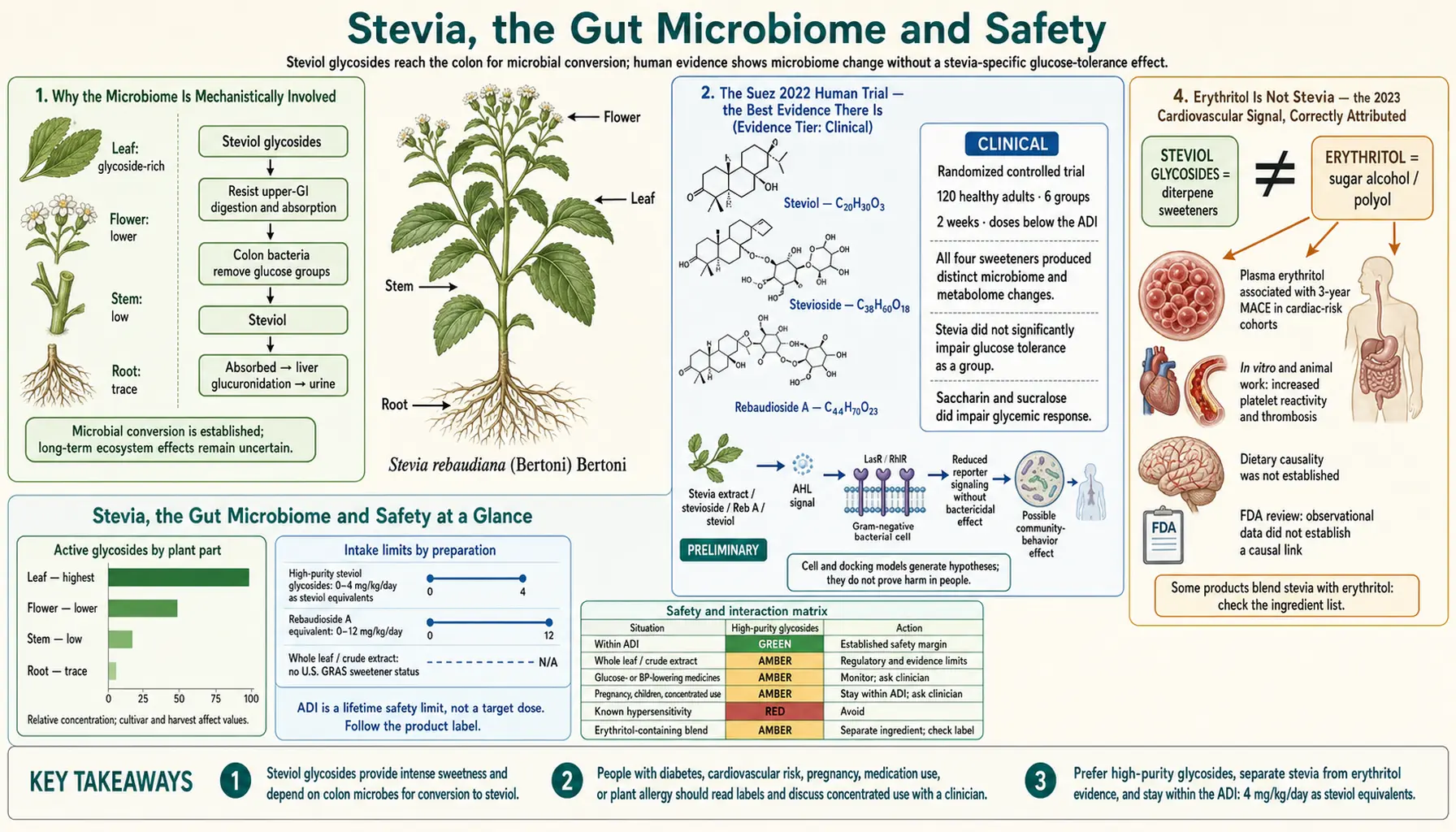
Stevia is unusual among sweeteners in that gut bacteria are not bystanders to its metabolism — they are a required step. Steviol glycosides are not absorbed in the small intestine; they arrive intact in the colon, and it is bacterial enzymes that release the steviol core which the body then absorbs and excretes. Any question about stevia and the microbiome is therefore a legitimate mechanistic question rather than a manufactured scare.
Whether that interaction matters for health is genuinely unresolved, and this page describes it as unresolved in both directions. It also handles the one thing that trips up nearly every news story on the subject: the 2023 cardiovascular signal attached to erythritol, which is the bulking agent in most retail stevia packets and is not stevia at all.
Table of Contents
- Why the Microbiome Is Mechanistically Involved
- The Suez 2022 Human Trial
- In Vitro and Quorum-Sensing Work
- Erythritol Is Not Stevia — the 2023 Signal Explained
- Reading the Label: Which Product Is in Your Hand
- The ADI and What It Actually Permits
- Whole Leaf and the Missing Dossier
- Allergy and the Asteraceae Question
- Pregnancy, Children, Kidneys and Medications
- Digestive Tolerance
- Key Research Papers
- Safety Note and Disclaimer
- Connections
1. Why the Microbiome Is Mechanistically Involved
Human digestive enzymes cannot break the beta-glucosidic bonds linking glucose and rhamnose units to the steviol core, and the intact glycosides are too large and polar to cross the intestinal wall. So they travel the full length of the small intestine and reach the colon essentially unchanged.
There, bacteria — chiefly Bacteroides species, which possess the relevant glycosidases — strip off the sugars and release free steviol. Steviol is small and lipophilic, crosses the colonic wall, is carried to the liver, conjugated with glucuronic acid, and excreted as steviol glucuronide in the urine. There is no accumulation in tissue. This pathway was characterised in work such as Metabolism of stevioside and rebaudioside A from Stevia rebaudiana extracts by human microflora (Journal of Agricultural and Food Chemistry, 2003) and confirmed in human pharmacokinetic and metabolic-fate studies including Metabolic fate in adult and pediatric population of steviol glycosides produced from stevia leaf and bioconversion (Regulatory Toxicology and Pharmacology, 2020).
An aside that matters when reading older toxicology: rats excrete steviol largely unconjugated in bile and faeces, while humans excrete steviol glucuronide in urine. Rodent studies are therefore not straightforwardly transferable.
2. The Suez 2022 Human Trial — the Best Evidence There Is (Evidence Tier: Clinical)
Suez and colleagues (2022), Personalized microbiome-driven effects of non-nutritive sweeteners on human glucose tolerance, published in Cell, is the most rigorous study on this question and deserves to be reported precisely, because it is routinely mis-summarised in both directions.
Design: healthy adults who did not normally consume non-nutritive sweeteners were randomized to saccharin, sucralose, aspartame, stevia, a glucose control, or no supplement, at doses below the ADI, for two weeks. Gut and oral microbiomes were profiled, glycaemic responses measured, and faecal samples from participants were transplanted into germ-free mice.
Findings:
- All four sweeteners, stevia included, altered the composition and function of the gut and oral microbiome. That is a real finding and it is what most headlines reported.
- Only saccharin and sucralose significantly impaired glycaemic responses. Stevia and aspartame did not. That is the half that usually gets dropped.
- Faecal transplants from the responding participants into germ-free mice transferred the glycaemic impairment — strong causal evidence that the microbiome was the mediating mechanism for the sweeteners where an effect occurred.
- Responses were highly individual. Some participants responded markedly, others not at all, and the researchers could partly predict who from baseline microbiome composition.
The honest reading: stevia changes the microbiome measurably; that change did not translate into impaired glucose tolerance over two weeks; and two weeks in healthy adults does not settle what happens over decades. A microbiome shift is not automatically harmful — diet changes the microbiome constantly — but it is not automatically benign either.
PubMed: the Suez 2022 sweetener microbiome trial
3. In Vitro and Quorum-Sensing Work (Evidence Tier: Preliminary)
A body of laboratory work has examined steviol glycosides against bacterial cultures and simulated gut systems.
- Quorum sensing. Studies such as Inhibitory effects of artificial sweeteners on bacterial quorum sensing (International Journal of Molecular Sciences, 2021) report that several sweeteners including steviol glycosides can interfere with the chemical signalling bacteria use to coordinate group behaviour, at concentrations plausibly reachable in the gut. This is hypothesis-generating. Quorum-sensing interference is not the same as killing bacteria, and its consequences for a whole community in a living colon are unknown.
- Community composition in vitro. Reviews such as The effects of stevia consumption on gut bacteria: friend or foe? (Microorganisms, 2022) and Effects of sweeteners on the gut microbiota: a review of experimental studies and clinical trials (Advances in Nutrition, 2019) survey this literature and reach the same conclusion: results are inconsistent, models differ wildly, doses used in vitro often far exceed realistic intake, and human data are scarce.
Treat every in-vitro finding here as a research direction, not a health claim. Bath concentrations in a flask routinely exceed anything achievable in a person by orders of magnitude.
PubMed: steviol glycosides and gut microbiota
4. Erythritol Is Not Stevia — the 2023 Cardiovascular Signal, Correctly Attributed
This section exists because the point is almost universally garbled, including by outlets that should know better.
In 2023, Witkowski and colleagues published The artificial sweetener erythritol and cardiovascular event risk in Nature Medicine. The study combined untargeted metabolomics in patients undergoing cardiac risk assessment, independent validation cohorts in the United States and Europe, platelet function experiments, an arterial-injury mouse model, and an intervention in which volunteers drank an erythritol-containing beverage. Higher circulating erythritol was associated with increased risk of major adverse cardiovascular events; erythritol enhanced platelet reactivity and thrombosis in the experimental work; and ingesting a typical erythritol-sweetened drink raised plasma erythritol far above the levels associated with risk, for days.
Now the part that matters here:
- Erythritol is a sugar alcohol. It is not a steviol glycoside and has no chemical relationship to stevia whatsoever. It is manufactured by fermenting glucose with yeast, and is also produced endogenously in the human body from glucose via the pentose phosphate pathway — which is one of the interpretive difficulties with the study, since endogenous production may itself be a marker of metabolic dysfunction rather than a consequence of intake.
- The reason it appears in a discussion of stevia is purely commercial: erythritol is the bulking agent that fills the spoon in most retail "stevia" packets and tubs. A rebaudioside is 200 to 400 times sweeter than sugar, so a teaspoon-equivalent is only a few milligrams; the remaining 99-plus per cent of the packet is something else.
- Consequently a product labelled "stevia" can deliver a substantial erythritol dose while containing a trace of actual stevia extract. Anyone concerned by the erythritol findings should be reading ingredient lists, not avoiding steviol glycosides.
- The findings are associative plus mechanistic, not a randomized outcome trial. Reviews such as Erythritol: an in-depth discussion of its potential to be a beneficial dietary component (Nutrients, 2023) have set out the counter-arguments, particularly around reverse causation from endogenous production. Regulators have not withdrawn erythritol's approval. But the signal is real enough to warrant attention and further study.
The practical upshot: if you want stevia without erythritol, buy pure steviol glycoside drops, liquid concentrate, or a product whose only listed ingredient is steviol glycosides. They exist and are widely available.
PubMed: the 2023 erythritol cardiovascular study
5. Reading the Label: Which Product Is in Your Hand
Three distinct things are sold as "stevia" and their safety profiles are not interchangeable.
- Whole stevia leaf. Dried or fresh leaf, traditional Guaraní use. Not an approved sweetener in the United States or the European Union. The FDA maintains an import alert on leaf and crude extract intended for food use. Legally sold in the US only as a dietary supplement or herbal tea, a pathway with a far lower evidence bar.
- Purified steviol glycosides — E 960. Not less than 95% total steviol glycosides. GRAS-notified in the US since 2008, authorised in the EU, Japan, Canada, Australia and New Zealand and most major markets. This is the form with the toxicological dossier and the ADI. Nearly all human trial evidence is on this form.
- Retail tabletop "stevia". Mostly erythritol, dextrose or maltodextrin by weight, plus a trace of rebaudioside A, sometimes with natural flavours or anti-caking agents. Safety questions about these products are usually questions about the bulking agent.
6. The ADI and What It Actually Permits
The Joint FAO/WHO Expert Committee on Food Additives set the Acceptable Daily Intake for steviol glycosides at 0–4 mg per kg body weight per day, expressed as steviol equivalents. The European Food Safety Authority's ANS Panel adopted the same figure in its 2010 scientific opinion on the safety of steviol glycosides, which underpins the E 960 authorisation.
Details worth knowing:
- "Steviol equivalents" is not product weight. Conversion factors of roughly 0.33 for rebaudioside A and 0.40 for stevioside apply, reflecting the mass fraction that is the steviol core.
- For a 70 kg adult, 4 mg/kg is 280 mg/day of steviol equivalents — roughly 850 mg of rebaudioside A, or 700 mg of stevioside.
- A tabletop packet contains only a few milligrams of glycoside, so ordinary use sits far below the limit. Dietary-exposure assessments in Europe, North America and Asia have generally found even high adult consumers under the ADI.
- The known exception is young children. Because the limit is per kilogram of body weight, modelling for children with high consumption of sweetened beverages has in some assessments approached or exceeded the ADI. This is a reason for moderation in children, not alarm.
- An ADI is a lifetime-average figure with a safety factor of about one hundred applied to the no-observed-adverse-effect level in animal studies. Exceeding it on one day is not a toxic event.
The genotoxicity question was examined specifically — Steviol glycoside safety: is the genotoxicity database sufficient? (Food and Chemical Toxicology, 2013) reviewed the isolated positive in-vitro signals for steviol and concluded that the overall weight of evidence, including negative in-vivo results, does not indicate genotoxic risk at dietary exposures.
PubMed: steviol glycoside safety evaluations and the ADI
7. Whole Leaf and the Missing Dossier
The regulatory exclusion of whole leaf is often read as a claim that the leaf is dangerous. It is not. It is a statement that the leaf has never been through the evaluation.
A stevia leaf contains hundreds of compounds beyond the glycosides — flavonoids, chlorogenic acid derivatives, sterols, minerals, a small essential-oil fraction. Purified E 960 is one well-characterised chemical family whose absorption, distribution, metabolism, excretion and chronic toxicity have been studied. Whole leaf is a botanical mixture for which none of that exists. The toxicological package that supported approval simply does not apply to it.
One historical claim deserves correcting because it still circulates: a 1968 Paraguayan report suggested anti-fertility effects of stevia leaf in rats, which is the origin of the folk contraceptive reputation. Later, better-controlled animal studies did not reproduce it, and multigeneration reproductive toxicity studies of steviol glycosides have not found reproductive effects. It should not be treated as an established property of the plant, in either direction.
People who grow stevia and drop a leaf in tea are doing something with a long traditional record and essentially no modern safety file. That is a defensible personal choice; it is not the same decision as using an approved additive, and no label will explain the difference.
8. Allergy and the Asteraceae Question
Stevia rebaudiana belongs to Asteraceae, the daisy family, alongside ragweed, chrysanthemum, marigold, chamomile and artichoke. That raised an early theoretical concern about cross-reactivity in people with ragweed or chrysanthemum allergy.
The question was examined directly in Steviol glycoside safety: are highly purified steviol glycoside sweeteners food allergens? (Food and Chemical Toxicology, 2015), which concluded that purified steviol glycosides pose a negligible allergenic risk. The reasoning is structural: allergens are proteins, and purification to 95%-plus glycoside removes the plant protein fraction. A purified glycoside is a small molecule, not a protein.
Whole leaf is a different matter — it retains plant proteins, and people with strong Asteraceae sensitivities have more reason for caution with leaf tea than with a Reb A packet. Individual hypersensitivity reactions to stevia-containing products have been reported occasionally in the case literature and are rare.
PubMed: steviol glycoside allergenicity
9. Pregnancy, Children, Kidneys and Medications
- Pregnancy and breastfeeding. Purified steviol glycosides within the ADI are considered acceptable by regulators; reproductive and developmental toxicity studies did not identify effects. Human trial data specifically in pregnancy are limited, so the usual advice is moderation. Whole leaf and crude extract are best avoided in pregnancy, given the absent safety file.
- Children. The per-kilogram ADI is the reason for care. High intake of sweetened beverages relative to a small body weight is the realistic route to exceeding it.
- Kidney function. Steviol glucuronide is cleared renally. There is no established contraindication in kidney disease, but the excretion route is worth knowing about, and clinicians managing advanced kidney disease should be told about high-dose supplement use.
- Medications. No clinically significant drug interactions are established for steviol glycosides at sweetener-level intakes. Theoretical concerns exist at pharmacological doses: additive hypotension with antihypertensives (see the Blood Pressure page, where those doses are discussed and the effect is not established), and additive effects with glucose-lowering drugs, which the trials on the Blood Sugar page did not observe.
- People with diabetes are the one group the 2023 WHO guideline on non-sugar sweeteners explicitly excluded from its recommendation.
10. Digestive Tolerance
Steviol glycosides themselves are consumed in milligram quantities and are not a common cause of digestive complaints. When people report bloating, gas, cramping or osmotic diarrhoea from "stevia", the cause is nearly always the sugar alcohol filling the packet.
- Erythritol is the best tolerated of the polyols because roughly 90% is absorbed in the small intestine and excreted unchanged; large single doses can still cause symptoms.
- Xylitol, sorbitol and maltitol, which appear in some blends, are much more fermentable and much more likely to cause symptoms, particularly for people with irritable bowel syndrome or small intestinal bacterial overgrowth. See IBS and SIBO. Polyols are the "P" in the low-FODMAP framework for a reason.
- Xylitol is severely toxic to dogs, causing hypoglycaemia and liver failure. A sweetener blend left on a counter is a genuine household hazard. Erythritol and steviol glycosides do not carry this risk.
If a stevia product upsets your digestion, switch to pure liquid glycoside before concluding you cannot tolerate stevia.
11. Key Research Papers
Cited as PubMed search links rather than record numbers; resolve each from the stated title, journal and year.
- Suez J et al. Personalized microbiome-driven effects of non-nutritive sweeteners on human glucose tolerance. Cell, 2022. — Find on PubMed
- Witkowski M et al. The artificial sweetener erythritol and cardiovascular event risk. Nature Medicine, 2023. — Find on PubMed
- Mazi TA, Stanhope KL. Erythritol: an in-depth discussion of its potential to be a beneficial dietary component. Nutrients, 2023. — Find on PubMed
- Gardana C et al. Metabolism of stevioside and rebaudioside A from Stevia rebaudiana extracts by human microflora. Journal of Agricultural and Food Chemistry, 2003. — Find on PubMed
- Purkayastha S, Kwok D. Metabolic fate in adult and pediatric population of steviol glycosides produced from stevia leaf and bioconversion. Regulatory Toxicology and Pharmacology, 2020. — Find on PubMed
- Ruiz-Ojeda FJ et al. Effects of sweeteners on the gut microbiota: a review of experimental studies and clinical trials. Advances in Nutrition, 2019. — Find on PubMed
- Kasti AN et al. The effects of stevia consumption on gut bacteria: friend or foe? Microorganisms, 2022. — Find on PubMed
- Markus V et al. Inhibitory effects of artificial sweeteners on bacterial quorum sensing. International Journal of Molecular Sciences, 2021. — Find on PubMed
- Urban JD, Carakostas MC, Taylor SL. Steviol glycoside safety: are highly purified steviol glycoside sweeteners food allergens? Food and Chemical Toxicology, 2015. — Find on PubMed
- Urban JD et al. Steviol glycoside safety: is the genotoxicity database sufficient? Food and Chemical Toxicology, 2013. — Find on PubMed
- Toews I et al. Association between intake of non-sugar sweeteners and health outcomes: systematic review and meta-analyses. BMJ, 2019. — Find on PubMed
- Samuel P et al. Stevia leaf to stevia sweetener: exploring its science, benefits, and future potential. The Journal of Nutrition, 2018. — Find on PubMed
12. Safety Note and Disclaimer
Purified steviol glycosides have been evaluated by JECFA, the FDA and EFSA and are considered safe within an ADI of 4 mg/kg body weight/day as steviol equivalents. That evaluation covers the purified glycoside only. It does not cover whole leaf, which has no equivalent dossier and is not an approved sweetener in the US or EU, and it does not cover the bulking agents that make up the great majority of a retail packet by weight.
The open questions on this page — long-term microbiome consequences, and the erythritol cardiovascular signal — are described as open because that is their honest status. Neither is settled, and neither justifies either alarm or dismissal.
If you have inflammatory bowel disease, IBS, SIBO, kidney disease, are pregnant, or are managing diabetes, discuss sweetener choices with the clinician who knows your history. Nothing here is medical advice or a diagnosis. This site is an educational resource, not a treatment service.
Connections
- All Herbs
- Stevia (Stevia rebaudiana) — main topic page
- Stevia — Benefits Deep Dive
- Stevia for Blood Sugar and Diabetes
- Stevia for Weight and Calorie Control
- Stevia and Blood Pressure
- Irritable Bowel Syndrome
- SIBO
- Gastroenterology
- Gut Healing
- Cardiovascular Disease
- Atherosclerosis
- Artificial Sweeteners
- Food Additives
- All Toxins
- Type 2 Diabetes
- Honey