Slippery Elm for Digestive & Gut Health
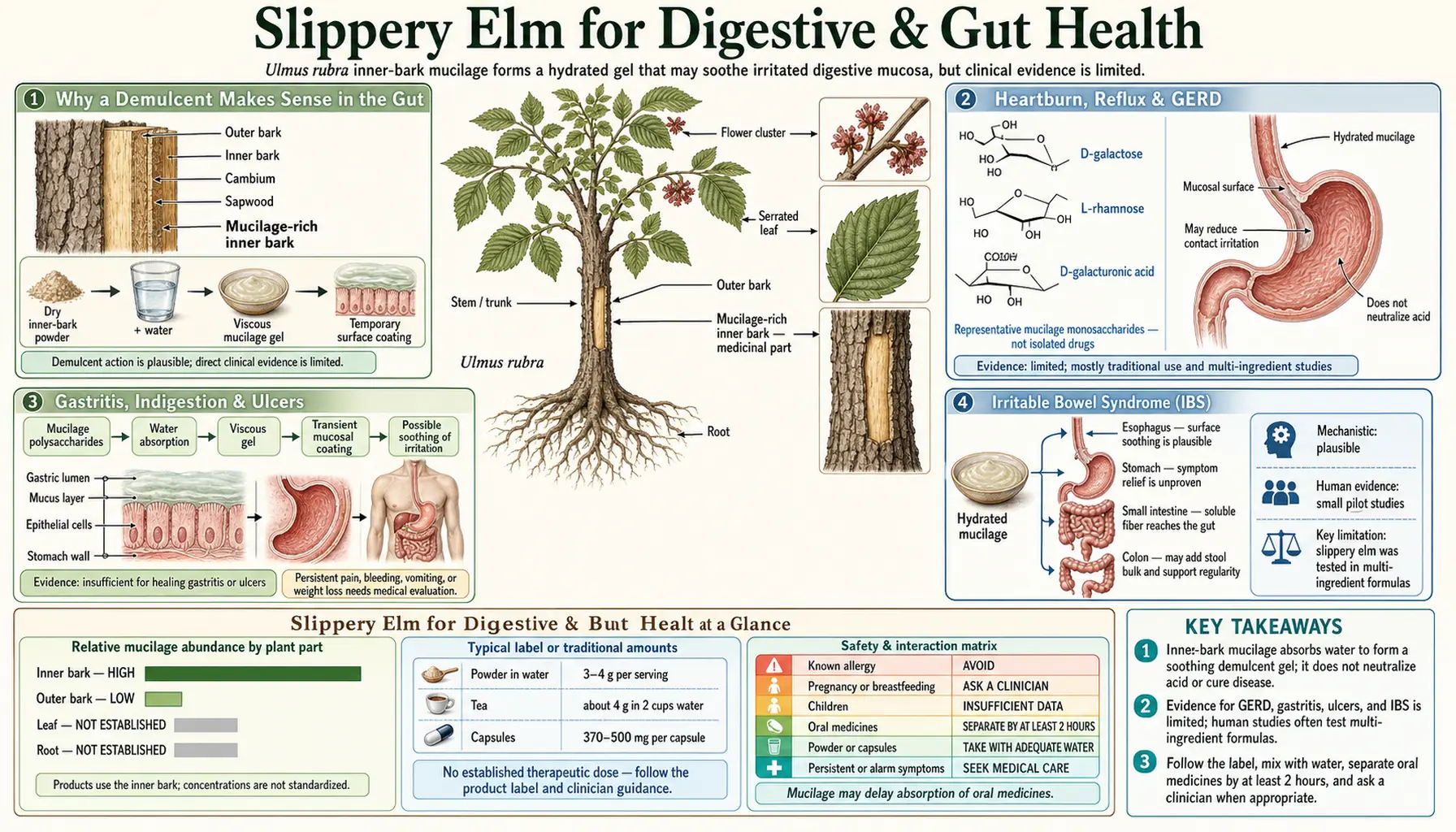
Of all slippery elm's traditional uses, the digestive ones are the most enduring — and the most reasonable. The inner bark's mucilage swells into a soft gel that can coat the lining of the esophagus, stomach, and intestine, which is exactly why generations of herbalists reached for it in heartburn, indigestion, irritable bowel, and inflammatory gut conditions. This page lays out the demulcent rationale honestly: what the coating plausibly does, slippery elm's role in classic gut formulas such as “Robert's Formula,” the handful of small human trials (nearly all of multi-herb blends, not slippery elm alone), and the preclinical antioxidant and anti-inflammatory signals from elm-bark extracts. It also draws a clear line between soothing a symptom and treating its cause — because reflux, IBS, and IBD all deserve a real diagnosis, not just a coating.
Table of Contents
- Why a Demulcent Makes Sense in the Gut
- Heartburn, Reflux & GERD
- Gastritis, Indigestion & Ulcers
- Irritable Bowel Syndrome (IBS)
- Inflammatory Bowel Disease (IBD)
- Robert's Formula & Gut-Soothing Blends
- What the Human Evidence Actually Shows
- How People Use It & Practical Cautions
- Key Research Papers
- External Resources
- Connections
- Featured Videos
Why a Demulcent Makes Sense in the Gut
The digestive tract is a long tube lined with delicate mucous membrane. That lining is normally protected by its own mucus layer, but heartburn, infection, medications like NSAIDs, and chronic inflammation can all leave it raw and irritated. A demulcent works by adding a second, borrowed layer of protection: when slippery elm mucilage meets moisture, it forms a slick gel that clings to the mucosa.
The rationale is intuitive and mechanistically plausible. If a coating physically separates inflamed tissue from acid, rough food, or friction, the surface gets a chance to calm down. Modern gastroenterology uses the very same idea in evidence-based products — alginate rafts (which float on stomach contents and shield the esophagus) and sucralfate (which sticks to ulcer craters). Slippery elm is the traditional, botanical cousin of these agents. The crucial difference is the depth of testing: alginates and sucralfate have been through many controlled trials, while slippery elm has been through very few. So the mechanism is credible; the clinical proof is thin. Both facts are true at once, and this page keeps them both in view.
Heartburn, Reflux & GERD
Gastroesophageal reflux disease (GERD) happens when stomach acid washes back up into the esophagus, whose lining is not built to withstand it. The result is heartburn, regurgitation, and, over time, inflammation of the esophageal wall. Herbalists have long suggested slippery elm before or after meals on the theory that its gel coats and soothes the irritated esophagus and may buffer the sensation of acid.
There is a genuine scientific thread here, even though it does not come from slippery elm trials directly. Researchers have shown that the topical integrity of the esophageal mucosa can be protected by surface agents, and that alginate-based coatings measurably shield esophageal cells from acid-and-pepsin damage in laboratory models. Those studies validate the general principle — a physical coating can protect the esophagus — without proving that slippery elm specifically does the job as well as a purpose-built alginate. Modern GERD management is also clear that persistent reflux needs proper evaluation, because untreated inflammation can progress to ulceration and, rarely, precancerous change.
The sensible framing: slippery elm may be a reasonable comfort measure for occasional heartburn, taken well away from other medicines, as an adjunct to the standard tools (weight management, meal timing, avoiding late meals, and, where indicated, acid-suppressing therapy). It is not a substitute for evaluating frequent or alarm-symptom reflux.
Gastritis, Indigestion & Ulcers
The same coating logic extends to the stomach itself. In traditional practice, slippery elm gruel was a classic food-medicine for an inflamed or ulcerated stomach — bland, soothing, and easy to keep down when appetite fails. For gastritis and functional dyspepsia (indigestion with no structural cause), the gruel served double duty as gentle nourishment and a soothing layer.
It is important to be candid about what has changed. Most peptic ulcers are now known to be caused by Helicobacter pylori infection or by NSAID use, and they are cured by targeting those causes — antibiotics for the bacterium, acid suppression, and stopping the offending drug. Slippery elm does nothing to eradicate H. pylori. So while a demulcent may ease the discomfort of an irritated stomach, it should sit alongside a proper work-up, not replace it. Preclinical studies of elm-bark extracts show antioxidant and anti-inflammatory activity in cells and animals, which is encouraging background biology but not evidence of ulcer healing in people.
Irritable Bowel Syndrome (IBS)
Irritable bowel syndrome is a functional disorder of gut sensation and motility — abdominal pain with altered bowel habits, and no visible damage on scans or scopes. Because slippery elm both soothes the gut lining and adds soluble, gel-forming fiber, it has a plausible dual role: comfort for a hypersensitive gut and stool-normalizing bulk. In practice, herbalists tend to use it more for the constipation-predominant and mixed subtypes, where its soluble fiber can soften and regulate stools.
The most relevant human data come from a small Australian pilot study by Hawrelak and Myers, which tested two whole formulas — one for constipation-predominant IBS that contained slippery elm (alongside other agents) and one for diarrhea-predominant IBS that did not. The constipation formula was associated with improvements in bowel habit and some symptoms. This is a genuine, published signal, but it comes with heavy caveats: it was a small, uncontrolled pilot, and because slippery elm was only one ingredient in a blend, its individual contribution cannot be separated out. A later trial of a different multi-herb digestive formula (which also included slippery elm) reported improvements in upper and lower GI symptoms in adults with digestive complaints — again a formula, not slippery elm alone.
Honest bottom line for IBS: slippery elm is a low-risk, plausibly helpful soluble-fiber demulcent that some people find settling, and it appears in formulas with modest pilot-level evidence — but there is no rigorous trial isolating slippery elm itself for IBS.
Inflammatory Bowel Disease (IBD)
Unlike IBS, inflammatory bowel disease — Crohn's disease and ulcerative colitis — involves real, immune-driven tissue damage that can lead to serious complications. This is exactly the setting where a demulcent should be positioned carefully as a comfort adjunct, never as a replacement for disease-modifying therapy.
The most cited laboratory work is Langmead and colleagues' in vitro study of herbal remedies used by IBD patients, which found that several — slippery elm among them — had measurable antioxidant activity and could reduce reactive oxygen species in intestinal tissue models. Separately, extracts of the related East Asian elm Ulmus davidiana have shown anti-inflammatory and immune-modulating effects on macrophages and mouse intestinal immune cells, and an elm phytoglycoprotein reduced inflammatory cytokines (TNF-alpha, IL-6) in a chemical model of early colon tumorigenesis in mice. These are legitimate preclinical findings that make the “soothing plus mild anti-inflammatory” story biologically coherent.
But preclinical is not clinical. None of this shows that slippery elm induces or maintains remission in human IBD. People with Crohn's or ulcerative colitis should keep slippery elm firmly in the “may soothe symptoms” category and continue their prescribed treatment, using the herb, if at all, as an adjunct discussed with their care team.
Robert's Formula & Gut-Soothing Blends
Slippery elm rarely appears alone in traditional gut medicine. Its classic home is Robert's Formula, a naturopathic combination handed down through the Eclectic and naturopathic traditions for inflamed or ulcerated digestive tissue. Recipes vary, but a typical version pairs slippery elm and marshmallow root (both demulcents) with an astringent (such as geranium or bayberry), an anti-inflammatory or antimicrobial (such as goldenseal or Echinacea), a carminative (such as cabbage powder or okra), and sometimes a laxative or bitter. The philosophy is layered: coat and soothe, tone and tighten, and calm inflammation all at once.
Modern digestive blends echo this design — the formulas tested in the pilot studies above combined slippery elm with other soothing and motility-supporting botanicals. The strength of a formula is also its scientific weakness: blends may work better than single herbs in practice, but they make it impossible to know how much credit slippery elm deserves. When you read that “slippery elm helped in a study,” it is almost always a formula that helped.
What the Human Evidence Actually Shows
Pulling the threads together, here is the state of the evidence in plain terms:
- Strong tradition, weak trials. Slippery elm has centuries of documented use for digestive irritation, but only a few small human studies, almost all of multi-herb formulas.
- Plausible mechanism. The demulcent coating idea is supported indirectly by mucosal-protection research on purpose-built agents (alginates, sucralfate), and by antioxidant/anti-inflammatory findings in elm-bark cell and animal models.
- No isolated randomized trial. There is, at the time of writing, no well-powered randomized controlled trial of slippery elm by itself for GERD, IBS, or IBD.
- Low risk, modest expectation. Taken sensibly, slippery elm is very well tolerated. The reasonable expectation is symptom comfort, not cure.
That combination — safe, plausible, under-studied — is precisely why slippery elm endures as a folk remedy while remaining absent from formal treatment guidelines. It is a fair candidate for a gentle adjunct, held to honest expectations.
How People Use It & Practical Cautions
Traditional digestive preparations include a warm gruel (1–2 teaspoons of inner-bark powder whisked into hot water or plant milk), a tea, capsules (often 400–500 mg), and chewable lozenges. Many people take it shortly before meals for reflux, or between meals for general gut soothing. See the companion Sources & Preparation page for full details on forms and dosing.
Two cautions matter most for gut use:
- Separate it from medications. Because mucilage forms a coating and adds soluble fiber, slippery elm can slow or reduce the absorption of drugs taken at the same time. Take it at least 1–2 hours apart from any oral medication.
- Do not use it to mask alarm symptoms. Unintended weight loss, difficulty swallowing, vomiting blood, black stools, persistent vomiting, or a marked change in bowel habits all require prompt medical evaluation — not a demulcent.
Used within those limits, slippery elm is one of the gentler options in the herbal digestive toolkit, sitting comfortably beside other soothing plants such as licorice (as DGL), fenugreek, chamomile, and peppermint.
Key Research Papers
Slippery elm's digestive evidence base is small and mostly preclinical or formula-based. The papers below are real and directly relevant; note carefully which tested a blend rather than slippery elm alone.
- Hawrelak JA, Myers SP (2010). Effects of two natural medicine formulations on irritable bowel syndrome symptoms: a pilot study. Journal of Alternative and Complementary Medicine. — PubMed PMID 20954962
- Wu DN et al. (2020). Herbal formula improves upper and lower gastrointestinal symptoms and gut health in Australian adults with digestive disorders. Nutrition Research. — PubMed PMID 32151878
- Langmead L et al. (2002). Antioxidant effects of herbal therapies used by patients with inflammatory bowel disease: an in vitro study. Alimentary Pharmacology & Therapeutics. — PubMed PMID 11860402
- Lee SJ et al. (2013). Anti-inflammatory and immune-modulating effect of Ulmus davidiana var. japonica Nakai extract on a macrophage cell line and immune cells in the mouse small intestine. Journal of Ethnopharmacology. — PubMed PMID 23384785
- Lee SJ et al. (2007). Inhibitory effect of phytoglycoprotein on TNF-alpha and IL-6 at the initiation stage of colon cancer in 1,2-dimethylhydrazine-treated ICR mice. Toxicology and Applied Pharmacology. — PubMed PMID 17868752
- Woodland N et al. (2015). Topical protection of human esophageal mucosal integrity. American Journal of Physiology – Gastrointestinal and Liver Physiology. — Search PubMed
- In vitro study of topical sodium alginate protection against peptic damage in treatment-resistant GERD (2024). International Journal of Molecular Sciences. — PubMed PMID 39409043
- Pharmacological management of gastro-esophageal reflux disease: state of the art in 2024. Expert Opinion on Pharmacotherapy. — PubMed PMID 39392340
- Gastrointestinal pharmacology: practical tips for the esophagologist (2020). Annals of the New York Academy of Sciences. — PubMed PMID 32822080
- Drugs and Lactation Database (LactMed). Slippery Elm monograph. NCBI Bookshelf. — Search PubMed
PubMed Topic Searches
- PubMed: Slippery elm & gastrointestinal
- PubMed: Slippery elm & IBS
- PubMed: Ulmus & IBD
- PubMed: Demulcent & esophageal protection
- PubMed: Herbal formula & dyspepsia
External Resources
- Memorial Sloan Kettering — About Herbs: Slippery Elm
- MedlinePlus — Slippery Elm
- NCBI Bookshelf (LactMed) — Slippery Elm
- NCCIH — Herbs at a Glance
Connections
- All Herbs
- Slippery Elm Benefits Hub
- Slippery Elm for Throat & Cough
- Slippery Elm Sources & Preparation
- Slippery Elm (Main Page)
- GERD (Acid Reflux)
- Irritable Bowel Syndrome
- Inflammatory Bowel Disease
- Crohn's Disease
- Ulcerative Colitis
- Gastritis
- Peptic Ulcer Disease
- Functional Dyspepsia
- SIBO
- Licorice (DGL)
- Fenugreek