Slippery Elm Sources & Preparation
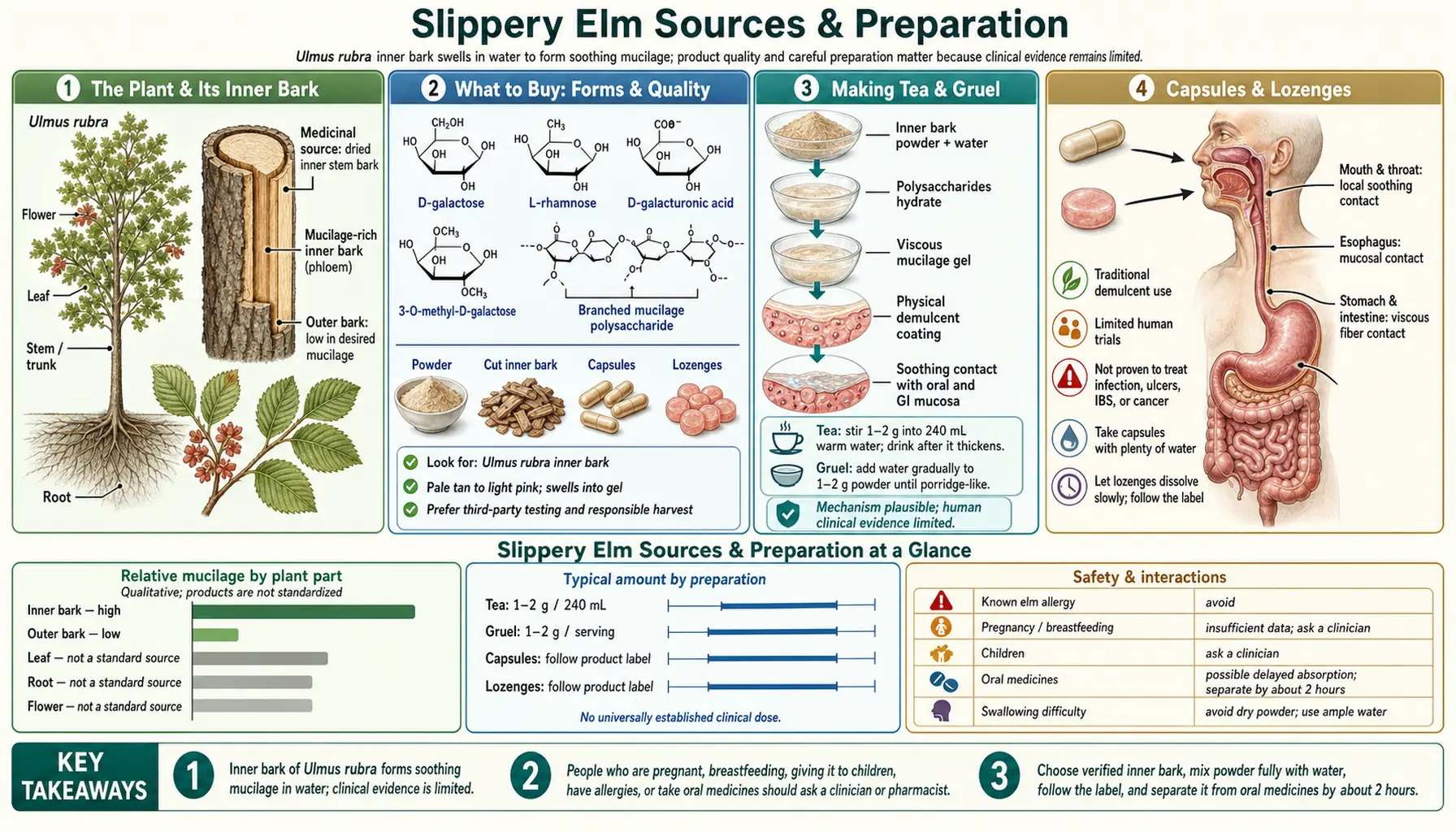
The active part of slippery elm is the inner bark — the soft, mucilage-rich layer just beneath the rough outer bark of Ulmus rubra. Dried and powdered, it is the raw material for every preparation: teas, gruels, capsules, and lozenges. This practical page covers how to choose a good product, how to make each form, sensible dosing ranges, and the two safety points that matter most — taking slippery elm well away from other medicines (because its mucilage can slow their absorption) and using caution in pregnancy. It closes with a genuinely important note that gets skipped too often: slippery elm is a slow-growing native tree that is stripped of its bark to harvest, so sustainable sourcing is part of using it responsibly.
Table of Contents
- The Plant & Its Inner Bark
- What to Buy: Forms & Quality
- Making Tea & Gruel
- Capsules & Lozenges
- Sensible Dosing
- Take It Away From Medications
- Safety, Pregnancy & Who Should Be Careful
- Sustainability & Ethical Sourcing
- Key Research Papers
- External Resources
- Connections
- Featured Videos
The Plant & Its Inner Bark
Slippery elm (Ulmus rubra Muhl., also called red elm, gray elm, or moose elm) is a medium-sized deciduous tree native to eastern and central North America. Its medicinal value is concentrated entirely in the inner bark (the phloem/cambium layer), which is rich in the gel-forming polysaccharide mucilage described throughout this hub. The bark also contains tannins, some antioxidants, and small amounts of other constituents, but mucilage is the defining ingredient and the reason for the plant's “slippery” feel when the powder meets water.
Only the inner bark is used. The rough outer bark is discarded. Historically there was even a caution distinguishing the mild inner bark from preparations of whole bark, which folk tradition associated with far stronger, riskier effects (discussed under Safety below).
What to Buy: Forms & Quality
Slippery elm inner bark is sold in several convenient forms:
- Powdered inner bark — the most versatile; makes tea, gruel, and poultices. A fine powder disperses and swells best.
- Cut/sifted bark or tea bags — for infusions.
- Capsules — typically 400–500 mg of bark powder each; convenient but deliver less of the soothing “coating” experience than a liquid preparation.
- Lozenges — formulated to dissolve slowly for throat contact; often combined with other soothing ingredients.
Quality pointers: choose products that clearly state Ulmus rubra and inner bark, ideally from a reputable supplier that can speak to sustainable sourcing (see below). Because botanicals are not tightly regulated, look for brands that test for identity and contaminants and that carry recognized quality seals. Store powder in an airtight container away from heat and moisture, since the hygroscopic mucilage will clump or spoil if it takes on water.
Making Tea & Gruel
Tea / infusion: whisk about 1–2 teaspoons of inner-bark powder into a cup of hot (not boiling-violent) water, or steep a tea bag. Because the mucilage keeps swelling and settling, stir or whisk well and drink while warm; a little honey and lemon suits throat use. Whisking briskly helps avoid lumps.
Gruel / porridge: the classic sickroom food. Make a paste by mixing 1–2 teaspoons of powder with a little cool water first, then whisk in hot water or warm plant milk to a thin-porridge consistency. Season simply (a pinch of cinnamon, a little honey). Gruel doubles as gentle nourishment and a soothing coating for an upset stomach, which is why it was a traditional convalescent food.
Both preparations are best made fresh, since the gel thickens on standing.
Capsules & Lozenges
Capsules are the tidy option for people who want the bark without preparing a drink — useful for on-the-go digestive support. The trade-off is that a capsule bypasses the direct throat-and-mouth coating, so for a sore throat the lozenge or tea is more logical. Take capsules with a full glass of water so the mucilage can hydrate.
Lozenges are purpose-built for the throat: slow dissolution maximizes how long the mucilage coats the pharynx. They are the most convenient throat format and are widely available over the counter, frequently blended with other demulcent or flavoring agents.
Sensible Dosing
There is no official established dose for slippery elm; the ranges below reflect common traditional and product-label practice, not trial-derived recommendations. Start low and adjust to comfort.
- Tea/gruel: roughly 1–2 teaspoons of powder per cup, up to a few times daily.
- Capsules: commonly 400–500 mg, one to a few times daily with water, per product directions.
- Lozenges: as needed for throat comfort, following the package.
- Always with adequate fluid. Like any soluble fiber/mucilage, slippery elm should be taken with plenty of water.
Because the evidence base is limited, more is not better — the goal is gentle soothing, and modest amounts achieve that. Follow label directions on commercial products.
Take It Away From Medications
This is the single most important practical rule for slippery elm. Its mucilage forms a coating in the gut and behaves like soluble fiber, which means it can bind or physically slow the absorption of other substances taken at the same time — including prescription and over-the-counter medicines. In theory this could reduce how much of a drug your body absorbs.
The simple, safe practice is to separate slippery elm from all other oral medications and supplements by at least 1–2 hours (before or after). This matters most for medicines where consistent blood levels are important, such as thyroid hormone, certain heart and seizure medications, and any drug with a narrow therapeutic window. If you take critical daily medication, mention slippery elm to your pharmacist or prescriber so timing can be planned. This interaction is about timing and absorption, not toxicity — spacing doses resolves it.
Safety, Pregnancy & Who Should Be Careful
Taken orally as a food-like inner-bark preparation, slippery elm is generally regarded as safe and well tolerated; it has a long history of use and few reported adverse effects beyond occasional allergy. Still, several honest cautions apply:
- Pregnancy. The mild inner bark is widely considered low-risk in food amounts, but caution is advised because reliable safety data are limited, and because folk tradition historically associated preparations of the whole bark (and mechanical use of the bark to dilate the cervix) with pregnancy risk. Reference sources such as LactMed note limited data. The prudent course in pregnancy is to avoid concentrated or medicinal-strength slippery elm unless a qualified clinician advises otherwise.
- Breastfeeding. Data are limited; discuss with a clinician before regular use.
- Allergy. Discontinue if any rash, itching, or reaction occurs; anyone with known plant or pollen allergies should introduce it cautiously.
- Medication timing. As above — always separate from other drugs by 1–2 hours.
- Not a substitute for diagnosis. Do not use slippery elm to self-treat persistent, severe, or alarm-symptom conditions (see the digestive, throat, and skin pages for the specific red flags).
Sustainability & Ethical Sourcing
Using slippery elm responsibly means thinking about the tree, not just the bark. Ulmus rubra grows slowly, and harvesting the inner bark can seriously injure or kill a tree if it is ring-barked. American elms have also been hit hard by Dutch elm disease, adding pressure to wild populations. For these reasons slippery elm has drawn conservation attention from botanical-preservation groups, which encourage buying only from cultivated or demonstrably sustainable, well-managed sources rather than wild-stripped bark.
Practical steps: prefer suppliers who source from cultivated stands or sustainable harvest programs and who are transparent about it; avoid buying more than you will use; and consider whether another demulcent with a lighter conservation footprint — such as fenugreek or licorice — would serve the same soothing purpose for your situation. Responsible sourcing keeps this traditional remedy available for the long term.
Key Research Papers
The references below are real and relevant to composition, forms, mucilage behavior (including why it can affect drug absorption), and safety. As elsewhere in this hub, note that the direct clinical evidence for slippery elm is limited.
- Drugs and Lactation Database (LactMed). Slippery Elm — composition, uses, and safety in pregnancy and lactation. NCBI Bookshelf. — PubMed PMID 38289993
- Structure, chemical modification, and functional applications of seed mucilage — a review (2024). International Journal of Biological Macromolecules. — PubMed PMID 38754657
- Techniques of mucilage and gum modification and their effect on hydrophilicity and drug release (2020). Recent Patents on Drug Delivery & Formulation. — PubMed PMID 33280600
- Thiol functionalization of flaxseed mucilage as a mucoadhesive polymer (2019). International Journal of Biological Macromolecules. — PubMed PMID 30557645
- Plant-derived bioadhesives for wound dressing and drug delivery systems (2019). Fitoterapia. — PubMed PMID 31201885
- Wu DN et al. (2020). Herbal formula (containing slippery elm) improves gastrointestinal symptoms and gut health in Australian adults. Nutrition Research. — PubMed PMID 32151878
- Hawrelak JA, Myers SP (2010). Effects of two natural medicine formulations (one containing slippery elm) on IBS symptoms: a pilot study. Journal of Alternative and Complementary Medicine. — PubMed PMID 20954962
- Lee SJ et al. (2013). Anti-inflammatory and immune-modulating effect of Ulmus davidiana extract. Journal of Ethnopharmacology. — PubMed PMID 23384785
PubMed Topic Searches
- PubMed: Slippery elm inner bark
- PubMed: Mucilage/fiber & drug absorption
- PubMed: Slippery elm safety & pregnancy
- PubMed: Ulmus rubra polysaccharide
- PubMed: Medicinal-plant conservation
External Resources
- Memorial Sloan Kettering — About Herbs: Slippery Elm
- NCBI Bookshelf (LactMed) — Slippery Elm (safety monograph)
- MedlinePlus — Slippery Elm
- NCCIH — Herbs at a Glance
- PubMed — all slippery elm research
Connections
- All Herbs
- Slippery Elm Benefits Hub
- Slippery Elm for Digestive & Gut Health
- Slippery Elm for Throat & Cough
- Slippery Elm (Topical / Skin)
- Slippery Elm (Main Page)
- Licorice (DGL)
- Fenugreek
- Aloe Vera
- Chamomile
- Fennel
- Peppermint
- GERD (Acid Reflux)
- Irritable Bowel Syndrome
- Laryngitis