Slippery Elm — Benefits Deep Dive
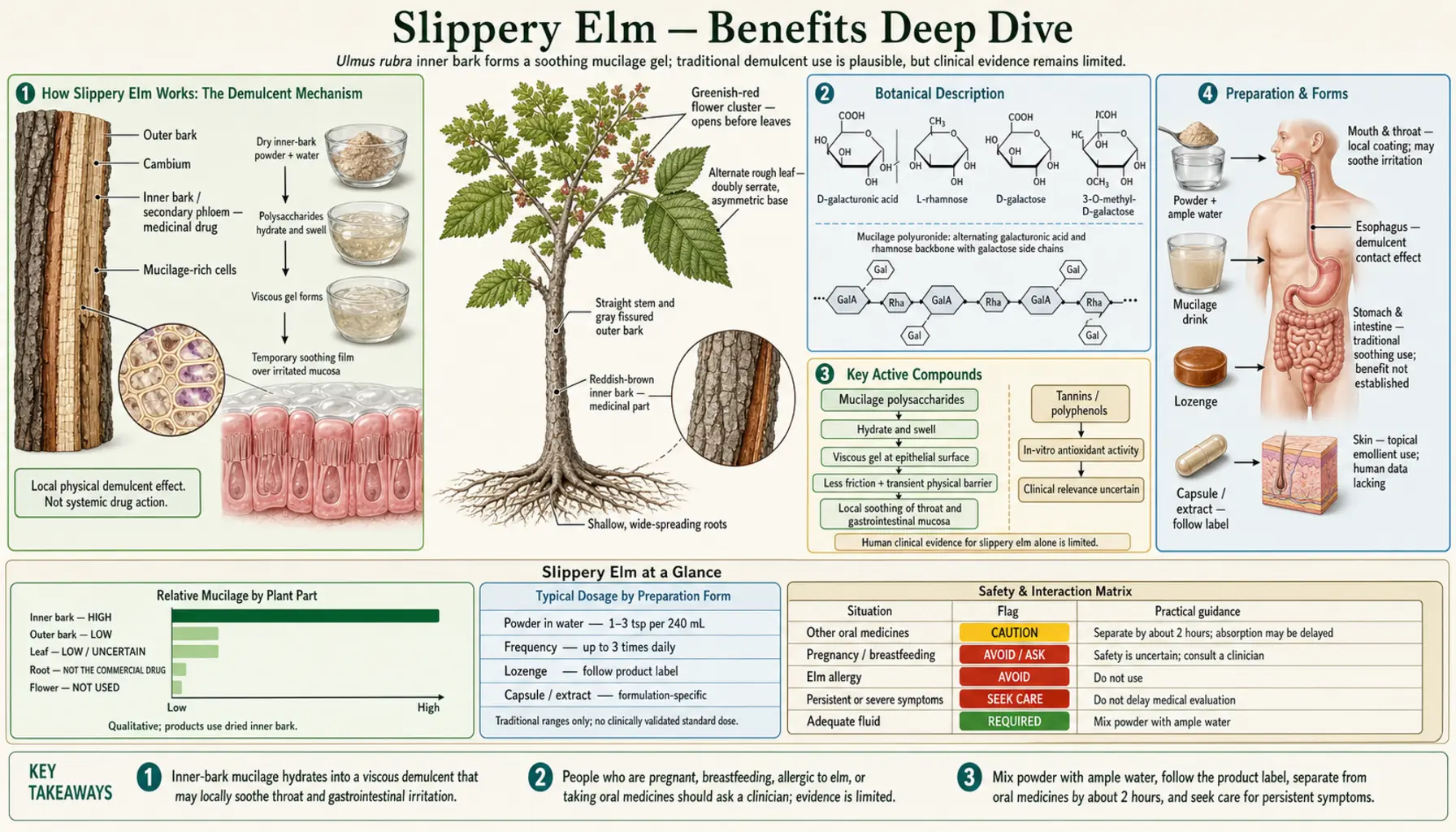
Slippery elm (Ulmus rubra, also called red elm) is one of North America's oldest folk remedies. Its inner bark is packed with mucilage — a group of gel-forming polysaccharides that swell into a slick, soothing coating when mixed with water. Herbalists call plants that work this way demulcents: they do not fight disease so much as physically soothe an irritated surface, the way a lozenge coats a raw throat. That single mechanism explains slippery elm's traditional uses across three body systems — the digestive tract, the throat and airways, and the skin. It is important to be candid up front: most of the evidence for slippery elm is traditional and preclinical, and the few human trials usually tested multi-herb formulas rather than slippery elm alone. The four deep-dive pages below explain what the mucilage plausibly does, what the studies actually show, and how to use the bark sensibly and safely.
Deep-Dive Articles
Digestive & Gut Health
The demulcent rationale for heartburn and reflux (GERD), irritable bowel syndrome (IBS), and inflammatory bowel disease (IBD), slippery elm's place in the naturopathic “Robert's Formula,” the small pilot trials of gut-soothing formulas that contained it, and an honest accounting of why we still lack a clean randomized trial of slippery elm by itself.
Throat & Cough
Why a mucilage lozenge or a cup of slippery elm tea soothes a sore throat and a dry, tickly cough, how the coating idea overlaps with modern esophageal-protection research, where slippery elm sits among throat remedies with real trial evidence, and the honest limits of “soothing” versus “curing.”
Skin (Topical)
The centuries-old poultice: powdered inner bark mixed to a paste and applied to irritated skin, boils, splinters, and minor wounds. The bioadhesive-polysaccharide mechanism that makes this plausible, the closely-related plant-mucilage wound-dressing research, and a frank note that controlled human trials of slippery elm poultices do not exist.
Sources & Preparation
Choosing inner-bark powder, making tea, gruel, and lozenges, sensible dosing, the important practical rule to take slippery elm well away from other medicines (its mucilage can slow their absorption), pregnancy and safety notes, and why sustainable sourcing matters for a slow-growing native tree under pressure from Dutch elm disease.
Table of Contents
- Deep-Dive Articles
- How Slippery Elm Works: The Demulcent Mechanism
- Research Papers: Digestive & Gut Health
- Research Papers: Throat, Cough & Mucosal Protection
- Research Papers: Skin & Mucilage Bioadhesion
- Research Papers: Mucilage Science, Forms & Safety
- External Authoritative Resources
- Connections
- Featured Videos
How Slippery Elm Works: The Demulcent Mechanism
Almost everything slippery elm is traditionally used for traces back to one physical property. The inner bark contains a high proportion of mucilage — long-chain polysaccharides (galactose, rhamnose, galacturonic acid and related sugars) that absorb many times their weight in water and swell into a soft, slippery gel. When that gel contacts a mucous membrane — the lining of the esophagus, stomach, intestine, throat, or an abraded patch of skin — it forms a thin, clinging film. Herbalists have described the sensation for two centuries: the bark is literally “slippery.”
A demulcent is any agent that soothes and coats irritated tissue in this mechanical way. The proposed benefits follow directly:
- A physical barrier. The gel film may shield inflamed tissue from further irritation — stomach acid, rough food, coughing, friction — giving the surface a chance to settle. This is the same intuition behind modern coating agents such as alginate rafts and sucralfate, though those have been tested far more rigorously.
- A soothing, lubricating layer. On a raw throat or a dry cough, the coating reduces the scratchy, tickly stimulus that drives the urge to cough and the sensation of pain.
- Possible reflex effects. One classical idea is that soothing the throat and upper gut reflexively calms irritation lower down — plausible but not well demonstrated.
- Mild antioxidant and anti-inflammatory activity. Laboratory work on elm-bark extracts (including the related Ulmus davidiana) shows measurable antioxidant and cytokine-modulating activity in cells and mice. This is genuine but preclinical — it does not by itself prove a benefit in people.
The honest summary is that slippery elm's mechanism is plausible and gentle rather than proven and potent. It is best understood as a comfort measure that coats and soothes, most sensibly used alongside — not instead of — evaluation of what is actually causing the symptom. Each deep-dive page below applies this lens to a specific body system and reports what the studies really found.
Research Papers: Digestive & Gut Health
- Hawrelak JA, Myers SP (2010). Effects of two natural medicine formulations on irritable bowel syndrome symptoms: a pilot study. Journal of Alternative and Complementary Medicine. — PubMed PMID 20954962
- Wu DN et al. (2020). Herbal formula improves upper and lower gastrointestinal symptoms and gut health in Australian adults with digestive disorders. Nutrition Research. — PubMed PMID 32151878
- Langmead L et al. (2002). Antioxidant effects of herbal therapies used by patients with inflammatory bowel disease: an in vitro study. Alimentary Pharmacology & Therapeutics. — PubMed PMID 11860402
- Lee SJ et al. (2013). Anti-inflammatory and immune-modulating effect of Ulmus davidiana var. japonica Nakai extract on a macrophage cell line and immune cells in the mouse small intestine. Journal of Ethnopharmacology. — PubMed PMID 23384785
- Lee SJ et al. (2007). Inhibitory effect of phytoglycoprotein on tumor necrosis factor-alpha and interleukin-6 at initiation stage of colon cancer in 1,2-dimethylhydrazine-treated ICR mice. Toxicology and Applied Pharmacology. — PubMed PMID 17868752
- Drugs and Lactation Database (LactMed). Slippery Elm — monograph on composition, uses, and safety. NCBI Bookshelf. — Search PubMed
Research Papers: Throat, Cough & Mucosal Protection
- Woodland N et al. (2015). Topical protection of human esophageal mucosal integrity. American Journal of Physiology – Gastrointestinal and Liver Physiology. — Search PubMed
- Woodland P et al. (2022). Alginates for protection against pepsin-acid induced aerodigestive epithelial barrier disruption. The Laryngoscope. — PubMed PMID 35238407
- Study of topical sodium alginate protection against peptic damage in an in vitro model of treatment-resistant GERD (2024). International Journal of Molecular Sciences. — PubMed PMID 39409043
- Management of acute cough by an herbal alternative treatment: a randomized trial (2018). Journal of Integrative Medicine. — PubMed PMID 29397088
- Schachtel BP et al. Efficacy and tolerability of the anti-inflammatory throat lozenge flurbiprofen 8.75 mg in sore throat — a randomised, double-blind, placebo-controlled study. Clinical Drug Investigation. — PubMed PMID 27517548
Research Papers: Skin & Mucilage Bioadhesion
- Plant-derived bioadhesives for wound dressing and drug delivery systems (2019). Fitoterapia. — PubMed PMID 31201885
- Thiol functionalization of flaxseed mucilage: preparation, characterization and evaluation as a mucoadhesive polymer (2019). International Journal of Biological Macromolecules. — PubMed PMID 30557645
- Structure, chemical modification, and functional applications of mucilage from Mimosa pudica seeds — a review (2024). International Journal of Biological Macromolecules. — PubMed PMID 38754657
- Lee SJ et al. (2013). Anti-inflammatory and immune-modulating effect of Ulmus davidiana extract. Journal of Ethnopharmacology. — PubMed PMID 23384785
Research Papers: Mucilage Science, Forms & Safety
- Drugs and Lactation Database (LactMed). Slippery Elm monograph. NCBI Bookshelf. — Search PubMed
- Techniques of mucilage and gum modification and their effect on hydrophilicity and drug release (2020). Recent Patents on Drug Delivery & Formulation. — PubMed PMID 33280600
- Structure, chemical modification, and functional applications of seed mucilage — a review (2024). International Journal of Biological Macromolecules. — PubMed PMID 38754657
- Wu DN et al. (2020). Herbal formula (containing slippery elm) improves gastrointestinal symptoms and gut health. Nutrition Research. — PubMed PMID 32151878
PubMed Topic Searches
- PubMed: Slippery elm / Ulmus rubra
- PubMed: Demulcent mucilage & mucosa
- PubMed: Ulmus davidiana anti-inflammatory
- PubMed: Herbal formula & IBS
- PubMed: Plant mucilage & wound bioadhesion
- PubMed: Esophageal mucosal protection
External Authoritative Resources
- Memorial Sloan Kettering — About Herbs: Slippery Elm — balanced, referenced summary of uses, evidence, and cautions
- NCBI Bookshelf (LactMed) — Slippery Elm — composition and pregnancy/lactation safety review
- MedlinePlus — Slippery Elm — consumer-facing overview from the U.S. National Library of Medicine
- NCCIH — Herbs at a Glance — U.S. government herb fact-sheet index
- PubMed — all research on slippery elm / Ulmus rubra
Connections
- All Herbs
- Slippery Elm (Main Page)
- Slippery Elm for Digestive & Gut Health
- Slippery Elm for Throat & Cough
- Slippery Elm (Topical / Skin)
- Slippery Elm Sources & Preparation
- Licorice (DGL, demulcent)
- Aloe Vera
- Fenugreek (mucilage)
- Chamomile
- Peppermint
- GERD (Acid Reflux)
- Irritable Bowel Syndrome
- Inflammatory Bowel Disease
- Laryngitis
- Eczema