Saffron for Mood and Depression
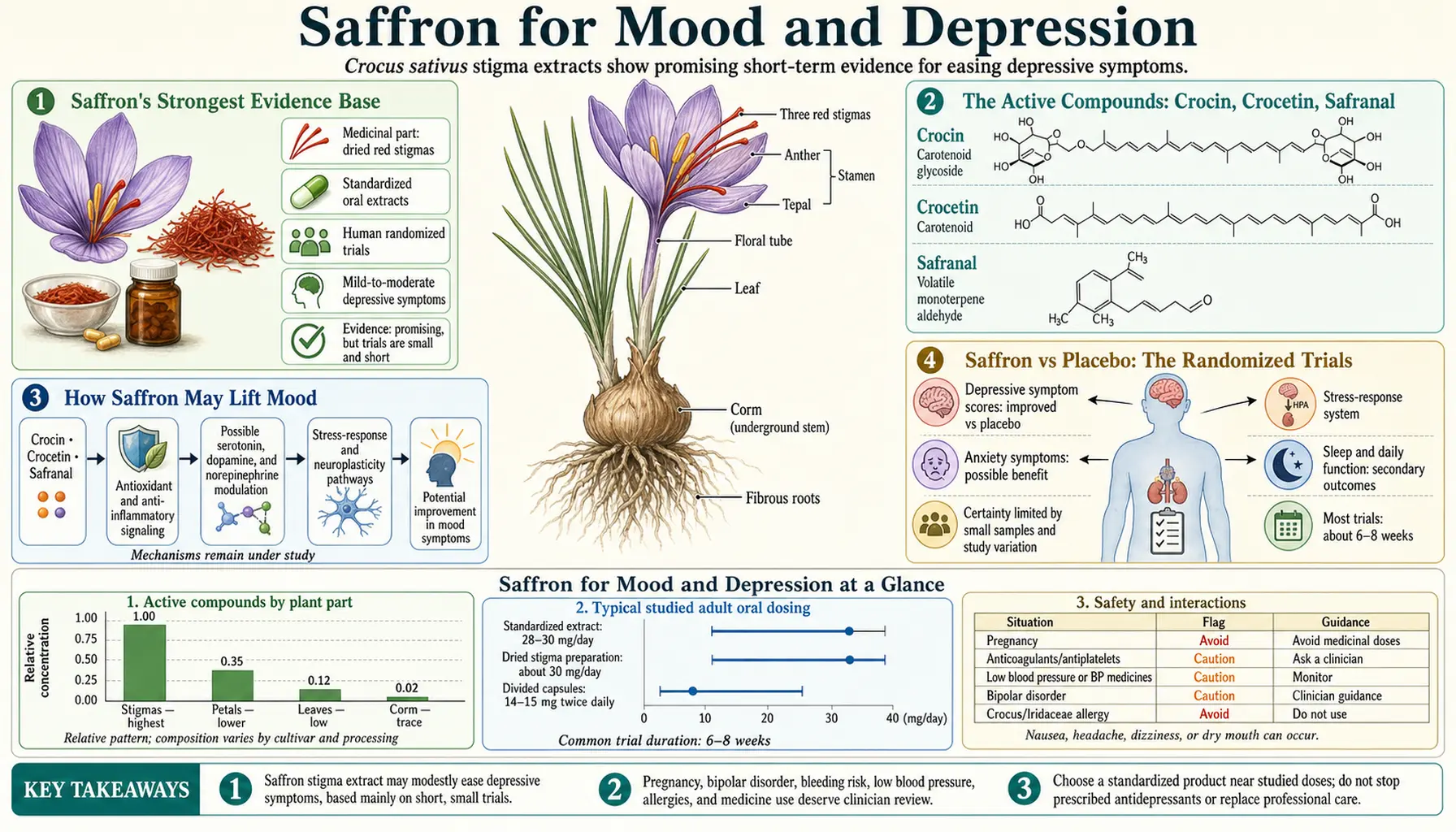
Of all the health uses claimed for saffron, depression is where the human evidence is genuinely strong. Since the early 2000s, more than a dozen randomized, double-blind, placebo-controlled trials have tested standardized saffron — usually about 30 mg per day — in adults with mild-to-moderate depression. Several went further and compared saffron directly against standard antidepressants such as fluoxetine (Prozac), imipramine, citalopram, and sertraline (Zoloft). Across these studies, saffron consistently beat placebo and generally performed about as well as the comparison drug over six to eight weeks, and multiple independent meta-analyses have reached the same conclusion. This page walks through that evidence honestly, including its real limitations — and it is emphatic on one point: encouraging trial results are never a reason to stop a prescribed antidepressant on your own.
Table of Contents
- Saffron's Strongest Evidence Base
- The Active Compounds: Crocin, Crocetin, Safranal
- How Saffron May Lift Mood
- Saffron vs Placebo: The Randomized Trials
- Head-to-Head With Antidepressants
- What the Meta-Analyses Show
- Add-On Use and SSRI Side Effects
- Standardized Extracts and Newer Trials
- Practical Use, Dose, and Timing
- Honest Limitations of the Evidence
- Important Cautions
- Key Research Papers
- Connections
- Featured Videos
Saffron's Strongest Evidence Base
Most herbal remedies rest on tradition, test-tube data, and a scattering of small studies. Saffron is unusual: for depression it has been put through the same kind of testing used for pharmaceutical drugs — randomized allocation, double-blinding (neither patient nor researcher knew who got saffron), a placebo or active-drug comparison group, and validated depression rating scales such as the Hamilton Depression Rating Scale (HAM-D) and the Beck Depression Inventory (BDI).
The reason so much of this research came out of Iran is simple: Iran grows roughly 90 percent of the world's saffron, and academic groups there — most prominently the team led by Shahin Akhondzadeh at Tehran University of Medical Sciences — had both the material and the interest to study it rigorously. Their early trials, published in respected international journals from 2004 onward, opened a field that later expanded to Australia, Europe, and elsewhere.
The overall picture that emerged is consistent: in adults with mild-to-moderate depression, standardized saffron at about 30 mg per day reduces depression scores significantly more than placebo, and about as much as a starting dose of a standard antidepressant. That is a stronger, more replicated result than almost any other botanical can claim for a mental-health condition — with the important caveat that "mild-to-moderate" is doing real work in that sentence. Saffron has not been shown to treat severe or treatment-resistant depression, and it has not been tested as a substitute for antidepressants in people who are already stable on them.
The Active Compounds: Crocin, Crocetin, Safranal
Saffron threads are the dried stigmas of the flower Crocus sativus. Their color, bitterness, and aroma come from three families of compounds, all of which have been studied for mood effects:
- Crocin — the water-soluble carotenoid pigment responsible for saffron's deep red-gold color. Chemically it is crocetin bound to sugar molecules, which makes it far more water-soluble than typical carotenoids like beta-carotene.
- Crocetin — the smaller carotenoid "core" released when crocin is digested. Its compact, partly water-friendly structure lets it cross into tissues, including the brain and retina, more readily than larger fat-soluble carotenoids.
- Safranal — the volatile molecule that gives saffron its distinctive hay-and-honey aroma. It forms from a bitter precursor called picrocrocin as saffron dries, and it carries much of the herb's antioxidant and mood-related activity in laboratory models.
In practice, commercial saffron supplements are usually standardized to a guaranteed content of these markers (for example, a minimum percentage of crocins, or a fixed amount of "safranal equivalents") so that each dose delivers a consistent amount of active compound. That standardization is part of why the depression trials are comparable to one another and is discussed further on the sources, dosing, and safety page.
How Saffron May Lift Mood
No one claims the mechanism is fully understood, but several plausible and partly overlapping pathways have emerged from laboratory and animal research, summarized in mechanistic reviews such as Lopresti and Drummond (2014) and Matraszek-Gawron and colleagues (2022):
- Monoamine reuptake. Crocin and safranal appear to modestly inhibit the reuptake of serotonin, dopamine, and norepinephrine — the same broad target as many conventional antidepressants, though saffron's effect in the test tube is weaker and less selective.
- Anti-inflammatory action. Depression is associated in many patients with elevated inflammatory markers. Saffron compounds reduce pro-inflammatory cytokines such as TNF-alpha and interleukin-6 in laboratory models, which may be relevant to the "inflammatory" subtype of depression.
- Antioxidant and neuroprotective effects. As carotenoids, crocin and crocetin quench reactive oxygen species and may protect neurons from oxidative damage, supporting healthier synaptic function.
- Stress-axis and neurotrophic effects. Some animal work suggests saffron dampens an overactive stress (HPA-axis) response and supports brain-derived neurotrophic factor (BDNF), a protein tied to resilience and recovery in mood disorders.
The honest caveat is that most of this mechanistic detail comes from cells and rodents, not from people. What the human trials show is a clinical effect on depression scores; the mechanisms above are the leading explanations for that effect, not proven causes of it.
Saffron vs Placebo: The Randomized Trials
The placebo-controlled trials are the foundation of saffron's reputation. Two are worth describing in detail because they set the template:
Akhondzadeh and colleagues (2005), Phytotherapy Research. Forty adults with mild-to-moderate depression were randomized to saffron 30 mg per day (as a stigma extract, 15 mg twice daily) or an identical-looking placebo for six weeks. The saffron group improved significantly more on the Hamilton Depression Rating Scale than the placebo group, and side effects were mild and no more common than with placebo.
Moshiri and colleagues (2006), Phytomedicine. This trial tested the petals of the saffron flower (a cheaper part of the plant than the prized stigma) at 30 mg per day against placebo over six weeks, again in mild-to-moderate depression. The petal extract also beat placebo, suggesting the antidepressant compounds are not confined to the costly red threads alone.
Subsequent placebo-controlled studies broadly reproduced this pattern in different populations, and it is this consistency — the same direction of effect, across independent research groups — that gives the placebo comparison its weight.
Head-to-Head With Antidepressants
What separates saffron from most "natural mood support" products is that it has been tested directly against prescription antidepressants, not only against placebo:
- Versus imipramine (a tricyclic antidepressant) — Akhondzadeh and colleagues (2004) found saffron 30 mg per day comparable to imipramine 100 mg per day over six weeks, with fewer of imipramine's side effects such as dry mouth and sedation.
- Versus fluoxetine (Prozac, an SSRI) — Noorbala and colleagues (2005) found saffron 30 mg per day comparable to fluoxetine 20 mg per day over six weeks. A later trial by Shahmansouri and colleagues (2014) reached the same conclusion in a more medically complex group: patients recovering from a percutaneous coronary intervention (a heart procedure), a population in whom drug interactions and side effects matter a great deal.
- Versus citalopram (an SSRI) — Ghajar and colleagues (2017) found saffron comparable to citalopram in major depressive disorder with anxious distress.
- Versus sertraline (Zoloft, an SSRI) — Ahmadpanah and colleagues (2019) found saffron comparable to sertraline in older adults with major depressive disorder.
The recurring theme across these trials is non-inferiority: saffron did not clearly outperform the drugs, but it kept pace with a standard starting dose while generally causing fewer side effects. It is important to read this correctly. "As good as a low dose of an SSRI over six weeks in mild-to-moderate depression" is a meaningful finding, but it is not the same as "as good as antidepressants for everyone." These were small, short studies in carefully selected patients, and none tested saffron in severe depression or over the many months that antidepressant treatment often lasts.
What the Meta-Analyses Show
When many small trials point the same way, meta-analysis pools them to estimate the overall effect. Several have now been done on saffron and depression:
- Hausenblas and colleagues (2013) pooled the early randomized trials and found a large, statistically significant benefit of saffron over placebo, and no significant difference between saffron and antidepressant drugs.
- Tóth and colleagues (2019), in Planta Medica, confirmed a significant antidepressant effect versus placebo across the accumulated trials.
- Shafiee and colleagues (2025), in Nutrition Reviews, specifically compared saffron against SSRIs and again found the two broadly comparable for depression and anxiety symptoms.
- Mahmoudi and colleagues (2026) published a large GRADE-assessed systematic review and meta-analysis of 34 randomized controlled trials covering depression, anxiety, and mood, reaching similar conclusions while formally rating the certainty of the evidence.
The consistency across independent meta-analyses is reassuring. At the same time, reviewers repeatedly flag that many included trials were small, short, conducted in a single country, and sometimes funded by extract manufacturers — all of which can inflate apparent benefit. The signal is real and repeated, but it should be read as "promising and consistent," not "settled beyond doubt."
Add-On Use and SSRI Side Effects
Two lines of research look at saffron alongside conventional treatment rather than instead of it:
As an add-on. Talaei and colleagues (2015) tested crocin — saffron's main pigment — added on top of an antidepressant (fluoxetine, citalopram, or sertraline) in people with major depressive disorder. The crocin add-on group improved more than the placebo add-on group, hinting that saffron compounds may complement, not just imitate, standard drugs. This was a small pilot study and needs replication, but it is a mechanistically sensible direction.
For a specific drug side effect. A common and under-discussed reason people quit SSRIs is sexual dysfunction. Modabbernia and colleagues (2012) ran a randomized, double-blind, placebo-controlled trial of saffron in men experiencing fluoxetine-induced sexual impairment and found saffron improved some measures of erectile function compared with placebo. A parallel body of work has examined saffron for SSRI-related sexual dysfunction in women. These are niche findings, but they illustrate that saffron's role may include making established treatment more tolerable rather than replacing it.
Standardized Extracts and Newer Trials
Much of the newer research uses standardized, branded saffron extracts (one widely studied example is marketed as affron) that guarantee a fixed content of active compounds per dose. Standardization matters because saffron sold as threads varies enormously in strength depending on grade, storage, and — as the safety page details — whether it has been adulterated.
- Kell and colleagues (2017) found a standardized saffron extract improved mood in healthy adults with low mood over four weeks compared with placebo.
- Lopresti and colleagues (2018) tested a standardized extract in adolescents with anxiety and depressive symptoms, with self-reported improvements, and later work extended this line into adults experiencing low mood.
These trials broaden saffron's evidence beyond clinically diagnosed major depression into the large group of people with subthreshold low mood, everyday stress, and mild anxiety — the audience most likely to reach for a supplement in the first place. As always, several of these studies were manufacturer-supported, which is a reason to weigh them alongside, not above, the independent academic trials.
Practical Use, Dose, and Timing
The dose used in nearly every depression trial is remarkably consistent, which makes practical guidance easy to summarize:
- Dose: about 30 mg of standardized saffron extract per day, most often taken as 15 mg twice daily with meals. Branded extracts studied in mood trials are frequently dosed at 28–30 mg per day.
- Time to effect: trials generally ran six to eight weeks, with separation from placebo often visible by week two to four. Saffron is not a fast-acting rescue for a bad day; it is taken daily like a conventional antidepressant.
- Form: a standardized capsule or tablet is more reliable than measuring out culinary threads, because thread potency varies widely and cooking amounts are far below the studied dose.
- Who it was studied in: adults with mild-to-moderate symptoms. There is no good evidence for saffron in severe, psychotic, or bipolar depression, and it should not be used as sole treatment in those situations.
If you are considering saffron for low mood, the sensible path is to treat it like any other active intervention: discuss it with your doctor or pharmacist, especially if you already take a prescribed antidepressant or other medication, and give it a fair, consistent trial of several weeks rather than a few days.
Honest Limitations of the Evidence
A fair reading of the saffron-depression literature has to acknowledge its weaknesses, because they shape how much confidence the results deserve:
- Small samples. Most individual trials enrolled a few dozen to roughly a hundred people — enough to detect an effect, but small enough that a few outliers can move the result.
- Short duration. Six to eight weeks tells us about getting better, not about staying better. Real-world depression treatment is often measured in months to years.
- Geographic concentration. A large share of trials came from a single country with a strong saffron industry, raising questions about how well the results generalize.
- Funding. Several newer extract trials were supported by manufacturers, a well-known source of optimistic bias.
- Mild-to-moderate only. The evidence simply does not cover severe depression, and it is not evidence that anyone can safely replace a working antidepressant with saffron.
None of this erases the positive signal — it is genuinely one of the better-supported herbal findings in psychiatry — but it does place a ceiling on how strongly the case should be stated.
Important Cautions
- Do not stop a prescribed antidepressant on your own. Suddenly stopping an SSRI or other antidepressant can cause withdrawal symptoms and a relapse of depression. Any change to prescribed treatment must be made with, and supervised by, the prescriber.
- Serotonergic overlap. Because saffron may nudge serotonin activity upward, combining it with SSRIs, SNRIs, MAO inhibitors, tramadol, triptans, or other serotonergic agents is a theoretical concern; use combinations only under medical guidance.
- Severe or emergency symptoms need real care. Saffron is not appropriate as sole treatment for severe depression, bipolar disorder, psychosis, or suicidal thoughts. If you or someone you know is in crisis, contact a doctor or a local emergency or crisis line immediately.
- Pregnancy. Medicinal doses of saffron should be avoided in pregnancy; high doses have traditionally been used to stimulate the uterus. See the safety page.
- Dose matters. Stick to the studied 30 mg/day range. High doses of saffron are toxic, as detailed on the safety page — more is not better.
Key Research Papers
- Akhondzadeh S, Tahmacebi-Pour N, Noorbala AA, et al. (2005). Crocus sativus L. in the treatment of mild to moderate depression: a double-blind, randomized and placebo-controlled trial. Phytotherapy Research. — PubMed PMID: 15852492
- Akhondzadeh S, Fallah-Pour H, Afkham K, et al. (2004). Comparison of Crocus sativus L. and imipramine in the treatment of mild to moderate depression: a pilot double-blind randomized trial. BMC Complementary and Alternative Medicine. — PubMed PMID: 15341662
- Noorbala AA, Akhondzadeh S, Tahmacebi-Pour N, et al. (2005). Hydro-alcoholic extract of Crocus sativus L. versus fluoxetine in the treatment of mild to moderate depression. Journal of Ethnopharmacology. — PubMed PMID: 15707766
- Moshiri E, Basti AA, Noorbala AA, et al. (2006). Crocus sativus L. (petal) in the treatment of mild-to-moderate depression: a double-blind, randomized and placebo-controlled trial. Phytomedicine. — PubMed PMID: 16979327
- Shahmansouri N, Farokhnia M, Abbasi SH, et al. (2014). A randomized, double-blind, clinical trial comparing the efficacy and safety of Crocus sativus L. with fluoxetine for improving mild to moderate depression in post percutaneous coronary intervention patients. Journal of Affective Disorders. — PubMed PMID: 24289892
- Ghajar A, Neishabouri SM, Velayati N, et al. (2017). Crocus sativus L. versus citalopram in the treatment of major depressive disorder with anxious distress: a double-blind, controlled clinical trial. Pharmacopsychiatry. — PubMed PMID: 27701683
- Ahmadpanah M, Ramezani S, Bahmani D, et al. (2019). Crocus sativus L. (saffron) versus sertraline on symptoms of depression among older people with major depressive disorders. Psychiatry Research. — PubMed PMID: 31669837
- Talaei A, Hassanpour Moghadam M, Sajadi Tabassi SA, et al. (2015). Crocin, the main active saffron constituent, as an adjunctive treatment in major depressive disorder: a randomized, double-blind, placebo-controlled pilot clinical trial. Journal of Affective Disorders. — PubMed PMID: 25484177
- Modabbernia A, Sohrabi H, Nasehi AA, et al. (2012). Effect of saffron on fluoxetine-induced sexual impairment in men: randomized double-blind placebo-controlled trial. Psychopharmacology. — PubMed PMID: 22552758
- Lopresti AL, Drummond PD, Inarejos-García AM, Prodanov M (2018). affron, a standardised extract from saffron for the treatment of youth anxiety and depressive symptoms: a randomised, double-blind, placebo-controlled study. Journal of Affective Disorders. — PubMed PMID: 29510352
- Kell G, Rao A, Beccaria G, et al. (2017). affron a novel saffron extract improves mood in healthy adults over 4 weeks in a double-blind, parallel, randomized, placebo-controlled clinical trial. Complementary Therapies in Medicine. — PubMed PMID: 28735826
- Hausenblas HA, Saha D, Dubyak PJ, Anton SD (2013). Saffron (Crocus sativus L.) and major depressive disorder: a meta-analysis of randomized clinical trials. Journal of Integrative Medicine. — PubMed PMID: 24299602
- Tóth B, Hegyi P, Lantos T, et al. (2019). The efficacy of saffron in the treatment of mild to moderate depression: a meta-analysis. Planta Medica. — PubMed PMID: 30036891
- Lopresti AL, Drummond PD (2014). Saffron (Crocus sativus) for depression: a systematic review of clinical studies and examination of underlying antidepressant mechanisms of action. Human Psychopharmacology. — PubMed PMID: 25384672
PubMed Topic Searches
- PubMed: Saffron depression randomized trials
- PubMed: Saffron vs fluoxetine
- PubMed: Saffron depression meta-analyses
- PubMed: Crocin antidepressant mechanism
- PubMed: Saffron anxiety and mood
External Authoritative Resources
- NIH NCCIH — Saffron
- MedlinePlus — Saffron (uses, dosing, interactions)
- NIMH — Depression (overview and when to seek help)
Connections
- All Herbs
- Saffron (Main Page)
- Saffron Benefits Hub
- Saffron for PMS & Menstrual
- Saffron: Sources & Safety
- Depression
- Anxiety
- Premenstrual Dysphoric Disorder
- St. John's Wort
- Rhodiola Rosea
- Ashwagandha
- Lavender
- Alzheimer's Disease
- Curcumin
- Magnesium