Saffron for Eye and Macular Health
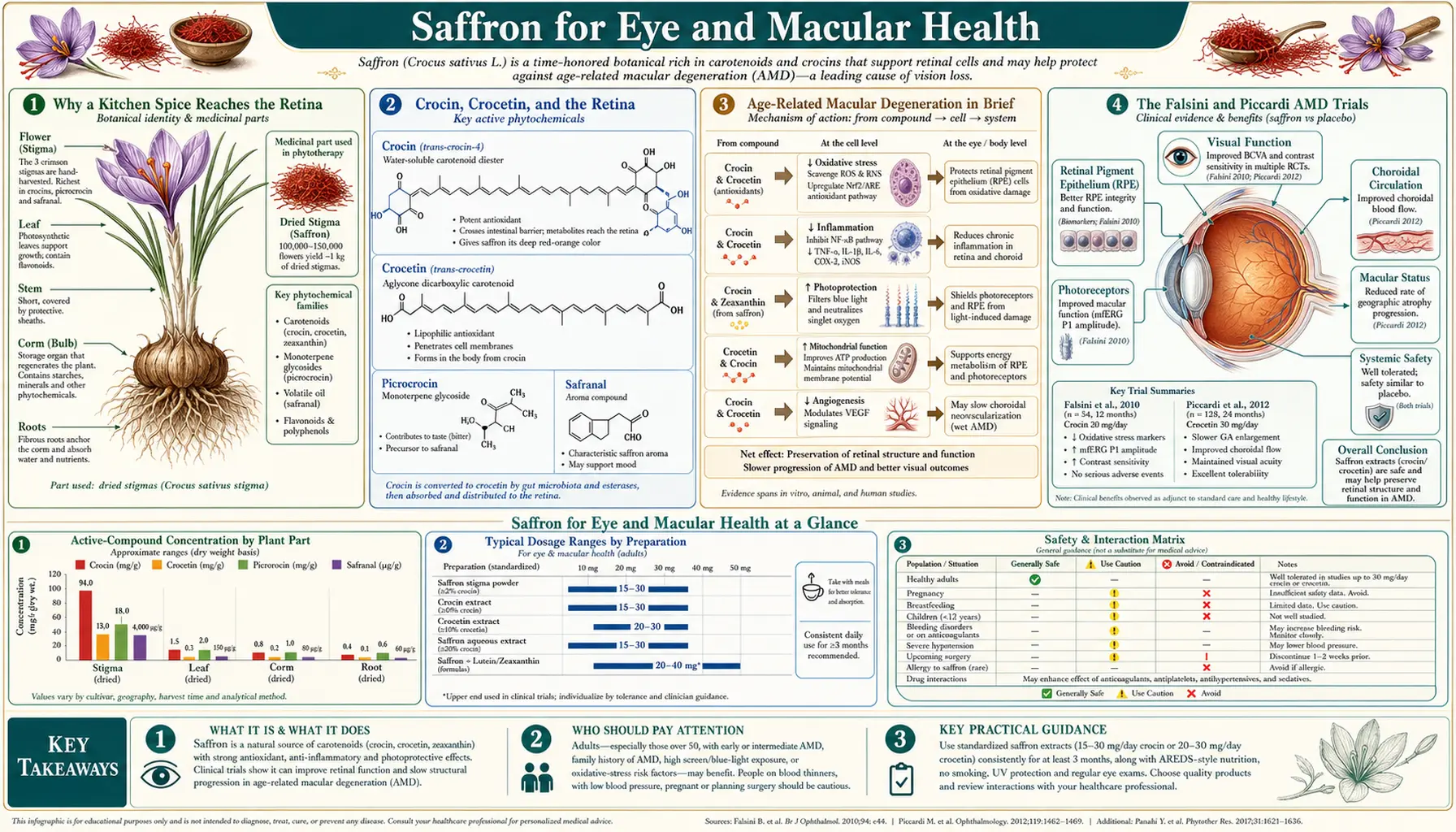
It sounds unlikely that a cooking spice could reach the back of the eye — but saffron's main pigments, crocin and crocetin, are carotenoids, the same chemical family as the lutein and zeaxanthin already known to concentrate in the retina. A series of small but carefully designed clinical trials, most from an Italian research group, has found that oral saffron can measurably improve retinal function in people with early age-related macular degeneration (AMD), the leading cause of vision loss in older adults. There is additional early-stage work in retinitis pigmentosa, glaucoma, and the diabetic retina. This page reviews that evidence enthusiastically but honestly: the studies are small and short, saffron is not a cure, and it does not replace an ophthalmologist, AREDS2 supplements, or anti-VEGF injections where those are indicated.
Table of Contents
- Why a Kitchen Spice Reaches the Retina
- Crocin, Crocetin, and the Retina
- Age-Related Macular Degeneration in Brief
- The Falsini and Piccardi AMD Trials
- Does Genetic Risk Change the Response?
- Newer and Longer AMD Studies
- Retinitis Pigmentosa and Retinal Protection
- Glaucoma and Eye Pressure
- The Diabetic Retina
- What This Evidence Can and Cannot Support
- Key Research Papers
- Connections
- Featured Videos
Why a Kitchen Spice Reaches the Retina
The retina is protected by a selective barrier, so most compounds we eat never reach it in meaningful amounts. Two carotenoids are famous exceptions: lutein and zeaxanthin, which the eye actively concentrates into the macula to form the yellow "macular pigment" that filters damaging blue light and quenches oxidative stress. Saffron's pigments belong to the same broad carotenoid family, and that chemical kinship is the starting point for the eye research.
What makes saffron's carotenoids especially interesting is their solubility. Crocin is a carotenoid bound to sugars, which makes it unusually water-friendly, and its digestion product crocetin is small enough to diffuse across cell membranes and even reach the central nervous system and retina. In laboratory and animal studies reviewed by Bisti and colleagues (2014) and Di Marco and colleagues (2019), saffron compounds protect photoreceptors (the light-sensing cells) from oxidative and light-induced damage, improve retinal blood flow, and support the survival of stressed retinal cells. Those mechanisms are the biological rationale behind the human trials that follow.
Crocin, Crocetin, and the Retina
Three properties of saffron's actives are repeatedly invoked to explain a retinal benefit:
- Antioxidant defense. The retina has one of the highest oxygen demands of any tissue and is bathed in light, making it exquisitely vulnerable to oxidative damage. Crocin and crocetin are potent scavengers of reactive oxygen species.
- Support for retinal blood flow. Crocetin has been reported to improve oxygen delivery and microcirculation, which matters because reduced choroidal blood flow is part of the aging retina's decline.
- Photoreceptor protection and gene regulation. In animal models of light damage, saffron preserved photoreceptor structure and function and influenced the expression of stress- and survival-related genes, rather than acting only as a passive antioxidant.
These are the same antioxidant and circulatory themes that recur across saffron's other uses — the difference here is that the target tissue is the retina rather than the brain or the reproductive system.
Age-Related Macular Degeneration in Brief
Age-related macular degeneration (AMD) is a progressive disease of the macula, the small central part of the retina responsible for the sharp, straight-ahead vision used for reading and recognizing faces. It comes in two broad forms: the more common "dry" (atrophic) form, which develops slowly as the macula thins and accumulates deposits called drusen, and the less common but faster "wet" (neovascular) form, in which abnormal blood vessels leak under the retina.
Standard care depends on the stage. For intermediate dry AMD, the landmark AREDS2 trial established a specific antioxidant-and-mineral formula (vitamins C and E, lutein, zeaxanthin, zinc, and copper) that modestly slows progression to advanced disease. Wet AMD is treated with anti-VEGF injections into the eye. Saffron is being studied as a possible complementary approach in early and dry AMD — not as a replacement for AREDS2 supplements or anti-VEGF therapy.
The Falsini and Piccardi AMD Trials
The most influential saffron-and-eye research comes from a group in Rome working with a supplement providing about 20 mg of saffron per day.
Falsini and colleagues (2010), Investigative Ophthalmology & Visual Science. In this randomized, placebo-controlled crossover study, patients with early AMD took saffron 20 mg per day for 90 days. The researchers measured retinal function objectively using focal electroretinography and flicker sensitivity — not just how patients felt, but how the retina actually responded to light. Retinal flicker sensitivity improved during saffron treatment and returned toward baseline afterward, a pattern that strengthens the case that saffron, and not chance, drove the change.
Piccardi and colleagues (2012). A longitudinal follow-up of saffron supplementation in early AMD reported that the functional benefit was sustained over roughly 14 months of continued use, rather than fading after the first few weeks. Durability matters for a chronic, slowly progressive disease.
These results are striking because they used objective electrophysiology, but it is important to keep scale in mind: each study enrolled only a few dozen patients and measured retinal function rather than long-term prevention of blindness. They are proof of a measurable biological effect, not proof that saffron prevents advanced AMD.
Does Genetic Risk Change the Response?
AMD risk is strongly influenced by genetics, particularly variants in the CFH and ARMS2 genes. A reasonable worry is that saffron might only help people with a favorable genetic profile. Marangoni and colleagues (2013), in the Journal of Translational Medicine, examined this directly and found that the functional improvement with saffron appeared across risk genotypes, suggesting the effect was not confined to a genetically lucky subgroup. This was a small, preliminary analysis, but it is encouraging that the benefit did not obviously depend on genetic background.
Newer and Longer AMD Studies
Research has continued to test saffron in AMD with somewhat larger or longer designs:
- Lashay and colleagues (2016) ran a double-blind, placebo-controlled randomized trial of saffron supplementation in AMD patients and reported short-term functional improvements consistent with the earlier Italian work.
- Broadhead and colleagues explored saffron for the ongoing treatment of AMD, extending the question from short trials toward longer, real-world use.
- Sepahi and colleagues (2021) pulled the field together in a systematic review of saffron and its constituents across ocular disorders, cataloguing the in-vitro, animal, and clinical evidence and, importantly, noting where it remains thin.
The trend is consistent and positive, but the field still lacks the kind of large, multi-year, multi-center trial — on the scale of AREDS2 — that would be needed to recommend saffron as a standard part of AMD care. Until then, it sits in the category of "promising complementary option to discuss with an ophthalmologist," not established therapy.
Retinitis Pigmentosa and Retinal Protection
Retinitis pigmentosa is a group of inherited disorders in which photoreceptors gradually die, causing progressive night blindness and tunnel vision. Because saffron protects photoreceptors from stress in animal models, it has been explored here too. Fernández-Sánchez and colleagues (2015), in Molecules, showed that natural compounds including those from saffron helped prevent vision loss and retinal degeneration in experimental models. This is preclinical work — a signal worth pursuing, not a treatment recommendation — but it reinforces that saffron's retinal effect is a general neuroprotective one rather than a quirk specific to AMD.
Glaucoma and Eye Pressure
Glaucoma damages the optic nerve, usually in association with elevated pressure inside the eye (intraocular pressure). Jabbarpoor Bonyadi and colleagues (2014), in BMC Complementary and Alternative Medicine, ran a pilot study of saffron extract in primary open-angle glaucoma and reported a modest lowering of intraocular pressure compared with placebo. As a pilot, it is hypothesis-generating rather than practice-changing, and it does not mean saffron can substitute for pressure-lowering eye drops. But it hints that saffron's retinal interest may extend to the optic nerve as well.
The Diabetic Retina
Diabetic retinopathy is damage to the retina's blood vessels from long-standing high blood sugar. Given crocin's antioxidant and microcirculatory effects, researchers have asked whether saffron might protect the diabetic retina. Reviews such as Heydari and colleagues (2023), examining crocin as a vision supplement, summarize laboratory and early clinical signals of benefit while emphasizing that the human evidence in diabetic eye disease is still preliminary. The foundation of diabetic-retina protection remains blood-sugar and blood-pressure control plus regular eye screening; saffron is at most an experimental add-on.
What This Evidence Can and Cannot Support
To keep expectations calibrated:
- What it supports: multiple small randomized trials show saffron (about 20 mg per day) can measurably improve retinal function in early AMD, with objective electrophysiology and at least one longitudinal follow-up suggesting the benefit persists.
- What it does not support: that saffron cures AMD, reverses established vision loss, prevents progression to advanced disease over years, or can replace AREDS2 supplements, anti-VEGF injections, or ophthalmology care.
- Practical stance: anyone with AMD, glaucoma, retinitis pigmentosa, or diabetic eye disease should be under the care of an eye specialist. Saffron is reasonable to raise as a complementary option, but it belongs on top of proven care, not instead of it — and quality matters, since much retail saffron is adulterated (see the safety page).
Key Research Papers
- Falsini B, Piccardi M, Minnella A, et al. (2010). Influence of saffron supplementation on retinal flicker sensitivity in early age-related macular degeneration. Investigative Ophthalmology & Visual Science. — PubMed PMID: 20688744
- Piccardi M, Marangoni D, Minnella AM, et al. (2012). A longitudinal follow-up study of saffron supplementation in early age-related macular degeneration: sustained benefits to central retinal function. Evidence-Based Complementary and Alternative Medicine. — PubMed PMID: 22852021
- Marangoni D, Falsini B, Piccardi M, et al. (2013). Functional effect of saffron supplementation and risk genotypes in early age-related macular degeneration: a preliminary report. Journal of Translational Medicine. — PubMed PMID: 24067115
- Lashay A, Sadough G, Ashrafi E, et al. (2016). Short-term outcomes of saffron supplementation in patients with age-related macular degeneration: a double-blind, placebo-controlled, randomized trial. Medical Hypothesis, Discovery & Innovation in Ophthalmology. — PubMed PMID: 28289690
- Broadhead GK, Grigg JR, McCluskey P, et al. (2024). Saffron therapy for the ongoing treatment of age-related macular degeneration. BMJ Open Ophthalmology. — PubMed PMID: 38485112
- Bisti S, Maccarone R, Falsini B (2014). Saffron and retina: neuroprotection and pharmacokinetics. Visual Neuroscience. — PubMed PMID: 24819927
- Di Marco S, Carnicelli V, Franceschini N, et al. (2019). Saffron: a multitask neuroprotective agent for retinal degenerative diseases. Antioxidants. — PubMed PMID: 31319529
- Fernández-Sánchez L, Lax P, Esquiva G, et al. (2015). Natural compounds from saffron and bear bile prevent vision loss and retinal degeneration. Molecules. — PubMed PMID: 26263962
- Sepahi S, Mohajeri SA, Hosseini SM, et al. (2021). Pharmacological effects of saffron and its constituents in ocular disorders from in vitro studies to clinical trials: a systematic review. Current Neuropharmacology. — PubMed PMID: 32379589
- Jabbarpoor Bonyadi MH, Yazdani S, Saadat S (2014). The ocular hypotensive effect of saffron extract in primary open angle glaucoma: a pilot study. BMC Complementary and Alternative Medicine. — PubMed PMID: 25319729
- Heydari M, et al. (2023). Crocin as a vision supplement. Clinical and Experimental Optometry. — Search PubMed
PubMed Topic Searches
- PubMed: Saffron and macular degeneration
- PubMed: Crocin retinal neuroprotection
- PubMed: Saffron and retinal function
- PubMed: Saffron and glaucoma
- PubMed: Crocetin and photoreceptors
External Authoritative Resources
- National Eye Institute — Age-Related Macular Degeneration
- NIH NCCIH — Saffron
- MedlinePlus — Macular Degeneration
Connections
- All Herbs
- Saffron (Main Page)
- Saffron Benefits Hub
- Saffron for Mood & Depression
- Saffron: Sources & Safety
- Macular Degeneration
- Glaucoma
- Retinitis Pigmentosa
- Diabetic Retinopathy
- Lutein
- Zeaxanthin
- Vitamin A for Vision
- Zinc
- Ginkgo Biloba
- Curcumin