Saffron for PMS and Menstrual Symptoms
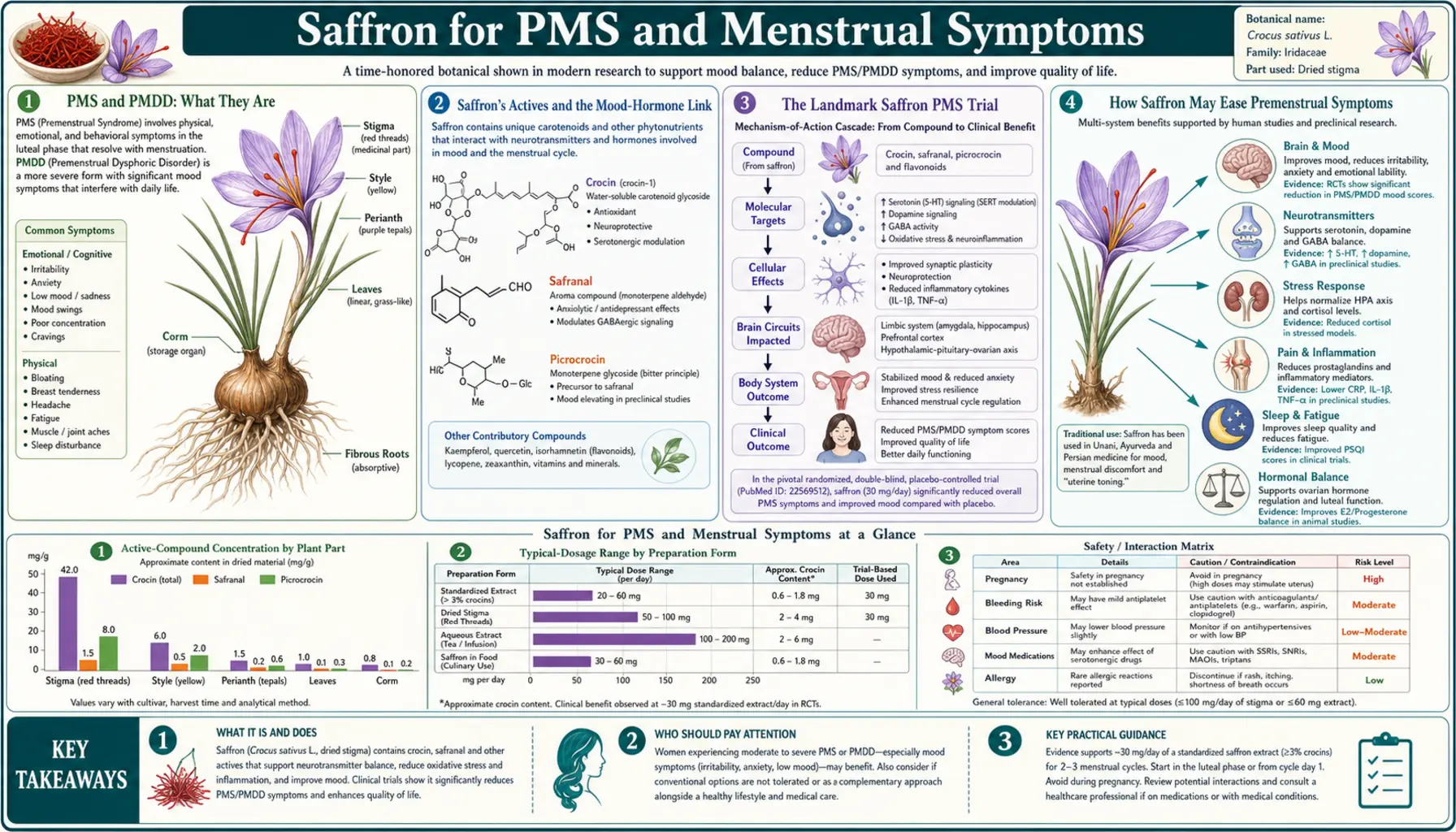
Premenstrual syndrome (PMS) mixes physical symptoms — bloating, breast tenderness, cramps, fatigue — with emotional ones like irritability, low mood, and tearfulness in the days before a period. Because saffron has the best-documented mood effect of any culinary herb, it is a natural candidate for the emotional side of PMS, and a landmark double-blind trial found it did reduce premenstrual symptoms more than placebo. There is also early evidence for menstrual cramps (dysmenorrhea). This page presents that research fairly: the mood evidence for saffron is strong, but the number of trials done specifically for PMS and menstrual pain is still small, so the honest verdict is "promising and biologically sensible," not "proven first-line treatment."
Table of Contents
- PMS and PMDD: What They Are
- Saffron's Actives and the Mood-Hormone Link
- The Landmark Saffron PMS Trial
- How Saffron May Ease Premenstrual Symptoms
- Saffron and Menstrual Cramps
- The Mood Overlap: PMDD and Premenstrual Depression
- Saffron Among Herbal Options for PMS
- Practical Use and Dosing for Cycle Symptoms
- Cautions (Especially Pregnancy)
- Key Research Papers
- Connections
- Featured Videos
PMS and PMDD: What They Are
Premenstrual syndrome (PMS) refers to a cluster of physical and emotional symptoms that appear in the luteal phase — the roughly two weeks between ovulation and the start of a period — and reliably ease once bleeding begins. Most people who menstruate notice some premenstrual changes; PMS is diagnosed when those changes are troublesome enough to interfere with daily life.
A more severe, mood-dominated form is premenstrual dysphoric disorder (PMDD), in which intense irritability, depression, anxiety, and a sense of being overwhelmed dominate the premenstrual window and substantially disrupt relationships and work. PMDD is classified as a depressive disorder, which is precisely why a compound with antidepressant activity — like saffron — is a plausible thing to study for it. The emotional symptoms of PMS and PMDD, more than the physical ones, are where saffron's known biology is most likely to help.
Saffron's Actives and the Mood-Hormone Link
Saffron's three key compounds — the carotenoid pigments crocin and crocetin and the aroma molecule safranal — are the same actives behind its antidepressant effects. The leading explanation for a premenstrual benefit is therefore an extension of the mood story: premenstrual mood symptoms are thought to arise partly from the brain's sensitivity to the natural fall in progesterone and its calming metabolite allopregnanolone in the late luteal phase, together with shifts in serotonin signaling.
Serotonin is central here. SSRIs are a first-line medical treatment for PMDD, and they can work within days rather than the weeks needed for depression — suggesting the serotonin system is the key lever premenstrually. Because saffron compounds appear to modestly support serotonin activity and reduce oxidative and inflammatory stress, they act on plausibly the right pathway. This is a mechanistic rationale, not a proven mechanism, but it is a coherent one.
The Landmark Saffron PMS Trial
The cornerstone study is Agha-Hosseini and colleagues (2008), published in BJOG: An International Journal of Obstetrics and Gynaecology — a respected mainstream journal, which is notable for a herbal trial.
The researchers enrolled women aged 20 to 45 with regular cycles and PMS and randomized them to saffron 30 mg per day (15 mg twice daily) or an identical placebo for two menstrual cycles. Symptoms were tracked with the Premenstrual Daily Symptoms questionnaire and, for mood specifically, the Hamilton Depression Rating Scale. The result was clear: a significantly greater proportion of women in the saffron group achieved a meaningful reduction in premenstrual symptoms (defined as at least a 50 percent drop in symptom scores) compared with the placebo group, and their depression scores fell further as well.
This was still a modest trial by pharmaceutical standards — a few dozen women over two cycles — but its double-blind, placebo-controlled design and publication in a leading obstetrics journal make it a genuinely useful data point rather than an anecdote. The dose it used, 30 mg per day, is the same one that recurs throughout saffron's depression research, which makes the findings easy to connect.
How Saffron May Ease Premenstrual Symptoms
Putting the mechanisms together, saffron could plausibly help premenstrual symptoms through several routes at once:
- Mood stabilization via modest support of serotonin, dopamine, and norepinephrine activity — the emotional core of PMS and PMDD.
- Reduced irritability and tension, consistent with saffron's documented effects on low mood and mild anxiety in non-menstrual settings.
- Anti-inflammatory and antioxidant effects, which may bear on the physical malaise, breast tenderness, and fatigue that accompany the luteal phase.
What the evidence does not establish is a hormonal effect — there is no good evidence that saffron changes estrogen or progesterone levels, and its benefit is better understood as acting on how the brain responds to normal hormonal shifts rather than on the hormones themselves.
Saffron and Menstrual Cramps
Dysmenorrhea — painful menstrual cramps caused largely by prostaglandin-driven uterine contractions — is a separate problem from PMS, though the two often coexist. Saffron has appeared in this research mainly as part of multi-herb formulas. Nahid and colleagues (2009), in the Journal of Midwifery & Women's Health, tested an Iranian herbal preparation combining saffron, celery seed, and anise against a conventional anti-inflammatory painkiller for primary dysmenorrhea and found the herbal formula reduced pain.
Because saffron was one ingredient among several, this trial cannot isolate saffron's specific contribution to pain relief — a real limitation. It suggests saffron-containing formulas may help with cramps, but it does not prove saffron alone is an effective analgesic. For cramps specifically, the physical mechanisms (relaxing uterine muscle, lowering prostaglandins) are less obviously saffron's strength than its mood effects are.
The Mood Overlap: PMDD and Premenstrual Depression
The strongest logical case for saffron in the menstrual context is the overlap between premenstrual mood symptoms and the depression and anxiety that saffron is best proven to help. PMDD is formally a depressive disorder, and premenstrual worsening of an existing mood or anxiety condition is common. The large body of saffron mood research — including systematic reviews and meta-analyses covering depression, anxiety, and general mood, and trials of standardized extracts in people with low mood — is therefore indirectly relevant here.
The reasonable interpretation is that saffron's well-supported mood benefit is likely to carry over to the emotional symptoms of PMS and PMDD, while acknowledging that few trials have tested this directly in a premenstrual population. That is a fair, evidence-based position: strong general mood data, limited PMS-specific data, and a coherent reason to expect the two to connect.
Saffron Among Herbal Options for PMS
Saffron is one of several botanicals studied for premenstrual symptoms. Dante and Facchinetti (2011) reviewed herbal treatments for PMS and PMDD and concluded that a handful — most notably chasteberry (Vitex agnus-castus), along with saffron and others — had randomized evidence of benefit, while many popular remedies did not. Placing saffron in that context is useful: it is among the better-supported herbal options for PMS, not a lone outlier, but the overall herbal evidence base for PMS remains modest and heterogeneous.
For the emotional symptoms, saffron's mood pedigree arguably gives it an edge over herbs studied mainly for physical complaints; for cramps and bloating, other approaches may be more directly targeted. Many people combine approaches — for example pairing a mood-focused option with magnesium and vitamin B6, both of which have their own PMS evidence.
Practical Use and Dosing for Cycle Symptoms
- Dose: the PMS trial used 30 mg per day of standardized saffron (15 mg twice daily), the same dose as the depression studies — a convenient consistency.
- Timing: in the landmark trial saffron was taken daily across the whole cycle for two cycles, not only in the premenstrual window. Give it a fair trial of at least two full cycles before judging the effect, as premenstrual symptoms vary month to month.
- Form: a standardized capsule is more reliable than culinary threads, whose potency varies and whose cooking amounts fall far below the studied dose.
- Track symptoms: keeping a simple daily symptom diary across a couple of cycles is the best way to tell whether saffron is genuinely helping you, since the placebo response in PMS is substantial.
If premenstrual symptoms are severe or PMDD is suspected, this is a medical issue worth discussing with a clinician — effective prescription options exist, and saffron is best considered a complementary choice to raise with them rather than a do-it-yourself substitute.
Cautions (Especially Pregnancy)
- Pregnancy — avoid medicinal doses. This is the most important caution for anyone in their reproductive years. High doses of saffron have traditionally been used to stimulate the uterus and menstruation, and are considered potentially unsafe in pregnancy. Anyone who could become pregnant, or is trying to conceive, should be cautious with supplement-level saffron. Culinary pinches in food are not the concern; concentrated 30 mg supplements are. See the sources and safety page.
- Serotonergic overlap. If you already take an SSRI (a common PMDD treatment) or another serotonergic medication, discuss adding saffron with your prescriber before combining them.
- Dose discipline. Stay within the studied 30 mg/day range; high doses of saffron are toxic, not more effective.
- Not a diagnosis substitute. Severe cyclical mood symptoms, very heavy or irregular bleeding, or disabling pain deserve a proper evaluation rather than self-treatment.
Key Research Papers
- Agha-Hosseini M, Kashani L, Aleyaseen A, et al. (2008). Crocus sativus L. (saffron) in the treatment of premenstrual syndrome: a double-blind, randomised and placebo-controlled trial. BJOG. — PubMed PMID: 18271889
- Nahid K, Fariborz M, Ataolah G, Solokian S (2009). The effect of an Iranian herbal drug on primary dysmenorrhea: a clinical controlled trial. Journal of Midwifery & Women's Health. — PubMed PMID: 19720342
- Dante G, Facchinetti F (2011). Herbal treatments for alleviating premenstrual symptoms: a systematic review. Journal of Psychosomatic Obstetrics & Gynaecology. — PubMed PMID: 21171936
- Lopresti AL, Drummond PD, Inarejos-García AM, Prodanov M (2018). affron, a standardised extract from saffron for the treatment of youth anxiety and depressive symptoms: a randomised, double-blind, placebo-controlled study. Journal of Affective Disorders. — PubMed PMID: 29510352
- Akhondzadeh S, Tahmacebi-Pour N, Noorbala AA, et al. (2005). Crocus sativus L. in the treatment of mild to moderate depression: a double-blind, randomized and placebo-controlled trial. Phytotherapy Research. — PubMed PMID: 15852492
- Lopresti AL, Drummond PD (2014). Saffron (Crocus sativus) for depression: a systematic review of clinical studies and examination of underlying antidepressant mechanisms of action. Human Psychopharmacology. — PubMed PMID: 25384672
- Hausenblas HA, Saha D, Dubyak PJ, Anton SD (2013). Saffron (Crocus sativus L.) and major depressive disorder: a meta-analysis of randomized clinical trials. Journal of Integrative Medicine. — PubMed PMID: 24299602
- Mahmoudi R, et al. (2026). Effect of saffron on depression, anxiety and mood disorder: a GRADE-assessed systematic review and meta-analysis of 34 randomized controlled trials. Nutritional Neuroscience. — PubMed PMID: 41693488
- Cerdá-Bernad D, Valero-Cases E, Pastor JJ, Frutos MJ (2022). Saffron bioactives against neuro-cognitive disorders: an overview of main bioactive compounds, metabolic fate and mechanisms of neurological protection. Nutrients. — PubMed PMID: 36558528
- Matraszek-Gawron R, Chwil M, Terlecki K, Skoczylas MM (2022). Current knowledge of the antidepressant activity of chemical compounds from Crocus sativus L. Pharmaceuticals. — PubMed PMID: 36678554
PubMed Topic Searches
- PubMed: Saffron and premenstrual syndrome
- PubMed: Saffron and dysmenorrhea
- PubMed: PMDD and herbal treatments
- PubMed: Saffron, women, and mood
- PubMed: Saffron and anxiety trials
External Authoritative Resources
- American College of Obstetricians and Gynecologists — Premenstrual Syndrome (PMS)
- NIH NCCIH — Saffron
- MedlinePlus — Premenstrual Syndrome
Connections
- All Herbs
- Saffron (Main Page)
- Saffron Benefits Hub
- Saffron for Mood & Depression
- Saffron: Sources & Safety
- PMS and PMDD
- Dysmenorrhea
- Premenstrual Dysphoric Disorder
- Depression
- Menopause
- Magnesium
- Vitamin B6
- Chamomile
- Lavender
- Ashwagandha