Rhodiola Rosea — Benefits Deep Dive
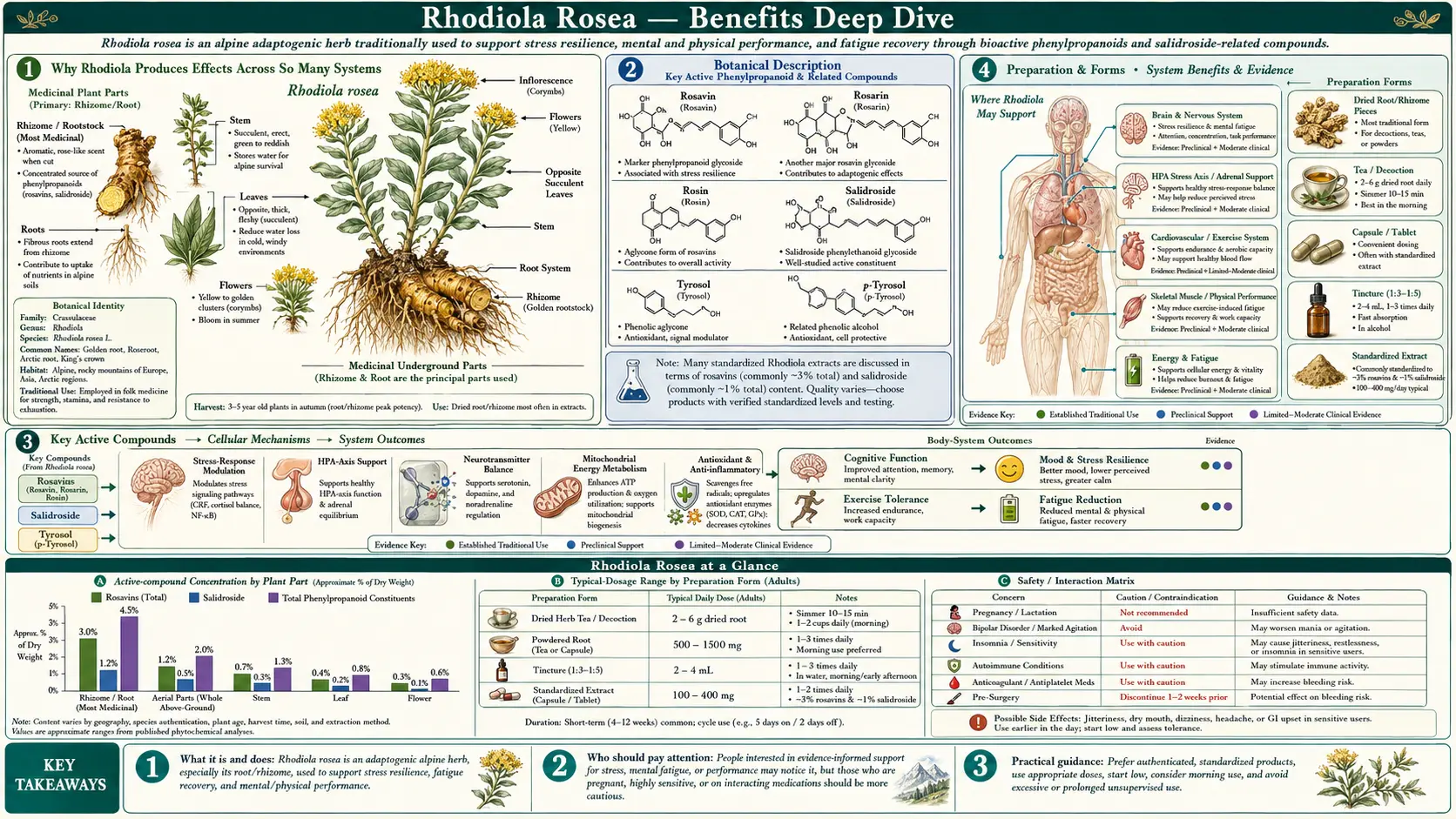
Rhodiola rosea is the Arctic adaptogen the Vikings reportedly brewed as a fortifying tea before long sea voyages and battle, the «golden root» (zolotoy koren) of Siberian folk medicine, and the single most-studied herb in the Soviet Union's fifty-year state-sponsored program to identify natural performance enhancers for soldiers, cosmonauts, and Olympic athletes. The two signature actives — the phenylpropanoid rosavins (rosavin, rosarin, rosin) and the phenylethanoid glycoside salidroside — are standardized to the naturally occurring 3:1 ratio (3% rosavins / 1% salidroside) in pharmaceutical-grade extracts such as the Swedish SHR-5. Four benefit pages below explore the conditions where Rhodiola produces the largest clinical effect: stress-related burnout and fatigue (the indication for which the European Medicines Agency granted formal monograph status in 2011), cognitive performance under sleep deprivation, mild-to-moderate depression (where the Mao 2015 Phase II trial found Rhodiola only slightly less effective than sertraline with dramatically fewer side effects), and endurance athletic performance dosed 60 minutes pre-exercise.
Deep-Dive Articles
Stress & Fatigue
The Olsson 2009 Nordic randomized trial of SHR-5 in stress-related fatigue, the Soviet space program research history dating to the 1960s, salidroside and rosavin as paired adaptogens, HPA axis modulation, cortisol normalization without abolishing the acute stress response, and the standardized 200-600 mg/day SHR-5 dosing range that became the European pharmaceutical reference.
Cognitive Performance
The Spasov 2000 Armenian medical-student examination-stress trial, the Darbinyan 2000 night-shift physician crossover trial, Krasik's 1970s Soviet military performance research, and the consistent finding that Rhodiola preserves attention, short-term memory, calculation speed, and audiovisual processing under sleep deprivation and sustained cognitive load.
Depression
The pivotal Mao 2015 Phase II Rhodiola vs sertraline randomized trial (Rhodiola produced slightly smaller effect size on HAM-D but dramatically fewer adverse events — the favorable side-effect profile is the headline), the Darbinyan 2007 trial in mild-to-moderate depression, monoamine oxidase A and B inhibition, and the role of Rhodiola as a real alternative to SSRIs for patients with intolerable serotonergic side effects.
Athletic Performance
The De Bock 2004 endurance trial in trained cyclists, lactate threshold improvement, reduction in rating of perceived exertion (RPE), military fatigue prophylaxis research (Spasov), and the 60-minutes-before-exercise dosing protocol that distinguishes Rhodiola's acute ergogenic effect from chronic adaptation seen with other adaptogens.
Table of Contents
- Deep-Dive Articles
- Why Rhodiola Produces Effects Across So Many Systems
- Key Research Papers
- External Authoritative Resources
- Connections
- Featured Videos
Why Rhodiola Produces Effects Across So Many Systems
Most herbs hit one principal target. Rhodiola rosea is unusual because it is a true adaptogen in the original Lazarev-Brekhman sense — a substance that increases nonspecific resistance to a wide spectrum of stressors by acting on the master control circuits of the stress response itself, rather than on any one downstream organ. The same molecular events therefore translate into protective effects across stress, fatigue, cognition, mood, endurance, and immunity. Four convergent mechanisms explain the breadth of clinical effect:
- HPA-axis modulation at the hypothalamus — salidroside reduces c-Fos expression in the paraventricular nucleus (PVN) of the hypothalamus, dampening corticotropin-releasing hormone (CRH) secretion at the very top of the stress cascade. The downstream ACTH and cortisol responses are not abolished (which would be dangerous), but they are proportionalized to the actual threat. This is the defining adaptogen signature: chronically elevated cortisol falls back to normal, but the acute fight-or-flight response is preserved. This mechanism underlies the stress-related fatigue and burnout effects documented in the Olsson 2009 SHR-5 trials.
- Monoamine oxidase inhibition (MAO-A and MAO-B) — both salidroside and rosavin inhibit MAO-A and MAO-B, the two enzymes that degrade serotonin, dopamine, norepinephrine, and other monoamine neurotransmitters in the synaptic cleft. This is the same enzymatic target hit by the older MAOI antidepressant class (phenelzine, tranylcypromine), but with vastly weaker and reversible binding that avoids the hypertensive-crisis tyramine risk. This pharmacology drives the antidepressant effects observed in the Darbinyan 2007 and Mao 2015 trials and is the most likely mechanism behind the cognitive enhancement under fatigue.
- Heat shock protein 70 (Hsp70) induction — Rhodiola extracts upregulate Hsp70 expression in stressed cells, including cardiomyocytes, neurons, and skeletal muscle. Hsp70 is the cell's master chaperone that refolds damaged proteins and prevents apoptosis during stress (heat, hypoxia, oxidative damage, ischemia). The Panossian rabbit immobilization-stress study showed that Rhodiola-treated animals maintained near-baseline levels of phosphorylated stress-activated protein kinase (p-SAPK/p-JNK), nitric oxide, and cortisol after stress, while placebo animals showed 200-300% elevations. Hsp70 induction is part of why Rhodiola produces muscle-fatigue protection during endurance exercise and cardioprotection during ischemic stress.
- Adrenal preservation and catecholamine moderation — Rhodiola reduces adrenal catecholamine release during stress and lowers myocardial cyclic AMP (cAMP) and tissue catecholamine concentrations in the heart. The metabolic translation is reduced lactate accumulation, improved fatty acid mobilization, enhanced ATP resynthesis through AMP-activated protein kinase (AMPK) modulation, and better mitochondrial function during exhaustive exercise. This mechanism is the molecular basis for the perceived-exertion reduction observed in the De Bock 2004 endurance trial.
The therapeutic complication that distinguishes Rhodiola from short-acting stimulants like caffeine is its biphasic dose-response. At standard doses (200-600 mg/day of SHR-5 standardized to 3% rosavins / 1% salidroside), Rhodiola produces clean adaptogenic effects without sedation or stimulation. At excessive doses (above approximately 900 mg/day), some patients experience paradoxical agitation, insomnia, and irritability — the same overstimulation patients describe with SSRI overdose. The clinical pattern is reliably reversible by dose reduction; the practical implication is that more Rhodiola is not better. Most clinical benefit appears at the low end of the dose range, and the modal effective dose in published trials is closer to 200-400 mg/day than the maximum 600 mg permitted under the EMA monograph.
Key Research Papers
- Olsson EM, von Scheele B, Panossian AG (2009). A randomised, double-blind, placebo-controlled, parallel-group study of the standardised extract SHR-5 of the roots of Rhodiola rosea in the treatment of subjects with stress-related fatigue. Planta Medica, 75(2), 105-112. — PubMed: Olsson SHR-5 stress fatigue 2009
- Mao JJ, Xie SX, Zee J, Soeller I, Li QS, Rockwell K, Amsterdam JD (2015). Rhodiola rosea versus sertraline for major depressive disorder: a randomized placebo-controlled trial. Phytomedicine, 22(3), 394-399. — PubMed: Mao Rhodiola vs sertraline 2015
- Darbinyan V, Kteyan A, Panossian A, Gabrielian E, Wikman G, Wagner H (2000). Rhodiola rosea in stress-induced fatigue — a double blind cross-over study of a standardised extract SHR-5 with a repeated low-dose regimen on the mental performance of healthy physicians during night duty. Phytomedicine, 7(5), 365-371. — PubMed: Darbinyan night-duty physicians 2000
- Spasov AA, Wikman GK, Mandrikov VB, Mironova IA, Neumoin VV (2000). A double-blind, placebo-controlled pilot study of the stimulating and adaptogenic effect of Rhodiola rosea SHR-5 extract on the fatigue of students caused by stress during an examination period with a repeated low-dose regimen. Phytomedicine, 7(2), 85-89. — PubMed: Spasov student exam stress 2000
- De Bock K, Eijnde BO, Ramaekers M, Hespel P (2004). Acute Rhodiola rosea intake can improve endurance exercise capacity. International Journal of Sport Nutrition and Exercise Metabolism, 14(3), 298-307. — PubMed: De Bock endurance exercise 2004
External Authoritative Resources
- European Medicines Agency — Rhodiola rosea L., rhizoma et radix (HMPC Community Herbal Monograph) — the formal EU regulatory monograph approving traditional adaptogen use, 2011
- NCCIH — Rhodiola (National Center for Complementary and Integrative Health)
- MedlinePlus — Rhodiola rosea
- Drugs.com — Rhodiola Professional Monograph
- PubMed — All research on Rhodiola rosea
Connections
- All Herbs
- Rhodiola Rosea (Main Page)
- Rhodiola for Stress & Fatigue
- Rhodiola for Cognitive Performance
- Rhodiola for Depression
- Rhodiola for Athletic Performance
- Ashwagandha
- Holy Basil
- Ginseng
- Schisandra
- Bacopa Monnieri
- Ginkgo Biloba
- Depression
- Anxiety
- Burnout
- Fatigue
- Stress Management
- Cortisol Test