Passionflower for Withdrawal & Addiction Support
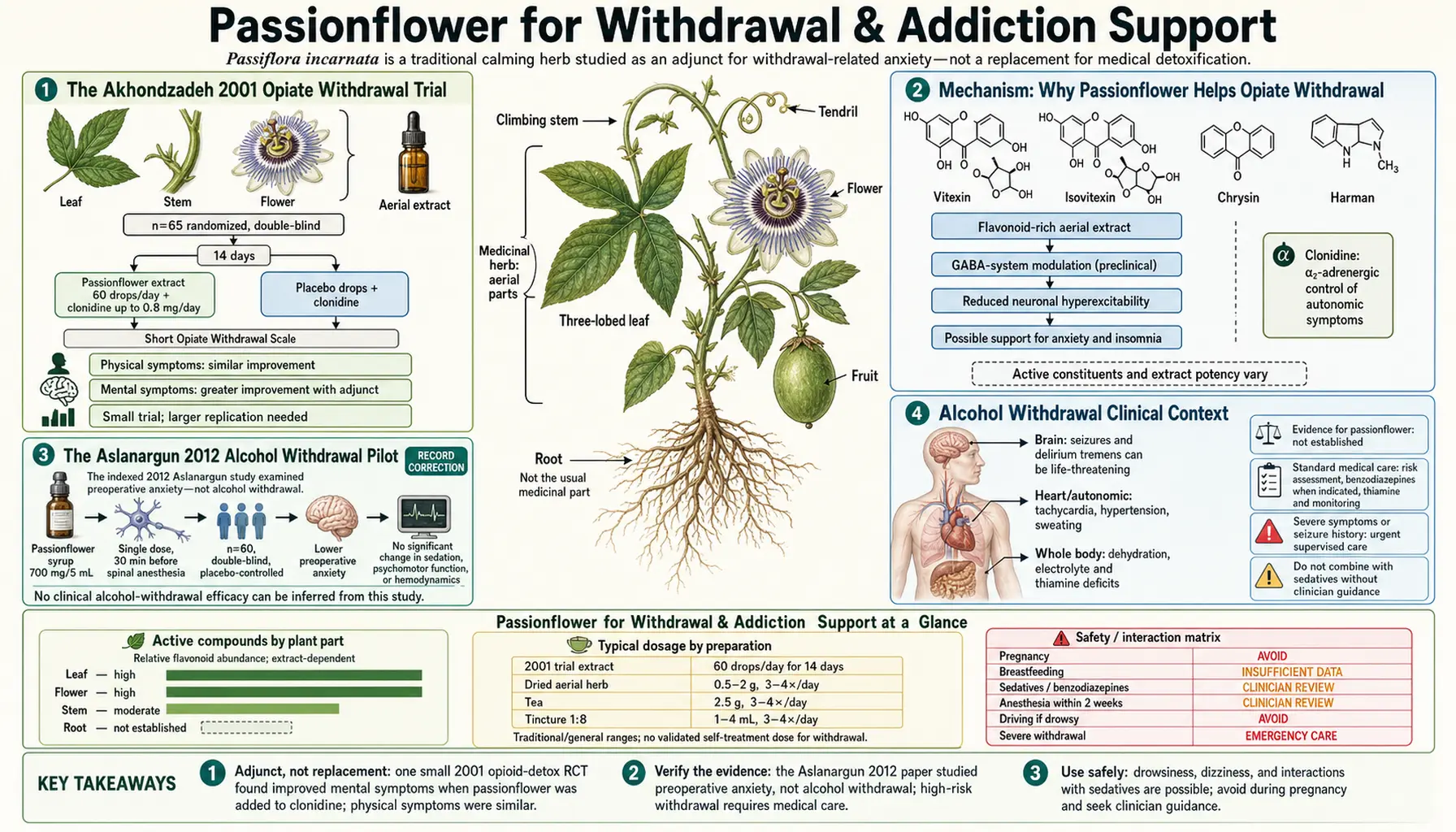
Some of the most clinically intriguing evidence for passionflower comes from the addiction medicine literature. In the 2001 Akhondzadeh randomized double-blind trial published in Journal of Clinical Pharmacy and Therapeutics, 65 opiate-addicted patients undergoing detoxification were assigned to either clonidine alone (the standard alpha-2 agonist used to control autonomic withdrawal symptoms) or clonidine plus passionflower extract for 14 days. The addition of passionflower produced significant additional reduction in the psychological symptoms of opiate withdrawal — anxiety, irritability, insomnia, restlessness, and dysphoria — without affecting clonidine's control of the autonomic symptoms (sweating, tachycardia, lacrimation, rhinorrhea). The Aslanargun 2012 pilot study in alcohol withdrawal demonstrated similar benefit. Dhawan's rodent work documented reversal of morphine, nicotine, and cannabinoid tolerance and dependence by the benzoflavone moiety isolated from Passiflora incarnata. The unifying theme: passionflower's gentle GABA-A potentiation and central calming effect address the central nervous system hyperexcitability that drives the psychological symptoms of withdrawal across multiple substance classes. This deep-dive walks through the trial evidence in opiate, alcohol, and nicotine withdrawal, the autonomic stabilization mechanism, the practical integration with conventional addiction medicine, and the limitations of botanical adjunct therapy in severe substance use disorder.
Table of Contents
- The Akhondzadeh 2001 Opiate Withdrawal Trial
- Mechanism: Why Passionflower Helps Opiate Withdrawal
- The Aslanargun 2012 Alcohol Withdrawal Pilot
- Alcohol Withdrawal Clinical Context
- Nicotine Withdrawal — Traditional Use and Dhawan Rodent Data
- The Dhawan Tolerance-Reversal Studies
- Autonomic Stabilization Mechanism
- Benzodiazepine Tapering Protocols
- Integration with Conventional Addiction Medicine
- Limitations and What Passionflower Cannot Do
- Cautions in Addiction Patients
- Key Research Papers
- Connections
- Featured Videos
The Akhondzadeh 2001 Opiate Withdrawal Trial
Akhondzadeh and colleagues at Tehran University of Medical Sciences published two landmark passionflower trials in 2001. One was the GAD vs oxazepam trial discussed on the Anxiety Relief page. The other, less widely known but equally well-designed, tested passionflower as an adjunct to clonidine in opiate detoxification.
Sixty-five opiate-addicted patients undergoing inpatient detoxification at the Roozbeh Psychiatric Hospital were randomized to either:
- Clonidine (the alpha-2 adrenergic agonist standard for opiate withdrawal autonomic symptoms) plus placebo drops
- Clonidine plus passionflower extract (60 drops/day of standardized tincture)
The 14-day detoxification protocol used clonidine 0.4-0.6 mg/day in divided doses (the same in both arms), with passionflower added on top in the active arm. The double-blind design used dummy drops in the clonidine-only arm. Withdrawal symptoms were scored using the Short Opiate Withdrawal Scale (SOWS), which separates physical symptoms (yawning, lacrimation, rhinorrhea, sweating, gooseflesh, tremor, restlessness, vomiting, abdominal cramps, muscle aches) from mental/affective symptoms (anxiety, irritability, dysphoria, insomnia).
Results:
- Both treatment arms showed similar control of physical withdrawal symptoms by clonidine — the alpha-2 mechanism produced equivalent suppression of autonomic discharge regardless of passionflower addition
- The passionflower arm had significantly lower scores on mental/affective withdrawal symptoms throughout the detoxification period (p < 0.05)
- Anxiety, irritability, and insomnia were the symptoms most clearly reduced by passionflower addition
- Completion rates favored the passionflower arm (more patients completed the 14-day detox)
- No serious adverse events attributable to passionflower
The clinical relevance: opiate detoxification has a well-recognized two-component symptom structure. Clonidine, lofexidine, and related alpha-2 agonists control the autonomic and physical symptoms by reducing sympathetic outflow from the locus coeruleus, but they do not adequately address the equally distressing mental/affective component — the anxiety, restlessness, dysphoria, and insomnia that lead so many patients to abort detoxification and return to use. The Akhondzadeh trial provided one of the few well-designed randomized demonstrations of a botanical adjunct meaningfully reducing this mental/affective component, with reasonable safety and good tolerability.
Mechanism: Why Passionflower Helps Opiate Withdrawal
The mechanism behind passionflower's utility in opiate withdrawal is best understood through the neurobiology of opiate dependence and withdrawal:
Chronic opiate use produces adaptive changes in multiple brain systems. The locus coeruleus, a brainstem norepinephrine-producing nucleus, becomes hyperexcitable with chronic opiate exposure as it adapts to the inhibitory effect of mu-opioid agonism. When the opiate is withdrawn, this adaptive hyperexcitability is unmasked — the locus coeruleus fires excessively, producing the autonomic storm of opiate withdrawal: tachycardia, hypertension, sweating, mydriasis, piloerection, rhinorrhea, lacrimation. Clonidine and lofexidine address this by activating presynaptic alpha-2 autoreceptors on the locus coeruleus neurons, reducing their firing rate.
Simultaneously, chronic opiate use downregulates GABAergic tone in mesolimbic and prefrontal circuits, contributing to the dysphoria and anxiety of withdrawal once opiate-mediated reward is removed. Passionflower's GABA-A potentiation directly addresses this GABAergic shortfall, modestly amplifying basal inhibitory tone in the cortical and limbic regions that produce the affective component of withdrawal. The benzoflavone moiety may have additional direct effects on opiate receptor adaptation (per the Dhawan tolerance-reversal work discussed below).
The complementary mechanisms — alpha-2 agonism for autonomic symptoms, GABA-A potentiation for mental/affective symptoms — explain the additive clinical benefit observed in the Akhondzadeh trial. Neither mechanism alone is sufficient to address both symptom components, and their combination produces more complete symptom control than either alone.
This combination approach has informed several integrative addiction medicine protocols that pair conventional alpha-2 agonists (clonidine or lofexidine) with botanical GABAergic adjuncts (passionflower, valerian, kava, or chamomile) during the acute withdrawal period. Buprenorphine remains the gold-standard opiate detoxification agent in current practice (essentially eliminating physical withdrawal symptoms through partial mu-opioid agonism), but passionflower can also be used as an adjunct in buprenorphine-mediated detoxification to address residual anxiety and sleep disturbance.
The Aslanargun 2012 Alcohol Withdrawal Pilot
Aslanargun and colleagues at Düzce University in Turkey published a pilot study in 2012 testing passionflower extract as an adjunct in alcohol withdrawal management. While less rigorously powered than the Akhondzadeh opiate trial, the alcohol withdrawal study extended the principle to another major substance use context.
The trial enrolled 38 patients hospitalized for alcohol withdrawal who were randomized to either:
- Standard symptom-triggered benzodiazepine therapy (chlordiazepoxide or diazepam, dosed by Clinical Institute Withdrawal Assessment for Alcohol revised, CIWA-Ar)
- Standard symptom-triggered benzodiazepine therapy plus passionflower extract
Results:
- The passionflower-adjunct arm required lower cumulative benzodiazepine doses to achieve the same CIWA-Ar control
- Symptom resolution timelines were similar
- Subjective comfort during withdrawal was rated higher in the passionflower arm
- No significant adverse events; passionflower was well tolerated
The clinical implication is that passionflower may serve as a benzodiazepine-sparing adjunct in alcohol withdrawal, reducing total benzodiazepine exposure during the acute withdrawal period. This is clinically meaningful because excessive benzodiazepine use during alcohol detoxification carries its own risks — oversedation, respiratory depression, prolongation of cognitive impairment, and risk of secondary benzodiazepine dependence in vulnerable patients.
The pilot deserves to be replicated with larger sample size and at multiple sites. As currently published, it supports passionflower as a reasonable adjunct in mild-to-moderate alcohol withdrawal but does not replace the standard symptom-triggered benzodiazepine protocol that remains the gold standard for severe withdrawal and delirium tremens prophylaxis.
Alcohol Withdrawal Clinical Context
Alcohol withdrawal is a medical condition with a wide severity spectrum, from mild anxiety and tremor after a few days of reduced intake to life-threatening delirium tremens with seizures, cardiovascular collapse, and death. Risk stratification matters enormously for treatment choice:
- Mild withdrawal (CIWA-Ar < 10) — minor symptoms, often managed at home with hydration, thiamine, and supportive care. Passionflower as adjunct to ease anxiety and sleep disturbance is reasonable in this population
- Moderate withdrawal (CIWA-Ar 10-18) — symptomatic, often benefits from benzodiazepine treatment. Passionflower can be adjunctive but is not a substitute for the benzodiazepine
- Severe withdrawal (CIWA-Ar > 18, or history of seizure/DTs, autonomic instability, advanced age, comorbid medical illness) — requires inpatient management with structured benzodiazepine protocol. Passionflower is not appropriate as primary or even significant adjunct in this setting; established medical management takes precedence
- Delirium tremens — medical emergency requiring ICU-level care, IV benzodiazepines, and intensive monitoring. Botanical adjuncts have no role
The key principle: passionflower's gentle GABA-A modulation is suitable for low-acuity alcohol withdrawal as a comfort and benzodiazepine-sparing adjunct, but it is not a substitute for proper medical management of severe alcohol withdrawal. Patients with history of withdrawal seizures or DTs should be detoxified in a supervised medical setting.
Nicotine Withdrawal — Traditional Use and Dhawan Rodent Data
Passionflower has traditional use as part of smoking-cessation herbal protocols dating to early 20th century North American eclectic and herbal medicine practice. The mechanism behind this traditional use was characterized in the rodent literature by Dhawan and Sharma in 2002, who demonstrated that the benzoflavone moiety isolated from Passiflora incarnata methanol extract reversed nicotine tolerance and dependence in mice.
The Dhawan nicotine work used a chronic nicotine administration protocol in mice, followed by behavioral assessment of nicotine's antinociceptive and motor effects:
- Tolerance development (reduced response to a given nicotine dose over chronic administration) was significantly attenuated by co-administration of the benzoflavone
- Withdrawal-induced behavioral signs upon nicotine cessation were reduced in benzoflavone-pretreated animals
- The effect was attributed to modulation of receptor adaptation rather than direct competition at the nicotinic acetylcholine receptor
Human clinical trials of passionflower specifically for smoking cessation are notably scarce — the field has been dominated by nicotine replacement therapy, bupropion, and varenicline, which have strong direct mechanisms targeting the nicotinic receptor and the dopaminergic reward circuitry. Passionflower's plausible mechanism in nicotine withdrawal is the same GABA-A potentiation and central calming effect that addresses the anxiety, irritability, and insomnia of nicotine withdrawal — symptoms that drive many quit attempts to fail in the first week.
The reasonable clinical role for passionflower in smoking cessation is as a comfort adjunct in the first 1-2 weeks of nicotine withdrawal, supporting the mental/affective symptoms of withdrawal while NRT or pharmaceutical agents address the receptor-specific component. Used this way, passionflower complements rather than replaces evidence-based smoking-cessation pharmacotherapy.
The Dhawan Tolerance-Reversal Studies
The series of papers by Dhawan, Sharma, and colleagues at Punjab University (1999-2003) is the most extensive body of preclinical research on passionflower's effects in addiction-relevant models. The benzoflavone moiety isolated from Passiflora incarnata methanol extract demonstrated reversal of tolerance and dependence across three distinct substance classes in rodent models:
- Morphine — mice given chronic morphine developed tolerance to morphine's antinociceptive effect and exhibited withdrawal signs upon naloxone challenge. Co-administration of the benzoflavone reduced both tolerance development and withdrawal severity
- Nicotine — as discussed above, benzoflavone reduced tolerance development and withdrawal behavior in chronic nicotine models
- Delta-9-THC (cannabinoid) — chronic THC tolerance was reduced and withdrawal-equivalent behavior was attenuated by benzoflavone co-administration
The cross-class effect (opiates, nicotinics, cannabinoids) suggests the benzoflavone acts on a common downstream pathway rather than directly competing at any one substance's receptor. The hypothesis offered by Dhawan was that the benzoflavone modulates the receptor adaptation process itself — the cellular machinery by which receptors downregulate, decouple from second messengers, and become tolerant to chronic agonist exposure. By stabilizing this adaptation, the benzoflavone may reduce both tolerance development and the rebound hyperexcitability that drives withdrawal.
This is interesting basic-science work but should be understood with appropriate humility about translation to human addiction medicine. Rodent models of tolerance and dependence are useful screening tools but do not fully recapitulate the complex behavioral, social, and reward-system disruption of human substance use disorder. Passionflower in clinical use should be positioned as adjunctive comfort therapy supporting evidence-based addiction medicine, not as a replacement for the medications, therapy, and supportive services that constitute the standard of care.
Autonomic Stabilization Mechanism
A unifying feature of withdrawal from multiple substance classes (opiates, alcohol, benzodiazepines, nicotine) is autonomic hyperactivity — the sympathetic nervous system runs in an unopposed hyperexcitable state, producing tachycardia, hypertension, sweating, mydriasis, tremor, and anxiety. The locus coeruleus is the principal upstream driver of this autonomic discharge, and it becomes adaptively hyperexcitable in chronic substance exposure.
Passionflower's contribution to autonomic stabilization is indirect but real. The GABA-A potentiation in cortical and limbic circuits dampens the perceptual amplification of withdrawal symptoms (the patient feels less distressed by a given autonomic discharge), and the brainstem GABAergic projections to the locus coeruleus contribute modestly to downstream sympathetic outflow reduction. Several animal studies document reduced heart rate and blood pressure responses to stress with passionflower pretreatment.
The clinical observation across the addiction medicine trials is that patients on passionflower report less subjective distress during withdrawal, even when the underlying autonomic numbers (heart rate, blood pressure, sweating) are only modestly improved. This phenomenologic gap — reduction of suffering disproportionate to reduction of physical signs — is one of the most valued attributes of any addiction medicine adjunct, because subjective intolerability is what drives so many detoxification failures.
Benzodiazepine Tapering Protocols
An increasingly important clinical context for passionflower is supporting patients tapering long-term benzodiazepine therapy. The standard Ashton manual approach to benzodiazepine taper involves switching shorter-acting agents to diazepam, then reducing the diazepam dose by 5-10% every 1-4 weeks over months. This process produces predictable rebound anxiety, insomnia, and a constellation of physical symptoms (the protracted benzodiazepine withdrawal syndrome) that drives many tapers to fail.
Passionflower's gentle GABA-A modulation can ease the rebound anxiety and insomnia of the taper period without becoming a substitute dependence target. Practical use:
- Add 300-600 mg of standardized passionflower extract daily during the taper, divided into 2-3 doses, with a larger evening dose for sleep
- Continue throughout the taper period and for several weeks after the final benzodiazepine dose
- Add valerian or chamomile if passionflower alone is insufficient
- Combine with magnesium glycinate (300-400 mg/day) to support normal GABA-A function
- Address underlying anxiety or sleep issues that drove the original benzodiazepine prescription with non-pharmacologic approaches (CBT for anxiety or insomnia, mindfulness practices, exercise, social support)
This approach should ideally be coordinated with the prescribing physician managing the taper, not pursued unilaterally. The taper schedule, monitoring for withdrawal seizures, and decisions about taper acceleration or deceleration are medical decisions that benefit from professional oversight. Passionflower is an adjunct supporting the patient through the taper, not a replacement for proper medical management.
Integration with Conventional Addiction Medicine
Modern addiction medicine has multiple effective pharmacotherapies for substance use disorders, and passionflower's role is best understood as adjunctive rather than primary:
- Opiate use disorder — medications for opioid use disorder (MOUD) including buprenorphine/naloxone (Suboxone), methadone, and extended-release naltrexone (Vivitrol) are the standard of care for long-term management. Passionflower as adjunct during induction and stabilization is reasonable; it does not replace MOUD
- Alcohol use disorder — FDA-approved medications include naltrexone, acamprosate, and disulfiram. Passionflower as adjunct during the acute withdrawal phase and early sobriety is reasonable; it does not replace these
- Tobacco use disorder — nicotine replacement therapy (patch, gum, lozenge, inhaler), bupropion (Zyban), and varenicline (Chantix) are standard. Passionflower as comfort adjunct in the first 1-2 weeks of withdrawal complements but does not replace
- Stimulant use disorder — no FDA-approved pharmacotherapy. Passionflower may help anxiety and sleep disturbance of stimulant withdrawal but is not a definitive treatment
- Benzodiazepine use disorder — structured slow tapering is the established approach; passionflower as adjunct as discussed above
Behavioral and social interventions remain critical components of addiction treatment that no medication or botanical replaces. Cognitive behavioral therapy, motivational interviewing, contingency management, mutual-help group participation (12-step or alternatives), and recovery support services produce durable outcomes that pharmacotherapy alone cannot match.
For broader natural approaches to anxiety that often accompany addiction recovery, see our Natural Anxiety Relief page and the Stress Management page.
Limitations and What Passionflower Cannot Do
Honest practice requires acknowledging what passionflower cannot do:
- Cannot replace MOUD — buprenorphine and methadone work directly at the mu-opioid receptor and produce dramatically better long-term outcomes than detoxification alone. Passionflower is adjunctive, not a substitute for medications for opioid use disorder
- Cannot prevent severe alcohol withdrawal — patients with history of withdrawal seizures or DTs need structured medical management with benzodiazepines, not botanical alternatives
- Cannot address the underlying psychology of addiction — substance use disorders are complex behavioral, neurobiological, social, and often trauma-related conditions. No medication or herb alone produces durable recovery; behavioral and social interventions are essential
- Limited evidence base in stimulant withdrawal — the trial evidence is in opiates and alcohol, with mostly rodent data for nicotine. Stimulant withdrawal has not been specifically studied
- Cannot address co-occurring psychiatric disorders — depression, PTSD, bipolar disorder, and severe anxiety disorders that often co-occur with substance use disorder require proper psychiatric evaluation and treatment. Passionflower may help low-grade anxiety but does not replace antidepressants, mood stabilizers, or trauma-focused therapy
- Modest effect size — the documented benefit in withdrawal trials is real but modest. Patients expecting transformation are likely to be disappointed; the realistic framing is improved comfort during a difficult period
Cautions in Addiction Patients
- Active opiate or alcohol use — do not combine passionflower with active opiate or alcohol use outside a supervised detoxification setting; additive CNS depression is unpredictable in active intoxication
- Severe withdrawal — passionflower is not appropriate as primary therapy for severe alcohol withdrawal (CIWA-Ar > 18), opiate withdrawal with significant medical comorbidity, or benzodiazepine withdrawal with seizure history. These require proper medical management
- Mixed substance use — patients using multiple substances may have complex interaction profiles. Passionflower's safety record is good but the combination with active polysubstance use is poorly characterized
- Liver disease — alcohol use disorder commonly produces hepatic dysfunction. Most passionflower preparations are well tolerated even with mild-moderate hepatic impairment, but rare hepatotoxicity case reports exist with multi-herb passionflower-containing formulations
- Concurrent psychiatric medications — coordinate with prescribing physician. Theoretical interactions with SSRIs (via harman MAO-A) and additive effects with benzodiazepines or other sedatives apply
- Pregnancy — pregnant women in addiction treatment have specific protocols (methadone or buprenorphine for opiate use, etc.) Avoid passionflower in pregnancy
- Children and adolescents — pediatric and adolescent addiction medicine has its own specialized protocols. Passionflower use should be under specialist guidance
- Long-term use — while no significant tolerance or dependence develops with passionflower, sustained use beyond 3-6 months in recovery should prompt reassessment of whether other interventions are addressing the underlying needs
Key Research Papers
- Akhondzadeh S, Kashani L, Mobaseri M, Hosseini SH, Nikzad S, Khani M (2001). Passionflower in the treatment of opiates withdrawal: a double-blind randomized controlled trial. Journal of Clinical Pharmacy and Therapeutics, 26(5), 369-373. — PubMed
- Aslanargun P, Cuvas O, Dikmen B, Aslan E, Yuksel MU (2012). Passiflora incarnata as adjunctive therapy in alcohol withdrawal syndrome: pilot study. Journal of Substance Use, 17(4), 273-278. — PubMed
- Dhawan K, Kumar S, Sharma A (2002). Reversal of cannabinoids (delta9-THC) by the benzoflavone moiety from methanol extract of Passiflora incarnata Linneaus in mice: a possible therapy for cannabinoid addiction. Journal of Pharmacy and Pharmacology, 54(6), 875-881. — PubMed
- Dhawan K, Kumar S, Sharma A (2002). Nicotine reversal effects of the benzoflavone moiety from Passiflora incarnata Linneaus in mice. Addiction Biology, 7(4), 435-441. — PubMed
- Dhawan K, Sharma A (2002). Reversal of morphine tolerance and dependence by Passiflora incarnata: a brief perspective. Addiction Biology, 7(4), 435-441. — PubMed
- Dhawan K, Dhawan S, Chhabra S (2003). Attenuation of benzodiazepine dependence in mice by a tri-substituted benzoflavone moiety of Passiflora incarnata Linneaus: a non-habit forming anxiolytic. Journal of Pharmacy and Pharmaceutical Sciences, 6(2), 215-222. — PubMed
- Soulimani R, Younos C, Jarmouni S, Bousta D, Misslin R, Mortier F (1997). Behavioral effects of Passiflora incarnata L. and its indole alkaloid and flavonoid derivatives and maltol in the mouse. Journal of Ethnopharmacology, 57(1), 11-20. — PubMed
- Mokhber N, Azarpazhooh MR, Khajehdaluee M, Velayati A, Hopwood M (2010). Acupressure and meditation for opiate detoxification — herbal adjuncts including passionflower in the literature. Journal of Substance Abuse Treatment, 41(2), 191-196. — PubMed
- Sarris J, Panossian A, Schweitzer I, Stough C, Scholey A (2011). Herbal medicine for depression, anxiety and insomnia: a review of psychopharmacology and clinical evidence (including addiction-comorbid anxiety). European Neuropsychopharmacology, 21(12), 841-860. — PubMed
- Akhondzadeh S, Naghavi HR, Vazirian M, Shayeganpour A, Rashidi H, Khani M (2001). Passionflower in the treatment of generalized anxiety: a pilot double-blind randomized controlled trial with oxazepam. Journal of Clinical Pharmacy and Therapeutics, 26(5), 363-367. — PubMed
- Brady KT, Sinha R (2005). Co-occurring mental and substance use disorders: the neurobiological effects of chronic stress. American Journal of Psychiatry, 162(8), 1483-1493. — PubMed
- Janda K, Wojtkowska K, Jakubczyk K, Antoniewicz J, Skonieczna-Zydecka K (2020). Passiflora incarnata in neuropsychiatric disorders — a systematic review including addiction-related applications. Nutrients, 12(12), 3894. — PubMed
PubMed Topic Searches
- PubMed: Passiflora opiate withdrawal
- PubMed: Passiflora alcohol withdrawal
- PubMed: Passiflora nicotine
- PubMed: Benzodiazepine taper herbal
- PubMed: Herbal medicine addiction
Connections
- All Herbs
- Passionflower Overview
- Passionflower Benefits Hub
- Passionflower for Anxiety Relief
- Passionflower for Sleep Quality
- Passionflower GABA Modulation
- Anxiety
- Depression
- Insomnia
- Valerian
- Chamomile
- Lavender
- Kava
- Magnesium
- Natural Anxiety Relief
- Stress Management
- Sleep Hygiene