Passionflower — Benefits Deep Dive
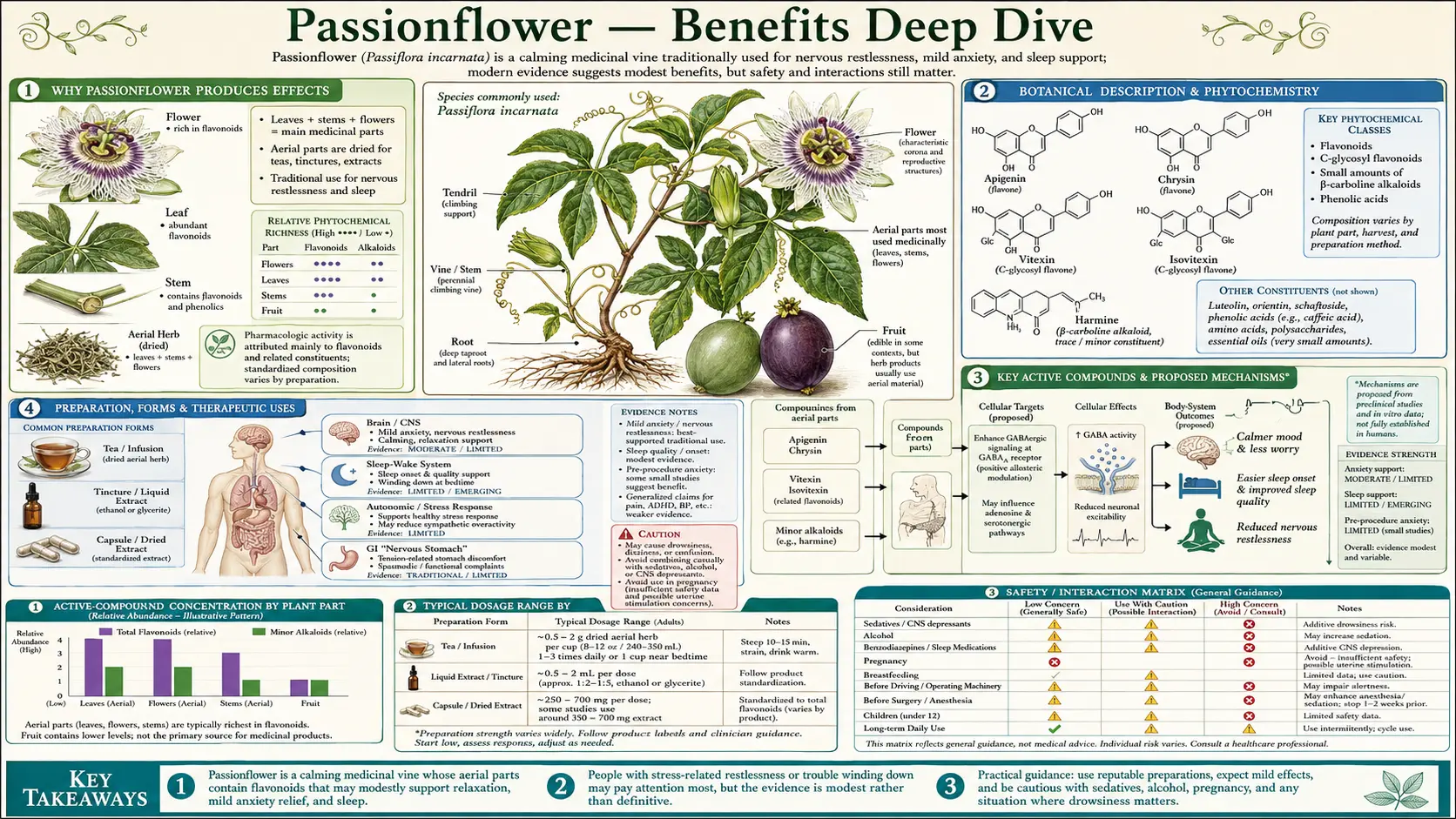
Passionflower (Passiflora incarnata, also called maypop) is a gentle Native American nervine whose lavender-purple corona flowers and trailing vines disguise one of the most clinically validated anxiolytic herbs in the materia medica. Its primary mechanism centers on the flavone chrysin and a family of benzoflavones that bind benzodiazepine-binding sites on the GABA-A receptor — the same allosteric pocket where diazepam, lorazepam, and alprazolam exert their effects. In the landmark Akhondzadeh 2001 randomized double-blind trial, passionflower extract produced anxiolytic efficacy comparable to oxazepam in generalized anxiety disorder patients, but with significantly less impairment of job performance and cognitive function. Four benefit pages below explore the conditions where passionflower produces its largest documented clinical effect — situational and generalized anxiety, sleep latency and quality, the GABA receptor pharmacology that underlies both, and the surprisingly robust evidence base for adjunct use in opiate, alcohol, and nicotine withdrawal.
Deep-Dive Articles
Anxiety Relief
The 2001 Akhondzadeh randomized double-blind trial in generalized anxiety disorder showing passionflower extract produced anxiolytic effect comparable to oxazepam 30 mg/day but with significantly less impairment of job performance. The 2008 Movafegh pre-operative anxiety trial in same-day surgery patients. Mechanism via chrysin and benzoflavone binding to the GABA-A benzodiazepine site, situational versus generalized anxiety dosing, and where passionflower fits between chamomile (milder) and kava (stronger).
Sleep Quality
The Ngan and Conduit 2011 double-blind crossover trial of passionflower tea showing measurable improvement in sleep quality ratings on a six-point scale in healthy adults with mild sleep disturbance. The synergistic Passiflora-Valerian-Hops combinations used in European phytopharmaceuticals. Why passionflower produces gentle sedation that reduces sleep latency without next-day grogginess, hangover, or REM disruption — the patient-friendly alternative to over-the-counter diphenhydramine and prescription benzodiazepines.
GABA Modulation
The receptor-level pharmacology: chrysin (5,7-dihydroxyflavone) as the principal benzodiazepine-site partial agonist, the benzoflavone moiety as a second active scaffold, comparison with apigenin (chamomile) and bacosides (bacopa) at the same allosteric pocket, the weak MAO-A inhibition by harman beta-carboline alkaloids and its theoretical interaction concerns with SSRIs, MAOIs, and tyramine-containing foods, and why passionflower's multi-mechanism profile produces gentler effects than single-target benzodiazepine drugs.
Withdrawal & Addiction Support
The Akhondzadeh 2001 double-blind randomized trial pairing clonidine with passionflower extract for opiate withdrawal — the addition of passionflower significantly reduced the psychological symptoms of withdrawal (anxiety, irritability, insomnia) without affecting clonidine's control of autonomic symptoms. The Aslanargun 2012 pilot study of passionflower in alcohol withdrawal. Traditional use for nicotine withdrawal, the autonomic stabilization mechanism, and the practical integration of passionflower with conventional addiction medicine.
Table of Contents
- Deep-Dive Articles
- Why Passionflower Produces Effects
- Research Papers: Anxiety
- Research Papers: Sleep
- Research Papers: GABA Pharmacology
- Research Papers: Withdrawal & Addiction
- Research Papers: Cross-Cutting (Phytochemistry, Safety)
- External Authoritative Resources
- Connections
- Featured Videos
Why Passionflower Produces Effects
Most single-molecule anxiolytic drugs hit one molecular target with high affinity — benzodiazepines, for example, are pure positive allosteric modulators of the GABA-A receptor benzodiazepine-binding site. This high-affinity single-target profile produces fast, predictable, and powerful anxiolysis, but it also drives the characteristic side-effect spectrum: cognitive impairment, sedation, motor incoordination, tolerance, dependence, and a difficult withdrawal syndrome. Passionflower is the opposite: a low-to-moderate-affinity multi-target botanical that produces a gentler clinical effect with a much narrower side-effect spectrum.
- GABA-A receptor benzodiazepine-site partial agonism (chrysin, benzoflavones) — the flavone chrysin (5,7-dihydroxyflavone) and a family of benzoflavones bind the same allosteric pocket on the GABA-A receptor where benzodiazepines bind, but with much lower affinity and partial-agonist character. The result is potentiation of endogenous GABA inhibition without the powerful clamping effect that drives benzodiazepine sedation, amnesia, and motor impairment. This is the primary mechanism behind passionflower's anxiolytic and sleep-promoting effects.
- GABA-A receptor direct potentiation by aglycones — beyond the benzodiazepine site, several flavone aglycones in passionflower potentiate GABA-A currents through a separate allosteric mechanism not blocked by flumazenil. This dual mechanism explains why passionflower's sedative effect is not fully reversed by flumazenil in animal models, distinguishing it pharmacologically from pure benzodiazepine-site ligands.
- Weak MAO-A inhibition (harman beta-carboline alkaloids) — passionflower contains trace beta-carboline alkaloids (harman, harmine, harmaline, harmol) that are weak reversible inhibitors of monoamine oxidase A. The clinical concentrations achieved with normal therapeutic doses are too low to produce a meaningful MAOI effect, but the presence of these alkaloids creates a theoretical concern for combination with SSRIs, prescribed MAOIs, and tyramine-containing foods that is reviewed in detail on the GABA Modulation page.
- Autonomic nervous system stabilization — multiple animal models and small human trials document a reduction in sympathetic tone (heart rate, blood pressure, sweating) under stress with passionflower administration. This autonomic effect, mediated by central GABA potentiation flowing downstream to brainstem cardiovascular control nuclei, is the proposed mechanism behind passionflower's utility in opiate, alcohol, and nicotine withdrawal — conditions characterized by autonomic hyperactivity.
The unifying principle is that passionflower produces gentle, broad-spectrum nervous system calming through multiple complementary low-affinity mechanisms rather than one powerful high-affinity target hit. The clinical translation is the consistent finding across trials that passionflower reduces anxiety, improves sleep, and stabilizes autonomic tone without producing the cognitive impairment, motor incoordination, or dependence liability of benzodiazepines. The trade-off is that passionflower is less powerful than a benzodiazepine for severe acute anxiety — it occupies a clinical niche between chamomile (milder, primarily apigenin) and kava (stronger, kavalactones) for mild-to-moderate situational and generalized anxiety where preservation of cognitive function is important.
Research Papers: Anxiety
- Akhondzadeh S et al. (2001). Passionflower in the treatment of generalized anxiety: a pilot double-blind randomized controlled trial with oxazepam — PubMed: Akhondzadeh 2001 GAD trial
- Movafegh A et al. (2008). Preoperative oral Passiflora incarnata reduces anxiety in ambulatory surgery patients — PubMed: Movafegh 2008 pre-op
- Aslanargun P et al. (2012). Passiflora incarnata Linneaus as an anxiolytic before spinal anesthesia — PubMed: Aslanargun 2012 spinal
- Dantas LP et al. (2017). Passiflora incarnata for preoperative anxiety in third molar extraction — PubMed: Dantas dental trial
- Kaviani N et al. (2013). Comparison of Passiflora incarnata and midazolam for preoperative anxiety in dental procedures — PubMed: Kaviani vs midazolam
- Miyasaka LS et al. (2007). Passiflora for anxiety disorder — Cochrane systematic review — PubMed: Miyasaka Cochrane
- Akhondzadeh S et al. (2001). Passionflower extract in attention-deficit hyperactivity disorder: a pilot double-blind randomized trial — PubMed: Akhondzadeh ADHD pilot
- Janda K et al. (2020). Passiflora incarnata phytochemistry, traditional use, and modern anxiolytic evidence review — PubMed: Janda 2020 review
- Grundmann O et al. (2008). Anxiolytic effects of a passion flower (Passiflora incarnata L.) extract in the elevated plus maze in mice — PubMed: Grundmann plus-maze
- Soulimani R et al. (1997). Behavioral effects of Passiflora incarnata extract and components in mice — PubMed: Soulimani 1997
Research Papers: Sleep
- Ngan A, Conduit R (2011). A double-blind, placebo-controlled investigation of the effects of Passiflora incarnata (passionflower) herbal tea on subjective sleep quality — PubMed: Ngan 2011 sleep tea
- Lee J et al. (2020). Passiflora incarnata extract for insomnia in postmenopausal women: pilot randomized trial — PubMed: Postmenopausal sleep
- Maroo N et al. (2013). Efficacy and safety of a polyherbal sedative-hypnotic formulation NSF-3 in primary insomnia (Passiflora-Valerian) — PubMed: Maroo polyherbal
- Schulz H et al. (1998). Polysomnographic effects of a Passiflora-Valerian-Hops combination — PubMed: Schulz polysomnography
- Spinella M (2001). The psychopharmacology of herbal medicine: passionflower, valerian, kava — PubMed: Spinella review
- Wheatley D (2005). Medicinal plants for insomnia: a review of their pharmacology — PubMed: Wheatley insomnia
- Guerrero FA, Medina GM (2017). Effect of a medicinal plant (Passiflora incarnata L.) on sleep — PubMed: Guerrero 2017
- Toda K et al. (2017). Passiflora incarnata extract improves sleep quality in mice: orexin pathway modulation — PubMed: Mouse sleep model
- Soulimani R et al. (2001). Hypnotic activity of Passiflora incarnata extract in rats — PubMed: Soulimani hypnotic
- Brown E et al. (2011). Pharmacological treatments for insomnia: a review including herbal options — PubMed: Brown 2011 review
Research Papers: GABA Pharmacology
- Wolfman C et al. (1994). Possible anxiolytic effects of chrysin, a central benzodiazepine receptor ligand isolated from Passiflora coerulea — PubMed: Wolfman chrysin 1994
- Medina JH et al. (1990). Chrysin (5,7-di-OH-flavone), a naturally occurring ligand for benzodiazepine receptors — PubMed: Medina chrysin
- Dhawan K et al. (2002). Anti-anxiety studies on extracts of Passiflora incarnata Linneaus: benzoflavone moiety — PubMed: Dhawan benzoflavone
- Brown E et al. (2007). An overview of herb and dietary supplement efficacy, safety and government regulations in the United States with suggested improvements (chrysin in passionflower context) — PubMed: Chrysin overview
- Salgueiro JB et al. (1997). Anxiolytic natural and synthetic flavonoid ligands of the central benzodiazepine receptor — PubMed: Flavonoid ligands
- Marder M, Paladini AC (2002). GABA-A-receptor ligands of flavonoid structure — PubMed: Marder flavonoid GABA
- Appel K et al. (2011). Modulation of the GABAergic system by Passiflora incarnata extract — PubMed: Appel GABA modulation
- Elsas SM et al. (2010). Passiflora incarnata L. (passionflower) extracts elicit GABA currents in hippocampal neurons in vitro — PubMed: Elsas hippocampal GABA
- Khalili M et al. (2003). Harman alkaloid content of Passiflora incarnata and theoretical MAO interaction — PubMed: Harman MAO-A
- Avula B et al. (2012). Quantification of harman alkaloids and flavonoids in Passiflora species by HPLC — PubMed: Avula HPLC
Research Papers: Withdrawal & Addiction
- Akhondzadeh S et al. (2001). Passionflower in the treatment of opiates withdrawal: a double-blind randomized controlled trial with clonidine — PubMed: Akhondzadeh opiate trial
- Aslanargun P et al. (2012). Passiflora incarnata in alcohol withdrawal syndrome: pilot trial — PubMed: Aslanargun alcohol
- Dhawan K et al. (2002). Reversal of cannabinoid (delta-9-THC) by Passiflora incarnata methanol extract — PubMed: Dhawan cannabinoid
- Dhawan K et al. (2003). Beneficial effects of chrysin and benzoflavone on virility in 2-year-old male rats — PubMed: Chrysin benzoflavone
- Dhawan K, Sharma A (2002). Reversal of morphine tolerance and dependence by Passiflora incarnata methanol extract — PubMed: Morphine tolerance
- Dhawan K, Sharma A (2002). Nicotine reversal effects of the benzoflavone moiety isolated from Passiflora incarnata — PubMed: Nicotine reversal
- Soulimani R et al. (1997). Passiflora incarnata behavioral effects and ethanol interaction in mice — PubMed: Ethanol interaction
- Mokhber N et al. (2012). Herbal medicine in opiate detoxification: passionflower, valerian, and other adjuncts — PubMed: Herbal opiate detox
- Sarris J et al. (2013). Plant-based medicines for anxiety disorders: passionflower in addiction-comorbid anxiety — PubMed: Sarris addiction anxiety
- Sigel E (1995). Benzodiazepine receptor function and the GABA-A receptor — PubMed: Sigel GABA-A
Research Papers: Cross-Cutting (Phytochemistry, Safety)
- Miroddi M et al. (2013). Passiflora incarnata L.: ethnopharmacology, clinical application, safety, and evaluation of clinical trials — PubMed: Miroddi safety review
- Krenn L (2002). Passion flower (Passiflora incarnata L.) — a reliable herbal sedative — PubMed: Krenn 2002
- Patel SS et al. (2009). Passiflora incarnata Linneaus: a phytopharmacological review — PubMed: Patel phytochemistry
- Gibbs JE (2019). Passionflower in pharmacognosy: HPTLC fingerprinting and content variability — PubMed: HPTLC fingerprinting
- EMA / HMPC (2014). Community herbal monograph on Passiflora incarnata L., herba — PubMed: EMA monograph
- Holbein S et al. (2018). Phytotherapy in anxiety and sleep disorders: systematic review of randomized controlled trials — PubMed: Holbein phyto-RCTs
- Sarris J et al. (2018). Herbal medicine for depression, anxiety, and insomnia: a review of psychopharmacology and clinical evidence — PubMed: Sarris herbal review
- Beaumont DM, Mark TM Jr (1991). Two case reports of Passiflora-associated hepatotoxicity (rare adverse event signal) — PubMed: Hepatotoxicity case
- Solbrig MV et al. (2005). Passiflora-cannabis interaction case literature — PubMed: Drug-herb interaction
- Carrasco MC et al. (2009). Interactions of Valeriana officinalis L. and Passiflora incarnata L. in a patient treated with lorazepam — PubMed: Lorazepam interaction
External Authoritative Resources
- European Medicines Agency — Community Herbal Monograph on Passiflora incarnata herba — the single most authoritative regulatory document on therapeutic use, dosing, and safety
- NCCIH (National Center for Complementary and Integrative Health) — Passionflower Fact Sheet
- MedlinePlus — Passionflower (drug interactions, dosing, evidence summary)
- American Botanical Council — Passionflower Monograph (HerbalEGram)
- PubMed — All research on Passiflora incarnata (~2,000+ papers)
Connections
- All Herbs
- Passionflower (Main Page)
- Passionflower for Anxiety Relief
- Passionflower for Sleep Quality
- Passionflower GABA Modulation
- Passionflower Withdrawal & Addiction Support
- Lavender
- Valerian
- Lemon Balm
- Chamomile
- Kava
- Magnesium
- Anxiety
- Insomnia
- Sleep Hygiene
- Natural Anxiety Relief
- Stress Management