Damiana — Benefits Deep Dive
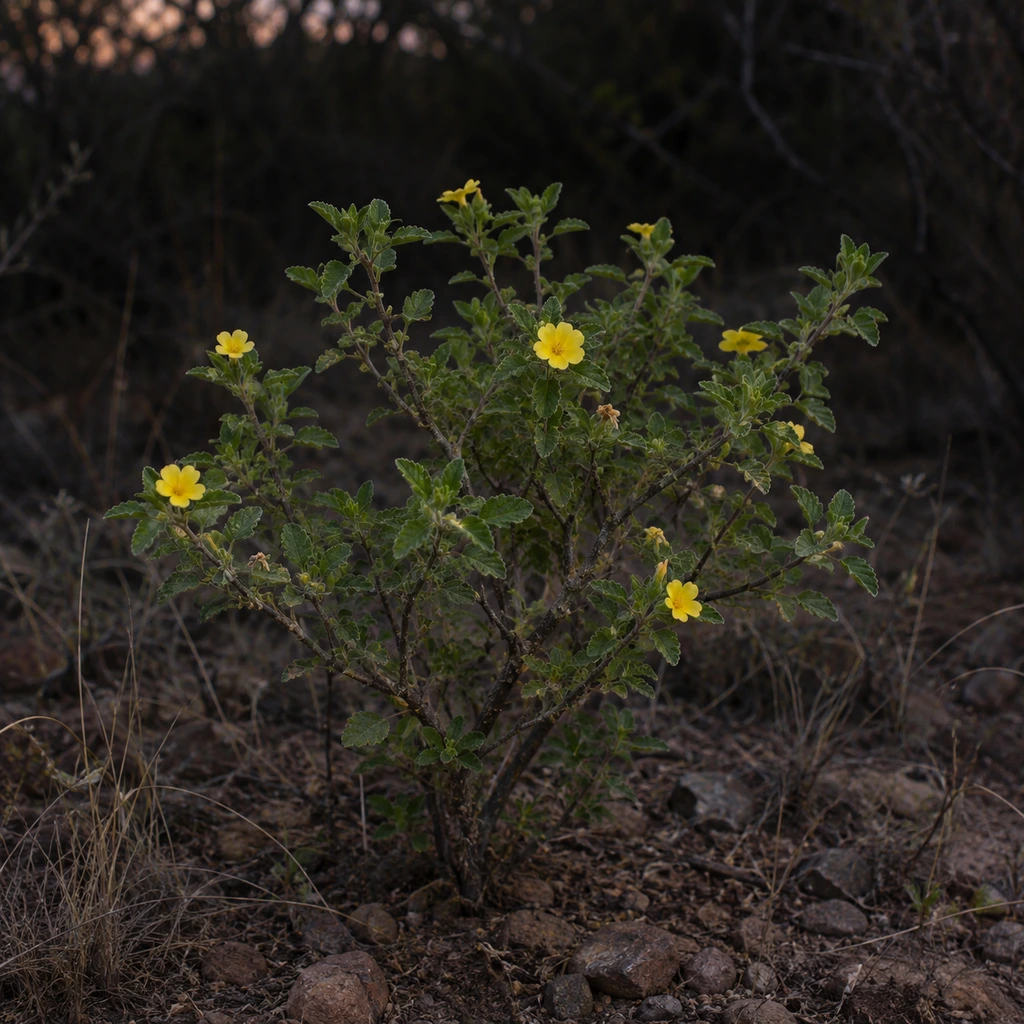
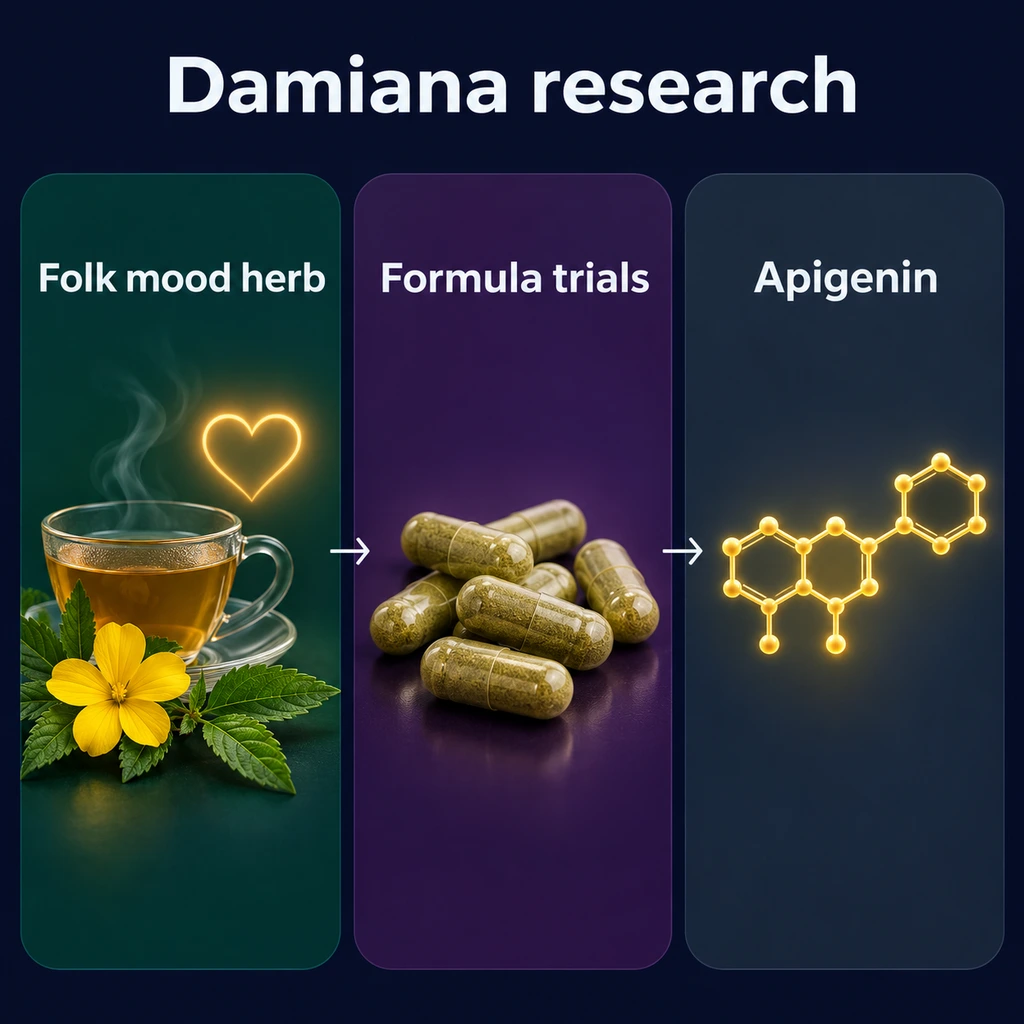
Damiana (Turnera diffusa) is a small aromatic shrub of Mexico, Central America and the Caribbean with a genuine folk record as a mood herb and a libido herb, and a commercial reputation that has run far ahead of it ever since North American patent-medicine sellers began importing "damiana elixirs" in the 1870s. These four pages examine each of its major claims separately and put an evidence tier on every one, because the tiers differ sharply — and because for the claim damiana is actually sold on, the honest tier is NOT SUPPORTED.
The confound comes first, because it explains most of what is written about damiana elsewhere. The human clinical evidence cited for damiana comes almost entirely from trials of multi-ingredient products — proprietary formulas combining L-arginine, ginseng, ginkgo, damiana and vitamins — which reported improvements in sexual function. Those trials are real. They also cannot attribute their result to damiana: with five or more actives in the capsule, any ingredient or combination could be responsible, and the L-arginine in the formula has its own textbook mechanism as the direct precursor of nitric oxide. A trial of a formula is not evidence for one of its ingredients. No randomised, placebo-controlled trial of damiana alone has ever been published for libido, mood, or anything else.
What damiana does have is a long and interesting traditional record, a couple of rodent studies that look genuinely promising, some plausible chemistry, and one safety point worth knowing — the leaf contains cyanogenic glycosides, which matters at very large doses and not at tea strength. Even the species name people quote as evidence, Turnera aphrodisiaca, is a nineteenth-century marketing artefact rather than a finding. The four pages below take each claim at its real tier.
Deep-Dive Articles
Damiana and Libido: The Aphrodisiac Claim Examined
The claim everybody arrives for, taken apart honestly. How the species epithet aphrodisiaca became a sales artefact, what the 1870s patent-medicine trade did to the herb's reputation, what the rodent studies in sexually exhausted male rats actually measured, and why in-vitro aromatase and PDE5 signals are not clinical results. Includes the full treatment of the multi-ingredient confound and the "borrowed evidence" pattern it belongs to. Verdict: NOT SUPPORTED for damiana alone in humans.
Read the deep dive →Damiana for Mood, Anxiety and Nervous Exhaustion
The quieter claim, and arguably the better one. Traditional Mexican use as a nervine and tonic, the 1870s "nervous exhaustion" framing that maps onto today's burnout and subthreshold low mood, the rodent anxiety studies published under the old name Turnera aphrodisiaca, and apigenin's gamma-aminobutyric acid-A story with its bioavailability limits. Also why damiana is neither a stimulant nor a sedative. Tier: traditional use plus preliminary animal data.
Read the deep dive →Damiana for Digestion and Other Traditional Uses
Damiana as a bitter aromatic digestive tea — the least glamorous use with the best-fitting mechanism, since bitter taste genuinely triggers cephalic-phase digestive reflexes. Plus the tannin–iron trade-off, the arbutin-based urinary reputation shared with uva-ursi, the emmenagogue and menopause claims, the long folk list (headache, bed-wetting, convalescence), and the liqueur, blends and smoking herb. Tier: traditional use only, with class-level plausibility.
Read the deep dive →Damiana Safety: Cyanogenic Glycosides, Dose and Interactions
The specific things worth knowing, sized proportionately. Cyanogenic glycosides and why they matter at 200 g of extract but not in a mug; the single case report of tetanus-like convulsions and paranoia after an enormous ingestion; the glucose-lowering signal and why diabetes medication is the most likely real interaction; arbutin and hydroquinone; tannins and iron; pregnancy; and why "no known interactions" here means nobody looked. Tier: mostly theoretical, one case report, one well-founded interaction caution.
Read the deep dive →Table of Contents
- Deep-Dive Articles
- The Multi-Ingredient Confound Comes First
- The Whole Evidence Picture in One Place
- Key Research: Sexual Function and the Formula Trials
- Key Research: Mood, Anxiety and Apigenin
- Key Research: Chemistry and Constituents
- Key Research: Glucose, Cells and Antimicrobial Screening
- Key Research: Toxicology and Product Quality
- External Resources
- Connections
- Featured Videos
The Multi-Ingredient Confound Comes First
This is the single most important idea on this hub, and it generalises far beyond damiana.
A clinical trial of a multi-ingredient formula tells you about the formula. It tells you nothing specific about any single ingredient in it.
The trials cited as human evidence for damiana tested one proprietary blend: L-arginine plus ginseng, ginkgo, damiana and assorted vitamins and minerals. Ito and colleagues reported improvements in female sexual function with such a formula in the Journal of Sex & Marital Therapy in 2001 and again in 2006, the latter stratified by menopausal status; an earlier account of a men's version appeared in the Hawaii Medical Journal. These are legitimate studies of products.
The positive and the negative trials of this formula differ in size, length and in who took part. The 2001 trial enrolled 77 women (34 on the formula, 43 on placebo) for 4 weeks; 73.5% of the formula group improved in satisfaction with their overall sex life, against 37.2% on placebo. The largest trial of the same formula, published in 2015, enrolled 186 women who had finished treatment for breast or gynaecologic cancer and gave them 3 capsules twice a day or placebo for 12 weeks. It found no difference between the groups in sexual desire, arousal, lubrication, orgasm, satisfaction or pain. Quality-of-life scores were better on the formula (87.5 against 82.9 on the Functional Assessment of Cancer Therapy – General scale), and side effects were similar in both groups.
Why the result cannot travel to damiana:
- No ingredient was isolated. The design contains no arm that would separate damiana's contribution from the other four-plus actives.
- Another ingredient has a much stronger prior. L-arginine is the direct substrate for nitric oxide synthesis, and genital blood flow is nitric-oxide-dependent. In a formula containing arginine, arginine is the obvious first suspect for any blood-flow-mediated effect — see arginine and nitric oxide.
- Ginseng has its own single-herb data. Korean red ginseng has been tested alone with some positive controlled results — see ginseng and erectile function. Damiana has none.
- Damiana's dose is usually undisclosed. In proprietary blends it can be a token amount included for the label and the folklore.
- Sexual-function endpoints have large placebo responses, which is why single-herb placebo-controlled trials are the only thing that would settle the question.
The same borrowed-evidence pattern runs through the whole botanical libido category. Tribulus is sold largely on animal data plus multi-ingredient sports formulas; Tongkat Ali has a somewhat better single-herb record but is constantly bundled; maca has a few small single-herb trials, which is more than damiana can show. The pattern is worth more than any individual fact on these pages. Its signs are a cited trial named after a brand rather than a plant, an abstract that lists several botanicals plus vitamins, and a promoted ingredient that is merely the one being sold rather than the one with the strongest mechanism.
The Whole Evidence Picture in One Place
Every damiana claim, sorted by what actually stands behind it:
- Randomised clinical trial — formula only, not the herb: one 4-week trial of a multi-ingredient L-arginine/ginseng/ginkgo/damiana product in 77 women reported better sexual satisfaction than placebo; a larger 12-week trial of the same formula in 186 female cancer survivors found no effect on sexual function. Multi-ingredient confound; not attributable to damiana.
- Randomised clinical trial — damiana alone: none, for any outcome. NOT SUPPORTED for libido, mood, digestion or anything else.
- Preliminary (animal): damiana extract (80 mg/kg) raised the share of sexually exhausted male rats completing one ejaculatory series and starting a second, and shortened the rest period after ejaculation; in a separate study of sexually sluggish male rats, blocking nitric-oxide synthase prevented the extract's pro-sexual effect; anxiolytic-like activity in mouse anxiety models; glucose-lowering in antidiabetic-plant screening.
- Preliminary (in vitro): flavonoid aromatase inhibition; antioxidant assay activity; antimicrobial inhibition in culture; cytotoxicity against cultured breast cancer cells. None of these is a human outcome, and none makes damiana a cancer or infection treatment.
- Traditional use only: aphrodisiac for both sexes; mood tonic and nervine; bitter digestive and appetite tonic; mild urinary complaints; menstrual and menopausal discomfort; headache; bed-wetting; convalescence.
- Case report (single, extreme dose): convulsions with tetanus-like features and paranoia after ingestion of roughly 200 g of extract — around a hundredfold a normal daily intake of leaf. One case; a real ceiling marker, not a description of ordinary use.
- Theoretical safety concerns: cyanide exposure from very large or concentrated intake; hydroquinone from chronic high-dose arbutin.
- Well established: tannins reduce non-heme iron absorption; combustion products of any plant, damiana included, harm the lungs.
- Marketing artefacts, not evidence: the synonym Turnera aphrodisiaca; "clinically studied ingredients" applied to blends; "detox," "hormone balance" and "adrenal support" labelling, which are not traditional uses at all.
Key Research: Sexual Function and the Formula Trials
Where a specific paper is named, the link is its PubMed record; general topics carry a live PubMed topic search that keeps working as the literature grows. Note that damiana is indexed under two botanical names, and searching only one misses roughly half the relevant work.
- Estrada-Reyes R, et al. "Turnera diffusa Wild (Turneraceae) recovers sexual behavior in sexually exhausted males." Journal of Ethnopharmacology, 2009;123(3):423–9. The central animal study, and a restorative rather than stimulant pattern; the water extract tested contained caffeine, arbutin and flavonoids as its main compounds. PubMed PMID: 19501274
- Estrada-Reyes R, Carro-Juárez M, Martínez-Mota L. "Pro-sexual effects of Turnera diffusa Wild (Turneraceae) in male rats involves the nitric oxide pathway." Journal of Ethnopharmacology, 2013;146(1):164–72. Mechanistic follow-up in sexually sluggish rats. PubMed PMID: 23298455
- Ito TY, Trant AS, Polan ML. "A double-blind placebo-controlled study of ArginMax, a nutritional supplement for enhancement of female sexual function." Journal of Sex & Marital Therapy, 2001;27(5):541–9. 77 women, 4 weeks. Multi-ingredient formula containing damiana — result not attributable to damiana. PubMed PMID: 11554217
- Ito TY, Polan ML, Whipple B, Trant AS. "The enhancement of female sexual function with ArginMax, a nutritional supplement, among women differing in menopausal status." Journal of Sex & Marital Therapy, 2006;32(5):369–78. Same multi-ingredient confound. PubMed PMID: 16959660
- Greven KM, Case LD, Nycum LR, Zekan PJ, Hurd DD, Balcueva EP, Mills GM, Zon R, Flynn PJ, Biggs D, Shaw EG, Lesser G, Naughton MJ. "Effect of ArginMax on sexual functioning and quality of life among female cancer survivors: results of the WFU CCOP Research Base Protocol 97106." Journal of Community and Supportive Oncology, 2015;13(3):87–94. The largest trial of the formula: 186 women, 12 weeks, no effect on sexual function, better quality-of-life scores. Same multi-ingredient confound. PubMed PMID: 26287032
- Ito T, Kawahara K, Das A, Strudwick W. "The effects of ArginMax, a natural dietary supplement for enhancement of male sexual function." Hawaii Medical Journal, 1998;57(12):741–4. The early account of the men's version of the same L-arginine-based blend. Small, uncontrolled and multi-ingredient throughout. PubMed PMID: 9893389
- L-arginine and nitric-oxide-mediated erectile function — the ingredient with the strongest prior claim in those formulas. PubMed: L-arginine erectile function randomized
- Screening literature on plant-derived phosphodiesterase-5 inhibition, the source of the "natural sildenafil" framing. PubMed: plant extract PDE5 inhibition in vitro
Key Research: Mood, Anxiety and Apigenin
- Kumar S, Sharma A. "Anti-anxiety Activity Studies on Homoeopathic Formulations of Turnera aphrodisiaca Ward." Evidence-Based Complementary and Alternative Medicine, 2005;2(1):117–119. Dried homoeopathic mother tinctures (85% ethanol extracts) from three manufacturers, given by mouth to mice on the elevated plus maze; anxiolytic-type activity. PubMed PMID: 15864356
- Kumar S, Sharma A. "Anti-anxiety activity studies of various extracts of Turnera aphrodisiaca Ward." Journal of Herbal Pharmacotherapy, 2005;5(4):13–21. The companion study of the plant's extracts. PubMed PMID: 16635964
- Kumar S, Madaan R, Sharma A. "Pharmacological evaluation of bioactive principle of Turnera aphrodisiaca." Indian Journal of Pharmaceutical Sciences, 2008;70(6):740–4. Fractionation pointing to apigenin as a principal contributor. PubMed PMID: 21369434
- Apigenin as a ligand at the GABA-A benzodiazepine site, with anxiolytic activity in animals — evidence for the compound at compound doses, not for the tea. PubMed: apigenin GABA-A benzodiazepine anxiolytic
- Flavonoid bioavailability and blood-brain-barrier penetration — where constituent-level claims usually break down. PubMed: flavonoid bioavailability blood-brain barrier
- Reviews of the predictive validity of rodent anxiety and depression screens, for judging what damiana's animal data can support. PubMed: predictive validity rodent anxiety models
- Passionflower randomised trials for anxiety — a family relative with better human data than damiana. PubMed: Passiflora incarnata anxiety RCT
Key Research: Chemistry and Constituents
- Szewczyk K, Zidorn C. "Ethnobotany, phytochemistry, and bioactivity of the genus Turnera (Passifloraceae) with a focus on damiana — Turnera diffusa." Journal of Ethnopharmacology, 2014;152(3):424–43. The comprehensive review and the best single entry point to everything on these pages. PubMed PMID: 24468305
- Zhao J, Pawar RS, Ali Z, Khan IA. "Phytochemical investigation of Turnera diffusa." Journal of Natural Products, 2007;70(2):289–92. Flavonoids including apigenin derivatives, arbutin, and other constituents. PubMed PMID: 17284070
- Zhao J, Dasmahapatra AK, Khan SI, Khan IA. "Anti-aromatase activity of the constituents from damiana (Turnera diffusa)." Journal of Ethnopharmacology, 2008;120(3):387–93. Purified flavonoids against an isolated enzyme — the source of the hormonal claims in both directions. PubMed PMID: 18948180
- Composition of damiana's volatile oil, responsible for its aroma and much of its "tonic" character. PubMed: Turnera diffusa essential oil composition
- Bitter taste receptors in the gastrointestinal tract and cephalic-phase digestive responses — the mechanism behind bitter tonics as a class. PubMed: bitter taste receptors gut cephalic phase
- Tannins and polyphenols inhibiting non-heme iron absorption — the most practical interaction for a tannin-rich tea. PubMed: tannins inhibit non-heme iron absorption
Key Research: Glucose, Cells and Antimicrobial Screening
- Alarcon-Aguilara FJ, Roman-Ramos R, Perez-Gutierrez S, Aguilar-Contreras A, Contreras-Weber CC, Flores-Saenz JL. "Study of the anti-hyperglycemic effect of plants used as antidiabetics." Journal of Ethnopharmacology, 1998;61(2):101–10. Animal screening of 28 plants in temporarily hyperglycaemic rabbits, including Turnera diffusa; the basis for the diabetes-medication caution rather than for a benefit claim. PubMed PMID: 9683340
- Avelino-Flores MDC, et al. "Cytotoxic activity of the methanolic extract of Turnera diffusa Willd on breast cancer cells." Journal of Medicinal Food, 2015;18(3):299–305. A cell-culture study routinely misrepresented online. Damiana is not a cancer treatment. PubMed PMID: 25299247
- Antimicrobial screening of Turnera extracts, for calibrating what in-vitro inhibition does and does not mean. PubMed: Turnera diffusa antimicrobial extract
- Antispasmodic screening of traditional Mexican medicinal plants on isolated gut smooth muscle. PubMed: Mexican medicinal plants antispasmodic isolated ileum. — Search PubMed
- Arbutin, hydroquinone metabolism and the urinary-antiseptic rationale shared with bearberry. PubMed: arbutin hydroquinone uva-ursi urinary
Key Research: Toxicology and Product Quality
- The damiana toxicity literature, including reports of convulsions after very large ingestion. Original case metadata is not stated here because it could not be verified; the finding is described in the Szewczyk and Zidorn review above. PubMed: damiana toxicity convulsions case report
- Cyanogenic glycosides in plants and foods, their metabolism, and the doses at which they matter — the context that keeps damiana's cyanogenic content proportionate. PubMed: cyanogenic glycosides dietary exposure risk assessment. — Search PubMed
- Human cyanide detoxification via rhodanese and thiocyanate excretion, the reason low-level dietary exposure is tolerated. PubMed: rhodanese cyanide detoxification
- Undeclared PDE5 inhibitors and other pharmaceutical adulterants found in "natural" sexual-enhancement supplements — the product category damiana is most often sold in. PubMed: undeclared sildenafil adulteration herbal supplements. — Search PubMed
- Synthetic cannabinoid adulteration of herbal smoking products, relevant to damiana smoking blends. PubMed: synthetic cannabinoid adulteration herbal smoking blends. — Search PubMed
- Herb–drug interaction mechanisms via cytochrome P450 and drug transporters — the studies that have never been done for damiana, which is why "no known interactions" is not reassurance. PubMed: herb-drug interactions cytochrome P450 review
- All current damiana literature under both botanical names, for anyone auditing these pages. PubMed: "Turnera diffusa" OR "Turnera aphrodisiaca"
External Resources
- U.S. National Center for Complementary and Integrative Health (NCCIH) — the US National Center for Complementary and Integrative Health; herb overviews and its "Know the Science" material on judging claims like the ones on this page.
- MedlinePlus — plain-language health and drug information from the US National Library of Medicine.
- U.S. National Institutes of Health (NIH) Office of Dietary Supplements — fact sheets, and background on how lightly supplements are regulated.
- PubMed — search the primary literature; try both Turnera diffusa and Turnera aphrodisiaca.
- European Medicines Agency — herbal monographs from its Committee on Herbal Medicinal Products.
- US FDA — supplement warnings and recalls, including tainted sexual-enhancement products.
- Poison Control — what to do after a large or accidental ingestion.
- Plants of the World Online (Kew) — authoritative nomenclature, for checking the T. diffusa / T. aphrodisiaca synonymy yourself.
- US Pharmacopeia — standards and verification marks worth looking for on botanical products.
Connections
- All Herbs
- Damiana — main article
- The aphrodisiac claim examined
- Mood, anxiety and nervous exhaustion
- Digestive and other traditional uses
- Safety, dose and interactions
- Erectile Dysfunction
- Arginine
- Arginine and erectile function
- Arginine and nitric oxide
- Maca and libido
- Maca, mood and cognition
- Tribulus and libido
- Tribulus testosterone claims
- Epimedium and the PDE5 question
- Tongkat Ali and testosterone
- Ginseng and erectile function
- Muira Puama
- Ginkgo Biloba
- Passionflower for anxiety
- Ashwagandha for stress
- Chamomile
- Lemon Balm
- Uva-Ursi (Bearberry)
- Apigenin
- Anxiety
- Depression
- Type 2 Diabetes
- Iron
- Reproductive Medicine
Safety and disclaimer. These pages are health information, not medical advice, and none of them recommends damiana as a treatment for anything. Damiana has no demonstrated benefit in humans for any condition, which means any risk it carries is taken for nothing proven. There is no safety data for damiana in pregnancy, breastfeeding or childhood. Its glucose-lowering effect in animal screening raises a concern that it adds to the effect of glucose-lowering medication. Its tannins cut non-haem iron absorption, including the iron from supplements taken with the tea. Smoke from any burned plant harms the lungs. The one reported poisoning followed a very large dose, and no study has looked at how damiana interacts with prescription medicines. Sexual difficulties, persistent low mood and ongoing digestive symptoms are all worth having assessed — the biggest real harm from an unproven herb is usually the delay it causes.