Damiana Safety: Cyanogenic Glycosides, Dose and Interactions
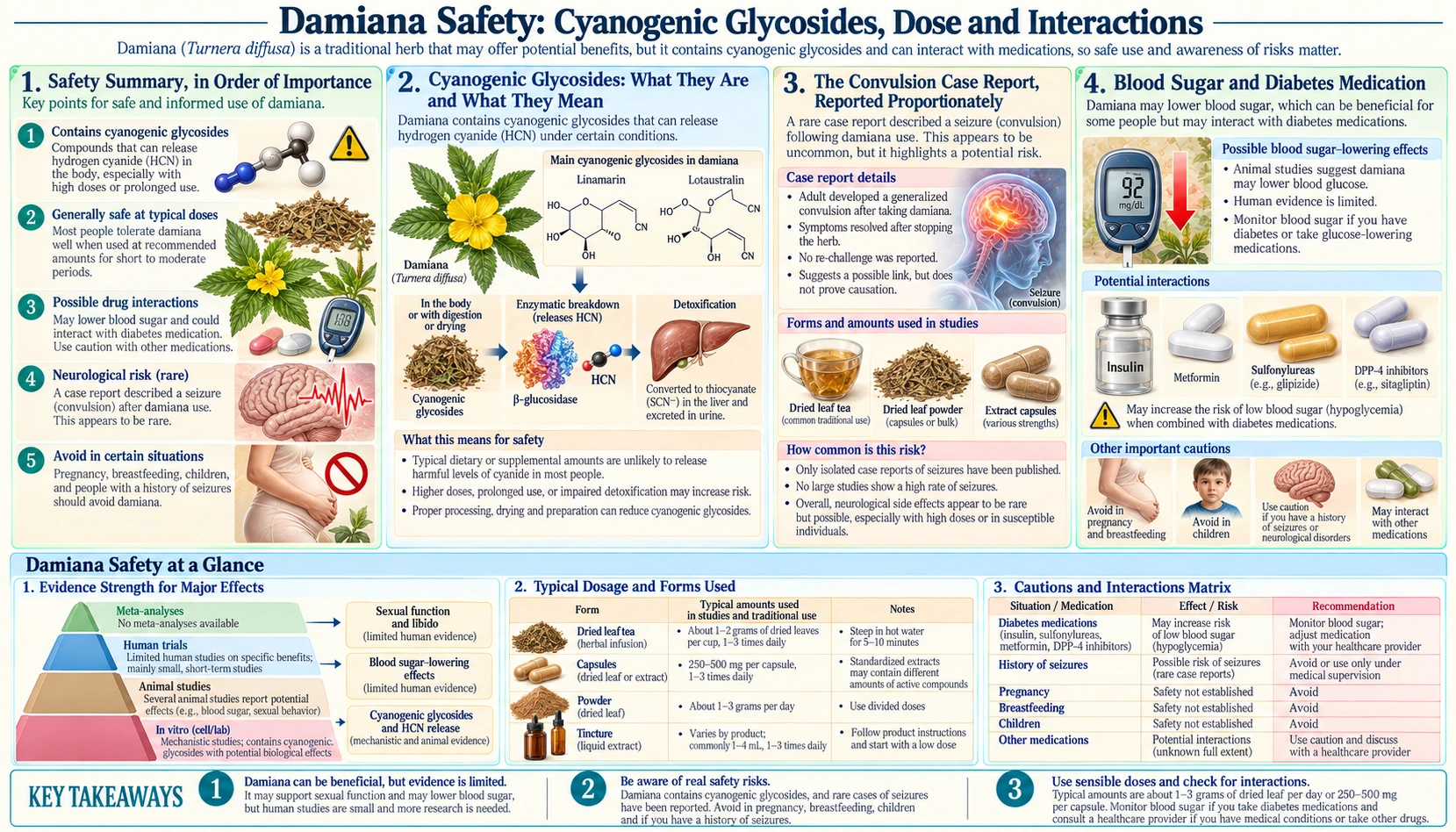
Damiana is, in the amounts people have drunk for generations, a low-risk herb. It is a tea. There is no pattern of poisonings, no organ-toxicity signal comparable to kava's liver problem or comfrey's, and no regulatory action against it. If you have been drinking a cup of damiana tea and arrived here worried, the short version is: that is not the situation this page is about.
But "low-risk as a tea" is a sentence with a boundary, and damiana's boundary is more interesting than most herbs'. The leaf contains cyanogenic glycosides — compounds that release hydrogen cyanide when broken down — and the herbal-safety literature carries a case report of convulsions and paranoia after an enormous ingestion, on the order of 200 grams of extract. Those two facts get handled badly in both directions online: some pages omit them entirely, and others present them as though a mug of tea were a poisoning risk. Neither is honest. This page states what is known and at what dose it applies. For most tea drinkers that is not much; the specific concerns are diabetes medication, iron, pregnancy, and the wild variability of what "damiana" means on a label.
Table of Contents
- Safety Summary, in Order of Importance
- Cyanogenic Glycosides: What They Are and What They Mean
- The Convulsion Case Report, Reported Proportionately
- Blood Sugar and Diabetes Medication
- Arbutin, Hydroquinone and Chronic High Doses
- Tannins, Iron and Absorption
- Pregnancy, Breastfeeding and Children
- Medication Interactions and the Data Vacuum
- The Exposure Problem: Tea, Tincture, Blend, Liqueur, Smoke
- What Is Known About Dose
- Product Quality, Identity and Adulteration
- Warning Signs and When Help Is Urgent
- Evidence Tiers at a Glance
- Key Research Papers
- External Resources
- Connections
- Featured Videos
Safety Summary, in Order of Importance
Ranked by how likely each item is to actually affect a reader, not by how alarming it sounds:
- Glucose-lowering medication. Damiana has shown blood-sugar-lowering activity in animal screening. If you take insulin or a sulfonylurea, an additive effect is plausible and hypoglycaemia is the realistic risk. This is the most probable meaningful interaction. Tier: preliminary (animal) mechanism, well-founded caution.
- Iron absorption. Damiana is tannin-rich; tannins reduce non-heme iron absorption. Matters most for people with iron deficiency; the effect depends on tea and iron being taken at the same time. Tier: well established for tannins generally.
- Pregnancy and breastfeeding. There are no reproductive-safety or breast-milk data; the herb has a traditional reputation for bringing on menstruation and contains cyanogenic glycosides. Tier: precautionary.
- Dose escalation and concentrated extracts. Where the cyanogenic-glycoside and arbutin considerations start to matter, and where the one case report sits. Ordinary tea is not in this territory. Tier: theoretical, plus one case report at an extreme dose.
- Smoking it. A real harm with no benefit, and the exposure route most likely to hurt someone. Tier: well established for combustion products generally.
- Unknown interactions. Damiana has essentially no human pharmacokinetic data, so "no known interactions" means nobody looked. Tier: absent data, not reassurance.
- Using it instead of care. The largest real-world harm from an unproven herb is usually the delay. Tier: well established as a pattern.
Cyanogenic Glycosides: What They Are and What They Mean
Damiana leaf contains cyanogenic glycosides. This is documented in the phytochemical and safety literature on the plant and is discussed in the 2014 Journal of Ethnopharmacology review by Szewczyk and Zidorn, "Ethnobotany, phytochemistry, and bioactivity of the genus Turnera (Passifloraceae) with a focus on damiana — Turnera diffusa," which is the reference to consult on damiana toxicology. The review counts 7 different cyanogenic glycosides and 22 different flavonoids reported from the genus Turnera, along with phenolics, terpenoids and caffeine. It also notes that most of the activities tested for these plants have so far been studied only in chemical, cell-based or animal tests, not in people.
Here is the chemistry in plain terms. A cyanogenic glycoside is a sugar-bound molecule that, when the plant tissue is damaged or when gut enzymes and gut bacteria act on it, releases hydrogen cyanide. Plants use this as a defence: intact leaf is harmless, chewed leaf turns bitter and toxic to the insect chewing it. Cyanide blocks cellular respiration at high enough exposure, which is why the word is frightening.
Now the context that keeps it proportionate, and this context is not a hand-wave — it is the reason food regulators do not ban ordinary groceries:
- Cyanogenic glycosides are common in ordinary food. Almond, apple and cherry seeds, stone-fruit kernels, lima beans, flaxseed, bamboo shoots and cassava all contain them. Cassava is a staple crop for hundreds of millions of people and contains far more than damiana; it is processed to reduce them.
- Humans detoxify small amounts continuously. The enzyme rhodanese converts cyanide to thiocyanate, which is excreted. Low-level exposure is routine and handled.
- Dose is everything, and the gap is large. The recorded harms from cyanogenic plants come from concentrated preparations or large quantities of a high-content plant — apricot-kernel supplements, poorly processed cassava — not from culinary or tea-strength exposure. Damiana is a low-content plant consumed at tea strength.
- Nobody has published a cyanide poisoning from damiana tea. Not one. If a cup of damiana carried meaningful cyanide risk, a plant this widely drunk across a large region for well over a century would have generated a case series long ago.
The honest status, then: a theoretical concern that becomes real only with very large or highly concentrated intake. It bears on megadoses of extracts, on long-term high-dose use, and on the assumption that a natural product has no ceiling. It does not make a mug of tea a cyanide hazard, and a page describing damiana as one at normal use is as misleading as one that omits the chemistry altogether. Damiana has a ceiling, and nobody has mapped where it is. That last point is the real problem — not the cyanide, but the absence of any dose-finding or toxicology study that would tell us how much is too much.
The Convulsion Case Report, Reported Proportionately
There is one published case in the herbal-safety literature that everyone writing about damiana has to handle, and it is usually handled badly.
What was reported: a person who ingested a very large quantity of damiana extract — described in the safety literature as on the order of 200 grams — developed convulsions with features described as tetanus-like or strychnine-like, along with paranoid symptoms. The episode resolved. It is discussed in reviews of damiana's toxicology, including the Szewczyk and Zidorn review, and it is the source of every "damiana can cause seizures" line you will read online.
How to size it. Two hundred grams of extract is not a large dose; it is an extraordinary one. A conventional cup of damiana tea uses roughly one to two grams of dried leaf, and an extract is more concentrated than the leaf it came from. The reported exposure is therefore in the region of a hundred times a normal daily intake of leaf, and considerably more than that in terms of extracted constituents. Nobody arrives at that amount by drinking tea.
What it does and does not establish. A single case report is the weakest tier of clinical evidence. It cannot establish causation, dose-response, frequency or mechanism, and it may be confounded by the identity and purity of the material actually consumed — a real concern in bulk herb commerce, and one that no case report can exclude. What a case report can legitimately do is flag a hazard worth remembering. This one flags that damiana has an upper limit, that it is not infinitely benign, and that the convulsive pattern is consistent with a plant carrying cyanogenic glycosides. That is a useful thing to know and it deserves to be on the page.
What it means in practice. For a tea drinker, the case describes an exposure far outside ordinary use. For people taking concentrated extracts, escalating the dose in search of an effect that no trial has ever demonstrated, or treating a herbal capsule as dose-flexible, it matters more: in that dose range this case is the only data point there is, and it is not a good one. It is a boundary marker, not a description of what damiana does.
Blood Sugar and Diabetes Medication
This is the most likely real-world interaction and it gets less attention than the cyanide point, which is the wrong way round.
Alarcón-Aguilar, Román-Ramos and colleagues published "Study of the anti-hyperglycemic effect of plants used as antidiabetics" in the Journal of Ethnopharmacology in 1998 — an animal screening study of 28 traditional Mexican plants used for diabetes. Each plant was prepared in the traditional way and given by stomach tube to rabbits whose blood sugar had been raised temporarily; 8 of the 28, Turnera diffusa among them, significantly lowered the blood-sugar peak and/or the area under the glucose-tolerance curve. The authors described clinical use of these plants as valid only after their toxicology had been investigated. Damiana is not primarily a folk diabetes herb, but it appears in that literature, and the finding is the basis of the caution.
Why it matters practically. If you take insulin or a sulfonylurea (glibenclamide/glyburide, gliclazide, glimepiride and relatives), your medication can cause hypoglycaemia on its own. Adding anything with even a modest additive glucose-lowering effect shifts your risk. Metformin and most newer agents rarely cause hypoglycaemia alone, so the concern is smaller but not zero in combination. The realistic scenario is not dramatic — it is a few unexplained low readings that you attribute to your diabetes rather than to a new tea.
What this means for people with diabetes who drink damiana:
- No interaction study exists. Insulin and sulfonylureas can cause low blood sugar on their own, and damiana lowered glucose in the rabbit screening, so an added drop is plausible; in effect, the tea behaves more like a medication change than a food.
- Closer glucose monitoring in the first couple of weeks is how an additive effect would show up, especially with insulin or a sulfonylurea and at the times lows usually happen.
- Consistency matters. Erratic use of an agent with any glucose effect is harder to manage than steady use or none.
- The usual signs of a low and a source of fast carbohydrate are the standard safeguards for anyone on insulin or a sulfonylurea.
- There is no human evidence that damiana treats diabetes. Substituting it for proven therapy risks serious harm. See type 2 diabetes.
Tier: preliminary (animal) for the effect; the caution itself is well-founded and standard for any glucose-lowering botanical.
Arbutin, Hydroquinone and Chronic High Doses
Damiana contains arbutin: a 2015 laboratory study in the Journal of Medicinal Food by Avelino-Flores and colleagues isolated arbutin (with apigenin) from a methanol extract of the leaf. A broader 2007 analysis by Zhao, Pawar, Ali and Khan, "Phytochemical investigation of Turnera diffusa," in the Journal of Natural Products, identified 35 compounds, including flavonoids, terpenoids, sugars, phenolics and cyanogenic derivatives. Arbutin is a glycoside of hydroquinone, and in the body a portion of it releases hydroquinone, which is excreted in urine — the basis for the traditional urinary use discussed on our other traditional uses page.
Hydroquinone is not a compound to accumulate exposure to indefinitely, which is why arbutin-bearing herbs such as uva-ursi are conventionally used in short courses rather than continuously, and why European herbal monographs place duration limits on them. Damiana's arbutin content is low relative to uva-ursi, so this is a weaker version of the same consideration.
In short: occasional or moderate tea use is not where the concern lies; indefinite daily high-dose extract use is the pattern the arbutin chemistry raises a concern for. Short courses with breaks are the conventional pattern for arbutin- and cyanogenic-glycoside-containing herbs, and no benefit has been demonstrated for continuous use in the first place. Tier: theoretical, based on arbutin chemistry; no reported harm from damiana specifically.
Tannins, Iron and Absorption
Damiana is astringent because it contains tannins, and tannins bind non-heme iron in the gut and reduce its absorption. This is thoroughly established for tea and coffee and applies to any tannin-rich infusion.
Who this matters for: anyone with iron deficiency or on iron supplements, anyone with heavy menstrual bleeding, people who avoid meat, pregnancy (where damiana has no safety data at all), and blood donors. For everyone else, a cup or two of any tea is not going to make an iron-replete person deficient.
The effect depends on timing: the usual spacing is one to two hours between tannin-rich tea and iron supplements or iron-rich meals. Vitamin C taken with iron improves absorption and partly offsets tannin inhibition. Taking herbal teas apart from medications and supplements sidesteps a whole class of absorption interactions, tannin-related and otherwise. See iron. Tier: well established for tannins; not damiana-specific.
Pregnancy, Breastfeeding and Children
Pregnancy: no safety data. The concern is straightforward and does not depend on any demonstrated harm. Damiana has a traditional emmenagogue reputation — a folk claim that it promotes menstrual flow — which is precisely the direction of activity that matters during pregnancy. It has no reproductive-toxicology data. It contains cyanogenic glycosides. And it has no established benefit for anything, so there is nothing on the other side of the scale: a substance with no proven benefit and unquantified risk.
Breastfeeding: no data. Nothing is known about transfer into milk or effects on an infant.
Children: no data. Children are more susceptible to cyanogenic-glycoside exposure per kilogram of body weight than adults, and damiana has no paediatric indication, no paediatric dosing, and no paediatric safety data. The traditional folk use for bed-wetting is worth naming precisely so it can be set aside: childhood enuresis has effective, well-studied management, and an unproven cyanogenic-glycoside-containing herb is not part of it.
Trying to conceive: the in-vitro aromatase-inhibition finding — Zhao, Dasmahapatra, Khan and Khan, "Anti-aromatase activity of the constituents from damiana (Turnera diffusa)," Journal of Ethnopharmacology, 2008 — is a hormonal signal of unknown human relevance. In that study the leaf extract blocked the aromatase enzyme with a half-maximal concentration (IC50) of 63.1 micrograms per millilitre, and pinocembrin and acacetin were the strongest of 24 tested compounds. The same study also ran a yeast test for estrogen-like activity and found it in the extract and in three compounds — apigenin 7-glucoside, Z-echinacin and pinocembrin. Both are test-tube results; whether either effect happens in people is not known, so the herb cannot be assumed to be hormonally inert for people in fertility treatment. See reproductive medicine. Tier: precautionary throughout.
Medication Interactions and the Data Vacuum
Here is a sentence that appears on many supplement pages and means the opposite of what readers take it to mean: "no known drug interactions." For damiana, the accurate version is no interaction studies have been done. There is no meaningful human pharmacokinetic data on damiana — no clinical work on whether it affects cytochrome P450 enzymes or drug transporters, which is how most clinically important herb–drug interactions occur.
What the absence means, drug group by drug group:
- Glucose-lowering drugs — the one interaction with a plausible mechanism behind it. Covered above; it is the most likely real interaction.
- Narrow-therapeutic-index drugs — warfarin and other anticoagulants, anticonvulsants, lithium, digoxin, immunosuppressants, thyroid hormone, human immunodeficiency virus (HIV) and transplant medication. For these, small unpredictable shifts in absorption or metabolism matter clinically, and an unstudied botanical is an unknown added on top.
- Psychiatric medication — damiana is claimed to act on mood and the brain. No specific interaction is documented, which again means unstudied. See our mood page.
- Erectile-dysfunction drugs — damiana is marketed alongside PDE5-inhibitor mimicry claims, and people do stack them. The theoretical concern is additive vasodilation and low blood pressure. There is no evidence damiana does this in humans, and combining an unstudied "natural PDE5" product with a real one has never been tested. See erectile dysfunction.
- Everything taken at the same moment — tannins can bind drug molecules in the gut, which spacing herbal teas apart from tablets avoids.
- Alcohol — relevant because damiana's best-known commercial form is a liqueur. The alcohol is the pharmacologically active ingredient in that product, and it interacts with far more than damiana ever will.
The overarching point: an empty interaction table is a description of the research, not of the herb. Around medication, damiana is an unknown quantity, and a source that presents the silence as safety is misreading it.
The Exposure Problem: Tea, Tincture, Blend, Liqueur, Smoke
Nearly all confusion about damiana safety comes from one fact: "damiana" describes exposures that differ by orders of magnitude. A safety claim is meaningless without saying which.
- Dried-leaf tea — roughly one to two grams of leaf per cup, partially extracted by hot water. The traditional form, the longest safety record, the lowest exposure to everything discussed on this page. This is what "damiana is safe" refers to.
- Tincture — alcohol-extracted concentrate, taken by the dropperful. Higher and less predictable exposure per dose than tea; extracts different constituents in different ratios than water does. Label doses are not based on clinical dose-finding, because none exists.
- Capsules of powdered leaf or extract — the easiest form to overdo, because swallowing capsules has no natural brake. Tea limits itself by volume and taste; capsules do not. Extract capsules can deliver many times a cup's worth of constituents.
- Multi-herb blends — damiana content usually undisclosed, so your exposure is unknown, and your risk profile is the union of every ingredient. This is also why any effect you notice cannot be attributed to damiana, as covered on the aphrodisiac claims page.
- Liqueur — a flavouring amount in a high-alcohol drink. From a damiana standpoint this is the most trivial exposure on the list; from a health standpoint the alcohol matters and the damiana does not.
- Smoking blends — the outlier, and the only form with a clear, well-established harm. Burning plant material produces carbon monoxide, fine particulates, tar and irritant aldehydes; that is true of every plant, and "herbal" confers no protection. There is no evidence of benefit by inhalation and no traditional-use argument that outweighs known respiratory harm. Herbal smoking products have also been found adulterated with synthetic cannabinoids, which is a serious hazard entirely separate from the plant. Smoking is the one damiana exposure with a clear harm.
What Is Known About Dose
There is no established effective dose of damiana, because the human trials that would define one have never been run. Any number you see quoted is convention, tradition, or a manufacturer's choice — not a clinically validated dose. It means dose escalation is not "trying properly": it moves further from the only exposure range anyone has experience with, in pursuit of an effect that has never been demonstrated.
What the traditional record and the one case report show:
- The traditional tea. Roughly a teaspoon (about one to two grams) of dried leaf per cup, steeped a few minutes; a cup, or a few cups a day at most. This is the traditional pattern and the one with the track record.
- Tinctures and capsules. The label dose is a convention, not a tested dose, and amounts above it move into a range nobody has studied.
- "Natural" does not mean dose-flexible. The single documented adverse event involved a massive ingestion, about 200 grams of extract, and that is the whole lesson from it.
- Continuous use. No benefit from continuous use has been shown, and the arbutin and cyanogenic-glycoside chemistry is why short courses with breaks are the conventional pattern for such herbs.
- Single-herb products labelled Turnera diffusa are the only form in which the amount of damiana taken is known.
- Ordinary side effects. Nausea from astringency, and mild headache, are the ordinary complaints, and both are dose-related.
Product Quality, Identity and Adulteration
For an unregulated botanical, product quality is a safety issue in its own right, and often a bigger one than the plant's own pharmacology.
- Botanical identity. The genus Turnera contains many species, and bulk "damiana" has historically been subject to substitution. A label naming Turnera diffusa is the basic identity check; knowing where it was grown says more.
- The synonym problem. Products labelled Turnera aphrodisiaca are not a different plant — it is the same species under an obsolete name kept because it markets well. Its presence on a label is a hint about the seller's priorities.
- Undisclosed amounts in blends. Proprietary formulas frequently list ingredients without quantities. Without the amounts, the dose is unknown.
- Contaminants. Imported bulk herbs can carry heavy metals, pesticide residues and microbial contamination. Third-party testing is the only way these are detected in a given product.
- Sexual-enhancement products are a high-risk category for spiking. Regulators have repeatedly found undeclared prescription PDE5 inhibitors — sildenafil, tadalafil and analogues — in "all-natural" male-enhancement supplements. That is genuinely dangerous for anyone on nitrates or with cardiovascular disease, and it is worth knowing that a herb sold for this indication sits in the product category most often adulterated. The adulteration findings concern finished "performance" products; plain dried leaf is a different product category.
Warning Signs and When Help Is Urgent
Signs that point to a problem in someone taking damiana:
- Symptoms of low blood sugar — shakiness, sweating, confusion, palpitations, unusual hunger — particularly with insulin or a sulfonylurea. The low itself is the urgent part, treated with fast sugar; the herb is the question afterwards.
- Any seizure activity, or unexplained confusion, agitation or paranoia. Hospitals treat these as urgent signs. A list of every supplement and herbal product taken, and the packaging, is exactly the information that makes a toxicology assessment possible.
- Persistent nausea, vomiting or abdominal pain after starting it.
- Yellowing of the skin or eyes, dark urine or unusual fatigue — not a documented damiana effect, but with any new supplement these are signs of possible liver injury, which liver-function blood tests check for.
- An allergic reaction — rash, swelling, wheezing. Any plant can sensitise someone.
- Anything unexpected — an unproven herb has no proven benefit to weigh against a side effect.
A large ingestion, or any ingestion by a child, is a situation poison centres and emergency services handle at once, without waiting to see. Poison centres are free, staffed by specialists, and exist precisely for this.
Evidence Tiers at a Glance
- Well established (general chemistry, applied to damiana): damiana contains cyanogenic glycosides, arbutin and tannins; tannins reduce non-heme iron absorption; combustion products of any plant harm the lungs.
- Case report (single, extreme dose): convulsions with tetanus-like features and paranoia after ingestion of roughly 200 g of damiana extract. One case, at a dose around a hundredfold normal; cannot establish causation or frequency, but marks a real ceiling.
- Preliminary (animal): blood-glucose-lowering activity in screening of traditional Mexican antidiabetic plants — basis for the diabetes-medication caution.
- Preliminary (in vitro): aromatase inhibition by damiana flavonoids — a hormonal signal of unknown human relevance.
- Theoretical: cyanide exposure from very large or concentrated intake; hydroquinone exposure from chronic high-dose arbutin.
- Precautionary (no data either way): pregnancy, breastfeeding, children, fertility treatment, and interactions with narrow-therapeutic-index and psychiatric medication.
- NOT SUPPORTED: that damiana is risk-free because it is natural; that "no known interactions" means it has been checked; that damiana at tea strength poses a cyanide hazard.
Key Research Papers
The first five entries link to their fixed PubMed records. The remaining entries link to live PubMed topic searches on background subjects; where a source's metadata cannot be stated with confidence, the finding is described and a topic search given instead.
- Szewczyk K, Zidorn C. "Ethnobotany, phytochemistry, and bioactivity of the genus Turnera (Passifloraceae) with a focus on damiana — Turnera diffusa." Journal of Ethnopharmacology, 2014;152(3):424-443. The reference review, including toxicology and the convulsion case. PubMed PMID: 24468305
- Zhao J, Pawar RS, Ali Z, Khan IA. "Phytochemical investigation of Turnera diffusa." Journal of Natural Products, 2007;70(2):289-292. 35 constituents, including flavonoids, terpenoids, phenolics and cyanogenic derivatives. PubMed PMID: 17284070
- Avelino-Flores Mdel C, Cruz-López Mdel C, Jiménez-Montejo FE, Reyes-Leyva J. "Cytotoxic activity of the methanolic extract of Turnera diffusa Willd on breast cancer cells." Journal of Medicinal Food, 2015;18(3):299-305. Laboratory study; arbutin and apigenin isolated from the leaf extract. PubMed PMID: 25299247
- Alarcon-Aguilara FJ, Roman-Ramos R, Perez-Gutierrez S, Aguilar-Contreras A, Contreras-Weber CC, Flores-Saenz JL. "Study of the anti-hyperglycemic effect of plants used as antidiabetics." Journal of Ethnopharmacology, 1998;61(2):101-110. Rabbit screening of 28 plants, including Turnera diffusa; basis for the glucose caution. PubMed PMID: 9683340
- Zhao J, Dasmahapatra AK, Khan SI, Khan IA. "Anti-aromatase activity of the constituents from damiana (Turnera diffusa)." Journal of Ethnopharmacology, 2008;120(3):387-393. The in-vitro anti-aromatase and estrogen-like signals. PubMed PMID: 18948180
- The damiana toxicity literature, including reports of convulsions after very large ingestion. Metadata for the original case letter is not stated here because it could not be verified; the finding is described in the reviews above. PubMed: damiana toxicity convulsions case report
- Cyanogenic glycosides in foods and plants, their metabolism and the dose at which they matter. PubMed: cyanogenic glycosides dietary exposure risk assessment. — Search PubMed
- Human cyanide detoxification via rhodanese and thiocyanate excretion, the reason low-level exposure is tolerated. PubMed: rhodanese cyanide detoxification thiocyanate
- Arbutin and hydroquinone exposure from arbutin-containing herbs, and why duration limits are conventional. PubMed: arbutin hydroquinone exposure safety
- Tannins and polyphenols inhibiting non-heme iron absorption. PubMed: tannins inhibit non-heme iron absorption
- Undeclared PDE5 inhibitors and other pharmaceutical adulterants found in "natural" sexual-enhancement supplements. PubMed: undeclared sildenafil adulteration herbal supplements. — Search PubMed
- Synthetic cannabinoid adulteration of herbal smoking products, relevant to damiana smoking blends. PubMed: synthetic cannabinoid adulteration herbal smoking blends. — Search PubMed
- Herb–drug interaction mechanisms via cytochrome P450 and drug transporters — the studies that have never been done for damiana. PubMed: herb-drug interactions cytochrome P450 review
- All current damiana literature under both botanical names, for auditing this page. PubMed: "Turnera diffusa" OR "Turnera aphrodisiaca"
External Resources
- U.S. National Center for Complementary and Integrative Health (NCCIH) — the US National Center for Complementary and Integrative Health, for herb safety overviews and its "Know the Science" material on evaluating claims.
- MedlinePlus — plain-language health and drug information from the US National Library of Medicine.
- U.S. National Institutes of Health (NIH) Office of Dietary Supplements — fact sheets and background on how supplements are regulated.
- PubMed — search the primary literature yourself; remember to try both Turnera diffusa and Turnera aphrodisiaca.
- Poison Control — the US National Capital Poison Center, for what to do after a large or accidental ingestion.
- US FDA — supplement warnings and recalls, including tainted sexual-enhancement products.
- European Medicines Agency — herbal monographs from its Committee on Herbal Medicinal Products, the source of conventional duration limits for arbutin-containing herbs.
- Plants of the World Online (Kew) — authoritative botanical nomenclature, for checking accepted names and synonyms.
Connections
- All Herbs
- Damiana — main article
- Damiana Benefits hub
- The aphrodisiac claim examined
- Damiana for mood and anxiety
- Digestive and other traditional uses
- Type 2 Diabetes
- Iron
- Iron Deficiency
- Uva-Ursi (Bearberry)
- Kava
- Erectile Dysfunction
- Reproductive Medicine
- Menopause
- Epimedium: adulteration and product quality
- Tongkat Ali: contamination and quality
- Tribulus: quality and safety
- Toxins
Safety and disclaimer. This page is health information, not medical advice, and it is not a substitute for talking to a pharmacist or clinician about your own medicines. Damiana has no demonstrated benefit for any condition, which means every risk it carries is a risk taken for nothing proven — which is why the size of the intake matters, though it is not a reason for alarm. There are no safety data for pregnancy, breastfeeding or childhood; the most likely real interaction is with glucose-lowering medication; smoking and very large doses carry the clearest risks; and no interaction studies exist for prescription medicines. A large ingestion is a matter for a poison centre or emergency services at once rather than waiting.